
A Feasibility Study of Natural Attenuation as a Viable Cleanup Method for Heavy Oil Spills
The constant focus of the public and media on oil spill pollution in the environment has led to a forced improvement in its clean-up process. But these methods are not as effective and efficient as society and the environment requires them to be. One of the major reasons for this is that an oil spill does not contain uniform distribution of the oil over an area, neither are the microorganisms present evenly distributed in the environment. However, when it is not possible for fiscal and any technical reasons to bring about ecosystem restoration, the obvious strategy is to prevent the discharge of pollutants. When this is not possible and crude oil (or heavy oil) has already been introduced to the environment, there is the potential for the Earth to heal itself and introduce balance over time. What is necessary as a society is to harness these natural methods and ensure that oil spills are contained in the shortest time possible.
Introduction
The planet is currently undergoing rapid environmental changes in the form of pollution of the environment, which has caused severe damage to a variety of floral and faunal species (including humans). The impacts of such pollution have very serious consequences for the floral and faunal populations. Our surroundings play a crucial role in our physical, mental and social well-being. Therefore, it is increasingly evident that floral and faunal species depend on the natural systems of the biosphere for survival.
Accidental releases of heavy oil (which in this context also includes crude oil, crude oil products, and Bunker C fuel oil) are a concern insofar as each ecosystem is a system that can influence, and is also influenced by, other ecosystems with anthropogenic forces continuing to change changing many of the world’s natural environmental systems. By way of clarification, Bunker C fuel oil, which is also known as No. 6 fuel oil in the United States, is a viscous grade of residual fuel oil that may be blended with smaller quantities of distillates to obtain a fuel oil with a specific viscosity as required by the end-user.
The effects of the spill of heavy oil depend on (i) the (chemical, physical, and geological characteristics of the location where the spill occurs, (ii) the mobility of the pollutants, and (iii) the effect of the pollutants on the floral and faunal species in that ecosystem and in neighboring ecosystems. Moreover, each heavy oil spill (and the spill of oil products) should be considered a different case because of the dissimilarity in the composition as well as structural differences of the chemical constituents of the spilled material [1, 2]. Each of these criteria is sufficient to influence the behavior the spilled, material ion an ecosystem and, hence, the selection of a cleanup technology.
Heavy oil (as well as conventional crude oil and crude oil products) is a complex mixture of many different constituents including hydrocarbon derivatives of which aliphatic derivatives, aromatic derivatives, naphthene derivative (i.e. alicyclic derivatives) of which there is often a mix of saturated and unsaturated derivative – some cases, the spilled material may also include organic compounds containing, nitrogen, oxygen, sulfur, and metals (particularly nickel and vanadium) [1, 2]. Therefore, characterization of the spilled material is an important aspect of the evaluation and prediction of the behavior of the contaminant(s) in terms of the short and long-term effects on the affected sites [3]. However, natural attenuation processes include a variety of chemical; physical, and biological processes that, under the most appropriate conditions, can proceed (without human intervention) to reduce the effects of the pollutants on soil or groundwater in addition to natural actions which include weathering, evaporation, oxidation, biodegradation, and emulsification [4]. When spilled into the environment, oil and oil products tend to spread rapidly whether spilled on land or water and the spill difficult to contain. By way of clarification, natural attenuation is a passive remedial approach to pollutant cleanup insofar as the process involves a variety of natural physical, chemical, or biological processes that, under favorable conditions, act without human intervention to reduce the mass, toxicity, mobility, volume, or concentration of contaminants in soil or groundwater.
These processes change the properties and behavior of the spoiled oil constituents and included processes such as biodegradation, dispersion, dilution, sorption, volatilization, and chemical or biological stabilization, transformation, or destruction of contaminants [5].
Materials and Methods
Soil contaminated with oil obtained from a local oil company was analyzed over a period to determine the natural degradation and biodegradation of the oil samples.
EPA Method 3540 was applied to the soil samples collected and is a procedure for extracting nonvolatile and semivolatile organic compounds from solids such as soils, sludges, and wastes. The Soxhlet extraction process ensures intimate contact of the sample matrix with the extraction solvent and is a neutral-pH extraction technique and is also for extracting nonvolatile and semi volatile organic compounds from sludges and wastes. In the method, the solid sample was mixed with anhydrous sodium sulfate, placed in an extraction thimble or between two plugs of glass wool, and extracted using an appropriate solvent in a Soxhlet extractor. The extract was then dried, concentrated (if necessary), and, as necessary, exchanged into a solvent compatible with the cleanup or determinative step being employed.
The most commonly referenced method for analyzing hydrocarbon contamination in soil is known as hexane extractable material (HEM, or hexane soluble material, HSM) which is the definition used by the United States Environmental Protection Agency (USEPA) SW-846 series, method 9071B. Method 9071 B specifies extracting contaminated soil with n-hexane, drying and evaporating and determining the residue by gravimetry. The method was adapted to determine the total petroleum hydrocarbons (TPH) in the soil samples. However, allowance was made for the incomplete extraction of the organic material – heavy oil contains a fraction know as the asphaltene fraction which, by definition is insoluble in hexane [1, 6]. The direct measurement of API gravity (ASTM D287, Standard Test Method for API Gravity of Crude Petroleum and Petroleum Products (Hydrometer Method) hydrometer method) was used for the oil samples. In the test method, 250 ml of the oil sample was placed in a 250 ml measuring cylinder and a precision hydrometer was used to measure the API gravity of the sample. The presence of the indigenous microorganisms was examined by using an adaptation of Pour Plate Method (9215B; Standard Methods for the Examination of Water and Wastewater 21st Edition). The pour plate method was used with an incubation temperature of 35oC (95oF) for 48 hours, using plate count agar. The soil that was tested for natural degradation without microbes was heated in an oven at the start of the experimental period to ensure that no microorganisms were present. The soil was left untouched for a week before the first sample was extracted for analysis was extracted.
Results and Discussion
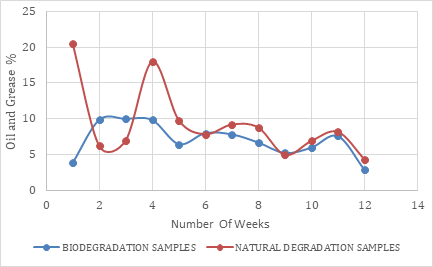
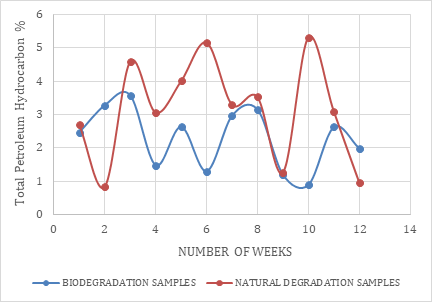
The API gravity of the oil sample (11.4o API. indicated that the oil sample that was used in the experimental work was heavy oil – typically heavy oil has an API gravity on the order of 10 to 20o API although some observers categorize heavy oil as any liquid crude oil or crude oil derivative with an API gravity of less than 22.3 [1, 6]. Heavy oils were best suited for the research because it has been recognized that reservoirs of light conventional crude oils are decreasing and, as a result, heavy crude oils are being added to the pool of crude oil feedstocks in refineries and the contribution of heavy crude oils in the crude oil pool is predicted to increase over the next several decades [1, 2, 7]. Therefore, the impact of oil spills of this nature must be taken into consideration to allow preventative measures to be implemented to protect the economy and the environment. The evaluation and remediation of contaminated sites have been regarded as difficult due to the complexity of the regulatory, scientific and economic issues. Thus, by providing certain data, informed decisions can be made to protect and preserve the environment. Also, the data scientists and engineers present to the technical community can assist in improving the efficiency and effectiveness of remediation. When oil is released to the environment, a variety of chemical, physical, and biological processes causes changes to the site. Therefore, by analyzing the oil, the grease, and the total petroleum hydrocarbon composition in the samples as a result of biodegradation and natural degradation (Figures 1 & 2), a determination can be made on the impact of natural degradation by evaporation, weathering, dispersion or chemical reaction and biodegradation. Also, depending on the properties of these materials, individual contaminants may separate from the original mixture, depending on the chemical properties of the compounds. For example, some of the constituents of the spill may evaporate and other constituents may dissolve into the groundwater and be removed from the site. Other compounds may be adsorbed by the soil particles and remain in the soil while another group of constituents from the release may be degraded the indigenous micro-organisms in the soil [8]. The rate of weathering is highly dependent on environmental conditions while biodegradation depends on the nature and on the amount of the hydrocarbons present therefore oil spills movements need to be modelled more accurately to allow full containment and cleanup. As a result, oil spills not only directly harm wildlife but can impoverish people and nations who depend on the environment for food, culture, environmental enrichment and recreation. Results suggest that the natural attenuation mechanisms can effectively be used in the cleaning up of oil spills [9].
Conclusions
The world is currently facing many crises (social, political, economic, and environmental) all of which are interrelated to the natural mechanism of the Earth. The future of is interlinked in the conservation of nature because oil spills causes injury to the environment at virtually all levels. Everything in society is economically driven where companies need to streamline effectiveness. Natural attenuation processes do occur at varying degrees when the constituents of crude oil are allowed (either deliberately or inadvertence) to contaminate an ecosystem Biodegradation processes are particularly important for the natural attenuation of such contaminants because the indigenous micro-organisms can degrade the chemical invaders.
The development of prevention strategies should be mandated, and research and development money should go into creating more effective, efficient and less toxic cleanup methods. If the earth continues to undergo rapid environmental changes because of anthropogenic actions the results are not only important at the individual level but will also have important implications for the general population. The fate of crude oil and oil products in the environment depends on the composition, source, and persistence of these materials and the health and welfare of the floral and faunal species will be affected in countless ways. Therefore, stricter regulations and stricter supervision and control are required.
References
-
Speight JG (2014) The Chemistry and Technology of Petroleum. 5th(Edn.), CRC Press, Taylor & Francis Group, Boca Raton, Florida, USA.
-
Speight JG (2017) Handbook of Petroleum Refining. CRC Press, Taylor & Francis Group, Boca Raton, Florida, USA.
-
Acevedo-Whitehouse K, Duffus ALJ (2009) Effects of Environmental Change on Wildlife Health. Philosophical Transactions of the Royal Society of London. Series B, Biological sciences 364(1534): 3429-3438.
-
US EPA (1999a) Understanding Oil Spills and Oil Spill Response. Report No. EPA 540-K-99-007, December, United States Environmental Protection Agency, Washington DC, USA.
-
US EPA (1999b) Monitored Natural Attenuation of Petroleum Hydrocarbons. Report No. EPA/600/F-98/021, May, United States Environmental Protection Agency, Washington DC, USA.
-
Speight JG (2015) Handbook of Petroleum Product Analysis. 2nd(Edn.), John Wiley & Sons Inc., Hoboken, New Jersey, USA.
-
Speight JG (2019) Heavy Oil Recovery and Upgrading. Gulf Publishing Company, Elsevier, Cambridge, Massachusetts, USA.
-
ASM (2011) Microbes and Oil Spills. The American Academy of Microbiology. Washington, DC, USA.
-
Das N, Chandran P (2011) Microbial Degradation of Petroleum Hydrocarbon Contaminants: An Overview. Biotechnology Research International 941810.
- Nigeria’s Vulnerability in the Face of Global Energy Policy
- A Simulation Study of Investigation of Optimum Oil Production Performance by Applying Various Gas Injection Methods in Oil Reservoir
- Characterization of Permo-Triassic Reservoirs through Thermal Maturity Assessment of Westphalian Source Rocks in the Cheshire Basin
- Influence of Microwax on the Rheological and Thermal Behaviour of a Wax Crude Oil
- Real-Time Monitoring and Performance Optimization of Steam Injection in Heavy Oil Reservoirs Using Fiber Optic Sensing and Integrated Predictive Simulation Models
- Rapid On-Site Determination of the Total Petroleum Hydrocarbon Content of Soils by Handheld Fourier Transform Near-Infrared Spectroscopy: Development of a Global, Site- and Scanner- Independent Calibration Model