
Role of Scientific Research in Improving Operational Performance and Profitability in the Oil Industry
R & D activity has played an active and rapid role in the prosperity of the developed countries and some developing countries whose economies we have been revitalized to adopt the ideas of knowledge development in their national policy. Scientific research and innovation is a path to economic growth and a driving force in creating competition among the countries’ economies, and in particular in the oil industry.
Introduction
The development of knowledge, proficiencies and the search for solutions to the problems of society has had an impact on the building of human, civilization.
Research and invention work on the technical development of the state and make a difference in society then create a strong and continuous competitive situation between developed countries and mechanisms of investment scientific research , innovation and seek to improve revenues and profits in the oil industry, Where scientific research contributed to the development and improvement of the performance of production processes in industry especially in the refining of crude oil, in raising production while improving the quality of products and giving them better marketing advantages, and that the success of these endeavors was the result of the support of developed countries for scientific research projects and stimulate creativity and innovation and investment and promotion and enter the labor market In the field of developing the oil industry and the emergence of new economic concepts that have a great economic impact on the research institutions such as the concept of selling the secrets of knowledge and exporting, and the Arab countries are major importers of such research and invention.
The revolution of oil and rock gas is the best evidence of the efforts of researchers and innovators based on analysis and survey. This effort took many years and became a turning point in the oil industry, as well as the horizontal and slant drilling of wells with complex geological structures that make it difficult to reach the overlapping oil gaps beneath the surface of the earth.
Despite the contribution of scientific research and innovation in the development of the oil industry, there are still many problems need to be treated to improve profitability, which requires thinking about finding solutions by focusing on scientific research.
This research addresses the factors and dangers that accompany the process of research work and treatments that prevent the utilization and investment of the results, as well as the most important research that has not taken its effective and applied in the field of petroleum industries in Iraq and the Arab world.
Problem
One of the most important problems facing the oil and gas sector in the Middle East is the limited research and development institutions and the proliferation of a culture of dependence on suppliers from abroad to transfer technology without relying on internal development, as well as the mechanism of financing scientific research and marketing.
Section 1
What is Scientific Research in the Oil Industry?
Scientific research plays an active and pivotal role in the economics of the oil industry and opens the horizons and competitiveness and focus on the requirements of the global market to manufacture products at the lowest cost and raise the quality with the invention of new products that serve the consumer and meet the needs of low prices.
In order to identify the importance of practical research in the oil industry requires first define the scientific research in the oil industry and then statement of its advantages and then address how to manage scientific research in the oil industry.
Definition of Scientific Research in the Oil Industry
The researchers [1] agreed to define practical research in general as a human activity, which aims to study certain topics in all fields to reach important scientific facts or to clarify and explain mysterious phenomena or attempt to solve economic, social or scientific problems that concern society and serve humanity and lead to the development of the individual and society.
Is an activity that aims to develop the oil industry and invent new and effective ways to improve the product and shorten the manufacturing workshops with the lowest costs and efforts and reduce the time, from the stage of exploration (upstream ) to the stage (don stream)of the arrival of derivatives to the end consumer.
Most Important Characteristics of Scientific Research in the Oil Industry
1. The researcher conducted a series of procedures, applications and long and complex tests and simulation of the reality of the reservoir pressures and high temperatures. 2. Depends on the provision of raw materials, advanced technologies and advanced laboratories in accordance with the highest standards of safety.
3. Research activity in the oil industry requires substantial funding. 4. Regional specificities in terms of type of geological structures, type of oil or cost criteria.
Most Important Challenges Facing the Oil and Gas [2] Industry are
- High operating costs.
- Volatility and volatility of market prices.
- Low profit margin.
- Marketing the product.
- The diversity and complexity of operating units and the diversity of events.
In order to achieve scientific research and innovation, some requirements must be met, this is called the triangle of management of integrated research activity (public policy of the state, financing of scientific research, marketing of scientific research) (Figure 1).
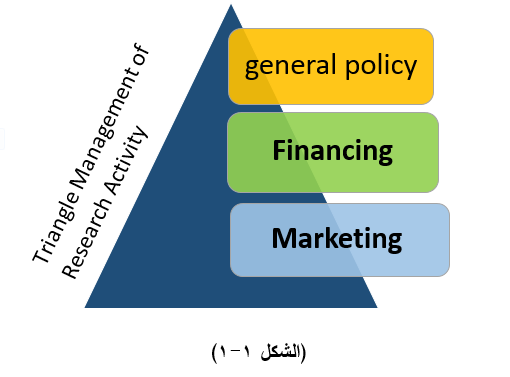
First: The General Policy of the State
The general policy of the State is the extent of the State’s belief in the importance of the scientific research activity and its effective role in raising the economic and social level of the State through the development of policies and plans to promote scientific reality and provide support and support for researchers [3].
The policy of the developed countries in support of research activities and the quality of scientific research and the importance of research in improving the social and economic performance of the state and adopting the strategy to support creativity and innovation within its annual plan and the future plans of the state and the development of an organizational structure for the management of research and innovation, and the most important procedure taken by the decision maker to stimulate scientific research and innovation are:
- Establishment of scientific institutions attentive with and research institutes, and the foundation of laboratories and supplies by creating technology to enable the researcher to complete his research. In the oil industry, the establishment of specialized research centers concerned with oil research activity has been adopted by most Arab countries.
- Develop a policy to manage the research activity and prepare an organizational structure for the scientific institutions and adopt a strategy to guide scientific research in accordance with the policy of the state and focus on research that achieve effective economic and marketing results.
- Monitor the problems facing the researcher during his research.
- Leaders responsible for the management of scientific research should seek appropriate funding for research and innovation spending [4].
- In order to operate these scientific institutions, it is necessary to select the appropriate leaders who possess knowledge and practical skills and to develop those skills related to their tasks and responsibilities in order to devise new methods of research and innovation in line with the continuous and continuous changes in science and technology in the world [5].
- Issuing legislation to regulate the work of research institutions and officials of these institutions and to facilitate the work of scientific researcher and the protection of intellectual rights.
Second: Financing Scientific Research
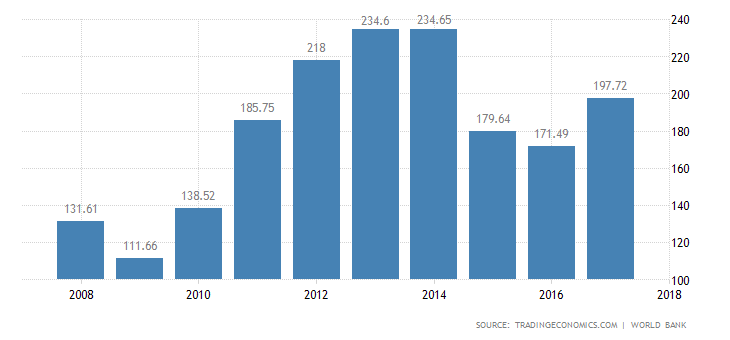
Financing is mean the provision of capital under which the expenditure on scientific research and the care of creativity and innovation, usually the owner of the problem of spending and funding. The funding of scientific research is one of the most important problems faced by scientific institutions and researchers. The process of scientific research requires necessary resources and supplies in infrastructure such as advanced laboratories, equipment and reliable resources. The researcher depends on this, in the developed countries; the private sector allocates a significant proportion of the profit product for funding scientific research to meet the ongoing competition and to gain advantage and position in the market. For example, oil companies operating in the field of oil refining in the countries are constantly seeking to develop and upgrade the operational performance of refineries for increasing profitability and reduce cost we find new ideas, fund the research project, and spend billions of dollars to invent new ways of manufacturing. In the United States, Britain, the EU and Korea, research and development activity accounts for between (2% and 4%) [6] of the GDP [7].
The ambition of the Arab private sector is consumption. It is an importer of new production methods, preferring to import knowledge instead of providing funding for research and innovation. Government institutions usually provide funding and support to educational institutions and research institutes. Expenditure rates are less than 1% of GDP, Most research institutions rely on external funding [5].
Third: Marketing of Scientific Research
In order for scientific research to take its effective role and be economically feasible, it requires determining the mechanism of marketing scientific research based on two pillars: the quality of scientific research and addressing a real problem. The resources derived from the research activity are referred to as the “flow of benefits” Research activity). Research and innovation have economic value if the revenue from research and innovation exceeds the cost of the research project.
For the purpose of marketing scientific research, the following must be considered:
Cost factor: The calculation of the economic value of the research is very important in the research activity and the research and innovation material value if the cost of implementation exceeds the revenue and above the expected profit [8]. This includes the oil industry cost factor is important and whenever the cost is low, on the oil company because of the advantages of the oil industry requires them for very high costs [9].
The time factor: The time factor is very important in estimating the quality of scientific research. Research work and innovation sometimes require a long time to reach the result. Research and innovation have a real market value in competitive markets and this factor linked to cost factor. The shorter the duration of scientific research, the lower the expected cost [8].
Quality of the product: In addition to cost factor and time factor, ensuring the quality of scientific research by assessing the effectiveness of the results of research and innovation and the amount of material benefit (production quality) also an important factor, according to criteria to be determined by the leaders and officials of the research institution Which oversaw the research is oil company that granted funding for scientific research activity.
If these three factors converge, scientific research and invention will be marketable and will have a significant economic impact on increasing state imports. We employ the requirements of scientific research activity with the reality of research and invention in Iraq we find the following: First: The State adopted a policy of supporting research activity through the establishment of scientific research institutions from universities, institutes and scientific centers interested in research and innovation in all fields, especially in the field of oil industry. There are specialized colleges and departments in this industry in most Iraqi universities in the fields of oil engineering, chemical engineering and branches Engineering and other sciences in addition to the oil institutes which are linked to the Ministry of Oil and in cooperation with the Ministry of Higher Education and Scientific Research and the Center for Oil Research and Development specialized in research of the Ministry of Oil as well as the issuance of laws and regulations and regulations governing the work of institutions Scientific. As well as encouraging the private sector to invest in the education sector and the establishment of universities in all disciplines. However, the level and quality of scientific research did not rise due to the lack of clarity in the policy of the state in the adoption of ideas of research and innovation and implementation strategies to develop society and improve the economy.
Second: The funding of scientific research various channels, including:
- The financial allocation provided by the state through the approval of allocations of the federal general budget to the Ministry of Higher Education and Scientific Research. This ministry undertakes the process of spending on universities and institutes and sets a very small percentage for research and innovation purposes that do not meet the research requirements.
- Allocations established under the Public Companies Law No. (
Third: Marketing. In spite of limited research and patents relative to the population, they face a problem in marketing and promoting them because there are no clear mechanisms for marketing, there are professional institutions involved in supporting this activity and limited access to scientific projects in the academic scope, and limited applications do not exceed the leading side with limited exceptions.
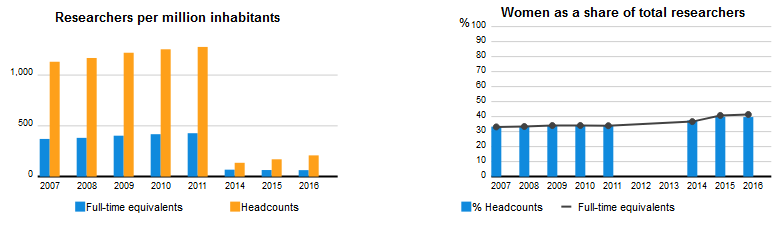
Descriptive Charts on the Level of Research and Development to the Ratio of Gross Output and Postgraduate Studies, According to UNESCO [10] Report.
Human Resources in R&D
| 2007 | 2008 | 2009 | 2010 | 2011 | 2012 | 2013 | 2014 | 2015 | 2016 | |
|---|---|---|---|---|---|---|---|---|---|---|
| Researchers in full-time equivalents (FTE) | ||||||||||
| Per million inhabitants | 371.15 | 381.71 | 403.02 | 417.68 | 427.36 | *** | *** | 68.39 | 64.82 | 63.73 |
| % female | 33.13 | 33.41 | 34.06 | 34.09 | 33.94 | *** | *** | 36.68 | 40.78 | 41.42 |
| Researchers in headcounts | ||||||||||
| Per million inhabitants | 1,131.19 | 1,168.27 | 1,219.95 | 1,253.86 | 1,277.18 | *** | *** | 136.12 | 170.51 | 209.18 |
| % female | 33.30 | 33.60 | 34.20 | 34.20 | 34.20 | *** | *** | 37.50 | 39.90 | 39.70 |
Table 1: Results of RD Ratio of Gross Output and Postgraduate Studies, According to UNESCO.
Expenditure on R&D
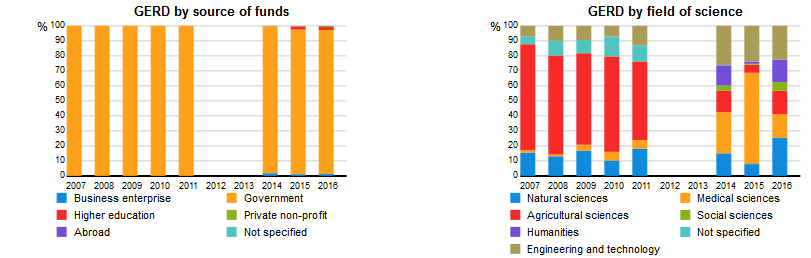
Rate of Expenditure by Sector
| 2007 | 2008 | 2009 | 2010 | 2011 | 2012 | 2013 | 2014 | 2015 | 2016 | |
|---|---|---|---|---|---|---|---|---|---|---|
| GERD by source of funds (%) | ||||||||||
| Business enterprise | *** | *** | *** | *** | *** | *** | *** | 1.77 | 1.10 | 1.21 |
| Government | 100 | 100 | 100 | 100 | 100 | *** | *** | 98.01 | 96.42 | 96.04 |
| Higher education | *** | *** | *** | *** | *** | *** | *** | o | 2.09 | 1.98 |
| Private en-profit | *** | *** | *** | *** | *** | *** | *** | 0.22 | 0.30 | 0.72 |
| Funds from abroad | *** | *** | *** | *** | *** | *** | *** | o | 0.09 | 0.05 |
| Not specified | o | 0 | 0 | 0 | 0 | *** | *** | o | o | 0 |
| GERD by field of science (%) | ||||||||||
| Natural sciences | 15.51 | 13.09 | 16.74 | 10.29 | 18.07 | *** | *** | 15.05 | 7.48 | 25.38 |
| Engineering & technology | 6.95 | 9.93 | 9.44 | 7.01 | 12.89 | *** | *** | 26.06 | 23.83 | 22.58 |
| Medical sciences | 1.57 | 1.13 | 4.03 | 5.74 | 5.88 | *** | *** | 27.40 | 60.84 | 15.69 |
| Agricultural sciences | 70.67 | 66.02 | 61 | 63.60 | $2.30 | *** | *** | 14.25 | 5.43 | 15.68 |
| Social sciences | o | 0.01 | 0.07 | 0.06 | 0.20 | *** | *** | 3.61 | 0.59 | 5.70 |
| Humanities | 0.01 | 0 | 0 | 0 | 0 | *** | *** | 13.40 | 1.43 | 14.89 |
| Not specified | 5.27 | 9.79 | 8.73 | 13.29 | 10.67 | *** | *** | 0.22 | 0 | 0 |
Table 2: Results of Expenditure by Sector.
GDP and Financing on R & D
Section 2
Role of Scientific Institutions in Raising the Level of Research Performance in the Oil Industry
The historical evidence shows that the countries it have expanded development strategies and plans and adopted the policy of spending on scientific research and innovation are the countries that have been able to achieve their scientific ambitions and have risen to the competitive level in the global markets such as China, Malaysia and Japan and achieved high rates of economic growth, They have institutions and research centers What serves the researcher such as advanced infrastructure and modern technology, while most of the Arab countries (except the Gulf States) suffer from weak economic and social development and relied mainly on their natural resources to improve their economy and the lack of policies of Scientific and urged the development and employed effectively and efficiently to achieve the goals of sustainable development.
Institutions that Promote the Research and Innovation System and Have an Active Role in Sustainable Development are
Institutions of higher education: There have been significant changes in the last decades of the last century in the higher education sector as a whole in the management of scientific research and innovation through its affiliated universities and research centers, especially in the developed countries whose scientific institutions have enjoyed great independence. They played an important role in the development and modernization of education, and follow the methods of advanced teaching and the establishment of integrated laboratories to serve researchers and open the field of graduate studies according to market requirements and follow up their achievements to the latest stages.
For higher education institutions in the Arab countries, the level of education varies from country to country. Some universities in the Arab countries have a comparative advantage in terms of laboratory infrastructure, laboratories, workshops, funding, evaluation and quality control of scientific research.
Despite the size of the expenditure on universities in the Arab countries, but its role in the management of research activity is still limited and minor and the main reason for this lack of research is not linked to the problems of industry and the lack of officials who do not have the skills and qualifications to enable them to overcome the challenges faced by research activity.
The treatment of deficiency requires the following:
- Develop a capacity-building program and develop knowledge and skills for researchers, administrations and leaders of these important scientific institutions.
- Exchange of knowledge and experience with other regional or international scientific institutions
- Classification of research according to the requirements of the market, which serve the community and contribute to the economic growth of the state and address the real problems and find them about real and realistic.
- The methodology of education must be consistent with the plans and strategy of the State in the management of this file.
- Interest in applied and experimental research and quality of scientific research and its evaluation through scientific and economic evaluation.
- Develop interim and future plans to promote the dissemination of scientific research and increase the impact factor.
R & D Centers in Scientific Institutions
Which are specialized centers in the field of research and development and are independent or affiliated to scientific institutions that undertake the task of carrying out research activities in various scientific fields. The Research Center of the League of Arab States is the first research center established in 1952 and then followed by several research centers specialized in all fields of applied science in most Arab countries.
Research specialized in all fields of applied science in most Arab countries.
As for research and development centers associated with the oil industry, most of the Arab oil producing countries has research centers funded by oil companies. The most important research centers in these countries are (Table 3): 1. Saudi Arabia: There are two centers for oil research and development, namely the National Center for Petroleum and Gas Technology and the National Center for Petrochemical Technology, where these centers played a role in the fields of oil, gas and petrochemical technology and the development of their own capacities in the fields of oil industry. 2. Kuwait: The Petroleum Center is affiliated to the Kuwait Institute for Scientific Research (KISR). In cooperation with KOC, the Center provides research, technical, laboratory and consulting services in the field of oil and gas production. Help improve the management of oil reservoirs and increase their production. 3. The Egyptian Petroleum Research Institute was established in 1974 for the purpose of finding solutions to the technical problems faced by the Egyptian oil companies.
4. Oil Research and Development Center in Iraq is one of the most important research centers for research and development in the oil and gas industry. It was established in 1992 and contributed effectively to providing alternatives to the oil industry and improving the operational performance of the oil industry through its scientific activities.
- Research and studies in the activities and sectors of oil (extraction research, liquidation research, environmental research and corrosion). In addition to the studies related to the transfer of crude oil, petroleum products, gas, marketing and market studies exchange of experiences and knowledge with regional and international research centers
- Invest the national potential of the researchers and mix them with the experiences in the Iraqi universities to carry out joint research or under the supervision of university professors to serve scientific research.
- Financing university research related to the oil sector by signing contracts with students to complete master’s and doctorate studies.
- To create the infrastructure of the Center to carry out specialized and pioneer research through the provision of financial allocations and research and innovation requirements of workshops, laboratories and advanced equipment.
- Strengthen the bonds of relations and links between scientists and researchers and build a database of data on the oil industry in Iraq.
- Assist the researcher in the marketing of scientific research.
- Dissemination of scientific research related to the energy industry in general and oil and gas in particular.
| Total research that entered the plan | Continuing research from the previous year | Applied Research | Number of researches Proposed by the Center | Number of researches approved within the Center's plan | Number of researches proposed by oil sector formations | Year | |
|---|---|---|---|---|---|---|---|
| 54 | 65 | 18 | 11 | 36 | 103 | 2010 | |
| 45 | 66 | 8 | 6 | 8 | 44 | 77 | 2011 |
| 20 | 36 | 3 | 5 | 8 | 20 | 33 | 2012 |
| 16 | 37 | 9 | 5 | 3 | 20 | 38 | 2013 |
| 21 | 45 | 13 | 3 | 7 | 22 | 50 | 2014 |
| 18 | 42 | 14 | 5 | 10 | 13 | 34 | 2015 |
| 22 | 46 | 28 | 6 | 7 | 29 | 32 | 2016 |
| 18 | 40 | 24 | 4 | 1 | 16 | 36 | 2017 |
Table 3: Research plan Oil Research and Development Center for the years (2017-2010).
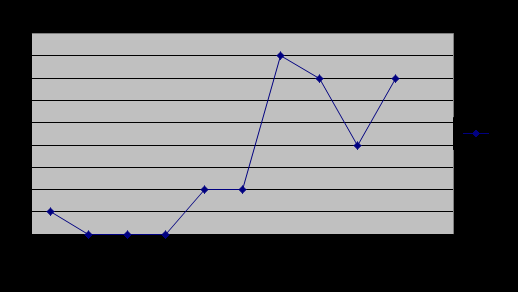
Patent scheme granted in the field of petroleum industry (Figure 6).
Recommendations
For upgrading the scientific research plans, the achievement of applied and academic research, increasing their efficiency, and the factors of influence and fatigue in the national development plans, the following points should be considered:
- Commitment to the role and importance of scientific research and innovation by the decision makers in the State and the development of the national policy document in the care of research and innovation and creativity and plans and programs of executive and long- term indicators through clear and measurable.
- The development of legislation and regulations governing the work structures of entities responsible for the management of scientific research activity.
- To prepare the guidelines and orientations for the management of this activity and to promote the construction of workshops, laboratories and specialized laboratories for the implementation of research.
- Reduce the migration of intellectuals and scientists through increased incentives and wages reward and provide financial and moral support.
- Raise the allocation of funding for research and development, patent protection and the maintenance and protection of intellectual property.
References
-
Johnson RB, Onwuegbuzie AJ, Turner LA (2007) Toward a Definition of Mixed Methods Research. Journal of Mixed Methods Research 1(2): 112-133.
-
Heavy Oil Refining (2014) Challenges and Opportunities. 10th Arab Energy Conference, Organization of Arab Petroleum Exporting Countries.
-
Asa Olsson, Meek L (2015) Effectiveness of research and innovation management at Policy and Institutional Levels. OECD.
-
Richard J, Son S, Towne L (2013) Scientific Research in Education. National Research Council.
-
Mohamed Taie (2012) Toward An Effective Strategy for Quality Assurance in Scientific Research in the Arab World. The Arab Journal for Quality Assurance of University Education 5(2).
-
Gross domestic spending on R&D.
-
Shu’ayb H, Taysir, Jafza (2013) Research and Development in the Industrial Corporation. Mohammed Khudair University, Algeria.
-
Mirowski P, Van Horn R (2005) The Contract Research Organization. Social Studies of Science 35: 505.
-
UNESCO Institute of Statistics.
- Nigeria’s Vulnerability in the Face of Global Energy Policy
- A Simulation Study of Investigation of Optimum Oil Production Performance by Applying Various Gas Injection Methods in Oil Reservoir
- Characterization of Permo-Triassic Reservoirs through Thermal Maturity Assessment of Westphalian Source Rocks in the Cheshire Basin
- Influence of Microwax on the Rheological and Thermal Behaviour of a Wax Crude Oil
- Real-Time Monitoring and Performance Optimization of Steam Injection in Heavy Oil Reservoirs Using Fiber Optic Sensing and Integrated Predictive Simulation Models
- Rapid On-Site Determination of the Total Petroleum Hydrocarbon Content of Soils by Handheld Fourier Transform Near-Infrared Spectroscopy: Development of a Global, Site- and Scanner- Independent Calibration Model