
Evaluation of the Additive Power of Ethanol Obtained from Angola Grass in Direct Distillation Gasoline Samples, Case Study: Straight Run (SR) Gasoline Produced at Luanda Refinery
Alongside the process of blending naphtha, fuel anhydrous ethyl alcohol is an additive recurrently used to adjust commercial properties such as the octane index of gasolines during its formulation. This additive is environmentally recommended due to the promotion of decarbonization in gasolines that is evidenced in its consumption with the reduction of CO2 emissions into the atmosphere, compared to the consumption of other gasolines. There are several ways to obtain the respective additive, the research leads to obtaining it from the Angolan grass (Brachiaria purpurascens "Forsk" Stapf). Angola grass has a low fiber and protein content, thus becoming with low preference in the choice for animal feed and has a significant content of nonnitrogen extractives giving it a high energy potential to be raw material for biofuel production Through an experimental study and on a laboratory scale, alcohol was produced, then the quantities of the two components of the mixture were determined using additive calculations, and then mixed in samples of Straight run (SR) gasolines direct distillation produced in Luanda Refinery. Next, octane index tests were performed in the final mixture by the RON method following ASTM D22699 and adulteration potencies were verified in the samples. The octane index defined to be reached was 95 octane and it was proven that alcohol produced from Angola grass has the potential to promote improvements in octane index, as we found increases in the octane index of additive gasoline shows. We recorded an improvement of the rate of 91% for sample 1 namely the mixture of anhydrous alcohol of grass and light gasoline (SR) of the Luanda Refinery and finally an improvement in the order of 81% for sample 2 namely the mixture of anhydrous alcohol of heavy gasoline grass of the Luanda Refinery. However, it is demonstrating in the first instance starting methodologies for the additive of gasoline samples, and in the second instance the "effect" of a fuel anhydrous alcohol derived from a "differentiated matter" called Angola grass, when used as an additive in direct distillation gasoline, which is concluded to be positive.
Introduction
Anhydrous alcohol is added to gasoline because it has two main advantages, which are the increase in the octane rate of gasoline and the decrease in carbon monoxide emissions into the atmosphere during gasoline consumption.
In theory, the addition of anhydrous fuel ethyl alcohol in gasoline has been a process that reduces the need for use and severity of certain processes of the normal chain of obtaining gasoline. Its production provides for the use of biomass, the most used being sugarcane, corn, and beetroot. These raw materials also play a role in the feeding and/or production of food derivatives, which in addition to the need for large quantities to obtain a volume of the product on a satisfactory scale, i.e. that meets the objectives of refinery production, they are also necessary for food functions, making them unfeasible to serve as raw material for obtaining fuel anhydrous ethyl alcohol, to feed gasoline production at a Refinery.
In view of this, our research launched itself in the challenge of obtaining fuel anhydrous alcohol through grass, and then evaluating its effect on the addition of gasolines where we expect the increase of its octane index, up to the regulated conditions for its consumption. Therefore, we took sample of SR gasoline produced at the Luanda Refinery and as raw material for production addition of anhydrous fuel ethyl alcohol to Angola grass.
Angola grass, currently called Brachiaria purpurascens (Forsk) Stapf, is a perennial grass, with a habit of stoloferous growth, vegetating well in the most diverse climate conditions. (...). It is a species originating from Africa [1, 2] is known as “fine grass”, “bengo”, “angolinha”, “colony grass”, “plant grass” and “white grass” [3]. To be used as animal food the Angola grass, has the low fiber and protein content making it with less preference in the choice for animal feed. And on the other hand it has a significant content of non-nitrogen extractives (energy suppliers elements), thus easing a high energy potential, which makes it more available to serve as raw material for obtaining other products such as ethanol.
Therefore, the study seeks an evaluation of the additive power of ethanol obtained from Angolan grass in samples of direct distillation gasolines, using as an analysis sample the Straight Run (SR) gasoline produced at the Luanda Refinery.
Previous Studies
Production Mechanism Ethyl Alcohol Anhydrous Fuel
The mechanism or pathway of chemical synthesis and the mechanism or route of fermentation, are the processes of obtaining the fuel anhydrous ethyl alcohol.
Through chemical synthesis, ethanol is produced from unsaturated hydrocarbons, such as ethene and etino, and from petroleum and coal gases. This process only has economic significance in countries with large oil reserves and advanced petrochemical industry. Obviously, ethanol obtained in this way does not come from renewable raw material nor can it be considered as an alternative fuel. The other route is Fermentative, which has been the method used in several countries, this process consists of three parts:
preparation of the substrate, fermentation and distillation of the fermented. In the preparation of the substrate, the raw material (biomasses such as grass, beetroot, corn and others) is treated to obtain fermentable sugars. This step depends on the type of raw material used, as described below. Fermentation is the process by which carbohydrates will be transformed into alcohol and carbon dioxide by the action of microorganisms. Finally, in distillation, ethanol is separated from fermentation broth and purified [4].
Among the biomasses used as raw material for the production of ethyl fuel alcohol, sugarcane, corn, and beetroot stand out. To this end, the production of these raw materials must ensure that a satisfactory volume of the product is obtained i.e. that it meets the production objectives and meets the general costs of the manufacture of ethyl alcohol.
Goals of Adding Alcohol to Gasoline
One of the reasons for the addition of alcohol to gasolines, is with the aim of reducing the need for use and severity of certain processes of the normal chain of obtaining gasoline, therefore the additive is used to improve the most important specification of this product namely the octane index. In turn, the octane index is the property with the greatest significance when indicating the quality of gasoline. Therefore, the higher the octane index, the better the quality of the gasoline, as it indicates the resistance capacity of the gasoline during combustion before its detonation.
By the type of oil used to produce gasoline, refineries resist the possibility of producing gasoline with a low octane rate. This scenario had promoted the existence of the consumption of gasoline with a poor quality for engines, thus promoting the reduction of the life of the media and the emission of pollutants. To this end, refineries use the route of the additive processes to improve the characteristics of products such as gasoline, in order to ensure good performance when they are consumed in the engines. Among the various additives to be used is recurrent to improve the most important specification of this product namely the octane index [5].
However, exist some disadvantages of adding anhydrous alcohol to gasoline, such as: 1. Increased fuel consumption: because, as already said, the calorific value of ethanol is lower than that of gasoline; 2. Increased production of nitrogen oxides (NOx): among which the main one is nitrogen dioxide (NO2). It reacts with water forming nitrous acid (HNO2) and nitric acid (HNO3):
NO2(g) + H2O(l)→ HNO2(aq) + HNO3(aq) (1)
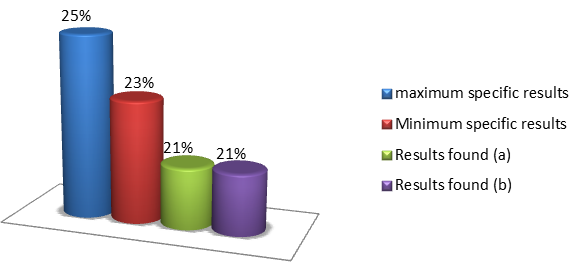
The minimum alcohol content 61 ml or 23% anhydrous alcohol is equivalent to a maximum permitted density, because the lower the alcohol content, the heavier the product becomes (the greater the amount of water). The maximum alcohol content 62 ml or 25% anhydrous alcohol is equivalent to a minimum permitted density, because the higher the alcohol content, the lighter the product becomes (the smaller the amount of water) [6].
Brief Considerations about The Angolan Grass (Brachiria mutica)
A study by PRADA et al, from (1984) analyzed the chemical composition of some forage plants, showed that samples of Angolinha grass ( as it was previously called Angola grass), harvested from December to May have the following crude nutrients as a percentage of dry matter (Table 1).
| Average | Dry matter (%) | Crude Nutrients as a Percentage of Dry Matter (%) | ||||
|---|---|---|---|---|---|---|
| Crude Protein | Ethero Extract | Crude Fiber | Non-Nitrogene Extractives | Mineral Matter | ||
| 27,4 | 7,1 | 2,9 | 33,8 | 49,4 | 6,8 | |
| * Average results obtained from samples taken from December to May. |
Table 1: Chemical composition of Angola grass [7].
To be used as animal food the Angola grass, has the low fiber and protein content making it with less preference in the choice for animal feed. And on the other hand it has a significant content of non-nitrogen extractives (energy suppliers), thus easing a high energy potential, which makes it more available to serve as raw material for obtaining other products as is ethanol case.
Methodology
The development of the study observed the production of ethanol on a laboratory scale, following the steps and using angola grass as raw material:

The fermentation that was used is alcoholic fermentation. This fermentation is biological in which sugars such as glucose, fructose and sucrose are converted into cellular energy with production of ethanol and carbon dioxide as metabolic residues [8], as can be seen in the reaction below:
$$ \mathrm {C} _ {6} \mathrm {H} _ {1 2} \mathrm {O} _ {6} \xrightarrow {\text {Y e a s t}} 2 \mathrm {C H} _ {3} \mathrm {C H} _ {2} \mathrm {O H} + 2 \mathrm {C O} _ {2} \tag {2} $$ Although almost half the weight of glucose is lost in the form of carbon dioxide, about 96% of the combustion heat of cellulose is preserved in the ethanol produced. It was performed using the yeast/sample ratio of 5g to 100ml, and the most satisfactory results were obtained using chemical yeast.
After obtaining ethanol, physical-chemical analyses were performed on a laboratory scale to measure the quality of the alcohol produced. In this sense, the following analyses were performed: Aspect, Absolute density at 20ºc, Freezing point, Boiling point, Flash point or Inflammation, Hydrogenic Potential (Ph). Once ethanol was found, although in the first phase not being 100% anhydrous, but with a concentration around 98% v/v of the solution, it was used to additive samples of SR gasolines, considering that previously the additive calculations should be performed. The methodology leads us to perform the following subsequenced steps of their respective calculations:
1st Step: Determine the RON of the Mixture (additive gasoline)
The octane index of the mixture can be determined using the following equation:
n $$ \mathrm {B I} _ {\mathrm {O N}, \mathrm {M i x}} = \sum_ {\mathrm {i} = 1} ^ {\mathrm {n}} \mathrm {x} _ {\mathrm {v} _ {\mathrm {i}}} \mathrm {B I} _ {\mathrm {O N} _ {\mathrm {i}}} \tag {3} $$ i i Where:
ON,Mix BI : Octane index of the mixture (additive gasoline);
iv x : Volume fraction of each component i;
i ON BI : Octane index of component [9]
i ON BI depends on the RON scale of each component of the mixture. Must meet the scale of the octane number (ON), the mixture to be additive (result of additive) and the additive, by choosing the following equations:
«Depending on the components of the mixture, the will be:
For 11 ≤ ON ≤ 76
$$BI_{ON_i} = 36,01 + 38,33(ON/100) - 99,88(ON/100)^2 + 341,3(ON/100)^3 - 507,02\left(\frac{ON}{100}\right)^4 + 268,64\left(\frac{ON}{100}\right)^5$$
(4)
For 76 ≤ ON ≤ 103
$$BI_{ON_i} = -299,5 + 1272(ON/100) - 1552,9(ON/100)^2 + 651(ON/100)^3$$
(5)
For 103 ≤ ON ≤ 106
$$BI_{ON_i} = (2206,3 - 4313,64(ON/100) + 2178,57(ON/100)^2$$
(6)
2nd Step: Determine the BI${NO^+}$ Mixture of the Mixture to be Additive, the BI${RON}$ of the Additive Mixture (Additive Result) and the BI$_{NO,Additive}$ Additive
Depending on the NO of the components, the conditions in the equations presented above are respected.
3rd Step: Determine the Volume of the Additive
The volume of the additive will be given by:
$$BI_{ON,Mix}(V_{Mix} + V_{Additive}) = \sum_{i=1}^{n} V_i(BI_{RON_i}) + V_{Additive}(BI_{ON,Additive})$$
(7)
Isolating it comes:
$$BI_{ON,Mix}V_{Mix} + BI_{ON,Mix}V_{Additive} = \sum_{i=1}^{n} V_i(BI_{RON_i}) + V_{Additive}(BI_{ON,Additive})$$
$$BI_{ON,Mix}V_{Additive} - V_{Additive}(BI_{ON,Additive}) = \sum_{i=1}^{n} V_i(BI_{RON_i}) - (BI_{ON,Mix}V_{Mix})$$
$$V_{Additive}(BI_{ON,Mix} - BI_{ON,Additive}) = \sum_{i=1}^{n} V_i(BI_{RON_i}) - BI_{ON,Mix}V_{Mix}$$
$$asi = Mixture Comes$$
$$V_{Additive}(BI_{ON,Mix} - BI_{ON,Additive}) = V_{Mix}(BI_{RON_{Mix}}) - BI_{ON,Mix}V_{Mix}$$
$$V_{Additive}(BI_{ON,Mix} - BI_{ON,Additive}) = V_{Mix}(BI_{RON_{Mix}}) - BI_{ON,Mix}V_{Mix}$$
$$V_{Additive} = \frac{V_{Mix}(BI_{RON_{Mix}} - BI_{ON,Mix})}{BI_{ON,Mix} - BI_{ON,Additive}}$$
(8)
Replacing the values in the equation (7) we will find the amount of additive to mix with gasoline in ways that it reaches the initially desired octane index. For such, it is necessary to know the content before mixing and the content after mixing.
Measurement of the new index after mixing, a monocylindrical compression ratio (CFR) was performed in the CFR (Cooperative Fuel Reserarch) with variable compression ratio, equipped with the necessary instrumentation and mounted on a stationary basis, whose procedures and operating conditions used form that of the RON (Research Octane Number) method according to the standard [10].
It was also evaluated whether the alcohol additive did not tamper with gasoline. To determine if the additive caused any adulteration to gasoline we used the bead method. According to [5, 11] the best known and widespread method of assessing the index or content of ethyl alcohol in gasoline is known as the test bead method.
Test to Determine the Percentage of Anhydrous Alcohol in Gasoline
Equipment and Substances
- 100ml beader with shaded mouth and lid;
- Distilled water with 10% salt (NaCl).
- Experimental Procedure
- Then put 50ml distilled water;
- Turn the bead upside down 3 to 4 times and let it sit for 1 minute.
This process allows channeling all anhydrous alcohol contained in gasoline.
As the water, besides being denser is not miscible with gasoline, it will be packed at the bottom of the test tube along with alcohol removed from gasoline, increasing in volume and getting between 61 and 62 ml or 23/25% water. If shefall outside these measures, she will be out of specification [6], since in Angolan standards for the quality analysis of fuels especially for gasoline today (May/2015) control is not required.
To find out the percentage of alcohol contained in the petrol, use the following formula:
$$P = (A \times 2) + 1$$
Being:
P = Percentage of anhydrous alcohol contained in gasoline;
2 A = Increased water flow in the beader;
= 50ml gasoline for a total of 100ml of the bead;
1 = Tolerance allowed.
Results and Discussion
As in most refineries at the Luanda Refinery, SR (straight run) gasoline is sent for reformation or isomerization to improve the octane index, which is a property that could be improved by adding anhydrous fuel ethyl alcohol, avoiding processing costs in isomerization and reformation that are relatively high in relation to the costs of acquiring and adding fuel anhydrous ethyl alcohol.
The characteristics of SR gasoline and other oil fractions depend in the first instance on the type of oil. They then depend on the process units that produce them. In particular, SR gasoline from the Luanda refinery, in general it should have the following characteristics (Table 2).
| Properties | Units | Specification accordingly | |
|---|---|---|---|
| GAL | GAP | ||
| Octane number, by RON, max | Octane | 69,4 | 57,2 |
| Distillation: - IBP, min - FBP, Max | °C | 38,3 139,2 | 70,7 153,7 |
| Steam Pressure, Max | Psi | 11,3 | 3,29 |
| pH, Max | (mg KOH)/ 100 sm3 | 1.0 | |
| Amount of Gums, Max | mg/100 sm3 | 2.0 | |
| Sulphur Content, Max | wt% | 0.060 | |
| Composition of Hydrocarbons: - HC Naphthenics - HC Aromatic, max - HC paraphilic, min | wt% | 12.0-40.0 25.0 50.0 | |
| Water soluble acids and caustic soda | - | ||
| Water and mechanical impurities (suspended solids) | - | None | |
| Density at 15°С | kg/l | 0,684 | 0,775 |
- As we see in the table above the octane number of
- Gasoline SR from the Luanda refinery is equal to 69.4 octanes for light GA and 57.2 for heavy gasoline.
- To advance to the additives we need to prepare the alcohol, then we take as raw material the Angola grass, in the
- Sample
- Property
- Standard limit for
- Ethanol
- Standard used
- Result
- According to
- Aspect
- Clean and free of impurities
- Visual method
- Clean and free of impurities yes
- Absolute density at 20 ͦC
- 0,806 – 0,810 g/cm3
- Pycnometer method
- 0,8126ºc yes
- Boiling point
- 78,2 - 78,5 ºc
- Fractional distillation
- 78, 3 ºc yes
- Fuel hydrated alcohol
- Ph
- 6 – 8
- Test strips method
- 6 yes
- Freezing point
- -114 ºc
- Sample freezing
- -107ºc
- No
- Absolute viscosity
- 1,20 Cp
- --
- --
- --
Table 3: Results obtained.
The results obtained show that it is a hydrated alcohol fuel whose test results proved to be Hydrated Ethanol (EH).
The properties presented above were the possible ones to be tested in the P4 laboratory of the Jean Piaget University of Angola, at the time of production and evaluation of the quality of the product. Another test was the test of the fuel power of the product, whose result demonstrated the possibility of the alcohol obtained serve as a producer of flames in the ignition source, which led the study to conclude that the alcohol obtained is a good fuel.
In order to ensure that they became anhydrous or close to being anhydrous, our preparation of these samples led us to perform in the P4 laboratory of the Jean Piaget University of Angola, successive distillations with the reduction of the intervals of the distillation ranges (finishing distillation before the true boiling point) and consequently with the progressive reduction of the quantities of the initial samples.
After obtaining the alcohol in a favorable condition it is then moved to define the intended NO.
For our study we defined as NO to be reached equal to 95, based on Executive Decree No. 288/14 of October 25, 2014, which regulates the specifications of petroleum products marketed in the Republic of Angola.
Then we started the determination of the quantities of the SR (Straight Run) Gasoline sample to be additive and the alcohol sample for additive.
For demonstrative purposes we will calculate the amount of gasoline equal to 1 liter (1000 ml). In this sense the amount of the additive (alcohol) will be:
In the case of light gasoline, based on the shape (8) the volume of the additive will be given by:
$$V_{\text{Additive}} = \frac{V_{\text{Mix}} \left( B_{\text{ION,LightMRGasoline}} - B_{\text{ION,Additive}} \right)}{B_{\text{ION,Mix}} - B_{\text{ION,Additive}}}$$
BI$_{\text{NO,Mix}}$ Determination of the Mixture to be Additive
The BI$_{\text{NO,Mix}}$ corresponds to the current octane index of SR(Straight Run) Gasoline Light. According to table 1, the Octane index of Sr Gasoline (Straight Run) is 69.4.
Based on expression BI$_{\text{ON}}$ for a NO between 11 and 76 comes:
For 11 ≤ ON ≤ 76
$$BI_{\text{ON,Mix}} = 36,01 + 38,33 \left( 69,4 / 100 \right) - 99,88 \left( \frac{69,4}{100} \right)^2 + 341,3 \left( \frac{69,4}{100} \right)^3 - 507,02 \left( \frac{69,4}{100} \right)^4 + 268,64 \left( \frac{69,4}{100} \right)^5$$
$$BI_{\text{NO,Mix}} = 36,01 + 38,33 \left( 69,4 / 100 \right) - 99,88 \left( 0,694 \right)^2 + 341,3 \left( 0,694 \right)^3 - 507,02 \left( 0,694 \right)^4 + 268,64 \left( 0,694 \right)^5$$
$$BI_{\text{NO,Mix}} = 36,01 + 38,33 \left( 0,694 \right) - 99,88 \left( 0,694 \right)^2 + 341,3 \left( 0,694 \right)^3 - 507,02 \left( 0,694 \right)^4 + 268,64 \left( 0,694 \right)^5$$
BI$_{\text{ON,Determination of Additive Mixture (Additive Result)}$
The BI$_{\text{ON}}$ of the additive mixture (result of additive) corresponds to the octane index, which is intended to be achieved with the addition of SR (Straight Run) Gasoline Light. For our study we defined as NO to be reached equal to 95.
Based on the expression BI$_{\text{ON}}$ for NO between 76 and 103 comes:
For 76 ≤ ON ≤ 103
$$BI_{\text{ON,Mix}} = -299,5 + 1272 \left( \text{ON}/100 \right) - 1552,9 \left( \text{ON}/100 \right)^2 + 651? \left( \text{ON}/100 \right)^3$$
$$BI_{\text{ON,Mix}} = -299,5 + 1272 \left( 95/100 \right) - 1552,9 \left( 95/100 \right)^2 + 651? \left( 95/100 \right)^3$$
$$BI_{\text{ON,Mix}} = -299,5 + 1272 \left( 0,95 \right) - 1552,9 \left( 0,95 \right)^2 + 651 \left( 0,95 \right)^3$$
$$BI_{\text{ON,Mix}} = -299,5 + 1272 \left( 0,95 \right) - 1552,9 \left( 0,9025 \right) + 651 \left( 0,857375 \right)$$
$$BI_{\text{ON,Mix}} = 299,5 + 1208,4 - 1401,49225 + 558,151125$$
$$BI_{\text{ON,Mix}} = 65,558875$$
BI$_{\text{ON,Additive Determination of Additive Mixture (Additive Result)}$
The BI$_{\text{ON,Additive}}$ corresponds to the octane index of the one to be used. For our study we defined ethyl alcohol. The NO of various ethanol alcohol from 120 to 130 [9, 12]. For calculation purposes, let's use 120.
Based on [9] for ethanol the expression BI$_{\text{ON,Additive}}$ for a NO between greater than the range of 103 to 106, the following expression is used:
Morais PG, et al. Evaluation of the Additive Power of Ethanol Obtained from Angola Grass in Direct Distillation Gasoline Samples, Case Study: Straight Run (SR) Gasoline Produced at Luanda Refinery. Pet Petro Chem Eng J 2022, 6(2): 000304.
$$BI_{NO,Additive} = 2206,3 - 4313,64(\text{ON}/100) + 2178,57(\text{ON}/100)^2$$
$$BI_{NO,Additive} = 2206,3 - 4313,64(120/100) + 2178,57(120/100)^2$$
$$BI_{NO,Additive} = 2206,3 - 4313,64(1,2) + 2178,57(1,2)^2$$
$$BI_{NO,Additive} = 2206,3 - 4313,64(1,2) + 2178,57(1,44)$$
$$BI_{NO,Additive} = 2206,3 - 4313,64(1,2) + 2178,57(1,44)$$
$$BI_{NO,Additive} = 2206,3 - 4313,64(1,2) + 2178,57(1,44)$$
$$BI_{NO,Additive} = 2206,3 - 4313,64(1,2) + 2178,57(1,44)$$
$$BI_{NO,Additive} = 167,0728$$
Finally, replacing the values calculated in the expression (1.8) of the additive volume comes from:
$$V_{Additive} = \frac{V_{Mix}(BI_{RON,Light SR,Gasoline} - BI_{ON,Mix})}{BI_{ON,Mix} - BI_{ON,Additive}}$$
$$V_{Additive} = \frac{1000ml(54,2 - 65,5)}{65,5 - 167,07}$$
$$V_{Additive} = \frac{1000ml(-11,3)}{-101,514}$$
$$V_{Additive} = 111,7ml$$
$$V_{Additive} \approx 112ml$$
$$V_{Additive} = 0,112L$$
Therefore to additive a quantity of 1 Liter of Gasoline SR (Streight Run) light, to be additive we should use 0.112 L of anhydrous alcohol fuel.
In the case of heavy SR gasoline, we have:
$$V_{Additive} = \frac{V_{Mix}(BI_{RON,Heavy SR,Gasoline} - BI_{ON,Mix})}{BI_{ON,Mix} - BI_{ON,Additive}}$$
BI_{NO,Mix} Determination of the Mixture to be Additive
The BI_{NO,Mix} corresponds to the current octane index of Sr (Streight Run) Gasoline Light. According to table 2, the octane index of heavy SR Gasoline (Streight Run) is 57.2.
Based on expression for a NO between 11 and 76 comes: For $11 \leq ON \leq 76$
$$BI_{no,Mix} = 36,01 + 38,33(0,572) - 99,88(0,572)^2 + 341,3(0,572) - 507,02(0,572)^4 + 268,64(0,572)^5$$
$$BI_{no,Mix} = 36,01 + 38,33(57,2/100) - 99,88(\frac{57,2}{100})^2 + 341,3(\frac{57,2}{100}) - 507,02(\frac{57,2}{100})^4 + 268,64(\frac{57,2}{100})^5$$
Therefore to additive an amount of 1 Liter of Gasoline SR (Streight Run) heavy, to be additive we should use 0.140 L anhydrous alcohol fuel.
Following the procedures of the additive calculations, we found a result with the significance that relates the ratio of 0.112 L ethyl alcohol to additive 1 L of SR Gasoline (Streight Run) light 0.140 L of ethyl alcohol to additive 1 L of Heavy SR Gasoline (Streight Run).
Given limitation of the CFR engine of the Luanda refinery laboratory, in having a capacity to admit 500 ml of gasoline and alcohol mixture, we determine the reasons for the mixtures in the possible technical conditions, which are presented below:
Sample 1 Formed by 112 ml of anhydrous alcohol from the grass obtained in laboratory P4 of the Jean Piaget University and 388 ml of light GE (SR) from the Luanda Refinery (Figure 1). Sample 2 Formed by 140 ml of anhydrous alcohol from the grass obtained in the laboratory of the Jean Piaget University and 360 ml heavy GE (SR) from the Luanda Refinery.
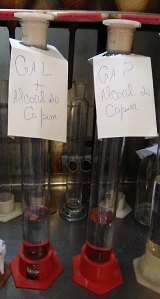
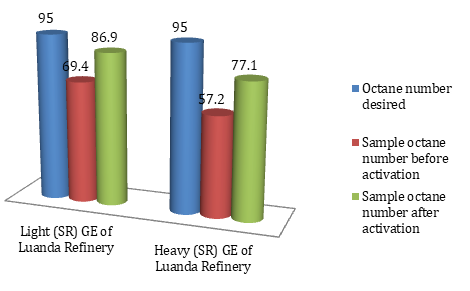
Sample 1, consisting of 112 ml of anhydrous alcohol from the 388 ml light GE (SR) grass from the Luanda Refinery. Placed this mixture on the CFR engine and observed the I.O. value of 86.8. Despite the increase, this value is not within the consumption specifications, according to Executive Decree No. 288/14 October 2014.
Sample 2, formed of anhydrous alcohol 140 ml of 360 ml heavy GE grass (SR) from the Luanda Refinery, we put this mixture to the CFR engine and observed the IO value of 77.1. Despite the increase, this value is not within the consumption specifications, according to Executive Decree No. 288/14 October 2014.
We recorded an improvement in the rate of 91% for sample 1 namely the mixture of anhydrous alcohol of grass and light GE (SR) of the Luanda Refinery and finally an improvement in the order of 81% for sample 2 namely the mixture of anhydrous alcohol of heavy GE grass (SR) of the Luanda Refinery.
In a perspective of consumption of these samples, in order to become viable for consumption we deduced that they needed more increment of additive (alcohol), safeguarding the balance of other properties of gasolines. To this end we would start with a study of the chemical composition of the samples to find out which component of the ideal range of octane index should increase the mixture (Figure 2).
The following figure helps us better appreciate the results:
In another analysis it was necessary to verify whether gasoline has adulterated its quality, according to the guidelines and procedures of mapa (2015).
We removed 50 ml of Sample 1, consisting of 112 ml of anhydrous alcohol from the grass obtained in the Laboratory P4 of the Jean Piaget University and 388 ml of light GE (SR) from the Luanda Refinery and mixed the 50 ml with a 10% NaCl solution and added in a 100 ml beatry then homogenized the mixtures. In the case of sample 2, we
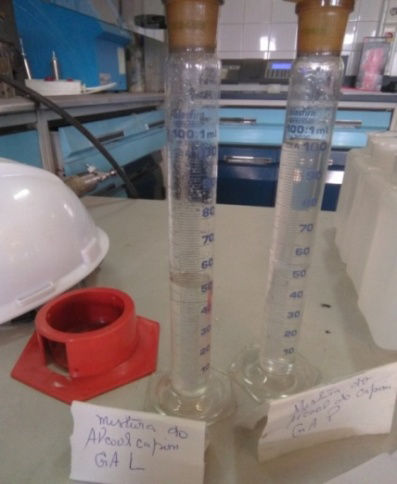
(a) removed 50,000 of the sample, which was initially formed by anhydrous alcohol 140 ml of 360 ml heavy GE (SR) grass from the Luanda Refinery. We removed 50ml of additive GE and mixed at 50 ml with a 10% NaCl solution and added it to a 100 ml beader then homogenized the mixtures A 5 min rest was observed before observations (Figure 3).
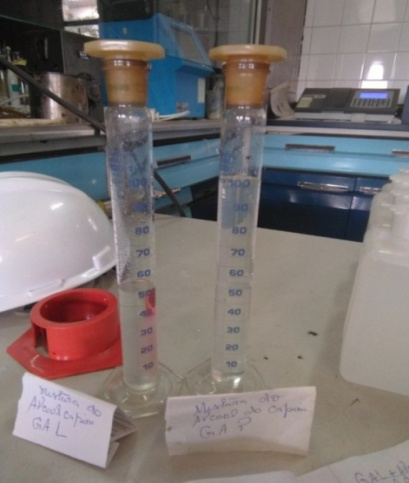
(b) Figure 3 : Sample 1 (Light gasoline with alcohol) (a) and sample 2 (Heavy gasoline with alcohol) (b) In both cases, we observed an increase in the volume of water in the test tube that was 10 ml and calculated the percentage of alcohol contained in the GAL and gave us 21%, the value was determined by replacing the values in the formula (1.9), as shown below:
$$ \mathrm {P} = (\mathrm {A} \times 2) + 1 $$
$$ \mathrm {P} = (1 0 \times 2) + 1 $$
21% Ρ=
Based on the guidelines of MAPA (2015), this result is considered that the mixture did not reach the specification range, being thus considered out of specification for consumption. However the result obtained also predicts that the added alcohol did not exceed its maximum limit, so we may also consider non-adulteration by adding anhydrous fuel alcohol.
The following figure help us better appreciate the results (Figure 4):
| Type of Gasoline SR | Result / Value Obtained from Parameters Determined or Analyzed | ||||||||
|---|---|---|---|---|---|---|---|---|---|
| Additive Used | Amount of Additive Determined (ml) | Octane Number Obtained octanes) Method of Analysis: ASTM- D22699, 2011 | Octane Number Improvement Percentage over 95 (%) | Tamper test result (%) Method of Analysis: ANP n° 309 de 2001 | |||||
| Recomendation | Alcois, Ethers, Aniline, etc. | Limit | N/A | Limit | 93 – 95 | Limit | 23%- 25% | ||
| GE IO = Light 69,4 | Ethyl alcohol (obtained from grass) | 112 ml ethyl alcohol/ 388 ml light GE | 75,1 | 79% | 21% | ||||
| GE IO = Heavy 57,2 | Ethyl alcohol (obtained from grass) | 140 ml ethyl alcohol/ 360 ml heavy GE | 77,1 | 81% | 21% |
Table 4: Results obtained.
Conclusion
The normal production chain of refineries, does not allow obtaining commercially usable refined, is therefore completed with blending processes and / or additive processes to find the best commercial properties of these refined products. An example is what occurs in the formulation of gasolines, a blending of several fractions of naphtha (direct distillation, crack, alkylated, isomerized, reformed, etc.) and/or additive, is made to adjust commercial properties. One of these properties is the octane index which can also be adjusted by additive with fuel anhydrous ethyl alcohol.
The production of this additive is described in the study, using a differentiated raw material, respectively the biomass grass Angola, (Brachiaria purpurascens “Forsk” Stapf), which is a species from Africa, also known as “capim fino”, “bengo”, “angolinha”, “capim da colônia”, “capim-de-planta” and “capim branco”. The production process involved pre-treatment, decanting, alcoholic fermentation (biology and chemistry) and successive distillations. Due to the characteristics of this grass, the alclit produced has a high energy power and gathered physicochemical conditions to be an additive of gasolines.
With obtaining the alcohol, the volumes of each component were determined for mixing direct distillation gasoline and alcohol, based on the previous definition of the octane index, whose reference was 95 octanes based on Executive Decree No. 288/14 of 25 September regulating the specifications of petroleum products marketed in the Republic of Angola.
After the addition (mixture) in samples gasoline SR (straight run) produced at the Luanda refinery, we evaluated the octane index in the final mixture by the RON method following the ASTM D22699 and as well as verifying the adulteration potencies of the samples as possible effect of this additive.
The study demonstrates the impact of the addition of fuel anhydrous ethyl alcohol obtained from Angola grass, in SR (straight run) gasoline, where we conclude that we are facing an industrial alternative potential, to improve the octane index of direct distillation gasolines and others at the stage of their addition, without reprocessing and more expensive and severe operations of the refinery, and as well as we are facing a potential industrial alternative for the complete replacement of additives with environmental refunds, or even chemicals obtained from raw materials with the potential to obtain other more valuable products.
Although we did not reach the desired octane levels, it was further proven that alcohol produced from Angola grass has the potential to promote the increase in octane index, because we see increases in octane rates, in the shows of additive gasoline. We recorded an improvement in the rate of 91% for sample 1 namely the mixture of anhydrous alcohol of grass and light GE (SR) of the Luanda Refinery and finally an improvement in the order of 81% for sample 2 namely the mixture of anhydrous alcohol of heavy GE grass (SR) of the Luanda Refinery. In a perspective of consumption of these samples, in order to become viable for consumption we deduced that they needed more increment of additive (alcohol), safeguarding the balance of other properties of gasolines. To this end we would start with a study of the chemical composition of the samples to find out which component of the ideal range of octane index should increase the mixture.
Acknowledgements
We thank Jean Piaget University for the handing over of laboratory P4 for the production of alcohol from Angola grass and the Luanda Refinery for the handing over of direct distillation gasoline samples and the laboratory for additive preparations, octane testing and power analysis adulteration of samples by addition of AEAC.
References
-
Sendulsky T (1977) Chave para identificação de brachiria. Journal Agroceres 5(56): 4-5.
-
Andrade CMS, Assis GML, Fazolin M, Goncalves RC, Sales MFL, et al. (2009) Capim-tangola: gramínea forrageira recomendada para solos de baixa permeabilidade do Acre. Embrapa Acre, Rio Branco: Brazilian Agricultural Research, Brazil.
-
Aronovich S, Rocha GL (1985) Gramíneas e leguminosas forrageiras de importância no Brasil Central Pecuário. Informe Agropecuário 11: 3-13.
-
Machado CMM, Rosa e Abreu F (2006) Produção de álcool combustível a partir de carboidratos. Revista Política Agrícola. 15(3): 64-78.
-
Morais P (2019) Saída para autonomia da indústria de transformação angolana com crescimento da refinação de petróleos. Petroangola, pp: 1-16.
-
MAPA (2015) Percentual máximo de álcool etílico anidro combustível na gasolina comum. Portaria 75(1).
-
Prada F, Zogno MA, Mendonça CX, Russo HG, Araujo JI, et al. (1984) Composição química de algumas plantas forrageiras oriundas do Estado do Mato Grosso do Sul. Revista da Faculdade de Medicina Veterinária e Zootecnia da Universidade de São Paulo 21(1): 77-88.
-
Ough CS (1992) Winemaking Basics. Food products press, New York, USA.
-
Fahim M, Al-Sahhaf T, Elkilani A (2009) Fundamentals of Petroleum Refining. 1st(Edn.), Elsevier, United Kingdom, pp: 516.
-
ASTM D 2699, Standard Test Method for Research Octane Number of Spark-Ignition Engine Fuel. The Intitut of Petroleum, USA.
-
Sousa FWD (2011) Estimativa da exposição e risco de câncer a compostos carbonílicos e btex em postos de gasolina na cidade de Fortaleza- CE. Engenharia Civil, Universidade Federal do Ceará Fortaleza. Fortaleza.
-
Guibet JC (1997) Characteristics of petroleum products for energy use.
-
Decreto Executivo n.º 288/14, Regulamenta as especificações dos produtos petrolíferos comercializados na República de Angola. Diário da Republica I Série, pp: 178.
- Nigeria’s Vulnerability in the Face of Global Energy Policy
- A Simulation Study of Investigation of Optimum Oil Production Performance by Applying Various Gas Injection Methods in Oil Reservoir
- Characterization of Permo-Triassic Reservoirs through Thermal Maturity Assessment of Westphalian Source Rocks in the Cheshire Basin
- Influence of Microwax on the Rheological and Thermal Behaviour of a Wax Crude Oil
- Real-Time Monitoring and Performance Optimization of Steam Injection in Heavy Oil Reservoirs Using Fiber Optic Sensing and Integrated Predictive Simulation Models
- Rapid On-Site Determination of the Total Petroleum Hydrocarbon Content of Soils by Handheld Fourier Transform Near-Infrared Spectroscopy: Development of a Global, Site- and Scanner- Independent Calibration Model