
Colloidal Stability of Bitumens Related to their Generic Composition
Three bitumens obtained from crude oils widely differing in chemical nature were analyzed for generic composition. Separation into group components was carried out by liquid chromatography, using a new procedure. With this method, five fractions were separated, i.e. saturates, cyclics, light resins, heavy resins and asphaltenes. The size distribution of the asphaltene particles in the bitumens and the Heithaus parameters characterizing the colloidal stability of bitumen were determined. The results suggest that the role of the light resins in bitumen differs from that of the heavy resins, as they are constituents of the dispersing and dispersed phase, respectively. The cyclic components and light resins form the dispersing medium of bitumen while the heavy resins and asphaltenes constitute the dispersed material. Saturates are the bitumen components that deteriorate the peptization of asphaltene particles.
Introduction
Bitumen has a complex chemical structure, and this imposes the requirement that its structural examination should be preceded by the separation into the group components which differ in chemical composition.
It is well established that the composition of bitumen plays a key role in pavement durability. Bitumen binders meeting the same specifications but differing in their chemical composition often give pavements which differ in performance. Besides the generic composition, it is also the chemical structure of the group components that affects the bitumen behaviour in the pavement [1].
The generic composition of bitumen is usually determined by high performance liquid chromatography (HPLC) [2, 3] and thin layer chromatography-flame ionization detection (TLC-FID; Iatroscan) [4, 5, 6, 7, 8, 9]. Although these analytical methods enable a quick determination of the generic composition, each of them has some limitations. Because of its destructive character, the TLC-FID method cannot be used to obtain fraction samples for structural examinations; the HPLC technique yields too small amounts of the fractions to enable complete structural analysis.
The known preparative methods for generic composition determinations of bitumen enable separation into four or more fractions [10, 11, 12, 13, 14, 15, 16, 17, 18, 19, 20, 21]. The majority of them involve the precipitation of asphaltenes with n-alkanes (C5 to C7), followed by the liquid chromatographic separation of maltenes on silica gel or alumina. The efficiency of separation depends on the adsorbent and eluent used [18]. The most common preparative method is ASTM D4124 [11], which allows the separation of bitumen into four fractions: saturates naphthene-aromatics, polar-aromatics and asphaltenes. A more recent method of bitumen separation into group components is the ion-exchange chromatographic technique developed under the Strategic Highway Research Program (SHRP), where bitumen is separated into five fractions differing in polarity [21].
The rheological properties of bitumen depend on the colloidal structure and the stability of the colloidal system. The type of the colloidal structure can be evaluated from the size distribution of the asphaltene particles in bitumen [22, 23]. The distribution of the asphaltene particles in the solution is described by the Crickmore and Hruska [24] equation, which fulfils Korcak’s law. Park and Mansoori have shown that resins are partly adsorbed on the associated asphaltene micelles (thus increasing the size of dispersed particles) and partly dissolved in the components which form the dispersing medium [25]. This finding implies that not all of the resins in bitumen account for the stabilization of the colloidal system. The colloidal stability of bitumen is determined by observing the onset of asphaltene flocculation during treatment of the bitumen solution in a good solvent (toluene or THF) with an appropriate low-molecular-weight paraffinic hydrocarbon. The bitumen stability can be assessed by several methods which differ primarily in the way of detecting the onset of asphaltene flocculation. The onset of asphaltenes precipitation is detected by the observation of a double ring on the filter paper after the addition of a droplet of the solution [26], by using fluorescence spectroscopy [27], conductivity measurements [26, 28], heat transfer analysis [29, 30], refractive index measurement [31, 32], intrinsic viscosity examination [33, 34], and microscopic observations [35, 36, 37]. In Pauli’s method of stability determination [38], the onset of asphaltenes precipitation during titration of the sample solution in toluene with n-heptane or iso-octane is observed by spectrophotometry at 740 nm wavelength. Initially, titration causes a decrease in the absorbance due to the dilution of the solution, while, when asphaltenes start to precipitate, the absorbance rises. From the amount of n-heptane or iso-octane needed to cause the onset of asphaltenes flocculation, the Heithaus parameters [26] characterizing the peptizability of asphaltenes, the peptizing power of maltenes, and the stability of bitumen can be calculated.
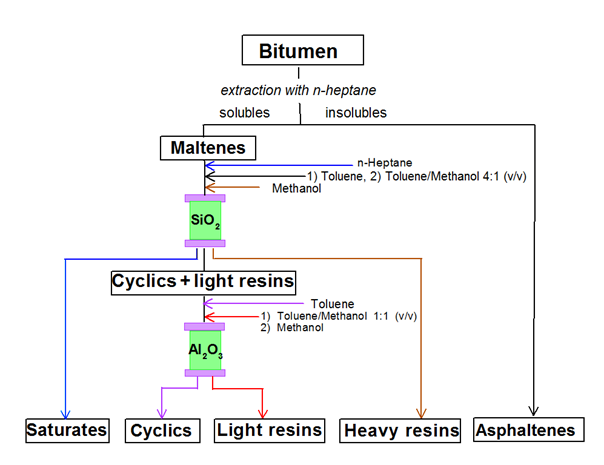
In this paper, a method is proposed, which enables a chromatographic separation of bitumen into five fractions. The precipitation of asphaltenes with n-heptane is followed by the separation of maltenes in two columns packed with silica gel (yielding saturates, cyclics + light resins and heavy resins) and alumina (cyclics + light resins were separated into two respective fractions). The separation of resins into light and heavy fractions is of importance when assessing the effect of the polar-aromatic components on the dispersion of asphaltenes and the colloidal stability of bitumen.
Experimental
Bitumens
Three road bitumens of 50/70 pen grade, obtained from crude oils differing in their chemical nature (Uralian, Brent- blend and Venezuelan), were selected for the study. Although the Uralian and Brent-blend crudes are both of paraffine- naphthenic type, the Brent-blend crude oil is more abundant in saturates. The heavy Venezuelan is a typical naphthenic crude oil. The crudes were processed in two different ways. The bitumens from the Uralian and Brent-blend crudes were obtained by atmospheric and vacuum distillations followed by air blowing of the vacuum residue. The Venezuelan bitumen was obtained by deep distillation of the crude oil under vacuum, and the vacuum residue was not air blown.
Method of Bitumen Separation
The scheme of bitumen separation into five fractions (saturates, cyclics, light resins, heavy resins and asphaltenes) is presented in Figure 1. An approximately 2.5g of the bitumen was separated into maltenes and asphaltenes by extraction with n-heptane in the same way as in the ASTM Standard D4124 procedure.
Further steps of maltenes separation were carried out using two chromatography columns (glass column 1m long, 20mm i. d.) packed with 120 g of silica gel (neutral, particle size 0.063-0.200mm, calcined at 160ºC, applied as slurry in n-heptane) or 100 g of alumina (neutral, particle size 0.063-0.200mm, activity I, calcined at 420ºC, applied as slurry in toluene), respectively. The maltenes solution in n-heptane was evaporated to the volume of approximately 20mL and subjected to chromatographic separation on silica gel column. A sequence of the following amounts of solvents were used for elution of the fractions: n-heptane (200 mL) for saturates, toluene (250 mL) and than toluene/methanol 4:1 (20 mL) for cyclics and light resins, and methanol (200 mL) for heavy resins. The fraction containing cycles and light resins mixture was evaporated to 20 mL and was further separated on alumina column. Elution of the column with toluene (200 mL) gave the cyclics fraction while further elution with toluene/methanol 1:1 (v/v) (100 mL) and mathanol (100 mL) gave the light resins.
For comparative purpose, the Uralian bitumen was separated by the commonly used ASTM D4124 method (Figure 2) into four fractions: saturates, naphthene- aromatics, polar aromatics and asphaltenes.
![Figure 2: Scheme of bitumen separation according to the ASTM D4124 method [11].](/fulltextimages/9671/fig_2.png)
Characterization of Bitumen Fractions by Instrumental Methods
The saturated and cyclic fractions separated from the Uralian bitumen by the proposed method, as well as the saturated and naphthene-aromatic fractions obtained with the ASTM procedure, were analyzed using 1H NMR and 13C NMR. Both the standard 1H and 13C NMR spectra were collected in deuteriochloroform solutions on a Bruker AMX 300 spectrometer operating in a quadrupole detection mode at 300 MHz. The position of the resonances was referred to the residual solvent peak CHCl3 and recalibrated to TMS. The spectra obtained were used for the assessment of aromaticity of the naphthene-aromatic fraction obtained by the ASTM method and of the cyclic fraction obtained by the developed method.
FT-IR analysis was carried out for the cyclic, the light resin and heavy resin fractions separated from the Uralian bitumen by the proposed method, as well as for the naphthene-aromatic fraction separated from the same bitumen by the ASTM procedure. The FT-IR spectra of the 5% solutions in carbon tetrachloride were collected on the Perkin-Elmer 2000 apparatus.
Average molecular weight of the fractions from the Uralian bitumen separation into five group components, as well as of the fractions from the same bitumen separated by the ASTM method, were determined with VPO, on a Knauer osmometer, at 45ºC, using toluene as a solvent.
Size distribution of Asphaltenes and Colloidal Stability
To determine the size distribution of asphaltene particles, the method proposed by Lin, et al. was used [22]. Each bitumen sample was dissolved in four different solvents: n-hexane, n-heptane, n-octane and n-decane. 2.5g of bitumen and 100ml of solvent were placed in a flask and agitated. The solution was kept at ambient temperature for 18 hours and then filtered using Whatman No. 1 filter paper. The precipitate was washed with the solvent used, dried under vacuum and weighed. The size distribution of the asphaltene particles was calculated in accordance the Crickmore and Hruska equation [24], which describes the relationship between the characteristic length of the solvent molecule (L) and the amount of bitumen in the solvent (m):
D D L D KFD m − − = ρ (1)
3 /) 3 ( * 3
where K is a constant, F is a normalizing factor and ρ denotes the average density of asphaltene in solution_. D_ and D* are fractal dimensions related to the particle size distribution and surface irregularity, respectively. Although D and D* cannot be evaluated directly, it is possible to establish the value of the expression KFDρ/(3-D), which describes the size distribution of the particles dispersed in bitumen, by using the method described by Lin, et al. [22].
The stability of bitumens was determined by the method proposed by Pauli [38]. The bitumen solutions in toluene (0.1 to 0.4 g of bitumen per one ml of toluene) were titrated with iso-octane. Knowing the amount of iso-octane needed for the onset of asphaltenes flocculation, we calculated the Heithaus parameters [26] as follows:
max 1 = − aP FR (2)
( ) 1 max min 1 − = + oP FR c (3)
a p p P − = 1
0 (4) where pa describes the peptizability of asphaltenes, po characterizes the peptizing power of maltenes, and P is the stability index of bitumen. When the value of P increases, so does the colloidal stability of bitumen. The FRmax and cmin data were evaluated from the plot of flocculation ratio, FR, versus bitumen concentration in the titration solution, c.
The flocculation ratio (FR) is calculated from equation (5):
V FR V V (5) = +
s s t where Vs is the volume of toluene (solvent) and Vt is the volume of iso-octane (titrant) needed to cause the onset of asphaltenes precipitation.
The concentration of bitumen in the solution, c, is calculated using the expression (6):
a V V W c + = (6)
t s where Wa denotes the weight of bitumen sample.
The FR and c values obtained with (5) and (6) were used to plot the correlation between the toluene to iso-octane ratio at the equilibrium point (FR) and the bitumen concentration in solution (c). The values of cmin and FRmax needed for the calculation of the Heithaus parameters were established from the intercept of the FR and c axes.
Results and Discussion
To assess the efficiency of bitumen separation into group components carried out with the proposed method, we compared the generic compositions of the Uralian bitumen determined by the proposed method and by ASTM D4124. The results are presented in Table 1, which also includes the average molecular weight of the fractions.
The ASTM procedure yielded a smaller amount of asphaltenes than that obtained using the proposed method (compare data in Table 1). This finding should be attributed to the difference in the n-heptane amount used in the two methods. With the ASTM procedure, where a greater amount of n-heptane is applied for the precipitation of asphaltenes, only the heaviest components enter the precipitate. This is substantiated by the molecular weight of the asphaltenes, which is noticeably higher than that obtained with the proposed separation method (Table 1). There were small differences in the content of the saturate fractions between the two separation procedures, but they became higher for the content of the cyclic (naphthene-aromatics) fractions, as well as for that of the resins. The proposed method yielded smaller amounts of cyclics as compared to naphthene- aromatics, and greater amounts of light + heavy resins than that of polar aromatics. The resin fractions separated in the two columns differ considerably in their molecular weight. On this basis, they are referred to in this study as light resins (fraction from Al2O3 column) and heavy resins (fraction from SiO2 column).
| Separation Method | Content of Fraction, Wt.% | Average Molecular Weight, Da |
|---|---|---|
| PROPOSED | ||
| Saturates | 18.78 | 702 |
| Cyclics | 25.01 | 746 |
| Light resins | 26.97 | 966 |
| Heavy resins | 10.25 | 1824 |
| Asphaltenes | 18.83 | 5040 |
| ASTM D4124 | ||
| Saturates | 17.11 | 696 |
| Naphthene-aromatics | 32.46 | 790 |
| Polar aromatics | 33.21 | 1445 |
| Asphaltenes | 16.54 | 6010 |
Table 1: Generic composition of Uralian bitumen and average molecular weight of the fractions.
The Figures 3a & 3b show examples of the 1H and 13C NMR spectra for the cyclic fraction separated with our method and for the naphthene-aromatic fraction obtained with the ASTM procedure, accordingly.
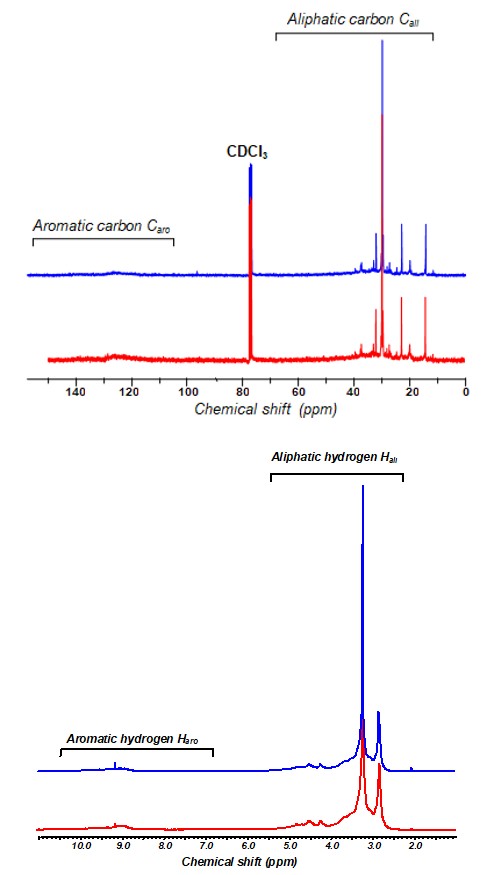
Figure 3a: 1H NMR spectra of the Uralian cyclic fraction separated by the proposed method (blue line) and naphthene-aromatic fraction obtained by the ASTM D4124 method (red line).
Figure 3b: 13C NMR spectra of the Uralian cyclic fraction separated by the proposed method (blue line) and naphthene-aromatic fraction obtained by the ASTM D4124 method (red line).
The 1H and 13C NMR spectra were used to calculate the integral ratios of aliphatic hydrogen atoms (Hali) to aromatic hydrogen atoms (Haro), as well as those of aliphatic carbon atoms (Cali) to aromatic carbon atoms (Caro), in the fractions analysed. The results presented in Table 2 clearly demonstrate a higher aromaticity of the naphthene-aromatic fraction separated by the ASTM method, as compared with the cyclic fraction obtained by using the proposed method. It may be inferred from the differences in the chemical structures of the fractions under consideration separated by the two methods, that the higher content and aromaticity of the naphthene-aromatics (ASTM procedure) in relation to the cyclics content (proposed method), results from migration of part of the light resins into naphthene-aromatics (Tables 1 & 2). It follows that separation of these components is better in the proposed method.
| Cyclic fraction - Proposed method | Naphthene aromatic fraction - ASTM D4124 method | |
|---|---|---|
| H /H ali aro | 21.18 | 17.1 |
| C /C ali aro | 10.14 | 8.14 |
Table 2: Integral ratios of aliphatic to aromatic hydrogen atoms (Hali/Haro) and aliphatic to aromatic carbon atoms (Cali/ Caro)
The Figure 4 shows the IR spectra of the cyclic fraction, light and heavy resins, from the separation of the Uralian bitumen into five components as well as naphthene-aromatic fraction from the same bitumen (ASTM D4124 method). As is evident from the comparison of the IR spectra (Figure 4), both resin fractions exhibit absorbances, which are absent in the cyclic fraction. The IR spectra of the two resin fractions show absorption band at 1710 cm-1 (Figure 4, traces B and C), characteristic for carbonyl groups. The IR spectra of the two resin fractions exhibit a broad absorption band (of low intensity) at around 3300 cm-1, which indicates the presence of H-bonded phenolic OH groups. The intensity of the peaks corresponding to the polar groups is greater for the fraction of heavy resins (1710 and 1072 cm-1). The absorption bands mentioned above do not occur in the spectrum of the cyclic fraction (Figure 4, trace A). The presence of absorbances in the cyclic fraction at 850-720 cm-1 and their lack in the resin fractions (Figure 4, compare traces A, B and C) substantiate the correctness of the separation into cyclics and resins.
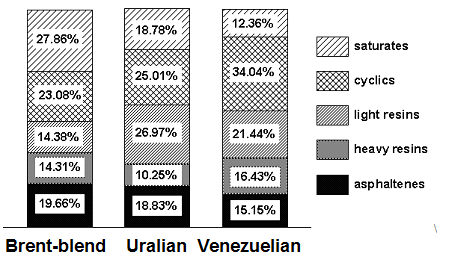
The IR analysis of the naphthene-aromatic fraction separated from the same bitumen by the ASTM procedure (Figure 4, trace D) shows the presence of carbonyl groups (absorption band at 1710 cm-1) and hydrogen-bonded OH groups (absorption band at 3300 cm-1), which do not occur in the IR spectrum of the cyclic fraction separated using our method (Figure 4, trace A).
On comparing the results of bitumen separation in two columns with those obtained with the ASTM D4124 procedure, we can see that the proposed method yields a better separation of cyclics and resins. This finding substantiates Speight’s observation [39] that the separation of bitumen into group components in a single column packed with silica gel or alumina is less effective than when two adsorption columns are used. The application of a single column is concomitant with a frequent overlap of the various fractions. Other investigators also have reported that using two columns for the fractionation of bitumen yields a better separation of relevant fractions [18, 19].
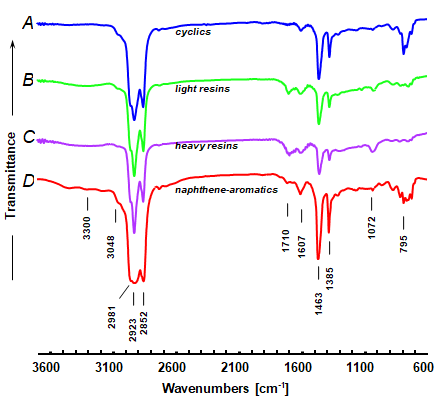
The fractionation method developed was used to determine the generic composition of the bitumens tested. The results are given in Figure 5. As shown by these data, the generic composition differs from one bitumen to another. The differences derive not only from the chemical nature of the crudes of which the bitumens originate, but also from the way they were obtained. Thus, the Venezuelan crude from which the bitumen tested was obtained contained high amounts of asphaltenes and resins (several times those of the Brent-blend or Uralian crude oils) and noticeably lower amounts of saturates, whereas the content of naphthene- aromatic components ranged from approximately 42 to about 47 wt.% in all the crudes [40, 41]. However, the bitumens from Brent-blend and Uralian crudes contained higher amounts of asphaltenes and considerably lower amounts of cyclics as compared to the Venezuelan bitumen. This should be attributed to the changes in the compositions of the Brent-blend and Uralian crudes in the course of their processing. The air-blowing of the vacuum distillation residue brought about the conversion of cyclics into resins and resins into asphaltenes, but there was no conversion of saturates. An earlier study has shown [42] that the saturated fractions from Brent-blend and Uralian residues are rich in long-chain n-alkanes which are rather resistant to oxidation. The investigated Venezuelan bitumen was obtained directly by vacuum distillation of the crude. In this process a part of the saturate and cyclic components were distilled off. The amounts of resins and asphaltenes in the Venezuelan bitumen increased proportionally to the loss of the crude mass due to the distillation of the light components, but there was no conversion of the components during crude oil processing.
The difference in the generic composition of the bitumens tested is reflected in their colloidal stability. Table 3 lists the values of the parameter characterizing the size distribution of the largest particles in the bitumen and the Heithaus parameters describing the colloidal stability of the bitumen.
| Parameter | Brent blend Bitumen | Uralian Bitumen | Venezuelan Bitumen |
|---|---|---|---|
| Cyclics + light resins / heavy resins+asphaltenes | 1.1 | 1.78 | 1.76 |
| Size distribution of asphaltenes | 1.55 | 1.67 | 1.67 |
| Parameters characterizing the stability of bitumen: | |||
| peptizability of asphaltenes, p o | 0.73 | 1.01 | 1.06 |
| stability index of bitumen, P | 2.33 | 3.15 | 3.47 |
Table 3: Parameters characterizing the size distribution of asphaltenes and colloidal stability of bitumens.
As shown by these data, the Brent-blend bitumen displays the lowest peptizability of asphaltene particles and the lowest colloidal stability. Although the Uralian and Venezuelan bitumens display the same value of the parameter characterizing the size distribution of asphaltene particles, the colloidal stability of the Venezuelan bitumen is slightly higher. Compared to the other two bitumens, the Brent- blend bitumen contains the highest amount of saturates and the lowest content of resins. Even though the Brent-blend bitumen includes cyclics and asphaltens in amounts similar to those found in the Uralian bitumen, it has a noticeably lower resins content, and the proportion of light to heavy resins is approximately half that of the Uralian bitumen. Here seems to lie the explanation for the poor colloidal stability of the Brent-blend bitumen. It is most likely that the light resins and heavy resins play different roles in the bitumen, where the former constitute the dispersing medium and the latter the dispersed phase. In the Venezuelan bitumen (which displays the same size distribution of asphaltene particles as does the Uralian bitumen, but has a slightly better colloidal stability), the proportion between light and heavy resins is lower than in the Uralian bitumen, but the Venezuelan bitumen contains a noticeably higher amount of cyclics. This implies that the role of the cyclic components in the colloidal structure of the bitumen is similar to the role of the light resins. Table 3 shows the ratio of the sum of cyclics and light resins to the sum of heavy resins and asphaltenes. This ratio is the lowest with Brent-blend bitumen, and approximately the same with Uralian and Venezuelan bitumens. The slightly lower values of the Heithaus parameters in the Uralian than in the Venezuelan bitumen are most likely to be due to the higher content of saturates in this bitumen, which deteriorates the peptization of the heaviest particles.
From the analysis of the results obtained it can be inferred that the dispersing media consist of cyclics and light resins while heavy resins and asphaltenes constitute the dispersed phase. Saturates are the bitumen components that deteriorate the peptization of heavy particles, as demonstrated by the examples of the Brent-blend and Uralian bitumens tested in this study.
Conclusion
- The bitumen fractionation method proposed in this study enables the separation of resins into two fractions differing in average molecular weight and polarity. It has been shown that the two fractions play different roles in the colloidal system of bitumen.
- The results of this study suggest that the dispersing media consist of cyclics and light resins while heavy resins and asphaltenes constitute the dispersed phase. Saturates are the bitumen components that deteriorate the peptizability of the heaviest particles constituting the dispersed phase.
- It has been shown that the proposed method seems more effective than ASTM D4124 method for bitumen separation into fractions suitable for further structural examinations enabling the assessment of the colloidal stability of bitumen.
References
-
Gawel I, Baginska K (1999) Changes in generic composition of bitumens after thin film oven test. Proceedings of Eurobitume Workshop 99, Luxembourg.
-
Bishara SW, Wilkins E (1989) Rapid Method for the Chemical Analysis of Asphalt Cement: Quantitive Determination of Naphthene Aromatic and Polar Aromatic Fractions Using High-Performance Liquid Chromatography. Transportation Research Record. pp: 183-190.
-
Qiang D, Lu W (1999) Hydrocarbon group-type analysis of high boiling petroleum distillates by HPLC. Journal of Petroleum Science and Engineering 22(1-3): 31-36.
-
Torres J, Gonzalez JM, Peralta X (1993) Correlation between the Fractionation of Bitumen by the Methods ASTM D4124 and JATROSCAN. Proceedings of 5th Eurobitume Congress, Stockholm, pp: 203-208.
-
Kamiński M, Gudebska J, Górecki T, Kartanowicz R (2003) Optimized conditions for hydrocarbon group type analysis of base oils by thin-layer chromatography– flame ionisation detection. Journal of Chromatography A 991(2): 255-266.
-
Karlsen DA, Larter SR (1991) Analysis of petroleum fractions by TLC-FID: applications to petroleum reservoir description. Organic Geochemistry 17(5): 603-617.
-
Bhullar AG, Karlsen DA, Lacharpagne JC, Holm K (1999) Reservoir screening using Iatroscan TLC-FID and identification of palaeo-oil zones, oil–water contacts, tar-mats and residual oil saturations in the Frøy and Rind petroleum accumulations. Journal of Petroleum Science and Engineering 23(1): 41-63.
-
Bhullar AG, Karlsen DA, Backer-Owe K, Le Tran K, Skalnes E, et al. (2000) Reservoir characterization by a combined micro-extraction-micro thin-layer chromatography (_Iatroscan_) method: A calibration study with examples from the Norwegian North Sea. Journal of Petroleum Geology 23(2): 221-244.
-
Ogasawara M, Tsuruta K, Arao S (2002) Flame photometric detector for thin-layer chromatography. J Chromatogr A 973(1-2): 151-158.
-
Corbett LW (1969) Composition of asphalt based on generic fractionation, using solvent deasphaltening, elution-adsorption chromatography, and densimetric characterization. Anal Chem 41(4): 576-579.
-
ASTM D4124-01 (2001) Standard Test Method for Separation of Asphalt into Four Fractions. ASTM International, West Conshohocken, USA.
-
Jewell DM, Albaugh EW, Davis BE, Ruberto RG (1974) Integration of Chromatographic and Spectroscopic Techniques for the Characterization of Residual Ols. Industrial Engineering Chemistry Fundamentals 13: 278-282.
-
Barbour RV, Dorrence SM, Vollmer TL, Harris JD (1976) Pyrolysis of Utah tar sands: products and kinetics. Am Chem Soc Div Fuel Chem Prepr 21(6): 278-289.
-
Selucky ML, Chu Y, Ruo T, Strausz OP (1977) Chemical composition of Athabasca bitumen. Fuel 56(4): 369-381.
-
Bulmer JT, Starr T (1979) Syncrude analytical methods for oil sand and bitumen processing. Alberta oil sands technology and research authority, Syncrude Canada Ltd, Edmonton, Alberta, pp: 121-124.
-
Fabb TRJ (1983) The dependence of the rheological properties of paving bitumens upon their chemical composition. Proceedings of RILEM, International Symposium Testing of hydrocarbon binders and materials. Beograd, Jugoslavia, pp: 247-269.
-
Chipperfield EH (1984) IARC Review on Bitumen Carcenogenicity. Bitumen production, properties and uses in relation to occupational exposures (IP 84-006), Institute of Petroleum, London.
-
Wallace D, Deborah H, Pongar K, Zimmerman D (1987) Evaluation of some open column chromatographic methods for separation of bitumen components. Fuel 66(1): 44-50.
-
Chatergoon L, Whiting R, Smith C (1992) Improved methods for separation and chromatographic analysis of natural asphalts. Analyst 117: 1869-1873.
-
Lee AK, Murray AM, Reynolds JG (1994) Metallopetroporphyrins as process indicators: Separation of petroporphyrins in green river oil shale pyrolysis products. Fuel Science and Technology International 13(8): 1081-1097.
-
Branthaver JF, Petersen JC, Robertson RE, Duvall JJ, Kim SS, et al. (1993) Exchange Chromatography Separations (IEC). In: Branthaver JF, et al. (Eds.), Binder Characterization and Evaluation. Strategic Highway Research Program, National Research Council, Washington DC, 2: 467.
-
Lin JR, Lian H, Sadeghi KM, Yen TF (1991) Asphalt colloidal types differentiated by Korcak distribution. Fuel 70(12): 1439-1444.
-
Chatergoon L, Whiting R, Grierson L, Peters T, Smith C (1995) Use of size distribution and viscosity to distinguish asphalt colloidal types. Fuel 74(2): 301-304.
-
Crickmore PJ, Hruska C (1989) Fractal geometry, the Korcak law and asphaltene precipitation. Fuel 68(11): 1488-1489.
-
Park SJ, Mansoori GA (1988) Aggregation and deposition of heavy organics in petroleum crudes. Energy Sources 10(2): 109-125.
-
Heithaus J (1962) Measurement and Significance of Asphaltene Peptization. Journal of the Institute of Petroleum 48(458): 45-73.
-
MacMilan DJ, Tackett JE, Jessee MA, McCluer TGM (1995) A Unified Approach to Asphaltene Precipitation: Laboratory Measurement and Modeling. Journal of Petroleum Technology 47(9): 788-793.
-
Fotland P, Anfindsen H, Fadnes FH (1983) Detection of asphaltene precipitation and amounts precipitated by measurement of electrical conductivity**.** Fluid Phase Equilibria 82: 157-164.
-
Clarke PF, Pruden BB (1997) Asphaltene precipitation: detection using heat transfer analysis, and inhibition using chemical additives. Fuel 76(7): 607-614.
-
Peramanu S, Clarke PF, Pruden BB (1999) Flow loop apparatus to study the effect of solvent, temperature and additives on asphaltene precipitation. Journal of Petroleum Science and Engineering 23(2): 133-143.
-
Buckley JS, Hirasaki GJ, Liu Y, Drasek SV, Wang JX, et al. (1998) Asphaltene precipitation and solvent properties of crude oils. Petroleum Science and Technology 16(3): 251-285.
-
Buckley JS (1999) Predicting the onset of asphaltene precipitation from refractive index measurements. Energy Fuels 13(2): 328-332.
-
Escobedo J, Mansoori GA (1997) Viscometric principles of onsets of colloidal asphaltene flocculation in paraffinic oils and asphaltene micellization in aromatics. SPE Prod & Fac 12(02): 116-122.
-
Andersen SI (1999) Flocculation onset titration of petroleum asphaltenes_._ Energy Fuels 13(2): 315-322.
-
Hirsberg A, deJong LN, Schipper BA, Maije JG (1984) Influence of Temperature and Pressure on Asphaltene Flocculation. SPE J 24 (03): 283-293.
-
Buckley JS (1995) Microscopic Investigation of the Onset of Asphaltene Precipitation. Fuel Science and. Technology International 14(1-2): 55-74.
-
Wiehe JA (1999) Application of the oil compatibility model to refinery streams. Proceedings of Symposium on Stability and Compatibility of Fuel Oils and Heavy Ends, Anaheim, pp: 171-174.
-
Pauli AT (1996) Asphalt compatibility testing using the automated Heithaus titration test. 212th ACS National Meeting, Orlando, USA.
-
Speight JG (2001) Fractional composition. In: Handbook of Petroleum Analysis. Wiley&Sons, New York, pp: 512.
-
Gawel I, Rutkowski M (1995) Laboratory evaluation of the suitability of crude oils for the production of bitumens. Chemik 48: 70-73_._
-
Gawel I, Rafalowski J (1997) Characteristion of asphalts from Venezuelan crude oil. Drogownictwo 52: 148-150_._
-
Gawel I, Czechowski F (1997) Study of saturated components in asphalt. Petroleum Science and Technology 15(7-8): 729-742.
- Nigeria’s Vulnerability in the Face of Global Energy Policy
- A Simulation Study of Investigation of Optimum Oil Production Performance by Applying Various Gas Injection Methods in Oil Reservoir
- Characterization of Permo-Triassic Reservoirs through Thermal Maturity Assessment of Westphalian Source Rocks in the Cheshire Basin
- Influence of Microwax on the Rheological and Thermal Behaviour of a Wax Crude Oil
- Real-Time Monitoring and Performance Optimization of Steam Injection in Heavy Oil Reservoirs Using Fiber Optic Sensing and Integrated Predictive Simulation Models
- Rapid On-Site Determination of the Total Petroleum Hydrocarbon Content of Soils by Handheld Fourier Transform Near-Infrared Spectroscopy: Development of a Global, Site- and Scanner- Independent Calibration Model