
Real Time Optimization of Drilling Operations and Performance Based on Drilling Specific Energy Determined from Actual Field Data
Drilling specific energy (DSE) is an important factor for improving the drilling performance after reaching the maximum energy that is necessary to remove and destroy the rock volume underneath the bit. Therefore, field data are used to optimize and analyze the drilling performance by combining between hydraulic data and mechanical data to obtain the maximum DSE on different types of bits used to drill the Colibași stratigraphic column. These bits are tricone and PDC. Furthermore, Two sections (17 1/2" and 12 1/4") are optimized based on DSE equation and the 8 1/2" hole section was optimized based on simulation analysis done by Landmark software. Well 268 drilling data are used to perform this study and verify the results. It was found that DSE from various equations with different parameters has reach the same results. Also, DSE shows higher values for lower ROP and vise verse, and three different hole conditions' zones. Additionally, the simulation study showed another bit optimization through determining the variation of bit power, impact forces, and pressure losses with various pumping rates.
Introduction
The optimization concept of the drilling operations is to require the recording of primary well information as a starting point and use optimization approaches to reduce drilling costs to encourage wells. The method of reducing downtime and maximizing penetration efficiency by using bottom and surface sensors, computer program, MWD and experienced experts is known as drilling optimization. The objective of real-time penetration parameter optimization in this setting is to create a framework that considers previous drilling information and estimates boring drift, providing the perfect penetration parameters to reduce penetration costs and the probability of encountering problems [1, 2]. The only informational source that offers advice on how to improve drilling operations is real data. The parameters indicated in Figure 1 are those that might be gathered from a drilling activity. All data collecting sensors should be appropriately calibrated and communicate the right measurement magnitude since data accuracy and dependability are highly critical. The caliber of the recorded drilling parameters has a direct impact on how well drilling optimization works. The parameters that are recorded for borehole optimization must accurately reflect the data they are intended to reflect. It is believed that a brief summary of the drilling parameters is necessary.
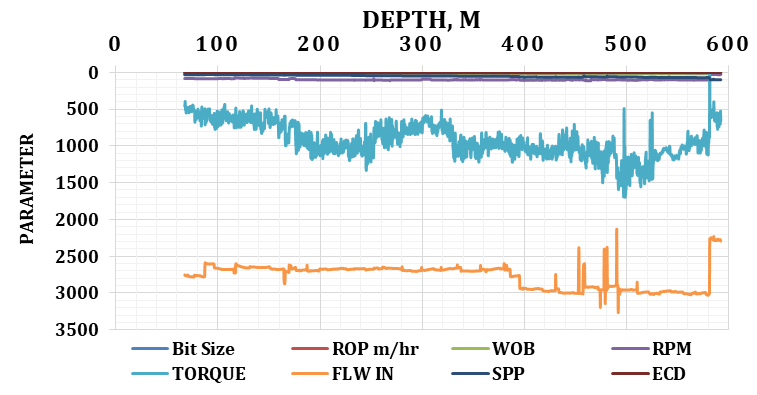
Regarding factors impacting the drilling activities for any drilled well in a certain field, drilling operations are greatly impacted by a number of factors. Usually, these variables are applied to drilling optimization. Consequently, it is crucial to be aware of these characteristics. Drilling parameters may generally be divided into two categories: formation parameters and parameters relating to the wellbore and drill bit. The effectiveness of the drilling operation is influenced by several drilling factors. If they are not appropriately adjusted, the process will be less cost-effective. Bit pressure, drilling speed, torque, and hydraulic parameters are the main categories of drill and bit parameters. However, the most crucial drilling parameters that impact drilling operations are WOB, RPM, flow, downhole hydraulics, and more crucially, bit type since these factors have an impact on penetration rate (drilling speed) and drilling economics. Local tensions, mineralogy, formation fluids, rock compaction, and formation abrasive are factors that affect the formation’s shape. Beyond the aforementioned characteristics, the drilling industry’s most sought-after parameters include the determination of penetration rate. This is due to the fact that it enables the optimization of drilling parameters, which lowers drilling costs and raises drilling process safety.
In order to maximize drilling performance, particularly in the context of Colibasi field development, it is necessary to first acquire data and then process that data. The necessary drilling data measurements, such as WOB, RPM, ROP, and flow rate, are available in data acquisition. Some of this data changes over time. Based on pertinent drilling data, data processing enables the tracking of the drill bit’s response with mechanical specific energy (MSE), the identification of events (steady drilling, vibration, cleaning issues, wear development), and the optimization of the drilling response (parameter adaptation surface data enable the tracking of drilling behavior. Since choosing the ideal qualities of drill bits and mud will be employed in the numerical approach, Figure 2 outlines the algorithmic processes that should be performed sequentially to optimize the drilling parameters of a hydrocarbon field. By applying the suitable mathematical model for each parameter optimization, this procedure may be executed step by step.
![Figure 2: Optimization algorithmic processes (Redrawn from Hossain and Al-Majed [1]).](/fulltextimages/9678/fig_2.png)
Background of Drilling Optimization and Drilling Energy
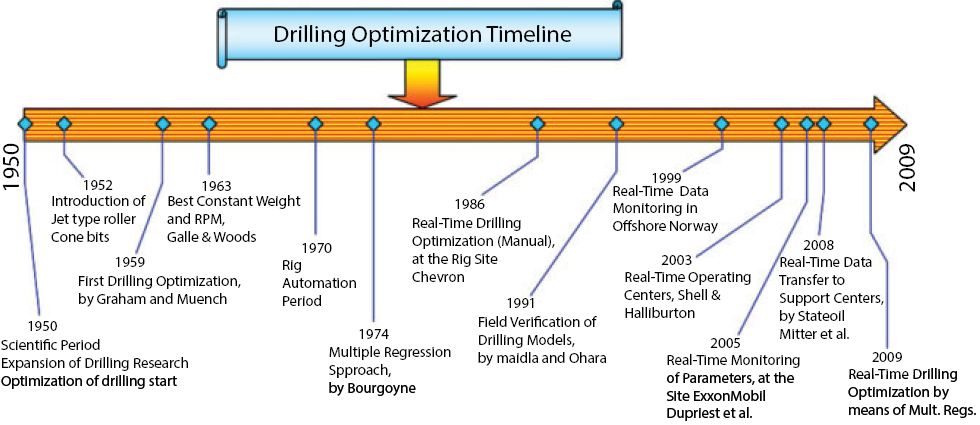
Drilling optimization and energy, drilling specific energy or mechanical specific energy have been extensively studied since long years. Several authors and textbooks have also presented more details about this subject. Furthermore, the historical timeline of the drilling optimization and ROP modelling is presented by Hossain and Al-Majed [1], Eren and Ozbayoglu [3] as shown in Figure 3. Also, Table 1 shows a survey study illustrating a background and a literature study regarding ROP modelling, drilling energy and optimization techniques. This table does not present all scientific papers and textbooks discussing this subject. However, it presents most common studies in this domain. In the last ten years most of researches are done using real time prediction with Artificial Intelligent (AI) or software simulations’ studies.
| Author | Year | Research Technique or Method |
|---|---|---|
| Graham and Muench [4] | 1959 | Executing the initial drilling optimization attempts by quantitatively assessing the WOB and RPM combinations to produce empirical mathematical formulas for bit life expectancy. |
| Maurer [5] | 1962 | Developing the a theoretical relationship between ROP and bit weight, rotary speed, bit size, and rock strength for rolling cutter bits. |
| Galle and Woods [6] | 1963 | Creating graphics and procedures forfield applications to discover the perfect drilling parameter combination. Also, they studied the influence of bit wear on ROP for roller-cone bits |
| Bingham [7] | 1965 | Suggesting a drilling equation of ROP as function of RPM based on laboratory and field data. |
| Bourgoyne and Young [8] | 1974 | Suggesting the use of a multiple regression analysis using a linear drilling penetration rate model to choose the optimal drilling factors. |
| Bourgoyne and Young [8] Paiaman, et al. [9] | 1974 2009 | Studying the relationship between ROP and mud density. |
| Operator companies [1] | mid 1980s | Approaching drilling optimization strategies so that their field staff may attempt optimization at the location utilizing the conditions and chart formats. |
| Reza and Alcocer [10,11] | 1986 | Creating a dynamic non-linear, multidimensional, dimensionless drilling model (ROP, bit dulling rate and bearing wear rate) utilizing the Buckingham theorem |
| Onoe, et al. [12] | 1991 | Outlining the idea, capabilities, and development of a cutting-edge real-time information system for drilling that would significantly improve drilling efficiency and engineering correctness, as well as operational safety and data management. |
| Teale [13] Pessier and Fear [14] | 1962 1992 | Studying the mechanical specific energy (MSE) as a function of WOB and ROP. |
| Bond, et al. [15] Carden, et al. [16] | 1996 2006 | Presenting various drilling planning strategies. |
| Schreuder and Sharpe [17] | 1999 | Presenting the leading well development exhibitions utilizing modern strategies, and moreover introducing optimization strategies for limit drilling. |
| Davis [18] | 2002 | Analyzing data with multiple variables involves characterizing an observation unit to predict ROP. |
| Montgomery and Runger [19] | 2003 | Studying the method of multiple regression models with several regressor variables to predict ROP. |
| Chen [20] | 2004 | Summarizing three new technologies i.e real-time modeling, coordinates real-time modeling and information, and a real-time operation center. |
| Ozbayoglu, et al. [21] | 2004 | Performing a comprehensive sensitivity analysis on the drilling cuttings transport that controls ROP. |
| Thonhauser [22] | 2004 | Examining of performance while drilling and after drilling using process-related data acquired in real time |
| Maidla and William [23] | 2005 2010 | Demonstrating how MSE was applied in a real-time drilling information system on the rig and at remote monitoring stations. Presenting the measurement approaches that involved autonomous drilling operations detections of common drilling activities and data quality control (QC). |
| Dupriest, et al. [24] Armenta [25] Khamis [26] | 2005 2008 2013 | Analyzing MSE used sparingly to look into particular field operations inefficiencies. Also, they studied relationships between ROP and WOB. |
| Osgouei [27] | 2007 | Constructing a drilling model to forecast and optimize the ROP by taking into account the effects of the various drilling parameters. |
| Rashidi, et al. [28] | 2008 2010 (a&b) | Introducing a novel technique to compute real-time bit wear by combining the MSE and ROP models and presenting the real-time use of a model created for bit wear analysis. Conducting a research to show how altering drilling parameters—bit wear and design— affected ROP for both procedures. |
| Armenta [25] | 2008 | Combining experimental and field data, and establishing a unique connection to discover ineffective drilling settings. |
| Mohan, et al. [29] | 2009 | Addressing a novel correlation that uses MSE to discover inefficient drilling circumstances. |
| Vogel and Asker [30] | 2010 | Displaying certain scenarios to educate administrators and other penetrating organizations almost the cost-effectiveness and significance of genuine time data management strategies and data exchange for complimenting innovation in drilling operation. |
| Staveley and Thow [31] | 2010 | Showing techniques for enhancing teamwork and analyzing current and past drilling data, increasing the cost and drilling efforts’ effectiveness. |
| Eren and Ozbayoglu [3] | 2010 | Studying the drilling optimization through data transmission process and developing a drilling model to optimize their operations’ parameters. |
| Sharma, et al. [32] | 2010 | Presenting 6 case histories where the utilize of downhole boring information increments penetrating efficiency |
| Mostofi, et al. [33] | 2010 | Generated rock strength log of the Asmary formation using a drilling operation’s backward simulation |
| Eren and Ozbayoglu [3] Hossain and Al- Majed [1] | 2010 2015 | Presenting the timeline of the drilling optimization |
| Alum and Egbon [34] | 2011 | Studying the relationship between ROP and mud viscosity. Making a semi-analytical demonstrate for ROP utilizing real-time bit recordings from wells penetrated within the Niger Delta supplies based on the first Bourgoyne and Young model. |
| Mitchell andMiska [35] | 2011 | Presenting a relationship between rock shear strength and threshold bit weight at 14.7 psi. |
| Zoellner, et al. [36] | 2011 | Examining a number of situations to track drilling hydraulics by comparing fluid flow to pump pressure and other pertinent sensor channels |
| Gidh, et al. [37] | 2011 | Building a software solution based on an artificial neural network (ANN) to monitor the real-time ANN’s application of operational parameters like WOB and RPM to boost overall ROP while optimizing bit life |
| Koederitz and Johnson [38] | 2011 | Discussing the creation and testing of an autonomous drilling system in the field. |
| Bataee and Mohseni [39] | 2011 | Using ANNs to forecast the correct ROP, optimizing the drilling parameters, anticipating how long a well would take to drill, and ultimately lowering the cost of drilling future wells. |
Table 1: Literature Survey study concerning drilling optimization and energy.
Drilling Specific Energy
In laboratory studies, the idea of mechanical specific energy (MSE) has been utilized successfully to assess drilling bit efficiency. MSE analysis has also been utilized sparingly to look at specific field operations inefficiencies [24]. The MSE investigation technique makes it possible to more- or-less continually spot changes in the drilling systems’ effectiveness. The founder point for the present drilling system and the root cause of founder are discovered via real- time MSE surveillance to maximize the rate of penetration (ROP). MSE measures the connection between input energy and ROP as a ratio. It presents the relationship between energy and ROP that Teale [40] found as follows:
Input Energy MSE Output ROP =
(1)
2 2 480 4 $$ M S E = \frac {4 8 0 \mathrm {T R P M}}{\mathrm {d} _ {\mathrm {b}} ^ {2} \mathrm {d R O P}} + \frac {4 \mathrm {W O B}}{\mathrm {b} ^ {2}} \tag {2} $$ b b However, the MSE principle and the fundamental Teale- developed mathematical formula were updated by Armenta [25]. He modified the original MSE connection by adding a small amount of hydraulic-related terminology and presented the drilling specific energy (DSE) equation as follows:
1,980,000 120 B $$ D S E = \frac {W O B}{A _ {B}} + \frac {1 2 0 \pi \times R P M \times T}{A _ {B} \times R O P} - \frac {1 , 9 8 0 , 0 0 0 \times \lambda \times H P _ {B}}{A _ {B} \times R O P} \tag {3} $$ B B B Where DSE = specific drilling energy, psi AB=borehole area, in2 λ= hydraulic factor of the bit, dimensionless HPB= hydraulic bit horsepower, psi T= the torque, lbf-ft. By utilizing the area of the drilling bit and adjusting the hydraulic component, Khamis [26] updated the DSE equation.
2 2 2 480 3,189,355 4 or B
$$ D S E = \frac {4 W O B}{\pi D _ {b} ^ {2}} + \frac {4 8 0 \times R P M \times T _ {o r}}{D _ {b} ^ {2} R O P} - \frac {3 , 1 8 9 , 3 5 5 H P _ {B}}{D _ {b} ^ {2} \times R O P} \tag {4} $$ b b b where $$ A _ {B} = \frac {\pi}{4} D _ {b} ^ {2} $$ (5)
2 1.2625 $$ \lambda = \frac {1 . 2 6 2 5}{D _ {b} ^ {2}} \tag {6} $$
In order to evaluate the DSE on the bit, it`s necessary to study the mud hydraulics, especially the following equations [1, 2, 35]:
$$ P _ {b i t} = \frac {n}{n + 1} \times S P P \tag {7} $$
$$ P _ {b i t _ {1}} = \frac {n}{n + 2} \times S P P \tag {8} $$
$$ P _ {c} = K \times Q ^ {n} \tag {9} $$
$$ B H H P = \frac {P _ {b i t} \times Q}{1 7 1 4} \tag {10} $$
1714 Where SPP is the standpipe pressure, Q is the flow rate, Pc is the circulation pressure, BHHP is the bit hydraulic horse power and n, k are constants. More details and equations are extensively presented and explained by several authors [1, 2, 35].
Field Description and Well Data
Southern Romania has the coastal oil field known as Colibasi field. The stratigraphic column that was exposed by the wells that were drilled into the Colibasi structure included deposits from the Oligocene and Paleogene, as well as the Helvetian, Meotian, Pontian, Dacian, and Levantin eras of the Neogene. The Oligocene regions are anticlines, whereas the Meotian and Helvetian regions are stratiform (Table 1). The lithology of the stores is incredibly diverse, and siliceous sandstones communicate with them. The field’s tectonics is incredibly intricate; the regions of either of the flanks are affected by a framework of longitudinal and cross inadequacies opposed between them, which divide the structure into more than 50 hydro-dynamically constrained squares. The Meotian hanging divider, Helvetian hanging wall, Meotian footwall, Helvetian footwall, and Oligocene are the best places for the oil aggregations. The 268 Colibasi well’s goal and the main lucrative oil arrangement (Proposed well to be penetrated). Figure 4 shows the field geological column, hole sections, bit features, and drilling parameters.
![Figure 4: Colibași stratigraphic column and optimized parameters for drilling program of drilled well 268 [41].](/fulltextimages/9678/fig_4.png)
Results and Discussions
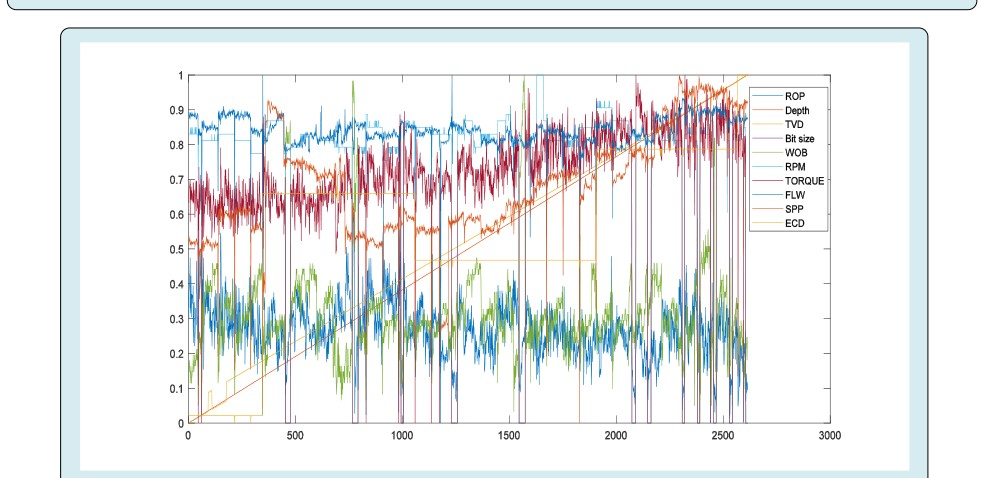
The improvement of drilling performance through the use of drilling specific energy (DSE) is crucial to achieving the greatest energy required to remove and destroy the rock volume beneath the bit. In order to maximize DSE on various bit types used to drill the Colibași stratigraphic column, field data (Figure 1) are combined with hydraulic and mechanical data to analyze and enhance drilling performance as shown in the procedures on Figure 2. These parts are PDC and tricone. Additionally, two portions (17 1/2” and 12 1/4”) are optimized using the DSE equation, and the 8 1/2” hole section was optimized using Landmark software’s simulation analysis.
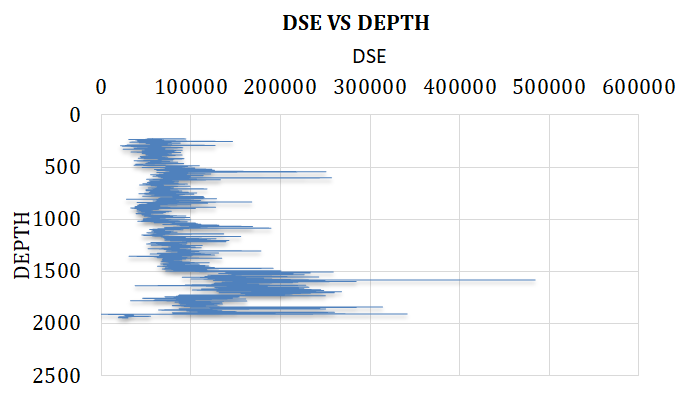
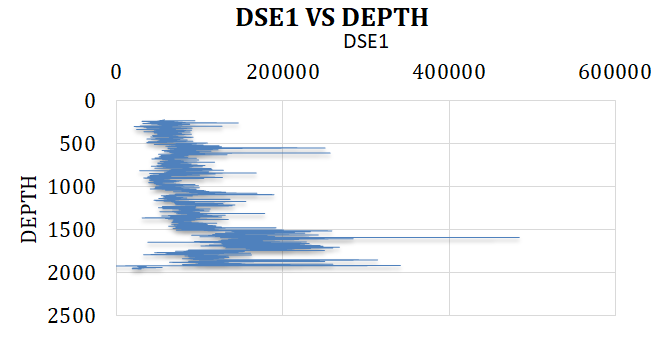
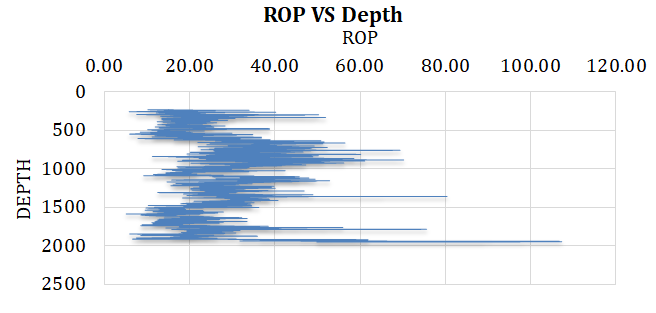
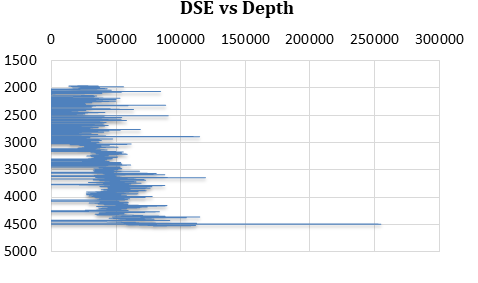
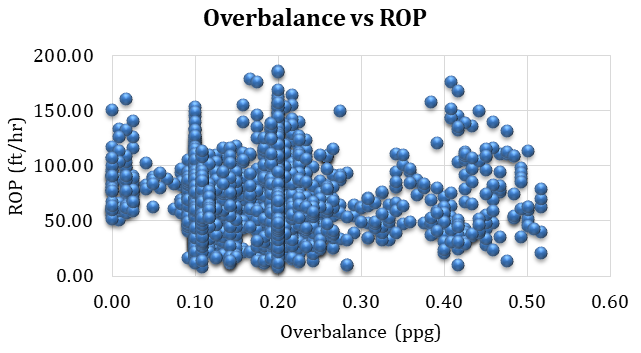
Firstly, the drilling fluid properties are selected and optimized to deduce the relationship between DSE, ROP and WOB for drilling the Colibasi stratigraphic column (Figures 4,5) based on the presented steps illustrated in Figure 2. Figures below show the selection of mud properties for the Dacia geological section as an examples of data selection and analysis (Figures 4, 12 through 16). The same method is used for the Helvetian and Pontian geological sections as summarized on Figure 4. Figures 4 through 16 show the relationship between ROP and WOB to report the mechanical specific energy MSE and the drilloff curve. The effectiveness of hole drilling has been assessed using MSE. Additionally, MSE analysis was utilized sparingly to look into specific inefficiencies in Colibasi’s field operations. The MSE monitoring procedure makes it possible to track changes in drilling systems’ efficacy more or less continuously. The MSE, however, differs in some ways from the DSE. Equations 1–6 were also used to evaluate the idea of DSE, and the connection between DSE and ROP for various drilling parameters was examined (i.e. WOB and HSI).DSE vs. The ROP for different WOB values for all experiments shows the clustering of the curves by WOB. The field data was used to calculate the DSE using Equations 1-6 to identify the inefficient borehole condition. Moreover, Equations 7-10 are the hydraulic necessary one to optimize the DSE. Both ROP and DSE were first plotted against depth to identify bit performance patterns for drilling Helvetian and Dacia formations using tricone and PDC bits respectively (Figures 6-11). Good agreement was observed between the DSE and DSE1 models that are estimated from Equations 3 & 4 including bit and hydraulic parameters. All curves have a similar pattern showing three main regions: i) high DSE and low ROP indicating inefficient drilling; ii) low DSE and high ROP indicating efficient drilling; iii) A transition zone from region 1 to region 2 between these two regions (Figures 6-11). Optimized values are determined to be used improve the drilling performance as shown in Figure 4.
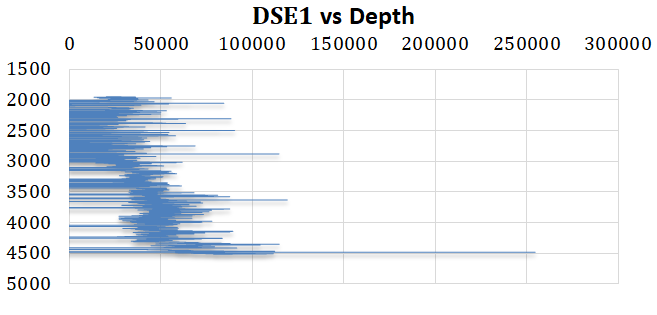
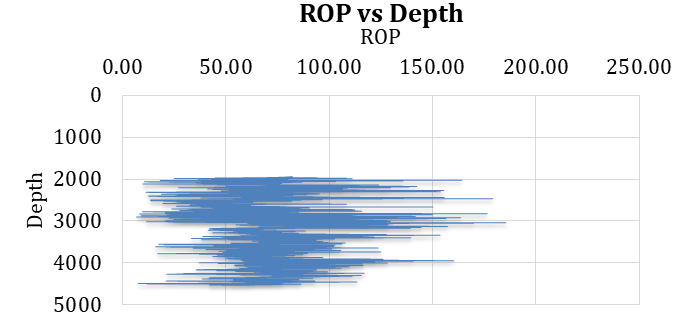
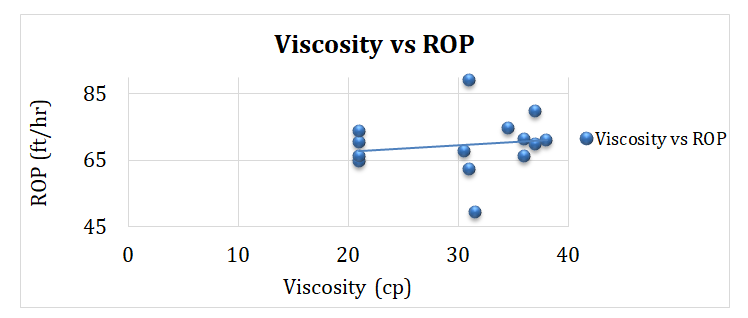
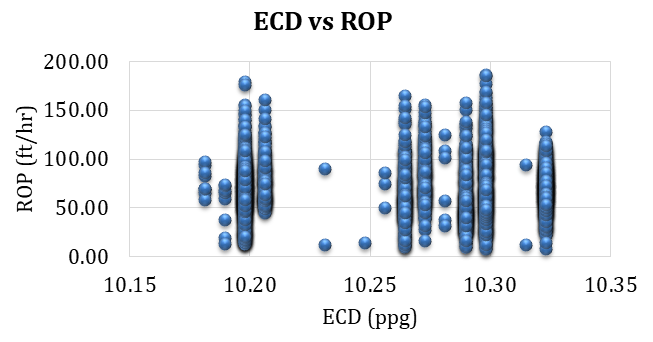
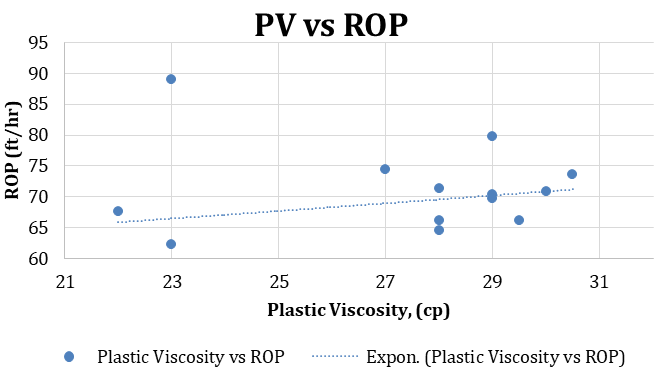
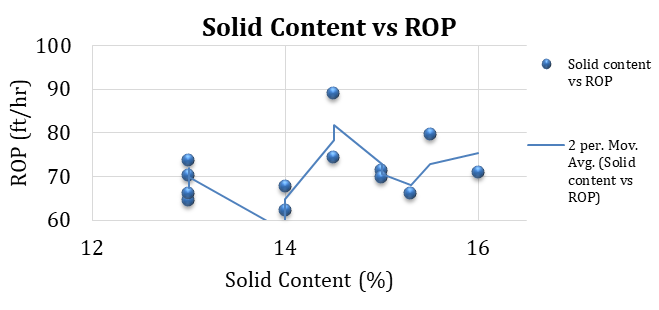
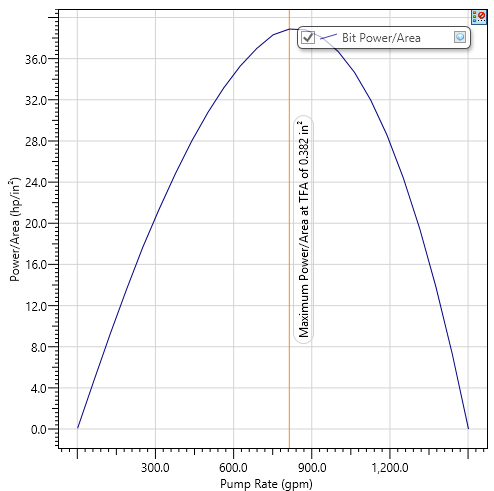
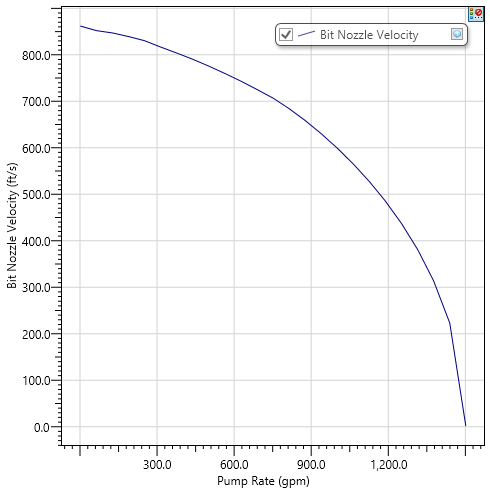
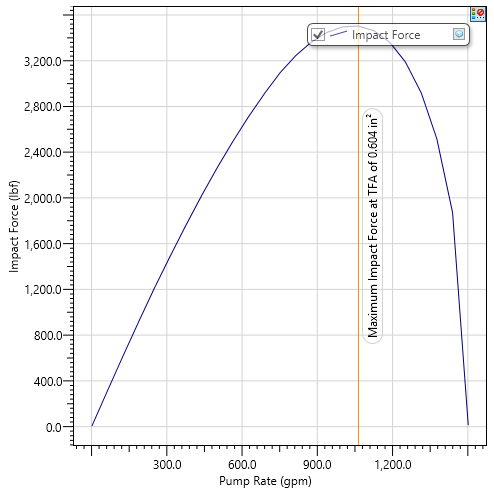
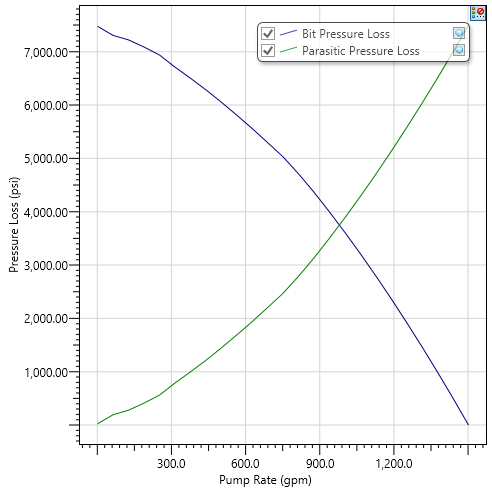
A simulation study is also done by using Landmark software to do bit optimization for 8 1/2” Pontian section. The bit used in this study is shown in Figure 4 with its features and parameters. The simulation results are appeared in Figures 17-20. Obviously, the following figures show that the maximum bit power, impact force and its nozzle velocity are achieved at higher pump rate, more than 800 gpm. It also achieves higher pressure losses. That`s why the best range (450-580 gpm) for that bit type is shown in Figure 4 based on DSE analysis which achieves higher drilling performance.
Conclusions
In this work, an optimization study is performed based on real time DSE optimization depending on actual well data taken from Colibasi field. Combining between drilling parameters, hydraulic data and bit mechanical data help to develop DSE model that improve the drilling performance. Therefore, the following conclusions are extracted based on DSE optimization and simulation results:
- DSE proves its success to identify the drilling conditions of Colibasi well and its performance is matched with literature studies.
- Integrating the bit data, drilling parameters, and hydraulic values helps to do DSE modelling and optimization successfully.
- Real time optimization can be done during drilling and modify the drilling path to the best one.
- Simulation analysis with Landmark is considered another important tool to bit optimization before, during and after drilling.
- Insufficient drilling conditions can be detected by DSE technique and simulation analysis.
- The relationships between DSE, ROP and WOB reveal the drilling conditions and help to select the optimum values.
References
-
Hossain ME, Al-Majed AA (2015) Fundamentals of sustainable drilling engineering. Scrivener Publishing, Wiley, Canada, pp: 786.
-
Mitchell BJ (1995) Advanced oil well drilling engineering handbook and computer programs. 10th (Edn.), Library of Congress, Mitchell Engineering, USA.
-
Eren T, Ozbayoglu ME (2010) Real Time Optimization of Drilling Parameters during Drilling Operations. SPE Oil and Gas Conference and Exhibition, Mumbai, India.
-
Graham JW, Muench NL (1959) Analytical Determination of Optimum Bit Weight and Rotary Speed Combinations. Fall Meeting of the Society of Petroleum Engineers, Dallas, Texas, USA.
-
Maurer WC (1962) The ‘Perfect-Cleaning’ Theory of Rotary Drilling_._ J Pet Technol 14(11): 1270-1274.
-
Galle EM, Woods AB (1963) Best Constant Weight and Rotary Speed for Rotary Rock Bits. Drilling and Production Practice, pp: 48-73.
-
Bingham MG (1965) A New Approach to Interpreting Rock Drillability. Re-printed from Oil and Gas Journal.
-
Bourgoyne AT, Young FS (1974) A Multiple Regression Approach to Optimal Drilling and Abnormal Pressure Detection. SPE J 14(04): 371-384.
-
Paiaman AM, Al-Askari MKG, Salmani B, Al-Anazi BD, Masihi M (2009) Effect of Drilling Fluid Properties on Rate of Penetration. Nafta 60(3): 129-134.
-
Reza MR, Alcocer CF (1986) A Unique Computer Simulation Model Well Drilling: Part I – Th e Reza Drilling Model_._ SPE California Regional Meeting of SPE, Oakland, USA.
-
Reza MR, Alcocer CF (1986) A Unique Computer Simulation Model Well Drilling: Part II – The Reza Drilling Model. SPE California, Regional Meeting of SPE, Oakland, California, USA.
-
Onoe Y, Yoder D, Lawrence M (1991) Improved drilling performance efficiency and operations using an advanced real-time information system for drilling. SPE Annual Technical Conference and Exhibition, Society of Petroleum Engineers, Dallas, Texas, USA.
-
Teale R (1962) The Concept of Specific Energy in Rock Drilling. International Journal of Rock Mechanics and Mining Sciences & Geomechanics Abstracts 2(1): 57-73.
-
Pessier RC, Fear MJ (1992) Quantifying Common Drilling Problems with Mechanical Specific Energy and a Bit-Specific Coefficient of Sliding Friction_._ SPE Annual Technical Conference and Exhibition, Washington, DC, USA.
-
Bond DF, Scott PW, Page PE, Windham TM (1996) Applying Technical Limit Methodology for Step Change in Understanding and Performance. SPE Drill & Compl 13(03): 197-203.
-
Carden RS, Grace RD, Shursen JL (2006) Drilling Practices. Petroskills-OGCI, Course Notes, Tulsa, OK, pp: 1-8.
-
Schreuder JC, Sharpe PJ (1999) Drilling The Limit – A Key to Reduce Well Costs. SPE Asia Pacific Improved Oil Recovery Conference.
-
Davis JC (2002) Statistics and Data Analysis in Geology. 3rd (Edn.), John Wiley & Sons, USA, pp: 461.
-
Montgomry DC, Runger GC (2003) Applied statistics and probability for Engineers. 3rd(Edn.), John Wiley & Sons, USA, pp: 482.
-
Chen DCK (2004) New Drilling Optimization Technologies Make Drilling More Efficient. Canadian International Petroleum Conference, Calgary, Alberta, Canada.
-
Ozbayoglu ME, Miska SZ, Reed T, Takach N (2004) Analysis of the Effects of Major Drilling Parameters on Cuttings Transport Efficiency for High-Angle Wells in Coiled Tubing Drilling Operations. SPE/ICoTA Coiled Tubing Conference and Exhibition, Houston, Texas, USA.
-
Thonhauser G (2004) Using Real-Time Data for Automated Drilling Performance Analysis. 4th (Edn.), Oil Gas European Magazine, pp: 170-173.
-
Maidla E, William J (2010) Rigorous Drilling Nonproductive-Time Determination and Elimination of Invisible Lost Time: Theory and Case Histories. SPE Latin American & Caribbean Petroleum Engineering Conference, Lima, Peru.
-
Dupriest FE, Koederitz WL (2005) Maximizing Drill Rates with Real-Time Surveillance of Mechanical Specific Energy. SPE/IADC Drilling Conference, Amsterdam, The Netherlands.
-
Armenta M (2008) Identifying Inefficient Drilling Conditions using Drilling-Specific Energy. Annual Technical Conference and Exhibition, Denver, Colorado, USA.
-
Khamis MAN (2013) Optimization of Drilling Parameters using Specific Energy in Real Time. PhD dissertation, KFUPM, Dhahran 31261, Saudi Arabia.
-
Osgouei RE (2007) Rate of Penetration Estimation Model for Directional and Horizontal Wells. MSc thesis, Middle East Technical University, Turkey.
-
Rashidi B, Hareland G, Nygaard R (2008) Real-Time Drill Bit Wear Prediction by Combining Rock Energy and Drilling Strength Concepts. Abu Dhabi International Petroleum Exhibition and Conference, Abu Dhabi, UAE.
-
Mohan K, Adil F, Samuel R (2009) Tracking drilling efficiency using hydro-mechanical specific energy. SPE/ IADC Drilling Conference and Exhibition, Amsterdam, The Netherlands.
-
Vogel S, Asker J (2010) Real Time Data Management and Information Transfer as an Effective Drilling Technique. IADC/ SPE Asia Pacific Drilling Technology Conference and Exhibition, Vietnam.
-
Staveley C, Thow P (2010) Increasing Drilling Efficiencies through Improved Collaboration and Analysis of Real- Time and Historical Drilling Data. SPE Intelligent Energy Conference and Exhibition, Netherlands.
-
Sharma N, Srinivasan A, Hood J (2010) Case Histories: Real-Time Downhole Data Increase Drilling Efficiency. SPE North Africa Technical Conference and Exhibition, Cairo, Egypt.
-
Mostofi M, Shabazi K, Rahimzadeh H, Rastegar M (2010) Drilling Optimization Based on the ROP Model in One of the Iranian Oil Fields. CPS/SPE International Oil & Gas Conference and Exhibition, Beijing, China.
-
Alum MAO, Egbon F (2011) Semi-Analytical Models on the Effect of Drilling Fluid Properties on Rate of Penetration (ROP). Nigeria Annual International Conference and Exhibition, Abuja, Nigeria.
-
Mitchell RF, Miska SZ (2011) Fundamentals of Drilling Engineering. Society of Petroleum Engineers, Richardson, Texas, USA.
-
Zoellner P, Thonhauser G, Lueft enegger M, Spoerker HF (2011) Automated Real time Drilling Hydraulics Monitoring. SPE/IADC Drilling Conference and Exhibition, Amsterdam, The Netherlands.
-
Gidh Y, Ibrahim H, Purwanto A, Bits S (2011) Real-Time Drilling Parameter Optimization System Increases ROP by Predicting/Managing Bit Wear. SPE Digital Energy Conference and Exhibition, Texas, USA.
-
Koederitz WL, Johnson WE (2011) Real-Time Optimization of Drilling Parameters by Autonomous Empirical Methods. SPE/IADC Drilling Conference and Exhibition, Amsterdam.
-
Bataee M, Mohseni S (2011) Application of Artificial Intelligent Systems in ROP Optimization: a Case Study in Shadegan Oil Field. SPE Middle East Unconventional Gas Conference and Exhibition, Muscat, Oman.
-
Teale R (1965) The Concept of Specific Energy in Rock Drilling. International Journal of Rock Mechanics and Mining Sciences & Geomechanics Abstracts 2(1): 57-73.
-
Halafawi M, Avram L, Mhanna A, El Dilbani A (2020) Integrated risk assessment improves Colibasi field drilling performance. Oil and Gas Journal.
- Nigeria’s Vulnerability in the Face of Global Energy Policy
- A Simulation Study of Investigation of Optimum Oil Production Performance by Applying Various Gas Injection Methods in Oil Reservoir
- Characterization of Permo-Triassic Reservoirs through Thermal Maturity Assessment of Westphalian Source Rocks in the Cheshire Basin
- Influence of Microwax on the Rheological and Thermal Behaviour of a Wax Crude Oil
- Real-Time Monitoring and Performance Optimization of Steam Injection in Heavy Oil Reservoirs Using Fiber Optic Sensing and Integrated Predictive Simulation Models
- Rapid On-Site Determination of the Total Petroleum Hydrocarbon Content of Soils by Handheld Fourier Transform Near-Infrared Spectroscopy: Development of a Global, Site- and Scanner- Independent Calibration Model