
Enhanced Oil Recovery by Surfactant Injection was improved during the Last 50 Years Thanks to the Multivariable HLD Formulation Equation
This report reviews the progress in Enhanced Oil Recovery (EOR) through surfactant injection over the past half century from 1974, with a specific focus on the role of the multivariable Hydrophilic-Lipophilic Deviation (HLD) formulation equation in different expressions. This equation has been instrumental in optimizing surfactant formulations for EOR, enabling the fine-tuning of surfactant types and properties to match specific reservoir conditions like brine salinity, crude characteristic, temperature and even pressure. This short assesment discusses the evolution of surfactant types, and their impact on EOR efficiency for a given reservoir specifications. It highlights the role of intramolecular and intermolecular mixing in surfactant performance, and the benefits of using a multivariable HLD equation to predict and optimize the injected formulation. Furthermore, it explores the challenges and solutions related to surfactant adsorption, aggregation, precipitation, and effect on phase behavior and interfacial tension, and how these factors have to be considered when using surfactants for EOR projects. This review aims to address the existing gaps in the literature, such as the complex effects of surfactant mixtures with insensitivity to temperature and injected composition (amphiphilic concentration and water/oil ratio) that make difficult to propose a unified approach for different petroleum reservoirs. It concludes a discussion on the state of the art and future of surfactant EOR, emphasizing the need for continued research and collaboration across academic and industrial sectors.
Introduction
The EOR Concept Started in the Mid 1970s
The global petroleum production experienced a significant reduction in 1973 due to the actions of the Organization of Petroleum Exporting Countries (OPEC), leading to a threefold increase in crude oil prices within a single week. The following years, the price stabilized at approximately $35 per barrel. This price was high enough for oil companies to consider new recovery methods with an extra cost of several dollars per barrel ($/Bl), something impossible at the 1970’s price of 3-5 $/Bl. With this new economic situation, the target of the so-called enhanced oil recovery (EOR) methods was to considerably increase the recovery of original oil in place (OOIP) twice or three times above the typical 25-30% attained by water flooding.
This new economic landscape stimulated substantial investment in research and development within both academic institutions and private research centers in most industrialized countries.
The early diagnostic indicated that the crude oil was trapped within pores by capillary phenomena that could be eliminated or significantly reduced, by quite improving water flooding yield through miscible or very low interfacial tension displacements using appropriate surfactant formulations.
Achieving miscibility of both oil and water in a single phase system typically involves a high surfactant concentration (i.e., at least 20-25%), which can result in a prohibitive cost. Hence, the attainment of a low interfacial tension with a relatively low surfactant concentration (e.g. around 1%) emerged as the most attractive alternative for the future as far as a potential high ultimate recovery (40- 50% in the swept zone) was concerned. However, such an achievement involves very complex phenomena, and as a consequence, it required the development of extensive research targeting at the recovery of crudes oil left in the reservoir after the usual secondary water flooding, in particular by injecting a surfactant system solution [1].
While other alternative methods have been proposed [2, 3] the present review is dedicated to EOR methods involving surfactants, often associated with alkaline substances and polymers to improve the flow conditions through the porous media in a reservoir.
This work highlights the advancements that have been made in the field of surfactant aqueous solution injection from 1973 to now, while also identifying the areas where still more research is needed. In Section 1 an introduction to the EOR concept is presented. Section 2 discusses the advancement of surfactant injection methods over the past 50 years, i.e. from 1974 to now. It highlights the evolution of surfactant flooding, from its initial development to the latest advancements, including a discussion on the various factors that influence its effectiveness, such as the type of surfactant used, the properties of the reservoir, and the injection strategy. Section 3 presents a comprehensive overview on the formulation and performance of surfactant mixtures that are necessary in practice. It discusses the individual behavior of each species in a mixture and how this can affect the overall performance of the surfactant. It includes a detailed analysis of the factors that influence the formulation effects, such as the type of surfactant mixture used, the characteristics of the oil and water, and the composition, i.e. the surfactant concentration and water-to-oil ratio WOR.
In comparison to other studies [4, 5, 6, 7, 8], this review provides an updated analysis to the year 2023 of the different surfactant injection methods. It also discusses the limitations and challenges associated with each method, including the ones associated with synergies in optimizing the performance of surfactant mixtures. Furthermore, it highlights the need for more research in certain areas, such as very complex surfactant mixture systems with insensitivity to temperature and concentration, and the fact that recent research indicates that surfactant EOR is more environmentally friendly when compared to other EOR methods such as steam or hot water injection [9].
First Studies on Formulation of SOW Systems for EOR from 1974 to 1979
The pioneering studies on surfactant systems conducted between 1974 and 1979 focused on the attainment of an ultralow interfacial tension between oil and water, e.g. with a typical value below 0.001 mN/m. This value is essentially 100-1000 times lower than the usual result reached with a detergent formula with soaps, since the Sumerians invention 4500 years BC.
A proper formulation to reach this particular occurrence of a very low interfacial tension minimum was found to correspond to a physicochemical situation in which the surfactant molecules adsorbed at interface exactly produce the same interactions with both the oil and water phases.
This equal affinity concept was rediscovered in the mid- 1970s, building upon earlier studies on the phase behavior of surfactant-oil-water (SOW) systems proposed by Winsor around 1950 [10] that are summarized below.
Background
Winsor’s Phase Behavior Approach (1948 to 1954)
All surfactant molecules inherently have an amphiphilic structure, characterized by a hydrophilic (i.e., water loving) group and a lipophilic (i.e., oil loving) group, and consequently, they are not in a completely favorable situation in either a water or an oil phase. The global affinity balance of the surfactant for the water or oil phase depends on the so- called formulation variables, which can alter the surfactant interactions with both water and oil. For instance, when the salinity of the water phase increases, the surfactant can pass from being water loving to oil loving.
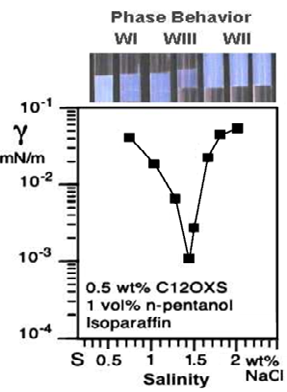
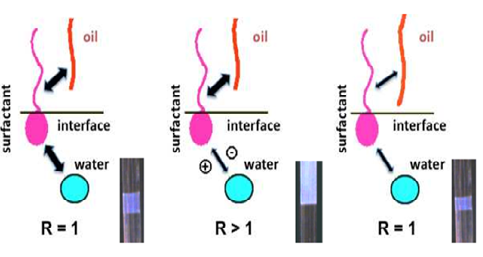
This kind of very general change is depicted in Figure 1, where the surfactant interaction with the water phase decreases as the brine salinity increases from left to right.
This change is attributable to the tendency in water (respectively oil) of the surfactant tail (respectively head) to be extracted from the bulk phase through self-association in micelles (respectively inverse micelle). Micellar structures are essentially colloidal surfactant aggregates that allow to solubilize the surfactant molecules in a favorable situation, such as a single phase containing a solvent, either water (below S=1.5% in Figure 1 case) or oil (above it). This is indicated in the aspect of Figure 1 test tubes, where the opacity of water or oil phases is produced by the light scattering on swollen colloidal micelles or inverse micelles.
At sufficiently high surfactant concentrations to allow the formation of micelles, the surfactant molecules have in general a preference to go to water or oil as a solution of micellar aggregates, thus resulting in two phases at equilibrium for the system. These consist of a micellar solution containing most of the surfactant and an excess phase, which is essentially pure oil or pure water.
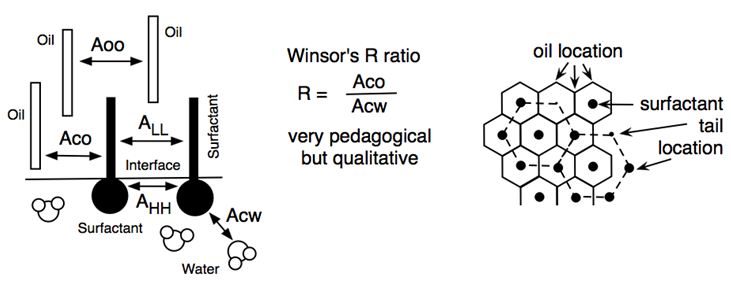
In a very particular case, the chemical potentials of the surfactant in the oil and water phases are exactly the same, i.e., there is a perfect equivalence of interactions between the surfactant and the oil and water molecules. This balance leads to a minimum interfacial tension, often with a third (middle) phase in equilibrium with both excess water and excess oil. In this occurrence seen in Figure 1 at S= 1.5 wt.%, the surfactant molecules are then in a “satisfied” situation so- called optimum formulation (i.e., in a free energy minimum). They are located in a very complex bicontinuous structure related to the so-called liquid crystals, containing both liquids in a single phase, so-called microemulsion by Schulman [11]. It must be stressed that such a term is quite misleading because it is not really an emulsion with tiny drops, nor a micrometer size structure as explained by Scriven, who gave arguments to call it “crazy mixed up stuff” [12], an amazing term which is pretty descriptive of the reality. Since the microemulsion name has been used by many people in the past 70 years, we will still use it to avoid confusion, but we specifically keep it only for the bicontinuous structure middle phase seen at S =1.5 wt.% salinity in Figure 1. In the late 1940’s and early 1950s, Winsor published comprehensive studies on the phase behavior of surfactant- oil-water (SOW) ternary systems and introduced the so- called R ratio of the interactions of the adsorbed surfactant at the interface with the oil (ACO) and water (ACW) molecules (Figure 2) [10]. “A” refers to the affinity (negative chemical potential), “O” and “W” to the corresponding oil and aqueous phase, and “C” to the surfactant film coating at interface.
CO CW R = A / A (1)
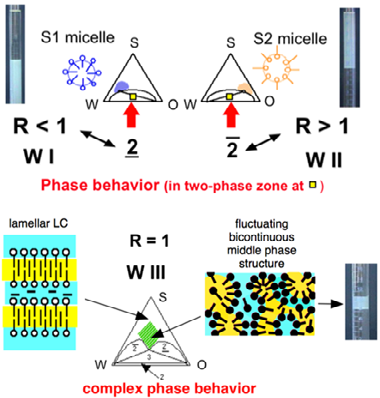
Winsor pioneering work [10, 13] demonstrated that the phase behavior of the system at the low surfactant concentration region was linked with the R value. When R is less than (or greater than) unity, the surfactant exhibits stronger interactions with water (or oil), and thus predominantly partitions into the water (or oil) phase. In these phases, it forms the corresponding S1 micelles (respectively S2 inverse micelles) with remaining oil (respectively water) excess phase having a very low concentration below the so-called critical micelle concentration. These R<1 and R>1 unbalanced situations correspond to surfactant-oil-water WI and WII ternary diagrams depicted in Figure 3.
When the interactions between the surfactant and the oil and water phases are exactly equal (R=1) and are high enough to be above the critical micelle concentration (CMC), a three phase behavior (WIII) occurs, with a middle phase arrangement (related to liquid crystal structures) able to satisfy equal affinities.
However, the so-called lamellar liquid crystals are gels or highly viscous liquids, which are not welcomed in a displacement process such as in EOR. Consequently, the so-called liquid bicontinuous microemulsion alternative is required, producing enough molecular disorder. This state can be attained by introducing branching or bending in the tail or by mixing surfactants with different tails and head groups, or using surfactants and cosurfactants species like alcohols with quite different sizes.
The Aco and Acw interactions depend on the nature and structure of the surfactant and oil molecules, as well as the substances that could alter the water phase polarity, such as electrolytes. It also depends on temperature and, to some extent, pressure. All these characteristics are considered as formulation variables and their effects are studied by changing only one of them at the time, while keeping all others constant. Such a so-called one-dimensional formulation scan results in the variation of the numerator or denominator of R, generally in a monotonous way, so that R increases or decreases, eventually passing through R =1, a situation which could be very easily detected by a minimum tension or an observation, as seen in Figure 1.
Consequently, an experimentally appropriate formulation scan comprises a series of systems in which the composition and formulation are the same with the exception of the value of a single formulation variable that changes from one tube to the next. The test tube series in Figure 1 upper part indicates the aspect of such a scan with a transparent oil phase.
Winsor’s studies, interpreted according to this formulation scan approach [13], indicated that all formulation variables were able to produce a scan from WI to WII or vice-versa, with a WIII three phase behavior case as the intermediate.
Depending on the effect of the variable on the interactions, i.e., on the numerator and denominator of R, the phase behavior transition would take place in one direction or the other. The experimental evidence in Figure 1 indicates that the transition is WI → WIII → WII by increasing brine salinity. The same would occur by increasing surfactant alkyl tail length, temperature (nonionics), or the hydrophobicity of alcohol co-surfactant (longer tail). Conversely, it is WII → WIII → WI variation if increasing alkane length, surfactant head hydrophilicity, temperature (ionics), hydrophilicity of alcohol co-surfactant (shorter tail) [13].
The key to the enhanced oil recovery issue is that the center of the WIII phase behavior range in a formulation scan is associated with a minimum interfacial tension, often an ultralow one [14]. Such a low tension condition results in a capillary number higher than 10-3, which is sufficient performance to produce the oil displacement as discussed elsewhere [14, 15].
When there are three phases, there are actually three tensions, the one between the microemulsion middle phase and each of the excess phase, γMO and γMW, and the one between the two excess phases γWO [14]. In general, the interfacial tension considered representative of the phenomenon is the crossing point between the curve γMO and γMW. Theoretical considerations on nonionic surfactants and on what happens with the third tension γWO may be found elsewhere [16, 17, 18].
Interfacial Tension and Solubilization in Microemulsion to Measure Performance from 1980 to 2000s
Since the lowest interfacial tension corresponds to the highest compatibility of oil and water due to the surfactant adsorbed at their interface, it also corresponds to the maximum solubilization [17, 19, 20]. This refers to the maximum quantity of oil and water cosolubilized in the middle phase microemulsion per unit amount of surfactant. The solubilization parameter SPw (respectively SPo) is the ratio of the amount of water (respectively oil) per amount of amphiphile (i.e., surfactant eventually with alcohol cosurfactant) in the microemulsion middle phase. In general, the amount is measured in volume. The so-called optimum formulation is attained when SPw=SPo=SP*, i.e., when the microemulsion middle phase contains equal quantities of water and oil [14].
The reasons for this coincidence between low interfacial tension and high solubilization were demonstrated by using a simple lamellar liquid crystal model [21, 22]. In fact, this equivalence has been expressed by Chun Huh simple relationship between tension and solubilization parameter as γSP2 = constant = 0.30±0.05 mN/m [21]. This coincidence has been corroborated numerous times over the past three decades [23, 24, 25, 26, 27].
Another way to measure the performance is through the height of the multiphase region in a ternary surfactant-oil- water diagram [14, 23, 28], i.e., the concentration of surfactant CS, eventually with alcohol cosurfactant as CS+A, required to reach the single phase region at equal proportions oil and water. The amphiphile concentration (CS+A) needed to reach complete miscibility in a microemulsion phase (at equal volumes of water and oil) is found to be minimum at optimum formulation as shown in Figure 4.
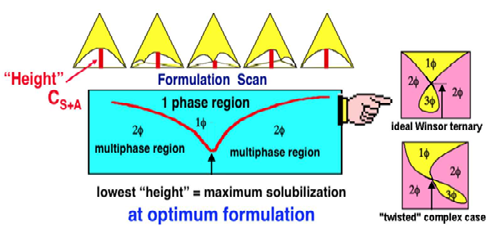
Below this minimum, there is a three phase region, as seen on the right part of Figure 4. This is also observed in the so-called fish diagram proposed (after a 90° rotation) by Kahlweit and Kunieda schools [29, 30, 31, 32] for nonionic surfactants with temperature as the formulation scale.
When the amphiphile is a mixture of several surfactant species or of a surfactant and cosurfactant, with quite different characteristics (e.g., one very hydrophilic and the other very lipophilic) the gamma shape zone gets twisted and the optimum formulation, which is the center of the three phase region, becomes slanted. In other words, the optimum formulation depends on the amphiphile mixture concentration, and this has been shown to be due to the individual fractionation of the different species between the phases and the interface [33].
While this results in some complexity, it does not change the principle, i.e., the fact that the best surfactant solubilization performance is attained at optimum formulation where the minimum tension takes place. In the twisted case, the optimum formulation is also measured at the lowest point of the 1φ region, according to the arrow that indicates the lower single phase microemulsion representative point in Figure 4 lower right map.
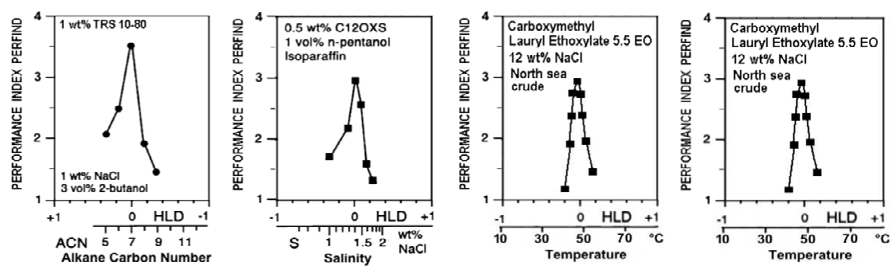
A performance index (PERFIND) [34] of a surfactant-oil- water system has been evaluated as the cologarithm of the minimum tension (in mN/m) in a formulation scan.
PERFIND=-log γ* (2)
This approximate relationship indicates that a system with an interfacial tension at minimum 10-2 mN/m (or 10-3 and 10-4) has a PERFIND of 2 (or 3 and 4), respectively.
Numerical Correlations to Attain an Optimum Formulation from 1978 to 2023
Winsor’s achievements showed that the condition to attain a minimum tension in a scan could be expressed as R=1, i.e., as a single condition which cumulates the effects of many formulation variables. However, the variations of R with the formulation variables cannot be expressed accurately from Winsor’s approach, and the regular solution theory is not suitable to describe a system containing such incompatible substances as oil and water. Consequently, when a numerical result to predict optimum formulation is needed, the approach to handle Winsor R concept with actual formulation variable values was through an empirical measurement.
Systematic studies to identify the occurrence of an optimum formulation were developed by using formulation scan experimental procedures. In the one-dimensional scan technique, one formulation variable is continuously changed and the phase behavior is monitored as described elsewhere [35]. In order to analyze the effect of two variables and their interaction, a second dimension is introduced in a so-called bi-dimensional scan technique [35, 36, 37].
The principle of a bi-dimensional scan can be briefly explained using as example the case in which water salinity and oil alkane carbon number are the two variables to be tested together [35, 37]. The starting point is a system at optimum formulation (Figure 5), in which the interactions (indicated by arrows) between the surfactant and both phases are equal. The first change step consists in increasing the salinity. The ion screening effect between the surfactant head group and the water molecules reduces the interaction on the water side, and consequently, the R denominator decreases, and R increases to becomes R > 1 (Figure 5). Then the compensation change takes place to alter the interaction the other side, i.e., by increasing ACN, which reduces the numerator of R, until the exact balance of interactions is attained again, i.e., R =1 and WIII behavior is exhibited again (Figure 5), but this time with smaller interactions in both sides as indicated by equal but thinned arrows.
Such a compensation study has been carried out by detecting optimum formulation by maximum performance, i.e., minimum tension (Figure 6), maximum solubilization parameter SP (Figure 6 center left) or minimum multiphase height CS+A (Figure 6 center right) versus the scanned formulation variable (S) at different values of the second formulation variable (oil ACN). The optimum formulation corresponds to R = 1 at the center line of the WIII phase behavior zone on a bi-dimensional map indicated in Figure 6 right plot.
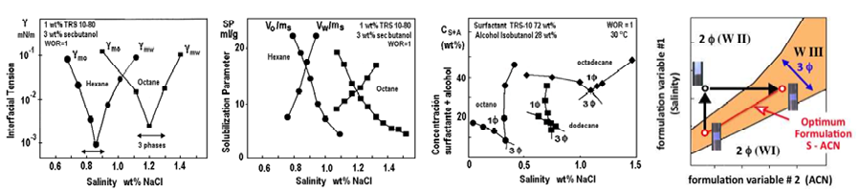
In such a two-steps bi-dimensional procedure, the first variation exactly opposes the second one, and the formulation value changes in S and ACN may be said to be equivalent and opposite. This results in exact data on the effect of the different variables that may be translated into a numerical relationship with two (or eventually more than two) variables. Thousands of experiments carried out for many systems have resulted in general correlations for the attainment of an optimum formulation which could be written as follows 45 years ago for basic systems containing surfactants and eventually alcohol co-surfactants, but with simple liquids, i.e., sodium chloride brine and n-alkane. The relations are linear because the MacLaurin first order approximation is very accurate for a mathematical coincidence explained elsewhere [38]. The very original equation dealt with the effects of the following typical variables in EOR formulation: water and oil characteristic, surfactant and co-surfactant effects as well as temperature. Later, other variables were added, but they are not needed for the present explanation that must be as simple as possible.
In S – k CAN +σ – f(A) - aT(T-25) =0 (3) for anionic or cationic surfactant systems [37, 39]
b S-k CAN+α-EON-Φ(A)+cT (T-25)=0 (4) for polyethoxylated nonionic surfactants systems [40]
In these equations coming from experimental evidence, S is the aqueous phase salinity expressed as wt.% NaCl, ACN is the alkane carbon number to specify the oil, α and β ( β = α - EON) are parameters depending of the surfactant head and tail groups, f(A) and Φ (A) represent the co-surfactant effects depending on an eventual alcohol, and T is the temperature. Original symbols b, k, aT and cT are positive constants depending of the system type, particularly the surfactant head group. k was found to be 0.17 for alkylbenzene sulfonate, 0.10 for alkyl sulfate, 0.19 for alkyl trimethyl ammonium cationics, and 0.05 for alkyl polypropoxy sulfates, 0.15 for alcohol ethoxylates, and 0.30 for polyglycerol surfactants. It is worth noting that the arbitrary unit coefficient in front of LnS and of σ , α and EOΝ has been the source of a confusion which will be discussed later.
It is worth noting that the different k values depending on the surfactant head group, has been stubbornly negated in spite of experiment evidence in some publications from Acosta’s group and some review authors who did not check the literature. Today, it is understood that this statement of non-variation of k was even worse, because the meaning of k was not the same for different cases of equations. For instance, in equation (3) k = ∂LnS/∂ACN and in [4] it is k = ∂EON/dACN that actually have different meanings. The parameter β (=α - EON) was found to decrease linearly with the number of ethylene oxide groups (EON) in the head group, where a represents the contribution of the surfactant n-alkyl tail length SAT also reported as the surfactant tail alkyl carbon number SACN [40, 41].
For all types of surfactants, the parameters σ /k and β /k have been found to increase linearly by 2.2 (± 0.2) units per carbon atom added in a linear tail group. This is certainly due to the actual 2:1 relation between the number of alkane molecules and surfactant molecule tails in the usual dual hexagonal adsorption organizations on the interface oil side, as shown in Figure 2 [42].
Some values of the original parameters can be found in Table 1, and more data has been published elsewhere [12, 37, 39, 40, 42].
Other relationships, less general than equations [3] and [4], are available for specific systems [18, 31, 32, 43, 44], particularly by the introduction of a concept related to curvature [45, 46], which is essentially equivalent, but somehow confusing because of a misnomer name “characteristic curvature” [46] that is not characteristic of a surfactant and that is not a curvature as discussed elsewhere [38, 47, 48].
- Experimental values of some characteristic parameters: α, β, k, b, aT, CT
- Surfactant σ or β ∗ k aT or cT
- SACN surfactant n-alkyl carbon number iso-C12 benzenesulfonate Na salt
- -1,6
- 0,16 iso-C12 o-xylenesulfonate Na salt
- -0,6
- 0,16
- C12 carboxylate Na salt
- +0,5
- 0,16
- Salt characteristic parameter (% -1) nonionic surfactants
- C12 sulfate Na salt
- -2,4
- 0,10
- Salt
- NaCl
- KCl
- CaCl2
- C12 ammonium chloride (pH = 3)
- -3,0
- 0,10
- 0,13
- 0,09
- 0,10
- ↑
- 0,01
- ↓
- 0,02
- 0,02
- ↑
- 0,04 – 0,08
- ↓ f(A) = m CA
- -0,8
- 0,17
- Alcohol parameter m concentration CA in wt% f(A) = m CA φ(A) = m CA
- C12 trimethylammonium chloride
- -3,6
- 0,19
- Alcohol
- Ionic
- Nonionic iso-C8 phenol ethoxylate
- +1,2
- 0,15
- 1 or 2 propanol
- 0
- -0,2 iso-C9 phenol ethoxylate
- +1,5
- 0,15
- 2-butanol
- +0,05
- -0,05
- C12 alcohol ethoxylate
- +0,9
- 0,15
- 1-butanol
- +0,3 / 0,5
- +0,3 / 0,4
- C14 alcohol ethoxylate
- +1,6
- 0,15
- Isopentanol
- +1,0
- +0,6 iso- C13 alcohol ethoxylate
- -0,7
- 0,15
- 1-pentanol
- +1,1
- +0,7
- * β = [α – EON] calculated for EON = 5
- 1-hexanol
- +4,0
- +1,1
Table 1: Some data on the original correlation parameters and constants.
It is worth noting that the temperature effects for ionic and polyethoxylated nonionic surfactants have opposite signs. For ionic surfactants, an increase in temperature tends to increase their affinity for water, i.e., the left term of equation (3) diminishes. Conversely, for ethoxylated or propoxylated nonionics, the polyether chain tends to dehydrate with increasing temperature.
The magnitude of the temperature effect is generally much less significant for ionic surfactants than for nonionics. It is aT = 0.01 °C-1 for sulfate and sulfonate anionics, 0.02 °C-1 for ammonium salt cationics, and cT = 0.04 to 0.08 °C-1 for ethoxylated nonionics, depending on the degree of ethoxylation and on temperature, for reasons discussed elsewhere [49]. Complex so-called extended surfactants, containing a short polyethylene oxide or polypropylene oxide intermediate between their alkyl tail and their ionic group, tend to exhibit a dominant trend following their nonionic nature (the temperature coefficient has a positive sign), but with a lower effect due to the opposite ionic contribution [50, 51, 52].
The left side term of these expressions (3) and (4), which is zero at optimum formulation, has been shown to represent the surfactant affinity difference (SAD), i.e., the variation of standard chemical potential per surfactant molecule when it passes from oil to water phase. It is thus no wonder that being an energy term, it could be split in additive contributions instead of a ratio [49, 53], i.e. as SAD = ACO - ACW.
Its dimensionless equivalent, known as the Hydrophilic Lipophilic Difference or Deviation from optimum HLD (= SAD/RT) [49] is a generalized formulation expression that describes the physicochemical situation as a deviation from the state of perfectly balanced affinities, i.e., from Winsor’s unit R condition. It is thus a scale that allows to compare properties with completely different formulation variable values. The following equations are as follows, in this case for simple systems without any alcohol contribution, so that the f(A) and φ (A) term are zero.
( ) T SAD/RT = HLD = ln S - k ACN + - a T -25 α (5)
( ) T SAD/RT = HLD = b S - k ACN + + c T-25 β (6)
In recent years, another normalized expression called HLDN was proposed to have the same unit coefficient before the term related to the effect of the oil contribution, which seems to be the same in all surfactant cases [47, 48, 54, 55].
This also eliminates confusion caused by the previous expressions (3) and (4), in which the k ACN term was mixing up the effect of the alkane oil length (ACN) and the surfactant head group (affecting k).
Such a normalized expression HLDN could be written as follows in equation (7), or with an even more complete correlation introducing the effects of alcohol co-surfactants, of the polypropylene oxide number PPO, of the pressure, of the WOR and the surfactant concentration and tail branching, which are not mentioned here to avoid unnecessary complications. Actually, the effects of the non-mentioned variables are included in the SCP term that is the only one that is not measured independently as the oil carbon number, the brine salinity or the temperature.
( ) ( ) N S S T ref HLD = SCP- EACN + k LnS or k S ± k T-T = 0 (7)
In this normalized equation, SCP is the “surfactant contribution parameter”, either α /K or β /K according to the previous expressions (5) and (6). ACN is the alkane carbon number when the oil is an n-alkane, or the equivalent EACN when it is another oil [56], S is the salinity expressed as wt./v% of NaCl, T is the temperature (°C). The numerical value for the constants kS and kT can be found elsewhere [55]. The HLDN is thus the hydrophilic-lipophilic deviation equation (3) or (4) divided by the coefficient k of the ACN variable. This allows the surfactant parameter for both anionic and nonionic surfactants to have the same reference (σ and α – EON from ionic and ethoxylated nonionic surfactant HLD equations, respectively) and to be expressed as a Surfactant Contribution Parameter (SCP or PACN [54, 57]) as the same term for all cases. For instance the SCP for surfactant parameter has been found to increase as 2 units (±10%) per additional carbon in its n-alkyl tail, whatever the surfactant [38], so that HLDN equation is quite general and expressed with the same ACN unit for SCP and it thus allow to compare the contribution of different surfactants and of other variables as S, ACN and T in the formulation [34].
The HLDN equation is useful to determine the optimum formulation of simple SOW mixtures and understand complex systems, as in the case of enhanced oil recovery, detergency, dewatering, or emulsification applications, where surfactant mixtures are often necessary [58]. The proper handling of the HLD expressions is quite important in practice because it allows to numerically diagnose the physicochemical situation of a system and to predict not only the change in formulation needed to attain a minimum interfacial tension in a multivariable space, which is what this report is concerned with. It also allows to calculate HLD as the departure from optimum formulation to predict the attainment of emulsion properties such as stability or drop size, as discussed elsewhere [59, 60, 61, 62, 63, 64].
It also allows to make comparisons in the same formulation yardstick. For instance, (Figure 7) performance index data plotted against HLD changes through different variables, exhibit strong similarities. It is clear for instance that the formulation range that produces the proper low interfacial tension performance is extremely narrow, regardless of the selected scan formulation variable, and that a deviation of more than 0.1 HLD unit from optimum formulation would produce a serious penalty in performance. This is why good formulation accuracy in the reservoir conditions is critical in enhanced oil recovery processes.
This generalized HLD scale allows to take into account differences. For instance, for the lauryl ethoxylate surfactant (Figure 7 fourth plot) the cT temperature coefficient is about twice as much as for the carboxymethyl lauryl ethoxylate (Figure 7 third plot), which has a head group containing both anionic and nonionic parts and is thus less sensitive to temperature. Plotting both data with the same temperature scale would suggest a difference in formulation range which does not exist.
The generalized HLD expression allows to characterize the contribution of each component in the system formulation, i.e., the naturally occurring oil and water, as well as the substances to be selected and added to attain the sough after result. The simple relations shown above for NaCl brine and n-alkane have been extended to realistic systems in which the compounds are not pure substances but mixtures with intermediate characteristics, which nevertheless are not changing necessarily in a linear way.
The Handling of Surfactant Mixtures and Studies on Formulation Performance from 1970 to 2000s
Surfactant mixtures can be handled as single substances [65] or as more or less complex combinations [66, 67]. Opposite trends with two different surfactants can be used to reach some insensitivity, for instance, to temperature effects [68]. However, the issue is that surfactant mixtures often exhibit fractionation phenomena due to the individual behavior of each species, and consequently, they do not keep a constant interfacial formulation when the concentration or water/oil ratio changes [69, 70, 71]. This nonlinear effect may be translated into specific relations to calculate or at least estimate some characteristic parameter of the mixture.
Generalized formulation relationships have become more comprehensive in the last 40 years, because a large amount of data has been available to deduce or estimate the equivalent alkane carbon number EACN for non-alkane hydrocarbons [72, 73, 74, 75], with fairly specific data on the effect of the molecular structure of the oil [56, 57]. Equivalent salinity may be calculated or estimated in some cases when NaCl is not the electrolyte [54, 76, 77, 78, 79, 80]. The effect of the pH on systems containing pH sensitive surfactants like fatty acids or amines has been described as similar to other formulation variables, though with an extremely nonlinear variation probably due to the fact that the pH is a logarithm scale. This understanding will be useful in dealing with enhanced oil recovery with alkaline components added to the surfactant systems as a way to reduce the cost [67, 81, 82, 83, 84].
As far as the performance in attaining a low interfacial tension is concerned, comparisons should be performed between systems at optimum formulation when R=1 or HLD=0 in both cases. However, such a comparison cannot be carried out by changing a single variable, as would be desirable to deduce a clear effect of such variable. Consequently, the resulting minimum tension increase or decrease cannot be said to be due to a single variable effect but to those of (at least) two concomitant variable changes.
The basic trends to improve the performance were proposed in Winsor’s pioneering work, and corroborated during the basic EOR studies in the 1970’s and early 1980’s. Some features have been found in the 1980-2000 decades, often outside the petroleum application purposes, when the EOR urgency had been diminishing with the return to an excess in production and a lower crude oil price.
The state of the art concerning the trends that are likely to improve performance, as recently summarized [85, 86, 87], has been corroborated by the current formulas, which have been empirically selected as the best from trials and error, and will be discussed later on.
Increasing Interactions on Both Sides According to Winsor’s Premise
After introducing the R ratio of the surfactant interactions for the oil and water phases, Winsor stated that the first condition to attain a maximum performance was to secure a unit interaction R (Figure 8a) in a formulation scan.
Thereafter, Winsor proposed a premise to improve the performance, as discussed below. The condition R = N/D = 1, which characterizes the attainment of an optimum formulation, may be achieved in different ways, for instance as R = 1/1 or R = 5/5, i.e., with two equally small or equally large interactions. Concerning the influence of the actual value of the numerator and denominator, Winsor stated that the performance should be improved when the interactions per unit interfacial area are increased on both sides of interfaces (and of course kept equal) and vice versa. This premise was systematically confirmed 20 years later [37, 40] by studying double changes in formulation, which started at a R = 1 case and ended at another R = 1 case, eventually with another numerator and denominator values. The first double effective change was the one previously shown in Figure 5, i.e., an increase in both the interaction of surfactant with water (by decreasing salinity), and with the oil phase (by decreasing the alkane ACN). This double effect due to formulation variables independent from the surfactant is indicated by the arrows in Figure 8b.
The same phenomenon was reported with two surfactants having completely different structures but with exactly the same R = 1 balanced interactions condition, for instance, C12OSO3Na and C18CH(COONa)NHCONH3, the second one being bulkier, hence having stronger interactions on both sides of the interface [88]. This double change in surfactant structure indicated by arrows in Figure 8c is essentially equivalent to thickening the interfacial layer through which the polarity shifts from polar (water) to non- polar (oil).
Similar double changes on N and D exhibit a performance effect that depends on the change in interactions between the surfactant and the oil and water phases. If the two changes with opposite effects in formulation alter one the numerator, and the other the denominator, the final (equal) values of N and D would be different from the initial (equal) ones, and a performance variation will be found.
The typical double changes which have been tested with changes on different sides of the interface are shown in Table 2, which summarizes the results found in the literature [23, 28, 89, 90].
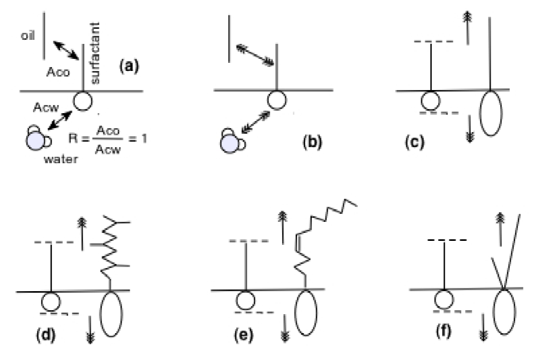
Figure 8: (a) Maximum performance in a formulation scan is attained at optimum formulation when R = 1. Different performance improvements at optimum formulation: (b) Increasing the interactions on both sides by changing oil and water characteristics. (c) Increasing the interactions on both sides by changing surfactant characteristics. There are three ways to increase the interaction of the surfactant tail with oil without producing surfactant precipitation: (d) branching; (e) bending with double bound; (f) double tail.
| Variable 1 | Variable 2 | PERFIND |
|---|---|---|
| Salinity ↓ | ACN ↓ | Increase ↑ |
| Salinity ↓ | Surfactant tail length ↑ | Increase ↑ |
| Salinity ↓ | Alcohol tail length ↑ | Increase ↑ |
| Salinity ↓ | Concentration of lipophilic alcohol ↑ | Increase ↑ |
| Surfactant head group more hydrophilic (e.g. EON ↑) | ACN ↓ | Increase ↑ |
| Surfactant head group more hydrophilic (e.g. EON ↑) | Surfactant tail length ↑ | Increase ↑ |
| Surfactant head group more hydrophilic (e.g. EON ↑) | Alcohol tail length ↑ | Increase ↑ |
| Surfactant head group more hydrophilic (e.g. EON ↑) | Concentration of lipophilic alcohol ↑ | Increase ↑ |
| Salinity ↓ | surfactant head group more hydrophilic (e.g. EON ↑) | Constant → |
| Salinity ↓ | concentration of hydrophilic alcohol ↓ | Constant → |
| ACN ↑ | Surfactant tail length ↑ | Constant → |
| Temperature (ionics) ↑ | a Salinity ↑ | Constant → or slightly ↓ |
| Temperature (ionics) ↑ | a Surfactant tail length ↑ | Constant → or slightly ↑ |
| Temperature (nonionic) ↑ | b ACN ↑ | Decrease ↓ |
| Temperature (nonionic) ↑ | b Surfactant head group more hydrophilic (e.g. EON ↑) | Decrease ↓ |
| Temperature (nonionic) ↑ | c Surfactant tail length ↓ | Decrease ↓ |
Table 2: Effect on performance of concomitantly changing two variables, but keeping an optimum formulation Source a[14]; b[36]; c
Conversely, if the two changes with opposite effects in formulation alter the same side of the interface, only N or D will be changed back and forth, and will return to the initial value (since the other is not changed). In this case the performance should not be altered [38, 47]. However, some slight variation may be noted if one of the changes alters not only the interaction between one surfactant molecule and a phase, but also the surface area occupied by a single surfactant molecule, as it is the case with a change in tail branching or ramification.
The proportion of two alcohols changes [48] (at same total concentration and with everything else constant) to maintain optimum formulation f(A) = cst results in a constant performance (PERFIND). Note that this is interesting because the selection of the alcohol could depend on some other consideration.
The most complex situation to decide upon is when the introduced changes are altering different effects, as does the temperature, which could produce a change not only in interactions, but also in the interfacial adsorption density. In such a case, only an experimental measurement will give the right answer.
Other specific tendencies have been reported for some particular surfactants and are worth noting. The presence of benzene ring enhances the partitioning of the surfactant into oil and tends to lower the cosolvent requirement. Alkane/a- olefin sulfonates exhibit an excellent performance and are quite effective at high salinity. However, they produce liquid crystal gels and thus require alcohol co-surfactant or a higher temperature. Their tail branching seems to have no large effect on formulation, contrary to the case for alkyl benzene sulfonates [90, 92, 93, 94].
Increasing both sides of the surfactant is probably the best way to boost the performance, but there is a limit. The increase in the lipophilic tail is always limited by solubility problems in water, particularly with linear alkyl groups that cannot be longer than C16-C18. Precipitation occurrence may be avoided or at least reduced in several ways.
The simplest one is to introduce some branching either as lateral methyl groups in the tail resulting from the polymerization of propylene or butylene, or by having double bonds, or by placing the head group in an internal position of a linear hydrocarbon chain, so that a double tail ramification is formed (Figure 8 d-e-f). However, it should be taken into account that branching or ramification in the tail results in other effects like a reduction of gel formation [95], but it also can decrease performance.
In another study by Graciaa, et al. [23], a C18 linear tail corresponds to a higher performance at optimum than the diC9 ramified tail, i.e., there is some apparent inconsistency with the previous case. This means that the actual N or D should be written as Winsor did, i.e., as the interaction per unit area of interface. A ramification does increase the interaction of the tail with oil per molecule, but it makes the tail bulkier and there are less molecules per unit area, and thus a compromise between the two tendencies is what leads to the best. Another way to avoid precipitation is to use a tail or a part of the tail with a less hydrophobic or a slightly hydrophilic substitute to a pure hydrocarbon, such as a polypropylene oxide chain, as will be discussed next.
Intermolecular Mixing of Different Substances at Interface
Another way to circumvent the precipitation problem is to use a mixture of several amphiphilic molecules at the interface, instead of a single species [96, 97]. If one of the molecules is quite hydrophilic and the other quite lipophilic, their preferred positions are rather on one side and on the other of the interface.
Hence, in their combination, the first one increases the reach on the water side of the interface and the other is doing the same on the oil side, as indicated by the vertical arrows in Figure 9a. This arrangement also reduces the ionic or steric repulsion between neighboring head groups, and allows a better molecular packing at the interface. This results in a better interaction per unit surface area, as indicated by the horizontal arrows, and consequently, this is a second reason for the performance to increase [11, 97, 98].
This is why mixing is a very general way to improve performance through a favorable situation often referred to as synergy between the mixture species. Moreover, the packing at interface is often denser when the species which are mixed are broadly distributed, because they can pack together better (Figure 9b), and this is why it is often said that the more complex the mixture, the better it is for EOR.
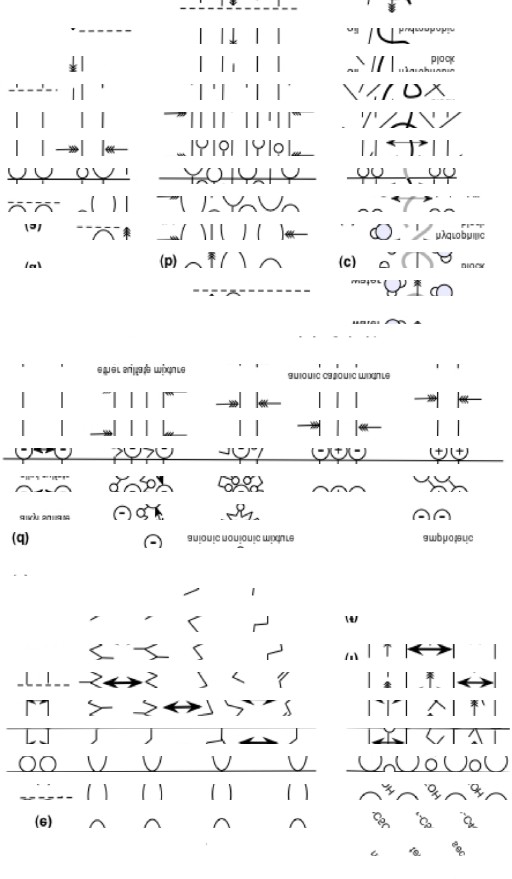
Figure 9: Different ways of improving the surfactant performance by intermolecular mixing: (a) mixing hydrophilic and lipophilic species increases the surfactant reach in both phases, produces a denser packing and generally increases performance. (b) broad range mixture improves packing. (c) a small amount of adsorbed diblock long copolymer boosts interactions. (d) less repulsion or more attraction between neighboring head groups improves packing. (e) branching, ramification and unsaturation reduces packing. (f) alcohol cosurfactants reduces packing, particularly branched ones.
This is not always true, and some exceptions can be found if a considerable interaction overrides the likely mismatching. This is the case of the impressive performance boost produced by adding a very small amount of balanced diblock copolymer to a conventional surfactant [99, 100]. The scheme of the attained synergy shown in (Figure 9c) is since the polymeric molecules are isolated from one another, i.e., they are diluted by the overwhelming proportion of conventional surfactant molecules. Nevertheless, they are anchored at interface and because of their very large hydrophilic and lipophilic parts, they considerably extend the reach of the amphiphilic mixture into the water and oil phases.
Mixing species whose molecules attract each other generally results in a denser interfacial packing and an improved performance. As seen in Figure 9d, this is the case of the well-known mixture of alkyl ether sulfates with a distribution of polyethylene oxide spacer lengths. This is also the situation of an anionic-nonionic combination because of the polyethylene oxide chain wrapping around the ionic head. In the combination of anionic and cationic species [67] (or amphoteric substances) the packing is very effective, but it could be extreme, eventually too dense if some moderating feature or additive is not present to pull apart the surfactant molecules and to avoid the precipitation or the formation of very viscous structures. However, this is also a feature to be handled with caution, because effects which tend to reduce the precipitation or the formation of gel such as double bond, branching or ramification in the tail group of the surfactant (Figure 9e), tend to decrease the packing density [101] and thus to penalize the performance.
Small amphiphiles like alcohol cosurfactants are often used to prevent the formation of liquid crystal gel mesophase, as well as for some other reasons in EOR processes, like a reduction in surfactant adsorption or a decrease in fluid viscosity. However, their use brings two main disadvantages as far as EOR performance is concerned.
First, alcohols tend to pull apart the surfactant molecules adsorbed at the interface and thus reduce the packing density (Figure 9f). Secondly, their small head and short tail reduce the average interactions of the amphiphile mixture with both phases, i.e., a penalty as far as performance is concerned. The alcohol cosurfactants with the most significant performance loss are isopropanol, sec-butanol, or ter-pentanol, which are more likely to adsorb at oil-water interface, and whose branching increases their interfacial occupancy, thus reducing even more the surfactant packing [88]. Other cosurfactants than common alcohols have been studied and are sometimes interesting candidates as useful additives [102].
It is worth noting that packing could be altered in some other way by merging neighboring molecules that could normally repel. Double chain sulfosuccinate compounds [96] and gemini surfactants are more likely to pack more and thus to lower the tension [101, 103]. All these different and amazingly complex features definitively show that mixing is a potential key to improvement, provided that the formulator knows how to open the door with the key.
Because of the synthesis mechanisms, polyethoxylated nonionic surfactants are mixtures that contain widely different oligomers, and most of the time exhibit enough disorder to avoid the formation of liquid crystals at optimum formulation. A wide range variety of species also takes place with anionic surfactants of the sulfate/ sulfonate type when the hydrophobic part comes from a refinery cut, for instance for petroleum sulfonates. Using olefins with random positioning of the double bound as the hydrophobic part, could result in a very different species from the physicochemical point of view. Mixing commercial surfactants produce even wider mixtures and can display extended reach and increased packing features favorable to enhanced performance, according to the previous discussion with the lipophilic linker role [98].
However, this favorable trend also exhibits a limit beyond which the performance tends to go down with the mixing of very different species. This is due to the so-called fractionation effect which has been studied in detail elsewhere particularly for polyethoxylated nonionics [33, 69, 104, 105]. For instance, when the mixture contains a too lipophilic surfactant, e.g., a nonionic with only 2 EO groups, this species exhibits a very strong tendency to migrate into the oil phase. Because of this selective partitioning, this surfactant is no longer available to adsorb at interface whose mixture formulation changes. The same preferential fractionation takes place with sulfonated anionics, but this time with the very hydrophilic species going into the water phase [104].
As a consequence of the fractionation and partitioning, mixing very different surfactants may lead to an improved performance as far as the interfacial amphiphile is concerned, but it also drives a large portion of the surfactant into the bulk phases, where it is lost for interfacial formulation purpose [71].
If a very lipophilic amphiphile, e.g., dodecanol, is added to a system, it does not adsorb to participate to the interfacial mixture with a surfactant [88]. Instead, it is mostly found to be segregated in the oil phase close to the interface because of Van der Waals long range forces.
This kind of slightly polar oil has been called lipophilic linker [98, 106, 107], and has been shown to extend the reach of the surfactant hydrophobic tail into the oil phase, indicated as a lipophilic linker LL in Figure 10a. It is worth noting that such linker does not really adsorb at the interface, and is consequently a different mixing feature than the typical cosurfactant effect which has been discussed before.
As a matter of fact, the lipophilic linker does not play a role in the attainment of the R = 1 condition at interface for the surfactant, i.e., it does not require a change of the hydrophilic part, and does not alter the surfactant packing at interface. However, it enhances the performance as shown in Figure 10-b plot that indicates the effect of different alcohol chains. The alcohol is a co-surfactant up to n-heptanol or n-octanol (white dots) and then becomes a lipophilic linker for longer n-alcohol (black dots), which are not migrating significantly to the interface.
Figure 10b clearly shows that the performance steadily increases with a longer extension of the combination of surfactant together with linker without any change in the surfactant head group indicated as EON in Figure 10b [107].
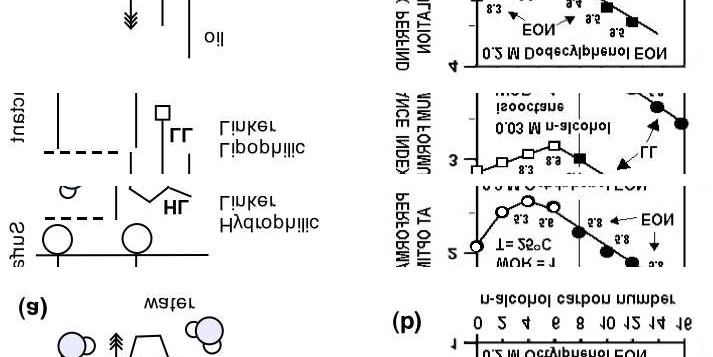
The segregation of the lipophilic linker in an oil layer close to interface [108] widens the transition zone thickness by making the oil layer close to interface slightly polar. Of course, the lipophilic linker is lost into the bulk phase but its segregation close to interface limits this penalty and a significant effect is seen at very low concentration in oil [98].
A similar effect proposed to take place in the water phase, was called hydrophilic linker, although with less performance improvement [109]. Then, the concomitant use of both lipophilic and hydrophilic linkers as shown in Figure 10a was found to result even better [110]. The improvement through the mixture feature was found to be significant by mixing lipophilic linkers [107].
Intramolecular Mixture and Extended Surfactants from the 1980s to Present Times
The first intramolecular mixtures for surfactants to be used in EOR was not really designed to generate a mixture synergy, but rather to attain an intermediate compromise between anionic species, which are likely to precipitate at high salinity, and polyethoxylated ones, which become lipophilic at high temperature [111, 112]. The principle of reaching a temperature insensitivity by mixing anionic and nonionic surfactants [68, 113] could be also applied to intramolecular mixture species called extended surfactants [114].
The small amount of ethylene oxide groups between the tail and anionic head produces different effects [95, 115, 116]. The first one is, of course, to increase the hydrophilicity of the surfactant, thus allowing to increase the tail length, though sometimes with at least a double bound to avoid the precipitation or the formation of structures, but resulting in a significant boost of the performance index [117]. Of course, the proper intermolecular mixtures of species with a different number of ethylene oxide intermediate would also facilitate the packing as shown in Figure 9-d. It is worth noting that this is not done on purpose but by the random ethoxylation mechanism. A ramified tail of the Guerbet type hydrophobe is also an alternative solution which eliminates the co-surfactant requirement [118].
Similar species of ethoxylated anionic surfactants with a carboxylate head group are found to be sensitive to pH, as could be sought in some circumstances [116]. If a strong salt tolerance is required because of the presence of divalent cations a long polyethylene oxide chain is required. Surfactant containing a few propylene oxide groups, eventually with a few ethylene oxide groups, were proposed to increase the nonionic characteristic, and also because they were found to reduce the formation of gel and thus to avoid the use of alcohol [119], as well as being less adsorbed [120].
A similar kind of surfactant has emerged independently from pharmaceutical application studies in the late 1980s when it was understood why the lipophilic linker was effective in enhancing solubilization, particularly of polar oils. They were called extended surfactant structure, and they were designed to accumulate all the advantages of the previously discussed features without some drawbacks. The argumentation to build up such a proper structure was as follows.
First, it had to be a single molecule that is compelled to go and stay at interface, like a mixture of surfactant and lipophilic linker that cannot fractionate and be partially lost into one of the bulk phase.
Secondly, the combined molecule had to be longer than a conventional surfactant to boost its performance by increasing the reach on both sides of the interface, but not with a long hydrophobic part that could precipitate. In order to mimic the improved solubilization efficiency attained with the lipophilic linker role of generating a slightly polar zone in the oil bulk phase close to interface, a somehow polar lipophilic spacer (polypropylene oxide —PPO—chain) was placed between the conventional hydrophilic and lipophilic groups (Figure 11) [74, 121], eventually with about 1-3 ethylene oxide connection added to easily attach the ionic head, and facilitate the packing as for alkyl ether sulfates.
The polypropylene oxide spacer, which is lipophilic but slightly polar, was found to have the first 2-3 propylene oxide groups somehow water wet [51], a situation that produces some twisting [114] in the hydrophobic tail close to interface, as shown in Figure 11. This adds up to the lateral methyl group branching to produce enough disorder in the tail to avoid the formation of gel, and consequently, this kind of structure does not need the addition of alcohol co- surfactants, as was found earlier [121].
$$ \mathrm {O I I} \Gamma $$
$$ O q C - S t a i t e r I T t e l s w e s a u q u o g n o g i n i s l b n s 1 9 w o s t e t o t a l $$ $$ \mathrm {E O} \mathrm {O} _ {2} \mathrm {O} _ {2} \mathrm {W A T E R} $$ Figure 11: Extended surfactant arrangement at interface.
This polypropylene oxide spacer is nevertheless globally lipophilic, and thus it is in the oil phase. Consequently, it drives the completely hydrophobic hydrocarbon group part further away from interface and increases the interactions on the oil side. However, the considerable increase in the tail length, which could be three or four times longer than the usual C12 alkyl, is attained without precipitation.
This extreme elongation results in a good performance index boosting by 2-3 times, and an exceptional 10 times better than the conventional surfactant performance with polar oils like triglycerides. For this reason, many studies have been developed recently to apply these properties to cleaning purposes and solubilization of polar oils [51, 114, 117, 121, 122]. They have been also tested for petroleum applications different from EOR but this time with a long polypropylene oxide chain as the spacer [48, 123, 124]. This very long extension requirement, which has not been mentioned in the EOR literature and patents, might become an important characteristic in the near future, for instance with heavy oils. In effect, it has been recently shown that the long extension is associated with the higher solubilization [125] and lower interfacial tension [126] with higher ACN hydrocarbons, contrary to the usual trend. This exceptional effect is catching attention because it is a way to circumvent a problem that is still pending in heavy crudes as well as viscous paraffin cosmetics and pharmaceuticals.
Recent research has demonstrated that extended surfactant structures function similarly, albeit with certain modifications consistent with the general trends. This has been corroborated with a variety of head groups other than sulfate, such as carboxylate or phosphate, as well as galactose, polyglucoside, polyethylene oxide and their combinations, with linear and branched tails, and with spacers from a small intermediate link to the main part of the molecule [87, 127, 128, 129, 130, 131]. Additionally, other research groups have studied its phase behavior [132, 133], sometimes referring to them as graded surfactants [134, 135], there is still a significant amount of research dedicated to the properties and applications of these extended surfactants. Nevetheless, some general trends have been found and explained in the literature. It may be said that Winsor’s premise regarding the concomitant increase of head and tail groups to boost performance seems to apply to extended surfactants too, with clear advantages over the conventional techniques of molecular enlargement and intermolecular mixing, e.g., there is no precipitation, no fractionation, and an intramolecular mixture synergy is exhibited.
Early studies in extended surfactants pioneering work Miñana-Pérez [136] indicated that they blend with other (conventional) surfactants according to the usual linear mixing rules [65, 67] as far as the formulation is concerned. However, the performance of the mixture uniquely depends on the proportion of the extended surfactant when the conventional surfactant does not exhibit a significant solubilization if used alone, as with polar oils [137]. This is quite an interesting situation because it means that the formulation and the performance can be handled separately. Although these mixing rule characteristics were clearly published [137], and later corroborated [138], they appear as if they were innovations in patents that curiously do not cite the academic original divulgations [139, 140].
A final word on this topic is that although the first so- called extended surfactant species were produced by Seppic for application in microemulsion to mimic the lipophilic linker effect in order to solubilize polar oils, the actual first surfactant species containing a polypropylene oxide intermediate were produced 20 years before in relation to oil recovery [119]. A patent for an alkyl PPO-PEO-anionic was taken by the Exxon group working in EOR [141], though with only a very few PO, e.g., a maximum of 10 PO groups. Condeavista, which was taken over by Sasol, produced Alfoterra products with highly branched tails, but short spacer too. Nevertheless this short spacer was not enough to produce the performance trend inversion previously noted, i.e., a higher performance with higher alkanes.
What became the main performance for the so-called extended surfactants for other applications, i.e., the high solubilization and low interfacial tension with polar oils, particularly natural triglycerides, was not mentioned either in the first papers and patents which were dedicated to EOR. Hence, the main idea behind this kind of molecule for use in EOR at this time was probably to make it an anionic surfactant more salt tolerant, and with less probability of formation of a liquid crystal gels or precipitate, because of the less hydrophobic polypropylene oxide part of the tail, with some methyl branching or Guerbet ramification. These substances were also said to be incorporated in EOR applications to overcome the chromatographic type separation in the formation [141]. Shell also produced similar substances and currently commercializes them under the name Enordet A/J/C/H series. In recent reviews on EOR such alkoxylated surfactants with a short polypropylene oxide chain are systematically mentioned as important ingredients [25, 26, 27, 142]. An academic study on this kind of product, with a low amount of propylene oxide but a very high tail branching provided by a Guerbet alcohol radical, was carried out in Texas [143] at the same time than the classical extended surfactants with a long polypropylene chain in France and Venezuela [74, 121, 137], but in mutual ignorance.
Current State of the Art and Near Future to Enhance Performance in Practical Cases
In the studies conducted over the past decade during the resurgence of interest in EOR, extended surfactants have been often included in complex mixtures because they were empirically found to contribute to a better performance with a low surfactant concentration process.
A few significant reviews [25, 87, 142] recently indicated that there is still an extreme variety of proposed substances and mixtures, and that the current formulation decisions are likely to be taken from available experience and a few empirical tests rather than through a systematic optimization using a clear cut know-how. Consequently, an effort of understanding and verification is necessary before launching a high scale project [144, 145].
A curious situation is that the information produced by scientists and technicians in different applications areas has not been scrutinized as a whole to try to understand the extreme complexity of the phenomena. This might be partly due to the fact that the expertise available in the scientific world, i.e., academic and industrial specialist who worked together more than 30 years ago in the first EOR drive, has vanished and has not been rebuilt as a similar effective cooperation. The main advice that could be suggested to speed up the starting of oil production by EOR is to put together all the available know-how on surfactant physical- chemistry and on inter- and intra-molecular mixing rules to attain reasonably secure optimization procedures. This would mean to select, organize and use all the available knowledge and know-how and to create a clever policy to reduce the competition level, as was done in the 1970s when industrial businesses and governments understood that none of the largest petroleum companies could solve the problem alone.
This is particularly important because several crucial problems still need to be solved as soon as possible, and they are not always close to a solution. Fortunately, most of them have been considered recently and a fair diagnostic has indicated that a solution could be available sooner or later, maybe with some optimistic forecast as far as the alkaline flooding is concerned.
In what follows, a first screening of the available experience would indicate the different alternatives and what are the different compromises which have to be adjusted [146]. The formula which are said to be efficient in EOR [25] are deduced by experience to be mixtures of surfactants with several characteristics previously mentioned as the keys to improve the performance:
- long branched tail or double (twin) tail olefin or alkane sulfonates [92].
- extended surfactant with a polypropylene oxide spacer chain and a sulfate head, typical anionics as alkyl aryl sulfonates [120, 142, 143].
- internal olefin sulfonates as mixtures including hydroxyalkene sulfonate species [147], with eventually a few ethylene oxide groups to improve salt tolerance [27, 11, 148].
- a definite ramification and branching to reduce or avoid the formation of gels, up to Guerbet alcohol double tail hydrophobes [143] (with EO & PO). Table 3 indicates the ingredients suggested recently to integrate high performance surfactant mixtures according to recent cases of presentations or discussions in congresses.
| Alkyl benzene sulfonate ABS | T-Φ-SO3- |
| Alpha olefin sulfonate AOS | T-CH=CH-CH2-SO3- |
| including hydroxy sulfonate | T-CH(OH)-CH-CH2-SO3- |
| Secondary alkane sulfonate SAS | T1-CH(SO3-)T2 |
| Internal olefin sulfonate IOS | T1-CH=CH-CH(SO3-)T2 |
| including hydroxy sulfonate | T1-CH(OH)-CH-CH2(SO3-)T2 |
| Alcohol ethoxy sulfate AES | T-O-[CH2-CH2-O]n-SO3- |
| Alcohol ethoxy sulfonate AES | T1-O-[CH2-CH2-O]n-O-CH(T2)CH2SO3- |
| Extended surfactant (propoxy-sulfonate) | T-O-[CH(CH3)-CH2-O]m-SO3- |
| including ethoxy group | T-O-[CH(CH3)-CH2-O]m-[CH2-CH2-O]n-SO3- |
Table 3: Principal surfactant species recommended as components of high performance mixtures for EOR (T = surfactant tail alkyl g
These proposed mixtures sometimes contain co- surfactants, particularly branched ones like sec-butanol, iso-butanol, or ter-pentanol, which do not significantly alter formulation. These co-surfactants have been known since 1975 to produce disorder, avoid the formation of viscous gel or precipitate with anionics, and speed up equilibration. However, most of the time they decrease the performance by reducing the surfactant interfacial density [87, 88]. Nevertheless, co-surfactants are also known to have some favorable effects, as improving long tail surfactant solubility and reducing their adsorption [149]. It is worth noting that the compromise to find is not obvious because the required disorder-making branching or ramification feature to attain surfactant reduced adsorption and higher water solubility could be less expensive when generated in the tail of the surfactant by polymerizing propylene or by using a Guerbet alcohol as T hydrophobe in Table 3.
There remain difficulties and some attempts to remove them, but they are at a level of complication not to be discussed here, but just mentioned. They refer to the fact that for both performance and cost reasons, used practical formulas would certainly contain a mixture of surfactants, and eventually co-surfactants as well as polymers. In such cases, different phenomena are likely to alter the behavior of some of the components in a different way than for others. Thus, some separation mechanisms (like ionization alteration, precipitation in the aqueous bulk, phase transfer to the oil, adsorption on solid) are likely to change the actual available formulation at interface.
Consequently, any spontaneous or inescapable formulation shift is unwelcomed and should be avoided or at least reduced or limited, or even better, if possible, compensated by some opposite phenomenon. Basic publications can be found on the precipitation of ionic surfactant at high salinity [150, 151] or of ethoxylated surfactants at high temperature [50, 51] that could be reduced using alkoxydes as polyglucosides [130, 131]. Adsorption should be reduced not only for cost reasons but also for unwanted chromatographic separations of surfactant mixtures that result in formulation shifts [104, 152, 153, 154, 155]. Some cheap surfactants like lignin derivatives could be used to save adsorption costs or extra negative charge on the rock surface and reduce the anionic surfactant adsorption.
The pH can modify the HLD of acid molecules like asphaltenes and might be an additional adjustment for cheaper flooding as done in many cases [82, 84], sometimes with retrograde trend [156, 157, 158] or much wider three phase behavior zones [67]. Other electrolytes effects have been reported also [77, 159] but with no clear classification for the cation effect.
Conclusions
The current know-how on the attainment of ultralow tension for enhanced oil recovery resulted from a series of advances that have been reached through conceptual and empirical research efforts. It started in 1948 with the Winsor’s R concept to the development of a numerical multivariable correlation in 1978, which was later refined into the Hydrophilic-Lipophilic Deviation (HLD) formulation equation proposed in 2000. This equation has been instrumental in elucidating many trends with a reasonable degree of accuracy. However, in real complex systems, the understanding of the physical chemistry and phenomenology linked to the phase behaviour is not always completely satisfactory to allow exact predictions. It is evident that further targeted research is necessary to refine the corresponding knowledge and develop a robust know- how that can be applied to efficient processes dealing with the current wide variety of surfactant-oil-water systems, not only for EOR applications but also for other industrial processes.
Despite the comprehensive nature of this review, there are certain limitations that need to be acknowledged. One of them is that while the HLD equation has significantly advanced our understanding, there are still gaps in the literature and areas where our comprehension is not entirely satisfactory for accurate predictions. Looking forward, there is a clear need for further research to refine our knowledge and develop more sustainable EOR methods [160, 161, 162, 163, 164, 165, 166, 167]. This includes exploring the application of emerging technologies in surfactant injection and assessing its environmental impact. Recent reports indicate that chemical EOR presents much lower CO2 equivalent emissions than steam or hot water injection [9]. Additionally, there are some reports including machine learning approaches to EOR, although the role of generative artificial intelligence in optimizing EOR processes could be crucial in the short time. It is important to continue improving EOR techniques to ensure that petroleum extraction becomes more efficient and more environmentally friendly and serves as a tool to support the energy transition.
Acknowledgements
We acknowledge the many discussions in this area in the past decades with Professors and Researchers from Lab. FIRP and related research centers everywhere in this planet, particularly R. E. Antón, J. M. Aubry, J. Bullón, A. Cardenas, L. Choplin, A. M. Forgiarini, D. Langevin and J. F. Ontiveros.
References
-
Baviere M, Canselier JP (1997) Microemulsions in the Chemical EOR Process. In: Solans C, et al. (Eds.), Ind Appl Microemulsions. Marcel Dekker, New York, USA, pp: 331- 353.
-
Lake LW, Schmidt RL, Venuto PB (1992) A niche for enhanced oil recovery in the 1990s. Oilf Rev 4: 55-61.
-
Manrique E, Thomas C, Ravikiran R, Izadi M, Lantz M, et al. (2010) EOR: Current status and opportunities. Proc - SPE Symp Improv Oil Recover 2: 1584-1604.
-
Salager JL, Marquez R, Bullon J, Forgiarini A (2022) Formulation in Surfactant Systems: From Winsor-to- HLDN. Encyclopedia 2(2): 778-839.
-
Salager JL, Marquez R, Rondon M, Bullon J, Graciaa A, et al. (2023) Review on some confusion produced by the bicontinuous microemulsion terminology and its domains microcurvature: A simple spatio-temporal model at optimum formulation of surfactant-oil-water systems. ACS Omega 8(10): 9040-9057.
-
Alvarado V, Wang X, Moradi M (2011) Stability Proxies for Water-in-Oil Emulsions and Implications in Aqueous- based Enhanced Oil Recovery. Energies 4(7): 1058-1086.
-
Chowdhury S, Shrivastava S, Kakati A, Sangwai JS (2022) Comprehensive Review on the Role of Surfactants in the Chemical Enhanced Oil Recovery Process. Ind Eng Chem Res 61(1): 21-64.
-
Massarweh O, Abushaikha AS (2020) The use of surfactants in enhanced oil recovery: A review of recent advances. Energy Reports 6: 3150-3178.
-
Marie G, Mathieu S, Mikel M, Eric D, David R, et al. (2023) Towards Sustainable Oil Production: CO2 Footprint Assessment of EOR Surfactant-Based Processes. SPE Int Conf Oilf Chem.
-
Winsor P (1954) Solvent properties of amphiphilic compounds. Butterworths Scientific Publications, London, UK.
-
Schulman JH, Stoeckenius W, Prince LM (1959) Mechanism of formation and structure of micro emulsions by electron microscopy. J Phys Chem 63(10): 1677-1680.
-
Scriven LE (1977) Equilibrium bicontinuous structures. In: Mittal KL, et al. (Eds.), Micellization, solubilization, and microemulsions. Springer, pp: 877-893.
-
Winsor PA (1968) Binary and multicomponent solutions of amphiphilic compounds. solubilization and the formation, structure, and theoretical significance of liquid crystalline solutions. Chem Rev 68(1): 1-40.
-
Reed RL, Healy RN (1977) Some physicochemical aspects of microemulsion flooding: a review. In: Shah DO, et al. (Eds.), Improved Oil Recovery by Surfactant Polymer Flooding, Academic Press, New York, pp: 383-437.
-
Stegemeier GL (1977) Mechanisms of Entrapment and Mobilization of Oil in Porous Media. Improved Oil Recovery by Surfactant Polymer Flooding, pp: 55-91.
-
Shinoda K (1983) Solution Behavior of Surfactants: The Importance of Surfactant Phase and the Continuous Change in HLB of Surfactants. Prog Colloid Polym Sci 68: 1.
-
Shinoda K, Shibata Y (1986) Principles for the attainment of minimum oil-water interfacial tension by surfactants: The characteristics of organized surfactant phase. Colloids and Surfaces 19(2-3): 185-196.
-
Kahlweit M, Strey R, Busse G (1990) Microemulsions: a qualitative thermodynamic approach. J Phys Chem 94(10): 3881-3894.
-
Shinoda K, Kunieda H, Arai T, Saijo H (1984) Principles of Attaining Very Large Solubilization (Microemulsion): Inclusive Understanding of the Solubilization of Oil and Water in Aqueous and Hydrocarbon Media. J Phys Chem 88(21): 5126-5129.
-
Wennerström H, Balogh J, Olsson U (2006) Interfacial tensions in microemulsions. Colloids Surfaces A Physicochem Eng Asp 291: 69-77.
-
Huh C (1979) Interfacial tensions and solubilizing ability of a microemulsion phase that coexists with oil and brine. J Colloid Interface Sci 71(2): 408-426.
-
Huh C (1983) Equilibrium of a Microemulsion That Coexists With Oil or Brine. Soc Pet Eng J 23(5): 829-847.
-
Graciaa A, Fortney L, Schechter R, Wade WH, Yiv S (1982) Criteria for Structuring Surfactants To Maximize Solubilization of Oil and Water - 1. Commercial Nonionics. Soc Pet Eng J 22(5): 743-749.
-
Liu S, Zhang DL, Yan W, Puerto M, Hirasaki GJ, et al. (2008) Favorable attributes alkaline-surfactant-polymer flooding. Soc Pet Eng J 13(1): 5-16.
-
Levitt DB, Jackson AC, Heinson C, Britton LN, Malik T, et al. (2009) Identification and evaluation of high- performance EOR surfactants. SPE Reserv Eval Eng 12: 243-253.
-
Hirasaki GJ, Miller CA, Puerto M (2011) Recent advances in surfactant EOR. Soc Pet Eng J 16(4): 889-907.
-
Wu Y, Iglauer S, Shuler P, Tang Y, Goddard WA, et al. (2010) Branched alkyl alcohol propoxylated sulfate surfactants for improved oil recovery. Tenside, Surfactants, Deterg 47(3): 152-161.
-
Bourrel M, Chambu C, Schechter RS, Wade WH (1982) The Topology of Phase Boundaries for Oil/Brine/ Surfactant Systems and Its Relationship to Oil Recovery. Soc Pet Eng J 22(1): 28.
-
Kahlweit M, Strey R, Schomäcker R, Haase D, Firman P, et al. (1988) General Patterns of the Phase Behavior of Mixtures of H2O, Nonpolar Solvents, Amphiphiles, and Electrolytes. Langmuir 5(2): 305-315.
-
Kahlweit M, Strey R (1987) Phase Behavior of Quinary Systems: Tracing the Three-Phase Body. J Phys Chem 91(6): 1553.
-
Kunieda H, Yamagata M (1993) Three-phase behavior in a mixed nonionic surfactant system. Colloid Polym Sci 271: 997-1004.
-
Yamaguchi S, Kunieda H (1997) Determination of a Three-Phase Tie Triangle (the Hydrophile− Lipophile Balance Plane) in a Composition Tetrahedron: Evaluation of the Composition of Adsorbed Mixed-Surfactant and the Monomeric Solubilities of Short-Chain Surfactant. Langmuir 13(26): 6995-7002.
-
Graciaa A, Lachaise J, Sayous JG, Grenier P, Yiv S, et al. (1983) The partitioning of Complex Surfactant Mixtures between Oil/Water/Microemulsion phases at high Surfactant Concentrations. J Colloid Interface Sci 93: 474-486.
-
Salager JL, Manchego L, Márquez L, Bullón J, Forgiarini A, et al. (2014) Trends to attain a lower interfacial tension in a revisited pure alkyl polyethyleneglycol surfactant– alkane–water ternary system. Basic concepts and straightforward guidelines for improving performance in enhanced oil recovry formulations. J Surfactants Deterg 17(2): 199-213.
-
Morgan JC, Schechter RS, Wade WH (1977) Recent advances in the study of low interfacial tensions. Improved Oil Recover by Surfactant Polymer Flooding, Elsevier, pp: 101-118.
-
Bourrel M, Lipow AM, Wade WH, Schechter RS, Salager JL, et al. (1978) Properties Of Amphiphile/Oil/Water Systems At An Optimum Formulation For Phase Behavior. 53rd Annu. Fall Tech. Conf. SPE AIME Oct. 1-3, Society of Petroleum Engineers, Houston, USA.
-
Salager JL, Morgan JC, Schechter RS, Wade WH, Vasquez E, et al. (1979) Optimum formulation of surfactant/ water/oil systems for minimum interfacial tension or phase behavior. Soc Pet Eng J 19(2): 107-115.
-
Salager JL, Graciaa A, Marquez R (2022) Analyzing the surfactant classification confusion through the HLD formulation equation. JCIS Open 8: 100060.
-
Antón RE, Garcés N, Yajure A (1997) A correlation for three-phase behavior of cationic surfactant-oil-water systems. J Dispersion Sci Technology 18(5): 539-555.
-
Bourrel M, Salager JLL, Schechter RS, Wade WH (1980) A correlation for phase behavior of nonionic surfactants. J Colloid Interface Sci 75(2): 451-461.
-
Hayes ME, Bourrel M, EI-Emary MM, Wade WH, El- Emary M, et al. (1979) Interfacial Tension and Behavior of Nonionic Surfactants. Soc Pet Eng J 19(6): 349-356.
-
Salager JL, Antón RE, Anderez JM, Aubry JM (2001) Formulation des micro-émulsions par la méthode HLD, Techniques de l’Ingénieur, paper J2157: 1-16.
-
Puerto MC, Reed RL (1983) A three-parameter representation of surfactant/oil/brine interaction. Soc Pet Eng J 23(4): 669-682.
-
Buzier M, Ravey JC (1983) Solubilization properties of nonionic surfactants. J Colloid Interface Sci 91(1): 20-33.
-
Acosta E, Yuan JS, Bhakta AS (2008) The characteristic curvature of ionic surfactants. J Surfactants Deterg 11(2): 145.
-
Acosta E (2008) The HLD–NAC equation of state for microemulsions formulated with nonionic alcohol ethoxylate and alkylphenol ethoxylate surfactants. Colloids Surfaces A Physicochem Eng Asp 320(1-3): 193- 204.
-
Salager JL, Antón RE, Bullón J, Forgiarini A, Marquez R (2020) How to Use the Normalized Hydrophilic- Lipophilic Deviation (HLDN) Concept for the Formulation of Equilibrated and Emulsified Surfactant-Oil-Water Systems for Cosmetics and Pharmaceutical Products. Cosmetics 7(3): 57.
-
Forgiarini A, Marquez R, Salager JL (2021) Formulation improvements in the applications of surfactant-oil- water systems using the HLDN approach with extended surfactant structure. Molecules 26(12): 3771.
-
Salager JL, Marquez N, Graciaa A, Lachaise J (2000) Partitioning of ethoxylated octylphenol surfactants in microemulsion-oil-water systems: Influence of temperature and relation between partitioning coefficient and physicochemical formulation. Langmuir 16(13): 5534-5539.
-
Balzer D (1982) Carboxymethylated ethoxylates as EOR surfactants. Proceedings 2nd European Sympm Enhanced Oil Recovery, November 8-10, Paris Technip.
-
Velásquez J, Scorzza C, Vejar F, Forgiarini AM, Antón RE, et al. (2010) Effect of temperature and other variables on the optimum formulation of anionic extended surfactant alkane brine systems. J Surfactants Deterg 13(1): 69-73.
-
Nguyen TT, Morgan C, Poindexter L, Fernandez J (2019) Application of the Hydrophilic–Lipophilic Deviation Concept to Surfactant Characterization and Surfactant Selection for Enhanced Oil Recovery. J Surfactants Deterg 22(5): 983-999.
-
Wade W, Morgan JC, Schechter RS, Jacobson JK, Salager JL, et al. (1978) Interfacial tension and phase behavior of surfactant systems. Soc Pet Eng J 18(4): 242-252.
-
Aubry JM, Ontiveros JF, Salager JL, Nardello Rataj V (2020) Use of the normalized hydrophilic-lipophilic- deviation HLDN equation for determining the equivalent alkane carbon number EACN of oils and the preferred alkane carbon number PACN of nonionic surfactants by the fish-tail method FTM. Advanced in Colloid and Interface Science 276: 102099.
-
Salager JL (2021) A normalized Hydrophilic-Lipophilic Deviation expression HLDN is necessary to avoid confusions close to the optimum formulation of Surfactant Oil Water systems. J Surfactants Deterg 24: 731-748.
-
Queste S, Salager JL, Strey R, Aubry JM (2007) The EACN scale for oil classification revisited thanks to fish diagrams. Journal of Colloid Interface Science 312(1): 98-107.
-
Ontiveros JF, Pierlot C, Catté M, Salager JL, Aubry JM (2018) Determining the Preferred Alkane Carbon Number PACN of nonionic surfactants using the PIT- slope method. Colloids Surfaces A Physicochemical Engineering Aspects 536: 30-37.
-
Salager JL, Forgiarini AM, Márquez L, Manchego L, Bullón J, et al. (2013) How to attain an ultralow interfacial tension and a three phase behavior with a surfactant formulation for enhanced oil recovery A Review Part 2 performance improvement trends from Winsor’s premise to currently proposed inter- and intra-molecular mixtu. J Surfactants Deterg 16: 631-633.
-
Salager JL, Bullón J, Pizzino A, Rondón González M, Tolosa L (2010) Emulsion formulation engineering for the practitioner. In: Somasundaran P, (Eds.), Encyclopedia of Surface colloid Science, Taylor & Francis 1(3): 1-6.
-
Marquez R, Acevedo N, Rondón M, Graciaa A, Daridon JL, et al. (2023) Breaking of Water in Crude Oil Emulsions 10 Experimental Evidence from a Quartz Crystal Resonator Sensor and an Oscillating Spinning Drop Interfacial Rheometer. Energy & Fuels 37(4): 2735-2749.
-
Meza L, Alvarado JG, Marquez R, Forgiarini A (2022) Performance evaluation of demulsifier using the optimum formulation HLD concept A practical case using Heavy crude oil diluted in naphtha or in synthetic aromatic oil. Soc Pet Eng J 27(4): 1856-1868.
-
Kilpatrick PK (2012) Water in crude oil emulsion stabilization Review and unanswered questions. Energy & Fuels 26: 4017-4026.
-
Marquez R, Forgiarini AM, Langevin D, Salager JL (2019) Breaking of Water In Crude Oil Emulsions. Part 9 New Interfacial Rheology Characteristics Measured Using a Spinning Drop Rheometer at Optimum Formulation. Energy and Fuels 33(9): 8151-8164.
-
Grenoble Z, Trabelsi S (2018) Mechanisms performance optimization and new developments in demulsification processes for oil and gas applications. Advances in Colloid and Interface Science 260: 32-45.
-
Salager JL, Bourrel M, Schechter RS, Wade WH (1979) Mixing Rules for Optimum Phase Behavior Formulation of Surfactant Oil Water Systems. Soc Pet Eng J 19(5): 271-278.
-
Antón RE, Gómez D, Graciaa A, Gómez D, Salager JL (1993) Surfactant Oil Water Systems Near the Affinity Inversion Part 9: Optimum Formulation and Phase Behavior of Mixed Anionic-Cationic Systems. J Dispersion Sci Technology 14(4): 401-416.
-
Anton RE, Anderez JM, Bracho C, Vejar F, Salager JL (2008) Practical Surfactant Mixing Rules Based on the Attainment of Microemulsion Oil Water Three Phase Behavior Systems. In: Narayanan, R. (Eds), Interfacial Processes and Molecular Aggregation of Surfactants. Advances Polymer Science, Springer, Berlin, Heidelberg, 218: 83-113.
-
Antón RE, Graciaa A, Lachaise J, Salager JL (1992) Surfactant Oil Water Systems Near the Affinity Inversion Part VIII Optimum Formulation and Phase Behavior of Mixed Anionic Nonionic Systems Versus Temperature. J Dispersion Sci Technology 13(5): 565-579.
-
Graciaa A, Lachaise J, Bourrel M, Osborne Lee I, Schechter RS, et al. (1984)Partitioning of nonionic and anionic surfactant mixtures between oil/microemulsion/water phases. SPE Reservoir Engineering 2(3): 305-314.
-
Márquez N, Graciaa A, Lachaise J, Salager JL (2002) Partitioning of ethoxylated alkylphenol surfactants in microemulsion oil water systems Influence of physicochemical formulation variables. Langmuir 18(16): 6021-6024.
-
Graciaa A, Andérez J, Bracho C, Lachaise J, Salager JL, et al. (2006) The selective partitioning of the oligomers of polyethoxylated surfactant mixtures between interface and oil and water bulk phases. Advances in Colloid and Interface Science 123: 63-73.
-
Cayias JL, Schechter RS, Wade WH (1977) The utilization of petroleum sulfonates for producing low interfacial tensions between hydrocarbons and water. Journal of Colloid and Interface Science 59(1): 31-38.
-
Cash R, Cayias JL, Fournier G, McAllister D, Shares T, et al. (1977) The Application Of Low Interfacial Tension Scaling Rules to Binary Hydrocarbon Mixtures. Journal of Colloid and Interface Science 59(1): 39-44.
-
Miñana Perez M, Graciaa A, Lachaise J, Salager JL, Pérez MM (1995) Solubilization of polar oils in microemulsion systems. In: Appell J, et al. (Eds.), Trends Colloid and Interface Science IX. Steinkopff, 98: 177-179.
-
Phan TT, Harwell JH, Sabatini DA (2010) Effects of triglyceride molecular structure on optimum formulation of surfactant oil water systems. J Surfactants Deterg 13: 189-194.
-
Bouton F, Durand M, Nardello Rataj V, Serry M, Aubry JM (2008) Classification of terpene oils using the fish diagrams and the Equivalent Alkane Carbon EACN scale. Colloids Surfaces A Physicochem Engineering Aspects 338(1-3): 142-147.
-
Antón RE, Salager JL (1990) Effect of the Electrolyte Anion on the Salinity Contribution to Optimum Formulation of Anionic Surfactant Microemulsions. Journal of Colloid and Interface Science 140(1): 75-81.
-
Puerto MC, Reed RL (1990) Surfactant Selection with a Three Parameter Diagram. SPE Reservoir Engineering 5(2): 198-204.
-
Skauge A (1999) Phase behavior and salt partitioning in two and three phase anionic surfactant microemulsion systems Part I phase behavior as a function of temperature. Journal of Colloid Interface Science 215: 201-215.
-
Li Z, Lu BCY (2002) Prediction of interfacial tension between an organic solvent and aqueous solutions of mixed electrolytes. Fluid Phase Equilibria 200(2): 239- 250.
-
Anton RE, Graciaa A, Lachaise J, Salager JL (1996) Phase behavior of pH-dependent systems containing oil-water and fatty acid, fatty amine or both. In: Lluria RD, et al. (Eds.), 4th World Surfactants Congress 2: 244-256.
-
Rivas H, Gutierrez X, Ziritt JL, Antón RE, Salager JL (1997) Microemulsion and optimal formulation occurrence in pH dependent systems as found in alkaline enhanced oil recovery. In: Solans C, et al. (Eds.), Ind Appl Microemulsions. Marcel Dekker, 66: 305-329.
-
Salager JL, Anton RE (2020) Ionic Microemulsions. In: Kumar P, et al. (Eds.), Handbook of Microemulsion Science and Technology, 1st(Edn.), CRS Press, pp: 247- 280.
-
Mendez Z, Anton RE, Salager JL (1999) Surfactant oil water systems near the affinity inversion part XI pH sensitive emulsions containing carboxylic acids. J Dispersion Sci Technology 20(3): 883-892.
-
Salager JL, Scorzza C, Forgiarini A, Pietrangeli G, Manchego L, et al. (2008) Amphiphilic Mixtures versus Surfactant Structures with Smooth Polarity transition across Interface to Improve Solubilization Performance. 7th World Surfactant Congress. CESIO, Paris.
-
Salager J, Forgiarini A, Marquez L (2011) Understanding of Extended Surfactants Intramolecular Structure to enhance solubilization for a variety of applications. 8th World Surfactant Congr. CESIO, Vienna.
-
Salager JL, Forgiarini A, Marquez R (2019) Extended Surfactants Including an Alkoxylated Central Part Intermediate Producing a Gradual Polarity Transition A Review of the Properties Used in Applications Such as Enhanced Oil Recovery and Polar Oil Solubilization in Microemulsions. J Surfactants Deterg 22(5): 935-972.
-
Salager JL, Forgiarini AM, Bullón J (2013) How to attain ultralow interfacial tension and three phase behavior with surfactant formulation for enhanced oil recovery A review Part 1 Optimum formulation for simple surfactant oil water ternary systems. J Surfactants Deterg 16(4): 449-472.
-
Barakat Y, Fortney LN, Schechter RS, Wade WH, Yiv SH, et al. (1983) Criteria for structuring surfactants to maximize solubilization of oil and water II Alkyl benzene sodium sulfonates. Journal of Colloid and Interface Science 92(2): 561-574.
-
Barakat Y, Fortney LN, Schechter RS, Wade WH, Yiv SH (1982) Alpha Olefin Sulfonates for Enhanced Oil Recovery. Proc 2nd Eur Symp. Enhanc. Oil Recover Paris Technip, pp: 11-20.
-
Salager JL (1977) Physico chemical properties of surfactant water oil mixtures phase behavior micro emulsion formation and interfacial tension. University of Texas at Austin Dissertation, USA.
-
Barakat Y, Fortney LN, LaLanne Cassou C, Schechter RS, Wade WH, et al. (1983) Phase Behavior of Simple Salt- Tolerant Sulfonates. Sulfonates. Soc Pet Eng J 23: 913- 938.
-
Doe PH, El‐Emary M, Wade WH, Schechter RS (1977) Surfactants for producing low interfacial tensions I Linear alkyl benzene sulfonates. Journal of the American Oil Chemists’ Society 54: 570-577.
-
Doe PH, Wade WH, Schechter RS (1977) Alkyl benzene sulfonates for producing low interfacial tensions between hydrocarbons and water. Journal of Colloid and Interface Science 59(3): 525-531.
-
Abe M, Schechter D, Schechter RS, Wade WH, Weerasooriya U, et al. (1986) Microemulsion formation with branched tail polyoxyethylene sulfonate surfactants. Journal of Colloid and Interface Science 114(2): 342-356.
-
Rosen MJ, Wang H, Shen P, Zhu Y (2005) Ultralow interfacial tension for enhanced oil recovery at very low surfactant concentrations. Langmuir 21(9): 3749-3756.
-
Huibers PDT, Shah DO (1997) Evidence for synergism in nonionic surfactant mixtures Enhancement of solubilization in water-in-oil microemulsions. Langmuir 13: 5762-5765.
-
Graciaa A, Lachaise J, Cucuphat C, Bourrel M, Salager JL (1993) Improving solubilization in microemulsions with additives 1 The lipophilic linker role. Langmuir 9(3): 669-672.
-
Jakobs B, Sottmann T, Strey R, Allgaier J, Richter D (1999) Amphiphilic block copolymers as efficiency boosters for microemulsions. Langmuir 15: 6707-6711.
-
Jakobs B, Sottmann T, Strey R (2000) Efficiency boosting with amphiphilic block copolymers: a new approach to microemulsion formulation. Tenside Surfactants Deterg 37(6): 357-364.
-
Shiao SY, Patist A, Free ML, Chhabra V, Huibers PDT, et al. (1997) The importance of sub-angstrom distances in mixed surfactant systems for technological processes. Colloids Surfaces A Physicochem Eng Asp 128(1-3): 197- 208.
-
Asgharian N, Otken P, Sunwoo C, Wade WH (1992) Synthesis and performance of high efficiency cosurfactants: 2. Commercial variants. J Dispersion Sci Technology 13(5): 515-525.
-
Han L, Ye Z, Chen H, Luo P (2009) The interfacial tension between cationic gemini surfactant solution and crude oil. J Surfactants Deterg 12(3): 185-190.
-
Koukounis C, Wade WH, Schechter RS (1983) Phase Partitioning of Anionic and Nonionic Surfactant Mixtures. Soc Pet Eng J 23(2): 301-310.
-
Ghoulam MB, Moatadid N, Graciaa A, Lachaise J (2002) Effects of oxyethylene chain length and temperature on partitioning of homogeneous polyoxyethylene nonionic surfactants between water and isooctane. Langmuir 18(11): 4367-4371.
-
Salager JL, Graciaa A, Lachaise J (1998) Improving solubilization in microemulsions with additives. Part III: Lipophilic linker optimization. J Surfactants Deterg 1(3): 403-406.
-
Graciaa A, Lachaise J, Cucuphat C, Bourrel M, Salager JL, et al. (1993) Improving Solubilization in Microemulsions with Additives. 2. Long Chain Alcohols as Lipophilic Linkers. Langmuir 9(12): 3371-3374.
-
Graciaa A, Lachaise J, Cucuphat C, Bourrel M, Salager JL, et al. (1993) Interfacial Segregation of an Ethyl Oleate/Hexadecane Oil Mixture in Microemulsion Systems. Langmuir 9(6): 1473-1478.
-
Acosta E, Uchiyama H, Sabatini DA, Harwell JH (2002) The role of hydrophilic linkers. J Surfactants Deterg 5(2): 151-157.
-
Uchiyama H, Acosta E, Tran S, Sabatini DA, Harwell JH, et al. (2000) Supersolubilization in chlorinated hydrocarbon microemulsions: Solubilization enhancement by lipophilic and hydrophilic linkers. Ind Eng Chem Res 39(8): 2704-2708.
-
Bansal VK, Gainesville, Shah DO (1978) Effect of Ethoxylated Sulfonates on Salt Tolerance and Optimal Salinity of Surfactant Formulations of Tertiary Oil Recovery. Soc Pet Eng AIME J 18(3): 167-172.
-
Aoudia M, Al-Shibli MN, Al-Kasimi LH, Al-Maamari R, Al-Bemani A, et al. (2006) Novel surfactants for ultralow interfacial tension in a wide range of surfactant concentration and temperature. J Surfactants Deterg 9(3): 287-293.
-
Antón RE, Rivas H, Salager JL (1996) Surfactant- oil-water systems near the affinity inversion. Part X: Emulsions made with anionic-nonionic surfactant mixtures. J Dispersion Sci Technology 17(6): 553-566.
-
Forgiarini AM, Scorzza C, Velásquez J, Vejar F, Zambrano E, et al. (2010) Influence of the mixed propoxy/ethoxy spacer arrangement order and of the ionic head group nature on the adsorption and aggregation of extended surfactants. J Surfactants Deterg 13(4): 451-458.
-
Carmona I, Schechter RS, Wade WH, Weerasooriya U (1985) Ethoxylated Oleyl Sulfonates As Model Compounds for Enhanced Oil Recovery. Soc Pet Eng J 25(3): 351-357.
-
Abe M, Schec RS, Selliah RD, Sheikh B, Wade WH, et al. (1987) Phase behavior of branched tail ethoxylated carboxylate surfactant/electrolyte/alkane systems. J Dispersion Sci Technology 8(2): 157-172.
-
Carmona I, Schechter RS, Wade WH, Weerasooriya U, Weerasooriya V, et al. (1983) Synthesis and performance of linear monois omeric ethylene oxide sulfonate surfactants. J Dispersion Sci Technology 4(4): 361-370.
-
Sunwoo CK, Wade WH (1992) Optimal Surfactant Structures for Cosurfactant-Free Microemulsion Systems I.C16 and C14 Guerbet Alcohol Hydrophobes. J Dispersion Sci Technology 13(5): 491-514.
-
Wilham CA, McGuire TA, Mehltretter CL, Otey FH (1973) Surfactants from fatty esters of polyalkoxylated polyol glycosides. J Am Oil Chem Soc 50(3): 155-158.
-
Osterloh WT, Jante MJ (1992) Surfactant-polymer flooding with anionic PO/EO surfactant microemulsions containing polyethylene glycol additives. Enhanced Oil Recovery. Tulsa SPE/DOE 24151.
-
Miñana-Perez M, Graciaa A, Lachaise J, Salager JL (1995) Solubilization of polar oils with extended surfactants. Colloids Surfaces A Physicochem Eng Asp 100: 217-224.
-
Do LD, Withayyapayanon A, Harwell JH, Sabatini DA (2009) Environmentally friendly vegetable oil microemulsions using extended surfactants and linkers. J Surfactants Deterg 12(2): 91-99.
-
Pereira JC, Delgado-Linares J, Scorzza C, Rondón M, Rodríguez S, et al. (2011) Breaking of Water-in-Crude Oil Emulsions. 4. Estimation of the Demulsifier Surfactant Performance To Destabilize the Asphaltenes Effect. Energy & Fuels 25(3): 1045-1050.
-
Salager JL, Marquez R, Delgado-Linares JG, Rondon M, Forgiarini A, et al. (2022) Fundamental Basis for Action of a Chemical Demulsifier Revisited after 30 Years: HLDN as the Primary Criterion for Water-in-Crude Oil Emulsion Breaking. Energy & Fuels 36(2): 711-730.
-
Arandia MA, Forgiarini A, Salager JL (2010) Resolving an Enhanced Oil Recovery Challenge: Optimum Formulation of a Surfactant-Oil–Water System Made Insensitive to Dilution. J Surfactants Deterg 13(2): 119-126.
-
Witthayapanyanon A, Phan TT, Heitmann TC, Harwell JH, Sabatini DA, et al. (2010) Interfacial Properties of Extended Surfactant based Microemulsions and related Macroemulsions. J Surfactants Deterg 13(2): 127-134.
-
Goethals G, Fernández A, Martin P, Miñana-Pérez M, Scorzza C, et al. (2001) Spacer arm influence on glucidoamphiphile compound properties. Carbohydr Polym 45(2): 147-154.
-
Scorzza C, Godé P, Martin P, Miñana‐Pérez M, Salager JL, et al. (2002) Synthesis and surfactant properties of a new “extended” glucidoamphiphile made from D‐ glucose. J Surfactants Deterg 5(4): 331-335.
-
Scorzza C, Godé P, Goethals G, Martin P, Miñana‐ Pérez M, et al. (2002) Another new family of “extended” glucidoamphiphiles. Synthesis and surfactant properties for different sugar head groups and spacer arm lengths. J Surfactants Deterg 5(4): 337-343.
-
Iglauer S, Wu Y, Shuler P, Tang Y, Goddard WA, et al. (2009) Alkyl polyglycoside surfactant-alcohol cosolvent formulations for improved oil recovery. Colloids Surfaces A Physicochem Eng Asp 339(1-3): 48-59.
-
Puerto M, Hirasaki GJ, Miller CA, Barnes JR (2010) Surfactant systems for EOR in high-temperature, high- salinity environments. Proc - SPE Symp Improv Oil Recovery Tulsa 1: 356-375.
-
Klaus A, Tiddy GJT, Touraud D, Schramm A, Stühler G, et al. (2010) Phase behavior of an extended surfactant in water and a detailed characterization of the dilute and semidilute phases. Langmuir 26(8): 5435-5443.
-
Klaus A, Tiddy GJT, Rachel R, Trinh AP, Maurer E, et al. (2011) Hydrotrope-induced inversion of salt effects on the cloud point of an extended surfactant. Langmuir 27(8): 4403-4411.
-
Sarkar B, Alexandridis P (2010) Alkyl propoxy ethoxylate “graded” surfactants: Micelle formation and structure in aqueous solutions. J Phys Chem B 114(13): 4485-4494.
-
Shusharina NP, Alexandridis P, Linse P, Balijepalli S, Gruenbauer HJM, et al. (2003) Phase behavior and structure of an ABC triblock copolymer dissolved in selective solvent. Eur Phys J E 10: 45-54.
-
Miñana-Pérez M (1993) Contribution à la microémulsification d’huiles polaires de synthèse ou naturelles. Université de Pau PA, France.
-
Miñana-Pérez M, Graciaa A, Lachaise J, Salager JL (1996) Systems containing mixtures of extended surfactants and conventional nonionics. Phase behavior and solubilization in microemulsion. Proc 4th World Surfactants Congr 2: 226-234.
-
Witthayapanyanon A, Harwell JH, Sabatini DA (2008) Hydrophilic-lipophilic deviation (HLD) method for characterizing conventional and extended surfactants. J Colloid Interface Sci 325(1): 259-266.
-
Smith GA, Hand K (2006) Enhanced solubilization using extended chain surfactants (US Patent No. 20060211593). Huntsman Corporation.
-
Sabatini DA, Harwell J, Do L, Witthayapanyanon A, Nguyen T, et al. (2010) Aqueous-based surfactant solution and method of making and using the same (US Patent App. PCT/US2009/39431).
-
Ashcraft TL, Gale WW, Puerto MC, Reed RL, Saunders RK, et al. (1981) Propoxylated ethoxylated surfactants and method of recovering oil therewith (US Patent 4,293,428).
-
Adkins S, Liyanage PJ, Arachchilage GWPP, Mudiyanselage T, Weerasooriya U, et al. (2010) A new process for manufacturing and stabilizing high- performance EOR surfactants at low cost for high- temperature, high-salinity oil reservoirs. SPE - DOE Improv Oil Recover Symp Proc 2: 1233-1241.
-
Wade WH, Weerasooriya V, Aoudia M, Wade WH, Weerasooriya V, et al. (1995) Optimum Microemulsions Formulated with Propoxylated Guerbet Alcohol and Propoxylated Tridecyl Alcohol Sodium Sulfates. J Dispersion Sci Technology 16(2): 115-135.
-
Klimenko A, Molinier V, Passade-Boupat N, Bourrel M (2022) Effect of surfactants at ultra-low concentration in oil/brine diphasic displacement: The way to unlock EOR polymer field projects. J Pet Sci Eng 211: 110190.
-
Molinier V, Klimenko A, Passade-Boupat N, Bourrel M (2021) Insights into the Intimate Link between the Surfactant/Oil/Water Phase Behavior and the Successful Design of (Alkali)–Surfactant–Polymer Floods. Energy & Fuels 35(24): 20046-20059.
-
Lemahieu G, Ontiveros JF, Molinier V, Aubry JM (2023) SPI-slope/PIT-slope mapping as a guiding tool for the selection of technical grade surfactants for chemical enhanced oil recovery. Colloids Surfaces A Physicochem Eng Asp 656: 130362.
-
Barnes JR, Dirkzwager H, Smit JR, Smit JP, Navarrete RC, et al. (2010) Application of internal olefin sulfonates and other surfactants to EOR. Part 1: Structure - Performance relationships for selection at different reservoir conditions. SPE - DOE Improv Oil Recover Symp Proc 1: 663-678.
-
Aoudia M, Al-Harthi Z, Al-Maamari RS, Lee C, Berger P, et al. (2010) Novel alkyl ether sulfonates for high salinity reservoir: Effect of concentration on transient ultralow interfacial tension at the oil-water interface. J Surfactants Deterg 13(3): 233-242.
-
Sahni V, Dean RM, Britton C, Kim DH, Weerasooriya U, et al. (2010) The role of co-solvents and co-surfactants in making chemical floods robust. Proc - SPE Symp Improv Oil Recover 2: 1515-532.
-
Wang D, Liu C, Wu W, Wang G (2010) Novel surfactants that attain ultra-low interfacial tension between oil and high salinity formation water without adding alkali, salts, co-surfactants, alcohol and solvents. SPE EOR Conf Oil Gas West Asia pp: 19-29.
-
Zaitoun A, Fonseca C, Berger P, Bazin B, Monin N, et al. (2003) New Surfactant for Chemical Flood in High- Salinity Reservoir. SPE Int Symp Oilf Chem pp: 315-325.
-
Liu Q, Dong M, Zhou W, Ayub M, Zhang YP, et al. (2004) Improved oil recovery by adsorption-desorption in chemical flooding. J Pet Sci Eng 43(1-2): 75-86.
-
Marquez N, Anton RE, Graciaa A, Lachaise J, Salager JL, et al. (1995) Partitioning of ethoxylated alkylphenol surfactants in microemulsion-oil-water systems. Colloids Surfaces A Physicochem Eng Asp 100: 225-231.
-
Márquez N, Bravo B, Ysambertt F, Chávez G, Subero N, et al. (2003) Analysis of polyethoxylated surfactants in microemulsion-oil-water systems: III. Fractionation and partitioning of polyethoxylated alcohol surfactants. Analytica Chimica 477(2): 293-303.
-
Zhang R, Somasundaran P (2006) Advances in adsorption of surfactants and their mixtures at solid/ solution interfaces. Adv Colloid Interface Sci 123-126: 213-229.
-
Hussain A, Luckham PF, Tadros TF (1997) Phase behaviour of PH dependent microemulsions at high temperatures and high salinities. Revue Institut Fr Du Pet 52(2): 228-231.
-
Ratnasari DK, Horn A, Brunner T, Yang W, Jönsson PG, et al. (2019) The thermal degradation of lignocellulose biomass with an acid leaching pre-treatment using a H-ZSM-5/Al-MCM-41 catalyst mixture. Fuel 257: 116086.
-
Qutubuddin S, Miller CA, Fort T (1984) Phase behavior of pH-dependent microemulsions. J Colloid Interface Sci 101(1): 46-58.
-
Warren M (2020) Understanding specific ion effects and interfacially active solutes using the colligative properties of microemulsions. PhD University of Oklahoma.
-
Torres L, Moctezuma A, Avendaño JR, Muñoz A, Gracida J, et al. (2011) Comparison of bio- and synthetic surfactants for EOR. J Pet Sci Eng 76(1-2): 6-11.
-
Bataweel MA, Shivaprasad YAK, Nasr-El-Din HA (2012) Low-tension polymer flooding using amphoteric surfactant in high salinity/high hardness and high temperature conditions in sandstone cores. Soc Pet Eng - SPE EOR Conf Oil Gas 2: 967-989.
-
Azdarpour A, Mohammadian E, Norouzpour M, Liu B (2023) The effects of a novel Bio-based surfactant derived from the Acacia concinna plant on chemical enhanced oil recovery in the presence of various salts and a synthesized HSPAM polymer. J Mol Liq 386: 122474.
-
Raffa P, Broekhuis AA, Picchioni F (2016) Polymeric surfactants for enhanced oil recovery: A review. J Pet Sci Eng 145: 723-733.
-
Saxena N, Goswami A, Dhodapkar PK, Nihalani MC, Mandal A, et al. (2019) Bio-based surfactant for enhanced oil recovery: Interfacial properties, emulsification and rock-fluid interactions. J Pet Sci Eng 176: 299-311.
-
Ge MR, Miao SJ, Liu JF, Gang HZ, Yang SZ, et al. (2021) Laboratory studies on a novel salt-tolerant and alkali- free flooding system composed of a biopolymer and a bio-based surfactant for oil recovery. J Pet Sci Eng 196: 107736.
-
Sharma K, Toor SS, Brandão J, Pedersen TH, Rosendahl LA, et al. (2021) Optimized conversion of waste cooking oil into ecofriendly bio-based polymeric surfactant- A solution for enhanced oil recovery and green fuel compatibility. J Clean Prod 294: 126214.
-
Li Z, Wu H, Hu Y, Chen X, Yuan Y, et al. (2020) Ultra-low interfacial tension biobased and catanionic surfactants for low permeability reservoirs. J Mol Liq 309: 113099.
- Nigeria’s Vulnerability in the Face of Global Energy Policy
- A Simulation Study of Investigation of Optimum Oil Production Performance by Applying Various Gas Injection Methods in Oil Reservoir
- Characterization of Permo-Triassic Reservoirs through Thermal Maturity Assessment of Westphalian Source Rocks in the Cheshire Basin
- Influence of Microwax on the Rheological and Thermal Behaviour of a Wax Crude Oil
- Real-Time Monitoring and Performance Optimization of Steam Injection in Heavy Oil Reservoirs Using Fiber Optic Sensing and Integrated Predictive Simulation Models
- Rapid On-Site Determination of the Total Petroleum Hydrocarbon Content of Soils by Handheld Fourier Transform Near-Infrared Spectroscopy: Development of a Global, Site- and Scanner- Independent Calibration Model