
Increasing Oil Recovery by Varying Surfactant Concentrations and Expanding the Well Drainage Area
Surfactant flooding plays a crucial role in advanced techniques for boosting oil recovery. There remains a significant volume of unrecovered oil in reservoirs, particularly in carbonate reservoirs. These reservoirs often face challenges with low primary and water-flood recovery due to inadequate sweep efficiency, resulting in the presence of bypassed or trapped oil. Chemical flooding approaches, including surfactant flooding, have demonstrated their effectiveness in the retrieval of this trapped oil. The fundamental concept of surfactant flooding involves injecting a surface-active agent, known as a surfactant, to reduce the interfacial tension and mobilize the residual oil saturation. Surfactants have been widely utilized for various purposes in the petroleum industry since its early years, owing to their capacity to modify interfacial interactions between two immiscible fluids in contact with one another. Interfacial phenomena play a significant role in rock-fluid interactions and the interactions between fluids from the reservoir to distribution pipelines. Consequently, surfactants find application in a variety of activities within the petroleum industry. Laboratory experiments, pilot-scale projects, and field-scale initiatives worldwide have yielded diverse outcomes regarding the use of surfactants for enhancing oil recovery. Multiple types of surfactants have been investigated to determine highly effective chemical formulations for enhanced oil recovery, with anionic and non-ionic surfactants being commonly employed in sandstone reservoirs.
Introduction
Surfactant flooding is an enhanced oil recovery (EOR) technique that involves injecting surfactants and co- surfactants into the reservoir to manage phase behaviour and create favourable conditions for oil mobilization. Properly formulated surfactant solutions, when combined with crude oil, can form micro-emulsions at the interface between crude oil and water, significantly reducing interfacial tension (IFT) to very low levels (0.001 mN/m). This reduction in IFT enables the mobilization of residual oil, leading to increased oil recovery [1].
However, several challenges exist in implementing this EOR method, such as the adsorption of surfactants and co- surfactants to the reservoir rock during injection and the chromatographic separation of these components within the reservoir. Therefore, developing single surfactant systems could represent a significant advancement as it minimizes the impact of adsorption and separation issues. Additionally, these surfactants must exhibit resistance and effectiveness in high-temperature, high-pressure, and high-salinity reservoir conditions [2].
Understanding the fundamental principles of systems that exhibit liquid-liquid equilibrium under reservoir conditions, including oil-brine systems, is becoming increasingly important in EOR. This holds true for both basic waterflooding and more advanced techniques, such as “smart” waterflooding where salinity is adjusted by adding or removing specific ions, as well as surfactant flooding, all aimed at enhancing oil recovery [3].
During surfactant flooding, a complex chemical system is typically introduced into the reservoir as a liquid surfactant, resulting in the formation of a micelle solution. It is crucial for this complex system to create micro-emulsions with the residual oil, as it aids in reducing IFT and enhancing oil mobility. However, micro-emulsion formation can have drawbacks, such as potential pore blockage. It is also essential to account for the substantial loss of surfactants within the reservoir due to adsorption and phase partitioning. In summary, surfactant flooding is an EOR method that boosts efficiency by reducing IFT and altering wettability. Figure 1 indicates the schematic of surfactant flooding in EOR [4].
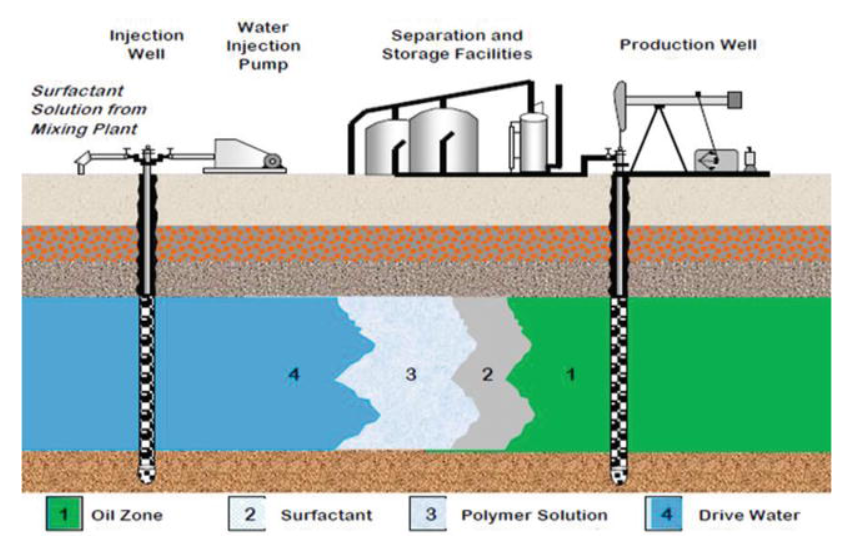
Surfactant flooding is the process of introducing one or more liquid chemicals and surfactants into the reservoir. This injection effectively alters the phase behaviour characteristics within the oil reservoir by reducing the interfacial tension (IFT) between the injected liquid and the trapped crude oil, thus mobilizing the trapped crude oil.
Surfactants play a critical role in reducing the IFT (interfacial tension) between oil and water. To enhance the properties of the surfactant solution, co-surfactants are introduced to the liquid surfactant solution. In this blended surfactant solution, the co-surfactant functions as a promoter or an active agent to create suitable conditions in terms of temperature, pressure, and salinity. However, significant surfactant losses can occur due to specific reservoir properties, such as adsorption to the rock and entrapment in the pore structure [5].
Surfactant systems typically include both surfactants and co-surfactants. However, practical challenges arise as chromatographic separation occurs in the reservoir, making the mixing of multiple components in the surfactant solution less effective. The primary objective of surfactant flooding optimization is to increase the amount of recovered oil while minimizing the associated chemical costs. Achieving a low IFT is crucial, but it may not always guarantee optimal oil recovery. To achieve successful and efficient oil recovery, it’s essential to consider optimal salinity in addition to low IFT [6].
Surfactants, which are polymeric molecules that reduce the IFT between the liquid surfactant solution and the remaining oil, act as surface-active agents in surfactant flooding. When surfactants are present in small quantities, they adsorb at a surface or at the fluid/fluid interface. The most common structural type of surfactants consists of a nonpolar hydrocarbon ‘tail’ and a polar or ionic component. Figure 2 provides a schematic diagram illustrating anionic, cationic, amphoteric, and non-ionic surfactants [7].
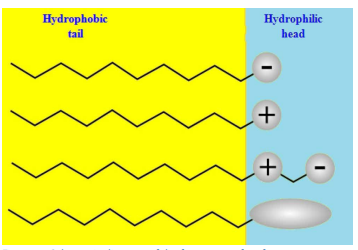
Surfactants, which are polymeric molecules that reduce the interfacial tension (IFT) between the liquid surfactant solution and the remaining oil, serve as surface-active agents in surfactant flooding. When surfactants are present in small quantities, they tend to adsorb to a surface or at the interface between different fluids. The most common structural type of surfactants consists of a nonpolar component known as a hydrocarbon ‘tail’ and a polar or ionic part.
Surfactants are typically categorized as anionic, cationic, non-ionic, or zwitterionic based on the ionic nature of their head group. Each type of surfactant has distinct characteristics depending on how the surfactant molecules ionize in aqueous solutions. Figure 3 provides a summary of the differences between anionic, cationic, and non-ionic surfactants [8].
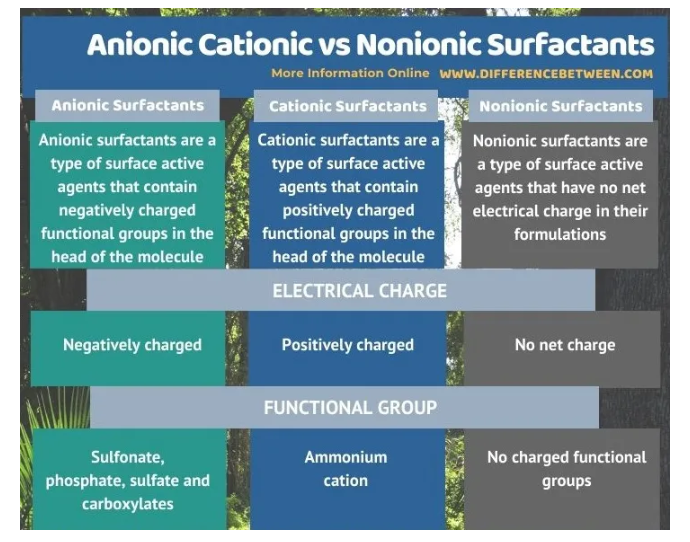
Sulfonated hydrocarbons like alcohol propoxylate sulfate or alcohol propoxylate sulfonate are commonly used surfactants in enhanced oil recovery (EOR). In the flooding process, surfactants and polymers are frequently combined to optimize surfactant flooding for a specific oil reservoir. Surfactants reduce the interfacial tension (IFT), while polymers enhance sweep efficiency. The determination of surfactant requirements can be challenging, and it is complicated to identify the most critical pathways. Reservoir conditions often involve high temperatures and pressures.
Anionic surfactants are characterized by their negatively charged head group. They are commonly used in applications such as detergents (e.g., alkyl benzene sulfonates), soaps (fatty acids), foaming agents (lauryl sulfate), and wetting agents, among other industrial uses (di-alkyl sulfosuccinate). In EOR, anionic surfactants are the most frequently employed type. They possess strong surfactant properties, including the ability to reduce IFT, form self-assembled structures, reasonable stability, low adsorption on reservoir rock, and cost-effective production. In water, anionic surfactants break down into an amphiphilic anion (negatively charged) and a cation (positively charged), typically an alkaline metal like sodium (Na+) or potassium (K+) [9].
Non-ionic surfactants lack a charged head group. They are also used in EOR, often as co-surfactants that complement the surfactant process. Their hydrophilic group does not dissociate or ionize in aqueous solutions. Examples of non-ionic surfactants include alcohols, phenols, ethers, esters, and amides. Research by Curbelo, et al. explored the relationship between non-ionic surfactants with varying degrees of ethoxylation and surfactant adsorption in porous media, such as sandstone.
Cationic surfactants feature a positively charged head group. In water, cationic surfactants break down into an amphiphilic cation and an anion, typically a halide (e.g., Br-, Cl-). Cationic surfactants undergo a high-pressure hydrogenation process during synthesis, which is often more expensive than the production of anionic surfactants. Consequently, cationic surfactants are less commonly used than anionic and non-ionic surfactants.
The Experimental Part
In this research, the Shallow Water Gunashli field has been chosen as the site for implementing surfactant flooding as an enhanced oil recovery (EOR) method. This approach was compared to conventional water injection. The reservoir model was specifically developed for the X horizon within the field, and it incorporates data from 142 active producing wells in this horizon. In this case, a five- spot water injection pattern is employed. The model includes comprehensive historical data, encompassing production, injection, pressure, perforation, and PVT (pressure, volume, and temperature) data. Initially, the model underwent a history matching process to align it with observed historical data. Subsequently, three wells were identified for surfactant flooding, namely Gun_042, Gun_081, and Gun_86. The implementation of surfactant injection from these wells began in July 2022.
It is important to note that the specific production rates would depend on the reservoir, well conditions, and the effectiveness of the surfactant flooding process. Typically, oil production increases initially with surfactant flooding as it enhances oil recovery. However, the rate of increase may slow down or plateau at higher concentrations. The specific data for different years and concentrations would need to be provided or calculated based on the reservoir characteristics and operational parameters.
Table 1 displays the annual oil production rates for the entire set of producing wells in horizon X under different concentrations of surfactant flooding. According to oil production predictions, by the end of the year 2034, the annual oil production rate is expected to reach 571.1 m³ from horizon X. The highest annual oil production rate is achieved with a surfactant concentration of 0.75 mM. Beyond the 0.75 mM surfactant concentration, increasing the surfactant concentration does not lead to a higher annual oil production rate. This suggests that the optimal concentration for surfactant flooding in this scenario is 0.75 mM.
| Years | Surfactant Concentration, (mM) | ||||
|---|---|---|---|---|---|
| base case | 0.25 | 0.5 | 0.75 | 0.8 | |
| Yearly OPR, 1000 m3 | Yearly OPR, 1000 m3 | Yearly OPR,1000 m3 | Yearly OPR,1000 m3 | Yearly OPR,1000 m3 | |
| 2022 | 0.7279 | 0.7282 | 0.7299 | 0.7236 | 0.7236 |
| 2023 | 0.7063 | 0.7088 | 0.714 | 0.7076 | 0.7076 |
| 2024 | 0.6896 | 0.6931 | 0.6996 | 0.6986 | 0.6986 |
| 2025 | 0.6704 | 0.674 | 0.6809 | 0.683 | 0.683 |
| 2026 | 0.6551 | 0.6591 | 0.6659 | 0.67 | 0.67 |
| 2027 | 0.6417 | 0.6457 | 0.6527 | 0.6582 | 0.6582 |
| 2028 | 0.6307 | 0.635 | 0.642 | 0.6487 | 0.6487 |
| 2029 | 0.6166 | 0.6209 | 0.6282 | 0.6359 | 0.6359 |
| 2030 | 0.6055 | 0.6099 | 0.6169 | 0.6252 | 0.6252 |
| 2031 | 0.5955 | 0.5995 | 0.6068 | 0.6153 | 0.6153 |
| 2032 | 0.589 | 0.5925 | 0.5987 | 0.6083 | 0.6083 |
| 2033 | 0.5792 | 0.5831 | 0.588 | 0.5981 | 0.5981 |
| 2034 | 0.5711 | 0.5752 | 0.5808 | 0.59 | 0.59 |
Table 1: The annual oil production rate varies depending on the concentration of surfactant flooding over the years.
The yearly oil production rate in different concentrations of surfactant flooding can vary based on the specific reservoir, well conditions, and the surfactant formulation used. Typically, surfactant flooding is employed in enhanced oil recovery (EOR) to reduce interfacial tension (IFT) between oil and water, making it easier to mobilize and produce trapped oil. The production rate may increase as surfactant concentration increases up to a certain optimal point. Beyond this point, increasing the surfactant concentration may not significantly impact oil production or may even lead to diminishing returns.
The specific data for yearly oil production rates at different surfactant concentrations would need to be obtained through reservoir modelling, laboratory experiments, or field trials tailored to the specific reservoir’s characteristics and the surfactant used. These experiments and simulations help determine the optimal surfactant concentration for maximizing oil recovery and improving production rates.
Figure 4 shows that, how the oil production rate will be increase as a result of surfactant flooding. In base case, yearly oil production rate for 2034 year will be 571.1 m3. But, by using surfactant with 0.75mM concentration, oil production rate will reach to the 590 m3. After 0.75 mM concentration, it will not increase oil production.
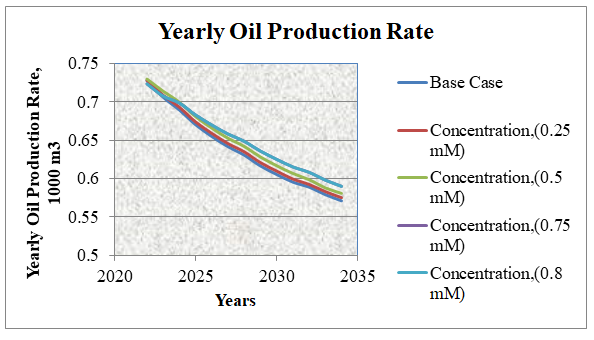
Figure 4: The yearly oil production rate in different concentrations of surfactant flooding. The total oil production over a year in different concentrations of surfactant flooding can vary significantly based on reservoir-specific conditions, the effectiveness of the surfactant formulation, and operational parameters. In surfactant flooding, the goal is to enhance oil recovery by reducing interfacial tension (IFT) between oil and water, making it easier to mobilize trapped oil.
To determine the total oil production in different surfactant concentrations over the year, reservoir engineers typically perform reservoir modelling and conduct laboratory experiments or field trials. These studies help establish the optimal surfactant concentration that maximizes oil recovery and, consequently, total oil production. The total production is calculated by considering the cumulative oil production from all producing wells over the year.
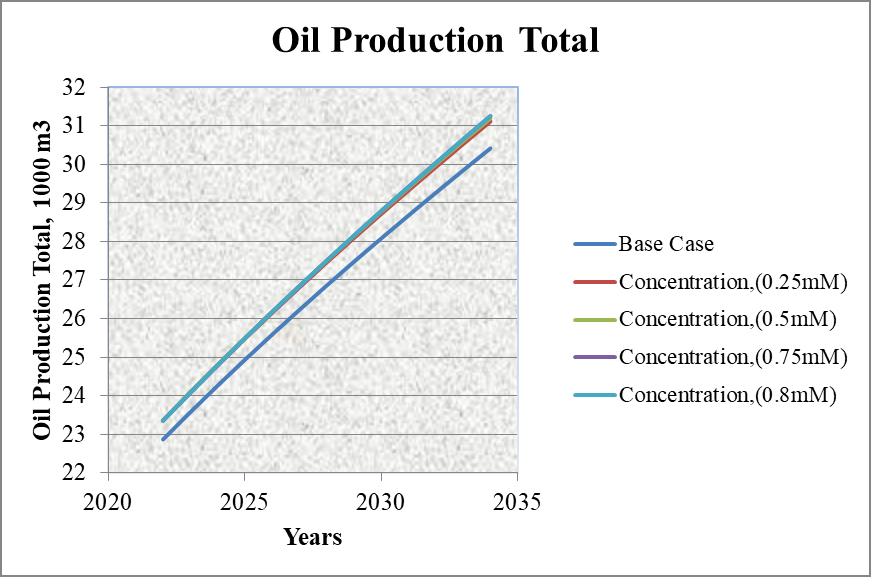
The specific data for total oil production at different surfactant concentrations would need to be obtained through these methods tailored to the unique characteristics of the reservoir and surfactant formulation used in the EOR project. Table 2 represents the increase of total oil production in different surfactant concentration in surfactant flooding in various years.
| Years | Surfactant Concentration, (mM) | ||||
|---|---|---|---|---|---|
| basic case | 0.25 | 0.5 | 0.75 | 0.8 | |
| OPT,1000 m3 | OPT,1000 m3 | OPT,1000 m3 | OPT,1000 m3 | OPT,1000 m3 | |
| 2022 | 22.865 | 23.3581317 | 23.3598674 | 23.3534351 | 23.3534351 |
| 2023 | 23.5713 | 24.0818165 | 24.0888614 | 24.0758947 | 24.0758947 |
| 2024 | 24.2609 | 24.7894716 | 24.803153 | 24.7891653 | 24.7891653 |
| 2025 | 24.9313 | 25.4776256 | 25.4983519 | 25.4865083 | 25.4865083 |
| 2026 | 25.5864 | 26.1505667 | 26.1782358 | 26.1705783 | 26.1705783 |
| 2027 | 26.2281 | 26.8098264 | 26.8446425 | 26.8426005 | 26.8426005 |
| 2028 | 26.8588 | 27.4581614 | 27.5001245 | 27.5049232 | 27.5049232 |
| 2029 | 27.4754 | 28.0921003 | 28.1415167 | 28.1541771 | 28.1541771 |
| 2030 | 28.0809 | 28.7148082 | 28.7713716 | 28.7925063 | 28.7925063 |
| 2031 | 28.6764 | 29.3268977 | 29.3909144 | 29.4207276 | 29.4207276 |
| 2032 | 29.2654 | 29.9318402 | 30.0021871 | 30.0418019 | 30.0418019 |
| 2033 | 29.8446 | 30.5271853 | 30.6025351 | 30.652462 | 30.652462 |
| 2034 | 30.4157 | 31.1144645 | 31.1955319 | 31.254852 | 31.254852 |
Table 2: The total oil production over a year in different concentrations of surfactant flooding.
Figure 5 illustrates how the total oil production increases because of surfactant flooding. In the base case, the total oil production rate for the year 2034 is projected to be 31,254.852 m³. However, when using surfactant with a concentration of 0.75 mM, the oil production rate is expected to reach 30,612 m³. In this scenario, the oil recovery factor is estimated to increase by approximately 2.76%. Additionally, the water cut in the base case for the year 2034 is projected to be 21,171.3 m³. However, in surfactant flooding with a 0.75 mM concentration, it is expected to be 21,840.26 m³ in the year 2034. It’s important to note that after reaching the 0.75 mM concentration, further increases in surfactant concentration do not lead to a significant increase in oil production.
Conclusion
The concentration of 0.75 mM for surfactant flooding is considered the optimal value under the testing conditions. This concentration led to a rapid increase in the recovery degree and a significant reduction in water content. As the concentration of surfactant increases, the recovery degree also increases, indicating a positive effect on oil recovery. Surfactant concentration is a critical factor in the effectiveness of surfactant flooding. However, it’s noteworthy that after reaching a concentration of 0.75 mM, further increases in surfactant concentration do not significantly impact the oil production rate. Therefore, 0.75 mM is deemed the optimum concentration for this case.
Surfactant flooding achieves its effectiveness by reducing the interfacial tension between the oil and water phases and by altering the wettability of the reservoir rock. This combination of effects helps mobilize the residual oil trapped in the reservoir, resulting in improved volumetric sweep efficiency and increased oil recovery.
References
-
Niu JG, Chen P, Shao ZB, Wang DM, Sun G, et al. (2006) Research and development of polymer enhanced oil recovery, In: Cao HQ (Ed.), Research and Development of Enhanced Oil Recovery in Daqing. Petroleum Industry Press, pp: 227-325.
-
Wang DM (2002) Development of new tertiary recovery theories and technologies to sustain Daqing oil production. PGODD 20(3): 1-7.
-
Sheng JJ (2013) Comparison of the effects of wettability alteration and IFT reduction on oil recovery in carbonate reservoirs. Asia Pac J Chem Eng 8(1): 154-161.
-
Sheng JJ (2011) Modern Chemical Enhanced Oil Recovery: Theory and Practice. Elsevier.
-
Eyvazov J, Guliyeva M (2023) Increase Oil Recovery in Different Surfactant Concentrations on the Basis of Increasing Well Drainage Area. Progress in Petrochemical Science 5(1): 463-467.
-
Stegemeier GL (1977) Mechanisms of entrapment and mobilization of oil in porous media, In: Shah DO, et al. (Eds.), Improved Oil Recovery by Surfactant and Polymer Flooding. Academic Press, New York, pp: 55- 91.
-
Sheng JJ (2013) Review of surfactant enhanced oil recovery in carbonate reservoirs. Adv Pet Explor Dev 6(1): 1e10.
-
Eyvazov J, Guliyeva M, Guliyev U (2022) How the Oil Recovery Factor Changes in Different Polymer Concentrations on in the Basis of Increasing Well Drainage Area. International Petroleum and Petrochemical Technology Conference, pp: 133-140.
-
Delshad M, Najafabadi NF, Anderson G, Pope GA, Sepehrnoori K (2009) Modelling wettability alteration by surfactants in naturally fractured reservoirs. SPEREE 12(3): 361-370.
- Nigeria’s Vulnerability in the Face of Global Energy Policy
- A Simulation Study of Investigation of Optimum Oil Production Performance by Applying Various Gas Injection Methods in Oil Reservoir
- Characterization of Permo-Triassic Reservoirs through Thermal Maturity Assessment of Westphalian Source Rocks in the Cheshire Basin
- Influence of Microwax on the Rheological and Thermal Behaviour of a Wax Crude Oil
- Real-Time Monitoring and Performance Optimization of Steam Injection in Heavy Oil Reservoirs Using Fiber Optic Sensing and Integrated Predictive Simulation Models
- Rapid On-Site Determination of the Total Petroleum Hydrocarbon Content of Soils by Handheld Fourier Transform Near-Infrared Spectroscopy: Development of a Global, Site- and Scanner- Independent Calibration Model