
Combinational CO2 and Polymer Injections for EOR and CO2 Storage in Depleted Reservoirs: A Mini Review on Laboratory, Simulation and Field Studies
Water-alternating-gas is commonly used in most of the existing enhanced oil recovery (EOR) projects in the world to regulate gas mobility and reduce fingering problems. Unfortunately, the expected recovery factor from most of the fields could not be attained with such EOR method. Development strategies of mature oil fields during the energy transition period may therefore involve the combination of polymer and CO2 injections to achieve incremental oil recovery and at the same time provide longterm geological storage solution for carbon. This paper therefore presents overview of the processes of polymer and CO2 floodings, and then highlights the overall benefits to be derived from the combination of CO2 and polymer flooding techniques in depleted hydrocarbon reservoirs, especially oil reservoirs. Reviews on studies related to the combinational CO2 and polymer injections are then carried out. Highlights of areas of the combinational CO2 and polymer injections needing more attention are also mentioned.
Introduction
The recovery rate of mature oil fields at the end of both the primary and secondary recovery phases are generally in the range of 20% to 40% of the original oil in place (OOIP). Although in some cases, recoveries could be lower or higher [1]. Thomas A, et al. [2] reported a recovery rate of about 15% to 35% on average of the oil in place. Mature fields, also known as brownfields, are present all over the global oil regions. From the study of Godec M, et al. [3], the largest 54 oil basins of the world show an estimated 4.622 trillion barrels of original oil in place (OOIP) in already discovered oil fields (Figure 1), about 0.687 trillion barrels (as of 2000) have been produced and a reported 0.845 trillion barrels of proved reserves, giving an overall recovery efficiency of 33%. Hence, about 3.090 trillion barrels of oil is remaining for enhanced oil recovery (EOR).
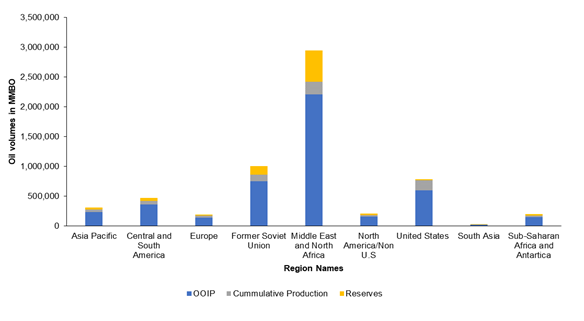
Some of the most important brownfields [4, 5, 6], are; Daqing field in China, Minas field in Indonesia, Samotlor and Romashikino fields in Russia, Forties filed in UK, Satfjord in Norway, Prudhoe Bay in Alaska, USA, Cantarell in Mexico, Roncador in Brazil, Bolivar Coastal in Venezuela, Cupiagua- Cuisiana in Colombia, Ghawar field in Saudi Arabia and Agbami field in Nigeria. Most of them have been under production for at least three decades and have already reached their peaks of production in the last decade [6]. Many methods of enhanced oil recovery techniques, most especially CO2 injection, have been applied successfully in some of the mature fields around the world. A large volume of oil is still left behind in a reservoir, as recovery is typically 5 - 15% of the OOIP, with the current “best practices” of CO2-EOR technology. Remson D [7] attributed it to the following reasons: insufficient injection of CO2, poor sweep efficiency, poor displacement efficiency, lack of CO2 contact with remaining oil resources, and inadequate management control. So, summary of options that can boost the recoveries from current “best practices” technologies will include: increasing CO2 injection volumes, optimizing flood design and well placement, improving the mobility ratio by increasing the viscosity of water by use of polymers, and extending miscibility by reducing the miscibility pressure using liquefied petroleum gas (LPG).
Unfortunately, there is little or no strategic combination of CO2 and polymer injections in these fields available in open literature. This work therefore looks briefly at the processes of polymer and CO2 floodings, and then reviews studies related to the combinational CO2 and polymer injections, available in open literatures. Areas needing more attention are also highlighted.
Overview on the Basics of CO2-EOR
Various gases, including natural gas, flue gas, nitrogen and CO2 in supercritical sate, have been used for EOR, with varying success rates and economic benefits [8]. When temperature and pressure exceed the critical value (31.16 OC; 1,070.6 psia), the CO2 viscosity, (0.05-0.08 cP), and interface tension are similar to those of gas, but the density is similar to that of liquid, which is helpful for effective oil flooding. Owing to its special properties, CO2 improves oil recovery by lowering interfacial tension, swelling the oil, reducing oil viscosity, and by mobilizing the lighter components of the oil. Injection of CO2 into hydrocarbon reservoirs can provide large underground storage for CO2 while enhancing hydrocarbon recovery thereby reducing the total expenses [9]. However, not all oil reservoirs are suitable for CO2- EOR for technical and economic reasons, Shaw J, et al. [10] suggested that a “YES/NO” screening method could be used for the selection of potential pools for CO2 flooding that meet certain technical criteria for achieving miscibility. The important technical criteria are:
- The reservoir pressure at the start of a CO2 flood should be at least 200 psi above the minimum miscibility pressure (MMP) to achieve miscibility between CO2 and reservoir oil, as reported by Rivas O, et al. [11]. Estimates of CO2-crude oil minimum miscibility pressure (MMP) can be found in the report of the National Petroleum Council [12].
- Oil gravity is generally recommended to be greater than 27 OAPI but less than 48 OAPI, because very light oil is not conducive to the development of multi-contact miscibility for miscible flooding.
- The fraction of remaining oil before CO2 flooding should be greater than 0.25 to ensure an economic outcome for CO2-EOR.
Some of the preliminary issues that need to be addressed, as highlighted by Shaw and Bachu [10], for EOR technology include: 1) screening for EOR suitability; 2) technical ranking of suitable reservoirs; and, 3) oil recovery and CO2-
sequestration capacity predictions. Other economic criteria can be considered after this preliminary technical evaluation.
CO2-EOR Processes
Depending on the reservoir pressure, temperature, and oil properties, the injected CO2 may become miscible or remain immiscible with the reservoir oil. The reservoir pressure is compared with the minimum miscibility pressure (MMP) to know if there is miscibility between CO2 and reservoir oil. When reservoir pressure is greater than the MMP (the pressure at which more than 80 percent of oil-in-place (OIP) is recovered at CO2 breakthrough, according to Holm LW, et al. [13]), miscibility is attained leading to multiple-contact or dynamic miscibility with time as displacement occurs. This will cause oil swelling and viscosity reduction thereby improving sweep efficiency and facilitating additional oil recovery [14]. However, When the reservoir pressure is below the MMP or the reservoir oil composition is not favorable, the CO2 and oil will be immiscible.
Note that; three types of hydrocarbon miscible mechanisms exist: (1) first contact, CO2 are not miscible on first contact, but they do develop miscibility on multiple contacts, known as dynamic miscibility, resulting in much improved oil recovery; (2) vaporizing gas drive, also known as high-pressure gas drive, this process achieves dynamic miscibility by in situ vaporization of the intermediate- molecular-weight hydrocarbons from the reservoir oil into the injected gas or CO2; and (3) the condensing gas drive, sometimes called enriched gas drive [8], this process achieves dynamic miscibility by in situ transfer of intermediate- molecular-weight hydrocarbons (or CO2 in case of CO2-EOR) into the reservoir oil.
Overview on the Basics of Polymer EOR
Recently, there are increasing interests in enhanced oil recovery (CEOR) with chemical application, especially polymer flooding, either alone or in combination with other chemical compounds to improve their compatibility and effectiveness in the reservoir [15]. Some of these other chemical compounds are; surfactant and alkaline-surfactant. Concentration and molecular weight of polymer affect its viscosity. Table 1 gives some examples of commercial polymer products that can be used in oilfields.
| Product Form | Polymer Type | Monomer | Commercial Product Examples | Comments |
|---|---|---|---|---|
| Powder | Copolymer | Acrylamide - Sodium acrylate | Flopaam 3630S | Reservoir temperature less than 80oC, medium hardness |
| Homopolymer post hydrolysed | Acrylamide | Flopaam 6030S | Reservoir temperature less than 75oC, low hardness | |
| Copolymer | Acrylamide - ATBS | Flopaam AN125SH | Reservoir temperature less than 95oC, all salinities | |
| Terpolymers | Acrylamide - Sodium | Flopaam 5205SH | Reservoir temperature less than 90oC, all salinities | |
| Acrylate - ATBS | Flopaam 5115SH | |||
| Associative polymers | Acrylamide - Sodium | Superpusher C319 | High resistance factor in reservoir | |
| Acrylate - Hydrophobic monomer | Medium hardness | |||
| Terpolymers | Acrylamide - ATBS- NVP | Flopaam SAV225 | Reservoir temperature less than 120oC, all salinities | |
| Liquid O/W Emulsion | Copolymers | Acrylamide - Sodium acrylate | Flopaam EM533 | Reservoir temperature less than 80oC, medium hardness |
Table 1: Commercial polymer products for various field conditions [2].
Field practice has shown that polymer flooding can increase recovery of 5-30% of OOIP, with decreased water production and increased oil production; in the range of 0.7 to 1.75 lb of polymer per bbl of incremental oil production [16]. Many examples of technically successful polymer field projects are reported in some literatures. Some field cases, reported by Sheng J [17], are; the Xiaermen field and the Daqing field in China, the East Bodo reservoir in Canada, the Marmul field in Oman, and the Vacuum field in New Mexico. From field applications experiences reported in Gao P, et al. [18], polymer flood is recommended for oil viscosity less than 100 cP under reservoir temperature in vertical wells, and sandstone reservoir with oil saturation higher than 30%, reservoir permeability greater than 20 mD, net thickness more than 3 m (10 ft), and reservoir temperature less than 90 oC or 200 oF. However, with horizontal wells, polymer flooding can be recommended for oil viscosity higher than 100 cP.
The selection of reservoirs which have poor waterflooding sweep efficiency due to high oil viscosity and/ or large-scale heterogeneity is one of the screening rules for polymer flooding. In other words, reservoirs with poor volumetric efficiency [19], but respect the polymer tolerance limits (temperature, salinity). Recent limits of some important parameters for polymer flooding implementation are: reservoir temperature, less than 130 oC; reservoir permeability, greater than 40 mD; salinity, less than 250,000 total dissolved solids (TDS); oil viscosity, greater than 2 mPa.s but less than 10,000 mPa.s [20, 21].
Polymer EOR Processes
Viscosification of the displacing fluid resulting from the addition of polymer, which is favorable for hydrocarbon recovery, is the primary recovery mechanism. The addition of polymer to the displacing fluid increases its viscosity, resulting in a decreased mobility ratio, as defined in Equation 1:
µ λ µ λ = = (1)
o k o o w w kw M
where; λ, μ, and k are the mobility, viscosity and effective permeability, respectively. The subscripts w and o represent water and oil, respectively.
The relative permeability of water in the reservoir reduced, then increases oil recovery due to increase of fractional flow. If the mobility ratio is one or slightly less, the displacement of the oil by the water will be efficient and the water will not finger through the oil leaving behind regions of unswept oil. Another recovery mechanism according to Wang D, et al. [22] is viscoelasticity, which is associated with the use of high Molecular weight (Mw) or associative polymers, but there is argument whether it applies to real reservoir conditions or not.
Polymer-Assisted CO2 Flooding
There are direct CO2 thickeners - polymers for EOR applications [24, 25, 26]. These polymers are soluble in the injected CO2 with resulting viscosity similar to (or slightly larger than) that of the displaced oil and also thermodynamically stable. Varying the concentration of the added thickeners regulates the CO2 viscosity [27]. Oligomers, which have low molecular weight, are possible thickeners of CO2 for EOR processes [28, 29, 30] and can be used to address solubility reduction as a result of increment in molecular weight of polymers [31].
There are several studies performed [32, 33, 34, 35, 36] showing the benefits of polymer-assisted CO2 injection in core flooding experiments. The benefits reported generally include: improvement in the density and viscosity of CO2 and super-critical CO2 (scCO2), acceleration and increment of oil recovery, and delay in CO2 breakthrough. However, Zaberi HA, et al. [36] reported a noticeable increase in the pressure drop with the use of polyfluoroacrylate (PFA), emanating from permeability reduction due to the adsorption of PFA on the rock surface.
Other researchers who have conducted studies on synthesised polymers for CO2 viscosity enhancement and CO2-mobility control include: Huang Z, et al. [37], Li Q, et al. [38], Kilic S, et al. [39].
Polymer-Alternating CO2 Gas (PAG) Flooding
Reviews of studies related to the combinational CO2 and polymer injections, especially the polymer-alternating gas (PAG) process, show more core flooding experiments and reservoir simulations have been carried out. Abbas AH, et al. [40] carried out a comparative numerical study considering several EOR, such as water flooding, CO2 flooding, water alternating gas, polymer flooding and polymer alternating gas, in homogenous high permeability reservoir. The designed flooding pattern used was a single producer- single injection scheme. Based on the simulation results, PAG flooding had the highest recovery factor of 56% with incremental recovery of 16%. Also, controlled water cut was achieved with the polymer alternating gas flooding scheme.
In 2018, Yang Y, et al. [41] examined the effectiveness of polymer-alternating-gas (PAG) process to recover viscous oil from highly heterogeneous reservoirs in Liaohe Oilfield in China experiencing low oil recovery. A heterogeneous reservoir model was built using a field case geological model from Liaohe Oilfield in China. Their simulation studies involve five different flooding development methods. Nine injectors and six producers, in a somewhat direct line (but diagonally placed) well pattern, were used. Peng-Robinson equation of state (EOS) was used for fluid modeling, rock adsorption and polymer viscosity (which are two important parameters for polymer flooding) were considered. The results were compared, with respect to recovery factor, oil rate, GOR, saturation profile, etc. Simulation results showed that PAG method increase oil recovery over 10% compared with other EOR methods and PAG was economically successful based on some assumptions. Li W, et al. [42] analyzed the feasibility of PAG through simulation. Models considering both miscible and polymer flooding processes were built to study the performance of PAG. A reservoir model from a typical section of the North Burbank Unit (NBU) was used to compare the performance between PAG, WAG, and polymer flooding. One vertical injector and one producer were diagonally located in the model. Sensitivity analyses of polymer adsorption and concentration were also studied. The feasibility of PAG in reservoirs with different permeabilities, different Dykstra- Parsons permeability variation coefficients (VDPs), and different fluids were also studied. Their study demonstrated that PAG can significantly improve recovery for immiscible/ miscible flooding in homogeneous or heterogeneous reservoirs. Song Z, et al. [26] carried out core experiments using magnetic resonance imaging (MRI) technique to study the fundamental characteristics (such as the piston- like displacement front, the phenomena of channeling and fingering, homogenization of the oil saturation distribution with CO2 injection, and the distribution of oil in porous media) of the combination of polymer and CO2 flooding processes. Their results showed that mobility ratio was improved with increasing concentration and viscosity of polymer solution. Supercritical CO2 displacement enhanced oil recovery and reduced consumption of polymer solution compared with alone polymer flooding. In summary, their studies indicated that the combination of polymer and CO2 flooding was viable and highly efficient.
Zhang Y, et al. [25] carried out experiment of coupled CO2 and polymer injection for heavy oil reservoirs. The oil recovery performance investigated in a laboratory scale linear coreflood tests, among three EOR modes - water- alternating-gas (CO2 WAG), polymer-alone flood and, showed better efficiency and higher recovery for the coupled CO2 and polymer injection.
The Bati Raman heavy oil (10 - 15oAPI) field in Turkey,
with primary recovery of 1.5% and CO2-EOR of about 5%, is one of the published examples of oil fields that has experienced polymer injection to improve the sweep efficiency of CO2. Increased production was observed in 16 production wells after 3 months of injection. The total cost of the polymer treatment was USD 445,000. The payout time was 1 year [43]. Other published reservoir simulation studies [44, 45, 46] involving coupled CO2 and polymer injection in both synthetic and real reservoir models with conventional well patterns generally indicate increase in oil recovery.
Areas needing more Attention: Well Pattern and Injection Sequence
Virtually all of the researches on combinational CO2 and polymer floodings available in open literature are either polymer-assisted CO2 flooding or polymer-alternating CO2 gas (PAG) flooding. For this reason, conventional flood patterns have been widely used. The concurrent (or simultaneous) polymer and CO2 flooding has yet to be investigated. If such flood sequence is considered, then flood patterns different, but similar to, from the traditional well pattern configuration has to be applied.
Proposed Flood Patterns for Concurrent CO2- EOR and Polymer Injections
In flooding projects, it is important to select the proper pattern that will provide the injection fluid with the maximum possible contact with the reservoir oil. Flood pattern design development of flooding projects for optimal recovery efficiency relies on the reservoir geology and its properties, hydrocarbon properties, waterflooding sequence, and well-pattern configuration. Injection pattern (or configuration) improves sweep efficiency. Analyses of reservoir performances are mostly through reservoir simulation approach or by the remaining oil compliant mapping (ROCM) process [47].
Verma MK [48] reported that a normal five-spot - one production well at the center and four injection wells at the corners, or an inverted five-spot (four production wells, one injection well) is one of the commonly used patterns for CO2- EOR or polymer flooding. In some cases, seven- or nine-spot patterns. The well pattern could even be a line drive, where the injection wells are opposite the production wells, if the permeability distribution and other geologic features favor it.
For a strategic combinational CO2-EOR and polymer flooding - with the right polymer and proper concentration, the following suggested well patterns with the following nomenclatures; 1-1-1, 4-2-1, and 8-4-1, could improve sweep efficiency and also result in optimal recovery efficiency.
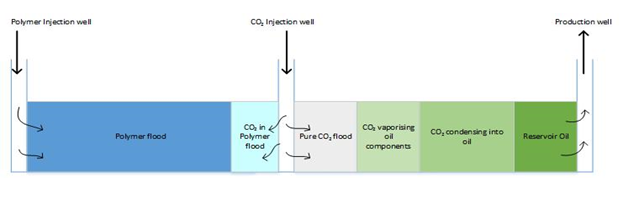
The 1-1-1 Well Pattern: This is similar to the direct line drive. However, in this case the lines of the same type of injections are in the same file, likewise that of the production. The 1-1- 1 well pattern typically means; one polymer injector-one CO2 injector- one producer. Existing direct line (or staggered line) well pattern in an oil field can easily be converted into the 1-1-1 well pattern scenario. Figure 2 presents a sketch of the 1-1-1 well pattern showing possible transition zone between the injectors and the producer.
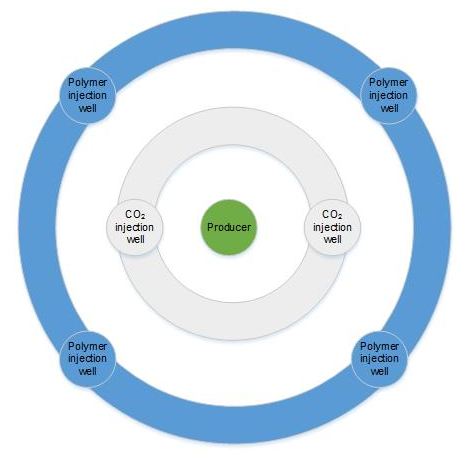
The 4-2-1 Well Pattern: The 4-2-1 well pattern typically means a combination of; four polymer injectors, two CO2 injectors and one producer, as shown in Figure 3. The regular five-spot can be transformed into the 4-2-1 well pattern with an infill drilling of two CO2 injection wells in the spacing between the production well and the polymer injection well.
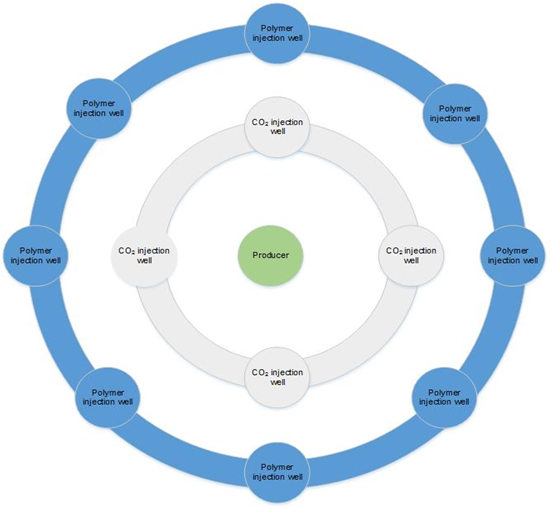
The 8-4-1 Well Pattern: The 8-4-1 well pattern typically means a combination of; eight polymer injectors, four CO2 injectors and one producer, as shown in Figure 4. The regular nine-spot existing in an oil field can be changed into the 8-4-1 well pattern with an infill drilling of four CO2 injection wells in the spacing between the production well and the polymer injection well.
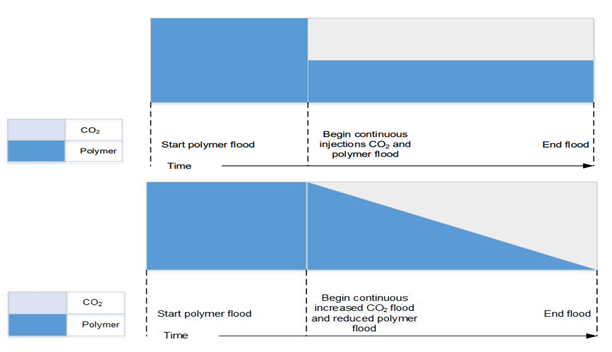
Note: The recovery method that may be suitable for the combinational CO2-EOR and polymer flooding could be; firstly, to commence with polymer injection until at least 30% reservoir pore volumes have been affected, and then the continuous injections of both polymer and CO2. Another recovery method that could be efficient in a combinational CO2-EOR and Polymer flooding is the gradual tapering (reduction) of polymer injection at the commencement of CO2 injection and the continuous increase of the injected CO2 (Figure 5).
Conclusion and Future Work
Many mature oil fields around the world have either CO2 or polymer injections as their enhanced oil recovery methods. Combinational CO2 and polymer injections can be the most viable development strategy for a good number of mature oil fields during the energy transition period because of improvement in the sweep efficiency and mobility, and at the same time providing long-term geological storage solution for carbon. Concurrent CO2 and Polymer injections has not been studied. For a strategic combinational CO2 and polymer flooding, new flood pattern configurations that may be suitable for the injections of both CO2 and polymer and as well as injection sequences that could improve sweep efficiency and also result in optimal recovery efficiency of the flooding process have been suggested. Immediate future work will concern numerical simulation of the combinational CO2 and polymer injections for oil in a synthetic reservoir model. Its performances on oil recovery will be compared with other EOR methods.
Declarations
Funding
This work received no specific grant from any funding agency in the public, commercial, or non-profit organisations.
Conflict of Interest
The authors wish to declare that they have no known competing financial interests or personal relationships that could have appeared to influence the work reported in this paper.
References
-
Stalkup FI (1984) Miscible displacement. Society of Petroleum Engineers of AIME, SPE Monograph, Dallas, New York, USA, pp: 204.
-
Thomas A, Gaillard N, Favero C (2012) Some key features to consider when studying acrylamide-based polymers for chemical enhanced oil recovery. Oil & gas science and technology-Revue d’IFP Energies nouvelles 67(6): 887- 902.
-
Godec M, Kuuskraa V, Leeuwen TV, Melzer LS, Wildgust N (2011) CO2 storage in depleted oil fields: the worldwide potential for carbon dioxide enhanced oil recovery. Energy Procedia 4(48): 2162-2169.
-
Dirceu B, Odair J (2010) Marlin field: An optimization study on a mature field. Society of Petroleum Engineers, pp: 1-9.
-
Badadagli T (2005) Mature field development - A Review. SPE Europec/EAGE Annual Conference, Madrid, Spain.
-
Robelius F (2007) Giant Oil Fields - The Highway to Oil: Giant Oil Field and Their Importance for Future Oil Production. Uppsala University, Sweden.
-
Remson D (2010) Storing CO2 and producing domestic crude oil with next generation CO2 -EOR technology. National Energy Technology Laboratory, pp: 59.
-
Stalkup FI (1983) Status of miscible displacement. J Pet Technol 35(4): 815-826.
-
Vega B, Kovscek AR (2010) Carbon dioxide (CO2) sequestration in oil and gas reservoirs and use for enhanced oil recovery (EOR). Dev Innov Carbon Dioxide 2: 104-126.
-
Shaw J, Bachu S (2002) Screening, evaluation and ranking of oil reservoirs suitable for CO2-flood EOR and carbon dioxide sequestration. J Can Pet Technol 41(9): 51-61.
-
Rivas O, Embid S, Bolivar F (1994) Ranking reservoirs for carbon dioxide flooding processes. SPE Advanced Technology Series 2: 95-103.
-
(1976) Enhanced oil recovery-An Analysis of the Potential for Enhanced Oil Recovery from Known Fields in the United States. National Petroleum Council, pp: 231.
-
Holm LW, Josendal VA (1974) Mechanism of oil displacement by carbon dioxide. Journal of Petroleum Technology 26(12): 1427-1438.
-
Martin FD, Taber JJ (1992) Carbon dioxide flooding. Journal of Petroleum Technology 44(4): 396-400.
-
Morel D, Vert M, Jouenne S, Gauchet R, Bouger Y (2010) First polymer injection in deep offshore field angola: recent advances on Dalia/Camelia field case. SPE Annual Technical Conference and Exhibition, Italy.
-
Pope GA (2007) Overview of Chemical EOR, Casper EOR Workshop. The University of Texas, Austin.
-
Sheng JJ (2013) Polymer Flooding - Fundamentals and Field Cases. Enhanced Oil Recovery Field Case Studies, Elsevier, pp: 63-82.
-
Gao P, Towler B (2011) Investigation of polymer and surfactant polymer injections in South Slattery Minnelusa reservoir Wyoming. J Pet Explor Prod Technol 1(1): 23-31.
-
Willhite GP, Green DW (1998) Enhanced Oil Recovery, Henry L Doherty Memorial Fund of AIME Society of Petroleum Engineers, Richardson, TX, USA.
-
Vermolen ECM, Haasterecht MJV, Masalmeh SK, Faber MJ, Boersma DM, et al. (2011) Pushing the envelope for polymer flooding towards high-temperature and high-salinity reservoirs with polyacrylamide based ter-polymers. SPE Middle East Oil and Gas Show and Conference, Bahrain, SPE-141497-MS.
-
Kulawardana EU, Koh H, Kim DH, Liyanage PJ, Upamali KA, et al. (2012) Rheology and transport of improved eor polymers under harsh reservoir conditions. SPE Improved Oil Recovery Symposium, USA, pp: 14-18.
-
Wang D, Dong H, Lv C, Fu X, Nie J (2009) Review of practical experience of polymer flooding at Daqing. SPE Reserv Eval Eng 12(3): 470-476.
-
Christensen JR, Stenby EH, Skauge A (2001) Review of WAG field experience. SPE Res Eval & Eng 4(2): 97-106.
-
Zhang S, She Y, Gu Y (2011) Evaluation of polymers as direct thickeners for CO2 enhanced oil recovery. J Chem Eng Data 56(4): 1069-1079.
-
Zhang Y, Huang SS, Luo P (2010) Coupling immiscible CO2 technology and polymer injection to maximize EOR performance for heavy oils. J Can Pet Technol 49(5): 25- 33.
-
Song Z, Li Z, Wei M, Lai F, Bai B (2014) Sensitivity analysis of water-alternating-CO2 flooding for enhanced oil recovery in high water cut oil reservoirs. Computers & Fluids 99: 93-103.
-
Carpenter C (2014) Development of small-molecule CO2 thickeners. J Pet Technol 66(7): 145-147.
-
O’Brien MJ, Perry RJ, Doherty MD, Lee JJ, Dhuwe A, et al. (2016) Anthraquinone siloxanes as thickening agents for supercritical CO2. Energy Fuels 30(7): 5990-5998.
-
Myers MB, Dehghani AM, Wood CD, Valdez R, Jin F, et al. (2019) Effects of oligomers dissolved in CO2 or associated gas on IFT and miscibility pressure with a gas-light crude oil system. J Petrol Sci Eng 181: 106210.
-
Nazari N, Hosseini H, Tsau JS, Shafer-Peltier K, Marshall C, et al. (2020) Development of highly stable lamella using polyelectrolyte complex nanoparticles: an environmentally friendly sc CO2 foam injection method for CO2 utilization using EOR. Fuel 261: 116360.
-
Dandge DK, Heller JP (1987) Polymers for mobility control in CO2 floods. SPE International Symposium on Oilfield Chemistry, Texas, USA.
-
Bae JH, Irani CA (1993) A laboratory investigation of viscosified CO2 process. SPE Adv Technol Ser 1(1): 166- 171.
-
Xiong Y, Kiran E (1995) Miscibility density and viscosity of poly (dimethylsiloxane) in supercritical carbon dioxide. Polymer 36(25): 4817-4826.
-
Xu J, Wlaschin A, Enick RM (2003) Thickening carbon dioxide with the fluoroacrylate-styrene copolymer. SPE J 8(2): 85-91.
-
Haghtalab A, Hasannataj H, Panah HS (2018) Prediction of minimum miscibility pressure of pure CO2, carbon dioxide gas mixtures and polymer-supercritical CO2 in oil using modified quadrupole Cubic Plus Association Equation of State (mqCPA EoS). Fluid Phase Equil 478: 114-128.
-
Zaberi HA, Lee JJ, Enick RM, Beckman EJ, Cummings SD, et al. (2020) An experimental feasibility study on the use of CO2-soluble polyfluoroacrylates for CO2 mobility and conformance control applications. J Petrol Sci Eng 184: 106556.
-
Huang Z, Shi C, Xu J, Kilic S, Enick RM, et al. (2000) Enhancement of the viscosity of carbon dioxide using styrene/fluoroacrylate copolymers. Macromolecules 33(15): 5437-5442.
-
Li Q, Wang Y, Wang F, San J, Li Q, et al. (2018) Synthetic process on hydroxylcontaining polydimethylsiloxane as a thickener in CO2 fracturing and thickening performance test. Energy Sources Part A: Recover Util Environ Eff 40(9): 1137-1143.
-
Kilic S, Enick RM, Beckman EJ (2019) Fluoroacrylate- aromatic acrylate copolymers for viscosity enhancement of carbon dioxide. J Supercrit Fluids 146: 38-46.
-
Abbas AH, Abdullah DS, Jaafar MZ, Sulaiman WRW, Agi A (2019) Comperative numerical study for polymer alternating gas (PAG) flooding in high permeability condition. SN Appl Sci 2: 938.
-
Yang Y, Li W, Zhou T, Dong Z (2018) Using polymer alternating gas (PAG) to enhance oil recovery in heavy oil. IOP Conf Ser: Earth Environ Sci 113(1): 012182.
-
Li W, Schechter DS (2014) Using polymers to improve CO2 flooding in the north burbank unit. Canadian Energy Tech & In 2(1).
-
Topguder N (2010) A review on utilization of crosslinked polymer gels for improving heavy oil recovery in Turkey. SPE/EUROPEC/EAGE annual conference, Spain, SPE- 131267-MS.
-
Majidaie S, Khanifar A, Onur M (2012) A simulation study of chemically enhanced water alternating gas (CWAG) injection. SPE EOR Conference at Oil and Gas West Asia, Oman, SPE-154152-MS.
-
Moon SJ, Jinhyung C, Jinsuk C, Lee JH, Lee KS (2014) Compositional simulation on the flow of polymeric solution alternating CO2 through heavy oil reservoir. Advances in Mechanical Engineering 6: 1-9.
-
Kong X, Delshad M, Wheeler MF (2015) A numerical study of benefits of adding polymer to wag processes for a pilot case. SPE Enhanced Oil Recovery Symposium, USA, SPE-173230-MS.
-
Alessio L, Moradi B, Kuzmichev D, Rina B, Samakoush SM, et al. (2017) Locating the remaining oil in mature fields. SPE Oil and Gas India Conference and Exhibition held in Mumbai, India, SPE-185417-MS.
-
Verma MK (2015) Fundamentals of carbon dioxide- enhanced oil recovery (CO2 -EOR)-A supporting document of the assessment methodology for hydrocarbon recovery using CO2-EOR associated with carbon sequestration. US Geological Survey Open-File, pp: 1-19.
- Nigeria’s Vulnerability in the Face of Global Energy Policy
- A Simulation Study of Investigation of Optimum Oil Production Performance by Applying Various Gas Injection Methods in Oil Reservoir
- Characterization of Permo-Triassic Reservoirs through Thermal Maturity Assessment of Westphalian Source Rocks in the Cheshire Basin
- Influence of Microwax on the Rheological and Thermal Behaviour of a Wax Crude Oil
- Real-Time Monitoring and Performance Optimization of Steam Injection in Heavy Oil Reservoirs Using Fiber Optic Sensing and Integrated Predictive Simulation Models
- Rapid On-Site Determination of the Total Petroleum Hydrocarbon Content of Soils by Handheld Fourier Transform Near-Infrared Spectroscopy: Development of a Global, Site- and Scanner- Independent Calibration Model