
An Application of Polymer Nanocomposites Based On Carboxymethylcellulose along with Aluminium (Al) and Copper (Cu) Nanoparticles for Increasing Oil Production
As an agent for displacing residual and hard-to-recover oil reserves, polymer nanocomposites based on sodium salts of carboxymethylcellulose (CMC) and aluminium (Al) and copper (Cu) nanoparticles were investigated. It has been shown that polymer nanocomposites are more effective as oil displacement agents than the sodium salt of carboxymethylcellulose itself. Increasing the viscosity of an oil displacement solution can be achieved by varying the concentrations of CMC and nanoparticles. This study thoroughly examined the dynamic viscosities of carboxymethylcellulose (CMC) and polymer nanocomposites that contain CMC and metal nanoparticles (Al and Cu) across various concentrations. The results obtained are robust and reliable. It has been shown that, among polymer nanocomposites containing Al nanoparticles, there is a higher dynamic viscosity compared to its Cu nanoparticle counterpart at equivalent concentrations. This work proposes a simulation reservoir model to enhance oil recovery from hard-to-recovery reserves. Through this reservoir model simulation, the oil recovery factor was calculated using filler sand and oil extracted from a hydrocarbon field. The experimental data revealed the most effective concentration of CMC and nanoparticles for oil displacement. The results suggest that polymer nano composites composed of different metal nano powders have varying impacts on oil displacement efficiency. In this experiment, a composition consisting of Al nanoparticles with a size range of 50-70 manometers (nm) proved to be more successful as an oil displacement agent than a polymer nanocomposite made of Cu nanoparticles and CMC. At these concentrations and combinations, the highest oil recovery factors were achieved.
Introduction
The modern approach to the development of oil fields requires the use of effective technologies that increase the degree of oil recovery at minimal cost. Today, oil companies have various methods for increasing the oil recovery factor (RF), which are used depending on the given conditions [1, 2, 3, 4]. One of these methods that has found wide application is polymer flooding - a technology for increasing oil recovery by increasing the sweep ratio of the formation by displacement and reducing the residual oil saturation in the washed zone by reducing the ratio of the mobility of oil and the displacing agent in the formation [5, 6, 7, 8]. There are many water-soluble polymers used as oil displacement agents, but sodium salt of carboxymethylcellulose (CMC) is one of the most widely used [9, 10, 11, 12]. The relatively low consumption of the reagent, the Possibility of use for the production of high-viscosity oils at various stages of field development with uneven permeability, the different reservoir structure and properties of water-soluble polymers, and their other positive characteristics, water-soluble polymers were widely used in oil production [13, 14, 15, 16]. However, polymer flooding, like any technology, has negative aspects, such as the dependence of polymer stability on temperature and the degree of salinity of formation waters [17, 18, 19, 20]. These disadvantages can be eliminated by modifying and stabilizing the polymers used. In the presented work, to improve the properties of water-soluble CMC polymers, the authors used Aluminium (Al) and copper (Cu) nanoparticles (size 50–70 nm).
The oil industry has made extensive use of nanotechnologies [21, 22, 23, 24], as they offer novel physicochemical traits and improved chemical resistance by utilizing polymer nanocomposites composed of different metals [25, 26]. To study the possible oil displacement effect of a polymer nanocomposite based on sodium salt of carboxymethylcellulose (Na-CMC) and nanoparticles (Al and Cu), the present article has examined different solutions of the polymer nanocomposites. Utilizing a reservoir model simulation that combines various nanomaterials is a highly effective method to confidently enhance oil recovery while minimizing the drawbacks of using polymers, all at an affordable cost.
**Materials and Methods**
The oil used in the experiments has been taken from one of the Russian hydrocarbon fields. The water-soluble polymer CMC was used in the experiments. Aqueous solutions of polymers were prepared using distilled water at room temperature. A magnetic stirrer was used to homogenize the solutions after they had been left for three days to swell completely.
The copper and aluminium nanopowders used in this study were manufactured by Advanced Powder Technologies LLC (Tomsk, Russia) [27, 28, 29, 30]. The viscosity of aqueous solutions of polymers was determined using a Reoest-2 rheometer [31, 32, 33, 34].
The installation for determining the oil-displacing ability of prepared compositions consists of glass tubes 70 cm long and 30 mm in diameter, filled 3/4 with sand from the corresponding field, simulating reservoir models. A filter made of 1–2 layers of metal mesh was installed at the lower end of the reservoir (formation) model. After preparing the models, they were installed vertically and soaked with information water, for which the installation was connected to a vacuum system, and water (VH2O) was passed through the formation model. The pores of the formation were filled with water, and excess water was collected and measured in a cylinder ($V_{out}$). The pore volume ($V_{pore}$ ml) of the reservoir model was determined using the formula:
$$V_{pore} = V_{H2O} - V_{out}$$
After the model was prepared, it was saturated with oil. A certain volume of prepared oil was passed through the reservoir model (the system operates under a vacuum), and some of the pores were filled with oil. Thus, the reservoir model has a certain amount of oil and water saturation. Water and oil displaced from the formation were collected in beakers, and the initial oil saturation of the formation was calculated as the difference between the volume of oil supplied to the formation and the volume measured in the beakers - $V_{out}$.
The volume of oil displaced into the beaker was measured. Next, the oil recovery factor (RF, %) was determined:
$$RF = \frac{V_1}{V_{\sup p}} \times 100\%$$
(RF= Recovery Factor)
Where $V_1$ is the volume of displaced oil, ml; $V_{\sup p}$ - volume of supplied oil, ml.
**Results and Discussion**
Oil from the reservoir model was alternately displaced by aqueous solutions of sodium salt of carboxymethylcellulose (Na-CMC) and polymer nanocomposites based on Na-CMC and nanoparticles (Al and Cu with a size of 50–70 nm) of various concentrations. To determine the working concentration, aqueous solutions of polymers with different concentrations of nanopowders were prepared, which were analysed by Fourier transform infrared spectroscopy (FTIR) for the destructive effect of nanoparticles on the polymer structure [35, 36, 37, 38]. Based on the data obtained, the working concentration of nanoparticles in the polymer solution was determined (0.05 g/l).
Tables 1-3 and Figure 1 show the results of measurements of the dynamic viscosity of aqueous solutions of CMC of various concentrations and the corresponding polymer nanocomposites (CMC + Al and Cu nanoparticles).
| Specimen | Composition | H O, l 2 | CMC , g/l | Dynamic Viscosity Pa.s, at 20 °С |
|---|---|---|---|---|
| 1 | H O + CMC 2 | 1,0 | 1,0 | 1,0 |
| 2 | H O + CMC 2 | 1,0 | 3,0 | 1,8 |
| 3 | H O + CMC 2 | 1,0 | 5,0 | 2,4 |
| 4 | H O + CMC 2 | 1,0 | 7,0 | 3,4 |
| 5 | H O + CMC 2 | 1,0 | 9,0 | 3,8 |
Table 1: Dynamic viscosity of aqueous solutions of CMC.
| Composition | H2O, l | CMC, g | Al (Magnetic nanoparticles, MNP), g | Dynamic viscosity, Pa.s | |
|---|---|---|---|---|---|
| 1 | H2O + CMC + Al | 1,0 | 1,0 | 0,05 | 1,8 |
| 2 | H2O + CMC + Al | 1,0 | 3,0 | 0,05 | 2,0 |
| 3 | H2O + CMC + Al | 1,0 | 5,0 | 0,05 | 5,4 |
| 4 | H2O + CMC + Al | 1,0 | 7,0 | 0,05 | 7,1 |
| 5 | H2O + CMC + Al | 1,0 | 9,0 | 0,05 | 8,0 |
Table 2: Dynamic viscosity of polymer nanocomposites based on CMC and Al nanoparticles.
| Composition | H2O, l | CMC, g | Cu (MNP), g | The dynamic viscosity Pa.s | |
|---|---|---|---|---|---|
| 1 | H2O + CMC + Cu | 1,0 | 1,0 | 0,05 | 1,80 |
| 2 | H2O + CMC + Cu | 1,0 | 3,0 | 0,05 | 1,70 |
| 3 | H2O + CMC + Cu | 1,0 | 5,0 | 0,05 | 3,00 |
| 4 | H2O + CMC + Cu | 1,0 | 7,0 | 0,05 | 5,10 |
| 5 | H2O + CMC + Cu | 1,0 | 9,0 | 0,05 | 6,90 |
Table 3: Dynamic viscosity of polymer nanocomposites based on CMC and Cu nanoparticles.
Compared with low concentrations of CMC (1–3 g/l), there is hardly any difference in the dynamic viscosity readings of the studied polymer and nanopolymer compositions, while with increasing concentrations (5.0; 7.0; 9.0 g/l), the gap between the dynamic viscosity readings increases. It should be noted that the polymer composite with Al nanoparticles at the same concentrations has a higher dynamic viscosity than its analogue with Cu nanoparticles.
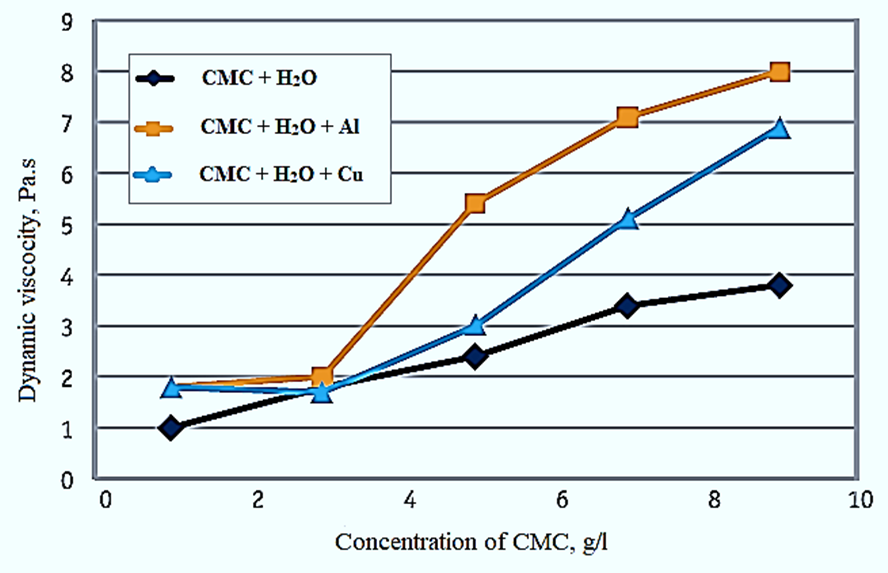
The ratio of the dynamic viscosity of oil and displacement solutions is one of the most important factors when selecting an oil displacement reagent [39, 40, 41, 42]. The closer the value of the dynamic viscosity of the displacement solution is to the value of the dynamic viscosity of oil, the more effective this solution will be as a displacement agent. Knowing the value of the dynamic viscosity of oil from a given field, it is possible to bring the value of the dynamic viscosity of the displacement agent closer to it by changing the concentrations of CMC and nanoparticles.
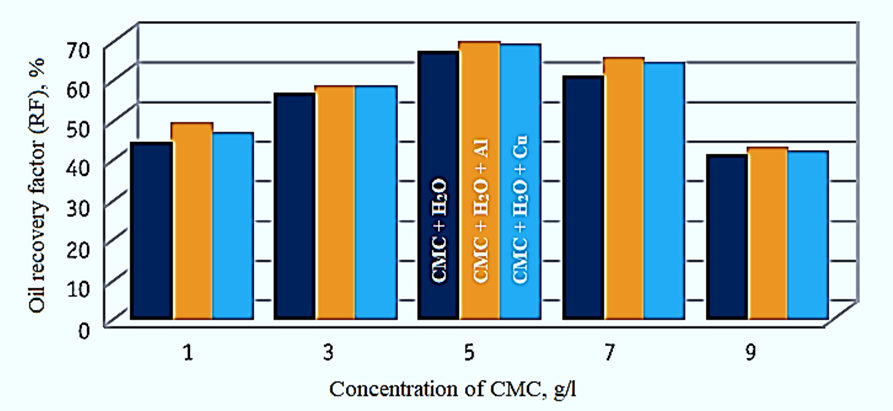
Next, a comparative analysis of the oil-displacing properties of aqueous solutions of CMC of various concentrations and the corresponding polymer nanocomposites (Al and Cu with dimensions of 50–70 nm) was carried out. The obtained data are presented in Table 4.
| S.No | Composition Structure | Oil Recovery factor, % |
|---|---|---|
| 1 | MC (1 g) + H O (1.01 g) 2 | 44,0 |
| 2 | CMC (3 g) + H O (1.01 g) 2 | 56,2 |
| 3 | CMC (5 g) + H O (1.01 g) 2 | 67,0 |
| 4 | CMC (7 g) + H O (1.01 g) 2 | 60,5 |
| 5 | CMC (9 g) + H O (1.01 g) 2 | 41,0 |
| 6 | CMC (1 g) + H O (1.01 g) + Al (0.05 g) 2 | 48,7 |
| 7 | CMC (3 g) + H O (1.01 g) + Al (0.05 g) 2 | 58,2 |
| 8 | CMC (5 g) + H O (1.01 g) + Al (0.05 g) 2 | 69,1 |
| 9 | CMC (7 g) + H O (1.01 g) + Al (0.05 g) 2 | 64,8 |
| 10 | CMC (9 g) + H O (1.01 g) + Al (0.05 g) 2 | 42,5 |
| 11 | CMC (1 g) + H O (1.01 g) + Cu (0.05 g) 2 | 46,2 |
| 12 | CMC (3 g) + H O (1.01 g) + Cu (0.05 g) 2 | 57,8 |
| 13 | CMC (5 g) + H O (1.01 g) + Cu (0.05 g) 2 | 68,4 |
| 14 | CMC (7 g) + H O (1.01 g) + Cu (0.05 g) 2 | 63,7 |
| 15 | CMC (9 g) + H O (1.01 g) + Cu (0.05 g) 2 | 41,8 |
Table 4: Comparative analysis of the oil recovery factor of aqueous solutions of CMC and the corresponding polymer nanocomposites
The essence of polymer flooding is the dissolution of the polymer in water to reduce its mobility [43, 44, 45, 46]. Consequently, the oil-water mobility ratio decreases due to an increase in viscosity. The concentration of the aqueous solution of the polymer can be increased to accomplish this goal, but this increase has its limits: CMC concentrations greater than 10 g/l negatively affect oil displacement. At the same time, at high concentrations, CMC does not mix well with water and creates problems when pumping solution into the formation. The resulting polymer nanocomposites based on CMC and copper and aluminum nanoparticles have improved properties compared to their polymer analogues (CMC): the dynamic viscosity is higher, the ability to displace oil is better. In addition to the above properties, the polymer nanocomposite (CMC + Cu nanoparticles) has pronounced bactericidal properties [47, 48, 49, 50].
Data obtained from the experiment on oil displacement with aqueous solutions of CMC and CMC + Al or Cu nanoparticles show that nanoparticles improve the oil displacement properties of CMC. The most effective concentrations are 3.0; 5.0; 7.0 g/l (Figure 2). At higher and lower concentrations the effectiveness decreases. As an oil displacement agent, the CMC + Al polymer nanocomposite is more effective than CMC + Cu.
Conclusions
The efficient use of oil displacement agents in hydrocarbon reservoirs can be achieved through the application of polymer nanocomposites containing the sodium salt of carboxymethylcellulose (CMC) and nanoparticles of Aluminum (Al) and Copper (Cu) measuring 50-70 nm in size. The study has demonstrated that the addition of Al and Cu nanoparticles to CMC-based aqueous solutions results in an increase in dynamic viscosity. Out of all the compositions tested, the most effective concentration for both oil displacement and polymer nanocomposites was found to be 5 g/L of CMC. This concentration also yielded the highest oil recovery factor. Furthermore, polymer nanocomposites containing Al were found to be more efficient in displacing oil and increasing dynamic viscosity compared to their counterparts containing Cu nanoparticles.
To optimize the use of polymers in the enhanced oil recovery process, it is essential to confidently consider various reservoir temperatures. The stability of the polymers is indisputably temperature-dependent, and taking this into account will undoubtedly minimize any negative impact of temperature.
References
-
Muggeridge A, Cockin A, Webb K, Frampton H, Collins I, et al. (2013) Recovery rates, enhanced oil recovery and technological limits. Philos Trans A Math Phys Eng Sci 372(2006): 20120320.
-
Al-Obaidi SH (2016) High oil recovery using traditional waterflooding under compliance of the planned development mode. J Petrol Eng Technol 6(2): 48-53.
-
Smirnov VI, Al-Obaidi S (2008) Innovative methods of enhanced oil recovery. Oil Gas Res 1(e101): 1.
-
Al-Obaidi SH (2021) Analysis of hydrodynamic methods for enhancing oil recovery. J Petrol Eng Technol 6: 20-26.
-
Wang D (2013) Polymer Flooding Practice in Daqing. In: Sheng JJ, et al. (Eds.), Enhanced Oil Recovery Field Case Studies. Gulf Professional Publishing, pp: 83-116.
-
Al-Obaidi SH, Khalaf F (2019) Development of traditional water flooding to increase oil recovery. International Journal of Scientific & Technology Research 8(1): 177- 181.
-
Chang WJ, Al-Obaidi SH, Patkin AA (2021) The use of oil soluble polymers to enhance oil recovery in hard to recover hydrocarbons reserves. Int Res J Mod Eng Technol Sci 3(1): 982-987.
-
Al-Obaidi SH (2015) The Use of polymeric reactants for EOR and waterproofing. J Petrol Eng Emerg Technol 1(1): 1-6.
-
Zhang J, Wang Q, Shan Y, Guo Y, Mu W, et al. (2022) Effect of Sodium Carboxymethyl Cellulose on Water and Salt Transport Characteristics of Saline-Alkali Soil in Xinjiang, China. Polymers 14(14): 2884.
-
AL-Obaidi SH, Hofmann M, Smirnova V (2022) Improvement of oil recovery in hydrocarbon fields by developing polymeric gel-forming composition. Nat Sci Adv Technol Educ 3(5): 425-434.
-
Hofmann M, Al-Obaidi SH, Hussein KF (2022) Modeling and monitoring the development of an oil field under conditions of mass hydraulic fracturing. Trends in Sciences 19(8): 3436.
-
Al-Obaidi SH, Khalaf FH (2023) A New approach for enhancing oil and gas recovery of the hydrocarbon fields with low permeability reservoirs. Pet Petro Chem Eng J 7(2): 1-8.
-
Gbadamosi AO, Kiwalabye J, Junin R, Augustine A, et al. (2018) A review of gas enhanced oil recovery schemes used in the North Sea. J Petrol Explor Prod Technol 8: 1373-1387.
-
Al-Obaidi SH (2016) Improve the efficiency of the study of complex reservoirs and hydrocarbon deposits – East Baghdad field. International journal of scientific & technology research 5(8): 129-131.
-
Patkin A, Al-Obaidi SH (2001) Influence of Temperature and Pressure of Incoming Oil- Containing Liquid from Field Wells on the Gas Separation Process. Journal of Petroleum Engineering and Emerging Technology 3(4): 20-24.
-
AL-Obaidi SH, Wj C, Hofmann M (2022) Modelling the development of oil rim using water and gas injection. Nat Sci Adv Technol Edu 31(3).
-
Khlaifat AL, Fakher S, Harrison GH (2024) Evaluating Factors Impacting Polymer Flooding in Hydrocarbon Reservoirs: Laboratory and Field-Scale Applications. Polymers 16(1): 75.
-
Al-Obaidi S (2019) Investigation of rheological properties of heavy oil deposits. Conference of the Arabian Journal of Geosciences 2019: 399-402.
-
Hofmann M, AL-Obaidi SH, Chang WJ (2023) Evaluation Of Quantitative Criteria For Triassic Reservoirs In The South Mangyshlak Basin. Natural Sciences and Advanced Technology Education 32(1): 7-24.
-
Al-Obaidi SH, Patkin AA, Guliaeva NI (2003) Advance use for the NMR relaxometry to investigate reservoir rocks. Journal of Petroleum Engineering & Technology 2(3): 45-48.
-
Franco CA, Franco CA, Zabala RD, Forero A, Bahamón I, et al. (2021) Field Applications of Nanotechnology in the Oil and Gas Industry: Recent Advances and Perspectives. Cortés Energy & Fuels 35(23): 19266-19287.
-
AL-Obaidi SH (2004) Modified use of microbial technology as an effective enhanced oil recovery. Journal of Petroleum Engineering and Emerging Technology 4(2): 41-44.
-
Chang WJ, Al-Obaidi SH, Patkin AA (2021) Assessment of the condition of the near-wellbore zone of repaired wells by the skin factor. Int Res J Mod Eng Tech Sci 3: 1371-1377.
-
Al-Obaidi SH, Kamensky IP, Hofmann M (2010) Changes in the physical properties of hydrocarbon reservoir as a result of an increase in the effective pressure during the development of the field. engrXiv 1(5): 16-21.
-
Santos RG, Loh W, Bannwart AC, Trevisan OV (2014) An overview of heavy oil properties and its recovery and transportation methods. Brazilian Journal of Chemical Engineering 31(3): 571-590.
-
Al-Obaidi SH (2020) A way to increase the efficiency of water isolating works using water repellent. Int Res J Modern Eng Technol Sci 2(10): 393-399.
-
Madhan NA, Guo K, Zhixin Y (2018) A State-of-the-Art Review of Nanoparticles Application in Petroleum with a Focus on Enhanced Oil Recovery. Applied Sciences 8(6): 871.
-
Al-Obaidi SH, Chang WJ, Hofmann M (2023) Development Of Oil Fields Using Science Artificial Intelligence And Machine Learning. Natural Sciences and Advanced Technology Education 32(3-4): 187-200.
-
Alexander G, Sudad AO, Viktor S (2023) Numerical Simulation of Water Alternating Gas Injections (WAG) into Hydrocarbon Reservoirs: Factors Influencing Oil Recovery. J Geol Geophys 12: 1147.
-
Al-Obaidi SH, Kamensky IP (2022) Express study of rheological properties and group composition of oil and condensate using nuclear magnetic resonance– relaxometry. J Oil Gas Coal Technol 4(1): 102.
-
Gulnaz ZM, Efendiyev GM, Kozlovskiy AL, Tuzelbayeva SR, Imansakipova ZB, et al. (2023) Study of the Rheological Characteristics of Sediment-Gelling Compositions for Limiting Water Inflows. Applied Sciences 13(18): 10473.
-
Al-Obaidi S, Galkin A (2005) Dependences of reservoir oil properties on surface oil. J Petrol Eng Emerg Technol 5: 74-77.
-
Patkin A, Al-Obaidi S (2001) Influence of temperature and pressure of incoming oil-containing liquid from field wells on the gas separation process. J Petrol Eng Emerg Technol 3(4): 20-24.
-
Obaidi SH, Khalaf FH (2020) Prospects for improving the efficiency of water insulation works in gas wells. J Geol Geophys 9(6): 483.
-
Jouenne S (2020) Polymer flooding in high temperature, high salinity conditions: Selection of polymer type and polymer chemistry, thermal stability. Journal of Petroleum Science and Engineering 195: 107545.
-
Al-Obaidi SH (2009) Experimental study of the influence of fluid flow rate on the risk of rock destruction. J Petrol Eng Emerg Technol 9(4): 84-89.
-
Kamensky IP, Al-Obaidi SH, Khalaf FH (2020) Scale effect in laboratory determination of the properties of complex carbonate reservoirs. Int Res J Mod Eng Technol Sci 2(11): 1-6.
-
Al-Obaidi S, Smirnov VI, Khalaf F (2020) New technologies to improve the performance of high water cut wells equipped with ESP. Technium 3(1): 104-113.
-
Cui K, Li H, Chen P, Li Y, Jiang W, et al. (2022) New Technique for Enhancing Residual Oil Recovery from Low-Permeability Reservoirs: The Cooperation of Petroleum Hydrocarbon-Degrading Bacteria and SiO2 Nanoparticles. Microorganisms 10(11): 2104.
-
Al-Obaidi SH, Khalaf FH (2017) The Effect of anisotropy in formation permeability on the efficiency of cyclic water flooding. Int J Sci Technol Res 6(11): 223-226.
-
Hofmann M, Al-Obaidi SH, Kamensky IP (2021) Calculation method for determining the gas flow rate needed for liquid removal from the bottom of the wellbore. J Geol Geophys 10(5): 1-5.
-
Al-Obaidi SH, Hofmann M, Smirnov VI, Khalaf FH, Alwan HH, et al. (2021) A study of compositions relevant to selective water isolation in gas wells. J Geol Geophys 10(7): 1000.
-
Lee Y, Lee W, Jang Y, Sung W (2019) Oil recovery by low- salinity polymer flooding in carbonate oil reservoirs. Journal of Petroleum Science and Engineering 181: 106211.
-
Al-Obaidi SH, Guliaeva NI (2002) Determination of flow and volumetric properties of core samples using laboratory NMR relaxometry. J Petrol Eng Technol 1(2): 20-23.
-
Hofmann M, Al-Obaidi SH, Patkin AA (2013) Problems of transporting” heavy” gas condensates at negative ambient temperatures and ways to solve these problems. Journal of Petroleum Engineering & Technology 3(3): 31-35.
-
Al-Obaidi SH (2004) Modified use of microbial technology as an effective enhanced oil recovery. J Petrol Eng Emerg Technol 4(2): 41-44.
-
Rahman MS, Hasan MS, Nitai AS, Nam S (2021) Recent Developments of Carboxymethyl Cellulose. Polymers 13(8): 1345.
-
Al-Obaidi SH (2023) Enhancing Hydrocarbon Field Recovery: Employing Multi-Stage Hydraulic Fracturing (MSHF) for the Development of Low-Permeability Deep- Lying Deposits. J Geol Earth Mar Sci 1(1): 102.
-
Guliaeva NI, Al-Obaidi SH (2017) Thermal adsorption processing of hydrocarbon residues. J Catal Catal 4(1): 6-10.
-
Al-Obaidi SH, Khalaf FH (2018) The Effects Of Hydro Confining Pressure on the Flow Properties of Sandstone and Carbonate Rocks. International journal of scientific & technology research 7(2): 283-286.
- Nigeria’s Vulnerability in the Face of Global Energy Policy
- A Simulation Study of Investigation of Optimum Oil Production Performance by Applying Various Gas Injection Methods in Oil Reservoir
- Characterization of Permo-Triassic Reservoirs through Thermal Maturity Assessment of Westphalian Source Rocks in the Cheshire Basin
- Influence of Microwax on the Rheological and Thermal Behaviour of a Wax Crude Oil
- Real-Time Monitoring and Performance Optimization of Steam Injection in Heavy Oil Reservoirs Using Fiber Optic Sensing and Integrated Predictive Simulation Models
- Rapid On-Site Determination of the Total Petroleum Hydrocarbon Content of Soils by Handheld Fourier Transform Near-Infrared Spectroscopy: Development of a Global, Site- and Scanner- Independent Calibration Model