
Progress of Research on Diesel Engine Oil-Machine Synergy Means and its Sensitivity Analysis
Diesel engines, with their high compression ratios, high thermal efficiency, and low fuel consumption rates, are still the main source of power in the engineering field. The performance of the diesel engine is essentially determined by the combustion process, which in turn depends on the fuel characteristics and the diesel engine's technical architecture of the work cycle mode suitability (oil-engine synergy). Currently, the sensitivity analysis of the core parameters of oil-engine synergy lacks theoretical support and means of reference. Aiming at the problems of unclear definition method of sensitivity parameters, unclear influence mechanism, and imperfect model construction, this paper proposes an evaluation method system composed of oil-engine synergistic sensitivity factor determination and quantitative analysis of contribution degree, which includes characteristic data acquisition, model construction and research, and sensitivity analysis and application. The sensitivity analysis method system of oil-engine synergistic parameters proposed in this paper aims to enhance the practical application effect of the sensitivity analysis algorithm and provide methods and data references in fuel design and control parameter optimization. In this paper, a sensitivity analysis phenomenological model is constructed based on the massive data of fuel physical and chemical characteristics parameters and engine control parameters on the efficiency of oil-engine cooptimization. The model specifies the influence weights of fuel physical and chemical characteristics parameters and engine control parameters on combustion elements and index parameters.
Abbreviations
CO: Carbon Monoxide (CO); HC: Hydrocarbons; NOx: Nitrogen Oxide; PM: Particulate Matter; BP-ANN: Back- propagation Artificial Neural Network; SVM: Support Vector Machine; BTE: Brake Thermal Efficiency; EGR: Exhaust Gas Recirculation; LTC: Low-temperature Combustion; ANN: Artificial Neural Network; GAs: Genetic Algorithm; ACO:
Ant Colony Optimization Algorithm; PSO: Particle Swarm Optimization; HC: Hydrocarbons; NOx; Nitrogen Oxide; PM: Particulate Matter; BP-ANN: Back-propagation Artificial Neural Network; SVM: Support Vector Machine; BTE: Brake Thermal Efficiency; EGR: Exhaust Gas Recirculation; LTC: Low-temperature combustion; ANN: Artificial Neural Network; Gas: Genetic Algorithm; ACO: Ant Colony Optimization Algorithm; PSO: Particle Swarm Optimization
Introduction
In 2022, among the CO, 7.43 million tons, HC 1.912 million tons, NOx 5.267 million tons, and PM 53,000 tons, and the total emission of the four pollutants is 14.662 million tons. Internal combustion engines are the main source of pollutants, of which CO, HC, NOx, and PM account for more than 80%. According to data, the national crude oil production will reach 209 million tons in 2023. The external dependence will increase to 72.99%, but the internal combustion engine will consume most of the crude oil [1]. It can be seen that environmental problems and energy shortage have become two major challenges for diesel engines at the same time, due to the apparent cleanliness and high efficiency of the new power devices represented by motors, coupled with misreading in all aspects,” banning the sale of fuel vehicles” has become the biggest pressure for employees of internal combustion engines and related industries that will still be the main power source in China for a long time.
In summary, “efficient near-zero emissions” has become a fundamental requirement for the internal combustion engine and its related industries to survive and continue to be a pillar industry of the national economy for a long time. The performance of a diesel engine is essentially determined by the combustion process, which in turn depends on the fuel characteristics and the technical structure and cycle mode of the diesel engine itself. Based on this, fuel design and intelligent diesel engines (oil engine collaboration) have become two origins to break the common demand for “ high efficiency and near-zero emission”. The compounding characteristics of fuel include cetane number, distillation temperature, density, viscosity, etc., which have a direct effect on the combustion process of fuel. The cetane value of the fuel determines the spontaneous combustion point of the fuel, and the distillation temperature of the fuel reflects the evaporation performance of the fuel. Engine control parameters, such as fuel injection strategy, EGR rate, etc., then affect the performance of the engine by affecting the combustion process of the fuel [2]. In the process of promoting energy conservation and emission reduction, oil machine coordination is crucial to solving related problems.
As a typical multi-input and multi-output system, the output response is nonlinear, discrete, and complex with the change of input parameters [3]. In recent years, in order to improve the economy and emission performance of diesel engines, many technologies such as high-pressure common rail systems and exhaust gas recycling have been developed and applied in diesel engines. The application of these new technologies not only enhances the controllability of the diesel engine but also makes the diesel engine system itself more complex, which leads to the insufficient correlation between the performance of the diesel engine and its emission characteristics and its control parameters/oil parameters.
In order to deeply study the relationship between the performance and emission characteristics of diesel engines and their fuel physicochemical characteristics and engine control parameters, researchers usually adopt research methods based on the test and model prediction of diesel engines. The experimental research method is undoubtedly a reliable way to verify the hypothesis and results, but in the face of increasingly complex diesel engine systems and increasing optimization goals, completely relying on experimental research cannot meet the needs of research, and the research cost has gradually become high. Therefore, the prediction model research methods are gradually favored by researchers [4].
By studying the input and output relationship of the diesel engine with the prediction model, and optimizing the diesel engine combined with the perfect model, this method shows the advantages of high efficiency and low cost. It can predict the performance of diesel engines before large-scale tests, thus guiding experimental design, reducing the number of unnecessary trials, and reducing research costs. For the study of this multi-input and multi-output system, and the output parameters are uncertain and influenced by the input parameters, linear regression, and response surface methods have become increasingly incompetent. In recent years, machine learning algorithms such as BP-ANN and SVM have shown great potential in diesel engine performance modelling [5]. However, in the practical application process, there are also problems such as the difficulty of model parameter selection and poor model accuracy, and the problems of parameter selection and optimization need to be solved urgently.
Based on the construction of the engine engine cooperative model, the intelligent algorithm is used to optimize the parameters of the diesel engine. The process of seeking the best needs to evaluate the control parameters frequently and give the fitness value, so there is a high demand for the calculation speed and accuracy of the calculation fitness model. At present, the commonly used methods of fitness calculation are the numerical simulation model and the empirical model. The advantage of the numerical simulation model is that it can provide high calculation accuracy, but the calculation speed is relatively slow. On the contrary, the calculation speed of an empirical model is very fast, but its calculation accuracy largely depends on the abundance of initial modeling data and the rationality of modeling methods. Therefore, when the performance and emission of diesel engines are optimized by an intelligent optimization method combined with a diesel engine model, the selection, establishment, and optimization process of the model need to be further studied and determined [6].
The current research on the interaction between the physicochemical characteristics of fuel and the control parameters of engine and its influence on the performance of engine is not deep enough. In particular, how to quantify these factors to engine performance through sensitivity analysis. In terms of influence, there is a large research space. Sensitivity analysis is an effective means to study and interpret the system model. By analyzing the operation law of the model, the influence degree of the change of input variables on the output result of the model is analyzed, and the influence of each input variable on the objective function is evaluated.
Therefore, in essence, sensitivity analysis is an important research tool to quantify the overall effect of system input variables on output functions. For sensitivity analysis, the core part is to determine the specific influence of each input parameter reflected by the output results of each model. Through sensitivity analysis, we can study the expected influence of these design variables on the combustion factors and index parameters of diesel engine in the scheme design stage, so as to get the leading factors for the efficient and clean combustion design of diesel engine, guide the designer to grasp the optimization focus and improve efficiency. Diesel engine is regarded as a multi input and multi output system.
With the change of input parameters, its output response is generally nonlinear, discrete and complex. In practice, with the increase of parameter dimension and the complexity of coupling between multiple parameters, the computational complexity of sensitivity analysis increases [7]. It is an urgent topic for the selection and establishment of sensitivity analysis methods and how to improve the accuracy and reliability of modeling and sensitivity analysis. Such research aims to meet the increasingly complex research and optimization needs of diesel engine systems and provide new methods for the application and optimization of more advanced technologies in diesel engines. Therefore, this article uses simulation and experimental methods to study the influence of fuel cooking characteristic coupling engine control parameters on the combustion and emissions of diesel engines.
Establishing a numerical simulation model related to the performance parameters of the fuel chemical and engine control parameters based on feature data, and then target them for their respective Insufficient, optimize. Use modern intelligent algorithms to further optimize research on models with higher accuracy. Coupling sensitivity analysis algorithm reveals the correlation and quantitative sensitivity of different levels, which provides theoretical guidance for the efficient cleaning and combustion of diesel engines.
Fuel Physical and Chemical Characteristics and Engine Control Parameter Optimization Performance
Fuel Physical and Chemical Characterization
The performance of diesel engines mainly depends on the advanced technologies and fuel chemical characteristics adopted. Diesel’s physical and chemical characteristics such as hexane value, distillation temperature, and other characteristics parameters have a certain impact on performance [8]. Studies have shown that the fuel distillation temperature will affect the atomization quality sprayed into the cylinder, and improving the fuel distillation temperature can help reduce the time of oil and gas mixing and reduce carbon smoke emissions at high loads. The fuel has better discharge results in low-temperature combustion [9].
Hutchison reports the research on the effect of fuel distillation temperature on the effect of PM emissions on the direct injection engine in the spark-ignition cylinder. The change in fuel distillation temperature is the main focus of the survey with seasonal changes, and the secondary goal is to investigate the effect of the ethanol hybrid fuel at different distillation temperature levels. Low distillation temperature fuel shows the elevation of particle number quality emissions. Etherol is added to the mixed low-distillation temperature fuel. Compared with pure fuel, PM emissions have not changed significantly, and ethanol matching mixed in high distillation temperature fuels increases significantly increased PM emissions [10, 11].
Sluder studied the effects of distillation temperature on the early direct spraying LTC. Five conventional diesel fuels were tested within a positive range of fuel injection and a lower distillation temperature fuel mixture with roughly the same energy and toluene. The results show that as early as the fuel injection time, due to the low surface temperature of the cylinder, a liquid fuel membrane may be formed, resulting in higher smoke, HC, and CO emissions [12].
Engine Control Parameters
With many technologies, the power and thermal efficiency of diesel engines are gradually increased by Tamanouchi, et al. [13]. At the same time, the combustion mode is also constantly updated. The existing advanced combustion technologies include gasoline compression ignition, reactivity control compression ignition, etc., which all have very high thermal efficiency [14]. Figure 1 shows the in-cylinder equivalent ratio and temperature distribution of various new combustion modes. The technical level of today’s diesel engine is as follows, excellent combustion system, using 4 valve technology, ultra-high pressure injection, pressurization and pressurization of medium cooling, controllable waste gas recirculation and oxidation catalyst, full electronic and full electronic management reflects the characteristics of the new generation of diesel engine using electronic control common rail fuel injection system [15].
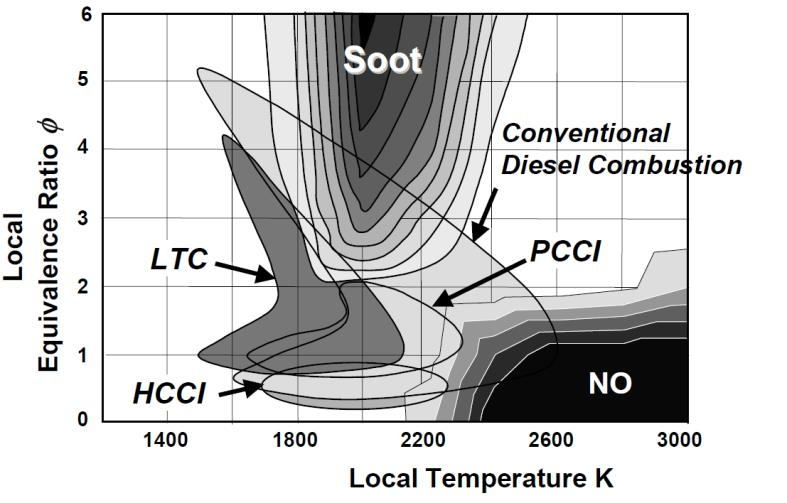
Chen studies the natural gas dual-fuel engine to achieve similar thermal efficiency as diesel engine while achieving lower emissions. However, the compromised relationship between CH4 and NOx emissions restricts the development of dual-fuel engines. The test shows that with the increase in fuel injection pressure, the speed and indicator thermal efficiency of methane flame spread. The EGR rate increases, indicating that the heat efficiency is the first to increase. The EGR ratio exceeds 30%, and CO and CH4 emissions are reduced by increasing fuel injection pressure [16].
Icingur the influence of different fuel hexetane values and fuel injection pressure on the performance of diesel engines is studied. The results show that when the fuel hexadecane value increases, the NOx and CO emissions decrease by about 15% and 5% respectively, but when the injection pressure decreases to 100, the smoke level increases significantly. Compared with the lower pressure, the NOx increased and the soot volume decreased when the injection pressure increased to 250 bar. The braking thermal efficiency increases with the fuel injection pressure [17].
Phenomenological Modeling and Application of Oil-Engine Synergy in Association with Diesel Engine Performance
Machine Learning in Diesel Engines
The construction of SVM is based on the principle of minimizing structural risk in statistical learning theory. It seeks the best balance between the complexity of the model and the learning ability to ensure the best generalization capacity of limited sample data. This balance ensures that the model can not only perform well on training data but also maintain a high predictive accuracy rate on no-see data so that it has strong adaptability and reliability in practical applications.
SVM has been applied to the field of diesel engines due to its accuracy and the ability to analyze non-linear problems. Niu studied the response prediction of SVM in direct -injection system auxiliary ships. The purpose of research is to determine better prediction methods on the basis of a small amount of training data. The results show that under limited experimental data, SVM can find global optimal solutions, with excellent predictive accuracy and generalization capabilities. ANN may converge to the local minimum value, facing overfitting problems [18].
A series of engine calibration tests were performed on the hydrogen-rich Wankel rotating engine. After recording the required experimental data, the application of multiple methods such as secondary polynomial, ANN and SVM is used to build a multi-target regression model, thereby building a multi-target regression model, thereby Mathematical relations have unique insights. As far as Ann is concerned, the impact of hidden layer nodes on the return performance of hidden layers has been discussed, and the use algorithm has optimized the weight of ANN. For SVM, the effects of nuclear functions and three optimization methods on regression performance. The results show that in the three methods, the SVM fitting effect is the best. The best R2 of BTE, fuel energy flow, NOx, CO, and HC are 0.9877, 0.9840, 0.9949, 0.9937 and 0.9992 [19].
Development and Application of Intelligent Optimization Algorithms
Intelligent optimization algorithm is a technology that integrates the multidisciplinary theories of computer science, mathematics, and statistics and aims to develop computational strategies that can automatically explore the optimal or suboptimal solution of the problem. In this kind of algorithm, GAs, ACO and PSO are all typical representatives. With their high efficiency, strong global search ability, and good robustness, they have been widely used in solving many complex problems [20]. In recent years, with the rapid rise of machine learning, intelligent optimization algorithms have gradually penetrated neural network training, reinforcement learning, and other fields, providing strong support for solving more complex problems. Among them, the core idea of the PSO algorithm is to solve the optimization problem by simulating the behavior of bird groups. Specifically, the algorithm transforms the optimization problem into a problem of optimization, and then by simulating the migration behavior of the bird group, lets each “particle” move randomly within the search space, and finally finds the optimal solution [21].
The application of PSO technology in the field of diesel engine mainly aims to improve the accuracy of the prediction model. Wu proposed an adaptive PSO to improve the fuel efficiency of diesel engines and reduce exhaust emissions. The proposed algorithm introduces adaptive inertial weights and a modified mutation mechanism to update the velocity and particles when the global optimal particles fall into possible local optima. The proposed PSO is evaluated on eight benchmark functions together with other adaptive PSO algorithms. The results show that compared with other algorithms, the proposed algorithm converges faster and its accuracy and reliability are higher [22].
Sensitivity Analysis Method and Application of Oil-Engine Synergy Parameters on Performance Improvement
The diesel engine is regarded as a multi-input and multi-output system. With the change of input parameters, its output response is generally nonlinear, discrete, and complex. For the diesel engine, many parameters can affect its performance. How to find the most sensitive parameter among the many parameters is very important. In order to quantify the influence of engine system input parameters on output parameters, the sensitivity analysis method is applied to the analysis process [23]. The selection of methods for parametric sensitivity analysis is essential because different methods apply to different situations. The sensitivity analysis method of diesel engine collaborative parameters can provide methods and data references for fuel design and control parameter optimization.
Early in the early 21st century, I.M. Sobol gave a detailed introduction to the mathematical calculation of the Sobol Sensitivity Analysis Method [24]. Abbas et al. analyzed the NOx of diesel engines based on the simulation model by using different sensitivity analysis methods, and the results show that the Sobol method has good performance for both linear models and nonlinear models [25].
Sobol’s sensitive analysis method is seldom used in the field of diesel engines, so it can be combined with machine learning to carry out the sensitivity analysis research on engine control parameters and physical and chemical characteristics parameters to combustion process parameters and engine performance, which provides theoretical guidance for the test.
Conclusions
Aiming at the lack of theoretical basis and effective parameter analysis means for diesel engine synergistic sensitivity analysis, this paper aims to solve the problems of unclear sensitivity parameter analysis method, unclear influence mechanism, and unclear model construction. To this end, this paper proposes a set of determination and quantitative analysis and evaluation systems of oil- engine synergistic sensitivity factors centered on the phenomenological model based on data mining, which covers three aspects of characteristic data acquisition, model construction and research, and sensitivity analysis and application. The method can reveal the correlation and quantitative sensitivity between different layers.
References
-
Lin B, Zhang A (2023) Can government environmental regulation promote low-carbon development in heavy polluting industries? Evidence from China’s new environmental protection law. Environmental Impact Assessment Review 99: 106991.
-
Jun W, Lizhong S, Yuhua B (2021) Modeling and optimization of a light-duty diesel engine at high altitude with a support vector machine and a genetic algorithm. Fuel 285: 119137.
-
Yinhui W, Rong Z, Yanhong Q, Jianfei P, Mengren L, et al. (2016) The impact of fuel compositions on the particulate emissions of direct injection gasoline engine. Fuel 166: 543-552.
-
Wang Z, Xu H, Jiang C, Wyszynski ML (2016) Experimental study on microscopic and macroscopic characteristics of diesel spray with split injection. Fuel 174: 140-152.
-
Whitacre SD, Adelman BJ, May MP, McManus JG (2004) Systems Approach to Meeting EPA 2010 Heavy-Duty Emission Standards Using a NO x Adsorber Catalyst and Diesel Particle Filter on a 15l Engine. SAE transactions 341-350.
-
Signer M, Heinze P, Mercogliano R, Stein HJ (1996) European programme on Emissions, Fuels and engine technologies (EPEFE)-heavy duty diesel study. SAE transactions, pp: 564-579.
-
Oyama K, Kakegawa T (2000) Japan Clean Air Program- Step I Study of Diesel Vehicle and Fuel Influence on Emissions. SAE transactions, pp: 1821-1847.
-
Kidoguchi Y, Yang C, Miwa K (2000) Effects of fuel properties on combustion and emission characteristics of a direct- injection diesel engine. SAE transactions, pp: 1149-1157.
-
Li X, Chippior WL, Gülder ÖL (1996) Effects of fuel properties on exhaust emissions of a single cylinder DI diesel engine. SAE transactions, pp: 2284-2295.
-
Hutchison BRM, Wallace JS (2021) Influence of fuel volatility on particulate matter emissions from a production DISI engine. Fuel 303: 121206.
-
Sluder CS, Curran SJ (2022) Diesel-range fuel property effects on medium-duty advanced compression ignition for low-load NOx reduction. SAE International Journal of Fuels and Lubricants 16: 57-74.
-
Broering LC, Holtman LW (1974) Effect of diesel fuel properties on emissions and performance. SAE Transactions, pp: 2557-2568.
-
Tamanouchi M, Morihisa H, Yamada S, Lida J, Sasaki T, et al. (1997) Effects of fuel properties on exhaust emissions for diesel engines with and without oxidation catalyst and high pressure injection. SAE transactions, pp: 293- 310.
-
Signer M, Heinze P, Mercogliano R, Stein HJ (1996) European programme on Emissions, Fuels and engine technologies (EPEFE)-heavy duty diesel study. SAE transactions, pp: 564-579.
-
Stradling R, Gadd P, Signer M, Operti C (1997) The influence of fuel properties and injection timing on the exhaust emissions and fuel consumption of an Iveco heavy-duty diesel engine. SAE transactions, pp: 1739- 1765.
-
Matheaus AC, Neely GD, Ryan III TW, Sobotowski RA, Wall JC, et al. (2000) EPA HDEWG Program-Engine Tests Results. SAE transactions, pp: 1195-1209.
-
Icingur Y, Altiparmak D (2003) Effect of fuel CN and injection pressure on a DI Diesel engine performance and emissions. Energy Conversion and Management 44: 389-397.
-
Niu X, Yang C, Wang H, Wang Y (2017) Investigation of ANN and SVM based on limited samples for performance and emissions prediction of a CRDI-assisted marine diesel engine. Applied Thermal Engineering 111: 1353- 1364.
-
Shi C, Ji C, Wang H, Wang S, Yang J, et al. (2021) Comparative evaluation of intelligent regression algorithms for performance and emissions prediction of a hydrogen-enriched Wankel engine. Fuel 290: 120005.
-
Shi Z, Wang J, Guo X, Liu X (2023) Multi-objective optimization of the structural design of a combustion chamber of a small agricultural diesel engine fueled with B20 blend fuel at a high altitude area. Sustainability 15(15): 11617.
-
Ye J, Peng Q (2023) Improved emissions conversion of diesel oxidation catalyst using multifactor impact analysis and neural network. Energy 271: 127048.
-
Ogren RM, Kong SC (2021) Optimization of diesel fuel injection strategies through applications of cooperative particle swarm optimization and artificial bee colony algorithms. International Journal of Engine Research 22(9): 3030-3041.
-
Ebert N, Goos JC, Kirschbaum F, Yildiz E, Koch T (2020) Methods of sensitivity analysis in model-based calibration. Automotive and Engine Technology 5: 45-56.
-
Sobol IM (2001) Global sensitivity indices for nonlinear mathematical models and their Monte Carlo estimates. Mathematics and computers in simulation 55(1-3): 271- 280.
-
Sharifi A, Ahmadi M, Badfar H, Hosseini M (2019) Modeling and sensitivity analysis of NOx emissions and mechanical efficiency for diesel engine. Environmental Science and Pollution Research 26: 25190-25207.
- Nigeria’s Vulnerability in the Face of Global Energy Policy
- A Simulation Study of Investigation of Optimum Oil Production Performance by Applying Various Gas Injection Methods in Oil Reservoir
- Characterization of Permo-Triassic Reservoirs through Thermal Maturity Assessment of Westphalian Source Rocks in the Cheshire Basin
- Influence of Microwax on the Rheological and Thermal Behaviour of a Wax Crude Oil
- Real-Time Monitoring and Performance Optimization of Steam Injection in Heavy Oil Reservoirs Using Fiber Optic Sensing and Integrated Predictive Simulation Models
- Rapid On-Site Determination of the Total Petroleum Hydrocarbon Content of Soils by Handheld Fourier Transform Near-Infrared Spectroscopy: Development of a Global, Site- and Scanner- Independent Calibration Model