
Deciphering Outbreaks of the Migratory Locust (Locusta Migratoria L.) (Orthoptera: Acrididae) With Their Management Strategies
The economic importance of locusts is well recognized throughout the world owing to their swarming behavior. The damage caused by hoppers on a small scale is mostly limited to local vegetation, primarily crops. Crop damage is overlooked, but it is tenacious in nature, and the effects they leave on planned systems, such as crop fields, are much more serious. Therefore, many taxa (genera or species) of the family Acrididae are considered as potential pests of farms, forests and even pastures. In general, the distribution of locusts decreases with increasing latitudes, i.e., Their occurrence increases towards the equator. When ecological conditions favour more plant growth and trigger more breeding, locusts can manage to aggregate in a huge voracious swarm and inflict damage to crops. When outbreaks of the migratory locust, Locusta migratoria L. arose in the southeastern part of Pakistan in the Sind, Bahawalpur, Bahawalnagar, Minchinabad and Chistian adjoining districts bordering the eastern sides of India. As a result, further damage to crops and migration to other areas were prevented. Morphometric measurements indicated that the migrants had reached the body dimensions typical for gregarious forms. Drum and empty tin beating and pesticide application are both effective in managing locusts under field conditions. Swarms of adults landed on the grazing and farming lands of the country, specifically from Sind (Thar) to Chistian, Bahawalpur, Rahim yar khan, Minchinabad, Lodhran and adjacent districts in the region in November 2019, and caused substantial damage to agricultural crops and pastures. In the fall of 2019, numerous locusts suddenly swarmed in the affected areas, and thus, control was essential. The organochlorines are highly persistent and include dieldrin and HCH. These insecticides were the most favoured for locust control because of their efficacy, cost and persistence. Sprayed from land or aerial vehicles, whole swarms can be targeted in relatively short periods of time. Traditionally, the use of empty tin/drum was beaten to produce a loud sound that drove the locust away. The practices are cost effective and environmentally friendly.
Introduction
Locusts (family Acrididae) are possibly the most critical pest insects in the world. Locusts are scandalous pests and famous farmers because of their enormous destruction of plantations. There are almost fifteen species of locust placed in the family Acrididae [1]. Two species are well documented as desert locust, Schistocerca gregaria, and the migratory locust, Locusta migratoria L. They establish stage polyphenism in which many characters change in response to population density [2]. Solitarious phase with little damage to agricultural crops, but as the population density increases and proceeds many generations into gregarious locusts. Nymphs demonstrate a gathering behavior and transfer in groups to seek food, and adults swarm and migrate over long distances. Because of their economic importance, profuse studies have been carried out, as abridged by Uvarov [2]. Other investigators in several parts of the world have extensively studied this topic [3, 4, 5, 6, 7]. Despite consistent efforts by many scientists and agricultural experts, locusts assume paramount importance and are still regarded as serious pests. The current paper defines the occurrence of locust (L. migratoria) outbreaks, effective control and the status of migrants in terms of phase polyphenism in the southeastern part of Pakistan’s districts and adjoining areas playing havoc. Thar Desert is an efficiently populated desert, with almost 85% of the area is occupied by India and 15% occupied by Pakistan with low rainfall, which could be a source of precipitation in the soil,; then, the desert would wait tilluntil the next monsoon.The majority of the population in the Thar Desert subsists on rain -fed agriculture and livestock. Millet crops were attacked by locusts in desert areas of Umerkot and Thar specifically from village Bhadi, where villagers told that their millet, and mong beans had been destroyed. Environmental conditions are favorable and suitable in any breeding region where solitarious locusts are attracted to that region with consequent outbreaks [8], unfavorably affecting the agricultural economy of the globe. Therefore, numerous outbreaks of locusts have been reported by many entomologists and organizations from extended times, and these plagues transported unwelcomed disasters to the cultivated lands and livestock of the people. Gallarious behaviour is initiated upon female crowding in a small breeding site for oviposition, and subsequently, young hatchlings crawl out of the soil at the same time,; contact by touching each other is unavoidable. Eventually touch receptors are stimulated on the body surface, in the large femur of the hind legs or in the antennae (Cullen et al. 2010; Maeno and Tanaka 2011; Rogers et al. 2003) [9, 10, 11]. In other parts of the world various scientists played their pivotal role reported in literature [12, 13, 14, 15, 16, 17, 18, 19, 20, 21, 22, 23, 24, 25, 26, 27, 28, 29, 30, 31, 32] and antilocust research. These scholars and organizations worked out on different aspects of locusts throughout the world [33, 34, 35, 36, 37, 38, 39, 40, 41]. In recent years, the role of serotonin in inducing gregarious behaviour as well as the transmission of maternal information subsequent to nest generation has been focused on Anstey, et al. [42, 43, 44, 45], but the results are not yet fully conclusive. These insects form enormous swarms that spread across regions, devouring crops and leaving serious agricultural damage in their wake. Scanty knowledge is available regarding locust is accessible in work already done. Therefore, new insights into the exhumed characteristics of locusts are presented. The objective of this work is to study the dynamics of the locust population in different southern regions of Pakistan.
Materials and methods
Collection of Locusts
Millions of locusts currently exist in Pakistan. In Pakistan, four species of locusts are well documented and separated by morphological characteristics that may be modified by environmental conditions. The locusts were collected from the different infested sites. The material was studied in the laboratory while putting them in plastic bags and subsequently arranged.
Description of Study Locations
Locust outbreaks have been newly recorded in Sind from Thar to southeastern borders and adjoining districts of Pakistan. The worst hit districts are UmarKot (25°21’41.65” N 69°44’10.46” E), Bahawalpur (29°23’60.00” N 71°40’59.99” E), Bahawalnagar (30.55° N 73.39° E), Minchinabad (28°23’21.84” N 69°21’11.59” E), Chistian (30°13’20.82” N 65°20’11.2” E), Rahim yar khan (30°23’21.84” N 69°21’11.59” E) and adjoining areas. These districts of are located on the southeastern border of Pakistan. In this region, wheat, corn, Berseem, Losan, Potato, Mustard, Grass, and Vahan (Salvadora oleoides) (Jal, Jall, Mitha Jall, Peelu, Pilu, Khabbar) are grown by irrigating the farming lands.
Bahawalpur
Bahawalpur is 114 m above sea level and is located at 29.40° N 71.78° E. Bahawalpur has a population of 552607. Mostly dry. Warm (max and minimum temperature range 12-24°C Wind) will be generally light.
Bahawalnagar
Bahawalnagar is 159 m above sea level and is located at 30.55° N 73.39° E. Bahawalnagar has a population of 126700. Mostly dry. Warm (min and max temperature range 8- 23°C). Wind will be generally light.
Minchinabad
Minchinabad is 157 m above sea level and is located at 30.17° N 73.57° E. Minchinabad has a population of 29253.
Mostly dry. Warm (min-max temperature range 9- 23°C). .Wind will be generally light. Moderate rain (total 12 mm). Warm (max 22°C). Wind will be generally light. Mostly dry.
Rahim Yar Khan
Rahim Yar Khan is 75 m above sea level and is located at 28.37° N 70.33° E. Rahim Yar Khan has a population of
788915.
Chistian
Chishtian is 139 m above sea level and located at 29.80° N 72.83° E. Chishtian has a population of 122199. Mostly dry. Warm (Temperature min -max 9-24°C. .Wind will be generally light. Light rain (total 9 mm).
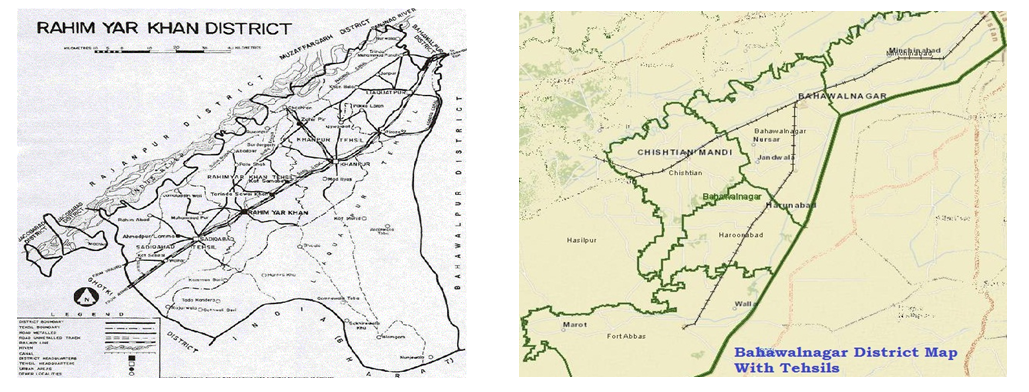
(a) (b) Figure 1: (a) Rahim Yar Khan has a population of 788915. (b) Bahawalnagar has a population of 126700
Sampling
Sampling of the specimens was performed in the infested area and at different sites, even field crops. The soil was clay loam, preferably in a semiarid area located on the border belt of the Indian side. This dry climate facilitated the preservation of locust remains. All swarms of locust covered an area of 2000 m2 with thick layers formed horizontally to the soil sparsely dominating the area of graveyard. A total of 1000 locusts from each locality were sampled. The locust density was much higher, and this site will be called the high-density sites. Subsequently, after their collection, the specimens were preserved in 70% alcohol in jars.
Killing and Preservation
Potassium cyanide was used to kill the collected specimens in the laboratory. The morphological characteristics of different taxonomic parts were observed. All specimens were mounted in a wooden box. Phenyl tablets were placed in boxes for subsequent damage.
Identification
Available literature and keys used for this purpose.
Distribution
Locusta migratoria was profusely distributed in crops, trees, graveyards and even in the different areas of Pakistan and worst-hit districts such as, Sahiwal, Bahawalpur, Bahawalnagar, Minchinabad, Rahim Yar Khan, Chistian, and Karachi and Indian borders devastatingly playing havoc (personal observation). Earlier records of locust collected from India, Rajasthan, Udaipur, Rajasmand; Suhail, et al. [46] from Pakistan Bahawalpur, Cholistan, Dera Ghazi Khan; Ahmad; Latif et al. [ 47,48] from Faisalabad; Perwin [49, 50] from Karachi [51].
Morphometric Measurements and Analysis
To perform the morphometric analysis, we analyse the following parameters: maximum width of head hind, femur length; Elytron length; and max pronotum length with a saddled/concave shape,which are often used for studies of phase polyphenism. Approximately 100 at the high-density site and all individuals (50 females and 50 males) collected at the infected site were measured. All individuals at high -density sites were photographed (Figure 1 and Table 1).
| Collection sites at infested districts | Sex ratio | Sample size | Maximum head width(mm) | Femur length(mm) | Elytron length(mm) | Pronotum length(mm) |
|---|---|---|---|---|---|---|
| UmarKot | Female | 200 | *8.18±0.35a | 23.65+1.20 | 54.28+1.64 | 58.0+0.04 |
| UmarKot | male | 200 | 7.55±0.30ab | 48.23+1.12 | 48.86+2.23 | 56.0+0.06 |
| Bahawalpur | Female | 175 | 8.20+0.37bc | 24.23+1.76 | 53.75+1.90 | 52.0+0.03 |
| Bahawalpur | male | 175 | 7.55+0.32c | 23.60+1.34 | 48.95+2.26 | 45.0+0.08 |
| Bahawalnagar | Female | 175 | 8.15+0.36d | 25.43+1.50 | 52.64+1.96 | 53.0+0.04 |
| Bahawalnagar | male | 175 | 7.65+0.30ac | 23.56+1.04 | 47.86+2.34 | 55.0+0.07 |
| Minchinabad | Female | 200 | 8.14+0.64d | 24.39+1.56 | 54.62+1.45 | 56.0+0.05 |
| Minchinabad | male | 200 | 7.65+0.33dc | 23.33+1.32 | 48.32+2.18 | 52.0+0.01 |
| Rahim Yar Khan | Female | 200 | 8.25+0.45e | 24.82+1.53 | 55.20+2.20 | 56.0+0.05 |
| Rahim Yar Khan | male | 200 | 7.45+0.54de | 23.55+1.23 | 50.65+2.56 | 48.0+0.09 |
| Chistian | Female | 200 | 8.22+0.38fe | 25.67+1.45 | 54.36+1.88 | 55.0+0.06 |
| Chistian | male | 200 | 7.70+0.45f | 23.58+1.28 | 50.56+2.65 | 50.0+0.04 |
Table 1: ** Morphometric measurements (Mean + SD) of locusts (L. migratoria) collected at high-density districts sites in Pakista
Different letters after mean +SD indicate significant differences by paired comparison using t-test (p<0.05). *Means in each column are significantly different between the two sexes for each district and between the two sites for each sex using the Mann-Whitney U-test (p<0.05). Table 1: Morphometric measurements (Mean + SD) of locusts (L. migratoria) collected at high-density districts sites in Pakistan attacked / infested districts in November 2019.
Statistical Analysis
Data were statistically analysed for morphometry using Minitab (version 19) and by paired comparison using t- test (P<0.05) and Mann Whitney U test (P<0.05).
Results
Description of Locusta Migratoria
Morphometrically, colour variable, green or grey, wings colourless exceedingly approaching abdominal extremities, Tegmina with light dark spot. Size of head large and thorax small, Mandibles blue or purples to dark, prosternal process Morphometry and body colouration absent. Serrations/pegs variable in size, numbers and location present, Stridulation present by rubbing together the ventral edge of the metanotum and the basalar sclerite, tibio-elytral present, no change of position in startle reaction as escape manoeuvres, tympanal nerve recordings present, presence of prepulse inhibition, attracted to conspecific, active diurnally.
The mean values of (head width), F (hind femur length) and (elytron length) were larger for the locusts from the high -density districts of the country, although a significant difference (P<0.05) was obtained only in elytron, and femur length for males (Table 1).
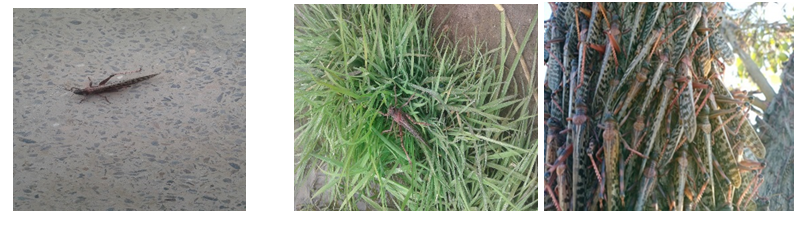
(a) (b) (c) Figure 2: Green adults (a, b) and brown adults (a) of Locusta. migratoria collected at the high density districts of Pakistan.
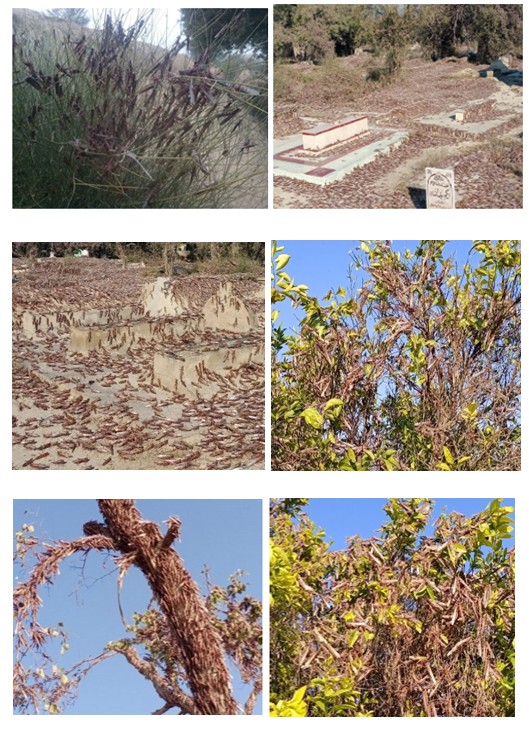
Locusta migratoria grows 35-60 mm in length, yellowish brown in color, posterior lateral part of hind wings with light black spots, antenna filiform and yellowish in color, median and hind wings spotless, pronotum raised from march, ,posterior end angular, eyes unstriped, head large, crested femur with dark marks, tibia with small spines. Green or brown in solitary form, straw coloured in gregarious form, flight strong and steady, metamorphosis incomplete, eggs protected with frothy liquid to prevent dehydration, contamination and from enemies, nymphs wingless, life span 8 weeks, Body-color polyphenism is a common phenomenon in locust morphometric characteristics (Figure 2) and morphometric ratios typical for gregarious forms, as shown in Table 1 & Figure 2. No significant difference (P<0.05) was found in either ratio between the greenish and brownish individuals of either sex (Mann Whitney U test; p<0.05). All specimens collected at the different infested districts in the high density area had already changed their body colour to brown as 3 weeks had passed. Most of them turned shiny brown, but a few retained green colourations. The proportion of greenish coloured individuals (approximately 50%) was almost the same, but 50% was brown, indicating that individuals were migrants.
Life Cycle of Locusta Migratoria
Locusta migratoria can be present throughout the year, but its incidence is high under favorable conditions.There are 4-6 generations per year depending upon the longevity of the soil moisture. Female lays eggs in sandy warm and moist areas called pods approximately 2-12 cm deep. Each pod having 70-80 banana -shaped eggs approximately 5-6cm long, egg bed variable and scattered in a large area, hatching within 15-20 days, crawling nymphs after 4-8 weeks transformed into an adult. After 2-4 weeks of egg mating and egg laying starts, 40-80 million locusts in each kilometer swarm, can travel 5-130 km/day.
Infestation of Economic Plants
Trees like citrus, Dalbergia, many fruits, forests and bush trees, Volatile oil bearing plants, Cereal crops, pastures,Wheat, Berseem,Losan,Potatos,Mustard, Grasses, Vahan (Jal).
(a) (b)
(c) (d)
(e) (f)
(g) (h)
(I) (J)
(k) (l)
(m) (n)
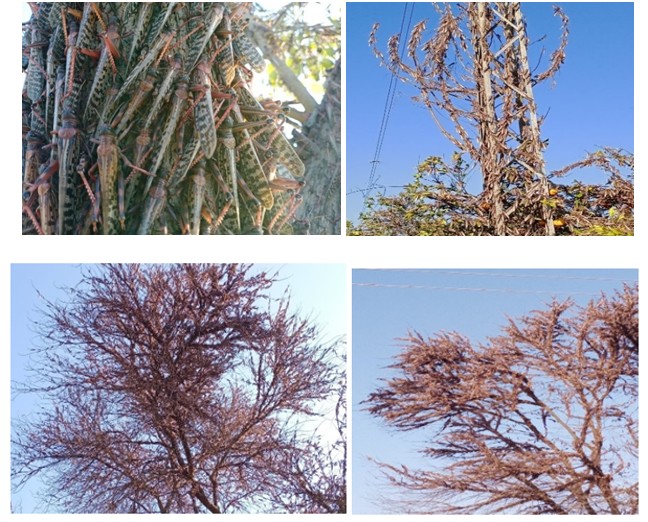
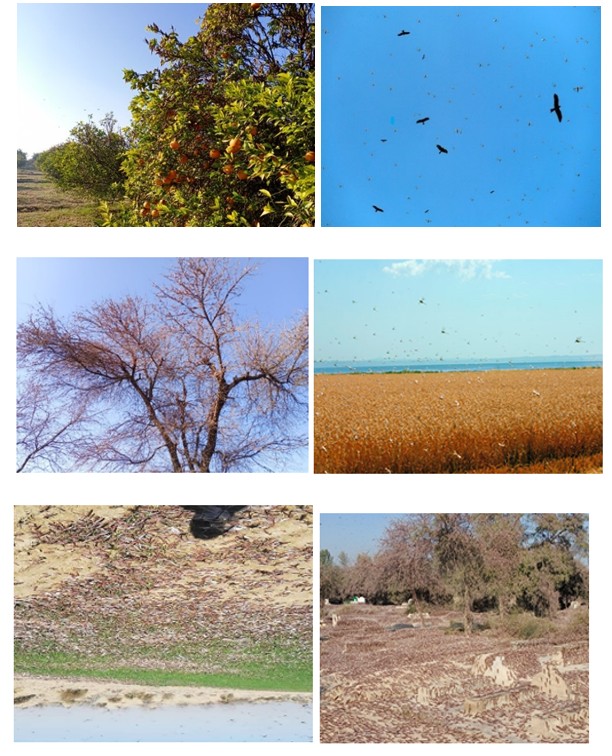
(o) (p) Figure 3: Attack of Locusta migratoria in Sind, Bahawalnagar and adjoining areas and infestation on different vegetation type (a) swarms of locust, (b) infestation on epiphyte around electric pole, (c) infested tree citrus after locust attack, (d) citrus tree after locust attack, (e) healthy citrus plant before locust attack (f) locusts fly over sky, (g) citrus tree after locust attack, (h) wheat crop destruction after locust attack (i) completed devastated mustard crop after attack , (J-m) attack in grave yards and mustard crop (n) citrus plant being attacked, (o) Shisham tree at attack, (p) citrus plant at attack (Magnification: 100 X).
Discussion
In Pakistan, a total of four species are documented, and two of the four species are disreputable pests of 400 species of plants. Collection was completed in cultivated fields, and infested vegetation was mostly found in bajra crops (Pennisetum glaucum), wheat crops, jowar (Sorghum bicolor) citrus orchards, even mustard crops and trees such as, Dalbergia sisso, vahan (Jal), jujube trees (Ziziphus nummularia) and rarely from other or natural vegetation, whereas infested vegetation was infested from cotton and other fodder crops. Previous investigations on bekar grass (Indigofera caerulea) [52] migratoria, both sexes were collected after infestation with sporadic rains but were observed in winter and fall. The population of S. gregaria increased with the increase in vegetation. During field surveys of various localities, the population density remains heavy, and thick, devastating multiple crops inflict massive damages. The farmer’s community was worried enough, as they had harvested different crops, wheat, mustard, and citrus and even massively damaged Locusta migratoria. However, winter climatic conditions acted as a barrier to some extent against locust. Our findings were in consistent with previous investigators in other parts of the world [53, 54, 55, 56, 57, 58, 59, 60, 61]. In the present study, the subfamily Oedipodinae species Locusta migratoria swarms and causes massive and injurious crop loss and damage compared to other locust species. The dry climatic conditions and profuse plantations are attractant sources of locust breeding sites and even greater reproduction followed by swarming. We recommend that the agriculture department should keep an open and vigilant eyes about the activities of the Locusta migratoria so that the warning type of information could be disseminated well on time to the public; specifically, the farmers community that is directly linked with the agriculture could be well protected from such menace.
Conclusion
Dry climate and profuse plantations are sources of Locusta migratoria breeding, and agriculture department should maintain vigilant surveillance and monitoring position to provide priority informations to prevent crops along with collateral damage. The farmer community should devise a control strategy prior to any infestation. Finally, this study allowed us to consider future possibilities for deepening our knowledge of the dynamics of the locust and their relationship with the environment, to limit the proliferation of this pest by a reasoned application of the integrated pest management method. This study documents the prevalence and distribution of locust species at different sites, specifically in the southern parts of Pakistan.
References
-
Song H (2005) Phylogenetic perspectives on the evolution of locust phase polyphenism, Journal of orthopteran Research 14(2): 235-245.
-
Uvarov BP (1966-1977) Grasshoppers and Locusts A handbook of general acridology Behaviour, ecology, biogeography, population dynamics, Cambridge University Press, London, UK 2: 1977 ix + 613.
-
Chapman RF, Joern A (1990) The Biology of Grasshoppers. Wiley, New York, pp: 563.
-
Pener M P (1991) Locust phase polymorphism and its endocrine relations. Advanced in Insect Physiology 23: 1-79.
-
(1999) The Panos Institute, London.
-
Krall S, Peneiling, D, Ba Diallo (1997) New Strategies in Locust Control. Birkhauser Verlag, Basel, pp: 522.
-
Hunter DM (2004) Advances in the control of locusts (Orthoptera: Acrididae) in eastern Australia: from crop protection to preventive control. Australian. Journal of. Entomology 43(3): 293-303.
-
Cressman K (1987) Monitoring Desert Locusts in the Middle East: an overview. Source Transformations of Middle Eastern Natural Environments: Legacies and Lessons. In: Albert JM & Bernhard son (Eds.), Yale School of Forestry and Environmental Studies. Bulletin Yale University Press, New Haven 103: 123-140.
-
Cullen D A, Sword GA, Dodgson T, Simpson SJ (2010) Behavioural phase change in the Australian plague locust, Chortoicetes terminifera, is triggered by tactile stimulation of the antennae. Journal of Insect Physiology 56(8): 937-942.
-
Maeno K, Tanaka S, Harano KI (2011) Tactile stimuli perceived by the antennae cause the isolated females to produce gregarious offspring in the desert locust, Schistocerca gregaria. Journal of Insect Physiology 57: 74-82.
-
Rogers S.M, Matheson T, Despland E, Dodgson T, Burrows M, et al. (2003) Mechano sensory-induced behavioural gregarisation in the desert locust Schistocerca gregaria. Journal of Experimental Biology 206: 3991-4002.
-
Ando Y (1993) Thermal responses and reversibility of diapause in the eggs of Locusta migratoria. Physiological Entomology 18: 1-6.
-
Belayneh YT (2005) Acridid pest management in the developing world: a challenge to the rural population, a dilemma to the international community. Journal of Orthoptera Research 14(2): 187-195.
-
Brader L, Djibo H, Faye, FG, Ghaout S, Lazar M, et al. (2005) Towards a more effective response to Desert Locusts and Their Impacts on Food Insecurity, Livelihoods and Poverty. Independent Multilateral Evaluation of the 2003-2005 Desert Locust Campaign. FAO, Rome, Italy, pp: 96.
-
Chen YL (1999) The Locust and Grasshopper Pests of China. China Forestry Publishing House, Beijing. 72, 1999.
-
Cressman K (1997) Monitoring Desert Locusts in the Middle East: an overview. Source Transformations of Middle Eastern Natural Environments: Legacies and Lessons. In: Albert J, et al. (Eds.), Yale School of Forestry and Environmental Studies. Bulletin Yale University Press, New Haven, pp: 5-498.
-
Dirsh VM (1953) Morphometrical studies on phases of the desert locust (_Schistocerca gregaria Forskal_). Anti- locust Bull 16 (4): 34.
-
Dirsh M (1965) The African Genera of Acridoidea. Cambridge University Press, London, pp: 579.
-
Dirsh VM (1974) Genus Schistocerca (Acridomorpha, Insecta), London, pp: 238.
-
Elder R, Sabine B, Wicks R (1979) Control strategies for locusts in Queensland, Agriculture Branch Report pp: 5: 79.
-
Ely SO, Njagi PGN, Bashir MO, Amin SET, Hassanali A (2011) Diel behavioral activity patterns in adult solitarious desert locust, Schistocerca gregaria (Forskal). Psyche A Journal of Entomology, pp: 1-9.
-
Farrow RA, Colless DH (1980) Analysis of the interrelationships of geographical races of Locusta migratoria (Linnaeus) (Orthoptera: Acrididae), by numerical taxonomy, with special reference to sub speciation in the tropics and affinities of the Australian race. Acrida pp: 9(2): 77-99.
-
Kirby WF (1914) Fauna of British India Including Burma and Ceylon. Taylor and Francis, London, pp: 276.
-
Kumar R, Khan ZH, Ramamurthy VV (2009) Tropical Outbreak of Migratory Locust, Locusta Migratoria Migratoriodes (Reiche & Fairmaire) in Ladakh Valley of J & K. Biological Forum- An International Journal 1(1): 89-97.
-
Kumar H, Usmani MK (2012) A Checklist of Acridida (Orthoptera: Acridoidea) of Himachal Pradesh. Advancements in Life Sciences 1(2): 162-163.
-
Peter R, Simpson SJ, Samantha J (1993) Analysis of phase related changes in behavior of desert locust nymphs. Proceedings of the Royal Society of London. Series B Biological sciences 252(1333): 43-49.
-
Simpson SJ, McCaffery AR, Hagele BF (1999) A behavioral analysis of phase change in the desert locust. Biological Reviews 74(4): 461-480.
-
Song H (2004) Revision of the Alutacea Group of genus Schistocerca (Orthopteracrididae): Steedman A. Locust handbook. 3rd (Edn.), Natural Resources Institute, Chatham, 1990.
-
Song H (2004) Revision of the Alutacea Group of genus Schistocerca (Orthoptera Acrididae: Cyrtacanthacridinae). Ann Entomol Soc Am 97(3): 420- 436.
-
Steedman A (1990) Locust Handbook. Natural Resources Institute, Chatham, pp: 204.
-
Sword GA (1998) Host Plant Use and Density-Dependent Aposematism in Schistocerca (Orthoptera: Acrididae). Thesis, Univ. Texas.
-
Van Der WW, Woldewahid G, Huis AV, Butrous M, Sykora K (2005) Plant communities can predict the distribution of solitarious desert locust Schistocerca gregaria. Journal of Applied Ecology 42(5): 989-997.
-
Ahmad MM (1958) The Acrididae of Lyallpur. M.Sc. Thesis, Punjab University, Lahore–Pakistan.
-
Baloch HA (1951) Taxonomy of Pyrgomorphidae and subfamilies Hamiacridinae, Oxyinae, Bei-Bienko GY, Mishchenko LL. Locusts and Grasshoppers of USSR and Adjacent Countries. Part I & II, Monston, Jerusalam 400: 1.
-
Khan AA (1992) Seasonal Occurrence of some grasshoppers in Bhawani Lasbela, Balochistan [Pakistan]. Pakistan Journal of Zoology 24(1): 79.
-
Latif A, Haq A, Ahmad M (1959) Acrididae of Lyallpur. Proceedings of 11th Pakistan Scientific Conference, 21.
-
Malik NM, Suhail A, Yousuf M (1993) Check list of the acrididae of the Punjab Province. Pakistan Entomologist 15: 9-12.
-
Moeed A (1971) Key to the identification of grasshoppers belonging to family Tetrigidae and subfamilies Acridinae and Oedipodinae of Hyderabad and adjoining areas. Sindh University Research Journal 5: 79-92.
-
Perwin R, Ahmad H, Ahmad M (1983) Seasonal incidence of grasshoppers in Karachi (Pakistan). Bulletin of Zoology 1: 67-77.
-
Riffat S, Wagan MS (2015) Grasshoppers and locusts of Pakistan. Higher Education Commission-Pakistan, Islamabad 180.
-
Riffat S, Yawar SW, Wagan MS (2013) Orthopteran biodiversity of Thar desert Sindh Pakistan. Pakistan Journal of Zoology 45(2): 299-304.
-
Anstey M L, Rogers SM, SR, Burrows SJ, Ott SR, Simpson SJ (2009) Simpson Serotonin mediates behavioral gregarisation underlying swarm formation in desert locusts, Science 323(5914): 627-630.
-
Rogers SM, Matheson T, Sasaki K, Kendrick K, Simpson SJ (2004) Burrows Substantial changes in central nervous system neurotransmitters and neuromodulators accompany phase change in the locust. Journal of Experimental Biology 207: 3603-3617.
-
Rogers S.M, Matheson T, Despland E, Dodgson T, Burrows M, et al. (2003) Mechano sensory-induced behavioural gregarisation in the desert locust Schistocerca gregaria, Journal of Experimental Biology 206: 3991-4002.
-
Simpson SJ, Miller GA (2007) Maternal effects on phase characteristics in the desert locust, Schistocerca gregaria: a review of current understanding, Journal of Insect Physiology 53(9): 869-876.
-
50. Suhail A, Suhail G, AL-Hariri MK (1999) Some Acridid Grasshoppers Belonging to Subfamily Sword GA. Density-dependent warning colorationcolouration. Nature 397: 217.
-
Ahmad MM (1958) The Acrididae of Lyallpur. M.Sc Thesis, Punjab University, Lahore–Pakistan.
-
Latif A, Haq A, Ahmad M (1959) Acrididae of Lyallpur. Proceedings of 11th Pakistan Scientific Conference, 21.
-
Perwin R, Ahmad H, Ahmad M (1983) Seasonal incidence of grasshoppers in Karachi (Pakistan). Bull. Zool 1: 67- 77.
-
Perwin R, Baig MAA, Ahmad M (1985) Host and food plants of some acridid grasshoppers in Pakistan. Record Zoological Survey. Pakistan 10: 101-109.
-
Malik NM, Suhail A, Yousuf M (1993) Check list of the acrididae of the Punjab Province. Pakistan Entomologist 15: 9-12.
-
Suhail A, Ghazala Suhail, Al-Hariri MK (2001) Some acridid grasshoppers belonging to subfamily Cyrtacanthacridinae (Acrididae: Orthoptera) from Pakistan. 2001, International Journal of Agriculture & Biology 3(1): 43-46.
-
Bei-Bienko GY, Mishchenko LL (1951) Locusts and Grasshoppers of USSR and Adjacent Countries. Part I &II, Monston, Jerusalam, pp: 400.
-
Dirsh VM (1974) Genus Schistocerca (Acridomorpha, Insecta).SeriesEntomologica Dr. W. Junk B.V. Publishers, The Hague 10: 238.
-
Kumar H, Usmani MK (2012) A Checklist of Acrididae (Orthoptera: Acridoidea) of Himachal Pradesh. Advances in Life Sciences 1(2): 162-163.
-
Linnaeus C (1707-1778) Systema naturæ per regna tria naturæ secundum classes, ordines, genera, species, cum characteribus, differentiis, synonymis, locis. Tomus I, Syst Nat 13th(edn), Vindobonae [Vienna], Typis Ioannis Thomae.
-
(1758) Editio decima, reformata. Holmiæ. (Salvius), pp: 1-824.
-
Kirby WF, Anstruther MG, Shipley AE, Owen WC (1914) Orthoptera (Acrididae). Fauna of British India Including Burma and Ceylon. Taylor and Francis, London, pp: 276.
-
Suhail A, Suhail G, Al-Hariri MK (2001) Some Acridid Grasshoppers Belonging to Subfamily Cyrtacanthacridinae (Acrididae: Orthoptera) from Pakistan. International Journal of Agriculture & Biology 3(1): 43-46.
-
Usmani K, Akhtar H, Nayeem R (2012) Diversity and taxonomic studies of acridoid pests (Acridoidea: Orthoptera) of pulses from Uttar Pradesh, India. Munis Entomology Zoology 7(2): 837-846.
-
Wagan MS (1990) Grasshoppers (Acrididae) of Sindh. Pakistan Science Foundation, Islamabad, pp: 110.
- Evaluation of Proximate and Mineral Compositions of Momordica charantia L. (Cucurbitaceae)
- Targeting Superbugs: Efficacy of Bacteriophage Therapy against Antibiotic-Resistant Pseudomonas Aeruginosa in Urinary Tract Infections
- Genetic Insights into Prepubertal Gynecomastia: A Comprehensive Analysis of a Rare 45,X[2]/ 46,X, + mar[28] Karyotype
- The Efficiency of Biological Treatment Plants in Some Private Hospitals in the City of Basra, Iraq
- Exploring the Combined Efficacy of Carvacrol and Friedelin against Multi-Drug Resistant Bacteria in Upper and Lower Respiratory Tract Infections
- Isolation, Identification and Comparative Analysis of Oral Microbial Communities in Smokers and Non-Smokers: A Scientific Investigation