
Evaluation of Cytological and Morphological Characteristics of S. aethiopicum Var “Anara Adazi” Found in Anambra State
Solanum aethiopicum L. var “anara Adazi” is a yearly shrub in the family Solanaceae. It is produced for its edible fruits which are cooked and eaten as a vegetable. In our locality, S. aethiopicum var “anara Adazi” is both nutritionally and medicinally important. But its morphological and basic mitotic and meiotic chromosomal counts are yet to be evaluated. This study was carried out to investigate the mitotic and meiotic chromosome counts and the external features of S. aethiopicum with regards to cytological and morphological characteristics. Mitotic and meiotic cytological study was done using the root tip and flower buds squash techniques, respectively. Morphological study was done by optical observations and use of hand lens to magnify those parts which are quite tiny. The Cytological result revealed the plant to be diploid with mitotic counts of 2n=2x=24 and meiotic chromosome number as n=12. The morphological result revealed among others the habit of the plant to be a fairly woody annual in the temperate or perennial shrub in other regions, leaves are alternately arranged, pinnately veined, and a racemose flower. Cytological studies indicated that the plant’s degree of fertility and viability is high and could be employed in hybridization programme. The overall data are valuable for taxonomic characterization and identification of the plant species in the genus.
Introduction
Solanum aethiopicum L. is one of the most valuable vegetable crops in tropical Africa. It has a diploid chromosome number of 24 and belongs to the family Solanaceae. Solanaceae includes 91 genera and 3000 species and a lot of variation in habit, morphology, and ecology. The family has a wide range of species, including perennial trees and herbaceous annuals, and can be found across a variety of terrestrial habitats, such as deserts and rainforests [1]. S. aethiopicum is commonly called African eggplant, scarlet eggplant, garden eggs and bitter tomato. The plant is considered to have originated from Africa and was brought to Brazil through slave trade [2]. According to Lester [3] S. aethiopicum was naturalized in Africa from the wild relative S. anguivi Lam. Other cultivated eggplants that are related to the scarlet eggplant are S. melongena and S. macrocarpon which are also mainly cultivated in Africa. The plant is essentially self-pollinated and most landraces are virtually purebred lines [4]. S. aethiopicum’s fruit, leaves, shoots, and roots can be utilized for both food and medicinal purposes, and the specific use is determined by the geographical location. For instance, S. aethiopicum’s unripe fruits can either be cooked or eaten raw, and the leaves and shoots can also be prepared as vegetables whereas in many African countries, bitter cultivars’ fruits, leaves, and roots are used as medicine to treat ailments such as colic and high blood pressure [5, 6, 7]. The traditional sub-Saharan African culture includes eggplants. The fruits are said to symbolize blessings and fruitfulness and are given as a gesture of goodwill during meetings, weddings, and other social gatherings. It has been demonstrated that extracts from eggplant fruit skin possess a high capacity for scavenging superoxide free radicals generations by chelating ferrous iron. Four cultivar- groups have been recognized in S. aethiopicum, and include Gilo, Shum, Kumba and Aculeatum based on morphological differences [8]. Solanum aethiopicum vary in fruit shape, fruit size, length, diameter, weight, seed content, colour and taste. The garden egg cultivars also vary in petiole length, leaf blade, branching habit, time of flowering, time of fruit set and maturity [9, 10].
In Nigeria, Anambra State precisely two cultivars of S. aethiopicum (S. aethiopicum var “Anara Adazi” and S. aethiopicum var “Anara”) are mainly grown and cultivated there. S. aethiopicum var “Anara Adazi” which is the point of interest in this research is called “Anara Adazi” in Igbo because they are the major people that produce it in Anambra State, and the variety does well in Adazi town more than any other place. It is widely cultivated for its edible fruit. It is about 2 m in height. The stem, branches and leaves are hairy and usually armed with prickles thus not edible. The cultivar is particularly grown for its edible fruit which is sweet and sometimes little bitter. The fruit shape is like hen’s egg or oval with stripes. It is consumed mostly unripe which is pale green in colour. The fruit is used for consumption and for medicinal goals.
The morphological characteristics of plants are easily visible and procurable and are “thus used often in taxonomic studies.” The data from external morphology supplies the “fundamental language for plant characterization, identification, classification and relationships” [11]. Taxonomists have approved that morphological data alone should not be considered in systematic classification of plants [12].
Pandey [12] and Dutta [13] reported that cytology has been found to be exceptionally appropriate in answering some of the taxonomical problems by supplying extra characters. Chromosomal number and homology mostly determine pairing behaviour at meiosis, which in part controls the level of fertility of hybrids and hence the breeding behaviour and pattern of variation of populations [14]. Chromosome number is an important and much used taxonomic character and it is, in fact, just about the only biosystematics evidence which is persistently set down in standard floras and the like [15].
S. aethiopicum var “Anara Adazi” is a species with vast notable medicinal and nutritional characteristics but details on its morphological and basic mitotic and meiotic chromosomal counts are yet to be evaluated. The objective of this research was to evaluate the cytological and morphological characteristics of S. aethiopicum var “Anara Adazi” for optimum taxonomic species characterization and utilization.
Materials and Methods
Area of Study
This research was carried out in the Department of Botany Laboratory, Nnamdi Azikiwe University, and Awka.
Procurement and Identification of Plant Materials
The cultivar S. aethiopicum var “anara Adazi” was procured between the months of March–April 2022 from Adazi town in Anambra State. The cultivar was authenticated at the Department of Botany Nnamdi Azikiwe University, Awka.
Morphological Studies
The observable traits of the plant were examined using specimens procured from fully developed plant. The third and fourth entirely spread out leaves from the apex were used. Measurements were taken of the length and width of leaves, seeds, fruits, flowers and other parts of the plant.
Cytological Studies
The following materials were utilized for the mitotic and meiotic study: Solanum aethiopicum var “anara Adazi” root tips, immature flower buds, photomicroscope, reagents and stains used were Carnoy’s fluid, 1:3(v/v) glacial acetic acid and 95% ethanol, 70% ethanol, 18% hydrochloric acid, F.L.P. orcein, distilled water and 0.002m, 8-hydroxy-quinoline.
Method for Mitotic Studies
After the seeds sprouted, fine forceps were used to cut off the root tips that had grown to about 1-2 cm. The root tips were separated by washing off the soil particles. The material was fixed overnight at room temperature after being transferred to a corked bottle filled with Carnoy’s fluid. The objective was to coagulate cell components without solution and dissolve their internal or external spacing. By reducing the staining of the cytoplasm and allowing the chromosomes to take up stain readily, the optical contrast of the cell is improved. The root tips were taken off using forceps and grabbing the cut end of the root, then transferred to a Petri dish containing distilled water and washed for a while to remove the fixative. The root tips were put into a test tube that had 18% hydrochloric acid for 3 minutes. The cementing substance between cells is loosened by this process, allowing the cells to spread out during crushing. The root tips were taken out of the acid, moved to a dish with 70% alcohol, and washed to get rid of the acid. The root tip was cut off onto a clean slide using a mounted needle. A single drop of F.L.P orcein stain was applied on the specimen. A thin cover slip was laid on top of the specimen and the material squashed by gently and briskly tapping the cover slip with the blunt end of a biro. The tapping continued until the material was spread out properly and was hardly visible. The slide was placed between a large filter paper on a hard smooth table surface and thumb pressure applied cautiously on top of the cover slip. The cover slip did not move in any direction during the process. This technique is called the “squash” technique. Excess stain was drained off with filter paper and the slides were examined to see the chromosomes under the high powers of the microscope and photomicrographs were taken. This procedure is as outlined by Ilodibia, et al. [15] and Okoli [16].
Method for Meiotic Studies
The specimen’s immature flower buds, which were harvested from 10-12 am, were fixed in Carnoy’s fluid for 24 hours. The fixed materials were taken out from Carnoyʼs fluid and the pollen mother cell teased out from the anther unto a clean slides. Some fixed materials were transferred to 70% ethanol and stored in a refrigerator for use later. A single drop of F.L.P orcein stain was applied on the specimen. A light cover slip was placed on top of the specimen and the material squashed by gently and quickly tapping the cover slip with the blunt end of a biro. The process continued until the material was distributed evenly and was barely visible. The slide was placed between a large filter paper on a hard smooth table surface and thumb pressure applied cautiously on top of the cover slip. Lateral movement of the cover slip was avoided during the process. This technique is called the “squash” technique. Stain was drained off with filter paper and the slides were examined to see the chromosome under the high powers of the microscope and photomicrographs were taken. This procedure is as outlined by Ilodibia, et al. [15] and Okoli [16].
Statistical Analysis
Results were analysed using analysis of variance (ANOVA) and treatment means were demarcated using DMRT at 5% level of probability. Results were presented in Mean ± Standard Deviation.
Results
Results of the study were presented in Table 1 and Figures 1-3.
Morphological Result
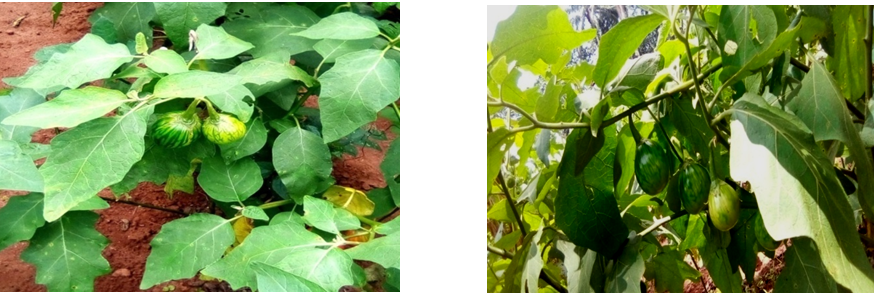
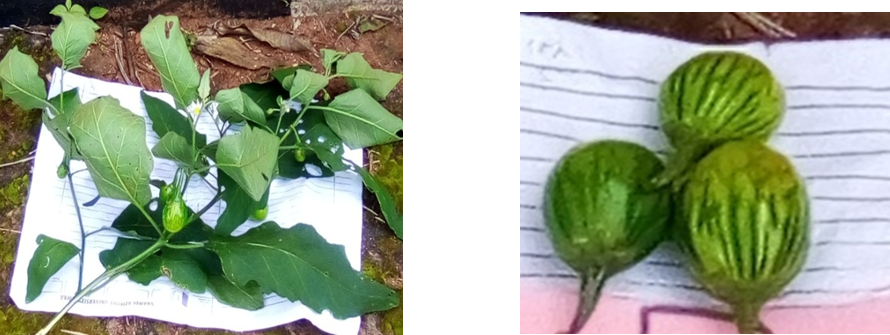
Careful examinations of the habit morphology of Solanum aethiopicum var “anara Adazi” plant Figure 1 showed the habit to be a fairly Woody deciduous annual or occasionally perennial shrub growing up to height of 100- 150 cm. It is frost tender, flowers from July to September; seeds ripen from August to October. It is also much branched; root system extending both vertically and laterally.
Careful examinations of the morphology of the leaf of Solanum aethiopicum var “anara Adazi” showed the following features: phyllotaxy to be alternately arranged, slightly too deeply lobed margin, pubescent, pinnately veined, acute to obtuse apex, obtuse to cordace base, colour-green, simple form, shape- oval, stipule is absent and petiole is 2-7cm (Figure1).
Careful examinations of the morphology of the flower of Solanum aethiopicum var “anara Adazi” showed the following: inflorescence- extra axillary, get flowered, racemose flower, filament is glaborous, calyx - campanulate, base and apex - Emarginate, Corolla: white or slightly purple and stellate. Flowers: bisexual, regular, pentamerous, Superior ovary. Stalked solitary axillary, measuring up to 1.2cm in diameter, Aestivation is valvate (Figure 2).
| Morphological Characteristics of S. aethiopicum | Mean | |
|---|---|---|
| 1 | Number of leaves per plant at flowering | 54.00±3.71 |
| 2 | Plant height at flowering | 33.09±1.90 |
| 3 | Plant height at harvesting | 134.57±3.10 |
| 4 | Number of branches per plant | 8.00±0.38 |
| 5 | Leaf petiole (cm) | 1.57±0.22 |
| 6 | Leaf length (cm) | 9.53±1.26 |
| 7 | Leaf width (cm) | 7.48±0.49 |
| 8 | Flower style (cm) | 0.58±0.05 |
| 9 | Fruit weight (g) | 2.78±0.63 |
| 10 | Fruit length (cm) | 4.10±0.20 |
| 11 | Fruit diameter (cm) | 4.30±0.18 |
| 12 | Yield(t/ha) | 34.8±3.06 |
| 13 | Petals length (cm) | 0.70±1.06 |
| 14 | Petals width (cm) | 0.35±0.06 |
| 15 | Sepal width (cm) | 0.40±1.06 |
| 16 | Length of style (cm) | 0.30±2.06 |
Table 1: Morphological Result of Solanum aethiopicum var “anara Adazi”.
Cytological Result
The mitotic chromosome number of S. aethiopicum var “anara Adazi” is 2n=24 and the meiotic chromosome number is n=12. From the result, S. aethiopicum var “anara Adazi” is a diploid with basic chromosome number of 12. In the association of chromosome at Metaphase 1, 12 bivalents were formed in the cell studies and this chromosome association was normal.

Discussion
The results of the external morphology showed Solanum aethiopicum var “anara Adazi” as a branched deciduous yearly or perennial shrub that reaches to the height of 150- 200cm. The morphology of leaf showed that the leaves are alternately arranged and have smooth or lobed margins. Leaf-blades can reach a length of up to 30 cm and a width of 21 cm. The leaves’ petioles are oval or elliptical, reaching a length of up to 11 cm, leaf arrangement- alternately arranged, pubescent, pinnately veined, acute to obtuse apex, obtuse to cordace base, colour-green, simple form, shape- oval, stipule is absent, length is 9.53, and width is 7.48. This is in line with the report of Bukenya and Carasco [17]. The morphology of flower showed that the inflorescence is a five-flowered lateral, racemose cyme, peduncle often short or even absent, rachis short to long, bisexual, regular, filament is glaborous, calyx - campanulate, base and apex - Emarginate, Corolla: white or slightly purple and stellate, pentamerous, Superior ovary. The flowers develop into egg- or spindle-shaped berries, which are red to orange in color with a smooth or grooved surface depending on the variety. The species is hermaphrodite (has both male and female organs) and mainly self-pollinated, but insect pollinators complement self-pollination as they provide cross-pollen, which augments gene exchange and hybrids in natural population and lessens inbreeding depression. This is in agreement with the findings of Som and Maity [18]. Fruit ranges from smooth to more or less strongly ribbed and the size ranges from 1.5- 3cm in diameter. Seed-reniform in shape, endospermic and 2-3.5mm in diameter. Pollen-tricolporate, isopolar, radially symmetrical, prolate-spheroidal to sub prolate.
These Morphological features evaluated fortify the intra and interspecific associations which can be utilized to augment the plant species identification and characterization. Morphological features according to Pandey [12] provided a healthy base in characterizing taxonomic groups. High genetic changes in crop genotypes on external traits have been described by Ilodibia, et al. [15] and Aremu, et al. [19] etc.
Mitotic and meiotic chromosome studies carried out on Solanum aethiopicum var “anara Adazi” indicated that the mitotic chromosome counts was 2n=2x=24, while the meiotic chromosome number was n= 12. This shows that Solanum aethiopicum var “anara Adazi” is a diploid. Consequently, the basic chromosome number of Solanum aethiopicum is 12. The chromosome showed one kind of chromosomal arrangement which is the bivalent relationship. Generally, Adesida and Adesogan [20] said that external traits alone should not be considered in systematic grouping of plants, cytology and others are found to be particularly beneficial by supplying extra characters.
Conclusion
The information gotten from this research showed that Solanum aethiopicum var “anara Adazi” is a diploid plant. Thus, it can be conveniently sustained and open to many genetic improvements. The overall data are valuable for taxonomic characterization and identification of the plant species in the genus.
Authors’ Contributions
This work was carried out in collaboration between all authors. Author CVI designed the study and all authors wrote the first draft of the manuscript and managed the literature searches. Author CVI managed the analyses of the study and Author CVI supervised the work
Competing Interests
Authors have declared that no competing interests exist.
References
-
Mabberley DJ (2008) Mabberley’s Plant-Book: A Portable Dictionary of Plants, their Classification, and Uses. Cambridge University Press, Cambridge, USA, pp: 110-200.
-
Norman JC (2009) Tropical Vegetable Crops. Arthur Stock well Ltd, Devon, London, pp: 341-352.
-
Lester RN (1986) Taxonomy of scarlet eggplants, Solanum aethiopicum L. In: van der Maesen LJG (Ed.), Acta Horticulturae 182: I International Symposium on Taxonomy of Cultivated Plants. ISHS, Leuven, Belgium, pp: 125-132.
-
Lester RN, Niakan L (1986) Origin and domestication of the Scarlet Eggplant, Solanum aethiopicum L., from S. anguivi in Africa. In: D Arcy WG (Ed.), Solanaceae: biology and systematics. Columbia University Press, New York, United States, pp: 433-456.
-
Lester RN, Seck A (2004) Vegetables. In: Grubben GJH, et al. (Eds.), Plant resources of Tropical Africa. Eartprint Limited, Wellington House, Hertfordshire, United Kingdom, pp: 472-477.
-
Sunseri F, Polignano GB, Alba V, Lotti C, Visignano V, et al. (2010) Genetic diversity and characterization of African eggplant germplasm collection. Africa Journal of Plant Science 4(7): 231-241.
-
Adeniji OT, Kusolwa P, Reuben SOWM (2012) Genetic diversity among accessions of Solanum aethiopicum L. groups based on morphoagronomic traits. Plant Genetics Resources 10(3): 177-185.
-
Lester RN, Daunay MC (2003) Diversity of African vegetable Solanum species and its implications for a better understanding of plant domestication. Symposium dedicated to the 100th birthday of Rudolf Mansfeld, Germany.
-
Wahaga E, Arimeyaw SIS (2021) Post-Harvest Losses of Eggplant in Ghana. Nigeria Agricultural Journal 52(3): 316-324.
-
Ofori K, Gamedoagbao DK (2005) Yield of scarlet eggplant (Solanum aethiopicum L.) as influenced by planting date of companion cowpea. Scientia Horticulturae 105(3): 305-312.
-
Radford AE (1986) Fundamentals of Plant Systematics. Harper and Row, New York, US, pp: 23.
-
Pandey BP (2007) A Textbook on Botany; Angiosperms, S Chand and Company Limited, New Delhi, India, pp: 990.
-
Dutta AC (2004) Botany for Degree Student. 6th(Edn.), Oxford University Press, London, pp: 708.
-
Stace CA (1980) Plant Taxonomy and Biosystematics. University Park Press, London, pp: 279.
-
Ilodibia CV, Okoli BE, Okeke CU (2019) Evaluation of cytological and morphological traits of Morinda lucida benth. An under-exploited tropical species. Asian Journal of Biological sciences 12(4): 891-897.
-
Okoli BE (2005) Field. Herbarium and Laboratory Techniques, Mbeyi and Associates (Nig.) Ltd, Port Harcourt, Nigeria, pp: 239.
-
Bukenya-Ziraba R, Carasco JF (1999) Ethno botanical aspects of Solanum L. (Solanaceae) in Uganda. In: Nee M, et al. (Eds.), Solanaceae 4: Advances in biology and utilization. Royal Botanic Gardens, Kew, Richmond, United Kingdom, pp: 345-360.
-
Som MG, Maity TK (1986) Brinjal. Vegetable Crops in India, pp: 293-341.
-
Aremu CO, Ariyo OJ, Adewale BD (2007) Assessment of Selection Techniques in Genotype X Environment Interaction in Cowpea Vigna unguiculata (L.) Walp. African Journal of Agricultural Resource 2(8): 352-355.
-
Adesida GA, Adesogan EK (1972) Oruwal, a novel dihydroanthraquinone pigment from Morinda lucida Benth. Journal of Chemical Soc Chem Commun 7: 405- 406.
- Evaluation of Proximate and Mineral Compositions of Momordica charantia L. (Cucurbitaceae)
- Targeting Superbugs: Efficacy of Bacteriophage Therapy against Antibiotic-Resistant Pseudomonas Aeruginosa in Urinary Tract Infections
- Genetic Insights into Prepubertal Gynecomastia: A Comprehensive Analysis of a Rare 45,X[2]/ 46,X, + mar[28] Karyotype
- The Efficiency of Biological Treatment Plants in Some Private Hospitals in the City of Basra, Iraq
- Exploring the Combined Efficacy of Carvacrol and Friedelin against Multi-Drug Resistant Bacteria in Upper and Lower Respiratory Tract Infections
- Isolation, Identification and Comparative Analysis of Oral Microbial Communities in Smokers and Non-Smokers: A Scientific Investigation