
Evaluation of Psychotropic Drugs and Falls among Discharged Elderly Patients in Sana’a City, Yemen
Background: In the elderly, falls are a common and important problem. One of the most feared consequences of falling is a hip fracture. Psychotropic drugs are used extensively among older people and there is a risk of falling that these drugs are used long-term and off-label. In addition to treatment of mental health problems such as depression, anxiety, and insomnia, with psychotropic drugs, these drugs are also prescribed to older patients for behavioral and psychological symptoms of dementia (BPSD). Aims of the study: To investigate whether psychotropic drugs are associated with an increased risk of fall injuries in older adults. Materials and Methods: A retrospective cross-sectional study was conducted on 170 discharge prescriptions of neurosurgery department from Mar 2022 to May 20202. In the present study, the elderly patients of 65 years and above were included in this study. The relevant data were collected from computerized records of a teaching hospital in Sana’a, Yemen. The prescriptions were evaluated and reviewed for investigate whether psychotropic drugs are associated with an increased risk of fall injuries. The obtained data was analyzed using descriptive statistics SPSS version 26. Categorical variables were presented as frequencies and percentages. Also, data were analyzed by chi-square test to know the relationship between the poly-pharmacy and major drug-drug interactions. A value of P-value > 0.05 was considered statistically significant. Results: A total of 170 discharge prescriptions were enrolled. 99 (58.3%) were male patients and 71 (41.8%) were female. It was showed that the major morbidity pattern was depression 79 (46.5). It had been found that (14 drugs) were drugs that generally should be avoided in older adults. The benzodiazepines were the most. The drugs that should be used with caution when prescribe to older adults were 6 drugs and the antidepressant SSRI was the most. Drugs to be avoided or dosage reduced with varying levels of kidney function were 3 drugs on discharge based on AGS 2019. According to the study results, 16.5% of patients had poly-pharmacy on discharge and 83.5% with no poly-pharmacy. The study results revealed that 62 (25.3%) of patients had at least one major drug-drug interactions on discharge. The most common drug-drug interaction was between antidepressant drugs (amitriptyline) with benzodiazepines (lorazepam) which result increase of falls and injuries. The relationship between poly-pharmacy at discharge and major drug-drug interaction was statistically significant in this study. Conclusion: This study showed a high prevalence of PIMs which are mostly psychotropic drugs that should be avoided or used with caution among older patients. Also, this study identifies the major drug-drug interactions that make falls and injures. Poly-pharmacy and chronic conditions were predictors for increased use of PIMs among older patients. Increase the knowledge about PIMs, psychotropic drugs and their potential side effects among patients and healthcare providers is warranted.
Introduction
Mental disorders are a concern in old age. Pharmacological treatment with psychotropic drugs (i.e., antipsychotics, anxiolytics, hypnotics, and antidepressants) is usually standard treatment and provision of psychotherapy is scarce in this age group. In addition to treatment of mental health problems, such as depression, anxiety, and insomnia, psychotropic drugs are also prescribed to older patients for behavioral and psychological symptoms of dementia (BPSD). Thus, psychotropic drugs are used extensively among older people and there is a risk that these drugs are used long‐term and off‐label [1].
The cumulative effect of use of multiple psychotropic drugs has gained little previous attention, although poly-pharmacy is a recognized problem in old age pharmacotherapy. The burden of multiple uses of psychotropic drugs on the aging brain can increase the risk of adverse drug reactions and should therefore be avoided in elderly patients. Although this is considered as inappropriate prescribing in United States national guidelines [2].
Poly-pharmacy, often defined as the use of five or more medications, is prevalent in adult’s ages 65 years and older, with 40% taking 5 to 9 medications and 18% taking 10 or more. Poly-pharmacy can result in inappropriate prescribing of medications, causing adverse drug events (ADEs). Studies have shown that ADEs in older adults can lead to increased emergency department visits and hospitalizations, resulting in increased health care utilization and cost. Older patients become more prone to adverse drug reactions from altered pharmacokinetics and pharmacodynamics [3].
Psychotropic drugs are a well‐documented risk factor for fall injuries, which can cause serious adverse outcomes in older persons including increased mortality risk. Studies have also suggested a direct link between antipsychotic use and increased mortality in frail older persons. However, few previous investigations have analyzed risk of fall injuries [1]. Some of the important health conditions are associated with falls such as vision impairment, frailty, poly-pharmacy, and use of potential fall risk-increasing drugs. Falls among older adults are largely preventable by identifying and controlling particularly modifiable risk factors [4].
The goal of the current study, which was the first one carried out in Yemen, was
- To investigate whether psychotropic drugs are associated with an increased risk of fall injuries in older adults.
- Psychotropic drugs that generally should be avoided and use with caution in older adults.
- Identify major drug- drug interactions in the elderly.
- Identify psychotropic drugs according to class with risk of falls in the elderly.
- Identify poly-pharmacy.
Materials and Methods
This retrospective cross-sectional study was conducted on patients’ medication discharge in Mar 2022. Patients of age 65 years and above of both sexes were included in the study. The 170 outpatient’s medical charts were reviewed to obtain their medication lists. The relevant data were collected from computerized records of a teaching hospital in Sana’a, Yemen and evaluated and reviewed for investigate whether psychotropic drugs are associated with an increased risk of fall injuries.
The study reviewed patients’ medical charts extracted from the electronic health record (EHR) database. to obtain the required data. Collected demographic data include:
- Age and gender,
- The diagnosis,
- Creatinine clearance and
- The list of discharged medications.
Beer’s criteria 2019 [5] are the criteria used to identify potentially inappropriate medications (PIMs) among the elderly patients. Based on these criteria, PIMs are classified into:
- Drugs that generally should be avoided in elderly.
- Drugs to be avoided in combination with specific comorbidities.
- Drugs to be used with caution.
- Drug-drug interactions that should be avoided in elderly.
- Drugs to be avoided or dosage reduced with varying levels of kidney function. Drugs, that generally should be avoided and drugs to be used with caution in elderly, were investigated in the present study.
Statistical analysis was done by SPSS software version 26.0 by using Pearson’s Chi-square test. P-value of less than 0.05 was considered significant. Categorical variables were presented as frequencies and percentages. Full ethical clearance was obtained from the qualified authorities who approved the study design. The study protocol was approved by the Ethics Committee of Saba University and hospital of university sciences and technology.
Results
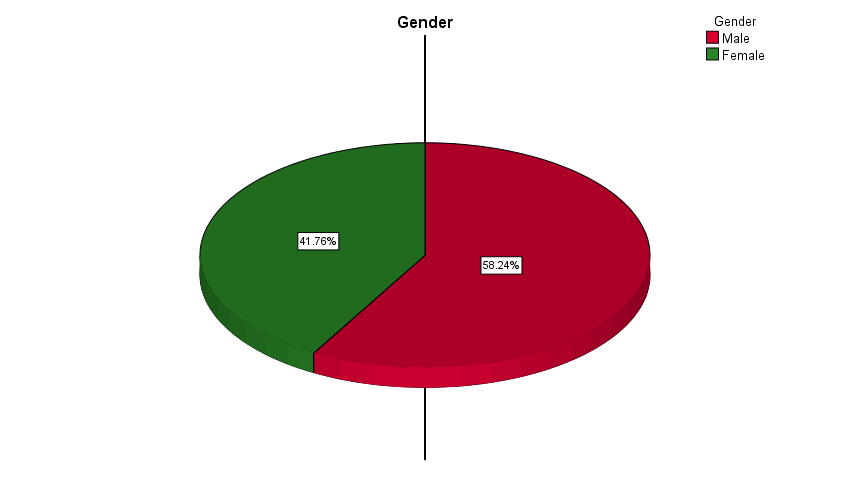
In the current study, a total of 170 in-patients discharge records were reviewed and 58.2 % of them were males and the remaining was female (Figure 1).
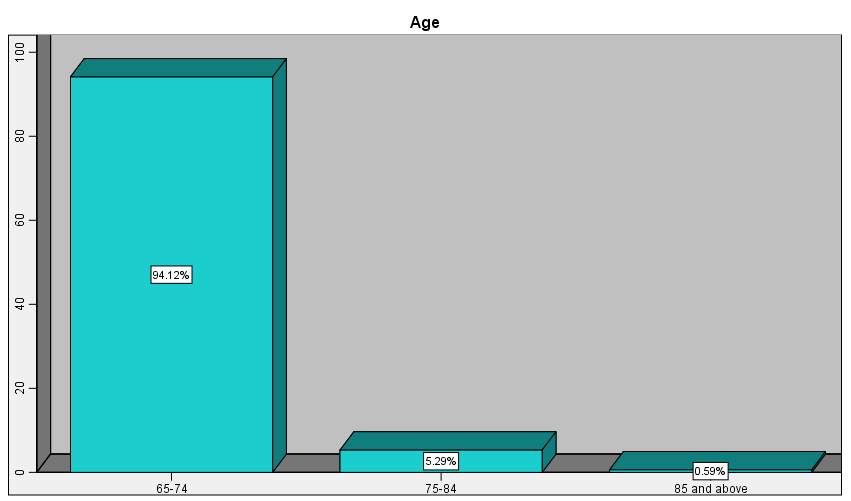
It was found that the patient’s age varied from 65 to 98 years. The age was categorized into three groups: 65- 74 years, 75-84 years and 85 years and above. According to the study findings, 94.1% of the patients were within 65-74 years old (Figure 2).
The major morbidity pattern of mental health problems was depression 46.5% and 21.2% of the morbidity included schizophrenia and anxiety disorders (Table 1).
| Variable | Frequency | Percent (%) |
|---|---|---|
| Alzheimer disease | 7 | 4.1 |
| Schizophrenia | 36 | 21.2 |
| Depression | 79 | 46.5 |
| Insomnia | 1 | 0.6 |
| Anxiety disorder | 36 | 21.2 |
| Epilepsy | 1 | 0.6 |
| Obsessive compulsive disorder | 2 | 1.2 |
| insomnia + anxiety | 1 | 0.6 |
| schizophrenia + anxiety | 2 | 1.2 |
| depression + anxiety | 5 | 2.9 |
| Total | 170 | 100 |
Table 1: Morbidity pattern of the elderly patients In the current study, 14 drugs were drugs that generally should be avoided in
| Drug | Frequency | Percent (%) |
|---|---|---|
| Olanzapine | 41 | 34.7 |
| Risperidone | 10 | 8.5 |
| Haloperidol | 3 | 2.5 |
| Zolpidem | 8 | 6.7 |
| Alprazolam | 10 | 8.3 |
| Quetiapine | 4 | 3.4 |
| Amitriptyline | 14 | 11.9 |
| Chlordiazepoxide | 10 | 8.5 |
| Clonazepam | 3 | 2.5 |
| Aripiprazole | 3 | 2.5 |
| Lorazepam | 1 | 0.85 |
| Hyoscyamine | 1 | 0.85 |
| Clomipramine | 4 | 3.4 |
| Paroxetine | 6 | 5.1 |
| Total | 118 | 100 |
Table 4: Psychotropic drugs that generally should be avoided in older adults.
The drugs that should be used with caution when prescribe to older adults were 6 drugs. The antidepressant SSRI was the most as mentioned on Table 3.
| Variable | Frequency | Percent (%) |
|---|---|---|
| Alzheimer disease | 7 | 4.1 |
| Schizophrenia | 36 | 21.2 |
| Depression | 79 | 46.5 |
| Insomnia | 1 | 0.6 |
| Anxiety disorder | 36 | 21.2 |
| Epilepsy | 1 | 0.6 |
| Obsessive compulsive disorder | 2 | 1.2 |
Table 2: Psychotropic drugs to be used with caution in older adults.
Drugs to be avoided or dosage adjusted with varying levels of kidney function were 3 drugs on discharge prescriptions based on AGS 2019 (Table 4).
| Variable | Frequency | Percent (%) |
|---|---|---|
| Ciprofloxacin | 1 | 33.3 |
| Nitrofurantoin | 1 | 33.3 |
| Ranitidine | 1 | 33.3 |
| Total | 3 | 100 |
Table 3: Drugs to be avoided or dosage reduced with varying levels of kidney function.
According to the study results, 16.5% of patients had poly-pharmacy on discharge and 83.5% with no poly- pharmacy (Table 5).
| Quetiapine | 4 | 3.4 |
| Amitriptyline | 14 | 11.9 |
| Chlordiazepoxide | 10 | 8.5 |
| Clonazepam | 3 | 2.5 |
| Aripiprazole | 3 | 2.5 |
| Lorazepam | 1 | 0.85 |
| Hyoscyamine | 1 | 0.85 |
Table 5: Prevalence of poly-pharmacy.
The study results showed that 62 (25.3%) of patients had at least one major drug-drug interactions on discharge. The most common drug-drug interaction was between antidepressant drugs (amitriptyline) with benzodiazepines (lorazepam) which result increase of falls and injuries. The relationship between poly-pharmacy at discharge and major drug-drug interaction was statistically significant (Table 6).
| Variable | At least one major Drug-Drug Interaction | No major Drug-Drug Interaction | Total | P-Value | |
|---|---|---|---|---|---|
| Poly-pharmacy at discharge (chronic drugs only) | Yes | 25 | 3 | 28 | 0 |
| No | 37 | 105 | 142 | ||
| Total | 62 | 108 | 170 |
Table 6: Distribution of major D-D interaction according to poly-pharmacy at discharge.
Regarding drug-disease interactions, 3(1.8%) of patients had at least one major drug-disease interaction on discharge. The most drug disease interaction was between patients that have history of falls and using antidepressant or benzodiazepine drugs (Table 7).
| Frequency | Percent | |
|---|---|---|
| At least one major Drug-Disease Interaction | 3 | 1.8 |
| No major Drug-Disease Interaction | 167 | 98.2 |
| Total | 170 | 100 |
Table 7: Drug-Disease interactions.
Discussion
Toxic effects of medications and drug-related problems can have profound medical and safety consequences for older adults and economically affect the health-care system. In this study, the presence of certain chronic conditions in older patients predicted the increased chance of PIMs use. We specified in our study that we collect the data from neuroscience department. The most common morbidity resulting in this section was depression, followed by schizophrenia and anxiety. Majority of drugs prescribed to the study population were those acting on central nervous system, among the (CNS) drugs, antipsychotics and antidepressants, which are psychotropic drugs were the most frequently prescribed drugs as mentioned above [6]. Among the psychotropic drugs, antidepressants were most strongly related to fall injuries. This is in line with recent research that has pointed out the risk of falls associated with these drugs [7].
The prevalence of PIMs is to be avoided for older adults which are 14 drugs. Olanzapine was the most prescribed with a frequency of 41 prescriptions followed by Amitriptyline with frequency of 14 prescriptions as mentioned in [Table 2]. Olanzapine can be used only with caution in schizophrenia and bipolar cases, in our study this drug was dispend for other these two cases such as Alzheimer disease.
The risk of any falls was 64% higher among psychotropic drug users compared to nonusers. In terms of major subgroups of psychotropic drugs, use of antidepressants overall increased the risk of falls significantly after considering all potential confounders [4].
In the study findings, the benzodiazepine and antidepressant drugs were the most prescribed drugs. All benzodiazepines increase risk of cognitive impairment, delirium, falls, fractures and motor vehicle crashes in older adults.
The most common type of anxiolytic-benzodiazepines has previously been investigated in relation to mortality among older people [7].
Hypnotics and sedatives may likely be used on a regular basis, whereas anxiolytics are probably used more irregularly. The timing of dosage during the day might also be of importance. Hypnotics and sedatives are taken before bedtime and may therefore exert influence only during sleep, whereas anxiolytics are used during day time and may therefore be more related to adverse outcomes such as day time excessive sedation, injuries, falls, and fractures [8].
Antipsychotics such as olanzapine can increase risk of cerebrovascular accident (stroke) and greater rate of cognitive decline and mortality in persons with dementia. Antidepressants such as amitriptyline and paroxetine have high anticholinergic and sedating effect and can cause orthostatic hypotension [9].
For PIMs that’s should be used with caution were 6 drugs, which Escitalopram and mirtazapine had the majority of prescribed drugs as mentioned on Table 3. All of those drugs may exacerbate or cause the syndrome of inappropriate antidiuretic hormone secretion (SIADH) or hyponatremia, so monitor sodium level closely when starting or changing dosages in older adults is important [10].
PIMs that’s should be avoided or dosage reduced with varying levels of kidney function according to GFR that was calculated using MDRD equation which are three drugs but not psychotropic drugs in our study, ciprofloxacin, nitrofurantoin and ranitidine were the only drugs that should be avoided according to eGFR. Ciprofloxacin with CrCl <30 mL/min increased risk of CNS effects (e.g., seizures, confusion) and tendon rupture, doses used to treat common infections typically require reduction when CrCl <30 mL/ min.
Nitrofurantoin with CrCl <30 mL/min can cause potential pulmonary toxicity, hepatotoxicity, and peripheral neuropathy so this drug should be avoided. Ranitidine is known to cause mental status changes and dose should be reduced when patient CrCl is <30 ml/min [11].
The most likely factor associated with PIMs use in this study and increase falls in the elderly was poly-pharmacy. We found that 16.5% of discharge prescriptions had poly- pharmacy [Table 5]. The higher rate of poly-pharmacy use in our study population may be attributed to the higher rate of multiple chronic conditions (i.e., two or more chronic conditions), in which they may need to take many medications to control their chronic conditions or to prevent complications associated with certain chronic conditions.
There was a strong relationship between psychotropic poly-pharmacy and risk of death. Smaller studies of dementia patients have also found an association between use of several psychotropic drugs and mortality [12].
Specific combination of various drugs in a given patient has the potential to result in an interaction. As numbers of medications increase the drug-drug interactions will increase [3].
The most major drug-drug interaction was between antipsychotic, benzodiazepines and antidepressants which are all increase risk of falls and injures. Other most common drug-drug interaction was between amisulpride and olanzapine they increase toxicity of each other, they increased risk of neuroleptic malignant syndrome, and they increase prolongation of QTC interval. The most drug-disease interaction was between olanzapine and Alzheimer disease; olanzapine increases mortality of Alzheimer patients. The role of health care providers should expand in order to take the necessary precautions when managing older patient’s conditions to avoid inappropriate medications prescribing, adverse events and other misadventures associated with older patients. Psychotropic drugs must be choosing and monitoring carefully because of serious adverse effect which is increased risk of falls and injures [13].
The study is subjected to some limitations. One of the study limitations is that not all psychotropic medications are available in the hospital formulary. Also, this study is done over one hospital only; one department and the study duration were short so, the results may be not representative of all geriatrics in Yemen.
Conclusion & Recommendations
This study showed a high prevalence of PIMs which are mostly psychotropic drugs that should be avoided or used with caution among older patients. Also, this study identifies the major drug-drug interactions that make falls and injures. Poly-pharmacy and chronic conditions were predictors for increased use of PIMs among older patients. Increase the knowledge about PIMs, psychotropic drugs and their potential side effects among patients and healthcare providers is warranted. According to the results obtained in this work, the following recommendations are proposed:
- Further studies should be done on admission and discharge psychotropic medication list at the hospital to avoid inappropriate use of them and to avoid increase risk of falls and injures.
- And to more improve the outcomes for the elderly patients.
- Physicians should be aware and given more attention during prescribing of psychotropic drugs.
References
-
Alamgir H, Muazzam S, Nasrullah M (2012) Unintentional Falls Mortality among Elderly in the United States: Time for Action. Injury 43(21): 2065-2071.
-
Bloch F, Thibaud M, Dugué B, Brèque C, Rigaud AS, et al. (2011) Psychotropic Drugs and Falls in the Elderly People: Updated Literature Review and Meta‐Analysis. J Aging Health 23(2): 329-346.
-
O’Connor MN, Gallagher P, Omahony D (2012) Inappropriate Prescribing: Criteria, Detection and Prevention. Drugs Aging 29(6): 487-452.
-
Du Y, Wolf IK, Knopf H (2017) Association of Psychotropic Drug Use with Falls among Older Adults in Germany. Results of the German Health Interview and Examination Survey for Adults 2008-2011 (DEGS1). PLoS ONE 12(8): e0182432.
-
American Geriatrics Society Beers Criteria Update Expert Panel (2019) American Geriatrics Society 2019 Updated AGS Beers Criteria® for Potentially Inappropriate Medication Use in Older Adults. J Am Geriatr Soc 67(4): 674-694.
-
Campbell AJ (1991) Drug Treatment as a Cause of falls in Old Age. A Review of the Offending Agents. Drugs Aging 1(4): 289-302.
-
Huang AR, Mallet L, Rochefort CM, Eguale T, Buckeridge DL, et al. (2012) Medication‐Related falls in the Elderly: Causative Factors and Preventive Strategies. Drugs Aging 29: 359-376.
-
Charlson F, Degenhardt L, McLaren J, Hall W, Lynskey M (2009) A Systematic Review of Research Examining Benzodiazepine‐Related Mortality. Pharmacoepidemiol Drug Saf 18(2): 93-103.
-
Johnell K, Laflamme L, Moller J, Monarrez‐Espino J (2014) The Role of Marital Status in the Association Between Benzodiazepines, Psychotropics and Injurious Road Traffic Crashes: A Register‐Based Nationwide Study of Senior Drivers in Sweden. PLoS One 9(1): e86742.
-
Salzman B (2010) Gait and Balance Disorders in Older Adults. Am Fam Physician 82(1): 61-68.
-
Garasto S, Fusco S, Corica F, Rosignuolo M, Marino A, et al. (2014) Estimating Glomerular Filtration Rate in Older People. Biomed Res Int 2014: 916542.
-
Hartikainen S, Rahkonen T, Kautiainen H, Sulkava R (2005) The Use of Psychotropics and Survival in Demented Elderly Individuals. Int Clin Psychopharmacol 20(4): 227-231.
-
Mahoney JE (2010) Why Multifactorial Fall-Prevention Interventions May Not Work: Comment on “Multifactorial Intervention to Reduce Falls in Older People at High Risk of Recurrent Falls.” Arch Intern Med 170(13): 1117- 1119.
- Gallic and Citric Acid Present in the Peels of Tropical Fruits as an Alternative in the Fight against Cancer
- Treating the Forehead Lines with Combination of Forehead and Glabellar Botulinum Toxin Among Japanese Patients
- Clinical Evaluation of Patients Suffering from Breast Cancer & Determination of Treatment Therapies and Better Strategies Related to Breast Cancer
- Medieval Recipes by Al-Zahrāwī for Heart Palpitations Treatment
- Etiology and Prescription Errors of Myocardial Infarction in Different Health Care Systems of Azad Kashmir
- Early Diagnosis and Multidisciplinary Management of Turner Syndrome: A Paediatric Case Study