
Overview on Pharmacovigilance: Ensuring Medication Safety
Pharmacovigilance plays a pivotal role in ensuring drug safety by monitoring and evaluating the effects of medications before and after their market launch. In India, a rapidly expanding pharmaceutical industry coupled with a diverse patient population and growing drug consumption necessitates robust pharmacovigilance measures. This abstract highlights the need for pharmacovigilance in India, emphasizing factors such as the expansion of the pharmaceutical sector, diverse patient demographics, increased drug consumption, limited awareness and reporting, regulatory compliance, globalization of clinical trials, and emerging safety concerns. The Pharmacovigilance Programme of India (PvPI) serves as a cornerstone for patient safety, focusing on data collection, signal detection, capacity building, and regulatory collaboration. Reporting adverse drug reactions (ADRs) to PvPI is crucial, and various reporting methods, including online reporting, Vigiflow software, ADR reporting forms, direct communication, telephone reporting, and email, are discussed. Additionally, advice on what to report, who can report, where to report, and the handling of submitted information is provided to encourage effective ADR reporting. Overall, pharmacovigilance in India is essential for ensuring the safe and effective use of pharmaceutical products, protecting public health, and minimizing risks associated with medications.
Introduction
Pharmacovigilance, the systematic monitoring and evaluation of drugs’ effects pre- and post-market release, is fundamental to ensuring medication safety and efficacy. This process involves the detection and prevention of adverse drug reactions (ADRs) through comprehensive data collection from healthcare providers, patients, and pharmaceutical companies. With the pharmaceutical industry rapidly expanding globally, including in India, the importance of robust pharmacovigilance measures cannot be overstated.
The Indian pharmaceutical sector has witnessed significant growth in recent years, emerging as a major player in the global generic drugs market [1]. This expansion has led to an increased influx of medications into the market, necessitating vigilant monitoring to safeguard public health.
Furthermore, India’s diverse population, characterized by variations in genetics, lifestyles, and healthcare practices among different regions and communities, underscores the need for tailored pharmacovigilance strategies [2]. Such diversity can result in differential drug responses and ADRs, emphasizing the importance of proactive surveillance to address varying safety concerns effectively. Additionally, the escalating consumption of pharmaceutical drugs in India due to population growth, urbanization, and improved healthcare access heightens the urgency for robust pharmacovigilance systems [3]. Despite these imperatives, challenges such as limited awareness among healthcare professionals and underreporting of ADRs persist in India [4].
In response to these challenges, regulatory agencies such as the Central Drugs Standard Control Organization (CDSCO) have mandated pharmacovigilance activities to ensure drug safety and regulatory compliance [5]. The Pharmacovigilance Programme of India (PvPI), launched in 2010, serves as a pivotal initiative to enhance patient safety and monitor the safety of pharmaceutical products nationwide [6]. Through a patient-centric approach, PvPI facilitates data collection, signal detection, capacity building, and regulatory collaboration to promote medication safety.
What is Pharmacovigilance?
Pharmacovigilance is the process of monitoring and evaluating the effects of drugs both before and after their launch into the market [7]. It involves assessing the quality of drugs and detecting and preventing any adverse effects that may arise. This comprehensive approach to drug safety encompasses gathering information from various sources, including healthcare providers, pharmaceutical companies, and patients, to better understand the risks and benefits associated with specific medications.
The development of new drugs involves significant investments of time and resources by pharmaceutical companies, including extensive clinical trials to ensure safety and efficacy before market approval. With the advancement of information technology (IT), pharmacovigilance has evolved to incorporate IT systems for enhanced safety signal detection and management.
Regulators now require proactive surveillance programs throughout a drug’s lifecycle, including comprehensive risk management plans and ongoing signal detection and analysis. This shift in approach highlights the importance of not only reporting adverse events but also actively monitoring safety concerns throughout a product’s lifespan.
Pharmacovigilance plays a crucial role in evaluating drug safety post-marketing, informing regulatory decisions, and ensuring the ongoing safety of both new and existing medications. It encompasses various activities, including spontaneous reporting of adverse events, systematic epidemiological studies, and the identification and evaluation of safety signals.
Safety signals, which indicate a potential concern about the safety of a drug, can arise from various sources, including post-marketing data and pre-clinical studies. Pharmacovigilance also addresses a range of other issues related to drug safety, such as substandard medicines, medication errors, lack of efficacy reports, and misuse or abuse of medications.
Need for Pharmacovigilance in India
Rapidly Expanding Pharmaceutical Industry: India’s pharmaceutical sector has experienced substantial growth in recent years, becoming one of the largest producers of generic drugs globally [8]. This expansion has led to an increase in the number of drugs entering the market, highlighting the necessity for robust pharmacovigilance measures to ensure their safety and efficacy.
Diverse Patient Population: India’s population is incredibly diverse, with variations in genetics, lifestyles, and healthcare practices among different regions and communities [9]. This diversity can result in differential drug responses and adverse reactions, underscoring the importance of pharmacovigilance to monitor and address such variations effectively.
Growing Drug Consumption: The consumption of pharmaceutical drugs in India has been steadily rising due to factors such as population growth, urbanization, and increased access to healthcare services [6, 9]. With more people using medications, there is a heightened need for pharmacovigilance to detect and mitigate any adverse effects that may arise.
Limited Awareness and Reporting: Despite the importance of pharmacovigilance, there remains a lack of awareness among healthcare professionals, regulators, and the general public in India [8]. This lack of awareness often leads to underreporting of adverse drug reactions, hindering the timely identification of potential safety concerns.
Regulatory Compliance: Regulatory agencies such as the Central Drugs Standard Control Organization (CDSCO) have mandated pharmacovigilance activities to ensure drug safety and regulatory compliance [8]. Pharmaceutical companies operating in India must establish pharmacovigilance systems to adhere to these regulations and maintain the safety of their products.
Globalization of Clinical Trials: India has become an attractive destination for clinical trials due to its large and diverse patient population, as well as lower research and development costs [9]. However, the globalization of clinical trials also brings the need for rigorous pharmacovigilance practices to safeguard the well-being of trial participants and ensure the ethical conduct of research.
Emerging Safety Concerns: The introduction of new drugs and therapies poses potential safety risks, including adverse drug reactions and medication errors [8]. Pharmacovigilance plays a crucial role in identifying and addressing these safety concerns, thereby enhancing patient safety and public health.
Role of Pharmacovigilance in Medicines Regulation
The role of pharmacovigilance in medicines regulation in India is pivotal for ensuring the safety, efficacy, and quality of pharmaceutical products. Pharmacovigilance encompasses systematic monitoring, detection, assessment, and reporting of adverse events associated with medicines a detailed exploration of its role.
Monitoring and Reporting Adverse Events: Pharmacovigilance involves the systematic monitoring, detection, assessment, and reporting of adverse events associated with medicines [10]. This includes collecting data on adverse drug reactions (ADRs) from healthcare professionals, patients, and pharmaceutical companies.
Risk Assessment and Management: Pharmacovigilance plays a pivotal role in assessing the risks associated with the use of medicines and implementing measures to manage these risks effectively [11]. This involves evaluating the benefit-risk profile of medicines and taking regulatory actions when necessary, such as updating product labels or issuing safety alerts.
Regulatory Compliance: Pharmacovigilance is integral to regulatory compliance in India’s medicines regulation framework [12]. Regulatory authorities such as the Central Drugs Standard Control Organization (CDSCO) require pharmaceutical companies to establish pharmacovigilance systems and adhere to reporting obligations outlined in pharmacovigilance guidelines.
Post-Marketing Surveillance: Pharmacovigilance extends beyond pre-market clinical trials to encompass post- marketing surveillance of medicines [10]. This involves monitoring the safety of medicines after they have been approved and marketed to detect any previously unidentified adverse effects or safety concerns.
Signal Detection and Analysis: Pharmacovigilance activities include the identification and analysis of safety signals, which are indications of potential safety issues associated with medicines [11]. This involves analyzing pharmacovigilance data to detect patterns or trends that may suggest previously unrecognized risks.
Public Health Protection: Pharmacovigilance ultimately serves to protect public health by ensuring the safe use of medicines and minimizing the risks of adverse drug reactions and other medication-related problems [12]. By promptly identifying and addressing safety concerns, pharmacovigilance contributes to improving patient safety and healthcare outcomes.
Pharmacovigilance Programme of India (PvPI)
The Pharmacovigilance Programme of India (PvPI) is a comprehensive initiative aimed at enhancing patient safety and monitoring the safety of pharmaceutical products in India. PvPI, role in patient safety [13] are: Establishment and Structure: The PvPI was launched in 2010 under the aegis of the Ministry of Health and Family Welfare, Government of India. It operates under the guidance of the Indian Pharmacopoeia Commission (IPC) and encompasses a nationwide network of Adverse Drug Reaction Monitoring Centers (AMCs).
Patient-Centric Approach: At the core of the PvPI is a patient-centric approach aimed at safeguarding the health and well-being of individuals who use pharmaceutical products. By actively monitoring adverse drug reactions (ADRs) and other medication-related issues, the PvPI strives to prevent harm and enhance patient safety throughout the healthcare system.
Data Collection and Reporting: The PvPI facilitates the collection, collation, and analysis of ADR reports from various sources, including healthcare professionals, consumers, and pharmaceutical companies. These reports are submitted to the CDSCO through the Pharmacovigilance Program of India (PvPI) website or Vigiflow software.
Signal Detection and Analysis: A key aspect of the PvPI is the detection and analysis of safety signals associated with pharmaceutical products. By systematically analyzing pharmacovigilance data, the PvPI identifies potential safety concerns, emerging trends, and patterns of adverse reactions, enabling timely intervention and risk mitigation strategies.
Capacity Building and Awareness: The PvPI conducts capacity building initiatives, training programs, and awareness campaigns to educate healthcare professionals, pharmacists, and consumers about pharmacovigilance principles, reporting procedures, and the importance of medication safety. These efforts aim to enhance reporting rates, promote proactive surveillance, and foster a culture of patient Regulatory Support and Collaboration: The PvPI
collaborates closely with regulatory authorities, healthcare institutions, pharmaceutical companies, and other stakeholders to strengthen pharmacovigilance activities and support evidence-based decision-making. By providing regulatory support and sharing pharmacovigilance data, the PvPI contributes to informed regulatory actions and policy formulation to protect public health
Work flow of Adverse Drug Reaction report in PvPI
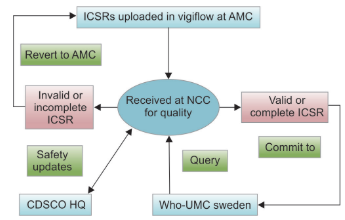
ICSRs- Individual Case Safety Reports. AMC- Adverse Drug Reaction Monitoring Centre. NCC- National Coordinating Centre (NCC) (at IPC, Ghaziabad).
Aims of Pharmacovigilance Program of India (PvPI)
It is due to pharmacovigilance program in India [14] that the regulatory agencies, media, and consumers have become more aware about the benefits and risks associated with the use of medicines. The various aims of PvPI are:
- To monitor ADRs in the Indian population
- To create awareness among HCPs about the importance of ADR reporting in India
- To generate evidence-based data/recommendations on the safe use of drugs
- To support the CDSCO in formulating safety-related regulatory decisions of medicines
- To identify and analyze new signal from the reported cases
- To communicate the safety information on use of drugs to various stakeholders to minimize the risk
- To create a national center of excellence at par with global drug safety monitoring standards
- To monitor benefit–risk profile of drugs and communicate information to all key stakeholders
- To collaborate with other national centers for the exchange of information on adverse drug reports
- To promote rational use of medicine.
The Pharmacovigilance Programme of India (PvPI) is a cornerstone of patient safety in India, encompassing data collection, signal detection, capacity building, and regulatory collaboration to ensure the safe and effective use of pharmaceutical products.
How Reporting adverse drug reactions (ADRs)
Reporting adverse drug reactions (ADRs) to the Pharmacovigilance Programme of India (PvPI) is a crucial step in ensuring medication safety [15].
Online Reporting: A convenient way to report ADRs to the PvPI is through the online reporting portal available on the Pharmacovigilance Program of India (PvPI) website [16]. The online reporting form allows healthcare professionals, consumers, and pharmaceutical companies to submit ADR reports electronically.
Vigiflow Software: Healthcare facilities and pharmacovigilance centers can use Vigiflow software, a dedicated tool provided by the PvPI, to collect, collate, and submit ADR reports [17]. Vigiflow facilitates systematic data entry and ensures standardized reporting formats for consistency and accuracy.
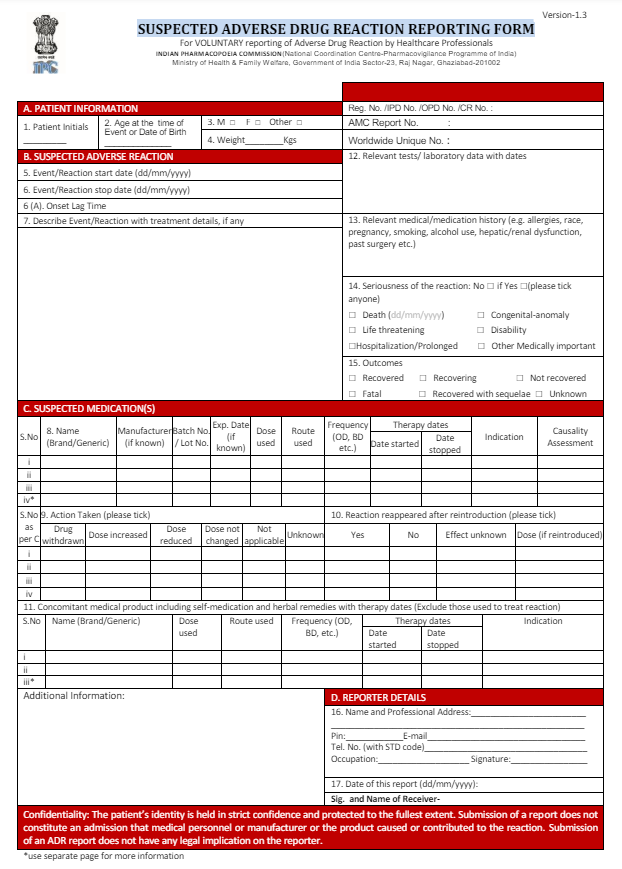
ADR Reporting Forms: Pharmacovigilance centers, healthcare institutions, and pharmacies may have physical ADR reporting forms available for healthcare professionals and consumers to fill out [18]. These forms capture essential information about the ADR, including details about the patient, the suspected medication, and the adverse event experienced.
Direct Communication: Healthcare professionals can report ADRs directly to designate [19]. These centers serve as focal points for ADR reporting and facilitate the collection and analysis of pharmacovigilance data Telephone Reporting: In some cases, healthcare professionals or consumers may prefer to report ADRs via telephone (toll free no 1800-180-3024) or email [20]. Contact information for pharmacovigilance centers or national coordinating centers can be obtained from the PvPI website or other official sources for direct communication and reporting.
Advice About Reporting [21]
What to report?
- Report serious adverse drug reactions. A reaction is serious when the patient outcome is:
- Death
- Life-threatening
- Hospitalization (initial or prolonged)
- Disability (significant, persistent or permanent)
- Congenital anomaly
- Required intervention to prevent permanent impairment or damage
- Report non-serious, known or unknown, frequent or rare adverse drug reactions due to Medicines, Vaccines and Herbal products etc.
Note: Adverse Event Following Immunization can also be reported in Serious AEFI case Notification Form available on http://www.ipc.gov.in).
Who can Report?
• All healthcare professionals (Clinicians, Dentists, Pharmacists and Nurses etc) can report adverse drug reactions
Where to Report?
- Duly filled inSuspected Adverse Drug Reaction Reporting Form can be sent to the nearest Adverse Drug Reaction Monitoring Centre (AMC) or directly to the National Coordination Centre (NCC) for PvPI.
- Call on Helpline (Toll Free) 1800 180 3024 to report ADRs or directly mail this filled form to pvpi.ipc@gov.in
- A list of nationwide AMCs is available at: http://www. ipc.gov.in, http://www.ipc.gov.in/PvPI/pv_home.html.
What Happens to the Submitted Information?
- Information provided in this form is handled in strict confidence. The causality assessment is carried out at AMCs by using WHO-UMC scale. The analyzed forms are forwarded to the NCC through ADR database. Finally the data is analyzed and forwarded to the Global Pharmacovigilance Database managed by WHO Uppsala Monitoring Centre in Sweden.
- The reports are periodically reviewed by the NCC-PvPI. The information generated on the basis of these reports helps in continuous assessment of the benefit-risk ratio of medicines.
• The Signal Review Panel of PvPI to review the data and suggest any interventions that may be required.
Mandatory Fields for Suspected ADR Reporting Form
• Patient initials, age at onset of reaction, reaction term(s), date of onset of reaction, suspected medication(s) and reporter information.
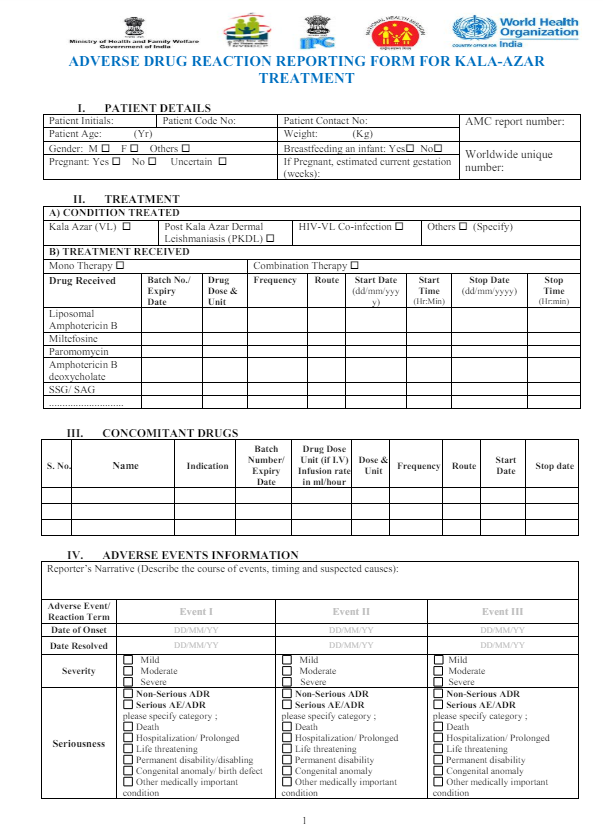
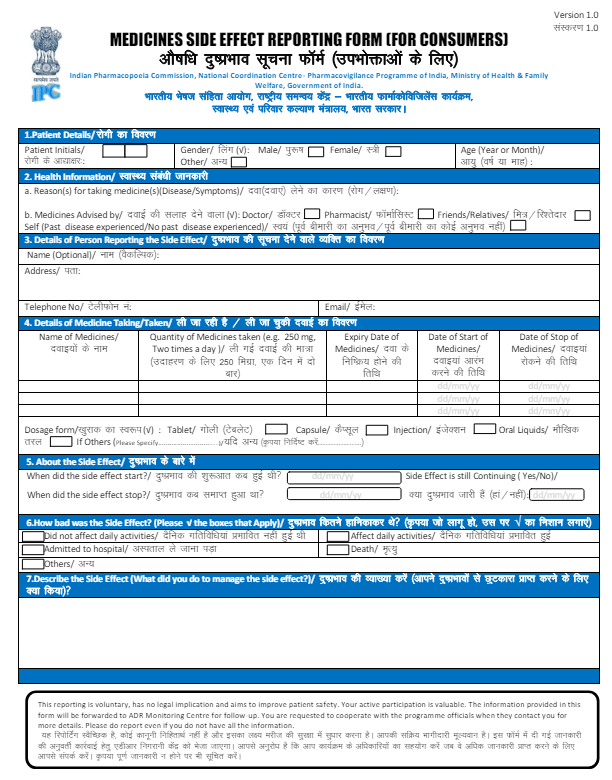
ADR Reporting Forms
Conclusion
It can be concluded that Pharmacovigilance is an important tool in ensuring patient safety as by reporting the ADRs, the patient morbidity and mortality can be reduced. This also enhances the knowledge of prescribers about drug- related events, and thus appropriate modification in the treatment can be done to benefit the patients.
References
-
Sharma A, Jacob A, Tandon M (2006) Indian pharmaceutical industry: An overview. Indian J Pharm Sci 68(2): 143-150.
-
Hema NG, Bhuvana K, Kishore G, Kumar BD (2015) An overview of pharmacovigilance practices in India. Int J Pharm Investig 5(4): 228-233.
-
Singh A, Bajpai R, Faruqi S, Singh A (2015) An insight into Indian pharmaceutical industry. Indian J Pharmacol 47(3): 262-263.
-
Ramesh M, Parthasarathi G, Deshmukh YA (2009) Adverse drug reactions reporting: Attitudes and Perceptions of Medical Practitioners. Asian J Pharm Clin Res 2(2): 10-14.
-
(2024) Indian Pharmacopoeia Commission. Pharmacovigilance Programme of India (PvPI). Indian Pharmacopoeia Commission, Ghaziabad.
-
Government of India (2010) The Gazette of India: Extraordinary Part II-Section 3-Sub-section (i). New Delhi: Ministry of Health and Family Welfare.
-
Lu Z (2009) Information technology in pharmacovigilance: Benefits, challenges, and future directions from industry perspectives. Drug, Health Care and patient safety 1: 35- 45.
-
Patel TK (2020) Emerging Importance of Pharmacovigilance in India. Journal of Pharmacovigilance 8(2): 1-2.
-
Kalaiselvan V, Sharma S, Singh GN, Gupta YK (2019) Need for Pharmacovigilance in India. Indian Journal of Pharmacology 51(2): 65-69.
-
Narayana D, Rao DN (2019) Pharmacovigilance: Importance in Indian Healthcare System. Journal of Pharmaceutical Sciences and Research 11(2): 503-507.
-
Begum S, Jain D, Singh A (2020) Pharmacovigilance: A Critical Evaluation. Journal of Advanced Pharmacy Education & Research 10(4): 186-195.
-
Chatterjee C, Debnath P, Bhaumik P (2021) Pharmacovigilance in India: An Overview. Journal of Clinical and Diagnostic Research 15(5): 1-5.
-
Pharmacovigilance Programme of India (PvPI).
-
Bavdekar SB, Karande S (2006) National pharmacovigilance program. Indian Pediatr 43(1): 27- 32.
-
How to report adverse drug reactions (ADRs). Pharmacovigilance Programme of India, Indian Pharmacopoeial Commission, Ghaziabad.
-
Online reporting portal. Pharmacovigilance Programme of India, Indian Pharmacopoeial Commission, Ghaziabad.
-
Vigiflow software. Pharmacovigilance Programme of India, Indian Pharmacopoeial Commission, Ghaziabad.
-
ADR reporting forms. Pharmacovigilance Programme of India, Indian Pharmacopoeial Commission, Ghaziabad.
-
Direct communication. Pharmacovigilance Programme of India, Indian Pharmacopoeial Commission, Ghaziabad.
-
Telephone reporting. Pharmacovigilance Programme of India.
-
ADR Reporting Form. Pharmacovigilance Programme of India, Indian Pharmacopoeial Commission, Ghaziabad.
- Gallic and Citric Acid Present in the Peels of Tropical Fruits as an Alternative in the Fight against Cancer
- Treating the Forehead Lines with Combination of Forehead and Glabellar Botulinum Toxin Among Japanese Patients
- Clinical Evaluation of Patients Suffering from Breast Cancer & Determination of Treatment Therapies and Better Strategies Related to Breast Cancer
- Medieval Recipes by Al-Zahrāwī for Heart Palpitations Treatment
- Etiology and Prescription Errors of Myocardial Infarction in Different Health Care Systems of Azad Kashmir
- Early Diagnosis and Multidisciplinary Management of Turner Syndrome: A Paediatric Case Study