
Resveratrol’s Action against Viral Infections
The biological activity of resveratrol (3,5,4’-trihydroxy-trans-stilbene) has been the subject of extensive study in the treatment of various diseases due to its anti-inflammatory, antioxidant and anticancer activities, as well as its minimal toxicity and side effects. It has been widely accepted that resveratrol also has antiviral activities. In this mini-review, we summarize resveratrol’s antiviral mechanisms. Since viral infections are often accompanied by inflammation, the TLRs/NF-κB signaling pathways are key and common molecular mechanisms for resveratrol to exert anti-inflammatory and antiviral effects.
Editorial
Some of Resveratrol’s antiviral mechanisms.
Resveratrol
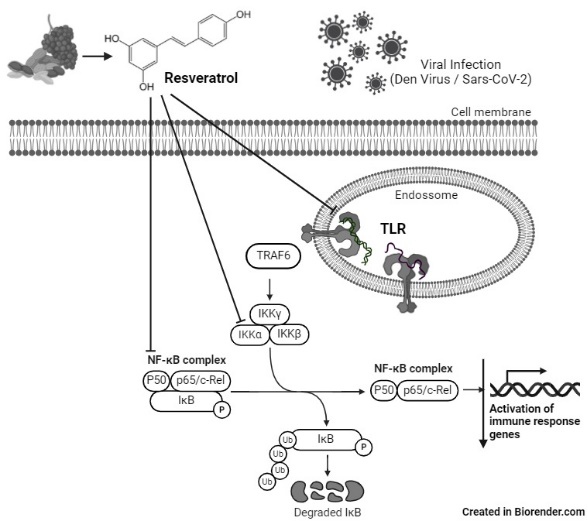
Resveratrol (3,5,4’-trihydroxy-trans-stilbene) was first isolated in 1939 from Veratrum grandiflorum (Takaoka, 1939) and subsequently found in various plant species and nutritious foods, such as grapes, blackberries, red wine, peanuts and others [1]. It has been used in the treatment of various diseases due to its anti-inflammatory, antioxidant and anticancer activities, as well as its and minimal toxicity and side effects. The antiviral mechanism of resveratrol focuses on its ability to activate the host’s immune defense responses, activating a complex network with the purpose of fighting or eliminating incoming viruses (Figure 1) [2].
NF-κB is a protein complex that belongs to a family of inducible nuclear transcription factors, found in almost all types of animal cells regulating a wide range of genes involved in various processes of antiviral activity, inflammatory and immune response. Meanwhile, we have Toll-like receptors (TLRs) located upstream of the NF-κB signaling pathway with the role of inducing antiviral innate immune responses through the recognition of virus infection, triggering the production of pro-inflammatory cytokines, interferons and chemokines. Thus, the TLRs/NF-κB pathway has been studied extensively, mainly through research into antiviral drugs.
Resveratrol regulates the expression of TLR3, influencing the recruitment of downstream factors and therefore modulating the regulation of associated signaling pathways [2, 3]. Resveratrol also modulate the activation of KF-kB pathways. Resveratrol inhibits the pseudo-rabies virus (PRV) (porcine herpesvirus) [4] by preventing the degradation of IκBα (nuclear factor of kappa light polypeptide gene enhancer in B-cells inhibitor alpha) induced by PRV infection, thus blocking the activation of the NF-κB signaling pathway in cells and consequently suppressing the transcription of viral genes, the synthesis of proteins and DNA, as well as the production of virions.
Thus, the TLRs/NF-κB signaling pathway plays an essential role in the antiviral activity of resveratrol. The Resveratrol also demonstrates the ability to inhibit the production of virions, either by directly inhibiting the expression of important viral genes, or by binding to essential enzymes and proteins that interfere with the viral replication cycle. There are several viruses that resveratrol has an effect on, such as herpes simplex virus, varicella- zoster virus, Zika virus, Enterovirus 71 [2], but this article will focus on covid and dengue due to their epidemiological relevance, among others [2]. In addition, the NF-κB signaling pathways are present in the well-known cytokine storms and oxidative stress, which are the hallmarks of COVID-19, where an important role for resveratrol can be observed [5].
COVID-19 and dengue are international public health problems with similar initial clinical manifestations and the serological overlap between the two increases the risk of diagnostic errors and also favors the development of overlapping immunological cascades that can define the progression of disease severity and also the development of vaccines. In COVID-19 and dengue, IL-6 is elevated, which is related to the severity of both, and can induce the production of other inflammatory cytokines, leading to an increase in endothelial permeability, which can lead to Acute Respiratory Distress Syndrome [6]. The pathophysiological similarities between the two diseases can promote the activation of immune cells by, such as interferon, for example, causing capillary extravasation, coagulopathy and thrombocytopenia [7]. The TLR pathway plays an important role in both cases. After the viral spike protein binds to host cells via ACE2, the SARS-CoV-2 RNA is detected by TLRs. Similarly, TLRs recognize dengue and TLR4 can establish a viral state by activating platelets in vitro [8, 9].
During SARS-CoV-2 infection, the massive inflammatory response seems to occur through the activation of the NLRP3 inflammasome, providing suitable conditions for immune cells to reach damaged sites, which can induce complement activation and opsonization when activated in severe COVID-19. In the case of dengue-positive patients, IL-
1B produced by platelets increases vascular permeability; however, patients with IL-1B-31C are at risk of developing dengue shock syndrome associated with the pathogenesis [6]. Resveratrol has demonstrated the ability to significantly reduce the expression of secretion of pro-inflammatory cytokines such as IL-1β both cellular and systemic generating a great impact on the benefits of resveratrol in reducing inflammation caused by viruses [10].
Resveratrol shows inhibitory activity against several viruses, however, despite significant advances, the molecular mechanisms by which Res exerts its broad biological effects have not yet been fully elucidated [10]. Therefore, the clinical potential of resveratrol as an antiviral agent has been observed, being widely found in medicinal plants and foods, but it should be better investigated for the development of synthetic derivatives with therapeutic applications against viral co-infections, especially dengue and COVID-19 [6, 10].
Conclusion
The clinical potential of resveratrol as an antiviral agent has been observed, being widely found in medicinal plants and foods, but it should be better investigated for the development of synthetic derivatives with therapeutic applications against viral co-infections especially dengue and COVID-19. This new drug is expected to become a valuable solution in the prevention and treatment of various human diseases, thanks to its considerable health benefits.
References
-
Huang Z, Li S, Zhong L, Su Y, Li M, et al. (2024) Effect of resveratrol on herpesvirus encephalitis: Evidences for its mechanisms of action. Phytomedicine: international journal of phytotherapy and phytopharmacology 127: 155476.
-
Chen X, Song X, Zhao X, Zhang Y, Wang Y, et al. (2022) Insights into the Anti-inflammatory and Antiviral Mechanisms of Resveratrol. Mediators of inflammation: 7138756.
-
Filardo, S, Di Pietro, M, Mastromarino, P, Sessa, R (2020) Therapeutic potential of resveratrol against emerging respiratory viral infections. Pharmacology & therapeutics 214: 107613.
-
Zhao X, Cui Q, Fu Q, Song X, Jia R, et al. (2017) Antiviral properties of resveratrol against pseudorabies virus are associated with the inhibition of IκB kinase activation. Scientific reports 7(1): 8782.
-
Szewczuk M, Forti L, Stivala A, Penning M (2004) Resveratrol is a peroxidase-mediated inactivator of COX- 1 but not COX-2: a mechanistic approach to the design of COX-1 selective agents. The Journal of biological chemistry 279(21): 22727-22737.
-
Zheng W, Wu H, Liu C, Yan Q, Wang T, et al. (2021) Identification of COVID-19 and Dengue Host Factor Interaction Networks Based on Integrative Bioinformatics Analyses. Frontiers in immunology 12 (707287): 1-15.
-
Harapan H, Ryan M, Yohan B, Abidin R, Nainu F, et al. (2021) Covid‐19 and dengue: double punches for dengue‐endemic countries in Asia. Reviews in Medical virology 31(2): e2161.
-
Catanzaro M, Fagiani F, Racchi M, Corsini E, Govoni S, et al. (2020) Immune response in COVID-19: addressing a pharmacological challenge by targeting pathways triggered by SARS-CoV-2. Signal transduction and targeted therapy 5(1): 84.
-
Tsai Y, Chang, S, Lee N, Kao C (2009) Human TLR3 recognizes dengue virus and modulates viral replication in vitro. Cellular microbiology 11(4): 604-615.
-
Kumar S, Sinha N, Kodidela S, Godse S, Singla B, et al. (2023) Resveratrol and its analogs suppress HIV replication, oxidative stress, and inflammation in macrophages. NeuroImmune Pharmacology and Therapeutics 2(4): 365-374.
- Gallic and Citric Acid Present in the Peels of Tropical Fruits as an Alternative in the Fight against Cancer
- Treating the Forehead Lines with Combination of Forehead and Glabellar Botulinum Toxin Among Japanese Patients
- Clinical Evaluation of Patients Suffering from Breast Cancer & Determination of Treatment Therapies and Better Strategies Related to Breast Cancer
- Medieval Recipes by Al-Zahrāwī for Heart Palpitations Treatment
- Etiology and Prescription Errors of Myocardial Infarction in Different Health Care Systems of Azad Kashmir
- Early Diagnosis and Multidisciplinary Management of Turner Syndrome: A Paediatric Case Study