
Antimicrobial Peptides as Therapeutic Tools for Intracellular Infections
Antimicrobial peptides (AMPs) selectively recognize and destroy microorganisms and, unlike conventional antibiotics, have a unique advantage in terms of harmlessness to host cells. AMPs are characterized by cationic properties and amphiphilicity, which facilitates their interaction with microbial membranes. The crucial role of AMPs in resolving infections is based on two main mechanisms: direct destruction of pathogens and immune modulation. AMPs expand their therapeutic potential through adaptive immunity. Finally, by enhancing both innate and adaptive immunity, AMPs facilitate pathogen elimination through destroy microbial membranes, lysis of foreign cells via promoting the activation of T- and B-lymphocytes, neutrophils and macrophages stimulation. Due to their diverse modes of action/multitasking, AMPs demonstrate a reduced likelihood of developing resistance to them. Since the most difficult infections to treat are intracellular bacterial infections, where antibiotics are virtually ineffective, AMPs are becoming a promising alternative for treatment. In summary, one and the same AMP can express itself in multiple structural and functional forms, which increases their adaptability and effectiveness against various microbial attacks. Antimicrobial peptides (AMPs) are essential components of immune system, capable of selectively recognizing and eliminating microorganisms that inhabit the host body. Unlike conventional antibiotics, AMPs offer a unique advantage in targeting pathogens without causing harm to host cells. These short peptides, typically ranging from 12 to 50 amino acids, are characterized by their cationic properties due to an abundance of positively charged amino acids. This enables them to exhibit amphiphilic behavior, with both hydrophilic and hydrophobic regions that facilitate interactions with microbial membranes. AMPs are critical not only for their bactericidal properties but also for their ability to modulate immune responses, thus enhancing both innate and adaptive immunity. AMPs play a pivotal role in the resolution of infections through two primary mechanisms: direct pathogen killing and immune modulation. They accomplish the former by disrupting microbial membranes, leading to cell lysis, while the latter involves the stimulation of immune cells such as neutrophils and macrophages, which amplify inflammation and accelerate pathogen clearance. Recent studies have revealed that AMPs also influence adaptive immunity, facilitating the activation of T and B-lymphocytes, thereby expanding their therapeutic potential. Importantly, AMPs exhibit a reduced likelihood of resistance development due to their diverse and simultaneous modes of action. One of the most challenging infections to treat is intracellular bacterial infections, where pathogens replicate within host cells. Antibiotics often fail in these cases due to their limited ability to penetrate host cells and the growing issue of antibiotic resistance, which prevents the therapeutic concentrations of antibiotics from reaching effective levels within the infected cells. Consequently, these infections can persist and become chronic, evading standard antibiotic treatment. In contrast, AMPs are emerging as a promising alternative for managing intracellular infections. In summary, the same AMP can exhibit multiple structural and functional properties, demonstrating a high degree of versatility. These overlapping characteristics often enhance their adaptability and efficacy against diverse microbial threats.
Introduction
Antimicrobial peptides (AMPs) represent a cutting-edge approach to managing intracellular infections, leveraging their exceptional structural and functional adaptability. Unlike conventional antibiotics, which primarily target extracellular pathogens, AMPs are uniquely equipped to penetrate host cell membranes and effectively neutralize intracellular pathogens. Their multifaceted mechanisms of action - ranging from disrupting microbial membranes to modulating host immune responses - make them highly effective against intracellular infections. Furthermore, their ability to adapt to extreme physiological conditions ensures sustained efficacy where traditional antibiotics often fail. This unparalleled capability positions AMPs as a transformative addition to the therapeutic arsenal, particularly for combating intracellular infections caused by antibiotic-resistant strains.
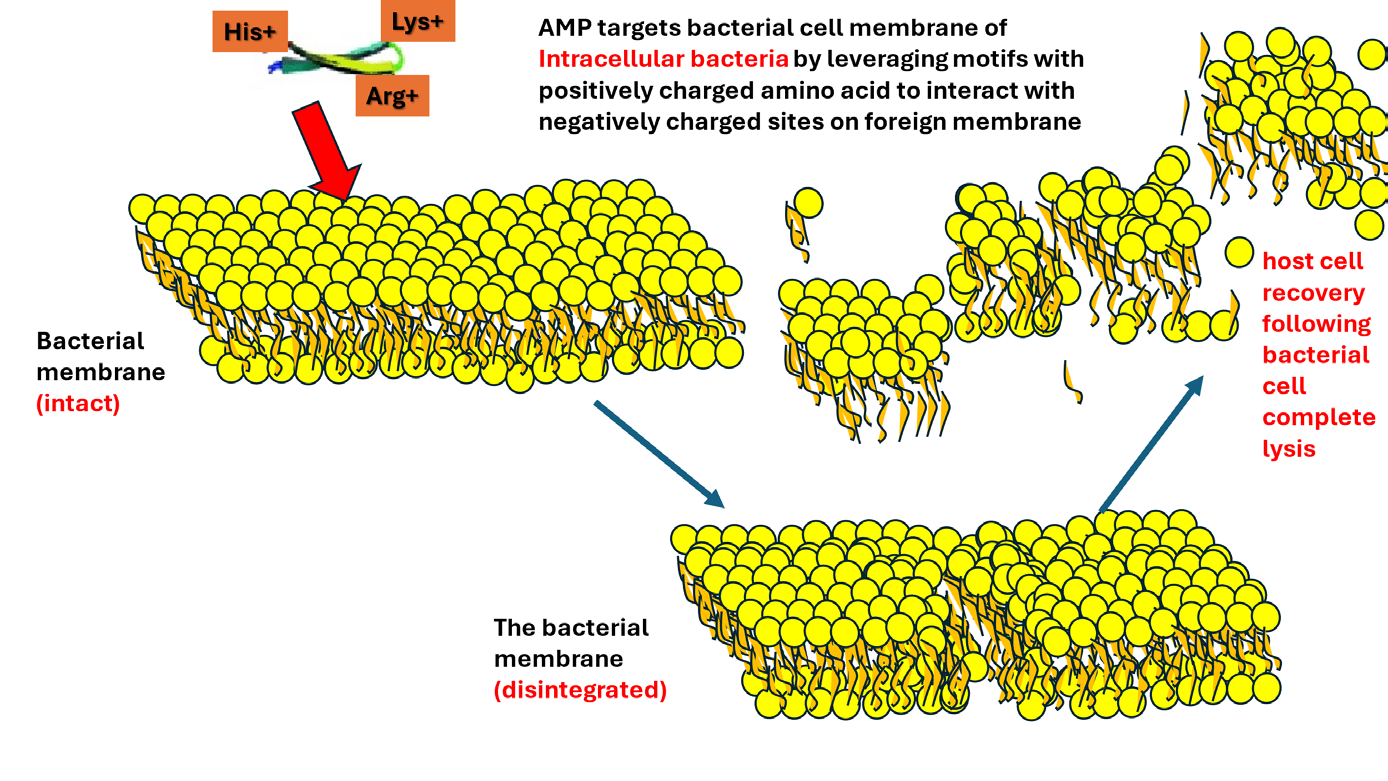
Over 3,500 cationic AMPs have been identified or predicted across six biological kingdoms, highlighting the widespread and conserved nature of these molecules [1]. Notably, AMPs are effective against microbes that have developed resistance to conventional antibiotics, positioning them as essential alternatives in the fight against drug- resistant infections [2]. Due to their ability to modulate immune responses and interact directly with bacterial membranes, AMPs offer a mechanism of action that is less susceptible to bacterial resistance. In addition, induced in response to stimuli during inflammation, AMPs penetrate the cell membrane due to their amphiphilic structure [3]. AMPs are equipped with hydrophilic, cationic, and hydrophobic domains and have been shown to modulate not only the innate but also the adaptive immune response [4]. But initially studied for their direct antimicrobial properties, AMPs have primarily been shown to be critical effector molecules within the innate immune system [5]. These peptides are distributed across a wide range of life forms, providing a universal defense against diverse pathogenic microorganisms, including gram-positive and gram-negative bacteria, viruses, archaea, fungi, and parasites [6]. AMPs exhibit considerable structural and sequence variability, yet share common characteristics that define their antimicrobial activity. Most AMPs are relatively short, typically consisting of 12-50 amino acids, and possess a net cationic charge due to the presence of arginine (Arg) and lysine (Lys) amino acids critical for AMPs ability to disrupt the pathogen membranes integrity leading to microbial membrane lysis [7]. Due to their remarkable structural and functional flexibility, AMPs possess a unique ability to adapt and protect the body even in extreme conditions. Their mechanisms of action go beyond traditional antibiotics, particularly in their superior ability to penetrate host cells and combat intracellular pathogens. This ability makes AMPs an invaluable asset in the fight against intracellular infections, where pathogens reside within host cells, evading conventional antibiotics that primarily target extracellular bacteria. Moreover, AMPs are less prone to resistance development due to their multifaceted mechanisms, which include disrupting microbial membranes, modulating the immune response, and interfering with intracellular processes (Figure 1).
According to AMPs structure they can be classified as amphipathic α-helical peptides, β-sheet peptides stabilized by disulfide bonds, stabilized by a single disulfide bridge cyclic loop peptides, and tryptophan-rich peptides [8]. Amphipathic α-helical peptides, such as cathelicidins, adopt an α-helical conformation upon interacting with lipid membranes. Their amphipathic nature enables them to integrate into and disrupt microbial membranes effectively [9]. A prominent example of stabilized by disulfide bonds β-sheet peptides defensins are characterized by β-sheets reinforced by multiple disulfide bonds that confer structural stability, enabling the peptides to retain their activity in diverse environmental conditions [10]. Cyclic loop peptides stabilized by a single disulfide bridge, bactensins are representatives mainly of cyclic conformation maintained by a single disulfide bond. These AMPs enhance resistance to proteolytic degradation and facilitate interactions with microbial membranes [11]. Tryptophan-rich peptides, indolicidins exhibit functional properties showing ability to intercalate into lipid bilayers and disrupt microbial membranes [12]. Indolicidins might combine tryptophan-rich motifs with other structural features to enhance membrane targeting while maintaining stability and activity across different conditions. This classification highlights the diverse structural adaptations AMPs employ to combat a wide range of pathogens. Each structural class contributes uniquely to the peptide’s mechanism of action and stability under physiological and pathological conditions. AMPs can exhibit multiple structural or functional properties simultaneously, rather than being restricted to just one classification (structural/functional overlap). For instance, depending on environment or interactions with microbial membranes certain AMPs might predominantly adopt an α-helical structure but also contain β-sheet segments stabilized by disulfide bonds. Environmental influence can lead to the conformational change in AMPs in dynamic way [13]. So, an AMP might adopt an amphipathic α-helical structure when interacting with lipid bilayers but remain unstructured in aqueous environments. Functional versatility of AMPs is based on their ability to exhibit dual or multi-functional roles beyond their primary antimicrobial activity. For instance α-helical cathelicidins not only disrupt microbial membranes but may also exhibit immunomodulatory effects, such as enhancing chemotaxis or neutralizing endotoxins [14]. β-Sheet peptides defensins can act synergistically with other components of the immune system and also demonstrate activity against a range of pathogens, including viruses, fungi, and bacteria [10]. Given these advantages, AMPs hold immense potential as complementary tools in addressing intracellular infections caused by antibiotic-resistant strains. Their versatility and efficacy highlight their promise in expanding the therapeutic arsenal against a broad spectrum of challenging pathogens.
Conclusion
AMPs action mechanism differs from that of conventional antibiotics, as AMPs exhibit selectivity, targeting specific bacterial membranes, unlike non-selective antibiotics.
Due to their special structural and functional flexibility, AMPs are able to adapt the body to protection in extreme situations, significantly exceeding the effect of antibiotics in their ability to penetrate cells and fight intracellular foreigners.
In the battle against intracellular infections, AMPs represent a valuable complement to antibiotics, particularly for strains that have developed resistance. AMPs hold promise not only for addressing the pressing issue of antimicrobial resistance but also for strengthening host defenses against elusive pathogens.
References
-
Qu H, Yao Q, Chen T, Wu H, Liu Y, et al. (2024) Current status of development and biomedical applications of peptide-based antimicrobial hydrogels. Adv Colloid Interface Sci 325: 103099.
-
Xuan J, Feng W, Wang J, Wang R, Zhang B, et al. (2023) Antimicrobial peptides for combating drug-resistant bacterial infections. Drug Resist Updat 68: 100954.
-
Bui H, Phuong T, Doan Ngan H, Le Huy B, Vu Dinh H, et al. (2024) The amphipathic design in helical antimicrobial peptides. ChemMedChem 19(7): e202300480.
-
Lei J, Sun L, Huang S, Zhu C, Li P, et al. (2019) The antimicrobial peptides and their potential clinical applications. Am J Transl Res 11(7): 3919-3931.
-
Pasupuleti M, Schmidtchen A, Malmsten M (2012) Antimicrobial peptides: key components of the innate immune system. Crit Rev Biotechnol 32(2): 143-171.
-
Talapko J, Meštrović T, Juzbašić M, Tomas M, Erić S, et al. (2022) Antimicrobial Peptides-Mechanisms of Action, Antimicrobial Effects and Clinical Applications. Antibiotics (Basel) 11(10): 1417.
-
Lyu Z, Yang P, Lei J, Zhao J (2023) Biological Function of Antimicrobial Peptides on Suppressing Pathogens and Improving Host Immunity. Antibiotics (Basel) 12(6): 1037.
-
Huan Y, Kong Q, Mou H, Yi H (2020) Antimicrobial Peptides: Classification, Design, Application and Research Progress in Multiple Fields. Front Microbiol 11: 582779.
-
Li Ch, Cai Y, Luo L (2024) TC-14, a cathelicidin-derived antimicrobial peptide with broad-spectrum antibacterial activity and high safety profile. I Science 27(7): 110404.
-
Lehrer RI, Bevins CL, Ganz T (2005) Defensins and Other Antimicrobial Peptides and Proteins. Mucosal Immunology pp: 95-110.
-
Schouten A, Roosien J, Bakker J, Schots A (2002) Formation of disulfide bridges by a single-chain Fv antibody in the reducing ectopic environment of the plant cytosol. J Biol Chem 277(22): 19339-19345.
-
Schibli DJ, Epand RF, Vogel HJ, Epand RM (2002) Tryptophan-rich antimicrobial peptides: comparative properties and membrane interactions. Biochem Cell Biol 80(5): 667-677.
-
Vermeer LS, Lan Y, Abbate V, Ruh E, Bui TT, et al. (2012) Conformational flexibility determines selectivity and antibacterial, antiplasmodial, and anticancer potency of cationic α-helical peptides. J Biol Chem 287(41): 34120- 34133.
-
Van Harten RM, Van Woudenbergh E, Van Dijk A, Haagsman HP (2018) Cathelicidins: Immunomodulatory Antimicrobials. Vaccines (Basel) 6(3): 63.
- An Efficient and Affordable Method for Isolating Bone Marrow- Derived Mesenchymal Stem Cells from Swiss Albino Mice
- Superposition of Cryo-EM and AlphaFold Predictions of Dengue Antigen-Antibody Complexes
- Jugular-Applied Coherent Low-Level Laser Therapy Enhances Systemic Mitochondrial Metabolic Function and Antioxidant Response
- Role of OMC32 Polypeptide in Acrosin-Mediated Exocytosis during the Bovine Sperm Acrosome Reaction
- Association of Galectin-3 but not Laminin in Tamoxifen-Induced Growth Suppression in Breast Cancer MCF-7 Cells
- Effect of Different Wavelengths of Light on the Rate of Photosynthesis