
Floating Objects of Non Marine Origin, Rafting of Marine Organisms, and the Interfering Role of Man in Mediterranean Sea
Floating material (rafts) is present from the birth of oceans and comes from land (by means of rivers, glaciers, wind, and runoffs of any types), or is endogenous if derives from sea organisms and/or volcanic pumice. All the floating material is interested by colonization of benthic organisms. An additional distinction can be done on the basis of the organic composition, due to the fact that only organic rafts supply also food to rafters. This ancient interaction allowed the evolution of a recognizable rafters community, with some species recognized as obliged rafters. In the very recent geological period (the Antropocene, last 10,000 years) human activities in the Mediterranean area started to halter this already complex frame, and Italy (in the centre of the Mediterranean) has been used as a representation of the general phenomenon. In Italian Antropocene, extension of forests has been reduced, floating vehicles have been added to the sea surface, without following winds and/or currents, and raft material composition has been changed. In the last 100 years, hundreds of dam buildings are acting as logs and trees retainers, new material (plastic) has been added to the system, and climate changes (indirectly caused by human activities) are producing extreme phenomena with re-proposal of intense runoffs. What is asked is a more detailed perception of how much such changes are affecting the rafters communities, adapted to different materials, routes, and timing.
Introduction
Benthic species are sedentary (even sessile) in the majority of their life duration. A short living, free swimming stage (mostly a larva) represented in scientific Floating Objects of Non Marine Origin, Rafting of Marine Organisms, and the Interfering Role of Man in Mediterranean Sea literature the only opportunity of many benthic species to expand their geographic distribution and/or to recover local demographic collapses [1]. The Supply-Side Ecology was funded on the existence of such pelagic stages (larvae), and on their role of propagules in dispersal and colonization of new sites [2]. The Supply-Side Ecology proposes the role that variable larval input plays in determining the size of local adult populations [3, 4, 5, 6, 7].
Int J Oceanogr Aquac
Planktonic stage durations should be related with the dispersal range, and the geographic distribution of different species [8, 9]. Generalization, however, is dangerous or impossible, because many benthic species without a planktonic stage have been found to be successful inhabitats and/or colonizers of extended geographic areas more than co-generics with a planktonic stage [10, 11]. Modular (colonial) organisms, although sessile, appear as not dependent from the larva for their distribution over a wide geographic scale; in fact, the colonial condition appears associated with the lost of a long swimming larval stage [9]. Jokiel PL [12] proposed the rafting of small sessile colonies on floating pumice as the solution for the exchange of reef species propagules among volcanic islands in the Pacific Ocean. Bryan SE, et al. [13] in addition, described more than 80 species as interested by a >5000 km rafting in 7-8 months on pumice, consequently the eruption of a volcano in Tonga archipelago. Their findings emphasize pumice rafting of small benthic colonies as important in the geographic distribution of marine benthic organisms.
Floating Debris as Vectors for Species Dispersal
Larvae are not the only responsible of species dispersal, and their huge production in some species, when compared with their extremely low survival rate, represents an embarrassing lost of genetic material at each reproductive event. The high number, however, could acquire importance if considered as a strategy to intercept floating objects timely available at sea. Benthic, travelling rafters could connect, in this way, benthic populations of distant sites. Seasonality in reproductive phenomena could even represent a pre-adaptation of species to profit of periodical availability of floating materials at sea (e.g., when these derive from run offs at each rain season). Bryan SE, et al. [14] proposed an adaptive answer of benthos to earthquakes connected with unpredictable volcanic eruptions by coupling spawning of coral species with pumice availability in the water. The plausibility of the strategy of the rafting mediated dispersal, based on the availability of rafts in space and time, justifies its consideration as actual, and fundamental in the affirmation of coastal benthos which evolved synchronization of propagule production with the presence period of abundant rafting objects at sea.
Origin and Destiny of Floating Material
From the early down of the planet, ocean receives materials from land regularly and also in consequence of exceptional weather events. Volcanoes throw pumice in the air, winds transport dust all around the planet surface (which is represented by ocean for more than 70%), glaciers scrape the land surface laying in a river, or directly into the sea, what they collected, and rivers transport materials from the land to the oceans at least at each rain. Such material transport is commonly the field study of geology, linked to problems of land erosion and sediment accumulation on the sea floor. Some studies of paleoecology, in fact, explicitly recognized rafting events in the stratigraphic sequences [15]. Materials, of any size and type, are destined to long floating time if buoyant. The consequential destiny of buoyant material is a sink far from their origin site, often after long periods of pelagic existence.
Floating debris can be of many types, but the most evident and deserving attention are surely the vegetal ones which reach also great volumes if based on the presence of wood logs. Differently from the volcanic pumice, the presence of organic floating debris is widespread in any part of the planet, everywhere a river mouth exists, and in addition it also offers organic material as food supply for rafters. Engineers of coast management report quantities (volumes and weight) of log subtracted from forests on land, and transferred by rivers to the sea where they accumulate along the coast, close to the river mouth, enforcing the coastline in capturing and maintaining sediments, and producing problems to the management of the coastline by man [16]. Rivers, volcanoes, wind, and ice, are the responsible for the transport of land materials to the ocean, but submarine vegetation could be added to the floating material able to transport benthos for long distances [15].
Thiel M, et al. [17] recognized three main types of rafts according the permanence and the availability in coastal areas: a) frequent b) intermittent and c) episodic. All that review is focused on the ecological implications of such a phenomenon, and its reflections on the species genetics. What appears as not duly considered, however, is the evolutionary importance it has, to justify any intervention of management in the frame of nature conservation. The destiny of floating debris is to sink to the sea bed because sessile benthos settle on them and, with time, increases the weight of the floating structure. In the case of organic rafts, microbes and rafters degrade the organic matter with time, contributing to a diminution of its floatability. The substrate composition inevitably affects the composition of the rafters community. Mainly suspension feeders are hosted on abiotic rafts (pumice), while grazing and boring species abound on rafting macroalgae and wood [18, 19]. Mouths of large rivers have been always considered a danger for sailing (and for this reason accurately avoided by ship routes) just for the possible presence of floating debris of large size, sometimes intertwined in small floating islands. Such large rafts have probably an important role also in the colonization of oceanic islands by terrestrial organisms (those able to resist for long time to starvation and thirst, possibly with a lethargic stage), but a huge importance they should have in transferring marine benthos organisms (sessile and vagile) in their submerged parts.
Similarly to teleplanic larvae [20], rafting of sessile benthos could be considered responsible of the wider geographic distribution of species. In this frame, many coastal benthic species should have evolved a synchronization of their own reproductive output with the season of availability of travelling vegetation in the ocean surface (the rainy season, or the hurricane period). The production of huge quantities of larvae of some species (apparently a squandering of resources) could be explained with the precise goal to intercept floating vectors and settle sedentary stages on them, with a sessile-moving phase able to disperse the population propagules more and better than larvae. The historical (evolutionary) presence of floating material at sea surface is indirectly confirmed by the adaptations of organisms to stay on rafts (many of them being obliged rafters), and the rafting habitus of large animal groups (as the goose barnacles) witnesses for the ancient evolution of such a practice. Entire and large communities, as the Sargasso ones, are based on floatability and raft, thus testifying the evolution from long time of the rafting habitus [19].
If the production of huge quantities of larvae could be supposed as an evolutionary pre-adaptation to interception of floating objects, the predominance of brooding and/or direct developing species on rafts is a fact [19]. If the spawning of larvae could have the rafting dispersal as a by-product, we have to understand what behaviour the direct developing species evolved to go on board a floating object without a pelagic swimming stage. The species richness of such a floating benthos (1205 species reported by Thiel M, et al. [15]) can equal that on the coastline, and the case of vagile benthos of the Sargassum floating community in the centre of the Atlantic Ocean is emblematic.
Changes in Abundance and Composition of Floating Material
The Neolithic agriculture revolution used warm temperate regions, and forests, as the main places where to realize human settlements, and obtain culture products from fertile terrains. Forest woods, in addition, were the main resource to obtain building materials and heat production. The abandon of nomadism corresponded to an abrupt increase of deforestation. The elimination of temperate forests, however, was never completed until historical recent times when the human demographic growth, and the increased request of heat energy of the industrial revolution, surpassed the natural renewal rate of vegetal communities. In the recent historical period, as a consequence, woods and logs started to diminish in the rivers runoff due to the reduction of the forested surface on land. In the Mediterranean area, as a detail of a temperate climate heavily impacted by human presence, ice does not transfer material from land to the sea, and pumice is produced by a small number of volcanoes, and only episodically. In the Mediterranean area, consequently, the most important natural element in transferring of materials from land to sea has been the river run-off. This last element, however, has been very recently (the last 100 years) reduced by building of dams (Figure 1).
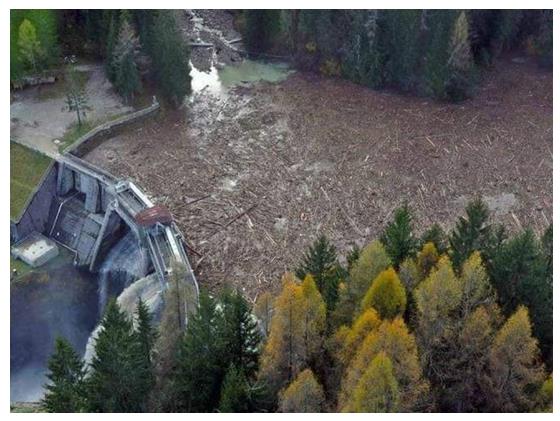
The geologically recent mountain uplift (Alpine orogeny) is still ongoing and erosive agents had not the time (geologically speaking) to lower mountain tips. This corresponds to a general shortness of rivers and steeper slopes in their first traits. Even in absence of large water volumes, the short distance and the strength of floods are able to inject huge amounts of material in the sea. Large rivers, to tell the truth, are just the collectors of what small and steep water courses give them from the mountains. Whatever we can consider the Mediterranean situation, the energy that short rivers produce coming down from mountains to sea has justified the realization of 537 large dams plus 8463 small barrages only in Italy [21] in about 100 years. This capillary barrage of rivers, useful for energy production, water reservoir, and land protection, produced inevitably a diminution of materials injected into the sea. Coastlines and dunes are, from many years, endangered and continuously managed to avoid their disappearing, mostly in consequences of the lacking of a useful support of suspended particles (both large and small) in the rivers’ run off. Suspended particles of small size diminished in consequence of the building of dams and barriers on rivers’ paths, but logs and trees have been abruptly reduced and the rafting around of marine communities should be someway affected.
The modern situation is, consequently, a new level of the ecological connectivity with the disappearing/alteration of actors and actions which lasted millions years, more enhanced in closed basins as the Mediterranean Sea, which cannot widely exchange materials coming from far oceans. An additional alteration of the ancient situation is also the variation in the composition of floating materials. In short, a combination of increasing vector diversity and changing climate sets the stage for a new era of rafting in the world’s oceans [22]. If wood logs have been drastically reduced in the recent story of the Mediterranean Sea, it is noteworthy that the existence of human marine vehicles added floating surfaces to the system in the last 3,000 years with a drastic increase in the last 300 years. The Italian marine fleet, in the center of the Mediterranean, offers today floating surfaces at sea with about 100,000 vessels.
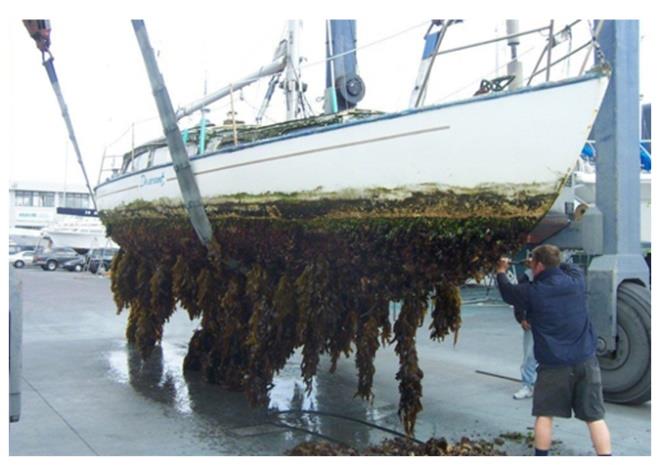
This fleet has the possibility to shunt in any direction, independently from surface currents and winds, thus sensibly altering ancient natural routes for possible rafters hosted on the hulls. The existence of marine fouling on the submerged parts of ships and boats is an evident proof of the possibility of the benthos to easy settle on floating objects of any type (Figure 2).
Globally, shipping is the most important vector of introduction of marine non-indigenous species (NIS); both the larger commercial vessels and the smaller recreational boats act in the process of NIS introduction, via ballast water and hull fouling [23, 24]. In the Mediterranean Sea, shipping and boating occur within a complex network of port structures [25], thus facilitating the spread of propagules. Moreover, the abundance of artificial hard structures in ports provides suitable habitat for NIS, accelerating their spreading process [26]. Notwithstanding it is still unknown how a species without a pelagic stage can colonize a floating object of non marine origin (pumice or tree), rafting species rose the suspect, to Bryan SE, et al. [14] that benthos is able to perceive even these irregular opportunities. The denied attention to the role of floating material as rafts for benthos ordinary dispersal, impedes, today, to have a historical perception on how, and if, the quantity of floating material varied in the oceans. A final element has to be added to the already complex frame of the variation of the floating material composition in the recent historical period. If ships and boats were exclusively built with wood until two centuries ago, now the used materials exclude wood but only exceptional and rare cases. In addition, modern metallic or synthetic hulls are continuously cleaned and/or covered with anti-fouling to impede the settlement of any kind of benthic community. Curiously, and contrarily to the past, boats and ships today play a role in transferring plankton living forms (possibly as resting stages) in the ballast waters, more than benthos forms as fouling on the hull [27, 28].
Another revolution in floating debris composition has been the discovery/synthesis of plastic materials (widespread in the last 60 years) which are not biologically degradable, and persist in the marine system for long times before to sink and accumulate on the sea bed. This long lasting floating material represents a huge trouble for the ocean of the future [29, 30]. A final element concurring to the alteration of the rafting material in the ocean in temperate areas, is the ongoing climate change (indirectly sustained by Human activities) which produces weather phenomena of high energy and run-off power [22] (Figure 3).
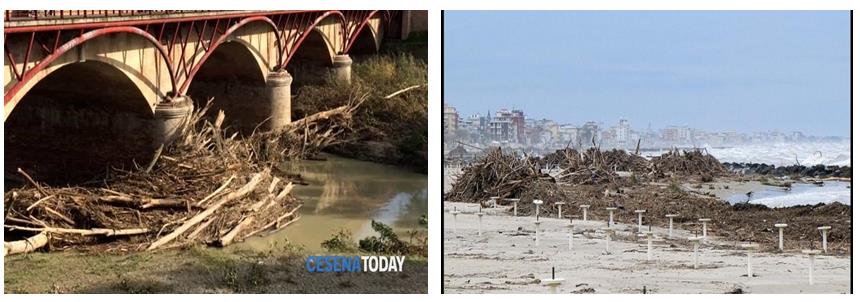
Oceanography, Geology, and Coastal Management developed, however, a large basis of knowledge to ensure a successful description of the particular aspect of dispersal of organisms mediated by floating debris. The recent interest of Marine Scientists on floating plastics, in addition, ensures the availability of methods and materials to better understand this suspected important role in the genetic connectivity and evolution of benthic communities. What here is called is to progress on processes understanding the patterns [32] by encouraging the study of pelagic floating debris to better understand the affirmation and evolution of coastal benthos (Figures 4a-4d).
Perspectives
The adaptation of species to rafting material availability is disregarded in reviews of Marine Biologists on reproductive strategies and larval dispersal [31] for absence of studies. The reduction of floating organic debris in the recent historic period, in consequence of the deforestation and dam buildings, is an unconsidered but probably heavily affecting element endangering the equilibrium of benthic communities’ distribution and their affirmation on large spatial scales. The injection of new materials (metals and plastics, in the last 200 and 60 years respectively) in the ocean deriving by modern human activities could be not enough to balance the lost of floating woods caused by deforestation and river damming, because species (if not generalists) are probably not adapted to these new substrata. Thiel M, et al. [19] reported a total of 1205 species of organisms which have been reported as rafters. These, however, are related exclusively to the rafting materials of the last 100 years, and nothing can be compared with evolutionary past thus allowing us to understand the role of Humans in altering the rafting material composition.
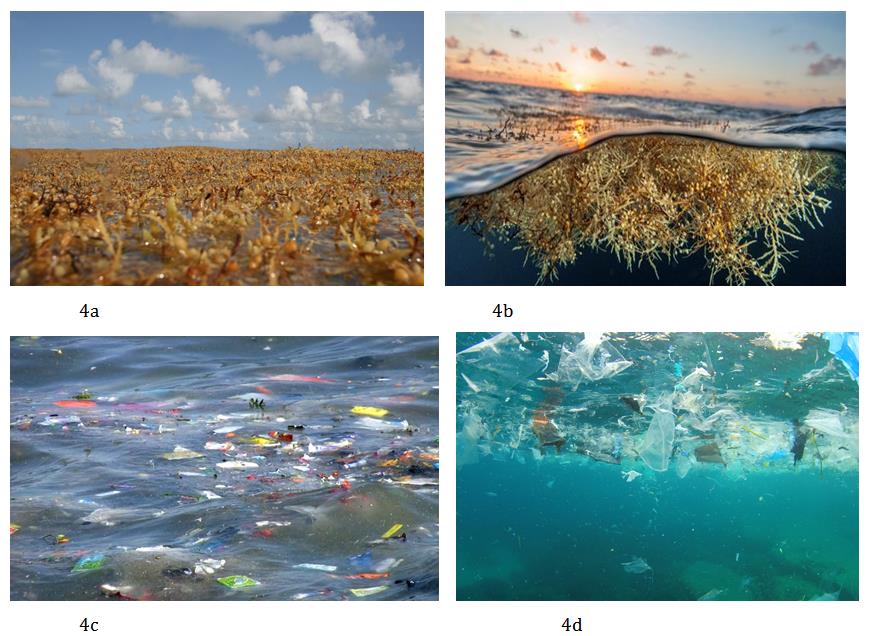
Figure 4a-d a,b: Natural floating material at Sargassum community, Atlantic ocean. a) Sight from surface; b) close up just below the sea level. c,d: Artificial floating material. b) Sight from surface d) close up just below the sea level. Apparently similar scenarios probably are perceived as different by rafting organisms).
References
-
Hughes TP, Baird AH, Dinsdale EA, Moltschaniwskyj NA, Pratchett MS, et al. (2000) Supply-side ecology works both ways: the link between benthic adults, fecundity, and larval recruits. Ecology 81(8): 2241- 2249.
-
Lewin R (1986) Supply Side Ecology. Science 234(4772): 25-27.
-
Hughes TP (1984) Population dynamics based on size rather than age: a general model with reef coral example. The American Naturalist 123(6): 778-795.
-
Hughes TP (1990) Recruitment limitation, mortality, and population regulation in open systems: a case study. Ecology 71(1): 12-20.
-
Hughes TP, Baird AH, Dinsdale EA, Moltschaniwskyj NA, Pratchett MS, et al. (1999) Patterns of recruitment and abundance of corals along the Great Barrier Reef. Nature 397: 59-63.
-
Underwood AJ, Denley EJ (1984) Paradigms, explanations and generalizations in models for the structure of intertidal communities on rocky shores. In: Strong DR, et al. (Eds.), Ecological Communities: Conceptual Issues and the Evidence. Princeton University Press, New Jersey, pp: 151-180.
-
Gaines S, Roughgarden J (1985) Larval settlement rates: a leading determinant of structure in an ecological community of the marine intertidal zone. PNAS 82(11): 3707-3711.
-
Victor BC (1986) Duration of the planktonic larval stage of one hundred species of Pacific and Atlantic wrasses (family Labridae). Marine Biology 90(3): 317-326.
-
Strathmann RR (1990) Why life histories evolve differently in the sea? Integrative and Comparative Biology 30(1): 197-207.
-
Johannesson K (1988) The paradox of Rockall: why is a brooding gastropod (_Littorina saxatilis_) more widespread than one having a planktonic larval dispersal stage (_L. littorea_)? Marine Biology 99(4): 507-513.
-
Boero F, Bouillon J (1993) Zoogeography and life cycle patterns of Mediterranean hydromedusae (Cnidaria). Biological Journal of Linnean Society 48(3): 239-266.
-
Jokiel PL (1990) Long-distance dispersal by rafting: reemergence of an old hypothesis. Endeavour 14(2): 66-73.
-
Bryan SE, Cook AG, Evans JP, Hebden K, Hurrey L, et al. (2012) Rapid, long Distance Dispersal by Pumice Rafting. PLoS One 7(7): 40583.
-
Bryan SE, Cook A, Evans JP, Colls PW, Wells MG, et al. (2004) Pumice rafting and faunal dispersion during 2001–2002 in the Southwest Pacific: record of a dacitic submarine explosive eruption from Tonga. Earth and Planetary Science Letters 227(1-2): 135- 154.
-
Thiel M, Gutow L (2005) The ecology of rafting in the marine environment. I. The floating substrata. Oceanography and Marine Biology: Annual Review 42: 181-264.
-
Maser C, Tarrant RF, Trappe JM, Franklin JF (1988) From the forest to the sea: a story of fallen trees. Pacific Northwest Research Station 229: 153.
-
Thiel M, Hayes PA (2006) The ecology of rafting in the marine environment. III. Biogeographical and evolutionary consequences. Oceanography and Marine Biology: An Annual Review 44: 323-429.
-
Thiel M (2003) Rafting of benthic macrofauna: important factors determining the temporal succession of the assemblage on detached macroalgae. Hydrobiologia 503(1-3): 49-57.
-
Thiel M, Gutow L (2005) The ecology of rafting in the marine environment. II. The rafting organisms and community. Oceanography and Marine Biology, Annual Review 43: 279-418.
-
Scheltema RS (1992) Passive dispersal of planktonic larvae and the biogeography of tropical sublittoral invertebrate species. In Colombo G, et al. (Eds.), Marine Eutrophication and Pollution Dynamics, Olsen and Olsen, Fredensborg, pp: 195-202.
-
Padovani M (2018) Caratterizzazione idrologica delle grandi dighe italiane. Master Degree Thesis, Politecnico di Torino, pp: 320.
-
Carlton JT, Fowler AE (2018) Ocean rafting and marine debris: A broader vector menu requires a greater appetite for invasion biology research support. Aquatic Invasions 13(1): 11-15.
-
Hulme PE (2009) Trade, transport and trouble: managing invasive species pathways in an era of globalization. Journal of Applied Ecology 46(1): 10- 18.
-
Murray CC, Pakhomov EA, Therriault TW (2011) Recreational boating: a large unregulated vector transporting marine invasive species. Diversity and Distributions 17(6): 1161-1172.
-
Kölzsch A, Blasius B (2011) Indications of marine bioinvasion from network theory. An analysis of the global cargo ship network. The European Physical Journal B 84(4): 601-612.
-
Legentil LS, Legentil ML, Erwin PM, Turon X (2015) Harbor networks as introduction gateways: contrasting distribution patterns of native and introduced ascidians. Biological Invasions 17(6): 1623-1638.
-
Carlton JT, Geller JB (1993) Ecological Roulette: The Global Transport of Nonindigenous Marine Organisms. Science 261(5117): 78-82.
-
Belmonte G, Rubino F (2019) Resting cysts from Coastal marine Plankton. Oceanography and Marine Biology Annual Review 57.
-
Harse GA (2011) Plastic, the Great Pacific Garbage Patch, and International Misfires at a Cure. UCLA Journal of Environmental Law and Policy 29 (2): 331- 363.
-
Suaria G, Avio CG, Mineo A, Lattin GL, Belmonte G, et al. (2016) The Mediterranean Plastic Soup: synthetic polymers in Mediterranean surface waters. Scientific Reports 6: 37551.
-
Giangrande A, Geraci S, Belmonte G (1994) Life cycle and Life history diversity in marine invertebrates and the implications in community dynamics. Oceanography and Marine Biology, Annual Review 32: 305-333.
-
Underwood AJ, Chapman MG, Connell SD (2000) Observations in ecology: you can’t make progress on processes without understanding the patterns. Journal of Experimental Marine Biology and Ecology 250(1-2): 97-115.
- Genetic Improvement of Nile Tilapia (Oreochromis niloticus): Advances in Selective Breeding and Genomic Approaches for Sustainable Aquaculture
- Microplastics, Contaminants, and Waste Hotspots: Divergences and Faults in Prioritizing Control Efforts
- Creating a Healthier, More Vibrant Open and Closed Aquatic Environment. A Submersible, Centrifugal Magnetically Affixed Current Changing Aquarium Pump
- An Attempt to Assess Alpha Diversity and Sample Size: Using the Ostracod Assemblages off Kumamoto Port, Japan
- Assessment of the Efficiency of Common Fishing Gears and Crafts Used at Mohananda River of Chapai Nawabganj, Bangladesh
- Fish Productivity and Biodiversity Status of Sundarban Mangrove in Bangladesh