
Enumeration of Emergent Bacterial Pathogen Isolated from Small Indigenous Fish Species: Pabda (Ompok Spp) and Gulsha (Mystuscavasious spp)
The present study attempted to determine the prevalence of pathogenic bacteria within two most popular small indigenous fish species of Bangladesh. A total of 51 infected fish samples were collected from different places in Bangladesh between April 2019 to December 2020. Among 51 infected fish samples (26 Pabda, & 25 Gulsha), 47(92.16%) were infected with pathogenic bacteria and 4(7.84%) were normal flora. From the total of 51 isolated bacterial strains, the highest number was 16(31.37%) for Vibrio spp., the second highest for Aeromonas spp, was 12(23.52%), and the next was 5(9.80%) for Streptococcus spp. On the other hand, Pseudomonas spp, only 4(7.84%) and the rest 3(5.88%) Flavobacterium spp., Citobacter spp., and Edwarsiella spp., Enterobacter spp., and parasite 1(1.96%). In our study, among the isolated pathogenic bacteria, 39(76.47%) were resistant to Amoxicillin and 28(54.90%) were resistant to Erythromycin. Whereas maximum sensitivity was found for Ciprofloxacin 35(68.63%). The isolation of emergent bacterial pathogens that impose a threat to fish is the main objective of this article.
Introduction
Fish and fish products have been one of the main food ingredients for humans and animals from the ancient period. Approximately, 60% of animal proteins come from fish in Bangladesh [1]. In Bangladesh, freshwater aquaculture plays a major role in improving the economic condition of fish farmers. Most of the fish production Bangladesh come from rural freshwater aquaculture [2]. From Bangladesh, a total of
253 freshwater fish species have been recorded [3], of these, over 150 species have been classified as ‘small indigenous species’ [4]. This ‘small indigenous species’ group of fish is an important source of protein, calcium and minerals in the daily diet and has been identified as an important source of income for small-scale fishermen [5].
Ompok spp (pabda) locally known as Modhupabda (commonly known as Butter catfish), is a small indigenous catfish that belongs to the family Siluridae of the order Siluriformes [6]. This fish species is considered to be one of the most nutritious, tasty and demanding fish of the people of Bangladesh. Mystuscavasious locally known as ‘Gulsha’ has been attracting the attention amongfish farmers in Bangladesh due to its profitable farming, high market value, and good taste [7]. For this reason, farmers of the greater Mymensingh region are cultivating these fish to a large extent. Pabda is omnivorous in nature, feeding on fishes, algae, crustaceans, insects, and protozoans, parts of plants and debris [8], while Gulsha is a carnivore, eating insect larvae, and small fish [9]. Pabda and Gulsha are usually found in low- lying areas, beels and canals. During the monsoon months (May to July) the young and adult fish of these species gain access to these waters from flooded rivers where they breed.
Unfortunately, due to the growth and activity of pathogenic microorganisms a large amount of fish in the country deteriorates every year. The export market of Bangladesh is threatened by poor quality processed foods that may be infected by pathogenic bacteria such as coliform, faecal coliform, Vibrio cholerae, Salmonella spp., Listeria monocytogenes, Clostridium botulinum, Shigella spp., Streptococci and Staphylococcus aureus. Such pathogenic flora of living fish depends on the microbial content of the aquatic habitat [10, 11]. Soft tissue and the condition of the aquatic habitats make fish susceptible to microbial contamination which deteriorates the quality of fish [12]. However, it is reported that improper handling, poor icing and bad trading practices are the factors that have a negative impact on the fish quality [13].
Aquatic environmental conditions which are undoubtedly important for the persistence of bacterial pathogens contribute to long-term survival resulting in disease outbreaks [14]. The extensive misuse of antibiotics has led to serious resistance problems and limiting the effectiveness of antibiotics in eliminating bacterial infections [15, 16]. In Bangladesh, a study showed that more than 70% of infectious pathogens were resistant to at least one of the commonly used antibiotics [17]. Therefore, this study attempted to enumerate the bacterial load in Pabda and Gulsha fishes and to isolate the newly emerged pathogens.
Materials and Methods
Collection and Transportation of Samples
A total of 26 infected Pabda (Ompok spp) and 25 infected Gulsha (Mystuscavasious spp) fish samples were taken from different Upazila (Fulbaria, Gowripur, Ishwargonj, Maskanda, Netrokona, Tarakanda, Trishal, Muktagacha, Purbodala, Mukkurpur, Kishorgonj, Kendua, Mowna) in greater Mymensingh, and Sherpur districts in Bangladesh between April 2019 to December 2020. Aseptic measures were maintained during the collection of fish samples to avoid touch and cold chains were maintained by using an ice box. The samples have then brought to the Quality Aqua Laboratory of Quality Feeds Limited, Mymensingh.
Sample Processing and Enrichment of Bacteria
During the sampling process, aseptic measures were strictly maintained to prevent sample contamination. For the microbiological test, three types of specimens including skin, intestine and gills of infected fishes were collected (Figures 1&2). The samples were taken on a sterile cutting board then chopped them appropriately and grinded together. Ten (10) gm of samples is diluted with 90 milliliters (ml) of freshly prepared 0.1% peptone water. After that for enrichment of bacterial isolates, 0.1 ml of homogenized sample was then inoculated on to selective media, for example: Pseudomonas Base agar (for Pseudomonas spp), Rimler-Shotts Medium Base agar (for Aeromonas spp.), Thiosulfate citrate bile salt sucrose (TCBS) agar (for Vibrio spp.), Brain Heart Infusion (BHI) Agar (for fastidious organisms), Tryptic Soy Agar (TSA) and incubated at 370 C for 24 hours.
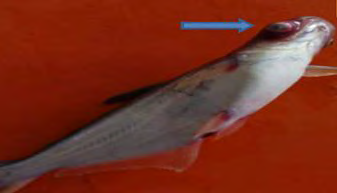
Figure1: Pabda (Ompok spp) with pop eye and reddish discoloration around the eye and mouth.
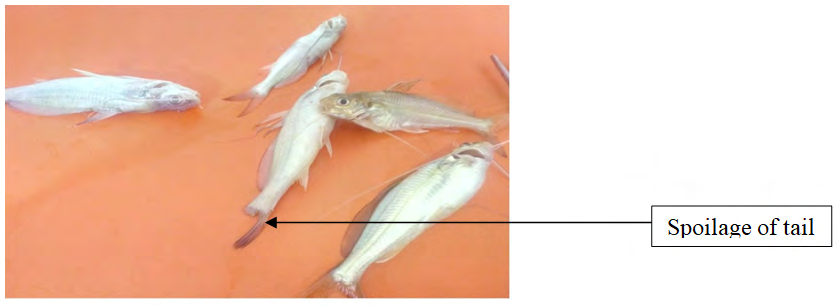
Figure2: Infected tail of Gulsha fishes.
Identification of Bacterial Pathogens
From different culture plates, suspected bacterial colonies were isolated and then streaked on TSA slants, Simon citrate agar slant, and MIU medium followed by overnight incubation at 37°C. Bacterial cell morphology, alkaline and acidic reaction, H2S (hydrogen sulfide production) and gas production, motility test, indole production, urease test, oxidase test, catalase test, Methyl Red (MR) test, and Voges- Praskaure (VP) test were performed for identification of pure isolates. Gram positive and Gram negative bacteria were identified by performing Gram staining techniques. According to Bergey’s Bacteriological Classification Manual [18], biochemical tests were performed to identify pathogens.
Biochemical Tests for Bacterial Identification
The pure bacterial isolates were identified by performing a group of biochemical tests including alkaline reaction, acidic reaction, indole production, H2S (hydrogen sulfide production) gas production, urea hydrolysis, oxidase test, catalase test, Methyl-Red (MR) test, Voges-Praskaure (VP) test, motility test. Among the isolated microbes, only one microbe was found as Gram positive Cocci and the remaining 7 isolates were found as Gram negative bacteria.
In-Vitro Antimicrobial Sensitivity Test
According to the CLSI guidelines [19], the Kirby-Bauer disc diffusion methods were used for in-vitro antimicrobial susceptibility tests of all the pathogenic bacterial isolates. In this experiment, the antibiotics used were namely Colistin (25μg), Doxyciline (30μg), Ciprofloxacin (5μg), Amoxicillin (10μg), Erythromycin (15μg), Clotetracyclin (30μg), Cotrimoxazole (25μg). Throughout the study Vibrio cholerae (ATCC 14035), Aeromonas hydrophila (ATCC 7966), Pseudomonas aeruginosa (ATCC 27853), and Flavobacterium columnare (ATCC 23463) were used as quality control. The suspected isolated bacterial colonies were taken in sterile PBS (phosphate buffered saline) water and then adjusted to 0.5 McFarland’s turbidity standard. The bacterial suspension was spread onto Mueller–Hinton agar (Hi-media, India) and afterwards impregnated antibiotic discs (Himedia, India) were placed and incubated at 370C for 24 hours. According to the manufacturer’s guidelines, the interpretation of the antimicrobial spectrum is measured in millimeters (mm) in terms of diameter as sensitive, medium and resistant.
Results
Fifty-one (51) bacterial strains were isolated from the investigated samples of Pabda and Gulsha fishes, where 47 were pathogenic and 4 were normal flora. The bacterial pathogens isolated from infected fish are shown in Figure 3. Among the infected fish samples, 47(92.2%) were infected with pathogenic bacteria and 4(7.8%) were normal flora. Out of the culture positive samples, 26(51.0%) were Pabda (Ompok spp), 25(49.0%) were Gulsha fishes.
The highest number were 16(31.4%) for Vibrio spp., the second highest for Aeromonas spp., was 13(25.5%), and the next was 5(9.8%) for Streptococcus spp., 5(9.8%) for Pseudomonas spp, and 3(5.9%) for Flavobacterium spp., and 3(5.9%) for Citobacter spp., and the rest 3(5.9%) were Edwardsiella spp., Enterobacter spp. and parasite and each of this was only 1(1.9%).
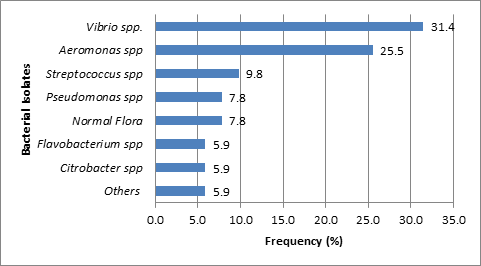
Bacteria Isolated from Pabda (Ompok Spp)
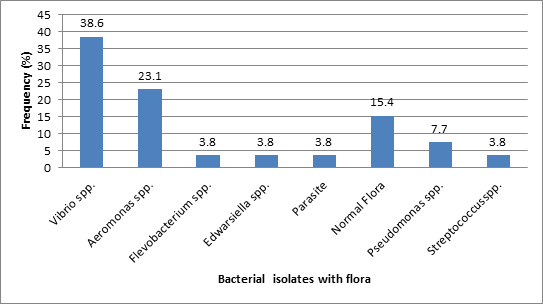
The bacteria isolates and others flora were identified from 26 infected of Pabda (Ompok spp) fish samples which were confirmed through morphological characteristics, Gram staining, and different biochemical tests. The isolated bacterial pathogens were founded in the infected fishes of pabda are shown in Figure 4. Out of 26 infected fishes samples, 22(84.6%) were infected with pathogenic bacteria and 4(15.4%) were normal flora. Among the total isolation of 26 bacterial strains, the highest number was 10(38.5%) for Vibrio spp., the second highest for Aeromonas spp, was 6(23.1%), and the next was 2(7.7%) for Pseudomonas spp. On the other hand, only 3(11.5%) of Flavobacterium spp., Edwardsiella spp., and Streptococcus spp. and the rest of 1(3.8%) was parasite.
Bacteria Isolated from Gulsha (Mystuscavasious)
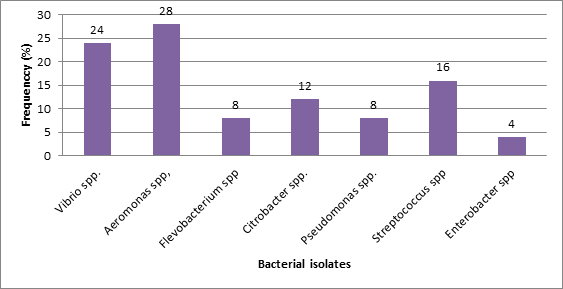
A total of 25 infected Gulsha fishes (Mystuscavasious spp) were used to isolates of enumeration of total viable bacterial count and antimicrobial susceptibility test. A 7(28.0%) of Aeromonas spp., were the most predominant bacterial isolates of Gulsha fishes and then Vibrio spp., 6(24%) were the second dominant species among the isolates. The remaining 4 (16%) were Streptococcus spp., 3(12%) Citrobacter spp., 2(8%) Flavobacterium spp., 2(8%) Pseudomonas spp., and 1(4%) Enterobacter spp were shown in Figure 5.
Antimicrobial Susceptibility
In this study, all the pathogenic isolated bacteria from Pabda fishes were 21(100%) resistant to Amoxicillin and 8(38.09%) resistant to Erythromicin and Coletetracycline. On the other hand, 21 (100%) isolates showed sensitive to Ciprofloxacin, 17(80.95%) to Doxicycline, 15(71.42%) to Cotrimoxazole, and Colistin (Table 1).
In present study, among the pathogenic bacteria isolated from Gulsha fish, 20(80%) and 18(72%) showed resistant to Erythromicin, Amoxicillin respectively. On the other hand, 14(56%) showed sensitive to Ciprofloxacin, 13(52%) to Colistin, Doxycicline, and Cotrimaxazole (Table 2).
| Bacterial isolates | Sensitivity patterns | Antibiotics susceptibility patterns (%) | ||||||
|---|---|---|---|---|---|---|---|---|
| CL | DO | ERY | CIP | AMX | COT | CTE | ||
| Vibrio spp.,(n=10) | S | 80 | 90 | 50 | 100 | 0 | 90 | 40 |
| M | 20 | 10 | 40 | 0 | 0 | 0 | 30 | |
| R | 0 | 0 | 10 | 0 | 100 | 10 | 30 | |
| Aeromonasspp., (n=6) | S | 66.7 | 66.7 | 33.3 | 100 | 0 | 33.3 | 50 |
| M | 33.3 | 33.3 | 16.7 | 0 | 0 | 33.3 | 0 | |
| R | 0 | 0 | 50 | 0 | 100 | 33.4 | 50 | |
| Pseudomonasspp., (n=2) | S | 100 | 100 | 0 | 100 | 0 | 100 | 0 |
| M | 0 | 0 | 50 | 0 | 0 | 0 | 50 | |
| R | 0 | 0 | 50 | 0 | 100 | 0 | 50 | |
| Flavobacteriumspp., (n=1) | S | 100 | 0 | 100 | 100 | 0 | 0 | 0 |
| M | 0 | 100 | 0 | 0 | 0 | 0 | 0 | |
| R | 0 | 0 | 0 | 0 | 100 | 100 | 100 | |
| Edwarsiellaspp., (n=1) | S | 0 | 100 | 0 | 100 | 0 | 100 | 100 |
| M | 100 | 0 | 0 | 0 | 0 | 0 | 0 | |
| R | 0 | 0 | 100 | 0 | 100 | 0 | 0 | |
| Streptococcus spp., (n=1) | S | 0 | 100 | 0 | 100 | 0 | 100 | 0 |
| M | 100 | 0 | 0 | 0 | 0 | 0 | 100 | |
| R | 0 | 0 | 100 | 0 | 100 | 0 | 0 |
Table 1: Frequency (%) of antibiogram profiling of identified bacterial isolates from Pabda fishes.
Note: R=Resistant, S=Sensitive,CL-Colistin, DO-Doxycicline, ERY- Erythromicin, CIP- Ciprofloxacin, Amx- Amoxicilin, COT- Cotrimoxazole, CTE-Coletetracycline. Table 1: Frequency (%) of antibiogram profiling of identified bacterial isolates from Pabda fishes.
| Bacterial isolates | Sensitivity pattern | Antibiotics susceptibility patterns (%) | ||||||
|---|---|---|---|---|---|---|---|---|
| CL | DO | ERY | CIP | AMX | COT | CTE | ||
| Aeromonas spp., (n=7) | S | 0 | 43 | 0 | 100 | 0 | 14 | 42.8 |
| M | 0 | 43 | 0 | 0 | 0 | 43 | 28.6 | |
| R | 100 | 14 | 100 | 0 | 100 | 43 | 28.6 | |
| Vibrio spp., (n=6) | S | 17 | 33 | 17 | 67 | 0 | 33 | 16.7 |
| M | 83 | 67 | 33 | 33 | 33.3 | 50 | 33.3 | |
| R | 0 | 0 | 50 | 0 | 66.7 | 17 | 50 | |
| Streptococcus spp., (n=4) | S | 50 | 100 | 0 | 50 | 0 | 50 | 25 |
| M | 50 | 0 | 25 | 50 | 0 | 50 | 25 | |
| R | 0 | 0 | 75 | 0 | 100 | 0 | 50 | |
| Citrobacter spp., (n=3) | S | 67 | 0 | 0 | 33 | 0 | 33 | 0 |
| M | 33 | 100 | 0 | 33 | 66.7 | 0 | 100 | |
| R | 0 | 0 | 100 | 33 | 33.3 | 67 | 0 | |
| Flavobacterium | S | 100 | 0 | 0 | 0 | 0 | 0 | 0 |
| spp., (n=2) | M | 0 | 100 | 100 | 100 | 100 | 0 | 100 |
| R | 0 | 0 | 0 | 0 | 0 | 100 | 0 | |
| Pseudomonas | S | 0 | 0 | 0 | 0 | 0 | 0 | 0 |
| spp., (n=2) | M | 100 | 100 | 50 | 100 | 50 | 0 | 0 |
| R | 0 | 0 | 50 | 0 | 50 | 100 | 100 | |
| Enterobacter spp., (n=1) | S | 100 | 100 | 0 | 100 | 0 | 0 | 100 |
| M | 0 | 0 | 0 | 0 | 0 | 0 | 0 | |
| R | 0 | 0 | 100 | 0 | 100 | 100 | 0 |
Table 2: Frequency (%) of antibiogram profiling of of identified bacterial isolates from Gulsha fishes.
Note: R=Resistant, S=Sensitive,CL-Colistin, DO-Doxycicline, ERY- Erythromicin, CIP- Ciprofloxacin, Amx- Amoxicilin, COT- Cotrimoxazole, CTE-Coletetracycline. Table 2: Frequency (%) of antibiogram profiling of of identified bacterial isolates from Gulsha fishes.
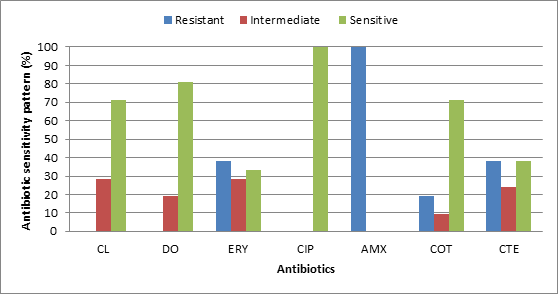
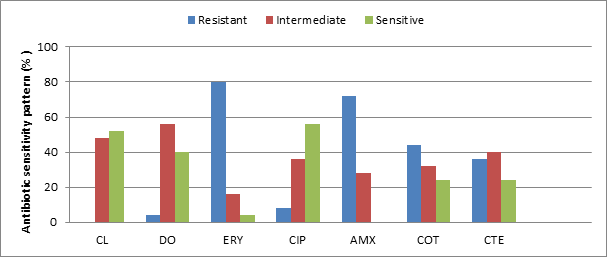
Figure7: Overall antibiotic sensitivity of bacterial isolates of Gulsha Fish.
The overall sensitivity pattern of the isolates among the total isolates tested is shown in Table 1&2. Prevalence of their resistance patterns to the antibacterial agents tested is shown in Figure 6&7. In case of Pabda fish, the prevalence of resistance was highest to Amoxicillin followed by Erythromycin, Coletetracycline and the lowest to Cotrimoxazole. On the other hand, when it comes to Gulsha fish, the prevalence of resistance was the highest to Erythromycin followed by Amoxicillin after that Cotrimoxazole and lowest observed in isolates of Gulsha fish.
Discussion
Since 1988, Bangladesh has been experiencing outbreaks of various diseases in farmed and wild fish, and this disease has been a limiting factor in fish production. The study of fish diseases in farmed fish within the framework of this study shows that the incidence of fish diseases in Bangladesh is very high every year. A few species of bacteria are pathogenic to fish, including Aeromonas spp, Pseudomonas spp, Vibrio spp, Staphylococcus spp, Flavobacterium spp, Edwardsiella spp, Citobacter spp, and Enterobacter spp [20, 21, 29, 30, 31].
A total of 47(92.16%) pathogenic bacteria and 4(7.84%) non- pathogenic bacteria were isolated. Among the pathogenic bacteria, Gram positive cocci and Gram negative bacilli were 5(9.80%) and 45 (88.23%) respectively. In this work, a variety of bacterial species have been recovered from Pabda and Gulsha fishes including Vibrio spp, Aeromonas spp, Streptococcus spp, Flavobacterium spp, Pseudomonas spp, Citobacter spp., with a frequency of 16(31.4%), 13(25.5%), 5(9.8%), 3(5.9%), 5(9.8), and 3(5.9%) respectively, and the remaining 3(5.9%) were Edwardsiella spp., Enterobacter spp. and parasites which each of this was only 1(1.9%). Similar findings have also been reported from other districts of Bangladesh [22, 23, 24, 26]. From aquaculture pond fishes, Pseudomonas strains, Aeromonas spp and other isolates were identified by Hossian, et al. [25]; Abedin MZ, et al. [29, 30, 31]. Pathogenic bacteria are quite dominant on normal flora and among those pathogens; the curve of gram negative strains is at peak.
In our work, Vibrio spp 16(31.3%) were the most predominant Gram negative bacteria and Aeromonas spp13(25.49%) were the second common isolated bacteria found in Pabda fish (Ompok spp) and Gusha fish [26]. In this study, among the bacterial isolates, 87.5% Vibriospp were resistant to Amoxicilin. Aeromonas spp was 100% resistant to Amoxicilin, Flavobacterium spp was 100% sensitive to Colistin, and 66.7% showed intermediate sensitivity to Amoxycilin, Erythromycin, Ciprofloxacin, and Clotetracyclin. Vibrio spp were highly sensitive (87.5%) to Ciprofloxacin, 68.75% to Coletetracyclin and Doxycycline, 56.25% to Colistin. 100% Streptococcus spp., in our study, was found sensitive to Doxycycline and 60% showed sensitivity to Ciprofloxacin and Cotrimoxazole. On the other hand, 100% Streptococcus spp., showed resistance to Amoxycilin and 80% showed resistance to Erythromycin. Among the 8 strains, Edwarrseilla spp. were not found in Gulsha and Citrobacter spp. and Enterobacter spp. are limited to Gulsha fish. These three strains are uncommon whereas the other strains are found in both fish samples.
Pseudomonas spp., showed maximum resistance of 75% to Amoxicillin and Coletetracycline 50% of it showed sensitivity to Colistin, Doxycycline and Ciprofloxacin. Citrobacter spp., showed the highest 100% resistance to Erythromicin and 100% of it was found intermediately sensitive to Doxycycline and Coletetracycline. These findings were not similar to a different study led by Simu, et al. [27].
Surprisingly, many isolates were found to be resistant to the common antibacterial agents tested. The rate of resistance to Amoxicillin and Erythromycin was found to be very high. Many of these resistant isolates possessed multiple patterns of resistance to the drug tested. The reasons for these resistance properties have not been studied, but it is presumed that resistance was developed due to the illegal use of antibacterial drugs in fishponds.
According to Begum, et al. [28], the uncontrolled and irregular use of antibacterial agents in aquaculture systems is one of the reasons for the emergence of multiple antibiotic resistances [28]. We ourselves should practice rational use of antimicrobial agents in fish ponds as well as the fish farmers of the community. The government might play a great role in educating people by arranging seminar or training which in turn will be paid off as through this the people for example fish consumers will be benefitted directly.
Conclusion
This study is intended to ascertain the existing situation of aquaculture infection and drug resistance among small indigenous fish species particularly in Pabda and Gulsha fish. The prevalence of pathogenic bacteria in fish sample indicates a significant risk to public health. From the data of prevalence and resistance, we should be cautious in using antibiotics in fish ponds. The conclusion drawn from this study is that Vibrio spp., and Aeromonas spp., were the predominant aquaculture infections followed by Streptococcus spp., Flavobacteriumspp and Pseudomonas spp., In the current study, Ciprofloxacin, Doxycycline and Cotrimoxazole were found as a reliable therapeutic choice for the identified pathogens due to their broad-spectrum activity. In addition, the types of drug resistance traits of the pathogen predicted in the study, can greatly contribute to the treatment of fish- borne diseases during outbreaks. Antibiotic selection should be guided by culture and susceptibility testing, and empirical drug status should be determined based on the recent spectrum of antibiotics in a specific geographic area
Acknowledgements
We thank all the staffs of the Aqua Laboratory, Quality Feeds Limited, Mymensingh and Department of Microbiology, Khwaja Yunus Ali University for his assistance in the laboratory analysis. We would like to thank specially Professor Dr. Abdullah Akter Ahmed for his expert advice and encouragement throughout this difficult study.
Conflict of Interests
The authors declare no conflicts of interests.
Ethical Statement
Institutional ethical clearance was taken from the ethical committee of KhwajaYunus Ali University before conducting the research.
Funding Information: None
References
-
Noor R, Acharjee M, Ahmed T, Das KK, Paul L, et al. (2013) Microbiological study of major sea fish available in local markets of Dhaka city, Bangladesh. J Microbiol Biotech and F Sci 2(4): 2420-2430.
-
Islam MN (2001) An overview of aquaculture development in Bangladesh. Aquaculture Asia 6: 4-9.
-
IUCN Bangladesh (2015) Red List of Bangladesh Freshwater Fishes. IUCN 5: 3-359.
-
Kostori FA, Parween S and Islam MN (2011) Availability of small indigenous species (SIS) of fish in the ChalanBeel - the largest wetland of Bangladesh. Univ J Zool Rajshahi Univ 30: 67-72.
-
Islam S (2011) Brood rearing and induced breeding of fish (Ompok-pabda) at BFRI, Mymensingh. M.Sc Thesis, Department of Aquaculture, Bangladesh Agricultural University, Mymensingh.
-
Banik S, Goswami P, Acharjee T, Malia S (2012) Ompok pabda (Hamilton-Buchanan,1822): An endangered catfish of Tripura, India: reproductive physiology related to freshwaterlotic environment. Journal of Environment 1(2): 45-55.
-
Saha S, Thavasi R, Jayalakshmi S (1998) Phenazine pigments from Pseudornonas aerginosa and their application as antibacterial agent and food colorants. Research Journal of Microbiology 3(3): 122-128.
-
Taleb MA, Rahman MM, Hossain MA (1991) Food and feeding habits of small omnivorous fish, Ompok Pabda (Hamilton). Proceedings of 15th Annual Bangladesh Science Conference Abstracts, pp: 17.
-
Islam KR, Azadi MK (1998) Study on impact of aqua drugs and chemicals on shrimp health and production of Bangladesh. MS Thesis, Department of Aquaculture, Bangladesh Agricultural University, Mymensingh, Bangladesh.
-
Frazier WC, Westhoff DC (1995) Food Microbiology. Fourth edit. New Delhi: Tata Mcgraw-Hill publishing company limited, PP: 22-39.
-
Eze EI, Echezona BC, Uzodinma EC (2011) Isolation and identification of pathogenic bacteria associated with frozen mackerel fish (Scomberscombrus) in a humid tropical environment. African Journal of Agricultural Research 6(7): 1918-1922.
-
Francoise L (2010) Occurrence and role of lactic acid bacteria in seafood products. FoodMicrobiol 27: 698- 701.
-
Duarte S, Silva FCD, Zauli DAG, Nicoli JR, Araujo FG (2014) Gram-negative intestinal indigenous microbiota from two Siluriform fishes in a tropical reservoir. Braz J Microbiol 45(4): 1283-1292.
-
Chowdhury MBR, H Wakabayashi (1990) Survival of four major bacterial fish pathogens in different types of experimental water. Bangl J Microbiol 7: 47-54.
-
Mathew AG, Cissell R, Liamthong S (2007) Antibiotic resistance in bacteria associated with food animals: a United States perspective of livestock production. Foodborne Pathogens and Diseases 4(2): 115-133.
-
Allerberger F, Mittermayer H (2008) Antimicrobial stewardship. Clinical Microbiology and Infection 14(3): 197-199.
-
Jilani MSA, Murshed M, Sultana L, Hasan Z (2008) Common clinically important aerobic bacteria and their antibiotic resistance pattern of Dhaka city and its vicinity. Bangladesh Medical Collage Journal 14: 66-71.
-
John G, Holt Noel R, Peter K, James S, Stanely T (1998) Bergey’s Manual of Determination Bacteriology. Lippincott Williams and Wilkins Publication, pp: 816.
-
CLSI-Clinical and Laboratory Standards Institute (2015) Performance standards for antimicrobial susceptibility testing. Wayne, pp: 1-25.
-
Shayoet SD, Mwita CJ, Hosea KM (2012) Virulence of Pseudomonas and Aeromonasbacteria recovered from Oreochromisniloticus (Perege) fromMtera Dam; Tanzania. Ann Biol Res 3(11): 5157-5161.
-
Anshary H, Kurniawan RA, Sriwulan S, Ramli R, Baxa DV (2014) Isolation and molecular identification of the etiological agents of Streptococcosis in Niletilapia (Oreochromisniloticus) cultured in net cages in Lake Sentani, Papua, Indonesia. SpringerPlus 3(1): 1-11.
-
Al Harbi AH, Uddin N (2005) Bacterialdiversity of Tilapia (Oreochromisniloticus) cultured in brackish water in Saudi Arabia. Aquaculture 250(3-4): 566-572.
-
Amal MNA, Zamri Saad M, Siti Zahrah A, Zulkafli R, Misri S, t al. (2010) Prevalence of Streptococcusagalactiae in Tilapia kept indifferent water bodies. Online J Vet Res 11(2): 153-162.
-
Marcel G, Sabri MY, Siti Zahrah A, Emikpe BO (2013) Water condition and identification of potential pathogenic bacteria from red Tilapia reared in cage cultured system in two different water bodies in Malaysia. Afr J Microbiol Res 7(47): 5330-5337.
-
Hossian MM, Chowdhury MR (2009) Pseudomonas anguilliseptica as a pathogen of Tilapia (Oreochromisniloticus) culture in Bangladesh. Bangladesh Research Publication Journal 4: 721-721.
-
Abedin MZ, Rahman MS, Hasan R, Shathi JH, Jarin L, et al. (2020) Isolation, identification, and antimicrobial profiling of bacteria from aquaculture fishes in pond water of Bangladesh. Am J Pure Appl Sci 2(3): 39-50.
-
Simu ZA, Umme M, Kaniz F, Sofi U M, Tanvir R, et al (2019) Investigation of a bacterial pathogen isolated from farmed Ompok pabda. Bangladesh J Fish 31(2): 243-252.
-
Begum MK, Chowdhury MM, Haque W, NasrinT (2015) Comparative microbiological assessment of export oriented fishes and locally marketed fishes of Bangladesh. IOSR J of Phar and Bio Sciences 10(3): 17-23.
-
Abedin MZ, Hasan R, Rahman MS, Jarin L, Shilpi RY, et al. (2021) Detachment, distinguishing proof of bacterial pathogens from infected Shing (Heteropneustes fossilis) cultured in freshwater ponds in Bangladesh. Int J Biomol & Biomed 12(3): 10-16.
-
Abedin MZ, Islam MI, Yeasmin F, Rahman MS, Islam J, et al. (2021) Microbiological screening and Antibiotics responsiveness of pathogenic bacteria isolated from pond cultivated pangas fishes (Pangasius hypothallus) in Bangladesh. Science Archives 2 (3): 238-244.
-
Abedin MZ, Babul A, SifatUz Z, Rubait H, Laila J, et al. (2020) Occurrence and Antimicrobial Susceptibility Profiling of Bacteria Isolated from Cultured Pangas Catfish (Pangasius pangasius) and Climbing Perch (Anabas testudineus) Fishes. J Marine Biol Aquacult 6(1): 7-12.
- Genetic Improvement of Nile Tilapia (Oreochromis niloticus): Advances in Selective Breeding and Genomic Approaches for Sustainable Aquaculture
- Microplastics, Contaminants, and Waste Hotspots: Divergences and Faults in Prioritizing Control Efforts
- Creating a Healthier, More Vibrant Open and Closed Aquatic Environment. A Submersible, Centrifugal Magnetically Affixed Current Changing Aquarium Pump
- An Attempt to Assess Alpha Diversity and Sample Size: Using the Ostracod Assemblages off Kumamoto Port, Japan
- Assessment of the Efficiency of Common Fishing Gears and Crafts Used at Mohananda River of Chapai Nawabganj, Bangladesh
- Fish Productivity and Biodiversity Status of Sundarban Mangrove in Bangladesh