
Efficacy of Nutmeg (Myristica fragrans) as Anaesthetics in Three Life Stages of African Catfish (Clarias gariepinus)
The use of botanicals to replace as anaesthetics in fish is gaining momentum in recent years. This study was carried out to determine the efficacy of Nutmeg (Myristica fragrans) as anaesthetics in three life stages of African catfish (Clarias gariepinus). A total of 180 specimens of C. gariepinus were procured from Production Ponds in African Regional Aquaculture Centre, (ARAC), Aluu, and Rivers State of Nigeria. They were exposed to nut Meg extracts at different concentrations of 4.00, 6.00, 8.00, 10.00 and 12.00mg/L. The results obtained indicated a size related responses to nut Meg extracts. The induction time decreased significantly (P<0.05) as the concentrations of the nut Meg extracts increased. The highest induction time (15.08±0.04 min) was recorded in adult fish at 12.00mlL-1. While the lowest (3.18±0.06 min) was recorded in fingerlings at 4.00mlL However, the longest recovery time (11.59±0.06 min) was observed in the adult fish at 12.00 mg/l and the shortest (1.13±0.02) in fingerlings at 4.00mg/l of the nut Meg extracts. The recovery time for all the life stages generally increased as the concentrations of the anaesthetics increased. Also, the recovery times in adult fish were higher at all concentrations; this was closely followed by juvenile fish, while the shortest recovery time was observed in fingerlings in all concentrations of exposure. This trend followed the pattern of typical fish anaesthetics in terms of induction time and recovery time.
Introduction
Anaesthesia is a biological state with the partial or complete loss of sensation or loss of voluntary neuromotor control induced by chemical or nonchemical means [1]. Anaesthesia abolishes pain in fish and induces a calming effect followed by loss of equilibrium, mobility and consciousness [2]. Anaesthetics in fish farms are used to minimize mortality during handling and transport. This may reduce susceptibility to pathogens and infection (Woody et al. 2002). Anaesthetics are also used in fish during artificial spawning, weighing, tagging, grading, blood sampling, surgery and surgical procedures [3, 4]. When choosing ananaesthetics, a number of considerations are important, such as efficacy, cost, availability and ease of use, as well as toxicity to fish, humans and the environment [5] and the choice may also depend on the nature of the experiment and species of fish [6, 7]. Also, anesthetics are also used in fish during artificial spawning, weighing, tagging grading, blood sample, surgery and surgical procedures [8]. Knowledge about the ideal and optimum concentration of an anaesthetic for various fish species is necessary because in-appropriate concentrations may lead to adverse effects such as stress [9]. Therefore, access to safe and effective fish sedatives is a critical need of fisheries researchers, managers, and culturists [10, 11, 12].
Recently, nutmeg (Myristica fragrans) received favorable reviews as an alternative fish anesthetic for a variety of fish species as well as for crustaceans. Nutmeg has been used since time immemorial for medicinal purposes. Nutmeg (Myristica fragrans) is a member of the Myristicaceae family. It is a perennial tree found ecologically in the tropics and well distributed in the north-central region of Nigeria [13]. Extracts from its nuts contains 70 – 90% myristidate4-21% beta-caryophyllene, 1-21% eugenyl acetate and 10 19% tannin [14].
The clarids are scaleless fishes with slimy skin. They are darkly pigmented on the dorsal and lateral parts of the body. The pigment turns lighter in colour when exposed to light. During stress the fish develop a mosaic-like pattern of dark and white spots. Clarias gariepinus have eight barbels around the mouth, which serve as tentacles with strong olfactoric sense, enabling the fish to identify food and prey in the night and in area of low light penetration [15]. C. gariepinus species have well developed pectoral fins serving locomotory and protective functions. They are able to migrate long distances on moist soil/vegetation using the spines. They have functional gills for gas exchange in water and they also possess accessory respiratory organs, which enable air breathing to survive very adverse oxygen deficient conditions. Generic differences between Clarias gariepinus are well marked. Clarias gariepinus has a single dorsal fin, with 65 to 80 rays, which extends from the head region to the caudal peduncle.
Despite the huge activities on C. gariepinus the information on the use of naturally derived anaesthetics to manage both intentional and unintentional stress across its production chain is scarce, hence the need for this study. This study will shed more light on stress management in fish farming using plant extract as anaesthetics. Data concerning the haematological side effects of nutmeg as anaesthetics on C. gariepinus species are also scarce and incomplete. The aims of the present study are to evaluate the effects of anaesthesia with nutmeg in fingerlings, juvenile and adult of C.gariepinus.
Material and Methods
Sources of Experimental Fish
A total of 180 specimens of C. gariepinus comprising of 60 each of fingerlings (mean length 6.87cm±1.54 SD and mean weight 10.23g±123SD), juveniles (mean length 17.78cm±2.88 SD and mean weight 106.99g± 4.78SD), and adults (mean length 29.33cm±3.01 SD and mean weight 654.43g±11.89SD), were procured from Production Ponds in African Regional Aquaculture Centre, (ARAC), Aluu, Rivers State of Nigeria.
Acclimation of Experimental Fish
They were transferred in 50L jerry cans to the Demonstration Farm and acclimated for a period of seven days. During this period they were fed with commercial feed (be specific which commercial feed) (40% CP) at 3% body weight. The water in acclimation tanks was renewed every two days.
Preparation of Nutmeg
Dried nutmeg seeds Myristica fragrans (Plate1) were purchased from Choba Market in ObioAkpor Local Government Area of Rivers State. Plant authentication was done using the keys of Agbaje [16]. The nuts were taken to the laboratory and ground into power using a kitchen blender (Model H2, Ken Wood, Japan). The milled nutmeg was sieved using 0.1 micro nylon mesh to obtain the fine powder.
Experimental Design
The design of the experiment was a Completely Randomized Design (CRD) having five treatments levels each with three replicates for each of the life stages. A total of 60 plastic basins of dimension (52 x 44 x 34 cm3) each were used for the experiments. The 60 basins were labeled based on life stage of the fish, treatment levels and replicates. Each basin was stocked with five (5) fish per tank. A total of 180 (two hundred and twenty five) reconcile this 5 fish in 60 plastic tanks will give 360 fish) fish were stocked.
Experimental Procedure
The powder were weighed into different concentrations (10.0, 20.0, 30.0, 40.0 and 50mg/l) using weighing balance. It was applied directly in three replicates into the water (10L) in 30L experimental plastic aquaria. The mixtures were stirred vigorously to ensure homogenous mixture. The fish were weighed with 20 kg round top weighing scale (Model 1123HK, Digital Scales, Ltd, Beijing, China). While the length was measured with transparent meter rule. They were introduced into prepared experimental aquaria, containing five concentrations of powdered nutmeg (4.00; 6.00; 8.00; 10.00 and 50.00 mg/l) at the rate of five fish per tank in triplicates.
Determination of Induction and Recovery Time
The time for onset of anesthesia for the exposed fish with the nutmeg extracts was measured using a digital stopwatch. Fish behaviour was monitored individually through the induction and recovery stages in each life stage and concentrations (Tables 1-3). In the induction stage, five different behaviours were observed [17]. After the anesthesia, fish was removed individually using a scoop net and transferred into a clean water tank. Recovery time which followed the following stages; reappearance of opercula movement, partial recovery of equilibrium, irregular balance, total recovery of equilibrium and lastly, normal swimming was observed [18, 19]. Recovery time was then recorded.
Evaluation of Water Quality Parameters
The water pH was determined in situ in each of the aquarium with a pH meter (Hanna Products, Portugal). This was achieved by dipping the end of the electrode into the test solution and the mode button was selected and reading was taken. The temperature of the water was measured by placing the mercury in glass thermometer in the water and taking a reading after five minutes at 15cm depth. The values of Ammonia-nitrogen Nitrite, dissolved oxygen and sulphide were evaluated using LaMotte fresh water test kit (Model AQ4, Chestown, Maryland, USA [18].
Statistical Analysis
The data obtained from the study was collated and analyzed using statistics software 8.0 for windows. Data was first tested for normality (Kolmogorov - Smirnov test) and homosesdasticity of variance (Bartetts test). When these conditions were satisfied, a two way analysis of variance (ANOVA) was employed to reveal significant differences in measured variables among control and experimental groups. When a difference was detected (P<0.05), Tuckey’s multiple comparison test was applied to identify which treatment was significantly different.
Results
The water quality parameters in experimental tanks in fingerlings, juveniles and adult sizes of C. gariepinus exposed to nutmeg seed extracts are presented in Tables 1 to 3 The results indicated a significant reduction (P<0.05) in the values of dissolved oxygen which reduced with increasing concentration of the nutmeg seed extracts . While other water quality parameters were within the same range with no significant different in relation to the concentration of the nutmeg seed extracts (P>0.05). The induction time in various life stages of C. gariepinus exposed to nutmeg seed extracts are presented in Tables 4 to 6. The use of nutmeg seed extracts as anaesthetics resulted in different induction times depending on the dosage and size of the fish. The various stages of induction which include: decrease in caudal fin strokes; decrease in swimming ability; loss of equilibrium; cessation in Operculum beat frequency and immobilization, decreased with the increase in the concentrations of clove bud extracts in all the three life stages of the fish. Anaesthetics (Tables 4-6). Furthermore, the induction time in adult size of C. gariepinus was higher than the juveniles which in turn were higher than the fingerlings. The results of the recovery time in C. gariepinus exposed to nutmeg seed extracts are presented in Tables 7-9. The result indicated a significant (P < 0.05) increased in the recovery time, as the concentrations of nutmeg seed extracts increased. The various stages of recovery in the exposed fish differ significantly at various concentrations.
| Parameters | Concentrations (mg/L) | ||||
|---|---|---|---|---|---|
| 4 | 6 | 8 | 10 | 12 | |
| pH | 5.50 ±0.05 a | 5.35 ±0.07 a | 4.94±0.03 a | 4.75±0.03 a | 4.66±0.03 a |
| Temp. (oC) | 29.00±0.00 a | 29.10±0.10 a | 28.67±0.06 a | 28.60±0.00 a | 28.50±0.00 a |
| DO(mg/l) | 4.34 ±0.03a | 3.53 ±0.03 a | 2.85±0.04 b | 2.92±0.01 b | 2.80±0.02 b |
| Ammonia | 0.54 ±0.02 a | 0.83±0.02 a | 0.95±0.02 a | 1.05±0.03 a | 1.24 ±0.01 a |
| 4 | 6 | 8 | 10 | 12 | |
| pH | 5.50±0.02a | 5.32±0.02a | 4.87±0.03a | 4.67±0.04a | 4.80±0.01a |
| Temp.(oC) | 29.40±0.10a | 28.93±0.15a | 28.60±0.10a | 28.50±0.00a | 28.40±0.00a |
| DO(mg/l) | 4.30±0.02a | 3.54±0.03a | 2.94±0.03b | 2.88±0.30b | 2.81±0.02b |
| Ammonia | 0.58±0.01a | 0.86±0.02a | 0.96±0.02a | 1.05±0.02a | 1.26±0.02a |
Table 1: Water Quality Parameters in Experimental Tanks of C. gariepinus Fingerlings Exposed to Nutmeg Seed Extracts (Mean±SD).
Means within the same roll with different superscripts are significantly different (P<0.05) Table 1: Water Quality Parameters in Experimental Tanks of C. gariepinus Fingerlings Exposed to Nutmeg Seed Extracts (Mean±SD).
Means within the same roll with different superscripts are significantly different (P<0.05) Table 2: Water Quality Parameters in Experimental Tanks of C .gariepinus Juveniles Exposed to Nutmeg Seed Extracts (Mean±SD).
| Parameters | Concentrations (mg/L) | ||||
|---|---|---|---|---|---|
| 4 | 6 | 8 | 10 | 12 | |
| pH | 5.43±0.04a | 5.29±0.02a | 4.87±0.04a | 4.74±0.03a | 4.83±0.02a |
| Temp.(oC) | 28.97±0.02a | 28.52±0.01a | 28.60±0.03a | 28.75±0.04a | 28.98±0.02a |
| DO(mg/l) | 2.84±0.02a | 2.91±0.02a | 2.92±0.02b | 3.49±0.03b | 4.25±0.03b |
| Ammonia | 0.57±0.01a | 0.85±0.02a | 0.96±0.01a | 1.03±0.02a | 1.25±0.03a |
Table 2: Water Quality Parameters in Experimental Tanks of C .gariepinus Adults Exposed to Nutmeg Seed Extracts (Mean±SD).
Means within the same roll with different superscripts are significantly different (P<0.05) Table 3: Water Quality Parameters in Experimental Tanks of C .gariepinus Adults Exposed to Nutmeg Seed Extracts (Mean±SD).
| Stages of Induction | 4 | 6 | 8 | 10 | 12 |
|---|---|---|---|---|---|
| I | 3.28±0.02c | 2.34±0.03c | 1.39±0.02b | 1.29±0.05b | 1.06±0.01a |
| II | 3.56±0.03e | 3.19±0.05d | 2.47±0.02c | 1.58±0.09b | 1.23±0.02a |
| III | 4.34±0.04e | 3.46±0.05d | 3.33±0.03c | 2.14±0.04b | 2.48±0.06a |
| IV | 4.58±0.05c | 4.23±0.07c | 3.57±0.04c | 3.28±0.08b | 2.38±0.04a |
| V | 5.20±0.06b | 5.04±0.09b | 4.59±0.04b | 4.48±0.09b | 3.18±0.03a |
Table 3: ** Induction time (mins) in C. gariepinus Fingerlings Exposed to Nutmeg Seed Extracts (Mean ±SD).
Means within the same roll with different superscripts are significantly different (P<0.05) KEY: I- Decrease in caudal fin strokes; II- Decrease in swimming ability; III- Loss of equilibrium; IV-Cessation in Operculum beat frequency; V- Immobilization Table 4: Induction time (mins) in C. gariepinus Fingerlings Exposed to Nutmeg Seed Extracts (Mean ±SD).
| Stages of Induction | 4 | 6 | 8 | 10 | 12 |
|---|---|---|---|---|---|
| I | 11.480.08d | 7.24±0.04c | 4.47±0.04b | 4.31±0.03a | 4.12±0.02a |
| II | 12.56±0.08d | 7.46±0.08c | 5.56±0.02b | 5.23±0.01a | 4.39±0.03a |
| III | 13.23±0.05c | 8.39±0.01c | 6.42±0.01c | 6.18±0.02b | 5.33±0.05a |
| IV | 13.51±0.01c | 9.28±0.03b | 7.21±0.02b | 7.12±0.03b | 6.57±0.02a |
| V | 14.03±0.02b | 10.51±0.08b | 8.56±0.09a | 8.03±0.02a | 7.33±0.02a |
Table 4: ** Induction time (mins) in C. gariepinus Juveniles Exposed to Nutmeg Seed Extracts (Mean ±SD).
Means within the same roll with different superscripts are significantly different (P<0.05) KEY: I- Decrease in caudal fin strokes; II- Decrease in swimming ability; III- Loss of equilibrium; IV-Cessation in Operculum beat frequency; V- Immobilization. Table 5: Induction time (mins) in C. gariepinus Juveniles Exposed to Nutmeg Seed Extracts (Mean ±SD).
| 4 | 6 | 8 | 10 | 12 | |
|---|---|---|---|---|---|
| $I | 11.38±0.05^{c}$ | $11.19±0.03^{d}$ | $10.37±0.04^{c}$ | $8.27±0.01^{b}$ | $6.39±0.02^{a}$ |
| $II | 12.57±0.08^{c}$ | $12.37±0.08^{c}$ | $11.26±0.02^{c}$ | $8.56±0.02^{b}$ | $7.14±0.04^{a}$ |
| $III | 13.56±0.06^{b}$ | $13.25±0.01^{a}$ | $12.38±0.08^{a}$ | $9.43±0.01^{a}$ | $7.45±0.05^{a}$ |
| $IV | 14.24±0.05^{c}$ | $13.36±0.05^{b}$ | $13.14±0.01^{b}$ | $9.18±0.03^{a}$ | $8.23±0.03^{a}$ |
| $V | 15.08±0.04^{d}$ | $14.18±0.03^{c}$ | $13.38±0.04^{b}$ | $10.27±0.03^{b}$ | $9.56±0.02^{a}$ |
Table 5: ** Induction time (mins) in C. gariepinus Adults Exposed to Nutmeg Seed Extracts (Mean ±SD).
Means within the same roll with different superscripts are significantly different (P<0.05) KEY: I- Decrease in caudal fin strokes; II- Decrease in swimming ability; III- Loss of equilibrium; IV-Cessation in Operculum beat frequency; V- Immobilization Table 6: Induction time (mins) in C. gariepinus Adults Exposed to Nutmeg Seed Extracts (Mean ±SD).
| 4 | 6 | 8 | 10 | 12 | |
|---|---|---|---|---|---|
| $I | 0.38±1.08^{a}$ | $1.12±0.02^{b}$ | $1.59±0.02^{b}$ | $2.23±0.01^{e}$ | $3.38±0.06^{c}$ |
| $II | 0.49±1.25^{a}$ | $1.52±0.03^{b}$ | $2.27±0.04^{c}$ | $3.16±0.02^{e}$ | $4.15±0.05^{d}$ |
| $III | 0.57±3.32^{a}$ | $2.03±0.05^{b}$ | $2.48±0.03^{c}$ | $3.48±0.02^{d}$ | $4.48±0.08^{d}$ |
| $IV | 1.03±0.03^{a}$ | $2.41±0.06^{b}$ | $3.22±0.08^{c}$ | $4.16±0.03^{d}$ | $5.41±0.08^{e}$ |
| $V | 1.13±0.02^{a}$ | $3.45±0.01^{b}$ | $3.57±0.10^{b}$ | $5.44±0.10^{e}$ | $6.51±0.06^{c}$ |
Table 6: ** Recovery time (mins) in C. gariepinus Fingerlings Exposed to Nutmeg Seed Extracts (Mean ±SD).
Means within the same roll with different superscripts are significantly different (P < 0.05) KEY: I- Reappearance of Opercula movement; II- Fin movement resumes; III- Partial Swimming Resumes; IV- Regains full equilibrium; V- Fish regains full and active swimming Table 7: Recovery time (mins) in C. gariepinus Fingerlings Exposed to Nutmeg Seed Extracts (Mean ±SD).
| 4 | 6 | 8 | 10 | 12 | |
|---|---|---|---|---|---|
| $I | 0.38±0.02^{a}$ | $1.11±0.03^{a}$ | $1.57±0.02^{b}$ | $3.31±0.01^{c}$ | $4.59±0.08^{c}$ |
| $II | 0.46±0.05^{a}$ | $1.52±0.05^{a}$ | $2.05±0.04^{b}$ | $4.58±0.02^{c}$ | $5.56±0.05^{c}$ |
| $III | 1.12±0.02^{a}$ | $2.12±0.01^{b}$ | $3.01±0.05^{b}$ | $5.09±0.02^{c}$ | $6.54±0.03^{c}$ |
| $IV | 1.34±0.07^{a}$ | $2.34±0.08^{a}$ | $3.18±0.03^{b}$ | $6.58±0.03^{b}$ | $7.59±0.08^{b}$ |
| $V | 2.32±0.02^{a}$ | $3.56±0.03^{b}$ | $4.25±0.02^{c}$ | $7.05±0.02^{c}$ | $8.17±0.03^{c}$ |
Table 7: ** Recovery time (mins) in C. gariepinus Juveniles Exposed to Nutmeg Seed Extracts (Mean ±SD).
Means within the same roll with different superscripts are significantly different (P<0.05) KEY: I- Reappearance of Opercula movement; II- Fin movement resumes; III- Partial Swimming Resumes; IV- Regains full equilibrium; V- Fish regains full and active swimming Table 8: Recovery time (mins) in C. gariepinus Juveniles Exposed to Nutmeg Seed Extracts (Mean ±SD).
| 4 | 6 | 8 | 10 | 12 | |
|---|---|---|---|---|---|
| $I | 3.23±0.03^{a}$ | $4.28±0.04^{b}$ | $5.36±0.04^{b}$ | $6.59±0.04^{c}$ | $7.32±0.07^{d}$ |
| $II | 4.35±0.06^{a}$ | $5.47±0.05^{b}$ | $6.49±0.06^{c}$ | $7.54±0.08^{c}$ | $8.54±0.02^{d}$ |
| $III | 5.26±0.08^{a}$ | $6.15±0.02^{a}$ | $7.21±0.03^{b}$ | $8.19±0.07^{b}$ | $9.51±0.02^{b}$ |
| $IV | 5.58±0.02^{a}$ | $6.38±0.05^{b}$ | $7.49±0.04^{b}$ | $8.58±0.02^{c}$ | $10.47±0.03^{c}$ |
| $V | 6.11±0.02^{a}$ | $7.22±0.01^{b}$ | $8.13±0.04^{b}$ | $9.28±0.05^{c}$ | $11.59±0.06^{c}$ |
Table 8: ** Recovery time (mins) in C. gariepinus Adults Exposed to Nutmeg Seed Extracts (Mean ±SD).
Means within the same roll with different superscripts are significantly different (P<0.05) KEY: I- Reappearance of Opercula movement; II- Fin movement resumes; III- Partial Swimming Resumes; IV- Regains full equilibrium; V- Fish regains full and active swimming Table 9: Recovery time (mins) in C. gariepinus Adults Exposed to Nutmeg Seed Extracts (Mean ±SD).
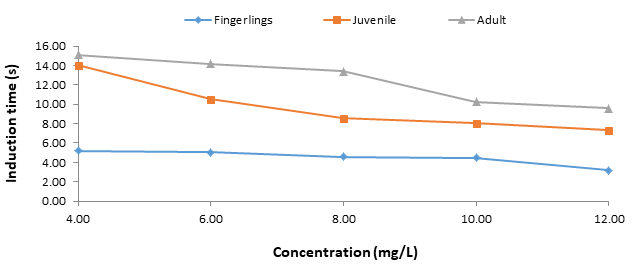
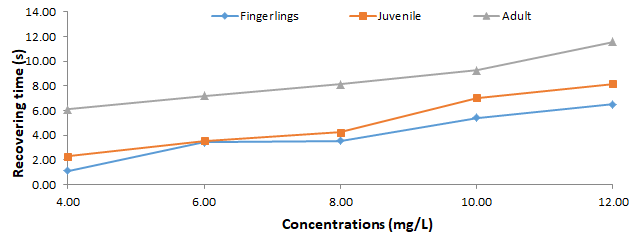
The comparative induction time (time taken for the fish to be anaesthetized) in C. gariepinus exposed to nutmeg seed extracts were shown in Figure 1. The highest induction time (15.08±0.04) was recorded in adult fish at 4.0mL-1. While the lowest (3.18±0.03 s) was recorded in fingerlings at 12.0mL-1 (Figure 1). For the recovery time, Figure 2 the longest recovery time (11.59±0.06s) was observed in the adult fish at 12.00 mg/l and the shortest (1.13±0.02 (S) in fingerlings at 4.00mg/l of the nutmeg seed extracts. The recovery time for all the life stages generally increased as the concentrations of the anaesthetics increased. Also, the recovery times in adult fish were higher at all concentrations; this was closely followed by juvenile fish. However, a shortest recovery time was observed in fingerlings in all concentrations of exposure (Figure. 2).
Discussion
The results obtained from the present study shows that different sizes of C. gariepinus exposed to nutmeg extract sequentially progressed through all the stages of anaesthesia and the experimental fish were successfully tranquilized at all levels of concentration, similar to the findings from the study on the effects of sodium bicarbonate on common carp (Cyprinus Carpio) juveniles which only reached all the stage of anaesthesia [19]. The effect of the anaesthetizing extracts appeared to be concentration dependent since faster tranquilization was achieved at higher concentration of the extract as reported in other studies [20, 21, 22]. This observation is also in agreement with Kavitha C, et al. [23] that the degree of anaesthesia is influenced by the concentration of the anaesthetic in the central nervous system (CNS) of the organism.
Moreover, in the present investigation the shorter induction time taken to tranquilize the experimental fish, C.gariepinus, with increased concentration of the anaesthetic extracts may be attributed to the accumulation of the active ingtredients, rotenoids, in the body system of the fish which impaired the activity of CNS at a much faster rate [23]. When the time taken for C. gariepinus to enter anaesthesia or to be tranquilized (induction time) and recovery time are considered in the present investigation, significant differences in induction time were recorded at anaesthetic stages depicting the effect of concentration on induction time at this stage of anaesthesia [24].
The recovery times in agreement with other researchers [25], and it tended to increase with increasing concentration of nut Meg extracts. However, Hseu JR, et al. [26] reported that higher drug concentration or dose increase recovery time. In the case of immersion anaesthetics Florida, et al. [27] suggested that this may be due to the fact that higher dose induced anaesthesia more rapidly thus allowing the experimental fish to be removed from the anaesthetic bath and placed in clean water earlier than fish exposed to lower doses. Since the degree of anaesthesia is influenced by the concentration of the anaesthetic in the CNS of the experimental fish [28], in the present study where the parental route of anaesthesia was used this may explained by the fact that more of the active ingredients of the anaesthetic extract accumulated in the CNS of the fish at higher concentrations thus suppressing the activity of the CNS to a greater degree than at lower concentrations and consequently prolonging the recovery time. The recovery time of 506.67 minutes (8.43 Hrs) obtained with the freeze-dried leaf extract is close to the 12 hour recovery time reported for Oreochromis niloticus anaesthetize with quinaldine [29].
The higher concentration of anaesthetics obtained in adult, when compared to other sizes as obtained in this study could be due to the size and weight of the fish in relation to the low concentration used since larger individuals generally require a greater concentration of the anaesthetic than smaller individuals [30]. This could also be due to the stage of the life cycle, age, lipid content and body condition, all of which are biological factors that influence metabolic rate and therefore the pharmacokinetics of the anaesthetic compound [31]. The result further indicated that the effective concentration of the aqueous extract of nutmeg was similar to the induction time reported for Valamugil cunnesius and Monodactylus argenteus respectively, following clove oil anaesthesia [30], and the 1.5minutes for Acepenser perscicus exposed to clove oil [31]. When the rapid induction time (3–5 minutes) required of an ideal anaesthetic [32, 33, 34] is considered, the aqueous extract nutmeg seed closely meet the requirement of an ideal anaesthetics.
Conclusion and Recommendations
Nut Meg extracts was able to sedate fingerlings, juveniles and adult sizes of C. gariepinus brood stock within 4-6 min and recover from sedation within 6.0-6.5 minutes. Nutmeg seed extracts possess the desirable properties of affordable, accessible and suitable anaesthetics agent for handling, restraint and immobilization of Clariids for various handling procedure in aquaculture.
References
-
Summerfelt RC, Smith LS (1990) Anaesthesia, surgery and related techniques. In: Methods for Fish Biology. Schreck CB, Moyle PB (Ed.), Bethesda MD: American Fisheries Society, pp: 213-272.
-
Altun T, Bilgin R, Danabas D (2009) Effects of sodium bicarbonate on an anaesthesia of common carp (Cyprinuscarpio) juveniles. Turkish Journal of Fisheries and Aquatic Sciences 9: 29-31.
-
Avilez IM, Altran AE, Agira LH, Morales G (2004) Haematological responses of the neotropically teleost matrixa (Bryon cephalous) to environmental nitrite. Comparative Biochemistry and physiology 139: 135-139
-
Gabriel UU, Deekae SN, Akinrotimi OA, Orokotan OO (2015) Assessment of efficacy and egg hatchability in African catfish Clarias gariepinus exposed to anesthetic metomidate. ARC Journal of Animal and Veterinary Sciences 1(1): 24-31.
-
Sovio A, Nylom K, Huhti M (2007) Effects of anaesthesia with MS-222, and benzocaine on the blood constituents of rainbow trout (Salmogairdineri). Journal of Fish Biology 10: 91-101.
-
Munday PL, Wilson SK (1997) Comparative efficacy of clove oil and other chemicals in anaesthetization of pomacentrus amboinensis, a coral reef fish. Journal of Fish Biology 51(5): 931-938.
-
Akinrotimi OA, Gabriel UU, Edun OM (2015) The efficacy of clove seed extracts as an anaesthetic agent and its effect on haematological parameters of African catfish (Clarias gariepinus). International Journal of Aquaculture and Fishery Sciences 1(2): 42- 47.
-
Martins M, Martinez-Cordova LR, Ramos-Enriquez R (2009) Cortisol and Glucose: Reliable indicators of fish stress. Pan-American Journal of Aquatic Sciences 4(2): 158-178.
-
Popovic TN, Strunjak-Perovic I, Coz-Pakovac R, Barisic J, Jadan M, et al. (2012) Tricaine methane-sulfonate (MS- 222) application in fish anaesthesia a review. Journal of Applied Ichthyology 28(4): 553-564.
-
Akinrotimi OA, Okereke AN, Ibemere IF (2011) Studies in plasma glucose as biomakers for stress response in Tilapia guineensis. African Journal of General Agriculture, 7(3): 125-130.
-
Adamek Z, Tasic K, Paul K, Lamasic M (2016) The effect of 2-phnenoxyethanol narcosis on blood of young carp. Veterinary Archives 63: 245-250.
-
Akinrotimi OA, Aranyo AA, Ibemere IF (2011) Physiological response in Tilapia guineensis subjected to handling stress. Advances in Agriculture science and Engineering Research 1(2): 34-39.
-
Akar AM (2011) Effects of clove oil on the response of blue tilapia (Oreochromis aureus) by transportation stress. Journal of the Arabian Aquaculture society 6(1): 77-86.
-
Acrete L, Espinosa E, Josa A, Tont L (2016) Physiological response of hybrid stripped bass subjected to Photobacterium damselas. Aquaculture 298(1-2): 16- 23.
-
Adewumi AA, Olaleye VF (2011) Catfish culture in Nigeria: Progress, prospects and problems. African Journal of Agricultural Research 6(6): 1281-1285.
-
Agbaje EO (2008) Gastrointestinal effects of Syzigium aromaticum (L) Merr. & Perry (Myrtaceae) in animal models. Nigeria Quarterly Journal of Hospital Medicine 18(3): 137-141.
-
Akinrotimi OA, Aranyo AA, Ibemere IF (2011) Effects of capture, handling and confinement on the glucose levels of black jaw tilapia Sarotherodon melanotheron. Advances in Students Research 1(2): 27-30.
-
APHA (1998) Standard methods for the examination of water andwaste water 17th (Edn.), American Public Health Association Press, Washington D. C, USA.
-
Akinrotimi OA, Edun OM, Mebe ED (2013) effects of clove seeds as anaesthetic agents in two species of grey mullets Liza falcipinnis and Liza grandisqumis. Journl of Aquatic Science 1(1): 7-10.
-
Iwama GK, Ackerman PA (1994) Anaesthesia. In: Biochemistry and Molecular Biology of Fishes, Hochachka PW, Mommsen TP (Ed.), Amsterdam: Elsevier Science, pp: 1-15.
-
Iversen M, Finstaz B, Mckinley RS, Carlson KT, Evjen T (2015) Stress responses in Atlantic Salmo (Salmosalar) smolts during commercial boat transports and effects on survival after transfer to sea. Aquaculture 243(1-4): 373-382.
-
Iversen M, Eliassen RA, Fibstad B (2009) Potential benefit of clove oil sedation on animal welfare during salmon smolt, (Salmosalar) transport and transfer to sea. Aquaculture Research 40(2): 233-241.
-
Kavitha C, Malarvizhi A, Kumaran SS, Ramesh M (2016) Toxicological effect of anaesthetic exposure on haematological, biochemical and liver transaminases activity in an Indian major carp Catla catla. Food Chemistry and Toxicology 48(10): 2848-2854.
-
Akinrotimi OA, Ansa EJ, Edun OM (2016) Effectiveness of clove seed extracts as anaesthetics in transportation of Tilapia guineensis juveniles. Journal of Aquaculture Engineering and Fisheries Research 2(2): 67-75.
-
Lays N, Iversen MMT, Frantzen M, Jorgen EH (2017) Physiological stress responses in spotted wolfish (Anarhinchasminur) subjected to acute disturbance and progressive hypoxia. Aquaculture 295(1-2): 126-133.
-
Hseu JR, Yeh SL, Chu YT, Ting YY (2016) Application of sodium bicarbonate and sulforic acid for anaesthetization of black porgy (Acanthyopagrus schlegeli). Journal of Taiwan Fish Fisheries Research 3(2): 151-159.
-
Florida, Gainesville Fries JN, Berkhouse CS, Morrow JC, Carmichael GJ (1993) Evaluation of an aeration system in a loaded fish-hauling tank. The Progressive Fish Culturist 55(3): 187-190.
-
Ariweriokuma SV, Gabriel UU, Deekae SN, Akinrotimi OA (2016) Haematological charcacteristics of African catfish (Clarias gariepinus) fed dietary inclusion levels of green leaf (Amaranthus cruentus). International Journal of Innovative Studies in Aquatic Biology and Fisheries 2(2): 11-22.
-
Carneiro PC, Urbrinati EC, Martins ML (2002) Transport with different concentration of benzocairne concentrations and its consequences on haematological parameters and gill parasite populations of matrixa. Acta Science 24(2): 555-560.
-
Carmichael GJ, Tomasso JR, Schwelder TE (2001) Fish transportation. In: Wedemeyer GA (ed.), Fish Hatchery Management, American Fisheries Society, pp: 641-660.
-
Bright BA, Cech J (2002) Physiological changes in fish from stress in aquaculture with emphasis on the response and of corticosteroids. Aunual Review of fish Diseases 1: 3-26.
-
Marking LL, Meyer FP (1985) Are better anaesthetics needed in fisheries. Fisheries 10(6): 2-5.
-
Mylonass CC, Cardinality G, Sigelaki L, Polzonetti- Magni A (2005) Comparative efficacy of clove oil and 2-phenoxyethanol as anaesthetics in the aquaculture of European seabass and gill-head sea bream (Sparusaurata) at different temperatures. Aquaculture 246(1-4): 467-481.
-
Kolarova M, Kolarova L, Perina A, Chalupa P (2012) Animal products and selected human infections disease. Cech Journal of Animal Science 47: 297-307.
- Genetic Improvement of Nile Tilapia (Oreochromis niloticus): Advances in Selective Breeding and Genomic Approaches for Sustainable Aquaculture
- Microplastics, Contaminants, and Waste Hotspots: Divergences and Faults in Prioritizing Control Efforts
- Creating a Healthier, More Vibrant Open and Closed Aquatic Environment. A Submersible, Centrifugal Magnetically Affixed Current Changing Aquarium Pump
- An Attempt to Assess Alpha Diversity and Sample Size: Using the Ostracod Assemblages off Kumamoto Port, Japan
- Assessment of the Efficiency of Common Fishing Gears and Crafts Used at Mohananda River of Chapai Nawabganj, Bangladesh
- Fish Productivity and Biodiversity Status of Sundarban Mangrove in Bangladesh