
Evaluation of National Proficiency Testing (PT) Provision in the Scheme of Soil Analysis on PH, Organic Carbon, Total Nitrogen and Available Phosphorus Based On the Same Soil Sample Exchange in Ethiopia
Proficiency testing (PT) is to monitor the quality of their analytical results, demonstrating analytical competence, developing and training analysts, and the validation of methods and instruments as stipulated in ISO/IEC 17025 in Ethiopia. Composite surface soil samples at the depth of 0-20 cm were collected from the experimental sites. The sample was air dried, grained using mortal and pestle and sieved < 0.5mm mesh size. Soil pH, organic carbon, total N and available P were determined at respective agricultural research soil Laboratories following standard lab procedures in fifteen soil laboratories of EIAR & regional centers participated in the PT organized for 2022. The results of the analytical results were evaluated by calculating Z scores.
Introduction
Soil and agronomic studies have been conducted in Ethiopia since the 1950s. A great deal of work has been conducted related to crop response to fertilizer applications and soil survey and mapping. However, the data collected from the studies are scattered across different individuals and organizations and exist in diverse formats. As a result, most of the data are difficult to access and lack standards or are incomplete, which diminishes their utility. This resulted in duplication of effort and wasting of resources to collect redundant data. Those research technologies were released based on data collected from field and laboratory experiments. The soil laboratories is fundamental to such agricultural research endeavors, involving: analysis of soils as a basis for soil characterization and classification, identifying plant nutrient constraints, and establishing criteria for fertilizer application and efficient nutrient use, along with water, plant, and fertilizer analysis. Decision- making by policymakers, farmers, and researchers depends on reliable data on soils, water, and crops. However, a study conducted in 2016 on the status of Ethiopian soil laboratory infrastructure indicated that the data collected (in the chain of soil sampling to laboratory output) are not reliable enough for decision-making purposes [1]. Accordingly, the study emphasized the need to improve the output of Ethiopian soil, plant, and water laboratories and suggested strategies for them to fully reach their potential.
The findings of the study cast a shadow over the quality of the legacy data and data being collected and/or analyzed by the Ethiopian public and private laboratory infrastructure. Therefore, besides collating legacy soil and agronomic data, the implementation of a careful standardization and harmonization mission for legacy data is indispensable for national synthesis. It is advisable to follow global and national soil data standardization and harmonization guidelines such as the World Soil Information Service (WoSIS)- Towards the standardization and harmonization of world soil data [2].
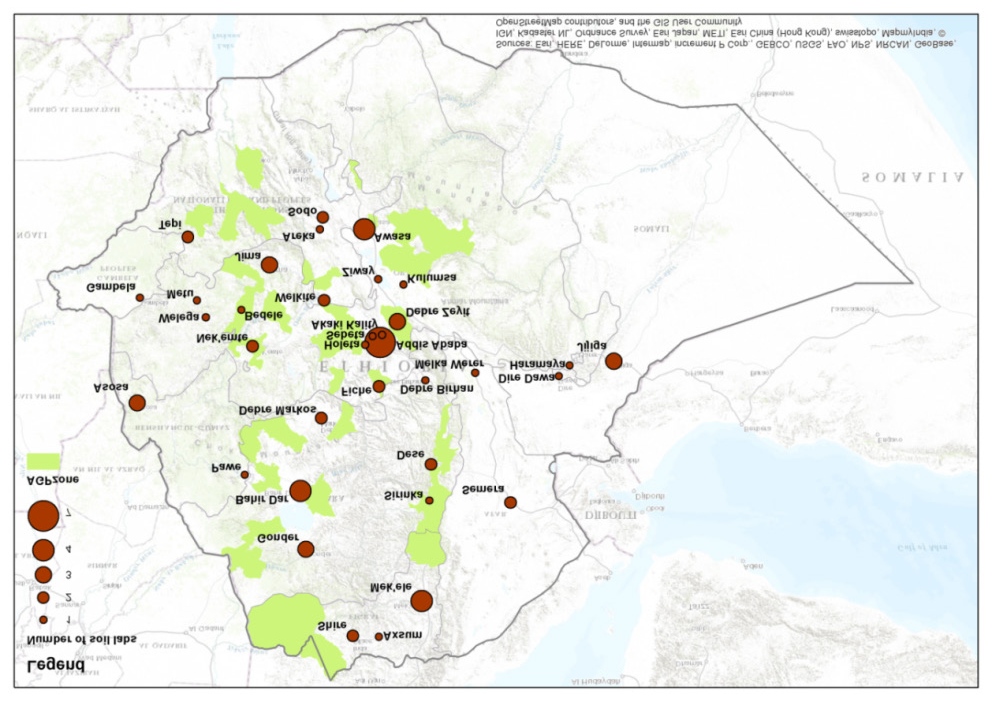
Various institutions have made efforts since 1963 to generate soil information for Ethiopia for assessing the agricultural development potential of each soil. These studies varied widely in scope, scale, and approach as well as in the quality of outputs [3]. The first attempt to map the soils of Ethiopia was made by Schantz and Marbut in 1923 as part of the mission of mapping the soils of Africa at a scale of 1:25 million. Among early efforts was the soil fertility survey conducted by Murphy HF [4], who also studied the general fertility status of soils in Ethiopia by collecting some 2,600 samples along the main roads across the country. Proficiency testing (PT) is a significant component in the laboratories competency process as it allows laboratories to monitor the quality of their analytical results as stipulated in ISO/IEC 17025. There are a number of benefits to participating in PT, including improving quality of analytical results measurements, demonstrating analytical competence, developing and training analysts, and the validation of methods and instruments. In this regard, Holeta Agricultural Research Center Soil laboratory takes an initiative to coordinate soil PT provision for interested soil laboratories (Fifteen soil laboratories of EIAR and regional centers) of Ethiopia. Currently, there are 68 soil laboratories distributed over 35 cities in different parts of Ethiopia [1].
PT evaluation is to monitor the quality of their analytical results, demonstrating analytical competence, developing and training analysts, and the validation of methods and instruments as stipulated in ISO/IEC 17025 in Ethiopia. Among few accredited soil laboratories, Holeta Agricultural Research Center (HARC) soil laboratory has been accredited since 2014.
Objective
To organize soil proficiency testing (PT) that contributes to maintaining and improving the quality of Ethiopian soil laboratories.
Purpose
The purpose of the soil PT is to offer the participating laboratories the opportunity to compare their analytical results with those of other laboratories. For this purpose, representative subsamples were sent to the participating laboratories for them to analyse according to their regular procedures. Participation was open for any laboratory.
**Methodology**
**Sample Collection and preparation**
Composite surface soil samples (0-20 cm) were collected from the experimental sites. Care was taken during sampling to avoid any heterogeneous material other than the soil was mixed. Then, the sampled soil was air dried in soil preparation room, ground manually in a porcelain mortar and pestle and then sieved < 0.5mm mesh size. Soil pH, organic carbon, total N and available P was determined at respective agricultural research soil Laboratories following standard lab procedures. Soil pH was measured using digital pH meter in 1:2.5 soil to solution ratio with H2O [5], the organic carbon was determined following wet digestion methods as described by Walkley A [6] and Nelson DW, et al. [7] whereas the Kjeldahl procedure was used for the determination of total N as described by Bremner JM, et al. [8]. The available P was determined by Bray II method [9].
**Quality Control**
Subsamples were tested by a homogeneity test. To perform this test, samples were collected at regular intervals during the preparation of the samples. These samples, with a minimum of 10, are analysed in duplicate measurements under repeatability conditions. Organic carbon analysis was used during homogeneity test.
**Homogeneity and stability studies**
Soil particles were difficult to mix and need repeated subsampling to make homogeneous. Therefore, after grinding dried sample and sieved by 0.5mm sieve size, the bulk sample was divided in to sub samples by using rotary sample divider. Each sample was subjected to homogeneity and stability test before dispatched to each participating laboratories.
All fifteen soil laboratories of EIAR & regional centers participated in the PT organized for 2022. About 10 kg of a soil sample was sampled from Wemera District located in West Shewa Zone of Oromia. It was prepared following the standard procedure. Samples dispatched to each participating laboratories were homogenized using rotary sample divider equipment. Then, homogeneity test performed before dispatched to each participating laboratory to ensure every laboratory receive the same item.
**Data Analysis**
Description of the statistical analysis was used, including the determination of assigned values and any outlier detection techniques Microsoft Excel software or self-programmed software for the data processing was used after the functionality according to the intended purposes proved on the basis of a sufficient number of test sets of data. All data were back-up to eliminate potential loss of electronic data. Assigned values are based on consensus values, obtained from the results of the participants using their routine methods. The robust standard deviation is used as standard deviation for proficiency assessment.
Participant’s performance was evaluated by calculating Z scores: $z_i = \left( x_i - xpt \right) / \sigma - pt$
The following criteria were used for the performance assessment.
- $Iz$-score $\leq 2.0$: Satisfactory Performance,
- $2.0 < Iz$-score $\leq 3.0$: Questionable Performance,
- $Iz$-score $\geq 3.0$: Unsatisfactory Performance
The uncertainty in the assigned value is calculated as:
$$ ux = 1.25 * s / \sqrt{N} $$
Where:
- $s$ = robust standard deviation
- $N$ = number of results
The uncertainty in the assigned value may influence the evaluation of the results (calculated Z-scores).
**Result and Discussion**
Participants in the soil proficiency testing scheme were listed below
From 15 different soil laboratories were participated in the proficiencies tests
- EIAR: - Holeta, Melkasa, kulumsa, Pawe, Jimma, Assosa, and DebreZeit Agricultural Research Centers soil laboratories
- OIAR: - Batu, Bedele Agricultural Research Centers
- AIAR: - Adet, Debribihan Agricultural Research Centers
- SolAR: - Jinka, Areka, Hawasa Agricultural Research Centers
- Netherland: - WEPAL
All laboratories submitted the analysis result based on the instruction though some laboratories lately submitted the results. Most of the laboratories tested and submitted results for about six parameters as indicated in the Table 1.
| No. | Centers | PH (1:2.5) | % OC | % TN | Avail. P ppm bray II |
|---|---|---|---|---|---|
| 1 | 1 | 4.85 | 3.33 | 0.3 | 19.23 |
| 2 | 2 | 4.82 | 3.48 | 0.35 | - |
| 3 | 3 | 4.62 | 3.26 | 0.29 | - |
| 4 | 4 | 4.65 | 2.96 | 0.29 | 5.22 |
| 5 | 5 | 4.68 | 2.79 | 0.27 | 5.38 |
| 6 | 6 | 4.79 | 3.2 | - | 18.5 |
| 7 | 7 | 4.6 | 3.86 | 0.23 | 2.92 |
| 8 | 8 | 4.62 | 3.71 | 0.21 | 2.98 |
| 9 | 9 | 4.58 | 3.39 | 0.33 | - |
| 10 | 10 | 4.53 | 2.98 | 0.274 | - |
| 11 | 11 | 4.5 | 3.46 | 0.24 | - |
| 12 | 12 | 4.7 | 4.1 | 0.35 | - |
| 13 | 13 | 4.81 | 3.25 | 0.296 | 14.22 |
| 14 | 14 | 4.47 | 3.27 | 0.31 | 3.35 |
| 15 | 15 | 4.6 | 3.62 | 0.31 | 7.02 |
Table 1: Soil PT report for some parameters by most of soil laboratories
Evaluation of Soil PT Participating Laboratories (Z-scores)
The Z score analysis was performed only for four parameters (pH-H2O, TN, Avail. P and OC) using the software as they fulfills the minimum number of participants for analysis i.e. fifteen. The evaluation result (Z score and assessment) is indicated in each of the following Table. Soil pH was measured using digital pH meter in 1:2.5 soil to solution ratio with H2O [5], The organic carbon was determined following wet digestion methods as described by Walkley A [6] and Nelson DW, et al. [7] whereas the Kjeldahl procedure was used for the determination of total N as described by Bremner JM, et al. [8]. The available P was determined by Bray II method [9].
Soil pH-H2O
From fifteen participants, soil lab 01, 02, 04, 05, 06 11 and 12 scored satisfactory result for pH-water analysis. While soil lab 03, 07, 08, 09 and 15 scored questionable result that can be improved with taking a corrective action (for example: calibrating the pH meter with carefully prepared pH buffer solutions). But the soil lab 10, 11 and 14 scored unsatisfactory result that questioned the reliability of the labs reporting soil pH for customers. So, the labs should take serious measures (analysing the root cause and takes corrective action) to improve the analytical performance for testing a soil pH.
| No. | Laboratory | PH (1:2.5) | Z-score | Assessment |
|---|---|---|---|---|
| 1 | 1 | 4.85 | 0.2 | S |
| 2 | 2 | 4.82 | -0.1 | S |
| 3 | 3 | 4.62 | -2.2 | Q |
| 4 | 4 | 4.65 | -1.9 | S |
| 5 | 5 | 4.68 | -1.6 | S |
| 6 | 6 | 4.79 | -0.4 | S |
| 7 | 7 | 4.6 | -2.4 | Q |
| 8 | 8 | 4.62 | -2.2 | Q |
| 9 | 9 | 4.58 | -2.6 | Q |
| 10 | 10 | 4.53 | -3.1 | N |
| 11 | 11 | 4.5 | -3.4 | N |
| 12 | 12 | 4.7 | -1.3 | S |
| 13 | 13 | 4.81 | -0.2 | S |
| 14 | 14 | 4.47 | -3.7 | N |
| 15 | 15 | 4.6 | -2.4 | Q |
Table 2: Assessment Soil pH.
S = Satisfactory [z-score] ≤ 2.0; n = Not Satisfactory [z-score] ≥ 3.0; q = Questionable 2.0< [z-score]< 3. Table 2: Assessment Soil pH.
Soil Organic Carbon
From fifteen participants, soil lab 1, 2, 3, 6, 9, 11, 13, 14, and 15 scored satisfactory result for OC analysis. Soil lab 4, 7, 8 and 10 scored questionable result and the lab can improve with taking slight corrective action. However, the soil lab 02, 03, 05 and 08 scored unsatisfactory result that questioned the reliability of the labs reporting soil OC for customers. Soil lab.5 and 12 score not satisfactory and reject table. So, the labs should take serious measures (analysing the root cause, implement and document appropriate corrective action) to improve the OC testing result.
| No. | Laboratory | % OC | Z-score | Assessment |
|---|---|---|---|---|
| 1 | 1 | 3.33 | -0.4 | s |
| 2 | 2 | 3.48 | 0.4 | s |
| 3 | 3 | 3.26 | -0.9 | s |
| 4 | 4 | 2.96 | -2.6 | q |
| 5 | 5 | 2.79 | -3.6 | n |
| 6 | 6 | 3.2 | -1.2 | s |
| 7 | 7 | 3.86 | 2.7 | q |
| 8 | 8 | 3.71 | 1.8 | s |
| 9 | 9 | 3.39 | -0.1 | s |
| 10 | 10 | 2.98 | -2.5 | q |
| 11 | 11 | 3.46 | 0.3 | s |
| 12 | 12 | 4.1 | 4.1 | n |
| 13 | 13 | 3.25 | -0.9 | s |
| 14 | 14 | 3.27 | -0.8 | s |
| 15 | 15 | 3.62 | 1.3 | s |
Table 3: Assessment of Soil Organic Carbon.
S = Satisfactory [z-score] ≤ 2.0; n = Not Satisfactory [z-score] ≥ 3.0; q = Questionable 2.0< [z-score]< 3. Table 3: Assessment of Soil Organic Carbon.
Soil Total Nitrogen
From fourteen participants, soil lab 1, 2, 3, 4, 9, 12, 13 and 15 scored satisfactory result for TN analysis. Soil lab 5, 10, 8 and 14 scored questionable result can improve with taking slight corrective action and the soil lab. 7, 8 and 11 scored not satisfactory and rejectable. So, the labs should take serious measures (analysing the root cause, implement and document appropriate corrective action) to improve the TN testing result.
| No. | Centers | % TN | Z-score | Assessment |
|---|---|---|---|---|
| 1 | 1 | 0.3 | -1.3 | S |
| 2 | 2 | 0.35 | 1.3 | S |
| 3 | 3 | 0.29 | -1.8 | S |
| 4 | 4 | 0.29 | -1.8 | S |
| 5 | 5 | 0.27 | -2.8 | Q |
| 6 | 6 | ND | ND | ND |
| 7 | 7 | 0.23 | -4.9 | N |
| 8 | 8 | 0.21 | -5.9 | N |
| 9 | 9 | 0.33 | 0.3 | S |
| 10 | 10 | 0.274 | -2.6 | Q |
| 11 | 11 | 0.24 | -4.4 | N |
| 12 | 12 | 0.35 | 1.3 | s |
| 13 | 13 | 0.296 | -1.5 | s |
| 14 | 14 | 0.31 | -0.8 | s |
| 15 | 15 | 0.31 | -0.8 | s |
| No. | Centers | Avail.P ppm bray II | Z-score | Assessment |
| 1 | 1 | 19.23 | 0 | S |
| 2 | 2 | ND | - | |
| 3 | 3 | ND | - | |
| 4 | 4 | 5.22 | -9.1 | N |
| 5 | 5 | 5.38 | -9 | N |
| 6 | 6 | 18.5 | -0.5 | S |
| 7 | 7 | 2.92 | -10.6 | N |
| 8 | 8 | 2.98 | -10.6 | N |
| 9 | 9 | ND | - | |
| 10 | 10 | ND | - | |
| 11 | 11 | ND | - | |
| 12 | 12 | ND | - | |
| 13 | 13 | 14.22 | -3.3 | n |
| 14 | 14 | 3.35 | -10.3 | n |
| 15 | 15 | 7.02 | -7.9 | n |
Table 4: Assessment of Soil Total Nitrogen.
S = Satisfactory [z-score] ≤ 2.0; n = Not Satisfactory [z-score] ≥ 3.0; q = Questionable 2.0< [z-score]< 3. Table 4: Assessment of Soil Total Nitrogen.
Soil Available Phosphorus
From nine participants, soil lab 1, and 6 scored satisfactory result for TN analysis. Soil lab 4, 5, 7, 8, 13, 14 and 15 scored not satisfactory and rejectable. So, the labs should take serious measures (analysing the root cause, implement and document appropriate corrective action) to improve the TN testing result.
S = Satisfactory [z-score] ≤ 2.0; n = Not Satisfactory [z-score] ≥ 3.0; q = Questionable 2.0< [z-score]< 3. Table 5: Assessment of Soil Available Phosphorus.
Conclusion
From the above result the laboratories should take serious measures (analyzing the root cause, implement and document appropriate corrective action) to improve the OC, TN and Available P testing result. However, the data generated from the Ethiopian soil laboratories are not reliable enough and need to improve their analytical services quality. Reliable and acceptable data was generated when laboratories fulfill ISO/ IES 17025 standard, gets an accreditation certificate and participate in Proficiencies tests.
References
-
Bakker G, Okx JP, Assen M, Solomon T (2016) Ethiopian soil laboratory infrastructure: CASCAPE scoping mission. Alterra, Wageningen University and Research Centre, Netherlands.
-
ISRIC (2018) World Soil Information Service (WoSIS)– Towards the standardization and harmonization of the world soil data. Procedure Manual 2018, ISRIC Report.
-
Esayas A, Debele B (2006) Soil survey in Ethiopia: The past, present and future. Proceedings of the seventh conference of the Ethiopian Society of Soil Science on soils for sustainable development, Addis Ababa, Ethiopia, pp: 61-79.
-
Murphy HF (1968) A Report on the Fertility Status and Other Data on Some Soils of Ethiopia. Experiment Station Bulletin No. 44. College of Agriculture, Haile Selassie I University.
-
Mclean EO (1982) Soil pH and Lime Requirement. In: Methods of Soil Analysis Edited by Page Miller RH, Keeney DR, Part 2 chemical and microbiological properties. 2nd (Edn.), American Society of Agronomy, Madison, USA, pp: 199-234.
-
Walkley A (1947) An examination of Degtjareff method for determining soil organic matter and the proposed modification of the chromic acid titration method. Soil Science 37: 29-38
-
Nelson DW, Sommers LE (1982) Total Carbon, Organic Carbon and Organic Matter. In: Methods of soil analysis. Edited by Page Miller RH, Keeney DR, Part 2 chemical and Microbiological properties. 2nd edition, America Society Agronomy, Madison. WI. USA, pp: 359-580.
-
Bremner JM, Mulvaney CS (1982) Nitrogen-total. In: Methods of Soil Analysis Edited by Page Miller RH, Keeney DR, part 2 chemical and microbiological properties. 2nd edition, Madison, WI: American Society of Agronomy, pp: 595-624
-
Bray HR, Kurtz LT (1945) Determination of organic and available forms of phosphorus in soils. Soil Science 59(1): 39-46.
- Genetic Improvement of Nile Tilapia (Oreochromis niloticus): Advances in Selective Breeding and Genomic Approaches for Sustainable Aquaculture
- Microplastics, Contaminants, and Waste Hotspots: Divergences and Faults in Prioritizing Control Efforts
- Creating a Healthier, More Vibrant Open and Closed Aquatic Environment. A Submersible, Centrifugal Magnetically Affixed Current Changing Aquarium Pump
- An Attempt to Assess Alpha Diversity and Sample Size: Using the Ostracod Assemblages off Kumamoto Port, Japan
- Assessment of the Efficiency of Common Fishing Gears and Crafts Used at Mohananda River of Chapai Nawabganj, Bangladesh
- Fish Productivity and Biodiversity Status of Sundarban Mangrove in Bangladesh