
Exploring the Ichthyofauna of District Mardan, Khyber Pakhtunkhwa, Pakistan
The current study aimed to investigate the diversity and distribution of freshwater fish in the districts of Mardan, located in the northwest of Khyber Pakhtunkhwa province, Pakistan. Mardan is home to numerous streams and rivers between the Indus and Kabul rivers, making it an important area for fishing and farming. A total of 250 fish samples were collected from February to November 2021. Eight species were identified in Mardan, including Mastacembelus armatus, Gara gotyla, Cyprinus carpio, Puntius ticto, Caraccius auratus, Oreochromis mosambicus, Puntius sophore, and Tor putitora. The results suggest that overfishing and water pollution are major factors affecting the survival and expansion of fish species in the area. To improve the fish populations in the rivers and streams, proper stocking and regulations to control overfishing and pollution are needed. The study found that the Cyprinidae family was the most dominant, with eight species identified in the experimental area. However, the number of Mastacembelidae and Cichlidae was found to be low due to pollution, toxic heavy metals, and other environmental factors that affect breeding and other activities of fish.
Introduction
Freshwater fish are a vital component of aquatic ecosystems, providing food and income for local communities and serving as indicators of water quality and ecosystem health [10]. However, human activities such as overfishing and pollution are putting increasing pressure on these populations [11]. Mardan and Swabi are districts located in the northwest of the Khyber Pakhtunkhwa province in Pakistan. These areas are characterized by numerous streams and rivers that are of great importance for fishing and farming. The main streams and rivers in Mardan and Swabi, previous literature and studies have identified several significant water bodies. Some of the notable watercourses in the region include the Kabul River, Bara River, Swat River, and various smaller streams and tributaries. When considering the fish fauna in Mardan and Swabi, it is important to mention the local species that hold significant weight in terms of size and ecological importance. Previous studies have identified certain fish species that are particularly large or have high ecological significance in these rivers. These species contribute to the overall biodiversity and play a crucial role in the aquatic ecosystem of the region. These water bodies serve as vital habitats for a diverse range of fish species. The current study aimed to fill this knowledge gap by conducting a comprehensive survey of freshwater fish in Mardan and Swabi. A total of 250 fish samples were collected from February to November 2021, and the results provide valuable insights into the species present, their distribution, and the factors affecting their populations. Understanding the diversity and distribution of fish in Mardan and Swabi is crucial for developing effective conservation and management strategies to ensure the sustainable use of these resources for the benefit of local communities and the environment [12]. However, it is worth noting that the frequency of fish species has been observed to decrease in recent years due to pollution. Pollution from various sources, such as industrial waste, agricultural runoff, and improper waste disposal, can have detrimental effects on water quality and the survival of fish populations. This pollution can lead to habitat degradation, reduced oxygen levels, and the accumulation of harmful substances, all of which contribute to the decline in fish numbers.
Materials and Methods
In this study, we aimed to investigate the diversity and distribution of freshwater fish in the district Mardan, located in the northwest of Khyber Pakhtunkhwa province, Pakistan. The district is home to numerous streams and rivers between the Indus and Kabul rivers, making it an important area for fishing and farming. To collect fish samples, we employed a variety of methods including hooking of multiple lengths, cast nets, automatic rods, gill nets, drag nets, hooking nets, and hand nets. These methods were used to collect fish from eight different locations in Mardan. The study was conducted over a period of nine months, from February to November 2021, with ten collections conducted every month. The collected fish were preserved in 10% formalin for larger specimens and 5% formalin for smaller ones. Some were also preserved in 70% ethanol [13]. The fish were dissected to collect parasites, which were then fixed in alcohol-formol- acetic acid and identified using standard keys [13, 14]. The prevalence rate of parasites was calculated using the formula: (number of parasite-infected fish x 100) / total number of fish analyzed [15]. In addition to parasite analysis, physical parameters of the water were also measured, including temperature, pH, water velocity, TSS, and TDS [15]. Using standard fish identification keys, seven species were recognized in the Islamia college university Peshawar laboratory, Fish species were identified using standard identification keys and morphometric criteria. Statistical analysis was done using Korean Statistic 9 software. All measurements were made with a calibrated compound microscope and are in millimeters. This allowed us to have a detailed understanding of the fish species present in the area, their distribution and the factors affecting their populations, which is crucial for developing effective conservation and management strategies to ensure the sustainable use of these resources for the benefit of Human.
Results
In this study, we conducted a biodiversity assessment of freshwater fish in the district of Mardan in Pakistan. A total of 250 fish samples were collected from various locations in these districts during the study period, which lasted from February to November 2021. Using various identification keys and literature, we were able to identify eight different species of fish, including Mastacembelus armatus, Gara gotyla, Cyprinus carpio, Puntius ticto, Caraccius auratus, Oreochromis mosambicus, Puntius sophore, and Tor putitora. These species were classified into Cypriniformes, Synbranchiformes, Perciformes and as well as three families: Cyprinidae, Mastacembelidae and Cichlidae. Our findings revealed that the Cyprinidae family was the most abundant in the streams and rivers of District Mardan, with a strong association between the occurrences of fish species in these water bodies. This could be attributed to the minimal fishing pressure and the substrate of the rivers and streams, which provide suitable conditions for nesting and rearing.
Mardan Data (Tables 1-8) and (Figures 1-7)
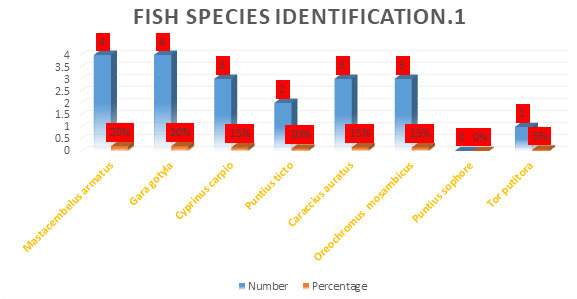
In the first sample, 20 fishes were collected out of these four fishes belong to Mastacembelus armatus, which make 20% of the total fish, four fishes belong to Gara gotyla which make up 20% of fish, three fishes belong to Cyprinuscarpio
which make 15% of the total fishes, two fishes belong to Puntius ticto which make 10% of fishes, three fishes belong to Caraccius auratus which make 15% of fishes, three fishes belong to Oreochromus mosambicu s which make 15% of fishes,0 fishes belong to Puntius sophore which make 0% of fishes and one fish belong to tor putitor which make 5% of total fishes.
| Fish Species | Number | Percentage | |
|---|---|---|---|
| 1 | Mastacembelusarmatus | 4 | 20% |
| 2 | Garagotyla | 4 | 20% |
| 3 | Cyprinuscarpio | 3 | 15% |
| 4 | Puntiusicto | 2 | 10% |
| 5 | Caracciusauratus | 3 | 15% |
| 6 | Oreochromusmosambicus | 3 | 15% |
| 7 | Puntiussophore | 0 | 0% |
| 8 | Tor putitora | 1 | 5% |
Table 1: Mardan Data.
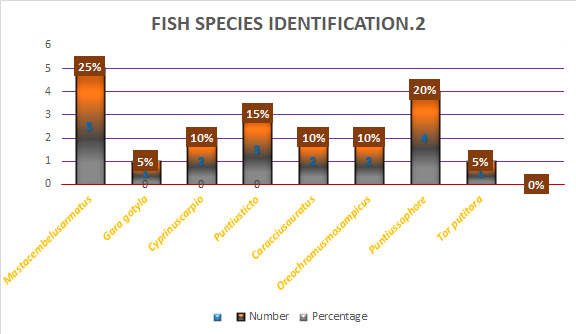
| Fish Species | Number | Percentage | |
|---|---|---|---|
| 1 | Mastacembelusarmatus | 5 | 25% |
| 2 | Garagotyla | 1 | 5% |
| 3 | Cyprinuscarpio | 2 | 10% |
| 4 | Puntiusicto | 3 | 15% |
| 5 | Caracciusauratus | 2 | 10% |
| 6 | Oreochromusmosambicus | 2 | 10% |
| 7 | Puntiussophore | 4 | 20% |
| 8 | Tor putitora | 1 | 5% |
Table 3: Mardan Data.
In the second sample, 20 fishes were collected out of these five fishes belong to Mastacembelus armatus, which make 25% of the total fish, one fishes belong to Gara gotyla which make 5% of fish, two fishes belong to Cyprinuscarpio which make 10% of the total fishes, three fishes belong to Puntius ticto which make 15% of fishes, two fishes belong to Caraccius auratus which make 10% of fishes, tw0 fishes belong to Oreochromus mosambicu s which make 10% of fishes, four fishes belong to Puntius sophore which make 20% of fishes and one fish belong to tor putitor which make 5% of total fishes.
| No | Fish Species | Number | Percentage |
|---|---|---|---|
| 1 | Mastacembelusarmatus | 2 | 10% |
| 2 | Garagotyla | 1 | 5% |
| 3 | Cyprinuscarpio | 1 | 5% |
| 4 | Puntiusicto | 3 | 15% |
| 5 | Caracciusauratus | 7 | 35% |
| 6 | Oreochromusmosambicus | 4 | 20% |
| 7 | Puntiusophore | 1 | 5% |
| 8 | Tor putitora | 1 | 5% |
Table 2: Mardan Data.
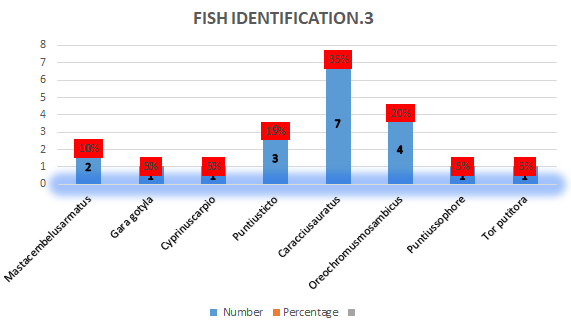
In the third sample, 20 fishes were collected out of these two fishes belong to Mastacembelus armatus, which make 10% of the total fish, one fishes belong to Gara gotyla, which make up 5% of fishes, and one fishes belong to Cyprinuscarpio, which make up 5% of the total fish; three fishes belong to Puntius ticto, which make up 15% of fish, seven fishes belong to Caraccius auratus_which make 35% of fish, four fishes belong to _Oreochromus mosambicu s which make 20% of fishes, one fishes belong to Puntius sophore which make 5% of fishes and one fish belong to tor putitor which make 5% of total fishes.
| Fish Species | Number | Percentage | |
|---|---|---|---|
| 1 | Mastacembelusarmatus | 5 | 25% |
| 2 | Garagotyla | 3 | 15% |
| 3 | Cyprinuscarpio | 1 | 5% |
| 4 | Puntiusticto | 6 | 30% |
| 5 | Caracciusauratus | 2 | 10% |
| 6 | Oreochromusmosambicus | 0 | 0% |
| 7 | Puntiussophore | 2 | 10% |
| 8 | Tor putitora | 1 | 5% |
Table 4: Mardan Data.
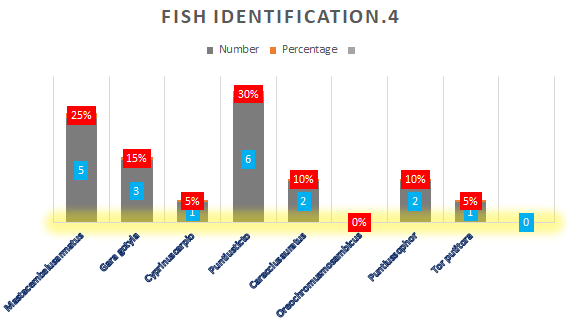
In the fourth sample, 20 fishes were collected out of these five fishes belong to Mastacembelus armatus, which make 25% of the total fish, three fishes belong to Gara gotyla which make 15% of fish, one fishes belong to Cyprinuscarpio which make 5% of the total fishes, six fishes belong to Puntius ticto which make 30% of fishes, two fishes belong to Caraccius auratus which make 10% of fishes, zero fishes belong to Oreochromus mosambicu s which make 0% of fishes, two fishes belong to Puntius sophore which make 10% of fishes and one fish belong to tor putitor which make 5% of total fishes.
| No | Fish Species | Number | Percentage |
|---|---|---|---|
| 1 | Mastacembelusarmatus | 4 | 20% |
| 2 | Garagotyla | 1 | 5% |
| 3 | Cyprinuscarpio | 5 | 25% |
| 4 | Puntiusticto | 2 | 10% |
| 5 | Caracciusauratus | 3 | 15% |
| 6 | Oreochromusmosambicus | 1 | 5% |
| 7 | Puntiussophore | 2 | 10% |
| 8 | Tor putitora | 2 | 10% |
| 1 | Mastacembelusarmatus | 0 | 0% |
| 2 | Garagotyla | 0 | 0% |
| 3 | Cyprinuscarpio | 0 | 0% |
| 4 | Puntiusticto | 0 | 0% |
| 5 | Caracciusauratus | 8 | 40% |
| 6 | Oreochromusmosambicus | 3 | 15% |
| 7 | Puntiussophore | 2 | 10% |
| 8 | Tor putitora | 7 | 35% |
Table 6: Mardan Data.
In the fifth sample, 20 fishes were collected out of these four fishes belong to Mastacembelus armatus, which make 20% of the total fish, one fishes belong to Gara gotyla which make 5% of fish, five fishes belong to Cyprinuscarpio which make 25% of the total fishes, two fishes belong to Puntius ticto which make 10% of fishes, three fishes belong to Caraccius auratus which make 15% of fishes, one fish belong to Oreochromus mosambicu s which make 5% of fishes, two fishes belong to Puntius sophore which make 10% of fishes and two fishes belong to tor putitor which make 10% of total fishes.
| No | Fish Species | Number | Percentage |
|---|---|---|---|
| 1 | Mastacembelusarmatus | 5 | 25% |
| 2 | Garagotyla | 3 | 15% |
| 3 | Cyprinuscarpio | 2 | 10% |
| 4 | Puntiusticto | 3 | 15% |
| 5 | Caracciusauratus | 2 | 10% |
| 6 | Oreochromusmosambicus | 2 | 10% |
| 7 | Puntiussophore | 2 | 10% |
| 8 | Tor putitora | 1 | 5% |
Table 5: Mardan Data.
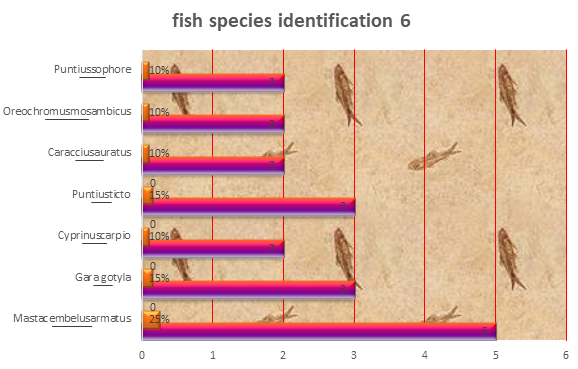
In the six samples, 20 fishes were collected out of these five fishes belong to Mastacembelus armatus, which make 25% of the total fish, three fishes belong to Gara gotyla which make up 15% of fish, two fishes belong to Cyprinuscarpio which make 10% of the total fishes, three fishes belong to Puntius ticto which make 15% of fishes, two fishes belong to Caraccius auratus which make 10% of fishes, two fishes belong to Oreochromus mosambicu s which make 10% of fishes, two fishes belong to Puntius sophore which make 10% of fishes and one fish belong to tor putitor which make 5% of total fishes.
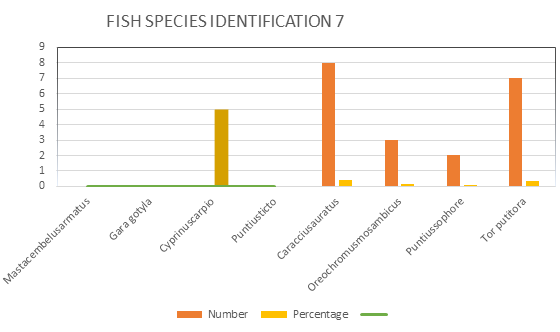
In the seven samples, 20 fishes have collected out these. No fishes belong to Mastacembelus armatus, which make 0% of the total fish; no fishes belong to Gara gotyla, which make 0% of fish; no fishes belong to Cyprinuscarpio, which make 0% of the total fishes, no fishes belong to Puntius ticto which make 0% of fishes, eight fishes belong to Caraccius auratus which make 40% of fishes, three fishes belong to Oreochromus mosambicu s which make 15% of fishes, two fishes belong to Puntius sophore which make 10% of fishes and seven fishes belong to tor putitor which make3 5% of total fishes.
Mardan Data (Table 9)
| Fish Species | Number | Percentage | |
|---|---|---|---|
| 1 | Mastacembelusarmatus | 0 | 0% |
| 2 | Garagotyla | 0 | 0% |
| 3 | Cyprinuscarpio | 0 | 0% |
| 4 | Puntiusticto | 0 | 0% |
| 5 | Caracciusauratus | 8 | 40% |
| 6 | Oreochromusmosambicus | 3 | 15% |
| 7 | Puntiussophore | 2 | 10% |
| 8 | Tor putitora | 7 | 35% |
Table 7: Mardan Data.
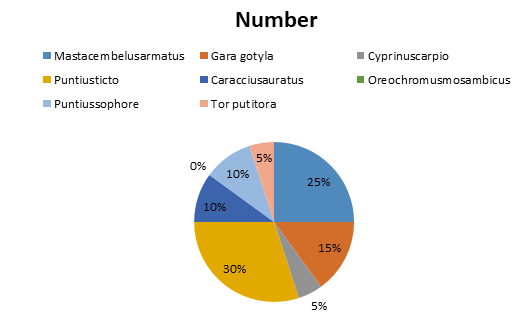
In the eight samples, 20 fishes were collected out of these five fishes belong to Mastacembelus armatus, which make 25% of the total fish, three fishes belong to Gara gotyla, which make 15% of fish, one fishes belong to Cyprinuscarpio which make 5% of the total fishes, six fishes belong to Puntius ticto which make 30% of fishes, two fishes belong to Caraccius auratus which make 10% of fishes, 0 fishes belong to Oreochromus mosambicu s which make 0% of fishes, two fishes belong to Puntius sophore which make 10% of fishes and one fish belong to tor putitor which make 5% of total fishes.
| Serial No. | Class | Order | Family | Genus | Species | |
|---|---|---|---|---|---|---|
| 1 | Actinopterygii | Synbranchiformes | Mastacembelidae | Mastacembelus | armatus | |
| 2 | Actinopterygii | Cypriniformes | Cyprinidae | Garra | gotyla | |
| 3 | Actinopterygii | Cypriniformes | Cyprinidae | Cyprinus | carpio | |
| 4 | Actinopterygii | Cypriniformes | Cyprinidae | Puntius | ticto | |
| 5 | Actinopterygii | Characiformes | Characidae | Carassius | auratus | |
| 6 | Actinopterygii | Perciformes | Cichlidae | Oreochromis | mosambicus | |
| 7 | Actinopterygii | Cypriniformes | Cyprinidae | Puntius | sophore | |
| 8 | Actinopterygii | Cypriniformes | Cyprinidae | Tor | putitora | |
| S.No | Class | Order | Family | Genus | Species | |
| 1 | Actinopterygii | Synbranchiformes | Mastacembelidae | Mastacembelus | armatus | |
| 2 | Actinopterygii | Cypriniformes | Cyprinidae | Garra | gotyla | |
| 3 | Actinopterygii | Cypriniformes | Cyprinidae | Cyprinus | carpio | |
| 4 | Actinopterygii | Cypriniformes | Cyprinidae | Puntius | ticto | |
| 5 | Actinopterygii | Characiformes | Characidae | Carassius | auratus | |
| 6 | Actinopterygii | Perciformes | Cichlidae | Oreochromis | mosambicus |
Table 8: Mardan Data
River Wise Breakdown (Tables 10-18)
• lundkhwar
• Dervezi Hathian
| S.No | Class | Order | Family | Genus | Species |
|---|---|---|---|---|---|
| 1 | Actinopterygii | Synbranchiformes | Mastacembelidae | Mastacembelus | armatus |
| 2 | Actinopterygii | Cypriniformes | Cyprinidae | Cyprinus | carpio |
| 3 | Actinopterygii | Cypriniformes | Cyprinidae | Puntius | ticto |
| 4 | Actinopterygii | Cypriniformes | Cyprinidae | Puntius | sophore |
Table 9: Dervezi Hathian.
• Kalpana
| S.No | Class | Order | Family | Genus | Species |
|---|---|---|---|---|---|
| 1 | Actinopterygii | Synbranchiformes | Mastacembelidae | Mastacembelus | armatus |
| 2 | Actinopterygii | Cypriniformes | Cyprinidae | Puntius | ticto |
| 3 | Actinopterygii | Characiformes | Characidae | Carassius | auratus |
| 4 | Actinopterygii | Perciformes | Cichlidae | Oreochromis | mosambicus |
Table 10: Kalpana.
• Baghiari Khawar
| S.No | Class | Order | Family | Genus | Species |
|---|---|---|---|---|---|
| 1 | Actinopterygii | Synbranchiformes | Mastacembelidae | Mastacembelus | armatus |
| 2 | Actinopterygii | Cypriniformes | Cyprinidae | Garra | gotyla |
| 3 | Actinopterygii | Cypriniformes | Cyprinidae | Puntius | ticto |
Table 11: Baghiari Khawar.
• Muqamkhawar
| S.No | Class | Order | Family | Genus | Species |
|---|---|---|---|---|---|
| 1 | Actinopterygii | Synbranchiformes | Mastacembelidae | Mastacembelus | armatus |
| 2 | Actinopterygii | Cypriniformes | Cyprinidae | Cyprinus | carpio |
| 3 | Actinopterygii | Characiformes | Characidae | Carassius | auratus |
| 1. | Actinopterygii | Synbranchiformes | Mastacembelidae | Mastacembelus | armatus |
| 2. | Actinopterygii | Cypriniformes | Cyprinidae | Garra | gotyla |
| 3. | Actinopterygii | Cypriniformes | Cyprinidae | Puntius | ticto |
Table 12: Muqamkhawar.
• Guddar
Table: 15: Guddar.
• Balar
| S.No | Class | Order | Family | Genus | Species |
|---|---|---|---|---|---|
| 1. | Actinopterygii | Characiformes | Characidae | Carassius | auratus |
| 2. | Actinopterygii | Perciformes | Cichlidae | Oreochromis | mosambicus |
| 3. | Actinopterygii | Cypriniformes | Cyprinidae | Puntius | sophore |
| 4. | Actinopterygii | Cypriniformes | Cyprinidae | Tor | putitora |
Table 13: Balar.
• Katlang
| S.No | Class | Order | Family | Genus | Species |
|---|---|---|---|---|---|
| 1 | Actinopterygii | Synbranchiformes | Mastacembelidae | Mastacembelus | armatus |
| 2 | Actinopterygii | Cypriniformes | Cyprinidae | Garra | gotyla |
| 3 | Actinopterygii | Cypriniformes | Cyprinidae | Puntius | ticto |
Table 14: Katlang.
| Collection River Name | Latitude | Longitude | Dominant Species | |
|---|---|---|---|---|
| 1 | Lund khwar | 34°22'55.1"N | 71°58'26.9"E | Mastacembelus armatus, Garra gotyla |
| 2 | Dervezi hathian | 34°22'39.7"N | 71°56'34.9"E | Puntius sophore, Mastacembelus armatus, |
| 3 | Kalpana | 34°12'15.8"N | 72°02'44.5"E | Carassius Auratus, Oreochromis Mossambicus |
| 4 | Baghiari khawar | 34°08'56.7"N | 72°27'19.1"E | Puntius ticto, Mastacembelus armatus |
| 5 | Muqam khawar | 34°12'21.7"N | 72°01'25.2"E | Cyprinus carpio, Mastacembelus armatus |
| 6 | Guddar | 34°16'17.4"N | 72°05'51.1"E | Puntius ticto, Mastacembelus armatus, Garra gotyla |
| 7 | Balar | 34°19'07.6"N | 72°11'56.6"E | Carassius Auratus Oreochromis, Tor putitora, Mossambicus |
| 8 | Katlang | 34°21'40.6"N | 72°05'02.5"E | Cyprinus carpio, Puntius ticto, Mastacembelus armatus |
Table 15: River Wise Breakdown.
Discussion
In the district of Mardan, Khyber Pakhtunkhwa, Pakistan, our research identified a diverse array of fish species, shedding light on the rich aquatic biodiversity of the region. A total of eight distinct species were recorded during our study, each contributing to the intricate aquatic ecosystem of Mardan.Among the identified species, Mastacembelus armatus, Gara gotyla, Cyprinus carpio, Puntius ticto, Caraccius auratus, Oreochromis mosambicus, Puntius sophore, and T. putitor_a exhibited a remarkable range of morphological and ecological adaptations. These adaptations reflect the unique environmental niches and conditions within Mardan. _Cyprinus carpio, commonly known as the common carp, is a well-known species globally and is often introduced into various aquatic systems for its economic value. Its presence in Mardan signifies the potential for aquaculture and the local importance of this species. Puntius ticto, Puntius sophore, and *Caraccius auratus* are small indigenous species that play vital roles in the local food web. Their presence highlights the importance of preserving the ecological balance within Mardan’s aquatic ecosystems. The identification of T. putitora, a species native to the region, is of particular ecological significance. Also known as the Himalayan mahseer, it is an iconic fish species renowned for its recreational value and ecological importance as a top predator. *Oreochromis mosambicus*, an exotic species, suggests potential ecological impacts and the need for further monitoring to understand its interaction with native species and habitats. Our findings underscore the need for ongoing conservation efforts in Mardan to safeguard the diverse fish fauna. Additionally, this research provides a foundation for future studies focusing on the biology, ecology, and conservation of these fish species within the district. Understanding the dynamics of these species and their roles in the local ecosystem is crucial for the sustainable management of aquatic resources and the preservation of Mardan’s unique aquatic biodiversity.
**Conclusion**
In conclusion, this study provides valuable information on the freshwater fish diversity in the district of Mardan in KPK, Pakistan. A total of 10 fish species belonging to four orders and four families were identified using various identification keys and literature. The species of the Cyprinidae family were found to be abundant in the streams and rivers of District Swabi, which could be attributed to minimal fishing traffic and suitable substrate in the rivers and streams for nest building and rearing. The comparison of this study with previous studies in other regions of Pakistan revealed similar trends in terms of dominant fish families and species. The findings of this study can be used for conservation and management purposes, and further research can be conducted to better understand the ecology and biology of these fish species in the study area. Fishes were collected from February to November 2021 and eight species were found in the study area. Due to harsh conditions like COV-19 were the main challenges in the research work, but I still managed to identify the following fishes. The eight fishes are *Mastacembelus armatus*, *Gara gotyla*, *Cyprinus carpio*, *Puntius ticto*, *Caraccius auratus*, *Oreochromus mosambicus*, *Puntius sophore*, *Tor putitora*. The number of fish is decreasing daily due to water pollution, inadequate drainage systems, plastic in the water; toxic chemicals are present in water. The following steps should be taken to save the fish biodiversity of the area.
- Illegal fishing like dynamiting and diverting the water to catch are significant threats to the fish fauna of the area.
- People should be adequately educated about the importance of fish fauna.
- People should be aware of the conservation of fish.
- Deforestation should be avoided to control silting, which is a significant threat to
- Fish fauna.
- Sewages and other waste materials should be appropriately disposed of.
**References**
- McGrouther M (2020).
- DOLGOFF S (2021).
- Graham JB (
Fish Parasites. University of Florida.
14. Bruno DW, Nowak B, Elliot DG (2012) Guide to the identification of fish protozoan and metazoan parasites in stained tissue sections. Dis Aquat Org 70: 1-36.
15. O Meara WP, Collins WE, McKenzie FE (2007) Parasite prevalence: a static measure of dynamic infections. Am J Trop Med Hyg 77(2): 246-249.
References
-
McGrouther M (2020).
-
DOLGOFF S (2021).
-
Graham JB (1997) Air-breathing fishes: evolution, diversity, and adaptation. Elsevier.
-
Pörtner HO, Peck L, Somero G (2007) Thermal limits and adaptation in marine Antarctic ectotherms: an integrative view. Philos Trans R Soc Lond B Biol Sci 362(1488): 2233-2258.
-
Mason JG, Woods PJ, Thorlacius M, Guðnason K, Saba VS, et al. (2021) Projecting climate-driven shifts in demersal fish thermal habitat in Iceland’s waters. ICES Journal of Marine Science 78(10): 3793-3804.
-
Winemiller KO, Agostino AA, Caramaschi EP (2008) Fish ecology in tropical streams. Tropical stream ecology, pp: 107-146.
-
Luo M, Lu G, Yin H, Wang L, Atuganile M, et al. (2021) Fish pigmentation and coloration: Molecular mechanisms and aquaculture perspectives. Reviews in Aquaculture 13(4): 2395-2412.
-
Arias ME, Cochrane TA, Norton D, Killeen TJ, Khon P (2013) The flood pulse as the underlying driver of vegetation in the largest wetland and fishery of the Mekong Basin. Ambio 42(7): 864-876.
-
Johns T, Sthapit BR (2004) Biocultural diversity in the sustainability of developing-country food systems. Food and nutrition bulletin 25(2): 143-155.
-
Alho CJ, Reis RE, Aquino PP (2015) Amazonian freshwater habitats experiencing environmental and socioeconomic threats affecting subsistence fisheries. Ambio 44(5): 412-425.
-
Sumaila UR, Tai TC (2020) End Overfishing and Increase the Resilience of the Ocean to Climate Change. Frontiers in Marine Science.
-
Ali U, Zaman Q, Farooq M, Ali J, Ullah R (2020) Identification and distribution of fishes in fresh water of District Malakand, Khyber Pakhtunkhwa Pakistan. Pure and Applied Biology 9(4): 2297-2304.
-
Klinger R, Floyd RF (2021) Introduction to Freshwater Fish Parasites. University of Florida.
-
Bruno DW, Nowak B, Elliot DG (2012) Guide to the identification of fish protozoan and metazoan parasites in stained tissue sections. Dis Aquat Org 70: 1-36.
-
O Meara WP, Collins WE, McKenzie FE (2007) Parasite prevalence: a static measure of dynamic infections. Am J Trop Med Hyg 77(2): 246-249.
- Genetic Improvement of Nile Tilapia (Oreochromis niloticus): Advances in Selective Breeding and Genomic Approaches for Sustainable Aquaculture
- Microplastics, Contaminants, and Waste Hotspots: Divergences and Faults in Prioritizing Control Efforts
- Creating a Healthier, More Vibrant Open and Closed Aquatic Environment. A Submersible, Centrifugal Magnetically Affixed Current Changing Aquarium Pump
- An Attempt to Assess Alpha Diversity and Sample Size: Using the Ostracod Assemblages off Kumamoto Port, Japan
- Assessment of the Efficiency of Common Fishing Gears and Crafts Used at Mohananda River of Chapai Nawabganj, Bangladesh
- Fish Productivity and Biodiversity Status of Sundarban Mangrove in Bangladesh