
Evaluation of Dietary Choices and Feeding Behaviour of Pseudotholithus elongatus (Bobo Croaker) from Jaja Creek, Niger Delta, Nigeria
This study of the diets of the Bobo croaker (Pseudotholithus elongatus) in Jaja Creek, Ikot Abasi LGA Akwa Ibom State, Nigeria was conducted from November 2020 to April 2021. It was found that fed specimens accounted for approximately 60.55% and unfed specimens (empty stomach) accounted for approximately 39.44%. Crayfish was the most commonly consumed food with a frequency of 45.87% and a numerical frequency of 32.05%, while detritus was the food with a frequency of 2.75% and a numerical frequency of 1.92%. The total number of foods consumed by all fish was 156 and the number of specimens found with foods was approximately 109. P. elongatus has been identified as a vigorous omnivore based on a gut repletion index of approximately 70%, and this fish can be characterized as an active feeder.
Introduction
Food is the main source of energy for fish, the material for growth and reproduction, and a key determinant of growth rate, condition, and population level which is common activity throughout the life cycle of fish [1]. Diet is one of the key factors that promotes growth and enriches the biochemical composition of fish, and dietary changes can affect fish welfare Arendt MD, et al. [2] therefore, it is important to understand the relationship between fish and food organisms. This helps to improve the production and utilization of fish populations and to determine their distribution. This is essential for successful fisheries management [3]. Information about fish food and feeding habits provides important understanding of fish biology, physiology, and behavior. Fish diet and feeding habits are important biological considerations when selecting fish collections for aquaculture to properly utilize all available food and avoid competition. They are also essential methods for studying trophic relationships in aquatic communities [4].
Nutritional ecology studies also help select programs to adopt in aquatic development to increase fish production by assessing the ecological role and position of species in food webs [5]. Knowledge of prey distribution and relative abundance, information about environmental parameters and dietary habits, and knowledge of identifying migration patterns in local and regional foraging grounds constitute fundamental tools in fisheries management [6]. Stomach content analysis provides important insights into the dietary patterns of fish and the quantitative assessment of eating habits, an important aspect of fisheries management. Accurate descriptions of fish diets and feeding habits are also fundamental to understanding trophic interactions in aquatic food webs [6]. Fish nutrition represents the integration of many important ecological factors such as behavior, condition, habitat use, energy uptake and intra-/ inter-species interactions. Dietary studies can be conducted to determine the most commonly consumed prey, or the relative importance of different food types in fish diets, and to quantify consumption rates of individual prey types. The feeding habits of different fish can change temporally due to seasonal variations in the availability and composition of food organisms [7]. The study of fish food and feeding habits is a subject of ongoing research as it forms the basis for developing successful fisheries management programs for fish capture and aquaculture [8].
The croakers (Genius: Pseudotholithus) is one of the commercially important fish in Nigeria’s coastal waters, found throughout the Atlantic coast of West Africa, and used in both industrial and artisanal fisheries. One of the most economically important and dominant species in Nigeria’s coastal waters is Pseudotholithus elongatus. This species is found in estuaries and seawater systems. Bobo croaker belongs to the Sciaenidae family and is widely distributed on the west coast of Africa [9]. They are mainly found in coastal waters on muddy sea beds, very close to shore. They also invade breeding estuaries and coastal lagoons [10]. In this study, we specifically focus on the diets and feeding habits of the species extending from Jaja creek. It aims to provide more information on the nutritional ecology of this species given their economic importance in artisanal fisheries.
Materials and Methods
Study Area
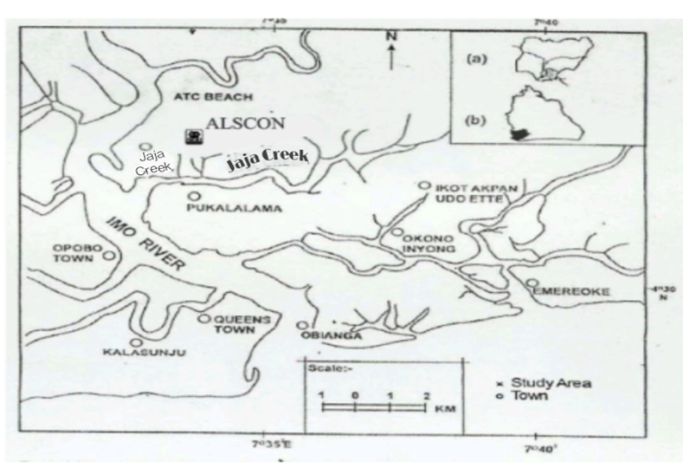
The study was conducted at Jaja creek, Ikot Abasi Local Government Area, Akwa Ibom State, Nigeria. The creek is located between latitude 40032-40052’N and longitude 70025-70045’E, with elevations generally less than 30 meters above sea level (Figure 1). It extends from the Imo River to the west bank of the Enyon River by about 12 km, and the water divides the coastal area into irregularly shaped tidal flats. This area is a typical estuary intertidal zone, with freshwater inflows from the vast mangrove swamps of Imo River and intertidal tidal flats. Jaja creek is flanked by thick mangroves, mostly of Rhizophora species, interspersed with Nypa palms. It has a climate that distinguishes between two seasons. The rainy season starts in April and ends in October with an average annual rainfall of 2000 mm to 3500 mm and the dry season starts in November he March. Jaja creek receives wastewater from the Aluminum Smelting Company (ALSCON) located approximately four miles from the creek. The main occupations of the people in this area are fishing, agriculture, chopping wood and water transport [11].
Samples Collection
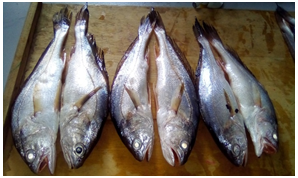
Monthly samples Figure 2 of the Bobo croaker, Pseudotholithus elongatus were caught between November, 2020 through April, 2021in Jaja creek, and a total of 180 fishes were collected in all. Services of local fishers were employed in the collections of the fish. The fish specimens were washed with salt water to remove any foreign debris such as leaf, mud, sand, that must have been attached to the body of the fish. They were preserved immediately after capture in 10% formalin solution in a plastic container prior to laboratory procedures. Thereafter, the samples were transported to Zoology laboratory, Akwa Ibom State University and preserved for further analyses.
Stomach Content Analysis
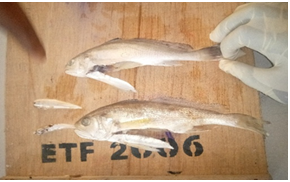
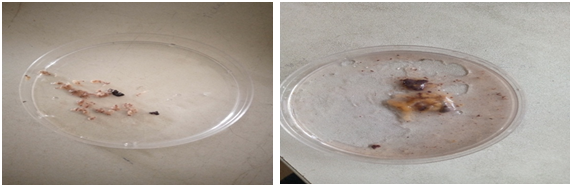
In the laboratory, the total length (TL) of each fish was measured using a measuring board and recorded to the nearest centimeter and weighed to the nearest 0.1g total weight (TW), using a top loading weighing balance. Each fish was dissected and the gut removed and preserved in 4% formalin solution. The gut of each fish was slit open using a scissors and the gut contents were poured into a petri dish, smeared with a few drops of water and the food items were identified macroscopically, then microscopically to the nearest taxonomic possible. Analysis was carried out using frequency of occurrence and numerical methods respectively (Figures 3 & 4).
Frequency of Occurrence
The number of stomachs in which each food items occurred was sorted out and expressed as percentage of the total number of fish stomachs examined according Witty LM [12]. It was calculated thus:
% 100 Total number of stomach with particular feed F Total number of stomach with feed = ×
Numerical Method
The number of individual of each food item was counted and summed up to give the total of each food item, then the grand total of all items was calculated and expressed as percentage of the overall items found in each stomach [13]. Percentage number of food items was calculated thus:
% 100 Total number of particular food item N Total number of food items = ×
Feeding Intensity
Feeding intensity was determined using Gut repletion index (GRI) and was calculated by dividing the number of non-empty guts by the total number of guts examined multiplied by 100 [14]. Gut repletion index (GRI) is expressed as:
100 Number of non empty stomach GRI Total number of specimen examined − = ×
Results
The overall food composition based on stomach content analysis of P. elongatus from Jaja creek is shown in the Table 1. The species consumed crayfish mostly alongside unidentified food particles as the least. Monthly diet composition of P. elongatus is shown in Table 2, with the highest number of food items being recorded in December, 2020 and the least being observed in April, 2021.
| S/N | Food items | Number of food items |
|---|---|---|
| 1 | Crayfish | 50 |
| 2 | Fish remain | 36 |
| 3 | Worm | 22 |
| 4 | Snail | 14 |
| 5 | Plant | 13 |
| 6 | Periwinkle | 10 |
| 7 | Detritus | 8 |
| 8 | Unidentified food particles | 3 |
| Total | 156 |
Table 1: Monthly diet composition of Pseudotholithus elongates from Jaja creek.
| Cray fish | Fish remains | Worm | Snail | Plant parts | Periwinkle | Detritus | Unidentified food particles | Gut repletion index | Total | |
|---|---|---|---|---|---|---|---|---|---|---|
| Nov | 8 | 6 | 5 | 2 | 3 | 0 | 1 | 1 | 60 | 26 |
| Dec | 10 | 8 | 5 | 2 | 3 | 2 | 1 | 1 | 63.33 | 32 |
| Jan | 8 | 5 | 3 | 3 | 5 | 2 | 2 | 0 | 66.66 | 28 |
| Feb | 8 | 6 | 3 | 3 | 1 | 2 | 1 | 0 | 60 | 24 |
| Mar | 8 | 6 | 2 | 2 | 1 | 2 | 2 | 1 | 53.33 | 24 |
| Apr | 8 | 5 | 4 | 2 | 0 | 2 | 1 | 0 | 60 | 22 |
| Total | 50 | 36 | 22 | 14 | 13 | 10 | 8 | 3 | 60.55 | 156 |
Table 2: Monthly diet composition of Pseudotholithus elongates from Jaja creek.
The overall percentage numerical abundance and frequency of occurrence of food consumed by P. elongatus from Jaja crek is shown in Table 3. In both methods, crayfish was the most consumed food item while the unidentified food particles were the least consumed items. In the frequency of occurrence method, the primary food items were crayfish, fish remains, worm, snail and plant materials while periwinkle, detritus and unidentified food particles constituted the secondary food items. Based on the numerical method crayfish, fish remain, and worm made up the primary diets while snail, plant materials, periwinkle, detritus and unidentified food particles constituted the secondary food items. The species is found to be an active feeder based on the gut repletion index of about 69.87 percent.
| Food Items | Number of stomachs with food items | Frequency Occurrence (%) | Numerical Abundance (%) |
|---|---|---|---|
| Crayfish | 50 | 45.87 | 32.05 |
| Fish remains | 36 | 33.03 | 23.08 |
| Worm | 22 | 20.18 | 14.1 |
| Snail | 14 | 12.84 | 8.97 |
| Plant materials | 13 | 11.93 | 8.33 |
| Periwinkle | 10 | 9.17 | 6.41 |
| Detritus | 8 | 7.34 | 5.13 |
| Unidentified food particles | 3 | 2.75 | 1.9 |
| Number of specimen with food examined | 109 | ||
| Total number of specimen examined | 180 | ||
| Total number of food items | 156 |
Table 3: Overall Numerical Abundance (%) and Frequency of Occurrence (%) of diet composition of Psuedotholithus elongatus from Ja
Discussion
The results of this study indicate that P. elongatus in Jaja Creek feeds on a wide range of food sources from plants (plant material), animals (crabs, fish remains, earthworms, snails, periwinkle) and non-living (debris and unidentified organisms). Eating a food containing both plants and animals makes the species more likely to be omnivorous, whereas eating plants, animals, and debris reveals that P. elongatus is omnivorous [8, 15]. A wide range of diets for this species is an index of trophic level flexibility that provides fish with the ecological advantage of effectively foraging in different dietary categories based on food availability [16, 17, 18]. The wide variety of elements found in the stomachs of this species of fish indicates that they are not selective in their food intake, and it appears that many food sources are available to the fish. This may lead to the species being called euryphagous, which is consistent with the study by Fagbenro OA, et al. [4]. The analysis of the gut contents of P. elongatus using abundance and numerical methods showed that the food constituents consumed by the fish follow nearly the same pattern. In descending order, crayfish > fish remains > worms > snails > plant material > periwinkle > detritus > unidentified food.
Based on index of food dominance, crayfish, fish remains, worms, snails and plant materials were the primary dietary materials while periwinkle, detritus and unidentified food particles were considered as secondary food items. The dominance of crayfish followed by fish remains as food items in this study is in agreement with the study of Isangedighi IA, et al. [10] on trophic spectrum of P. elongatus in Imo River estuary who reported that crustaceans constituted the most important prey group making up 51.81% of the index of relative importance followed by the fish which contributed 24.34% in the diets of the species. The result also corroborates the study of Ekpo IE, et al. [19] in food and feeding habits and condition factor of fish species in Qua Iboe river estuary who reported that P. elongatus fed mostly on adult crustaceans, molluscs, juvenile fish and some detrital matter in their diets. The results from this study is also agrees with the study of Abowei JFN, et al. [20] who reported that P. elongatus from Bonny estuary is a predator feeding on invertebrates such as shrimps, macro-branchium species, hermit crabs and small fishes.
The level consumption of crustaceans by the fish could be a reflection of their abundance in the creek and nutritional profitability. Besides being abundant, the crustaceans are also easy to capture [10, 21]. Fish is a common sight in the study area and as a beach and landing site for boats which purchase “by catch” from offshore vessels, most sorting and washing activities are carried out there, where the unwanted components of the fish are thrown back into the water hence this might become food for the P. elongatus and constitute the high percentage of fish remains in its diet and may allow its description as piscivorous species [19, 21]. The inclusion of worm, snail and periwinkle in the diet of P. elongatus might be because the fish occur along the coast and inhabit mud, sandy and rocky bottoms, from the shore to 7 meters depth hence can feed on the benthic organisms [22]. Loughurst AR [22] also classified P. elongatus as a demersal species which tend to feed on bottom dwelling preys and it is in agreement with the findings in this work whereby worms, snail, periwinkle were included in the diet of P. elongatus.
Based on the monthly food consumption, December recorded the highest food items while April recorded the lowest number of items, the highest abundance in December might be attributed to the adaptation towards ensuring the availability of energy for breeding activity, while higher foraging activity may also be attributed to the higher temperature associated with its attendant increase in metabolic activities [10, 23]. Thus the species fed more in the dry season to meet up with the increased metabolic demand linked with elevated temperature. The high gut repletion index (GRI) recorded by this species suggested that the species fed frequently and actively. This finding is in agreement with the reports of Ekpo IE, et al. [19] in their separate studies. The wide food spectrum of P. elongatus is an indication of flexibility in trophic level which gives the species ecological advantage to feed effectively on different types of food based on availability of food items. The ability to exploit wide range of food supply by this fish invariably decreases the rate of competition for food between conspecifics and congenera [19].
P. elongatus depended mostly on autochthonous food items as other estuaries, creeks have been found to be very productive in terms of flora and fauna hence they have been described as breeding, nursery and feeding grounds for species [24]. Offem BO, et al. [24] also reported that the ecological advantage of this is that it enables a fish species to alternate from one diet to another with regards to changes in the availability and abundance. This flexibility enhances the capability of the fish to make use of many different food items effectively and efficiently. The wide food spectrum of the species under study may be attributed to the high availability of this dietary items in the aquatic ecosystem regardless of the seasons so that the fish may have had unlimited access and consumed them according to their dietary needs [15, 25].
Conclusion
This investigation revealed that P. elongatus is an omnivore, feeding on a wide range of food items with a greater preference to carnivorous lifestyle. The study further revealed the species capacity to expand its dietary spectrum to reduce competition. The high gut repletion index qualifies the species an active feeder. The study recommends extensive studies on other aspects of the biology of the species including fecundity, length weight relationship, and breeding season in other to generate comprehensive baseline data towards the effective exploitation, conservation and management of this unique species [26, 27, 28].
References
-
Begum M (2008) On the food and feeding habit of an estuarine catfish, Mystus gulio (Hamilton) in the South coast of Bangladesh. Journal of Zoology Rajshahi 27: 91- 94.
-
Arendt MD, Olney JE, Lucy JA (2001) Stomach content analysis of cobia, Rachycentron canadum, from lower Chesapeake Bay. Fisheries Bulletin 99: 665-670.
-
Arthi T (2011) Food and feeding habits of two freshwater fishes, Ompok bimaculatus and O. malabaricus of river Amravathy, Tamil Nadu. The Bioscan 3: 417-420.
-
Fabenro OA, Adedire CO, Ayotunde EO, Faminu EO (2000) Haematological profile food composition and digestive enzymes assay in the gut of the African bony tongue fish, Heterotis (Clupisudis) niloticus (Cuvier, 1829) (Osteoglossidae). The Tropical Zoology 13(1): 1 -9.
-
Gomos A, Yilmaz M, Polat N (2002) Relative importance of food items in feeding of Chondrostoma regium (Heckel, 1843), and its relation with the time of annulus formation. Turkish Journal of Zoology 26(3): 271-278.
-
Joseph YJ, Djama T (1994) Food habits of two sciaenid fish species Pseudotolithus senegalensis off Cameroon. NAGA, ICLARM Quaterly, pp: 40-41.
-
Palmores MLD, Garces LR, Sia QP, Vega MJM (1997) Diet composition and daily ration estimates of selected trawl caught fishes in San Miguel bay, Philippines. NAGA, ICLARM Quaterly pp: 35.
-
Oronsaye CG, Nakpodia FAA (2005) Comparative study of the food and feeding habits of Chriysicthys nigrodigatatus and Brycinus nurse in a tropical river. Pak J Scilnd Res 48(2): 118-121.
-
Vreven EJ, Snoeks J, Sciaenidae I, Stiassny MLJ, Teugels GG, et al. (2008) Institut de Recherche pour le Developpement, Paris, France, Museum National d’Histoire Naturelle, Paris, France, and Musee Royal de l’Afrique Centrale, Tervuren, Belgium. The fresh and brackish water fishes of Lower Guinea West-Central Africa 2: 432-440.
-
Isangedighi IA, Ambrose EE (2015) Aspects of the Reproductive strategy of Pseudotolithus elongatus (Teleostei: Sciaenidae) in the Cross River estuary, Nigeria. International Journal of Multidisciplinary Research and Development 2(8): 593-595.
-
Esenowo IK, Akpan AU, Egwali EC, Akpabio EE (2016) The abundance and composition of crabs (Decapoda) in Uta Ewa brackish water, Akwa Ibom State, South-South, Nigeria. Journal of Applied Sciences and Environmental Management 20(4): 919-924.
-
Witty LM (2004) Practical guide to identifying freshwater crustacean zooplankton. In: 2nd (Edn.), Cooperative Freshwater Ecology Unit, pp: 60.
-
Pauly D (1983) Some simple methods for the assessment of tropical fish stocks. FAO Fisheries Technical Paper, (234), FAO, Rome, Italy, pp: 52.
-
Hyslop EJ (1980) Stomach content analysis: a review of methods and their application. J Fish Biol 17(4): 411-
-
Offem BO, Ayotunde EO, Ikpi GU (2008) Dynamics in the Reproductive Biology of _Heterobranchus longifilis_ Val, (Pisces: 1840) in the Inland Wetlands of Cross River, Nigeria. Research Journal of Fisheries and Hydrobiology 3(1): 22-31.
-
Udo MT (2002) Trophic attributes of the mudskipper, _Periophthalmus barbarus_ (Gobiidae: Oxudercinue) in the mangrove swamps of Imo River estuary, Nigeria. Journal of Environmental Sciences 14(4): 508-517.
-
Udo MT, Akpan AW, Ekpo IE, Essien-Ibok MA, Lebo PE (2008) Changes in the trophic attributes of the Atlantic mudskipper, _Periophthalmus_ _barbarus_ (Gobildae) between a mangrove and nipa swamp creek of Qua Iboe River estuary, Nigeria. Journal of Fish 5(2): 175-183.
-
Abiaobo NO, Asuquo IE, Ejiogu IN, Umoren UJ (2020) Diets and Trophic Niches of an Amphibious Fish From Jaja Creek South Eastern, Nigeria. American journal of Biology and Life Sciences 8(2): 8-13.
-
Ekpo IE, Obot OI, EssienIbok MA (2014) Studies on the Food Composition and Feeding Pattern of Fish Communities in Qua Iboe River, Niger Delta Region of Nigeria. American Journal of Biology and Life Sciences 2(5): 122-134.
-
Abowei JFN, Hart AI (2009) Some morphometric parameters of ten finfish species from the Lower Nun River, Niger Delta, Nigeria. Research Journal of Biological Sciences 4(3): 282-288.
-
Abiaobo NO, Asuquo IE, Ejiogu IN, Etimfon JJ (2021) Aspect of the biology of _Periophthalmus_ _barbarous_ (mudskipper) from Jaja creek, Niger Delta, Nigeria. Ecology and Evolutionary Biology 6(1): 15-22.
-
Longhurst AR (1964) Bioeconomics of the Sciaenidae of tropical West Africa. J Cons CIEM 29: 93-114.
-
Akpan AW, Isangedighi IA, Akpan BE (2004) Aspects of the reproductive biology of _Pseudotolithus elongatus_ (Sciaenidae: Teleostei) from three rivers estuaries in Southeastern Nigeria. Journal of Sustainable Tropical Agriculture Research 11: 23-29.
-
Offem BO, Samsons YA, Omoniyi IT (2009) Length-weight relationship, condition factor and sex ratio of forty six important fishes in a tropical flood river. Research Journal of Fisheries and Hydrobiology 4(2): 65-72.
-
Udo MT, Abiaobo NO, Asuquo IE (2016) Aspects of the reproductive biology in mudskippers _Periophthalmus_ _barbarus_ (Gobiidae) (Linneaus 1766) in mangrove swamps of Iko Estuary, Southeast, Nigeria. International Journal of Fisheries and Aquatic Studies 4(3): 27-32.
-
Bergmann GT, Motta PJ (2005) Diet and morphology through ontogeny of the nonindigenous Mayan cichlid ‘Cichlasoma (Nandopsis)’ urophthalmus (Günther 1862) in southern Florida. Environ Biol Fishes 72: 205-211.
-
Shep H, Konan KM, Outrattara M, Outattara A, Gourene G (2013) Comparative Analysis of Diet of two sympatric species of tilapia in ayane man-made lake. Livestock Res Rur Devt 25(9): 305-312.
-
Udo IU (2012) Taxonomic composition, Diversity and Abundance of the Ichthyofaunal Assemblage of Iba- Oku Stream, Ikpa River, Nigeria. International Journal of Zoological Research 8(2): 71-80.
- Genetic Improvement of Nile Tilapia (Oreochromis niloticus): Advances in Selective Breeding and Genomic Approaches for Sustainable Aquaculture
- Microplastics, Contaminants, and Waste Hotspots: Divergences and Faults in Prioritizing Control Efforts
- Creating a Healthier, More Vibrant Open and Closed Aquatic Environment. A Submersible, Centrifugal Magnetically Affixed Current Changing Aquarium Pump
- An Attempt to Assess Alpha Diversity and Sample Size: Using the Ostracod Assemblages off Kumamoto Port, Japan
- Assessment of the Efficiency of Common Fishing Gears and Crafts Used at Mohananda River of Chapai Nawabganj, Bangladesh
- Fish Productivity and Biodiversity Status of Sundarban Mangrove in Bangladesh