
Inventorying the Broodstocks of Belarusian Carp Breeds and Herbivorus Fish Species by the Genes of the Most Economically Valuable Traits to Maximize the Use of the Physiological Potential of a Fish Organism to Increase Fish Productivity in Ecological Conditions of Intensive Pond Fish Farming
One of the most promising marker genes for assessing and predicting animal meat productivity is the myostatin gene (MSTN). The protein encoded by this gene regulates the development of muscle tissue in various species of terrestrial and aquatic vertebrates. Mutations of the myostatin gene may lead to a twofold and in some cases even a threefold increase in muscle mass in the individuals of different species. Studies are underway to test the breeders of the Belarusian mirror carp and herbivorous fish species for the presence of mutations in the myostiatin gene (MSTN). When revising the broodstock of a new species of the Belarusian mirror carp, the effectiveness of using mutations of the MSTN gene associated with an economically valuable trait of fish productivity and mass accumulation has been established. The fish capacity of the juvenile mirror carp obtained during the reproduction of test breeders, where one parent was a GG homozygote and the other was an AG heterozygote with a mutation by the MSTN gene, was 1.3-1.7 times higher compared to the average productivity in the experimental and control groups and it showed a better productivity indicator for the control groups by 1.1-1.5 times. When testing silver carp and bighead carp selected for study (in Belarus and Uzbekistan), no mutations in the myostatin gene (MSTN) were found.
Introduction
Currently, the world is actively developing methods for the genotyping of plants and animals that are valuable both from environmental and agricultural perspectives. Activities are underway to search for the genetic markers of economically valuable traits in animals; innovative technologies are introduced for marker assisted selection, the certification of breeding products, the formation of the data banks of breeding products and the banks of sperm and genetic material, exchange of the genetic material of various species to obtain benefits pursuant to the Nagoya Protocol, as well as designing genetic certificates for various biological objects. The scale and importance of this trend is also illustrated by the fact that many countries have already introduced laws recording and regulating this process [1, 2].
Carp (Cyprinus carpio) is one of the most important polyploid Cyprinidae species, which, according to FAO, accounts for 10% of freshwater aquaculture production worldwide. Pond carp is of exceptional economic value in freshwater aquaculture due to its high adaptability both to food and environment. More than 4 million tons of carp are produced annually in aquaculture, and more than 100 thousand tons are caught in natural reservoirs. Historically, the common carp was also the first fish species domesticated in ancient China, and now there is a huge variety of pond carp species across the globe. The main trends in modern selection and breeding work with pond carp carried out in neighboring and far-abroad countries aim to address the issues related to studying the genome of carp; creating single-sex and sterile herds; assessing the molecular genetic and biochemical composition of existing breeds and lines of carp to maintain the purity of replacement broodstocks [3, 4, 5, 6, 7, 8, 9, 10, 11, 12]; carrying out breeding works aimed at increased productivity and maximum reduction in time required to grow marketable products [13, 14]; developing carp breeds with improved consumer qualities (low-scaled, small amount of bones, resistant to hypoxia, increased and improved muscle part in the trunk of marketable fish etc.); searching for the markers of immune resistance genes to diseases, including in the antiviral response of gene products (TRIM25, RIG-I) to dangerous carp diseases (spring viremia of carp (SVC), koi herpesvirus (KHV) [15, 16, 17, 18, 19]; studying a negative impact of the environment and the mutation process in fish [20]. Molecular genetic methods, in particular the analysis of microsatellite loci (STR loci), are widely used in the aquaculture of carp species. The use of STR markers, mtDNA in particular, makes it possible to evaluate the genetic heterogeneity of the fish stocks bred at a new and more effective level: they make it possible to study the genetic structure and variability of the breeding population; control the purity of breeding stocks; carry out intraspecies identification and determine interspecies hybrids; avoid genetic depression and control inbreeding in lines; evaluate the combining ability of lines and breeds in detail; carry out the genetic certification of breeds and breed groups in pond carp broodstocks. In Europe, the USA, and China, statistical genetic and bioinformatic analyses, as well as modeling, are also widely used in the breeding of carp species. Study is underway to establish the relationship between the polymorphic variants of genes and economically valuable traits. One of the approaches to solving the problem related to increasing of productivity in aquaculture is the use of marker assisted and genomic selection methods. The use of modern molecular genetic technologies makes it possible to increase the accuracy of assessing and prognosticating the productive qualities of fish. In this case, the study can be carried out immediately after the hatching of fish larvae from eggs, long before the manifestation of the phenotypic characteristics analyzed, which significantly facilitates a breeding process, increases the efficiency and economic profitability of fish farming. One of the most promising marker genes for assessing and prognosticating meat productivity in animals is the myostatin gene (MSTN) [21]. The protein encoded by this gene regulates the development of muscle tissue in various species of terrestrial and aquatic vertebrates [21, 22, 23]. Mutations in the myostatin gene may lead to a twofold and in some cases even a threefold increase in muscle mass in individuals belonging to different species. The data obtained from a number of studies allowed establishing a connection between some MSTN gene polymorphisms and an increase in muscle mass in the common carp and tilapia [24, 25], and it was also demonstrated that an induced mutation of the MSTN gene in channel catfish led to an increase in body mass by 30% [26]. One of the main factors determining the breeding value of fish is the development of a reproductive system. In natural and artificial reproduction, the problem related to increasing of fish fertility is an urgent task (saving pond space, labor costs for maintaining and feeding producers). Breeding practice and special experiments allowed establishing that this trait has a genetic component. The key genes regulating reproductive function and fertility in vertebrates are the genes of differential growth factor GDF9, transforming growth factor βI (TGF-β), and the gene of follicle-stimulating hormone receptor FSHR [27, 28, 29]. The polymorphism of these genes has a significant impact on fertility in vertebrates. Knowing the genotypes of genes (GDF9, βI (TGF-β), FSHR), which are responsible for the rate of eggs’ maturation, it is possible to prognosticate reproductive qualities in fish, carry out selection in carp with the formation of replacement broodstock of high reproductive capacity, and thereby, reduce the phenomenon of inbreeding in carp breeding.
Other economically important traits in carp breeding are resistance to hypoxia and cold stress. Hypoxia and cold stress are the two main unfavorable environmental factors frequently occurring when heat-loving carp is bred. The relationship between hypoxia and cold stress has been well studied, and the oxygen content of water is considered the main limiting factor in this case. In 2015, 23 genes were identified in Danio rerio (Cyprinidae) that change their expression due to hypoxia and cold stress. The five most important genes with a stronger change in their activity during hypoxia and when exposed to cold were discovered: hephl1 (hephaestin-like 1), mb (myoglobin), tfr1a (transferrin receptor 1a), urod (uroporphyrinogen decarboxylase), and steap3 (STEAP 3, metalloreductase). The genes presented (http://geneontology.org/) are involved in the redox process, oxygen transport, hematopoiesis, hemoglobin synthesis, and iron homeostasis in the cell.
Study of the structure of the genes MSTN, GDF9, βI (TGF-β), FSHR, hephl1 (hephaestin-like 1), mb (myoglobin), tfr1a (transferrin receptor 1a), uroporphyrinogen decarboxylase), and steap3 (STEAP 3, metalloreductase) in fish has not been carried out in Belarus. Therefore, the identification of genetic markers that determine gene alleles associated with the level of meat productivity, fertility, resistance to viral diseases, cold stress and hypoxia is an urgent scientific task of great theoretical and applied significance for the further development of carp farming in Belarus and across the globe in general.
In the framework of implementation of two scientific projects of the Belarusian Republican Foundation for Fundamental Research (No. B20-077 of May 4, 2020; No. B21UZB-026 of November 15,2021), research work has been carried out and is carried out to inventory the broodstock of Belarusian carp breeds and herbivorous fish species in Belarus and in Uzbekistan by the genes associated with important economically valuable traits.
Materials and Methods
At the first stage, we studied a gene (MSTN) associated with mass accumulation in the Belarusian mirror carp and herbivorous fish species in Belarus and Uzbekistan.
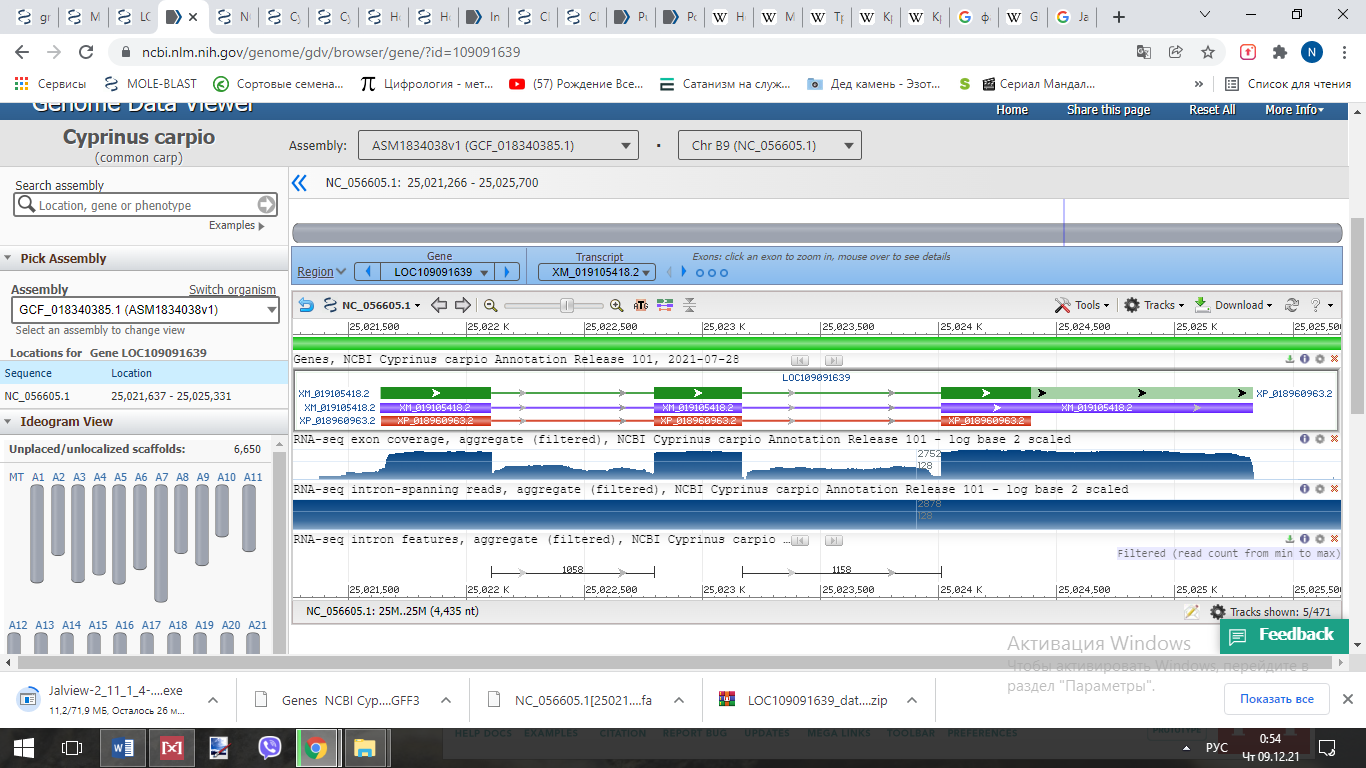
For carp, the MSTN gene is listed in the NCBI database as the Cyprinus carpio myostatin gene (MSTN) (GenBank: GQ214770.1), not associated with chromosomal location, and also as growth/differentiation factor 8 (Gene ID: 109091639, updated on the NCBI website).10.16.2021); located, according to one classification, on the chromosome B9 - NC_056605.1 (25021637..25025331) (Figure 1), and according to another, on the chromosome 11 - NC_031707.1 (10969591..10973239, complement).
According to Chinese researchers, when conducting a comparative analysis of the relationship between four growth indicators and SNP genotypes (single nucleotide polymorphism) in carp individuals, it was found that two SNP substitutions in exon 3 are significantly associated with body weight (BW) and the condition factor (K). For SNP c.42A>G, the frequency of the A allele was higher than the frequency of the G allele, and fish with the GG genotype were significantly more associated with BW and K than the fishes with the AA and AG genotypes. For SNP c.72C>T, the frequency of the C allele was significantly higher than the frequency of the T allele, and fish with the CT genotype had higher BW and K [24].
When conducting studies of the Belarusian mirror carp, a pair of primers (forward: 5’-AGCCTACCATAAAAGGTGTGTG-3’, reverse: 5’-TCAATAGTGTCC ATTCCCAAGT-3’) was selected for the carp MSTN myostatin gene (GenBank registration number: GQ214770.1) based on the complete sequence for the amplification of the fragment of the genomic DNA
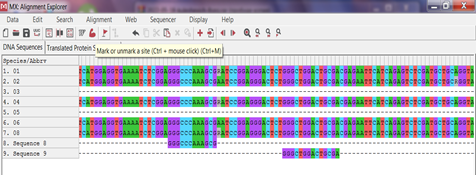
of 845 bp in length to identify SNP (single nucleotide polymorphism) in the labelled breeders. When analyzing the results of molecular genetic studies in mirror carp, it was found that for SNP c.42A>G, the frequency of the A allele was higher than the frequency of the G allele. For SNP c.72C>T the frequency of the C allele was significantly higher than the frequency of the T allele (Figure 2).
Results and Discussions
According to the results of a molecular genetic analysis of 40 breeders of the selected Belarusian mirror carp, mutations of the mass accumulation gene were identified only in 7 breeders. The identified mutations were represented by homozygotes (GG) and heterozygotes (AG). As a result of a genetic assessment of carp breeders based on MSTN gene mutations, 3 females and 2 males were selected for reproduction (Table 1).
| Gender of fish | Weight, kg | Transferrin | Genetic diversity coefficient | Point mutation in the myostatin gene MSTN | |
|---|---|---|---|---|---|
| 240 | ♀ | 5,8 | AC | 10,4 | AG |
| 246 | ♂ | 3,3 | AC | 7,7 | AG |
| 268 | ♂ | 5,4 | AB | 5,7 | GG |
| 279 | ♀ | 5,7 | AU | 6,0 | AG |
| 610 | ♀ | 6,0 | UU | 2,7 | GG |
Table 1: Characteristics of Belarusian mirror carp breeders selected for spawning.
A scheme for spawning options was developed consisting of four experimental pairs of carp breeders with a point mutation in the MSTN gene:
- ♀610 (GG) х ♂ 246 (AG)
- ♀610 (GG) х ♂ 268 (GG)
- ♀240, 279 (AG) х ♂ 246 (AG)
- ♀240, 279 (AG) х ♂ 268 (GG) The control group was a breeding group of the Belarusian mirror carp consisting of the breeders with no gene mutations (MSTN) selected for it.
The spawning of the experimental and control groups of carp breeders was successfully carried out. The carp larvae obtained after the carp spawning were released into the experimental and control ponds for rearing. Productivity and mass accumulation results in the F1 offspring both in the experimental and control groups were analyzed at the end of the rearing period of carp juveniles. In the fall of 2023, in the ponds with the experimental groups of juvenile carp No. 1 (♀ with the GG genotype x ♂ with the AG genotype) and No. 4 (♀ with the AG genotype x ♂ with the GG genotype), the high productivity and mass of the juvenile carp obtained from the spawning of breeders with a mutation in the myostatin gene (MSTN) were established. The productivity of fish in those groups was 1.3-1.7 times higher than the average productivity in the experimental and control groups, and it exceeded the best productivity indicator in the control group by 1.1-1.5 times.
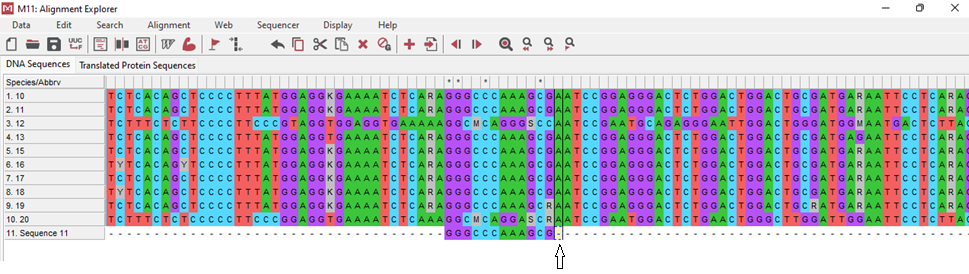
When analyzing the results of molecular genetic studies by SNP c.42A>G in herbivorous fish species, no mutations in the MSTN gene were found (Figure 3).

All the studied individuals of silver carp and of bighead carp from the Fergana Valley had the same AA genotype. When studying the individuals of silver carp and bighead carp in the Yangiyul fish farm and the Daryo Fish Cluster (Uzbekistan), as well as the grass carp, no mutations in the MSTN gene associated with mass accumulation were found. All the studied specimens turned out to be homozygous by the AA genotype (Figure 4).
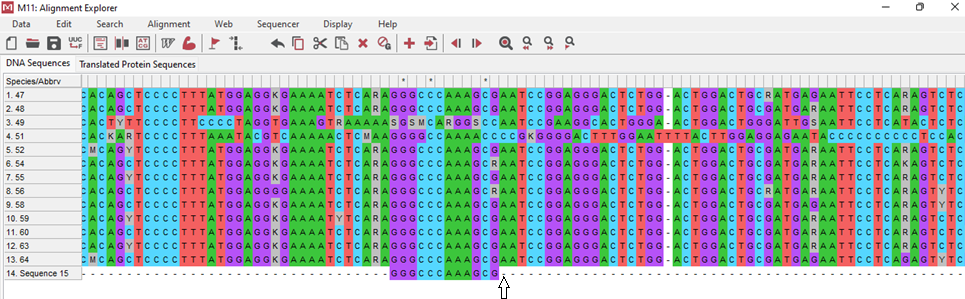
In the sample of the silver carp and of the bighead carp at the JSC Experimental Fish Farm “Selets” (Belarus), no mutations in the MSTN gene were observed (Figure 5).
Conclusions
• The effectiveness of inventorying of the broodstock of a new species of the Belarusian mirror carp for the presence of mutations in the MSTN gene associated with mass accumulation has been established for the purpose of selecting pairs for spawning, developing reproduction schemes and increasing fish productivity in juveniles (F1) when rearing in nursery ponds.
• When testing 66 specimens of silver carp and of bighead carp no mutations of the myostatin gene (MSTN) were found on the farms in Belarus and Uzbekistan.
Acknowledgements
This research is carried out with financially of the Belarusian Republican Foundation for Fundamental Research.
References
-
On State Genomic Registration in the Russian Federation (2008) Federal Law of the Russian Federation of December 3, 2008, No. 242-FZ. Collection of Legislative Acts of the Russian Federation 49: 5740.
-
(2021) Law of the Republic of Belarus of May 20, 2013, No. 24-З. On Pedigree Work in animal Husbandry.
-
Thai BT, Austin CM (2010) Molecular genetic studies on common carp (Cyprinus carpio). Molecular genetic common carp LAP LAMBERT Academic Publishing, pp: 216.
-
Xu P, Zhang X, Wang X, Li J, Liu G, et al. (2014) Genome sequence and genetic diversity of the common carp. Cyprinus carpio Nat Genet 46(11): 1212-1219.
-
Huang Q, Wang Z (2016) The complete mitochondrial genome of the Songpu mirror carp, Cyprinus carpio. Mitochondrial DNA B Resour 10(1): 116-117.
-
Chistiakov DA, Voronova NV (2009) Genetic evolution and diversity of common carp Cyprinus carpio L. Central European Journal of Biology 4: 304-312.
-
Mondol MK, Islam S, Alam S (2006) Characterization of different strains of common carp (Cyprinus carpio L.) (Cyprinidae, Cypriniformes) in Bangladesh using microsatellite DNA markers. Genet Mol Biol 29(4).
-
Artem V, Nedoluzhko, Sharko F, Shalgimbayeva GM, Tsygankova SV, et al. (2020) A new strain group of common carp: The genetic differences and admixture events between Cyprinus carpio breeds. Ecol Evol 10(12): 5431-5439.
-
Nielsen HM, JØdegård J, Olesen I, Gjerde B, Ardo L, et al. (2010) Genetic analysis of common carp (Cyprinus carpio) strains: I: Genetic parameters and heterosis for growth traits and survival. Aquaculture 304(1-4): 14-21.
-
Demkina NV (2005) Biochemical markers in the selection and breeding of carp and sturgeon fish: dissertation, Doctor of Sciences in Biological Sciences, pp: 256.
-
Tóth B, Khosravi R, Ashrafzadeh MR, Bagi Z, Feher M, et al. (2020) Genetic Diversity and Structure of Common Carp (Cyprinus carpio L.) in the Centre of Carpathian Basin: Implications for Conservation. Genes 11(11): 1268.
-
Simonov VM (1985) Oxygen supply for carp under conditions of intensified pond fish farming. Proceedings: Issues of intensification of pond fish farming. Russian Federal Research Institute of Fisheries and Oceanography 45: 218-221.
-
Simonov VM (2012) Selection of Cyprinus carpio by survival and productivity assessing fish at the larval stage of development. Fishery issues 3(51): 616-626.
-
Vinogradov EV (2021) Stress resistance of carp (Cyprinus carpio L.) in early ontogenesis and its impact on fish and biological characteristics. 03.02.06 – Ichthyology. Dissertaion for PhD in Biological Sciences. Moscow, pp: 137.
-
László Ardó, Zsigmond Jeney Alexandra Adams, Galina Jeney (2010) Immune responses of resistant and sensitive common carp families following experimental challenge with Aeromonas hydrophila. Fish Shellfish Immunol 29(1): 111-116.
-
Pronina GI (2012) Physiological and immunological assessment of cultivated aquatic organisms: carp, common catfish, crayfish. Abstract of the dissertation for a degree of Doctor of Biological Sciences M, pp: 39.
-
Maria Forlenza (2012) Immune Responses of Carp. A molecular and cellular approach to infections. Thesis Submitted in partial fulfilment of the requirements for the degree of doctor at the Wageningen University, pp: 212.
-
Gack MU, Axel Kirchhofer, Young C Shin, Kyung Soo Inn, Chengyu Liang, et al. (2008) Roles of RIG-I N-terminal tandem CARD and splice variant in TRIM25-mediated antiviral signal transduction. PNAS 105(43): 16743- 16748.
-
Palaiokostas CH, Robledo D, Vesely T, Prchal M, Pokorova D, et al. (2018) Mapping and Sequencing of a Significant Quantitative Trait Locus Affecting Resistance to Koi Herpesvirus in Common Carp. Genes Genomes Genetics 8(11): 3507-3513.
-
Yoshida K, Ravinet M, Makino T, Toyoda A, Kokita T, et al. (2020) Accumulation of Deleterious Mutations in Landlocked Three spine Stickleback Populations. Genome Biology and Evolution 12(4): 479-492.
-
Aiello D, Patel K, Lasagna E (2018) The myostatin gene: an overview of mechanisms of action and its relevance to livestock animals. Anim Genet 49(6): 505-519.
-
Ríos R, Carneiro I, Arce VM, Devesa J (2002) Myostatin is an inhibitor of myogenic differentiation. Am J Physiol Cell Physiol 282(5): C993-C999.
-
Shishkin SS (2004) Myostatin and some other biochemical factors regulating the growth of muscle tissue in humans and a number of higher vertebrates. Advances in biological chemistry 44: 209-262
-
Sun Y, Yu X, Tong J (2012) Polymorphisms in Myostatin Gene and associations with growth traits in the common carp (Cyprinus carpio L.). Int J Mol Sci 13(11): 14956- 14961.
-
Elkatatny NA, Elbialy ZI, El-Nahas AF, Mahmoud A (2016) Characterization of Myostatin Gene in Nile Tilapia (Oreochromis niloticus), the Possible Association of BsmI-exon 2 Polymorphism with Its Growth. American Journal of Life Sciences 4(3): 82-86.
-
Khalil K, Medhat Elayat, Elsayed Khalifa, Samer Daghash, Ahmed Elaswad, et al. (2017) Generation of Myostatin Gene-Edited Channel Catfish (Ictalurus punctatus) via Zygote Injection of CRISPR/Cas9 System. Sci Rep 7: 7301.
-
Lin Liu, Wei Ge (2007) Growth differentiation factor 9 and its spatiotemporal expression and regulation in the zebrafish ovary. Biol Reprod 76(2): 294-302.
-
Ellen R Busby, Graeme J Roch, Nancy M Sherwood (2010) Endocrinology of zebrafish: A small fish with a large gene pool. Fish Physiology 29: 173-247.
- Genetic Improvement of Nile Tilapia (Oreochromis niloticus): Advances in Selective Breeding and Genomic Approaches for Sustainable Aquaculture
- Microplastics, Contaminants, and Waste Hotspots: Divergences and Faults in Prioritizing Control Efforts
- Creating a Healthier, More Vibrant Open and Closed Aquatic Environment. A Submersible, Centrifugal Magnetically Affixed Current Changing Aquarium Pump
- An Attempt to Assess Alpha Diversity and Sample Size: Using the Ostracod Assemblages off Kumamoto Port, Japan
- Assessment of the Efficiency of Common Fishing Gears and Crafts Used at Mohananda River of Chapai Nawabganj, Bangladesh
- Fish Productivity and Biodiversity Status of Sundarban Mangrove in Bangladesh