
Effects of Methanolic Extract and Aqueous Fraction of Carica papaya Leaves on the Health and Zootechnical Performances of Farmed Clarias gariepinus (Burchell, 1822)
To prevent and control fish diseases, medicinal plants are used as an alternative to synthetic chemicals which are ecological unfriendly. This study aims to evaluate the effects of methanolic extract (ME) and aqueous fraction (AF) of Carica papaya leaves on the epidemiological and zootechnical characteristics of Clarias gariepinus farming. A total of 240 Clarias gariepinus fingerlings of 8.60±0.20g average weights and showing no clinical signs of pathology were distributed into duplicates in four treatments namely T0 (control), T1(250 mg/l Oxytetracycline + 500 mg/l Potassium permanganate), T2 (3ml/l of water ME) and T3 (3ml/l of water AF) of 60 fish per treatment. The evaluation of the epidemiological and zootechnical characteristics after 90 days farming showed that out of the six clinical signs observed, 73.33% were anatomical (body trauma, dropsy, disnopea), while 21.34% and 5.23% were physiological (body discoloration) and ethological (anorexia, vertical swimming) respectively. Overall, the highest prevalence (p = 0.001) of pathology was observed at the control group (5.74%), followed by AF (1.97%), the synthetic drugs (1.11.70%) and ME (0.80%). The condition factor varied insignificantly between the treatments with the highest values (K>1) observed at the control treatment and AF. The mortality rate ranged from 5 (T1) to 10.22% (T0) and was not significantly different among treatments. The ME recorded the highest (p > 0.05) average daily weight gain (2.06±1.43 g/day) and productivity (3.180±1.589 kg/m3/day) but a moderate (p = 0.02) medicinal production cost (0.841±0.332$/kg of fish).
Introduction
Aquaculture is an important socio-economic activity in a rural community, contributing to livelihoods, food security and poverty alleviation [1]. In Cameroon, the contribution of the aquaculture sector is only about 5% of the yearly production estimated at 335 000 tons/year [2]. This low aquaculture production can be attributed to a greater extend to fish diseases. Fonkwa, et al. [3] highlighted that diseases are among the major limiting factors to fish production. The economic loss caused by fish diseases have been reported worldwide. In the United States of America, the annual loss of revenues due to fish disease reached up to $ 6 billion compared to $ 5.3 billion in 2017 [4]. Economic losses resulting from reduced production and export due to infectious hepatopancreatic necrosis accounted for $ 12 billion in Thailand between 2010 and 2017 and over $ 26 million in Viet Nam in 2015 [5]. As far as Cameroon is concerned, though massive fish death are often recorded both in natural and culture milieu, few data related to the economic losses caused by fish diseases are available. Hence, from May to April 2021, an epizootics outbreak of Yersiniosis (Yersinia spp) of farmed Oreochromis niloticus (Nile tilapia) and Cyprinus carpio (Common carp) was observed in a fish farm located in the Centre Region and resulted in $ 420.50 direct financial loss [3].
Though Clarias gariepinus is among the most reared fish species in Africa because its resistant to diseases, disease outbreaks in C. gariepinus farms have been reported. The maintenance of good health of fish is achieved by using synthetic chemicals which at times turn be unaffordable, unsustainable and unavailable to some farmers. Negative consequences of synthetic drugs have been widely reported in Aquaculture [6]. The accumulations of chemical residues in free flowing waters thereby affecting humans’ health and polluting the environment have been reported [7]. Medicinal plants like Carica papaya is readily available in Cameroon, inexpensive, grows all year round and is more biodegradable in nature compared to synthetic drugs [8, 9]. Phytochemical analysis of Carica papaya leaf extracts revealed the presence of compounds such as alkaloids, glycosides, saponins, tannins, flavonoids, phenolic, proteins, vitamins which exhibit low toxicity and have excellent antibacterial and antiparasitic activities compared to seeds, fruits, stems or roots [6]. In Nigeria, Azizah, et al. [10] reported 600 mg/l of water as the effective dose of C. papaya leaf extract to control the Argulus infestation in common carp while Yuli, et al. [11] highlighted in Indonesia that the effective concentration of 3 ml Carica papaya leaves extract per liter of water was indicated for the treatment of Aeromonas hydrophila bacteria in koi fish (Cyprinus rubrofuscus). However there is a dearth of reports on the effects of the extracts and fractions of Carica papaya leaves on the epidemiological and zootechnical characteristics of farmed Clarias gariepinus in Cameroon. A thorough knowledge of the use of Carica papaya leaves extracts and fractions in fish disease prevention is likely to improve the health management of farmed fish and consequently boost fish production in Cameroon.
The overall objective of this study is to contribute to an effective and sustainable aquaculture by promoting the use of native plant resources in fish diseases prevention and control. More specifically, this study aims to evaluate effects of methanolic extract and aqueous fraction of Carica papaya leaves on the epidemiological and the zootechnical characteristics in Clarias gariepinus fingerlings.
Material and Methiods
Geoclimatic characteristics of the Study Area
The present study was carried out from March to May 2024 in an experimental fish farm located in the Douala 3 District, Littoral Region of Cameroon (4° 36’- 4° 43’ N; 9° 33’ - 9° 06’ E). The climate is of the equatorial type with a rainy season (March to November) and a dry season (December to February). The annual average temperature is 27.4°C and the rainfall of about 3619 mm. The soil is sandy and sometimes sandy-clay with an acidic pH (6-7) [12].
Preparation of Crude Extract and Aqueous Fraction of Carica papaya Leaves
Leaves of Carica papaya were collected in March 2024 at the Douala 3 District and processed in the Chemistry Laboratory of the University of Douala-Cameroon. Leaves were hence washed and dried for two weeks. The air dried powdered leaves (8kg) were extracted twice during 48 h at room temperature with methanol (MeOH (12 L). Removal of the solvent under reduced pressure yielded a dark brown oily extract (180 g). A part of this crude extract (180g) was suspended in H2O and successively partitioned with n-hexane, ethyl acetate (EtOAc) to give three fractions: hexane fraction (180g), EtOAc fraction (180g), and aqueous fraction (180g).
Preparation of Clarias gariepinus Fingerlings and Experimental Device
A total number of 240 Clarias gariepinus fingerlings of 8.6 ± 0.2g average weights were were first disinfected for 1 hour using successively a solution of potassium permanganate as antiparasitic (500 mg/l of water) and a synthetic drug i.e. Oxytetraycline (OTC) powder commonly used by fish farmers because of its antibacterial property. Oxytetracycline tablets were grinded and dissolved into water to obtain a concentration of 250 mg/l. The fish disinfection aimed to get rid of parasites and suspected bacteria. Disinfected fish were thereafter acclimatized for 15 days in the different basins with underground water.
Three days before the transfer of fish into their culture milieu, each fish sample was visually examined for any malformation or abnormality using standard procedures [13]. The teguments (skin, scales, eyes, fins, opercula) were examined using a brand magnifying hand lens of magnification 10× for ectoparasites detection. Only healthy fishes free from parasites and not showing clinical signs of diseases or abnormalities were selected for the experiment.
The experimental design made up of a total of 8 basins of 40l underground water each containing 30 fingerlings were divided into four randomized treatments. These basins were set up in parallel and each basin duplicated per treatment. The concentration of the synthetic drug (OTC), Carica papaya leaves methanolic extract and aqueous fraction used in the treatments Table 1 were adapted from the previous reports [10, 11]. The bathing technique was used for prophylaxis purposes of fish infection. So, every 4 days, the synthetic drugs OTC + potassium permanganate), the methanolic extract and aqueous fraction of the papaya leaves were added into the culture milieu for 48 hours for 3 months [11]. In addition, Clarias gariepinus fingerlings were manually fed twice a day until satiation with commercial pellet feed Skretting containing 35% crude protein, at 3% of fish biomass.
| Treatments | Characteristics | |
|---|---|---|
| Contents | Concentrations | |
| T0 (Control) | - | - |
| T1 | Oxytetracycline | 250 mg/l |
| Potassium permanganate | 500 mg/l | |
| T2 | Methanonlic extract of Carica papapya leaves | 3 ml/l |
| T3 | Aqueous fraction of Carica papapya leaves | 3 ml/l |
Table 1: Characteristics of treatments used during the experiment.
Assessment of the epidemiological characteristics and zootechnical performances of Clarias gariepinus fingerlings.
Harvest controls were carried out at a regular time interval of 14 days [14]. Fish behavior was firstly observed to determine any behavioral affection (anorexia, abnormal swimming). Thereafter, 100% fish specimens per basin were captured using a fish net. Thereafter, the fish total lengths and weight were measured using an ichthyometer and sensitive weighing balance of Scaletec brand respectively. Each fish sample was first examined with naked eye before using a hand lens to diagnose any clinical sign of diseases or abnormalities. These signs included dropsy, external hemorrhage, deep necrosis, pale gills, hypertrophy of scales etc. In this study, pathology is defined as any abnormality or affection occurring in the fish no matter their origin. The number of dead fish per treatment was also recorded. An infected fish sample was coded as 1 and uninfected as 0. The pH electrode and multimeter were used to determine the water hydrogen potential and temperature respectively after each harvest.
Data processing and statistical analysis
The characteristics studied were both epidemiological and zootechnical and defined as follows: Prevalence of clinical signs of pathologies or abnormalities (Pr): number of fish showing a given clinical sign of pathology/abnormality divided by the number of fish examined. The prevalence (Pr) was classified after Fonkwa, et al. [15] i.e. very low (Pr < 10 %), low (10 % ≤ Pr ≤ 50 %) or high (Pr > 50 %). The prevalence of the clinical signs of pathology was evaluated in this study instead of the prevalence of infection/disease or the prevalence of infection usually evaluated because the etiology of these abnormalities was not determined. Also, the ethological, anatomical and some physiological signs are the first ones to draw the attention of the farmers.
Condition factor (K): ratio of the weight of the fish to the cube of the total length Mortality rate: Estimated number of deaths fishes in a population within a period of time divided by the total number of the population. The mortality rate was classified as very low [0, 1, 2]%, low] 2-5]% or high i.e. > 5%.
Daily average weight gain: mass gained or lost by the fish over the number of days.
Productivity: total weight of fishes produced divided by the volume of infrastructures multiplied by the period of production.
Medical production cost of a kg of fish: ratio of production cost of the synthetic drugs, plant extracts and fractions to the total weight gain.
The data obtained were processed using Graph Pad Prism 8.0 software for analysis. The analysis of variance (F) was used to test the effect of treatments on the epidemiological characteristics and zootechnical performances expressed as mean ± standard deviation. In the case of a significant difference, that is the error probability p < 0.05, the means were separated using Tukey’s multiple comparison tests (q).
Results
Effects of methanolic extract and aqueous fraction of Carica papaya leaves on the prevalence of clinical signs of pathologies The effects methanolic extract and aqueous fractions of Carica papaya leaves on the prevalence of the clinical signs of pathology are summarized on Table 2. A total of six clinical signs including 73.33% anatomical (body trauma, dropsy, disnopea), 21.34% physiological (body discoloration) and 5.23 % ethological (anorexia, vertical swimming) were recorded in fish. Anorexia and body trauma were common to all treatments while disnopea was specific to methanolic extracts. Among the six clinical signs observed, 16.67% was noticed only in T2 contrary to 83.33% observed at T0, T1 and T3. Overall, thought the prevalence of the clinical signs of pathology was very low (<10%), the highest value (p = 0.001) was observed at the control treatment. The prevalence of body trauma and vertical swimming was higher at T0 followed by T3, T2 and T1.
| Clinical signs | Treatments | F | p | |||
|---|---|---|---|---|---|---|
| T0 (Control) | T1 (OTC+ KMnO4) | T2 (Methanolic extract) | T3 (Aqueous fraction) | |||
| Anorexia | 7.77±11.48 | 1.11±1.72 | 1.11±2.72 | 3.33±5.16 | 1.4 | 0.27 |
| Body trauma | 14.44a±13.93 | 1.11abc±1.71 | 1.67abc±1.82 | 3.89abc±6.47 | 3.84 | 0.02* |
| Vertical swimming | 7.22±12.37 | 0±0 | 0.55±1.36 | 2.22±3.44 | 1.55 | 0.231 |
| Dropsy | 11.11a±6.55 | 1.67bcd±2.79 | 0.55bcd±1.36 | 3.88bcd±2.51 | 12.8 | 0.001* |
| Disnopea | 0 | 0 | 1.66±4.08 | 0 | 1 | 0.413 |
| Body discoloration. | 2.22±5.44 | 4.99±8.36 | 0 | 0 | 1.36 | 0.284 |
| Dropsy + anorexia | 2.77±0.12 | 0 | 0 | 0.55±0 | 2.46 | 0.09 |
| Body trauma + anorexia | 3.88±8.00 | 0 | 0 | 1.11±2.71 | 1.31 | 0.36 |
| Vertical swimming + dropsy | 2.22±5.44 | 0 | 0 | 0 | 1 | 0.413 |
| Mean | 5.74a±3.48 | 1.11bcd±1.59 | 0.80bcd±0.73 | 1.97bcd±1.82 | 8.01 | 0.001* |
Table 2: Effects of methanolic extract and aqueous fraction of _Carica papaya_ leaves on the prevalence of the clinical signs
(a,b,c,d) : For a given row, values with the same letter do not significantly differ between treatments (p > 0.05); *: Significant; OTC: Oxytetracycline; KMnO4: Potassium permanganate; F: Anova value; p: Error probability. Table 2 : Effects of methanolic extract and aqueous fraction of Carica papaya leaves on the prevalence of the clinical signs of pathologies.
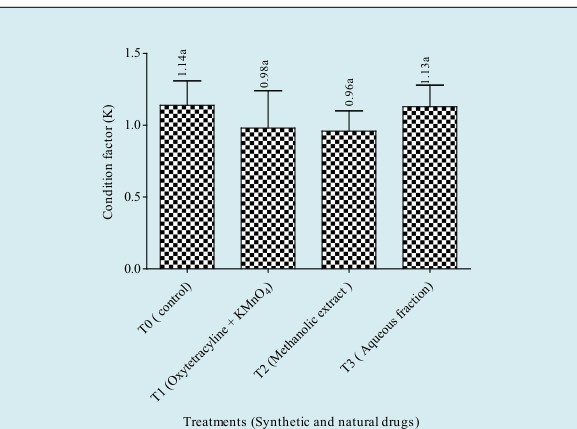
Bars with the same letter do not significantly differ between treatments (p > 0.05) Figure 1: Variation of the fish’s condition factor according to the synthetic drugs, methanolic extract and aqueous fraction.
Variation of the fish’s condition factor according to the synthetic drugs, methanolic extract and aqueous fraction of Carica papaya leaves The condition factor varied insignificantly (F= 1.56; p= 0.23) between the treatments with the higher values (K>1) recorded with the control treatment and aqueous fraction (Figure 1).
Treatments (synthetic and natural drugs)
2.0 T0 (Control) T1(Oxytetracycline+ KMn04)
1.5 Condition factor (K)
-0.5 Evolution of the fish’s condition factor per treatment based on the essay period The profile, trend and shape of the curves were similar during the trial period (Figure 2). Whatever the treatment, the condition factor varied irregularly with a peak observed at day 56th.
T2 (Methanolic extract) T3 (Aqueous fraction)
42-56
56-70
70-90 Figure 2: Condition factor trend per treatment based on the essay period.
Bars with the same letter do not significantly differ between treatments (p > 0.05). Figure 3: Variation of the fish’s mortality rate in relation to the synthetic drugs, methanolic extract and aqueous fraction.
Variation of the fish’s mortality rate in relation to the synthetic drugs, methanolic extract and aqueous fraction The mortality rate was high (> 5%) and varied insignificantly (F= 1.65; p = 0.23) from 5.24% to 10.22% respectively in T1 and T0 (Figure 3).
Mortality rate trend per treatment according to the experiment period Globally, the mortality rate progress in a synchronous manner with the higher values recorded in the control treatment (Figure 4). The values increased regularly during the experiment period excepted day 56th and 70th where they drastically decreased. The mortality rates peaked on day 56 and 84 with 15.38% and 20.00% respectively for the control group.
Treatments (synthetic and natural drugs)
T0 (Control) T1(Oxytetracycline+ KMn04) T2 (Methanolic extract) T3 (Aqueous fraction)
0-14 -5 Treatments (Synthetic and natural drugs) Figure 4: Mortality rate trend per treatment according to the experiment period. Effects of the methanolic extract and aqueous fraction of Carica papaya leaves on the zootecnical characteristics The effects of the methanolic extract and aqueous fraction of Carica papaya leaves on the zootechnical characteristics are recorded on Table 3. Whether the average daily weight
42-56
56-70
70-90 gain or productivity, the lowest and highest values were recorded respectively for the control and methanolic extract. Furthermore, the medicinal cost of production per kg of fish was about 2.4 times significantly more costly for the aqueous fraction compared to the synthetic drugs (T1).
| Zootechnical characteristics | Treatments (Synthetic and natural natural drugs) | F | p | |||
|---|---|---|---|---|---|---|
| T0 (Control) | T (OTC + 1 KMn04) | T (Methanolic 2 extract) | T (Aqueous 3 fraction) | |||
| DAWG (g/day) | 2.02a±1.40 | 2.04a±1.44 | 2.06a±1.43 | 2.04a±1.44 | 0 | 1 |
| Productivity (Kg/m3/day) | 2.607a±1.546 | 3.00a±1.362 | 3.180a±1.589 | 2.647a±1.551 | 0.2 | 0.89 |
| MCP ($/kg ) | - | 0.625a±0.257 | 0.841b±0.332 | 1.503b±0.761 | 4.99 | 0.02* |
Table 3: Effects of the methanolic extract and aqueous fraction of _Carica papaya_ leaves on the zootecnical characteristics.
Not considered; DAWG :daily average weight gain ; MCP : medical production cost of a kg of fish ; OTC: Oxytetracycline; KMn04 : Potassium permanaganate ; ( a,b,c) : values with the same letter on a given row do not significantly differ (p> 0.05); F: Anova test value; p: Error probability;*: significant. Table 3: Effects of the methanolic extract and aqueous fraction of Carica papaya leaves on the zootecnical characteristics.
Discussion
The results related to the effect s of the methanolic extract and aqueous fraction of Carica papaya leaves on the health and zootechnical characteristics of farmed Clarias gariepinus fingerlings, showed that the clinical signs were mostly anatomical. Some affections like abnormalities in the hematological profile (abnormal values of serum protein levels, eosinophilia, etc.) would probably have appeared and have not been diagnosed because they required a thorough diagnosis. The anatomical signs were the most predominant probably because they were the most perceptible compared to other signs. According to the World Organization for Animal Health (2023), the presence of viruses in a breeding environment increases the probability of anatomical clinical signs. It is then advised to determine the etiology of these abnormalities. The clinical signs observed in fish would not be pathognomonic. Thus, the reliability of fish disease diagnosis depends on the specific identification of pathogens by laboratory methods.
Fish skin was the most targeted organ probably because being in direct contact with water containing more pathogens specific to the body. This observation requires the systematic analysis of the microbiological quality of the water in order to establish correlations with the clinical signs appearing in the fish. Adam, et al. [16] on the other hand noted as clinical signs wounds, inflammations, ulcers and hemorrhages in the fish Carassius autarus using aqueous extract of Carica papaya leaves in the treatment of Aeromonas hydrophila infections. The difference between the results observed compared to the present study would be linked to the species of fish used and the difference in concentration (1000ppm) of the aqueous extract.
The higher and significant prevalence of clinical signs of pathology associated with the highest mortality rate observed in the control treatment might be due to the absence of drugs in T0 thus more pronged or vulnerable to affections. On the other hand, the relatively low mortality rate observed with methanolic extract might be explained by the fact that Carica papaya leaves contains water soluble karpain compounds that suppress activities of pathogens found on the fish body surface [10].
Whatever the treatment, thought the prevalence of the clinical signs of pathology was very low (<10%) probably because the physicochemical charactéeristics of the water did not favor the development and proliferation of pathogens. This very low prevalence would also reflect resistance to disease by the strain of Clarias gariepinus fingerlings used in the present study. The higher and significant prevalence observed at the control treatment compared to other treatments would result from the anti-inflammatory and anti-pathogenic properties of active compounds (flavonoids terpenoids, alkaloids etc) found in the Carica papaya leaves extracts and fractions [10].
The condition factor varied insignificantly between the treatments with the highest values (K>1) recorded with the control group and aqueous fraction. In other words, treatments T0 and T3 of the present study promoted the well-being or good body condition of the fish. The alkaloids and flavonoids present in the aqueous extracts of Carica papaya would have a positive effect on fish by promoting their growth, enhancing the immune response and rendering them more resistant to diseases. The condition factor was expeected to be <1 in the control treatment since it lacked drugs. Probably, the endogenous and exogenous factors to fish (physicochemical characteristics of the water) would have negatively affected the optimal expression of body fish condition by rendering them more susceptible to disease. This observation can also be buttressed by the highest mortality rate recorded in T0. The condition factor varies depending on the age of the fish, sex, season, stage of development of the reproductive organs, diet, amount of food in the intestine, amount of lipid reserve and degree of development of muscles. The low condition factor (k < 1) noted in this study with the synthetic drugs and methanolic extract was also observed by Diop, et al. [17] & Da, et al. [18] respectively on Clarias gariepinus and Clarias anguillaris.
The mortality rate was high (> 5%) and varied insignificantly from 5.24% (T1) to 10.22% (T0). Additionally it was greater than the expected 0% standard value. These deaths might be caused by pathology. The disparity of mortality rates recorded would be due to the anti-pathogenic compounds of the synthetic drugs (OTC + Potassium permanganate) and those (flavonoids, alkaloids etc) found in Carica papaya leaves extract administered in tretament T2 and T3. This low value of the mortality rate recorded with phytochemicals could also be due to the long duration of immersion (48hours) that increases the duration action of phytochelmicals, however it weakens the movement of fish [10]. The mortalty rate observed with the methnolic extract (5.28%) in this study is higher than 0% reported by Ekanem, et al. [19] when Gold fish infected with the ciliate Ichthyopthirius multifilis were immersed for 72 hours in baths with methanolic extract of Carica papaya leaves. The reason being probably that the dosage and immersion duration of methanolic extract and fish species used in both studies were different. The longer the immersion duration, the lower the mortality rate though fish are weakened.
As for the effects the methanolic extract and aqueous fraction of Carica papaya leaves on the zootechnical characteristics, the average daily weight gain varied between 2.02 (T1) to 2.06g/day for T2. These values are below 5.6g/d predicted by the feeding technical sheet for the “Skretting” feed supplied to fish in this study probably because the diseases led to anorexia, causing growth delays in fish. The highest productivity noted with the methanolic extract could be related to the lower mortality rate observed in the same treatment. This might explain why the control treatment which recorded the highest mortality rate recorded the lowest productivity. The medicinal cost of production per kg of fish was about 2.4 times significantly more costly for T3 compared to T1 because of the production process which requires expensive solvents.
Conclusion
The epidemiological and zootechnical characteristics were affected by the methanolic extract and aqueous fraction of Carica papaya leaves. The proportion of fish showing a clinical sign of pathology was significantly higher in the control treatment. Body trauma was the most observed affection. The highest and insignificant values of the fish condition factor were recorded with the control group and aqueous fraction. The mortality rate was high and varied insignificantly. The average daily weight gain and productivity were not significantly affected by the treatments contrary to the medicinal cost of production per kg of fish that was more costly for the aqueous fraction compared to the synthetic drugs (OTC + KMnO4).
Ethical Statement
The animals used in this study were not sacrificed and all were released alive into their environment of origin after use.
Conflicts of Interest
The authors declare that they have no conflicts of interest.
Aknowledgements
Authors are thankful to the staff of the Chemistry Laboratory of the University of Douala-Cameroon for the collaboration.
References
-
FAO (2018) The state of world fisheries and aquaculture 2018. Achieving the Sustainable Development Goals. Report on the state of world fisheries and aquaculture. Rome, Italy 20-41: 275.
-
MINEPIA (2021) Situation de la production halieutique au Cameroun. Media terre : hausse de la production halieutique au Cameroun. Fiche technique, Yaoundé, Cameroon, pp: 102-151.
-
Fonkwa G, Nack J, Awah-Ndukum J, Yamssi, C, Tomedi EM, et al. (2022) First report of enteric red plague of _Oreochromis niloticus_ (Cichlidae) and _Cyprinus carpio_ (Cyprinidae) reared in Cameroon: mortality rate, risk factors and financial loss. Research in Agriculture, Livestock and Fisheries 9(3): 323-335.
-
Hien VD, Seyed HH, Einar R, Maria AE, Maryam D, et al. (2020) Host-Associated Probiotics: A Key Factor in Sustainable Aquaculture, Reviews in Fisheries Science & Aquaculture 28(5): 6-42.
-
Shinn AP, Pratoomyot J, Bron EJ, Paladina G, Brooker EE, et al. (2018) Economic costs of protisan and metazoan parasites to global mariculture. International Journal for Parasitology: Parasites and wildlife 142(1): 196-270.
-
Ndakalimwe NG (2019) Review on the progress in the role of herbal extracts in tilapia culture. Cogent Food & Agriculture 5(1).
-
Bulfon C, Volpatti D, Galeotti M (2013) Current research on the use of plant-derived products in farmed fish. Aquaculture Research 46(3): 1-39.
-
Olusola SE, Emikpe BO, Olaifa FE (2013) The potentials of medicinal plant extracts as bio-antimicrobials in aquaculture. International Journal of Medicinal and Aromatic Plants 3(3): 404-412.
-
Reverter M, Bontemps N, Lecchini D, Banaigs B, Sasal P (2014) Use of plant extracts in fish aquaculture as an alternative to chemotherapy: Current status and future perspectives. Aquaculture 433: 50-61.
-
Azizah IS, Kismiyahi, Fasya AH (2019) Effectiveness of Pepapya leaf extract (_Carica papaya_ L.) to control Ectoparasites _Argulus_ on Common Carp (_Cyprinus_ _carpio_). The First International Conference on Fisheries and Marine Science. IOP Conference Series: Earth and Environmental Science.
-
Yuli MS, Maya I, Ratna Y (2023) Effectiveness of papaya leaf extract (_Carica papaya_ L.) in the treatment of Koinfish (_Cyprinus rubrofuscus_) seeds infected with _Aeromonas hydrophila_ bacteria. International journal on advanced technology, engineering, and information system 2(1): 1-8.
-
Feumba R (2015) Hydrogéologie et évaluation de la vulnérabilité des nappes dans le bassin versant de Besseke (Douala, Cameroun). Thèse de Doctorat/PhD, Université de Douala, Cameroon, pp: 254.
-
Farman UD, Muhammad FK, Rasool K, Safir U (2015) Prevalence of Parasites in Fresh Water Pond Fishes from District DI Khan, Pakistan. The Journal of Zoology Studies 2(2): 47-50.
-
Kone M, Cisse M, Ouattara M, Fantodji A (2012) Biosecurity and productivity of Nile tilapia _Oreochromis_ _niloticus_ (Linnaeus, 1958) reared in rural Ivory Coast. Tropicultura 30(2): 117-121.
-
Fonkwa G, Kouam KM, Tomedi EM, Tchuinkam T, Tchoumboue (2020) Epidemiology of Myxosporean Infections in Economically Important and Dietary Freshwater Fishes in the Sudano- Guinean Zone of Cameroon. International Journal of Oceanography and Aquaculture 4(1): 000187.
-
Adam H, Roffi G, Ibnu DB, Dan AS (2012) Tract effectiveness of papaya leaf (_Carica papaya_) for treatment of _Aeromonas hydrophila_ infection in goldfish (_Carassius_ _auratus_). Journal Perikanan dan Kelautan 3(3): 213-220.
-
Diop R, Konate A, Traore D, Camara M (2019) Length- Weight and condition factor of catfish sepcies (Genus _Clarias_) used in fish farming in Bamako periurban areas. Revue Malienne des Sciences Technologiques 22: 83-93.
-
Da N, Ouedraogo R, Oueda A (2018) Length-Weight relationship and condition factor of _Clarias anguilarus_ and _Sarotherodon galilaeus_ captured from Bam lake and Kompienga reservoir dam in Burkina-Faso. International Journal of Biological and Chemical Sciennces 12 (4): 1602-1610.
-
Ekanem AP, Obiekezie A, Kloas W, Knopf K (2004) Effects of crude extracts of _Mucuna_ _pruriens_ (Fabaceae) and _Carica papaya_ (Caricaceae) against the protozoan fish parasite _Ichthyopthirius multifiliis_. Parasitology Research 92: 361-366.
- Genetic Improvement of Nile Tilapia (Oreochromis niloticus): Advances in Selective Breeding and Genomic Approaches for Sustainable Aquaculture
- Microplastics, Contaminants, and Waste Hotspots: Divergences and Faults in Prioritizing Control Efforts
- Creating a Healthier, More Vibrant Open and Closed Aquatic Environment. A Submersible, Centrifugal Magnetically Affixed Current Changing Aquarium Pump
- An Attempt to Assess Alpha Diversity and Sample Size: Using the Ostracod Assemblages off Kumamoto Port, Japan
- Assessment of the Efficiency of Common Fishing Gears and Crafts Used at Mohananda River of Chapai Nawabganj, Bangladesh
- Fish Productivity and Biodiversity Status of Sundarban Mangrove in Bangladesh