
Population Growth Assessment of Common Guitarfish Rhinobatos rhinobatos and Vulnerability to Fishing along the Syrian Coast in the Eastern Mediterranean Sea
From January 2021 to December 2023, a total of 222 random samples of Rhinobatos rhinobatos were collected from the Syrian coast in the eastern Mediterranean Sea, spanning a three-year period. These samples underwent advanced analysis techniques, including artificial neural networks and fuzzy logic. The largest individual captured during the study had a total length of 115.73 cm and was estimated to be 9 years. By applying the von Bertalanffy growth equation (TLt = 149.46 (1-e-0.145 (t + 1.201))), it was determined that the species exhibited positive allometric growth (b = 3.17). The growth performance index (Φ’) was calculated as 3.51, indicating growth efficiency. The study also estimated several mortality coefficients for Rhinobatos rhinobatos. The coefficients were as follows: Z = 0.45 y-1 (total mortality), F = 0.15 y-1 (fishing mortality), M = 0.30 y-1 (natural mortality), and E = 0.33 y-1 (exploitation rate). The survival coefficient (S) was found to be 0.64 y-1. The analysis of population growth (FP = 49.7) of Rhinobatos rhinobatos from the Syrian coast indicated a moderate growth pattern within the local marine environment. However, the study also revealed a high vulnerability to fishing, with a vulnerability score of 65.6 FV. This vulnerability poses a significant threat to fish populations along the Syrian coast. The results of this study provide valuable insights into the population dynamics of Rhinobatos rhinobatos in the Syrian coastal region. They emphasize the importance of implementing conservation measures for the sustainable management of this species. Additionally, the results enhance our understanding of the growth, mortality, and vulnerability of Rhinobatos rhinobatos to fishing, laying the groundwork for future research and management strategies.
Introduction
The common guitarfish, scientifically known as Rhinobatos rhinobatos, is a species of cartilaginous fish belonging to the family Rhinobatidae. It is naturally distributed in the eastern Atlantic Ocean and the Mediterranean Sea. This benthic fish swims just above the sandy or muddy seabed, actively foraging for its primary food sources, which include crustaceans, other invertebrates, and fish [1].
Based on available abundance data and assessments of actual exploitation levels, it is strongly suspected that the population of the Rhinobatos rhinobatos has significantly declined by more than 80% over the past three generation lengths, estimated to be around 42 years. Consequently, in the most recent evaluation conducted in 2020, the Rhinobatos rhinobatos has been categorized as Critically Endangered under the A2bd criteria in The IUCN Red List of Threatened Species [2, 3].
Assessing the age of fish is crucial for effective management and conservation of fisheries. Traditionally, this has been done by expert readers who analyze the annual growth rings found in otoliths. However, recent developments in artificial intelligence (AI) offer a more efficient and precise alternative. The multilayer perceptron artificial neural network model has proven to be a superior choice compared to standard deep learning methods, showing greater accuracy, less effort, and lower costs [4, 5, 6, 7, 8, 9, 10, 11]. Notably, this approach aids in fish conservation by reducing mortality rates and improving chances for survival, reproduction, and distribution, especially for endangered species or those experiencing population declines and habitat degradation. Expert systems, a type of artificial intelligence (AI) that mimics human expertise, are being increasingly adopted in fisheries research. These systems utilize fuzzy logic and various AI techniques to tackle intricate challenges related to fish population dynamics, vulnerability assessments, and conservation strategies. For instance, Cheung, et al. [12] created a fuzzy logic-based expert system to evaluate the extinction vulnerability of marine fish due to fishing pressures. In another study, the same author Cheung WWL [13] used an expert system to analyze the vulnerabilities and conservation risks that marine species face from fishing activities. Additionally, Jones, et al. [14] applied fuzzy logic to assess how susceptible marine species are to the impacts of climate change. Hamwi, et al. [15] assessed the vulnerability of some Sparidae species along the eastern Mediterranean`s Syrian coast by employing a fuzzy logic approach. Moreover, Hamwi, et al. [16] introduced a model utilizing fuzzy logic expert systems to estimate fishery population growth.
The Rhinobatos rhinobatos fish species has not been extensively studied from a biological perspective along the Syrian coast. This study aims to address the aforementioned knowledge gap by examining the growth patterns and vulnerability to fishing activities of this specific Rhinobatidae species. To achieve this, advanced methodologies such as artificial neural networks and fuzzy logic have been employed within the framework of an expert system. This research represents a pioneering effort to gain a deeper understanding of the characteristics of Rhinobatos rhinobatos and its relationship with fishing activities.
Materials and Methods
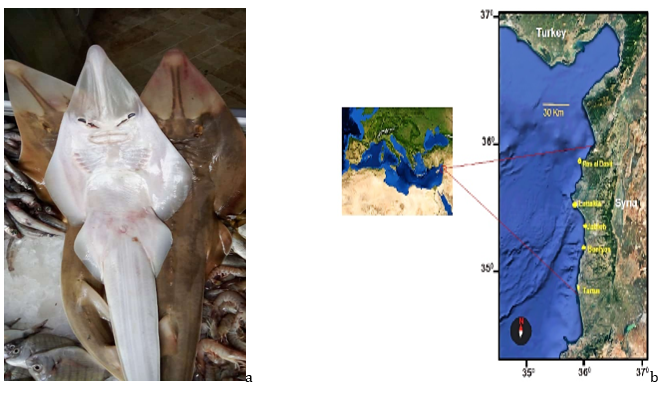
A thorough collection of 222 specimens belonging to the Rhinobatos rhinobatos species was obtained along the Syrian coast between January 2021 and December 2023. These specimens were obtained from commercial catches made by local fishermen. Various fishing techniques, such as trawling and netting, were employed in artisanal fisheries, and the specimens were also obtained as bycatch during fishing activities. Several measures were implemented to educate fishermen about the significance of conserving these fish and how to handle them appropriately. This involved providing guidance on the proper handling of adult individuals, which could potentially enhance their chances of survival and reproduction (Figure 1).
Age and Maturity
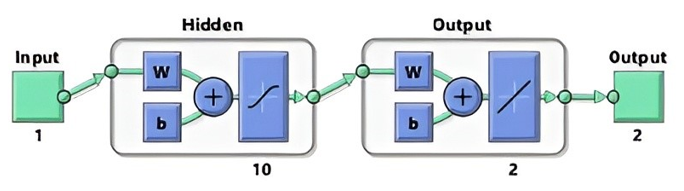
In the research conducted by Hamwi [4], a multilayer perceptron artificial neural network model with a configuration of (1, 10, 2) was utilised to estimate the maturity and age of Rhinobatos rhinobatos. The model utilised the total length (TL) of the fish as the input parameter for the updated network model (Figure 2).
Growth of Fishery Population (FP)
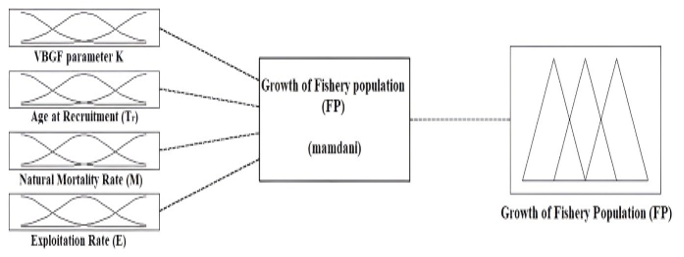
In their study, Hamwi, et al. [16] developed an expert system model based on fuzzy logic to estimate the growth of the Rhinobatos rhinobatos population along the Syrian coast. The model employed specific parameters (K, Tr, M, E) as inputs and employed fuzzy logic techniques to analyse and interpret the data (Figure 3).
The von Bertalanffy equation was employed to determine the parameters (K, TL∞), and the selection of the most suitable growth model was guided by the Akaike Information Criterion (AIC). The Akaike Information Criterion (AIC) is defined as AIC = N ln (WSS) + 2M, where N represents the number of data points, WSS is the weighted sum of squares of residuals, and M denotes the number of model parameters. The primary objective of the study was to compare different growth models that accurately describe the characteristics of the fish species in question [17]: TLt = TL∞ / [1 + e-K(t-t 0 )]. TLt represents the total length of the fish at a particular age (t), while TL∞ denotes the hypothetical asymptotic total length (in centimeters) that the fish can potentially attain. The growth coefficient is represented by K, and t0 represents the theoretical age at which the length of the fish is assumed to be zero.
To estimate the total mortality rate (Z), the Ricker method was employed [18]. This method involved calculating the regression equation for the catch curve (ln Nt = a - Zt)
across the entire population. The natural mortality rate (M) was determined using a specific relationship:
Log M = -0.0066 - 0.279 log TL∞ + 0.6543 log K + 0.4634 log T [19].
The von Bertalanffy parameters TL∞ and K were used, along with the average surface water temperature (T) in the fishing area. The average surface water temperature recorded during the study period was 23.29 °C. The fishing mortality rate (F) was calculated as the difference between the total mortality rate (Z) and the natural mortality rate (M) [18]. Thus, F = Z - M. The exploitation rate (E) was computed using the formula E = F / Z [20]. The survival rate (S) was determined by the equation S = e-Z [18].
To calculate the total length (TLc) and age (Tc) at first capture, equations proposed by Beverton and Holt [21] were applied: TLc = TL’ - [ K (TL∞ - TL’) / Z ]; Tc = - (1/K) * ln (1 - TLc / TL∞) + t0 Here, TL’ refers to the average total length of the captured fish.
The total length (TLr) and age (Tr) at recruitment were determined using equations proposed by Beverton, et al. [21]: TLr = TL’ - [ K (TL∞ - TL0) / Z ]; Tr = - (1/K) * ln (1- TLr / TL∞) + t0 (TL0 represents the total length of the fish at the moment of hatching or age zero).
The growth performance index (ΦTL`) can be calculated using the equation proposed by Pauly, et al. [22]: ΦTL` = logK + 2logTL∞ The relative yield-per-recruit (Y’/R) model, derived from the Beverton and Holt model [23], is presented as follows: Y’/R = [ E * U(M/K) ] * [ 1 – (3U / (1 + m) + (3U2 / (1 + 2m) – (U3 / (1 + 3) m] Where: U = 1-(Lc/L∞); m = (1-E) / (M/K) = (K/Z); E = F/Z.
The estimation of relative biomass-per-recruit (B’/R) is derived from the following relationship [18]: B’/R = (Y’/R) / F.
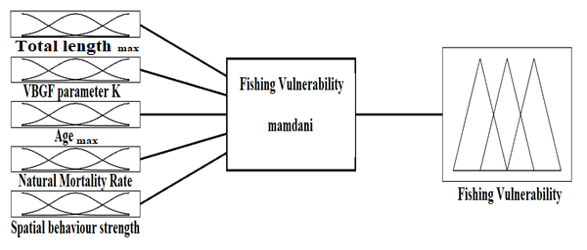
Fishing Vulnerability (FV) The vulnerability of Rhinobatos rhinobatos to fishing was assessed using the model developed by Hamwi, et al. [15]. This expert system used fuzzy logic techniques and used specific parameters (TLmax, K, Tmax, M, S) as inputs to analyse and evaluate the vulnerability of the species to fishing activities (Figure 4).
Results
The analysis of Rhinobatos rhinobatos’ age composition yielded findings that were of interest. The analysis revealed the presence of nine distinct age groups. It was somewhat unexpected that the third age group emerged as the most dominant, comprising a staggering 28.38% of the entire population. In contrast, the ninth age group was a negligible proportion, representing only 1.80 % of the overall catch. This indicates that Rhinobatos rhinobatos exhibits a short lifespan in the Syrian coast (Figure 5).
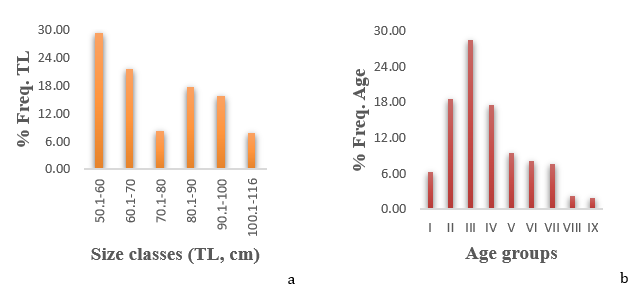
A further examination of the distribution of individuals based on their total length (TL) revealed that those with total lengths falling within the range of 50.1-60 cm was the most prevalent, accounting for 29.28% of the population, respectively. Conversely, individuals with total lengths of 100.1-116 cm were the least represented, comprising only 17% of the total population (Figure 5).
The von Bertalanffy growth equation was used to determine the parameters for total length in Rhinobatos rhinobatos, with the following calculations: TLt = 149.46 (1- e-0.145 (t + 1.201)) (AIC= 554.83; WSS= 4087.15; 95% confidence= 0.379).
The findings of this study indicate that the average age and total length of Rhinobatos rhinobatos individuals at the time of their initial capture were 3.33 years and 71.98 cm, respectively. Similarly, the average age and total length of individuals at the time of recruitment were found to be 1.64 years and 50.40 cm, respectively.
Furthermore, the growth performance index (Φ’) for total length growth was calculated and recorded as 3.51.
In this study, the total mortality coefficient (Z) of Rhinobatos rhinobatos was estimated to be 0.45 per year. The fishing mortality coefficient (F) and natural mortality (M) were calculated as 0.15 per year and 0.30 per year, respectively. Furthermore, the survival rate (S) was determined to be 0.64 per year. Furthermore, the exploitation mortality coefficient (E) was determined to be 0.33 per year.
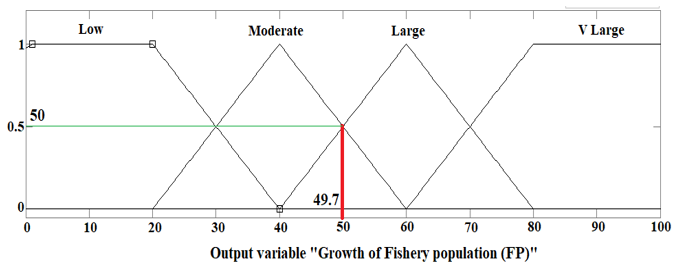
The fuzzy logic expert system proposed by Hamwi, et al. [16] gave a growth value of 49.7 for the Rhinobatos rhinobatos population along the Syrian coast (Figure 6).
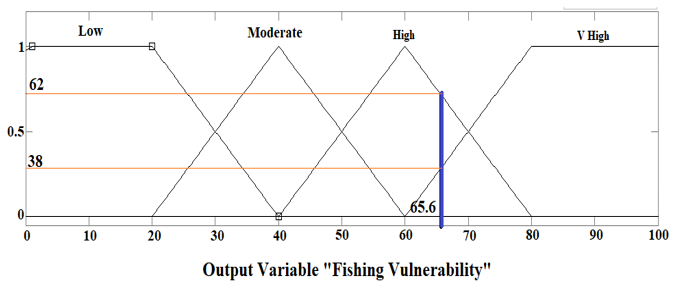
According to the expert system (fuzzy logic) developed by Hamwi, et al. [15], Rhinobatos rhinobatos had a fishing vulnerability of 65.6 FV, where the maximum vulnerability value (FV) is 100 (Figure 7).
Discussion
In the context of this study, individuals of the Rhinobatos rhinobatos species found along the Syrian coast exhibited a maximum total length of 115.73 cm at the age of 9+. In contrast, the smallest recorded total length for an individual was 54.87 cm at the age of 1+. In Iskenderun Bay, located in the northeastern Mediterranean Sea in Turkey, the recorded total lengths ranged from 39 cm to 147 cm, with the highest recorded age being 24 years [24]. In the Mediterranean Sea, the maximum observed total length was 181 cm in the Alexandria Waters (Table 1) [25].
| Location and author | Age | Total length (TL, cm) | |
|---|---|---|---|
| min | max | ||
| Iskenderun Bay, Turkey [24] | 24 | 39 | 147 |
| Syrian coast | 9 | 54.87 | 115.73 |
| Alexandria waters [25] | 181 |
Table 1: Maximum-minimum total length and age of Rhinobatos rhinobatos from different water bodies.
In order to assess the growth rate of total length in Rhinobatos rhinobatos, the growth coefficient (k) derived from the von Bertalanffy equation was analysed. The calculated value for total length growth was found to be 0.145. It is worth noting that this value is higher than that observed for females from the northern Mediterranean (0.134) and lower than that for males from the same region (0.310) [24].
The results of this study showed a positive allometric growth pattern (b = 3.17) with respect to total length, indicating a faster rate of increase in total weight compared to other dimensions. It is noteworthy that this positive allometric growth pattern (b = 3.192) was specifically observed in the northeastern Mediterranean [24].
The ratio of the length at first capture to the asymptotic length (Lc/L∞) is an indicator of whether the harvested fish are predominantly juveniles or mature individuals. When the (Lc/L∞) ratio is less than 0.5, it suggests that the majority of the catch consists of juvenile fish species [26]. In this study, the estimated (Lc/L∞) ratio was 0.48, which is less than 0.5. This indicates that the majority of the catch in the Rhinobatos rhinobatos fishery mainly comprises juvenile fish.
The presented results in Figure 8 illustrate the correlation between exploitation rates (E) and the relative yield per recruit (Y’/R) as well as the relative biomass per recruit (B’/R). The analysis considered a range of exploitation rates from 0.05 to 1.00 as variable input parameters. By examining the first derivative of the yield function concerning the exploitation rate, several significant values were determined. These values include Emax, which signifies the exploitation rate that maximizes the yield per recruit. For Rhinobatos rhinobatos, the calculated value of Emax was determined to be 0.770 y-1.
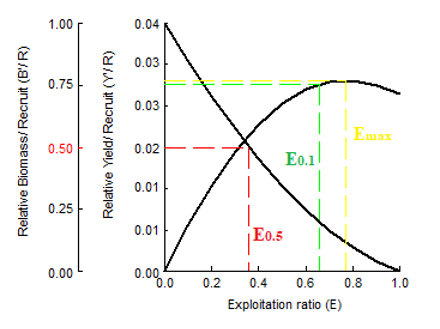
Furthermore, two other crucial values were identified. E0.1 represents the exploitation rate at which the marginal increase in relative yield-per-recruit reaches one-tenth of its value at E = 0. In the case of Rhinobatos rhinobatos, the calculated value of E0.1 was found to be 0.656 y-1. Additionally, E0.5 corresponds to the exploitation rate at which the stock’s biomass has declined to 50% of its unexploited state. The estimated value of E0.5 for Rhinobatos rhinobatos was determined to be 0.360 y-1. These findings enhance our comprehension of the association between exploitation rates and the relative yield and biomass per recruit for Rhinobatos rhinobatos. They provide valuable insights into the population dynamics of this species and offer guidance for implementing sustainable management practices.
Rhinobatos rhinobatos are generally subject to pressure from fishing activities and depletion of their populations. Consequently, their life cycle can be divided into two distinct phases: the unexploited phase, which extends from hatching to age at first capture (tc), and the exploited phase, which extends from tc onwards [27]. The current study showed that the exploitation mortality coefficient (E= 0.33) for Rhinobatos rhinobatos during the fishing season was low and below the allowable limit or optimal exploitation ratio (E0.5= 0.360). Consequently, Rhinobatos rhinobatos is considered to be in a sustainable fishing state, as F ≈ 0.5M [28].
The population of Rhinobatos rhinobatos along the Syrian coast exhibited a growth value of 49.7. This value corresponds to a high growth of 50 and a moderate growth of 35, based on a maximum fishing population growth (FP) value of 100.
Rhinobatos rhinobatos exhibited a fishing vulnerability score of 65.6 (FV), with the maximum vulnerability value being 100. This score indicates a very high vulnerability of 62 and a high vulnerability of 38, suggesting a strong susceptibility to fishing activities. Consequently, these fish species face significant threats along the Syrian coast. Furthermore, Fishbase’s intrinsic vulnerability assessment categorizes Rhinobatos rhinobatos as highly to very highly vulnerable, with a rating of 66 out of 100 [29].
Conclusion
This study highlights the importance of conservation measures in ensuring the sustainable management of this species by providing important insights into the population dynamics of Rhinobatos rhinobatos along the Syrian coast. The results provide a basis for future research and management strategies by contributing to our understanding of the growth patterns, mortality rates and vulnerability of Rhinobatos rhinobatos to fishing. The management of Rhinobatos rhinobatos fisheries in Syrian coast has significant implications from the results of this study. Overfishing can have a profound effect on the ability of the population to sustain itself, resulting in a decline in abundance. Therefore, the implementation of management strategies that minimise the catch of Rhinobatos rhinobatos and ensure the long-term sustainability of the fishery is of paramount importance.
Acknowledgments
The author would like to express their sincerest gratitude to Tishreen University for their invaluable support in facilitating this research. Furthermore, he would like to extend their profound gratitude to the artisanal fishermen, particularly the professional fisherman Abu Bassam.
References
-
Jabado RW, Pacoureau N, Diop M, Dia M, Ba A, et al. (2021) Rhinobatos rhinobatos. The IUCN Red List of Threatened Species 2021: e.T63131A124461877.
-
IUCN (2024) The IUCN Red List of Threatened Species.
-
Hamwi N (2024a) Predicting age and maturity of endangered Spiny butterfly ray, Gymnura altavela (Linnaues 1758) using artificial neural network (multilayer perceptron). Damascus University Journal for the basic sciences 40(1): 55-68.
-
Hamwi N (2024b) Population Growth of Thunnus thynnus and Vulnerability to Fishing along the Syrian Coast (Eastern Mediterranean Sea). International Journal of Oceanography & Aquaculture, 8(2): 000311.
-
Hamwi N (2024c) Population Assessment of White Grouper Epinephelus aeneus Using Specialist Technical Methods Along Coastal Syrian Waters in The Eastern Mediterranean. Journal of Marine Science and Research 3(1).
-
Hamwi N (2024d) Population growth of Katsuwonus pelamis and vulnerability to fishing along the Syrian coast (Eastern Mediterranean Sea). International Journal of Oceanography & Aquaculture 8(4): 000342.
-
Hamwi N, Ali-Basha N (2024) Growth of Spiny Butterfly Ray Gymnura altavela Population and Vulnerability to Fishing along the Syrian Coast (Eastern Mediterranean Sea). International Journal of Oceanography & Aquaculture 8(3): 000326.
-
Hamwi N, Ali-Basha N, Altajer H, Salem J (2024a) Assessment of Dusky Spinefoot Siganus luridus Population Dynamics along the Syrian Coast (Eastern Mediterranean Sea) Utilizing Different Expert System Techniques. International Journal of Oceanography & Aquaculture 8(3): 000329.
-
Hamwi N, Ali-Basha N, Altajer H, Salem J (2024b) Population assessment of greater amberjack Seriola dumerili along the Syrian waters in the eastern Mediterranean Sea using expert systems. Journal of Marine Science and Research 3(1).
-
Hamwi N, Ali-Basha N, Altajer H, Salem J (2024c) Assessment of Population Growth and Fishing Vulnerability of Pomadasys stridens along the Syrian Coast (Eastern Mediterranean Sea). International Journal of Oceanography & Aquaculture 8(3): 000333.
-
Cheung WWL, Pitcher T, Pauly D (2005) A fuzzy logic expert system to estimate intrinsic extinction vulnerabilities of marine fishes to fishing. Biological Conservation 124(1): 97-111.
-
Cheung WWL (2007) Vulnerability of marine fishes to fishing: from global overview to the northern south China sea. A Thesis in the University of British Columbia pp: 354.
-
Jones M C, Cheung W W L (2018) Using fuzzy logic to determine the vulnerability of marine species to climate change, Glob Change Biol 24(2): e719-e731.
-
Hamwi N, Ali Basha N (2019) Estimation of the vulnerability of some Sparidae species to fishing in the Eastern Mediterranean Sea (Syrian coast) by fuzzy logic method. Journal of Al-Baath University 41(10): 129-160.
-
Hamwi N, Ali-Basha N, Altajer H, Farah T (2022) A proposed model to estimate the growth of the fishery populations by expert system. Journal of Hama University 5(9): 92-106.
-
Hamwi N (2018) Use Akaike (AIC) and Schwartz (SC) information criterions in the differentiation between nonlinear growth models of different fish species. Journal of Al-Baath University 40(3): 45-66.
-
Ricker WE (1975) Computation and interpretation of biological statistics of fish populations. Bulletin of the Fisheries Research Board of Canada 191: 382.
-
Pauly D (1980) A new methology for rapidly acquiring basic information on tropical fish stocks: growth, mortality and stock recruitment relationships. In: Saila SB, Roedel PM (Eds.), stock assessment for tropical small-scale fisheries, ICMRD, Univ Rhode Island, Kinston, pp: 154-172.
-
Sparre P, Venema S C (1998) Introduction to tropical fish stock assessment-Part 1: Manual. FAO Fisheries Technical Paper 306(1): 407.
-
Beverton RJH, Holt SJ (1957) On the dynamics of exploited fish population. Fishery Investigations, Series II, London, UK, 19: 1- 533.
-
Pauly D, Munro JL (1984) Once more on the comparison of growth in fish and invertebrates. FishByte 2(1): 21.
-
Beverton RJH, Holt SJ (1966) Manual of methods for fish stock assessment. Part II. Tables of yield function. FAO Fish Biol Tech Pap (38)10: 67.
-
Başusta N, Demirhan S A, Çiçek E, Başusta A, Kuleli T (2008) Age and growth of the common guitarfish, Rhinobatos rhinobatos, in Iskenderun Bay (north-eastern Mediterranean, Turkey). Journal of the Marine biological Association of the United Kingdom 88(4): 837-842.
-
Abdel-Aziz S H, Khalil AN, Abdel-Maguid SA (1993) Reproductive cycle of the common guitarfish, Rhinobatos rhinobatos (Linnaeus, 1758), in Alexandria waters, Mediterranean Sea. Marine and Freshwater Research 44(3): 507-517.
-
Pauly D, Soriano ML (1986) Some practical extensions to Beverton and Holt’s relative yield-per-recruit model. In The first Asian fisheries forum. Manila: Asian Fisheries Society pp: 491-496.
-
Beverton RJH, Holt SJ (1956) A review of methods for estimating mortality rates in fish populations, with special references to sources of bias in catch sampling. Rapp. 140: 67-83.
-
Froese R, Winker H, Gascuel D, Sumaila U R, Pauly D (2016) Minimizing the impact of fishing. Fish and Fisheries 17(3): 785-802.
-
Froese R, Pauly D (2024) FishBase. World Wide Web electronic publication.
- Genetic Improvement of Nile Tilapia (Oreochromis niloticus): Advances in Selective Breeding and Genomic Approaches for Sustainable Aquaculture
- Microplastics, Contaminants, and Waste Hotspots: Divergences and Faults in Prioritizing Control Efforts
- Creating a Healthier, More Vibrant Open and Closed Aquatic Environment. A Submersible, Centrifugal Magnetically Affixed Current Changing Aquarium Pump
- An Attempt to Assess Alpha Diversity and Sample Size: Using the Ostracod Assemblages off Kumamoto Port, Japan
- Assessment of the Efficiency of Common Fishing Gears and Crafts Used at Mohananda River of Chapai Nawabganj, Bangladesh
- Fish Productivity and Biodiversity Status of Sundarban Mangrove in Bangladesh