
Effects of Gingerol on the Growth Performance, Digestive Enzyme Activities, Anti-Oxidation of Macrobrachium nipponense
A 2-month experiment was conducted with three groups (control group, Group 1, and Group 2) to study the effect of gingerol on the growth performance, digestive enzyme activities, and antioxidation of Macrobrachium nipponense. The results indicated that gingerol, when used as an additive at different feeding frequencies, had different effects on the growth performance of M. nipponense. The weight gain rate (WGR) of Group 1 (fed gingerol once a week) was 57.89 ± 6.53%, significantly higher than both the control group and Group 2 (fed gingerol twice a week) (P < 0.05). On the 60th day of the experiment, Group 1 had the longest average body length and highest body weight. The yield in Group 1 was also the highest (55 kg–60 kg per mu), while Group 2 had the lowest. Furthermore, we found that gingerol enhanced SOD activity, reduced MDA content, and improved the activities of pepsin, α-amylase, and β-amylase, thus promoting the anti-oxidation and digestive enzyme activities of M. nipponense. However, it is important to restrict the feeding frequency. In our study, using gingerol as an additive once a week for 60 days showed the optimal effect.
Wu D¹, Shan H¹*, Wang Q¹, Zheng H¹, Guo L¹, Xue Y¹, Shen Y¹, Zhang L², Liang K² and Wang Y¹
¹Nanjing Institute of Fisheries Science, China ²Nanjing Zhongcheng Zhengyuan Biotechnology, China
Introduction
Macrobrachium nipponense, commonly as the oriental river prawn is flavored by both consumers and fish farmers in Yangtze River Delta region of China given its delicious favor and high economic value [1, 2]. Jiangsu province is one of the main farming districts of M. nipponense, producing 34,000 tons in 2023 according to 2024 China Fishery Statistical Year book. But the yield of M. nipponense is relatively lower than other aquaculture species due to its fighting biological characteristics, aquatic diseases, autumn propagation, etc.
Ginger and its extracts have been widely used in aquaculture in recent years, and it is proved to have good effects in antibacterial, deworming, and anti-hypoxia. Gingerol is one of the active ingredients of ginger with strong antioxidant capacity [3]. Previous studies have shown that gingerol and gingerol-taurine compound preparation could effectively improve the antioxidant stress resistance of California sea bass under high temperatures. After 20 days of feeding, the activities of T-AOC, SOD, CAT, and GSH-Px significantly increased, while MDA content significantly decreased [4]. ZHANG Liang et al. performed a 5-days consecutive experiment to study the combined effect of gingerol and organic selenium on the resistance to high temperature stress in Macrobrachium nipponenseamn and found that they can increase the tolerance and resistance of M. nipponenseamn to high temperature stress [5].
M. nipponense is a kind of aquatic animals which have the behavior of fighting with their congeners during its growth which caused non negligible casualties and losses. Fighting also resulted in other problems such as susceptible to disease, environment change, etc. Additionally, the seedling propagation of M. nipponense in autumn will influence the final specification of M. nipponense for sale on the market in actual production. The use of gingerol has sedative effect, which may reduce cannibalism and lower the proportion of female shrimps with eggs, thus decreasing the breeding of M. nipponense in autumn and increasing the specification of M. nipponense for sale on the market, ultimately improving the benefits of this aquaculture.
As mentioned above, we added gingerol in feed to explore whether it can improve the activities of M. nipponense and improve aquaculture yield. Specifically, three groups with different gingerol feeding frequencies, i.e., control group (no gingerol fed), Group 1(fed at once a week) and Group 2(fed at twice a week) were set to perform a 2-month aquaculture experiment. The growth performance, digestive enzyme activities, anti-oxidation of Macrobrachium nipponense were evaluated and assessed.
Materials and Methods
Experimental Design
The experimental ponds were M. nipponense breeding ponds at Nanjing Yuzhige Aquaculture Co., Ltd. Three ponds with same area and stocking rate were selected to conduct the study. Each pond area was 0.467 ha. One pond was designated as the control group, while the other two ponds were assigned as Group 1 and Group 2, respectively. The Group 1 pond received gingerol once a week in addition to the regular prawn compound feed, while the Group 2 pond was fed gingerol twice a week alongside the regular feed. The gingerol was from the mixed feed additive “Jiang Jiening” produced by Nanjing Zhongcheng Zhengyuan Biotechnology Co., Ltd, of which the content of gingerol was 1500 mg/ kg. The usage of “Jiang Jiening” in feed was 2.5 mL/kg. The concentrations of the gingerol in treatment groups were 0.37 ppb.
M. nipponense Stocking Density
The bred M. nipponense was young shrimp of “Taihu No. 2”, with specification of about 5000 tails/kg. The stocking density was 1.124 million per hectare.
Feed Management
The feed was regular prawn compound feed and each pond was fed for two times daily at 8:00 in the morning and 17:00 in the afternoon during the experimental breeding period. Approximately 80 pounds of feed were used by each pond.
Sampling
The experiment was conducted from August 15 to October 18, 2023. Sampling every 20 days after the start of the experiment and 4 batches of experimental data were obtained, namely, D0, D20, D40, D60. Thirty shrimps of M. nipponense were randomly selected for measuring their body length and weight, and the proportion of female shrimps with eggs was recorded. The body length is the length of the prawn from the base of the eyestalk to the end of the caudal segment of the prawn. At the same time, the hepatopancreas was sampling for the test of SOD, MDA , etc.
Digestive and Immune Indicators Testing
The activities of digestive enzymes (lipase, protease, α-amylase and β-amylase), superoxide dismutase (SOD) and malondialdehyde (MDA) were tested by adopting the measurement method of kits provided by Nanjing Jiancheng Bioengineering Institute.
Calculation of Growth Indicators
$$ \left(W G R\right) = \frac {\left(W 2 - W 1\right)}{W 1} \times 1 0 0 $$
Weight gain rate WGR
$$ \frac {(2 - W 1)}{W 1} \times 1 $$ Wherein W2 means the weight of M. nipponense sampled from the D60 experimental data and W1 means the weight of M. nipponense sampled from the D0 experimental data. Drawing using Origin 8 software. T-test was employed to compare the differences between the experimental and control group. A difference of P < 0.05 was considered to be of significance. All statistical analyses were carried out with SPSS 20.0 (SPSS Inc., Chicago, IL, USA).
Results
Growth Performance
The results showed that WGR of group 1 was the highest, 57.89%±6.53%, which was significantly higher than both of control group and Group 2(P<0.05). WGR of group 2 was significantly lower than both of the other two groups(P<0.05). The initial body weights of the three groups had no significant differences. The final body weight of group
1 is significantly higher than that of group 2(P<0.05). Both group 1 and 2 had no significant difference with control group on the final body weight respectively(P>0.05) (Table 1).
| Initial body weight(IBW/g) | Final body weight(FBW/g) | WGR/% | |
|---|---|---|---|
| Control | 0.75±0.498 | 1.12±0.768,ab | 49.33±9.72,c |
| 1 | 0.95±0.305 | 1.50±1.058,a | 57.89±6.53,d |
| 2 | 0.66±0.393 | 0.93±0.471b | 40.91±8.12,e |
Table 1: Effects of gingerol on the weight gain rate of _M._ _nipponense_.
Data are expressed as mean ± SD. Numbers in the same column followed by no same lowercase letters indicate statistically significant differences using t- test at 5% probability between each treatment.
At the beginning of the experiment, the body lengths of group 1 and group 2 had no significant difference with control group respectively(P>0.05) but group 1 was significantly higher than group 2((P<0.05). On the 20th day, the three groups showed no significant difference(P>0.05) with each other. On the 40th day, the average body length of group 1 was the longest(4.35±0.77 cm), which had significant difference with the other two groups (P<0.05). On the 60th day, the body length of group 1 kept the longest, but showed no significant difference(P>0.05) with the others. The body length of group 2 was the shortest (3.91±0.23 cm) (Figure 1).
The average single body weight of the three groups had no significant difference at the beginning (P>0.05). The body weight of group 2 grew the most on the 20th day, but the control group and group 1 decreased. Then group 1 grew rapidly on 40th day(1.39±0.91 g), significantly heavier than the other groups(P<0.05). The body weight of group 2 was the lightest(0.93±0.47 g) while the body weight of group 1 was the heaviest(1.50±1.06 g) on the 60th day and they had significant difference with each other(P<0.05) (Figure 2).
control group Group 1 Group 2
d
2.4 d
2.0 cd
1.6 ac ac body weight/g c a ab a ab
Table 2: Effects of gingerol on the proportion of female shrimps with eggs _M. nipponense_.
1.2
Table 3: Effects of gingerol on the proportion of female shrimps with eggs _M. nipponense_.
Proportion of Female Shrimps with Eggs
The proportions of female shrimps with eggs of the three groups at the beginning and on the 20th of the experiment were counted and recorded. On the 40th day, all shrimps had almost done the ovulation and the proportion was 0. It was clearly seen that the proportion of female shrimps with eggs of group 2 declined the most, nearly 40%, followed by control group and group 1 respectively (Table 2).
| Control group(%) | Group 1(%) | Group 2(%) | |
|---|---|---|---|
| 0 | 36.84 | 26.32 | 57.45 |
| 20 | 23.23 | 26.67 | 16.67 |
Table 4: Effects of gingerol on the proportion of female shrimps with eggs _M. nipponense_.
Antioxidant Activity
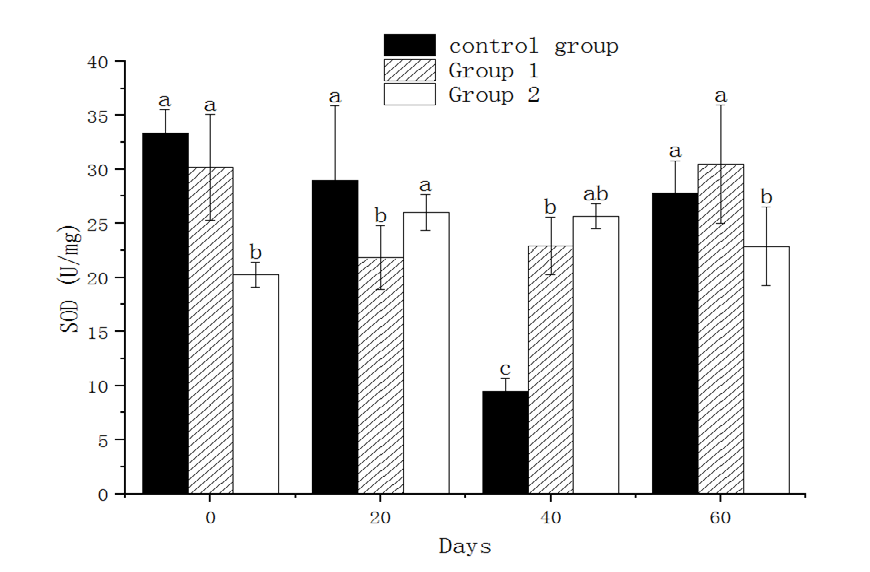
For control group, its SOD activity first decreased and then increased, reaching the lowest(9.48±1.18 U/mg) on the 40th day. The trend was similar to that of group 1, but the change range of group 1 was much smaller(P<0.05). The change trend of group 2 was on the contrary, which increased first and then decreased. On the 60th day, the SOD activity of group 2 was significantly lower than those of control group and group 1(P<0.05) and the SOD activity of group 1 was the highest(30.47±5.48 U/mg) (Figure 3).
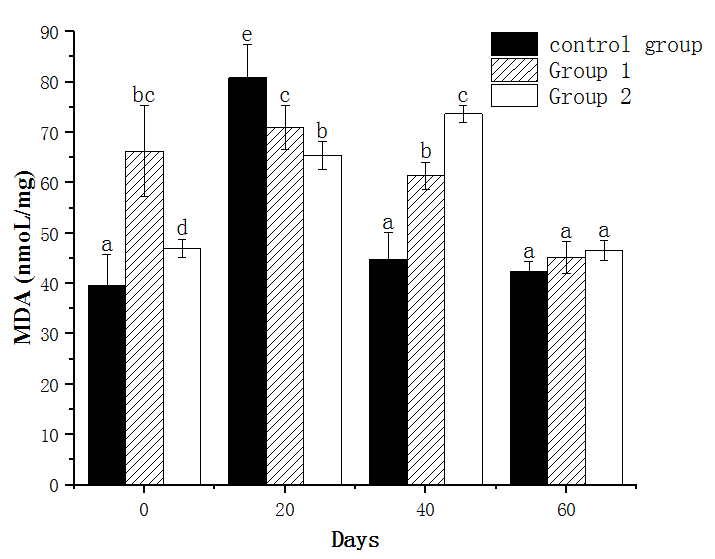
MDA contents of the three groups were significantly different at the beginning(P<0.05), wherein the group 1 was the largest(66.27±9.0 nmoL/mg) and the control group was the smallest (39.62±6.15 nmoL/mg). As the experiment progresses, MDA contents of all the three groups first increased and then decreased. Both MDA contents of control group and group 1 reached maximum on the 20th day(80.91±6.55 nmoL/mg and 70.98±4.32 nmoL/ mg respectively), while group 2 still grew and reached maximum(73.69±1.66 nmoL/mg ) on the 40th day. MDA content of control group increased on the 60th day compared to the beginning, which was contrary to group 1 and 2. MDA content decreased the most in group 1 from the 0th day to 60th day. On the 60th day, MDA contents of the three groups had no significant difference(P>0.05) (Figure 4).
Digestive Enzyme Activity
Lipase(LPS) activity of group 2 was significantly lower than those of control group and group 1 at the beginning of the experiment(P<0.05). On the 20th day, the activities increased in control group and group 2, wherein the increasing of group 2 was larger. But the activity in group 1 decreased at most on the 20th day. On the 40th day, the activities in both control group and group 2 decreased, and their values were close. The activity in control group went on decreasing on the 60th day but group 2 increased. On the whole, the change tend of the activity in group 1 was different, which decreased on the 20th day, then stabilized at about 5.5 U/g on the 40th day and the 60th day (Figure 5).
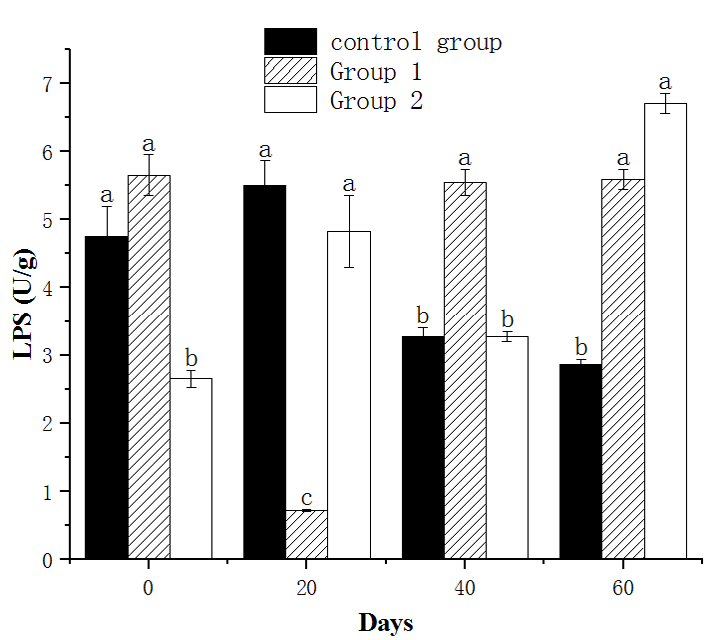
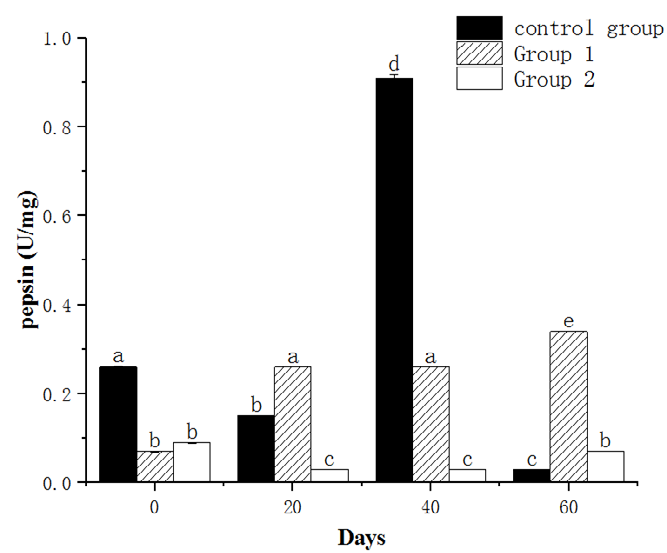
Figure 5: Effects of gingerol on lipase (LPS) activity in the hepatopancreas of M. nipponense. Pepsin activity in M. nipponense of control group was significantly higher than those of group 1 and 2 on the 0th day(P<0.05) and it showed a larger fluctuation range at each sampling. Pepsin activity of group 1 increased as the experiment progressed, and reached 0.34 U/mg on the 60th day, significantly higher than both of control group and group 2(P<0.05). Pepsin activity of group 2 decreased overall and was the lowest on 60th day. On the 20th day, it had already decreased to 0.03 U/mg (Figure 6).
The α-amylase activity in group 2 was the lowest compared to control group and group 2 at the beginning of the experiment(P<0.05). The change trends of control group and group 1 were similar, both first decreased and then increased, which were contrary to group 2. On the 60th day, α-amylase activity in group 2 was the highest and α-amylase activity in group 2 was the lowest. The change trends of β-amylase activity in each group were similar to those of α-amylase. At the beginning, β-amylase activity in group 1 was the highest and β-amylase activity in group 2 was the
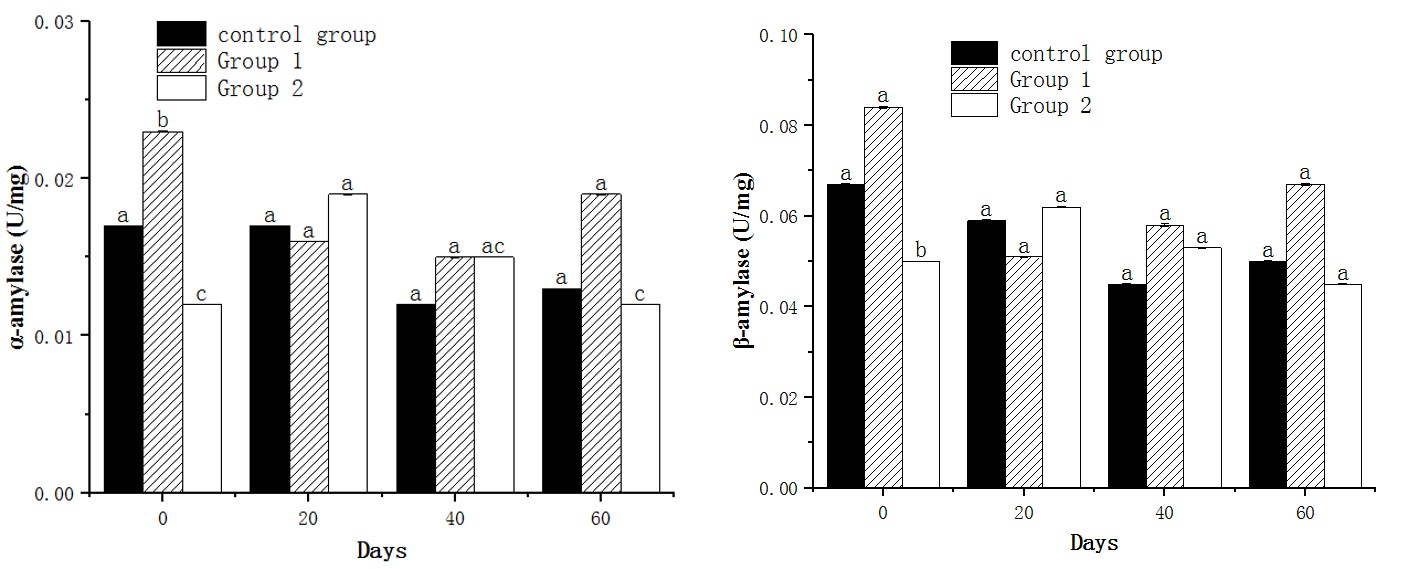
lowest. The β-amylase activity of control group decreased on the 20th day and the 40th day, but on the 60th day, there was a slight rebound. The β-amylase activity of group 1 decreased on the 20th day, and then increased on the 40th day and the 60th day. On the contrary, the β-amylase activity of group 2 increased on 20th day, and then dropped all the way. On the 60th day, β-amylase activity of group 1 was the highest and group 2 was the lowest, which was same with the result of α-amylase activity (Figure 7).
Yield
The mu yield of the pond of group 1 was the highest (110-120 kg), followed by control group (about 100 kg), the mu yield of the pond of group 2 was the lowest (80-90 kg). The proportions of shrimp products for sale in the pond of control group and group were close, about 30%, while the proportion in the pond of group 2 was relatively lower, about 25% (Table 3).
| mu yield(kg) | proportion of shrimp products(%) | |
|---|---|---|
| Control group | about 100 | 30 |
| Group 1 | 110-120 | 30 |
| Group 2 | 80-90 | 25 |
Table 5: The yield and proportion of shrimp products for sale of each pond.
Discussion
The promoting effect of gingerol on the growth of M. nipponense has not been reported before. In our study, feeding gingerol once a week promoted increases in body length and weight, resulting in the highest weight gain rate, significantly greater than in other groups. The yield results were consistent with this finding. However, higher feeding frequency did not always correlate with better outcomes. We found that feeding twice a week restricted the growth of M. nipponense compared to the control group, as it had the lowest weight gain rate and smaller, lighter individuals by the end of the study. Additionally, using gingerol twice a week significantly lowered the proportion of female shrimps with eggs during the autumn production period.
A report on the relationships between the dosage of 6-gingerol and its effects on the sea urchin Paracentrotus lividus found that the number of abnormal morphologies increased, and embryo size was reduced by up to 100% at a dosage of 100 μM. This suggests that gingerol may have a sedative effect, reducing shrimp vitality and lowering mating and feeding behavior. Our study provides insights into the decrease in the proportion of female shrimps with eggs after using gingerol twice a week, potentially restricting the development of egg cells in M. nipponense. Excessive gingerol feeding may also reduce shrimp intake during the growth period, so gingerol should be administered once a week, except during seedling propagation in autumn. Overall, our results suggest that using gingerol as a feed additive once a week is the most appropriate feeding frequency for the growth of M. nipponense. It is speculated that gingerol may promote gut health, improve feed conversion efficiency, and enhance growth rate.
Reactive oxygen species (ROS) are the main factors causing oxidative stress and damage in aquatic animals. Superoxide dismutase (SOD) is a metalloenzyme and a key player in the body’s defense against oxidative damage, primarily located in the cytoplasm and mitochondria. It catalyzes the dismutation of superoxide anions (O2⁻), reducing the peroxidation of polyunsaturated fatty acids and helping to eliminate oxygen free radicals, thus balancing intracellular ROS levels [7]. Gingerol, an extract from ginger, contains 3-methoxy-4-hydroxyphenyl functional groups and is known for its immune-boosting and antioxidant properties [8]. The phenolic hydroxyl group in gingerol effectively scavenges free radicals, particularly when methoxy groups are present [9]. Research has confirmed that gingerol enhances immunity and antioxidant activity, showing that 6-gingerol can serve as a natural antioxidant to minimize lipid oxidation [10].
The increase in SOD activity in M. nipponense reflects the body’s stress response and indicates improved antioxidant activity and health status. Adding gingerol to the feed helps activate the antioxidant system, promoting SOD activity and defending against oxidative stress from both the environment and free radicals generated within the body.
In our study, SOD activity in Group 2 increased on the 20th day, while the other groups showed a decrease. Subsequently, Group 2’s activity declined while Group 1’s increased. From the 40th to 60th day, SOD activity in Group 1 was significantly higher than in the control group, indicating that gingerol can enhance SOD activity, but high feeding frequency may limit its effectiveness over time. Feeding once a week had a better effect on SOD activity.
Malondialdehyde (MDA), the final product of lipid peroxidation, can increase membrane permeability and alter cell membrane structure and function, leading to cell damage. Elevated MDA levels indirectly reflect the degree of peroxidation in the body [11, 12]. In our study, MDA levels increased in all groups by the 20th day, with Group 1 showing the least increase, followed by Group 2 and the control group. This suggests that gingerol addition helped restrict MDA generation compared to the control group. MDA content in Group 1 decreased over time, indicating effective restriction of MDA generation, while Group 2 showed inconsistent inhibition on the 40th day. These results align with the findings on SOD activity, demonstrating that gingerol can enhance SOD activity and reduce MDA production, but feeding frequency should be controlled at once a week for long-term use.
Research by Zhou Jianzhong, et al. [4] found that feeding gingerol and gingerol-taurine compound preparations effectively improved the antioxidant capacity of Micropterus salmoides. After 20 days of continuous feeding, T-AOC and SOD activities in liver and muscle tissue increased significantly, while MDA content decreased, similar to our findings.
α-amylase plays a crucial role in food digestion and nutritional metabolism in shrimps, hydrolyzing starch. β-amylase helps digest food into easily absorbable molecules, providing energy and nutrients for growth and reproduction [13, 14, 15]. In our study, pepsin levels in Group 1 increased significantly on the 20th day compared to other groups, indicating that gingerol improves protein digestion capability when fed once a week. However, higher feeding frequency suppressed digestion capability, further restricting M. nipponense growth.
The trends in α-amylase and β-amylase activity in Groups 1 and 2 mirrored those of SOD, with Group 1 showing an initial decrease followed by an increase, while Group 2 initially increased then decreased. This indicates that gingerol promotes starch digestion, with once-a-week feeding yielding better long-term results compared to more frequent feeding.
Digestive function is closely related to the growth performance of M. nipponense. From the experimental results, the MGR, body length, weight, and yield in Group 1 were the best, aligning with the digestive enzyme testing results. Good digestive function promotes the healthy growth of M. nipponense.
Conclusion
Our study focused on its effect of different feeding frequencies on M. nipponense in terms of growth, yield, digestion and antioxidant activity as feed additives. Based on the results, it was clear that Gingerol had positive promoting effect on the growth of M. nipponense. When using as feed additive once a week in our study, its body length, body weight and WGR were all the highest. The yield was also the best. Suggesting in actual production we can use gingerol to improve the growth of M. nipponense for a better production efficiency with high yield and high proportion of commodity shrimp. But it should be noted that the feeding frequency should not be too high. From our study, once a week was the optimal.
Based on the data concerning growth (body length, weight, WGR), the proportion of female shrimps with eggs, and yield, it can be inferred that to ensure a high proportion of shrimps available for sale during the autumn production, gingerol can be used for a specific period, such as 20 days (from August 15 to September 5). After this period, its frequency of use can be reduced to achieve both yield improvement and an increase in product ratio.
Adding gingerol in feed can enhance SOD activity, reduce MDA production, indicating that it helps eliminate free radicals in the body, prevents lipid peroxidation reactions, and maintains the health of the shrimp body.
The results indicates that using gingerol as an additive can effectively improve the activities of SOD, pepsin, α-amylase, and β-amylase, whether applied in the short term with high feeding frequency or long term with lower feeding frequency.
Conflict of Interest: No conflict of interest was reported by all authors. Funding and Acknowledgements: Thank Zizhou Wang for polishing the language. This work was supported by Jiangsu Province Agricultural Science and Technology Independent Innovation Project (CX (23)3070).
References
-
Jin S, Fu H, Zhou Q (2013) Transcriptome Analysis of Androgenic Gland for Discovery of Novel Genes from the Oriental River Prawn, Macrobrachium nipponense, Using Illumina Hiseq 2000. Plos One 8.
-
Hong Tuo FU, Hui Q, Fa-Jun LI (2010) Genetic diversity of Macrobrachium nipponense on a regional scale in the Yangtze River. Journal of Fisheries of China.
-
Dugasani S, Pichika MR, Nadarajah VD (2010) Comparative antioxidant and anti-inflammatory effects of [6]-gingerol, [8]-gingerol, [10]-gingerol and [6]-shogaol[J]. Journal of Ethnopharmacology, 2010, 127(2): 515-520
-
Jianzhong Z, Liang Z, Wei W (2022) Effects of Gingerol and Its Compound Preparation on the Antioxidant Stress Ability of _Micropterus salmoides_ under High Temperatures. J Anhui Agric Sci 50(4): 95-91.
-
Liang Z, Kaijie L, Wei W (2023) The Combined Effect of Gingerol and Organic Selenium on the Resistance to High Temperature Stress in _Macrobrachium nipponenseamn._ Modern Agricultural Science and Technology 2023(14): 194-198.
-
Chiaramonte M , Bonaventura R , Costa C (2021) [6]-Gingerol dose-dependent toxicity, its role against lipopolysaccharide insult in sea urchin (Paracentrotus lividus Lamarck), and antimicrobial activity. Food Bioscience 39: 100833.
-
Zhou D, Wang C, Zheng J, et al_._ Dietary thiamine modulates carbohydrate metabolism, antioxidant status, and alleviates hypoxia stress in oriental river prawn _Macrobrachium nipponense_ (de Haan). Fish and Shellfish Immunology, 2022(131): 42-53.
-
Wei Q Y, Ma J P , Cai Y J (2005) Cytotoxic and apoptotic activities of diarylheptanoids and gingerol-related compounds from the rhizome of Chinese ginger.Journal of Ethnopharmacology 102(2): 177-184.
-
Connell DW, McLachlan R (1972) Natural pungent compounds: IV. Examination of the gingerols, shogaols, paradols and related compounds by thin-layer and gas chromatography. Journal of Chromatography A 67(1): 29-35.
-
Hong Bo MI, Guo X, Li JR (2016) Effect of 6-gingerol as natural antioxidant on the lipid oxidation in red drum fillets during refrigerated storage. Lwt Food Science & Technology.
-
Wang Z, He Z (2019) Effects of malondialdehyde as a byproduct of lipid oxidation on protein oxidation in rabbit meat. Food Chemistry.
-
Qing W, Guo L Y, Zhou GQ (2021) Effects of chicory polysaccharides on the growth, antioxidant activity, and disease resistance in the Chinese mitten crab Eriocheir sinensis H. Milne Edwards, 1853 (Decapoda: Brachyura: Varunidae). The Journal of Crustacean Biology 2: 2.
-
Teshima SI, Kanazawa A, Yamashita M (1986) Dietary value of several proteins and supplemental amino acids for larvae of the prawn Penaeus japonicas. Aquaculture 51(3-4): 225-235.
-
Qin L, Yong L, Bo Q (2008) Assessment of digestive enzymes activities during larval development of Pelteobagrus vachelli. Journal of Fishery Sciences of China 15(1): 73-78.
-
Zheng H, Shan H, Wang Q (2024) Application of Astaxanthin-Added Feed in Macrobrachiumnipponense Culture. International Journal of Oceanography & Aquaculture 8(3): 000332.
- Genetic Improvement of Nile Tilapia (Oreochromis niloticus): Advances in Selective Breeding and Genomic Approaches for Sustainable Aquaculture
- Microplastics, Contaminants, and Waste Hotspots: Divergences and Faults in Prioritizing Control Efforts
- Creating a Healthier, More Vibrant Open and Closed Aquatic Environment. A Submersible, Centrifugal Magnetically Affixed Current Changing Aquarium Pump
- An Attempt to Assess Alpha Diversity and Sample Size: Using the Ostracod Assemblages off Kumamoto Port, Japan
- Assessment of the Efficiency of Common Fishing Gears and Crafts Used at Mohananda River of Chapai Nawabganj, Bangladesh
- Fish Productivity and Biodiversity Status of Sundarban Mangrove in Bangladesh