
Effect of the Shearing Date on Wool Growth on Native Pasture in Merino Sheep
Wool growth rate has been studied in 30 Merino Australian adult wethers divided into three groups according to shearing dates: September, October and November. Differences in fleece weight were observed between shearing dates with heavier weight in October and November (5.50; 5.60 Kg) respect to September (4.95 Kg). Marked seasonal rate in wool growth was observed, reached its maximum in summer and minimum in winter. Annual wool growth average was 11.8g day-1 for September and 13.1g day-1 for October-November (p
Fernandez Abella D*, Irabuena O, Sterla S and Hernandez Ruso Z
Keywords: Sheep; Merino; Shearing Date; Wool Growth
Introduction
Is know the effects of time of shearing (twice or three time of year) [1, 2] or autumn versus spring [3, 4, 5], or shearing period of gestation (before or after lambing) [3, 6] on the quality and production of wool, and lamb survival [6, 7, 8]. However, little information is available on the effect of the shearing date on wool growth. Previously, in the Powarth breed has been shown the effect of different date in the spring of shearing in wool production on basaltic nature pastures [9]. In late winter, shearing determine lower wool growths corresponding to lower supply of native pastures [9]. This indicates that the shearing date can sharply infer in the production of wool from a farm, economically affecting its returns.
Thus, the aim of the present work was to study the effect Investigation Paper
of date shearing in another type of nature pasture (crystalline basement soil) on wool production.
Materials and Methods
The experiments took place in a farmer situated in the south part of Uruguay (latitude of 43° 39’ South, longitude of 54°40’ West), on native pasture (crystalline basement soil).
Thirty Merino Australian castrated males similar in age (3-year-old), body weight, quality and quantity of wool were randomly separated into three experimental groups: shearing September 15, October 15 and November 15.
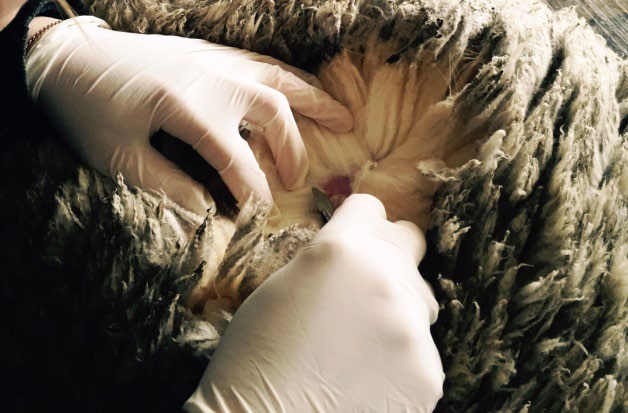
Tattoo Patch method [10, 11] was used to determine wool growth, taking samples (10 x 10 cm) every 60 days in the right rib of the animal. Wool yield was determined and fiber diameter was determined by AIR Flow [12]. Body weight was measured monthly; the weight of live weight without wool is calculated through the calculation of existing wool according to that obtained in the Patch. The fleece weight was determined with a precision balance (+0.100 Kg).
Pasture growth (exclusion cages), protein (Microkjeldhal) and dry matter were determined in the pasture [13, 14].
During the treatment period the wethers had good body condition and received drug treatments to minimize the parasitic burden.
Statistical analyses were computed using the GLM or FREQ procedures of the SAS (2008) System for Linear Models. The significance level was considered for values of P < 0.05 (Figure 1).
Results and Discussion
The results show differences between shearing dates increasing the weight of fleece when the shearing is already made in the spring (Table 1). The maximum wool growth that occurs three weeks post shearing was enhanced by the quantity and quality of pastures existing in November, as well as by a favorable photoperiod (long days) [15, 16]. Similar data have been reported by Fernandez Abella, et al. [9] in Polwarth breed on Basalt nature pasture, who obtained higher wool production in October-November versus August (3.86 vs 4.29 Kg, fleece weight), being a value for intermediate September (4.01 Kg).
In this work, results indicate an interaction between shearing date and nutrition, found by the correlation obtained between the weight of clean wool of the patch square (WCWPS) and the growth of the pasture (r=0.45; p<0.05). Significant differences were observed between shearing dates and wool growth (11.8g day-1 for September and 13.1g day-1 for October-November (p<0.05), explained by increased growth in spring-summer, which determined greater animal weight, as well as fleece weight. However, there were no different in fiber diameter (p >0.05) (Table 1).
There were different in body weight and fleece weight (p< 0.05; Table 1). Body weight follows the pasture production curve, with highs in summer-early autumn and lows in winter-early spring. These results are consistent with those obtained by Williams, et al. [16]; Hawker, et al. [17] who confirm that body weights accompany the growth curve of pastures. However, wool growth is delayed by 3-4 weeks in response to nutrition changes [19].
There were annual differences in wool growth rate, being in the second year largest due to higher growth during autumn, compared to the first year (Table 2). The average daily growth rate for the two years was 1.38; 1.70 and 1.73 mg/cm2 for each group (September, October and November, respectively). The maximum potential rate was not reached (2.0 mg/cm2) [19]. Similar resultants were observed on basaltic pasture [9].
The wool yield evaluated in the Patches shows a decrease in the winter, due to lower precipitation, lower diameter and increase in greasy content according to results observed by Hemsley, et al. [20]. Fiber diameter increases in all groups from the shearing to the maximum at the end of summer, then decreases to become minimal in the winter. There were differences in the diameter of the fibers, September shearing determined lower values (p<0.05). The length of wool fibers has seasonal variations, but not as marked as the diameter (multiple correlation WCWPS, diameter and length of the fibers 0.94). The correlation obtained between fleece weight and annual WCWPS was 0.49 and 0.60, for each year. The low correlation is based on the surface of the Patch performed is the same in all animals, however the body surface is different between individuals.
| September | October | November | |
|---|---|---|---|
| Fleece weight (Kg) | |||
| Average | 4.65 + 0.22 | 5.17 + 0.30 | 5.26 + 0.24 |
| Average | 5.25 + 0.34 | 5.83 + 0.17 | 5.93 + 0.38 |
| Average | 4.95 + 0.41 a | 5.50 + 0.41 b | 5.60 + 0.46 b |
| Fiber diameter (μ) | |||
| Average | 19.60 + 0.63 | 19.55 + 0.35 | 19.65 + 0.32 |
| Average | 20,76 + 0.62 | 21.29 + 0.82 | 21.50 + 0.83 |
| Average | 20.18 + 0.85 a | 20.42 + 1.08 a | 20.57 + 1.13 a |
| Body weight (Kg) (at shearing) | |||
| Average | 62.12 + 1.60 | 65.90 + 3.54 | 66.75 + 2.51 |
| Average | 64.18 + 1.57 | 67.05 + 3.39 | 67.90 + 2.50 |
| Average | 63.15 + 1.87 a | 66.48 + 3.42 b | 67.33 + 2.51 b |
| a vs b : p<0.05 | |||
Table 1: Effect of shearing date on fleece weight, fiber diameter and body weight (mean + standard error) during two years.
| Shearing Date | Sept. | Oct. | Nov. | Dec. | Jan. | Feb. | Mar. | April | May | Jun | July | Aug | Annual Average | |
|---|---|---|---|---|---|---|---|---|---|---|---|---|---|---|
| September | First Year | 1.12 | 2.12 | 1.43 | 1.2 | 1 | 1.15 | |||||||
| Second Year | 1.08 | 1.78 | 1.81 | 1.36 | 1.3 | 1.25 | ||||||||
| 1.1 | 1.95 | 1.62 | 1.28 | 1.15 | 1.2 | 1.38 + 0.33 a | ||||||||
| October | First Year | 1.95 | 2 | 2 | 1.14 | 1.3 | 1.81 | |||||||
| Second Year | 1.57 | 2.38 | 1.96 | 1.5 | 1.42 | 1.39 | ||||||||
| 1.76 | 2.19 | 1.98 | 1.32 | 1.36 | 1.6 | 1.70 + 0.38 b | ||||||||
| November | First Year | 1.3 | 1.78 | 2.1 | 1.92 | 1.65 | 1.52 | |||||||
| Second Year | 1.42 | 1.74 | 2.3 | 1.86 | 1.79 | 1.38 | ||||||||
| 1.36 | 1.76 | 2.2 | 1.89 | 1.72 | 1.45 | 1.73 + 0.27 b |
Table 2: Wool growth (mg/cm2 day -1) determined by Tattoo Patch every 60 days according to shearing date.
a versus b : p <0.05 Table 2: Wool growth (mg/cm2 day -1) determined by Tattoo Patch every 60 days according to shearing date.
The decrease in the digestibility and protein percentage of the pasture (Table 3) reduce the wool growth. Formoso, et al. [14] reported in the same native pastures (crystalline basement soil) pasture digestibility of 67.3; 57.7; 60.0 and
57.7% for spring, summer, autumn and winter respectively. Changes in pasture growth determine changes in wool growth; however other environmental factors such as temperature and photoperiod also get involved [21, 22, 23].
| Pasture production | Saison Growth Pasture (%) | ||||
|---|---|---|---|---|---|
| Kg (Dry Matter ha-1) | Spring | Summer | Autumn | Winter | |
| First year | 4110 | 36 | 28 | 20 | 16 |
| Second year | 4520 | 31 | 29 | 25 | 15 |
| Protein (%) | |||||
| First year | 10.2 + 1.5a | 9.1 + 0.5a | 8.9 + 0.5a | 7.7 + 0.8b | |
| Second year | 9.7 + 2.0a | 8.2 +0.4ab | 10.0 + 0.6a | 6.8 + 0.9b |
Conclusion
In conclusion, in our conditions (breed and native pasture) spring shearing date affect wool growth. There are no reports in the literature on the effect of shearing date on wool growth; except for an experiment conducted on another type of native pasture (Basalt) in our country [9]. Both confirm that in sheep feed pastures, shearing date change the quantity of wool produced.
References
-
Torell DT, Weir WC, Bradford GE, Spurlock GM (1969) Effects of time of shearing on wool and lamb production. California Agriculture pp: 16-19.
-
Salehi M (2009) The Season Effects and Shearing Time on Wool Production, Breaking Resistance, Fiber Diameter and Fiber Length of Baluchi Sheep Breed.
-
Campbell A (2006) The effect of time of shearing on wool production and management of a spring-lambing merino flock, PhD thesis, Veterinary Science, University of Melbourne pp: 188.
-
Story LF, Ross DA (1960) Effect of shearing time on wool. NZ J Agric Res 3(1): 113-124.
-
Fernandez Abella D, Rodriguez Palma R, Saldanha S (1996) Effects of season of shearing on the fertility of ewes mated early and on wool growth on natural basalt soil pasture. Produccion Ovina 9: 63-74.
-
Black JL, Bottomley GA (1980) Effects of shearing and lambing dates on the predicted pasture requirements of sheep in two Tasmanian locations. Austr J Exp Agric Anim Husb 20(107): 654-661.
-
Lightfoot RJ (1967) The effects of shearing time and stocking rate on wool production. J Dep Agric Western Australia 8(3): 90-98.
-
Lamb PR (2004) Staple strength and its relevance to worsted processing. Wool Technology and Sheep Breeding 52: 171-192.
-
Fernandez Abella D, Surraco L, Borsani L, Capurro A (1991) Effect of the shearing season on basalt natural pastures in Polwarth sheep. Boletin de Ciencias Biológicas 1: 31-48.
-
Turner HN (1956) Measurements as an aid to selection in breeding sheep for wool production. Animal Breeding 24(2): 87-118.
-
Langlands JP, Wheeler JL (1968) The dyebanding and tattooed patch procedures for estimating wool production and obtaining samples for the measurement of fiber diameter. Austr J Exp Agric Anim Husb 8: 265- 269.
-
Swan A **(**1997) Objective measurements of style in the CSIRO fine wool flock. AASMB yearbook pp: 46-47.
-
AOAC (2000) Association of Official Analytical Chemist. EUA.
-
Formoso D, Colucci PE (2012) Productivity of natural field improvements in Cristalino Central, Uruguay.
-
Allden WG (1979) Feed intake, diet composition and wool growth. In: Physiological and environmental limitations to wool growth. JL Black, PJ Reis, et al. (Eds.), pp: 61-78.
-
Williams AJ, Winston RJ (1965) Relative efficiencies of wool feed conversion at three levels of nutrition in genetically different batches in wool production. Austr J Exp Anim Husb 5: 390-395.
-
Hawker H, Crosbie SF, Thompson KF, McEwan JC (1984) Effects of season on the wool growth response of Romney ewes to pasture allowance. Proc Austr Soc Anim Prod 15: 380-383.
-
Black JL, Bottomley GA (1980) Effects of shearing and lambing dates on the predicted pasture requirements of sheep in two Tasmanian locations. Austr J Exp Agric Anim Husb 20: 654-661.
-
Reis PJ (1967) The growth and composition of wool. IV The differential response of growth and of sulphur content of wool to the level of sulphur-containing animo acids given per abomasum. Austr J Biol Sci 20(4): 809- 825.
-
Hemsley JA, Marshall JTA (1984) A column extraction method for the estimation of wax and suint in raw wool. Wool Technol. Sheep Breed 31: 158-163.
-
Nagorcka BN (1977) The description and analysis of wool growth. Austr J Agric Res 28(4): 737-746.
-
Pannaretto BA (1979) Effects of light on cyclic activity of wool follicles and possible relationships to changes in the pelage of other mammals. In Physiological and Environmental Limitations to Wool Growth, Black JL, Reis PJ, et al. (Eds.), Sidney, Australia, pp: 327-336.
-
Greenty KG, Orwin DFG, Woods JL, Young SR, Smith MC (1984) Seasonal wool production and staple strength of Romney ewes. NZ Soc Anim Prod 44: 57-59.
- California Red-Legged Frog and Non-Listed Amphibians Response to Non-Native Fish Removal
- Industrial Standardization of the Bio-OS: Algorithmic Codification of Resilience Engineering Guidelines and Version V8 Architecture
- Climate Variability and the Sustainability of Snail Farming in Nigeria: Past Trends, Present Challenges and Potential Outlook
- The Evaluation of the Surveillance System of Anthrax in Gilgit-Baltistan, Pakistan, 2018
- Natural Decline to Extinction of A New Zealand Rabbit Population
- Mitochondrial Bio-Logistics: Steering Co-Enzyme Q10 and Lycopene Synergies within the Science 4.0 Bio-OS Framework