
Expansion of the Distribution of Touit Stictopterus (Psitacidae) for the Central Cordillera, Colombia
We present a new record of T. stictopterus for Colombia, in the Tolima department, expanding the distribution of the species 423.9 km to the north, over the central mountain range.
Introduction
Touit stictopterus is a species little known and considered rare of which the urgency of having basic information on its natural history [1, 2, 3], distribution and population density has been pointed out, which will allow to have a Clearer idea of your current state. It has been pointed out that all records are valuable and should be reported to have a closer look at their status [1, 4]. At the global and national level the species has been classified as vulnerable (VU) [5, 6]. Mainly due to the fact that this parrot has lost about 42.5% of its habitat, rapidly and continuously [7].
Its distribution includes the north of South America in what corresponds to Colombia, E of Ecuador and North of Peru [8, 9, 10], inhabits humid cloudy and semi-humid forests and seasonally cultivated areas; occupying the natural regions of the Amazonian Tropical Humid Forest, Eastern Montane Forest and Eastern Piemontano Forest in temperate and cold thermal floors [10] from 600 m to 2,400 m, although it is more common between 1,050 and 1,700 m [10, 11].
In Ecuador it is distributed to the east, in the Provinces of Morona- Santiago, Napo, Pastaza, Sucumbíos and Zamora Chinchipe; as well as Miazi and other areas of the Cordillera del Cóndor [10, 12, 13]. Towards the north of Peru, it has been recorded on the north side of the Maranon River at 1,500- 1,600 m (Pomara, Amazonas Department) [3], in the Cajamarca Department (above San José de Lourdes), San Martín and the extreme southwest of Loreto [1, 13].
In Colombia eleven localities are currently known where it has been sighted, which mainly comprise jungle regions between 600 and 1,800 m [8, 14]. The first historical records of the species in the country were made; on the western slope of the Eastern Cordillera, in Cundinamarca, near Fusagasugá at 1,750 m and occasionally between 2,200 and 2,300 m [8, 15], at the entrance to the Serranía de la Macarena, Meta at 1,070 m and on the western slope of the central mountain range in the department of Cauca, San Andrés de Pisimbala at 1,600 m [14]; of historical locations of the species only in the latter, the species has been observed in recent years, after almost 50 years, thus it was considered extinct in Colombia or in some parts of the country [1, 16, 17, 18].
However, recently the species has been reported on the eastern slope of the Eastern Cordillera in Cerro La Mica, Los Picachos NPN, Caquetá at 1,600 m (Bohórquez & Repizo in Salaman et al. 2002), Boyacá in Santa María and Cundinamarca in Mámbita [19, 20] on the western slope of the same mountain range in Pandi, Cundinamarca [11, 20] and south of Huila where there have been several recent records uploaded to the eBird platform; in the municipality of Argentina on May 9, 2020, by Roderik Daza near the village of Rosario (2 ° 09’50.4 “N 76 ° 04’19.4” W); Palestine in the Eduardo Reserve on May 9, 2020 (1 ° 44’55.9 “N 76 ° 05’51.6” W) and the El Encanto Ecotourism Reserve (1 ° 43’12.5 “N 76 ° 07’09.6” W) where they were ten individuals observed on May 13, 2020 and in Garzón, Finca de Nidia Calderón vereda las Mercedes (2 ° 09’06.1 “N 75 ° 32’13.6” W) (Figure 1). Likewise, some authors have pointed out that the species is also possibly distributed by Nariño [8, 17].
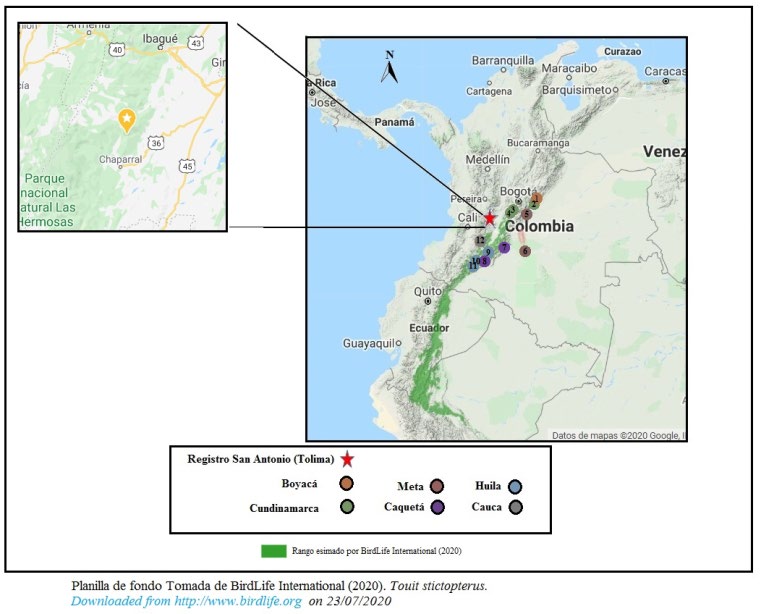
Figure 1: Geographical distribution of Touit stictopterus in Colombia. Registration in San Antonio, Tolima (Red star, see magnification for more detail in upper left box). Boyacá (coffee):
- Santa María; Cundinamarca (green):
- Mámbita,
- Fusagasugá,
- Pandi; Meta (purple):
- Serranía Macarena; Caquetá (purple):
- Cerro La Mica PNN Los Picachos; Huila (blue):
- Argentina,
- Garzón and
- Palestina; Cauca records (gray):
- San Andrés de Pisimbala.
Cubarral Meta The Vereda power plant The Finca Rosania power plant between 712 and 817 m and in the San Miguel farm La Pradera and Belén de los Andaquies, Caquetá mine is 548 m.
As observed by Dugand, et al. [21], the species seems to have altitudinal migrations conditioned by the fruiting of some wild species or the cultivation of corn [8, 21]. Its diet is based on fruits of “rubber” (Ficus spp.), “Capes” (Clusia spp.) And matapalos (Loranthaceae); in addition, it tends to feed on and invade cornfields when the grain is maturing [21].
Its reproductive biology is unknown in Colombia, however Del Hoyo, et al. [22] mention that there is some evidence of reproductive activity in Ecuador for March, and indicate that in that country large flocks are documented between the months of June and November, which are supposedly the non-reproductive months [17].
It is known to be local and to have low population densities. In Peru, the species is considered to have declined in its populations, as well as it has been pointed out that the distribution is fragmented throughout the Andes and that it is usually located in some isolated hills [9, 16], According to Renjifo, et al. [18], Colombian populations are unfortunately found in areas subject to high deforestation and consequently to severe habitat fragmentation.
It is suspected that there is a slow and constant decline in the population of the species due to the destruction and fragmentation of the hábitat [1]. The population is estimated to be 1,000-2,499 individuals based on an evaluation of known records, abundance descriptions, and range size. This estimate is equivalent to 667-1,666 mature individuals, rounded here to 600-1,700 mature individuals [13, 23].
In this article we report the first record of Touit stictopterus, for Tolima (Figure 1). Municipality where the presence of more than 800 species of birds is recognized, of which 22 are parrots. The record was made on Jul 20, 2020, corresponding to a group of four individuals observed between 09:30 and 10:30 in the forest of the Finca El Manantial Nature Reserve, San Antonio (Figure 2) (3 ° 55’37.8 “N; 75 ° 26’39.9” W) over 2,700 m where the species had previously been observed by J Vargas, et al. in Feb 2019. T. stictopterus, is known in the area as black parakeets, these were observed flying over the canopy of the trees, Dugand, et al. [21] pointed out that the species is also known as Lora Boba while Borrero, et al. [14] report that in Cauca they are called parrots.
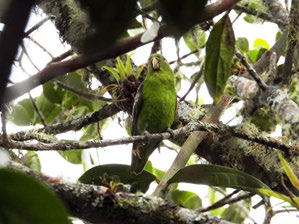
The records of the species were made in a low-growth forest where a good state of conservation is evidenced, where various palms abound, including the Cera palm (Ceroxylon wettinia) and Chontas of the genus Aiphanes sp (Figure 3) [24, 25]. Similarly, other species of parrots have been identified in the area, such as the yellow-eared (Ognorhynchus icterotis) and the chocolera parrots (Psittacara wagleri). This forest is located on the so-called Cordillera de Calarma, an isolated projection of the central mountain range from which different tributaries of the Tetuán River emerge. So this observation corresponds to an isolated forest, which agrees with what is referenced by some authors in Peru [9, 16].

Conclusion
The record of T. stictopterus complements the distribution of the species, which extends from the south of Huila and the western flank of the eastern mountain range, in such a way that the hypothesis of the presence of this species in Tolima is validated, since some authors such as Rodríguez- Mahecha and Hernández, et al. [14] already pointed out the possible presence of the species in the department, due to the analysis of the records of the species known until then in Colombia. However, this record covers an area not considered or indicated by various researchers as potential, because they only considered the distribution of the species in the border areas of the department of Tolima with Huila, Cauca and Cundinamarca. We conclude that this new record of T. stictopterus allows us to learn more about the population status of the species, where the distribution is extended by 423.9 km, in a straight line over the central mountain range, starting from the northernmost record known to date in the municipality of Argentina (Huila).
References
-
Brightsmith DJ (2018) Touit stictopterus. pp: 293 In: SERFOR. Red Book of the Threatened Wildlife of Peru. First edition. Lime, pp: 548.
-
Botero Delgadillo E, Páez CA (2011) Estado actual del conocimiento y conservación de los loros amenazados de Colombia. Conservación Colombiana 14: 86-151.
-
Ridgely RS (1980) Notes on some rare or previously unrecorded birds in Ecuador. Am Birds 34: 242-248.
-
Snyder N, Mcgowan P, Gilardi J, Grajal A (2000) Parrots: status survey and conservation action plan 2000-2004. International Union for Conservation of Nature and Natural Resources, Gland, Switzerland and Cambridge, UK.
-
Renjifo LM, Gomez MF, Velasquez Tibata J, Amaya Villarreal AM, Kattan GH, et al. (2014) Red Book of Birds of Colombia. VOL. I. Humid Forests of the Andes and the Pacific Coast.
-
Bird life International (2020) Species factsheet: Touit stictopterus.
-
Lineros JC (2014) Touit stictopterus. In: Renjifo lM, Gómez MF, Velásquez tibatá J, Amaya-Villarreal AM, Kattan GH, et al. (Eds.), Libro rojo de aves de Colombia, Volumen I: bosques húmedos de los Andes y la costa Pacífica. Editorial Pontificia Universidad Javeriana e Instituto Alexander von Humboldt. Bogotá DC, Colombia.
-
Hilty SL, Brown WL (1986) A guide to the birds of Colombia. Princeton University Press.
-
Schulenberg TS, Stotz DF, Lane DF, O’neill JP, Parker Ta III (2010) Birds of Peru (Revised and Update Edition). Princeton University Press. New Jersey, USA.
-
Freile JF, Poveda C (2019) Touit stictopterus In: Freile JF, Poveda C, et al. (Eds), Aves del Ecuador. Version 0. Museo de Zoología, Pontificia Universidad Católica del Ecuador.
-
Lineros JC (2012) Touit stictopterus pp: 317-318 In: Naranjo LG, Amaya JD, et al. (Eds.), Guía de las Especies Migratorias de la Biodiversidad en Colombia. Aves. Vol. 1. Ministerio de Ambiente y Desarrollo Sostenible / WWF Colombia. Bogotá, D.C. Colombia pp: 708.
-
Clements JF, Shany N (2001) A field guide to the birds of Peru. Ibis Publishing Company.
-
Brooks DM, O neill JP, Foster MS, Mark T, Dauphiné N, et al. (2009) Avifauna of the Pongos Basin, Amazonas Department, Peru. The Wilson Journal of Ornithology 121(1): 54-74.
-
Borrero HJI, Hernández Camacho J (1958) Apuntes sobre aves colombianas. Caldasia 8(37): 253-294.
-
Dugand A (1945) Notas ornitológicas colombianas II. Caldasia 3(14): 397-405.
-
Juniper T, Parr M (1998) Parrots: a guide to the parrots of the world. Pica Press, Robertsbridge, UK, pp: 138.
-
Rodríguez Mahecha JV, Hernandez Camacho JH (2002) Loros de Colombia. Tropical Field Guide Series 3. International Conservation, Bogotá, Colombia.
-
Renjifo LM, Franco Maya AM, Amaya Espinel JD, Kattan GH, López Lanús B (2002) Libro rojo de aves de Colombia. Instituto Alexander von Humboldt y Ministerio del Medio Ambiente, Bogotá, Colombia.
-
Laverde RO, Gomez F (2016) Las aves de Santa María. Serie Guías de Campo del Instituto de Ciencias Naturales N. ° 16. Bogotá, DC: Instituto de Ciencias Naturales, Universidad Nacional de Colombia pp: 1-186.
-
Chaparro Herrera S, Espejo N, Lopera Salazar A, León JFL, Danilo S, et al. (2020) Aves de Mámbita: lista de especies y nuevos registros en la vertiente oriental de la Cordillera Oriental, Cundinamarca, Colombia. Cotinga 42: 82-100.
-
Dugand A (1945a) Notas ornitológicas colombianas I. Caldasia 3(13): 337-401.
-
Hoyo D, Elliott J, Jordi S (1997) Handbook of the Birds of the World. Volume 4. Sandgrouse to Cuckoos. Lynx Editions. Barcelona, pp: 679.
-
Balchin CS, Krabbe N, Renjifo LM, Salaman P, Toyne P (2000) Touit stictoptera. In: Snyder N, McGowan P, Gilardi J, Grajal A, et al. (Eds.), Parrots: status survey and conservation action plan 2000-2004. International Union for Conservation of Nature and Natural Resources, Gland, Switzerland and Cambridge, UK.
-
Freile JF, Poveda C (2019) Touit stictopterus. In: Freile JF, Poveda C, et al. (Eds.), Aves del Ecuador. Version 2019.0. Museo de Zoología, Pontificia Universidad Católica del Ecuador.
-
Salaman P, Stiles F, Bohórquez CI, Álvarez M, Umaña AM, et al. (2002) New and Noteworthy Bird Records from the East Slope of the Andes of Colombia. Caldasia 24(1): 157-189.
- California Red-Legged Frog and Non-Listed Amphibians Response to Non-Native Fish Removal
- Industrial Standardization of the Bio-OS: Algorithmic Codification of Resilience Engineering Guidelines and Version V8 Architecture
- Climate Variability and the Sustainability of Snail Farming in Nigeria: Past Trends, Present Challenges and Potential Outlook
- The Evaluation of the Surveillance System of Anthrax in Gilgit-Baltistan, Pakistan, 2018
- Natural Decline to Extinction of A New Zealand Rabbit Population
- Mitochondrial Bio-Logistics: Steering Co-Enzyme Q10 and Lycopene Synergies within the Science 4.0 Bio-OS Framework