
New Apameini Species from Asia (Lepidoptera, Noctuidae)
The diagnosis and description of a new genus (Burmahabitans gen. n.) and three new species (Photedes macroductus sp. n., Sesamia waziristana sp. n. and Burmahabitans chinsilvicola sp. n.) of Apameini are presented and illustrated with 10 color imagines and 10 genitalia figures.
Introduction
The most recent comprehensive studies and revisions of the tribe Apameini were provided by Zilli, et al. [1, 2] giving a detailed characterization of the species and their genitalia, with colour imagines and genitalia figures. As a result of researches in Asia during the last twenty years, the occurrence of further new species was suspected, which was confirmed by genitalia studies.
Arenostola Hampson, et al. [3], Longalatedes Beck, et al. [13], and Photedes Lederer, et al. [4] (which form very likely a genus-group, see the idea of Zilli, et al. [1] are close relative genera of the Apameini. The species (some of them with a lot of synonyms) being associated to these genera, have rather small size, similar external features and some shared features both in the male and female genitalia. Thus, the exact taxonomic position of some of the species are uncertain and authors associate them to different genera. The male of the newly described species here below is not known yet, author interpretated it into the genus Photedes, by some of the features of the female genitalia.
Sesamia Guenée, et al. [5] is a worldwide distributed (except the arctic and cool areas) thermophilic and diversified genus; most of the species are inhabitants in the tropical and subtropical regions, some of them well-known agricultural pest (stem borer). The taxonomic position of the genus is a subject of discussion and it associated to different tribes of Noctuidae by authors and internet. Author accepts here the idea of Fibiger, et al. [6] who erected Sesamiina as a new subtribe for Sesamia (and some close relative – mostly African and south-eastern Asiatic - genera) and included it into the tribe of Apameini.
Abbreviations for personal and institutional collections used herein include: HNHM = Hungarian Natural History Museum (Budapest, Hungary); PGM=collection of Péter Gyulai (Miskolc, Hungary); GYP = genitalia slide of P. Gyulai; MF= genitalia slide of Michael Fibiger; VZ = genitalia slide of Zoltán Varga
Description of New Taxa
- Photedes macroductus sp. n.
- Holotype Female (Figures 1-11), Iran, prov. Esfahan, Zagros Mts., Fereidun Shar, 3000 m, 15-17.VI. 2010, leg. B. Benedek & T. Hácz, slide no. GYP 3276 m (coll. PGM, later to be deposited in the HNHM).
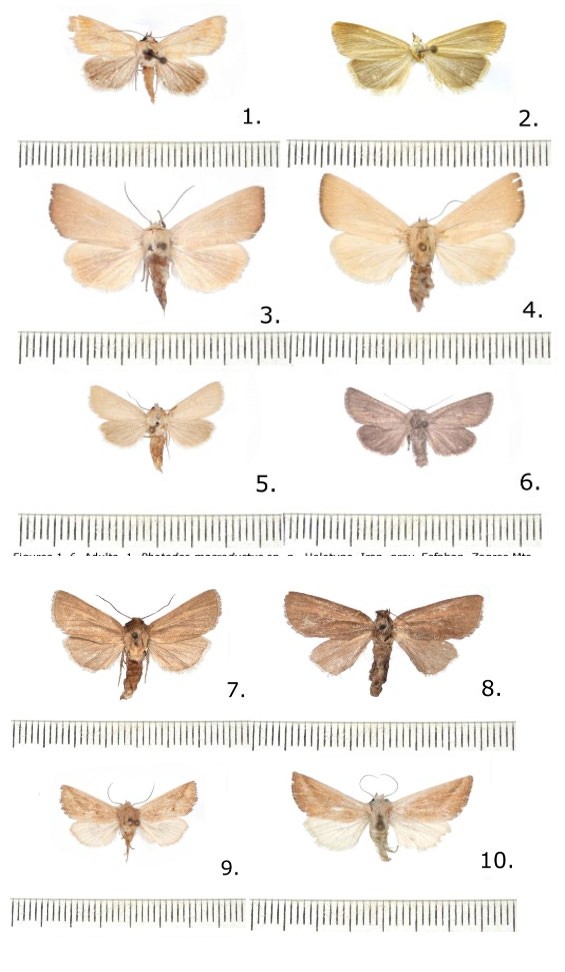
Figures 1-6: Adults 1: Photedes macroductus sp. n., Holotype, Iran, prov. Esfahan, Zagros Mts., leg. B. Benedek & T. Hácz, female, slides no. GYP 3276 (PGM/ HNHM); 2: Photedes improba Staudinger, et al. [7], Mongolia, Suchebaatar aimak, exp. Z. Kaszab, female, slide MF 5649 (HNHM); 3: Arenostola phragmitidis Hübner, et al. [8], Hungary, Fertőboz, female, GYP 5315 (PGM); 4: Arenostola unicolor Warren, et al. [9] Iran, Kordestan, female, GYP 5313 (PGM); 5: Sesamia waziristana sp. n. Holotype, Pakistan, NWFP S. Waziristan, leg. Gurko, male, GYP 5246 (PGM/HNHM); 6: Sesamia rungsi, Afghanistan, Sarobi, leg. Reshöft, male, GYP 5255 (PGM).
• Diagnosis Photedes macroductus sp. n. (Figure 1) is close relative and resembling of Photedes improba [7] (Figure 2). In comparison, the new species has stronger body, less elongate, slightly broader, pale ochre with fine reddish suffused forewings, with slight brown suffusion on the main veins and much darker brown hindwings; whereas the forewings of the Ph. improba are pale yellowish, without brown suffusion on the main veins and much lighter hindwings. In the female genitalia, the most striking difference is in the shape and sclerotization of the ductus bursae; it is asymmetrically enlarged, robust, sinuously ribbed and strongly sclerotized, and only the anterior third section tight, hardly sclerotized and longitudinally ribbed-wrinkled in the new species (Figure 11); controversy, in Ph. improba (Figures 12), the anterior section large, bulbous, distal section tubular, longitudinally slightly ribbed-sclerotized.
Figures 7-10: 7: Sesamia christophi Hacker, et al. [10] Kirgisia, Fergansky basin, leg. Lukhtanov, male, GYP3274 (PGM); 8: Sesamia christophi Hacker, et al. [10], Tajikistan, Parchar, leg. Tshetkin, female, GYP5333 (PGM/); 9: Burmahabitans gen.n. chinsilvicola sp. n., Holotype, Myanmar, Chin forest, leg. Loeffler & Naumann, male, GYP 4584 (PGM/ HNHM); 10: Burmahabitans gen.n. chinsilvicola sp. n., Paratype, Myanmar, Chin forest, leg. Loeffler & Naumann, female, GYP 4720 (PGM).
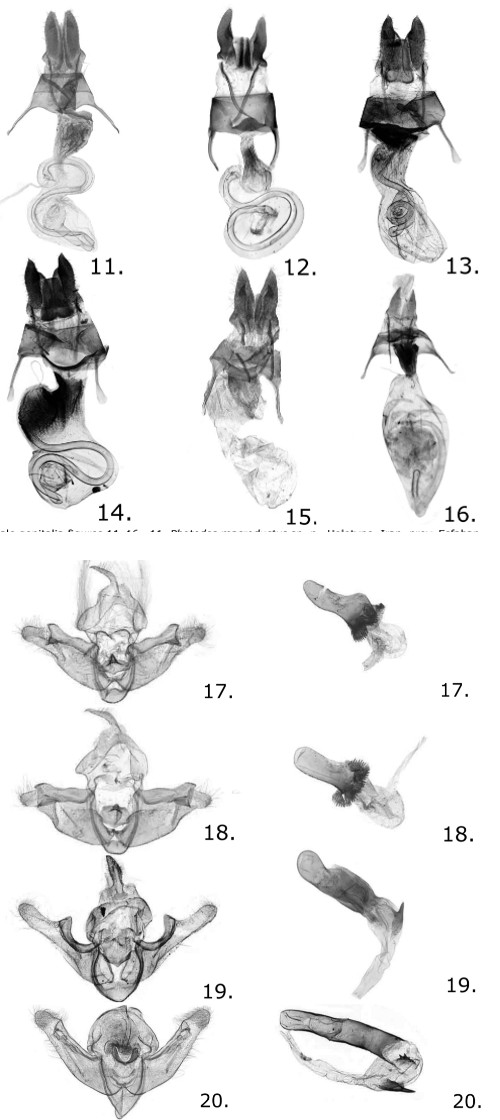
Figures 1-16: 11: Photedes macroductus sp. n., Holotype, Iran, prov. Esfahan, Zagros Mts., leg. B. Benedek & T. Hácz, slide no. GYP 3276 (PGM/HNHM); 12: Photedes improba [7], Mongolia, Suchebaatar aimak, exp. Z. Kaszab, slide MF 5649 (HNHM); 13: Arenostola phragmitidis Hübner, et al. [8], Hungary, Fertőboz, GYP 5315 (PGM); 14: Arenostola unicolor Warren, et al. [9] Iran, Kordestan, GYP 5313 (PGM); 15: Burmahabitans gen.n. chinsilvicola sp. n., Paratype, Myanmar, Chin forest, GYP 4720 (PGM); 16. Sesamia christophi Hacker, et al. [10], Tajikistan, Parchar, GYP5333 (PGM/).
Figures 17-20: 17: Sesamia waziristana sp. n. Holotype, Pakistan, NWFP S. Waziristan GYP 5246 (PGM/ HNHM); 18: Sesamia rungsi Boursin, et al. 1957, Afghanistan, Sarobi, GYP 5255 (PGM); 19: Sesamia christophi Hacker, et al. [10], Kirgisia, Fergansky basin, GYP3274 (PGM); 20: Burmahabitans gen.n. chinsilvicola sp. n., Holotype, Myanmar, Chin forest, GYP 4584 (PGM).
It is significantly smaller than the two, externally also similar Eurasiatic Arenostola taxa of the genus; forewing length 12 mm, wingspan 24 mm, while those are 14-19 mm and 30-35 mm in A. phragmitidis Hübner, et al. [8] (Figure 3) and A. unicolor Warren, et al. [9] (Figure 4), respectively. Another good key for external separation is the colouration of the hindwing; it is much darker in the new species, brown and only the fringes are pale beige, while those are much lighter, pale ochre to pale beige in the two relative species. The under side of the four wings is darker in the new species and the veins are well defined by brown suffusion, while those are the same coloured as on the upper side without or with a very slight pale ochre suffusion on the veins. In the female genitalia, the main differences are in the shape and sclerotization of ductus bursae and appendix bursae; the new species (Figure 11) differs from those of the two similar Arenostola taxa (Figures 13 & 14), in asymmetrically enlarged, sinuously ribbed ductus bursae and membranous appendix bursae; while in the two congeners the ductus bursae is almost evenly broad, longitudinally ribbed sclerotized, the appendix bursae is strongly sclerotized and ribbed and a broad sclerotized rod between the inner side of the papillae anales is present, which is basally the broadest.
• Description Figure 1 Forewing length 12 mm, wingspan 24 mm. Eyes globular, black; antennae light ochre, filiform. Palpi covered with beige scales, third segment only whitish ciliated, apex pointed. Head, thorax, abdomen vesture and legs are beige. Forewings are triangular, apex pointed. Ground colour of the forewings and fringe are pale ochre with fine reddish suffusion. Wing pattern (stigmata and transverse lines) are not present, only the main veins are somewhat defined by fine brown suffusion. Hindwings are brown and only the fringes pale beige. Under side of the four wings is similar to the upper side, but the middle area in the forewings is slightly brown suffused and the veins are well defined by slight brown suffusion.
Female Genitalia
Figure 11 can be characterized by the long, conical ovipositor, the presence of a long, scythe–like sclerotized rod in the inner side of the papillae anales and a small, dark claw–like shape inside them. Apophyses anteriores and posteriores are long, the latter ones longer. Ostium is displaced, antrum shallow. Ductus bursae is asymmetrically enlarged, robust, sinuously ribbed-wrinkled and strongly sclerotized, while the anterior third section tight, hardly sclerotized and longitudinally slightly ribbed-wrinkled; appendix bursae and corpus bursae are membranous. Male is unknown.
- Bionomics and Distribution The new species is known from the type locality only in western Iran, whereas the close relative Ph. improba is a local central Asiatic species. The somewhat similar Anatolian- Central Asiatic A. unicolor occurs in Iran only in the northern part.
- Etymology The new species is named after the robust ductus bursae.
Sesamia waziristana sp. n.
• Holotype Male Figures 5&17, Pakistan, NWFP S. Waziristan agency, near Tanai vill., 28.VII.-12.VIII.2005, 1500-2500 m, leg. V. Gurko, slide no. GYP 5246m (coll. PGM, later to be deposited in the HNHM).
• Diagnosis Sesamia waziristana sp. n. (Figure 5), is one of the smallest species of the genus. The most similar and closest relative of the new species is the Sesamia rungsi Boursin, et al. [11] (Figure 6), in Afghanistan. In comparison, the single one of the new species is practically the same size as the specimens of S. rungsi; forewing length 10 mm and 10-11mm, respectively. The best key for separation is the ground colour of the wings; which are much lighter in the new species, pale beige in the forewings, but slightly darker, light brown in the hindwings, while those are unicolorous brown in the S. rungsi. In the male genitalia, the main differences are in the valva and the cornuti configuration of the aedeagus. The new species (Figure 17) has much more elongate distal section of valvae, slightly longer uncus, much lower juxta with larger dorsal-medial prominence, thinner costal extension of valvae, terminated in a more bifurcate part, than in the S. rungsi (Figure 18). In the new species, the aedeagus bears two large flap-like appendages with numerous small cornuti; while in the S. rungsi two large and two smaller flap-like appendages with numerous small cornuti are visible, like a semi-belt on the aedeagus.
It is worth mentioning, that the also central Asiatic Sesamia christophi Hacker, et al. [10] (Turkmenistan, Kirgisia, Tajikistan) (Figures 7 & 8) resembling somewhat, however confusion is impossible, since this is conspicuously larger (forewing length 13-14 mm) than the new species, wings are brown with slight red-brown suffusion in the forewings. The male genitalia (Figure 19) also strikingly differs from that of the new species (Figure 17), by the much longer distal section and longer, but not bifurcate costal extension of valvae, the lack of the flap-like cornuted appendages of the aedeagus and the presence of a large single cornutus in the basal part of the vesica.
The correct identification is supported by the distribution pattern; the locality of the new species is rather far from those of the two relative taxa, thus sympatric occurrence seems to be impossible.
• Description Figure 5 Forewing length 10 mm, wing span 19 mm. Eyes are globular, black; antennae light brown, with a white longitudinal line, slightly ciliated. Palpi long, covered with pale ochre scales. Frons, collar, thorax vesture, under side of body and legs are also covered with pale ochre or beige scales. Forewing is triangle, apex rounded, ground colour pale beige. Wing pattern is incomplete; orbicular and claviform macula absent, reniform stigma obscure. Transverse lines absent, only the postmedial line is indicated by some fine brown dots; fringe pale ochre. Hindwing is slightly darker, light brown without discal spot and medial line; fringe pale ochre.
Male genitalia Figure 17 is characterized by the hooked uncus, broad tegumen; large, subtriangular juxta with dorsal-medial triangle prominence; u-shaped vinculum; distally tapering, terminally rounded valvae without corona but with a conspicuous, large, strongly sclerotized costal extension, terminated in a bifurcate part. The aedeagus short but strong, dorsally broaden toward the vesica, bearing two large flap-like appendages with numerous small cornuti. Vesica is short, ample; with a broader and a thinner basal- subbasal slightly sclerotized area. Female is unknown.
- Bionomics and Distribution The new species is known from the type locality and occurs only in western Pakistan.
- Etymology The new species is named after the type locality
Burmahabitans gen. n.
- Type Species: Burmahabitans chinsilvicola sp. n., by present designation
- Diagnosis The monotypic new genus (Figures 9 & 10), is a distinct evolutional line of Apameini. The main external diagnostic features in comparison the relative genera Arenostola Hampson, et al. [3], Longalatedes Beck, et al. [13] and Photedes Lederer, et al. [4] and Sesamia Guenée, et al. [5] (Figures 1-8), are as follows: more elongate forewings with acute apex; light rusty ground colour of forewings with a conspicuous, wide, oblique, diffused rufous fascia, running from the subapex toward the inner costa and light rusty body vesture. Externally slightly resembling species (Acrapex roseotincta Hampson, et al. [12], 1910, Figures 7-18 is known from Sri Lanka, however the ground color of forewing, the direction of the oblique fascia and the presence of some further elements of wing pattern do not correspond; furthermore the construction of both the male and female genitalia conspicuously differ. The male genitalia (Figure 20), shows more affinities to the Arenostola, Longalatedes and Photedes (the genitalia of almost all of the taxa were figured by Zilli, et al. [1]; however the cucullus section is not separated in the new genus, as it is in the first two genera, or separated by a narrow neck of the distal section of valvae as in the Photedes. The penicular lobes are less extended, and the presence of the elongate sclerotized costal streak of valvae is a good key for separation from the former ones. The sclerotized costa (and its extension) of valvae is characteristic to Sesamia Guenée, et al. [5] (Figures 17-19), however it is slight in the new genus and not extended and terminated in a bifurcate part or prominent, long, sometimes large head- like extension as it is in the Sesamia. The juxta is an uniquely built structure in Burmahabitans gen. n.; large, broadly cup- like, ventrally with two small, triangular, sclerotized marks; dorsally with two symmetrical, heavily sclerotized, wing-like appendages. The aedeagus is straight, longer than those of Sesamia, however caecum not so long, carina lacks spines, or the cornuted or/and strongly sclerotized belt. The gear-like, strongly sclerotized appendage in the middle of the vesica is also unique; additionally, the vesica is missing diverticulum, while it is present in Arenostola, Longalatedes and Photedes and in some species of Sesamia. In the female genitalia (Figure 15), the rod-like bars between the ovipositor lobes are broad, while these are very narrow or absent in Sesamiina (Figure 16); but fused with sclerotized trapezoidal plates in Arenostola. The antrum is higher than in all the Longalatedes and Photedes, medially slightly depressed, on the contrary as in Sesamiina, but the ostium is not displaced to the right side as in Arenostola Hampson, et al. [3]. The antrum plate is conjoined with the strongly sclerotized, triangular distal section of ductus bursae, which is similar to those of some of the African Sesamiina, but very different from those of the other relatives; while the ample, globular appendix bursae is not characteristic to Sesamiina, only to the three other relative genera.
• Description: The new genus is monotypic, therefore description see below under the Burmahabitans chinsilvicola sp. n. (Figures 9,10,15,20).
Burmahabitans chinsilvicola sp. n.
• Holotype: Male Figure 9, Myanmar West, Chin state, ca. 4,5 km W Thaing Gnin village, N 23°11.877’, E 93°47.964’, 2090 m, 6.XI.2015, leg. Loeffler & Naumann, slide no. GYP 4584 (coll. PGM, later to be deposited in the HNHM). Paratype Female, same data as holotype, slide no. GYP 4720 (coll. PGM).
• Diagnosis: The diagnostic features are given under the genus diagnosis, since only Burmahabitans chinsilvicola sp. n. is associated to the new genus.
• Description: (Figures 9 & 10) Moths are rather small sized (forewing length 11-14 mm, wingspan 22-27 mm, the female is slightly larger) with thin body, elongate forewings and acute apex. Eyes are globular, black; antennae light ochre with white line in the upper side, finely setose-ciliate of male, filiform that of female. Palpi are covered with pale ochre scales, third segment very tiny, brownish, pointed. Frons, collar, thorax and abdomen vesture and legs are pale ochre. Ground colour of the forewings and cilia is light rusty-pale ochre, with an oblique, slightly blurred rufous fascia, running from the subapex toward the inner costa, faintly tinged with ochreous in the outer side. The other elements of wing pattern are not present; only a few brown dots visible in the male. Hindwings and cilia are whitish. Underside of wings is whitish, slightly tinged with pale ochreous, with slight brown suffusion in the middle area of forewings.
Male genitalia (Figure 20) is characterized by the long, thin, terminally evenly tapering uncus; broad tegumen; large, broadly cup-like juxta, ventrally with two small, triangular, sclerotized marks, dorsally with two symmetrical, heavily sclerotized, wing - like appendages with a deep, broad depression between them; V-shaped vinculum; almost evenly broad valvae with sclerotized, terminally subtriangular costa, elongate sacculus, small, globular harpe and terminally slightly bifurcate digitus; cucullus section densely covered with fine hairs but without corona; rather long, almost straight, tube-like aedeagus; ample, distally long, tube-like vesica, with gear-like, strongly sclerotized appendage in the middle and a strongly sclerotized strong cornutus sitting on a long base subterminally.
Female genitalia (Figure 15) ovipositor lobes are strongly sclerotized, conical, long, with a darker claw – like construction inside and two rod-like parallel bars between them. Apophyses anteriors and posteriors are long, the last ones are longer. Antrum is broad, sclerotized, ostium medially slightly depressed, antrum plate is conjoined with the unevenly sclerotized, triangular distal section of ductus bursae; appendix bursae ample, globular, grainy; corpus bursae sack-like, membranous.
- Bionomics and Distribution: The new species is known from the type locality in Chin state, Myanmar (Burma).
- Etymology: The new species is named after the locality, living in Burma, in Chin state forest.
Acknowledgements
The author is grateful to prof. Zoltán Varga (Zoological Institute of Debrecen University, Hungary) and László Ronkay (HNHM, Hungary) for consultation and scanning for some of the genitalia slides; to V. S. Kononenko (Laboratory of Entomology, Vladivostok, Russia) and Anton Volynkin (Altai State University, Barnaul and Tomsk State University, Institute of Biology, Tomsk, Russia) for Photedes improba genitalia slide photo; to Zsolt Bálint and Balázs Tóth (HNHM, Hungary) for the colour imagine of Photedes improba; to Balázs Benedek (Törökbálint, Hungary) for help getting type material; to Adrienne Gyulai–Garai (Miskolc, Hungary) for much help in the computer works; to Péter Kozma (Debrecen, Hungary) for scanning some of the genitalia slides.
References
-
Zilli A, Fibiger M, Ronkay L (2005) Apameini. _Noctuidae_ _Europaeae_ 8. Entomological Press, Soro pp: 323.
-
Zilli A, Varga Z, Ronkay G, Ronkay L (2009) Apameini I-_The Witt Ctalogue,_ Volume 3_. A Taxonomic Atlas of_ _the Eurasian and North African Noctuoidea_. Heterocera Press pp: 393.
-
Hampson GF (1908) Catalogue of the Lepidoptera Phalaenae in the British Museum 7: 18.
-
Lederer J (1857) Die Noctuinen Europa’s mit Zuziehung einiger bisher meist dazu gezählter Arten _Noctuinen_ _Europa’s_ pp: 1-251.
-
Guenée A (1852) Histoire naturelle des insectes; spécies général des lépidoptères. Roret, Paris 5: 1-407.
-
Goldstein PZ, Fibiger MF (2005) Biosystematics and evolution of the Apameini: A global synopsis. In: Zilli A, Ronkay L, Fibiger M, et al. (Eds.), Noctuidae Europeae, Apameini. Soro, Denmark. Entomological Press 8: 15-23.
-
Staudinger O (1900) Neue Lepidopteren des palaearktischen Faunengebiets. Dt Ent Z Iris 12(2): 352- 403.
-
Hübner J (1803) Sammlung europäischer Schmetterlinge. IV. Augsburg (4): 155-194.
-
Warren W (1914) New species of _Drepanulidae_, Noctuidae, and Geometridae in the Tring Museum. Novit zool 21: 401-425.
-
Hacker H (1998) Noctuoidea (Lepidoptera) aus Zentralasien-Esperiana 6: 472-532.
-
Boursin CH (1957) Nouvelleas “Trifnae” d’Afghanistan de l’Expedition Klapperich-Bull. Mens. de la Soc. Linn. Lyon 26(9): 242-250.
-
Hampson GF (1910) Catalogue of the Lepidoptera Phalaenae in the British Museum pp: 1-552.
-
Beck H (1991) Taxonomische Änderungen bei den Noctuinae, Cuculliinae und Plusiinae (Noctuidae, Lepidoptera) - Atalanta (Dezember 1991) 22(2/4): 175- 232.
- California Red-Legged Frog and Non-Listed Amphibians Response to Non-Native Fish Removal
- Industrial Standardization of the Bio-OS: Algorithmic Codification of Resilience Engineering Guidelines and Version V8 Architecture
- Climate Variability and the Sustainability of Snail Farming in Nigeria: Past Trends, Present Challenges and Potential Outlook
- The Evaluation of the Surveillance System of Anthrax in Gilgit-Baltistan, Pakistan, 2018
- Natural Decline to Extinction of A New Zealand Rabbit Population
- Mitochondrial Bio-Logistics: Steering Co-Enzyme Q10 and Lycopene Synergies within the Science 4.0 Bio-OS Framework