
Diversity and Distribution of Butterflies and their Conservation in Cauvery Delta Region, Tamil Nadu, India
Butterflies are one of the beneficial insects as they serve as pollinators and indicators of environmental quality and are also appreciated for their aesthetic value. They play a pivotal role in determining the stability of an ecosystem since their numbers can fluctuate drastically with even slight changes in temperature, weather conditions, degradation or pollution. This study is one of the first attempts to conduct and fulfill the lacuna through the investigations on the diversity of butterflies at the basin of Cauvery in Kumbakonam region using transect counting method. Collection of specimen was made for taking photographic documentation. A total of 24 species of butterflies were collected from members of the family Nymphalidae, Papilionidae, Pieridae, Lycaenidae and Hesperiidae respectively. The study provides useful information about their diversity as well as baseline data for upcoming researchers. Global warming is one of the serious threats to the butterflies and conservation of this lepidopteron fauna is unavoidable.
Introduction
Butterflies (Lepidoptera: Rhopalocera) are one of the most plant dependent group of insects when compared to the other mega diverse insect groups [1]. Butterflies are beneficial as they serve as pollinators and indicators of environmental quality and are appreciated for their aesthetic value [2]. The holo metabolous life history of butterflies reveals that Lepidoptera are exposed to a wide range of environmental influences and are highly sensitive to the climatic changes in temperature, humidity and light levels [3, 4].
Many advanced faunal communities are dependent on insects for their services with respect to nutrient recycling, pollination, seed dispersal, predation, parasitism, etc and they are also found to comprise of a considerable portion of the biomass and energy of the system [5]. Butterflies are being one of the most studied groups of insects have been systematically documented since the 18th century [6]. Butterflies are diurnal insects which typically have a slender body with knobbed antennae and broad colorful wings. They differ from moths which are crepuscular or nocturnal insects having a stout body and feathery or hair like antennae. They play a pivotal role in determining the stability of an ecosystem since their numbers can fluctuate drastically with even slight changes in temperature, weather conditions, degradation or pollution. They also serve as indispensable links in the food web in many ecosystems and niches they inhabit. In addition, butterflies have been identified as bio indicators, capable of representing the overall health of the environment [7]. Before the adult stage, the larvae of the butterflies cause severe damage in the agriculture field and plantation areas. Some species that cause such losses are Euchrysops cnejus (Pod borer), Catochrysops strabo (Pod borer), Pieris canidia (Defoliator), Junonia orithya (Leaf feeder) [8]. Some species of Butterflies play a vital role in food chain as predators of the harmful, Pita clientella (Zeller) which feeds upon pupae of the castor slug, Parasa lepida (Cramer) [7].
Butterflies receive reasonable amount of attention throughout the world, not only by the entomologists but also by laymen. In India, pioneering work in butterfly studies were conducted dates back to the 19th century [9]. The number of Indian butterflies amount to one-fifth of the world species [10]. There are 16,823 species recorded from all over the world and among them 1501 species of butterflies are recorded from India [9]. Studying biological diversity is now increasingly being recognized as a vital parameter to assess the global and local environmental changes and sustainability of developmental activities of various species [11]. Of the 1501 species of butterflies recorded in India, 962 species have been reported from north eastern regions [12]. India constitutes about 84 species of butterflies belonging to the family Papilionidae or swallowtail butterflies, 81 species belonging to the family Pieridae or yellow and white butterflies, 439 species belonging to the family Nymphalidae or brush-footed butterflies, 225 species belonging to the family Hesperiidae or skipper butterflies. With regard to their documentation in Tamil Nadu, 319 species have been recorded in total out of which 19 species belong to Papilionidae, 32 species belong to Pieridae, 94 species belong to Nymphalidae, 97 species belong to Lycaenidae or blues, hairstreaks and gossamer winged butterflies and 77 species belong to Hesperiidae. Butterflies pollinate more than fifty economically important crops [13]. Biological diversity is increasingly recognized as a vital parameter to assess global and environmental changes in spite of many reports on butterflies, there are no studies carried out on butterfly diversity of Cauvery basin of Kumbakonam part. This is one of the first attempts to conduct and fulfill the lacuna through the investigations on the diversity of butterflies at the basin of Cauvery in Kumbakonam region with the objectives of to find out the diversity of butterflies, habitat preference and to make a checklist of butterflies in and around the Cauvery delta areas of Kumbakonam region.
Materials and Methods
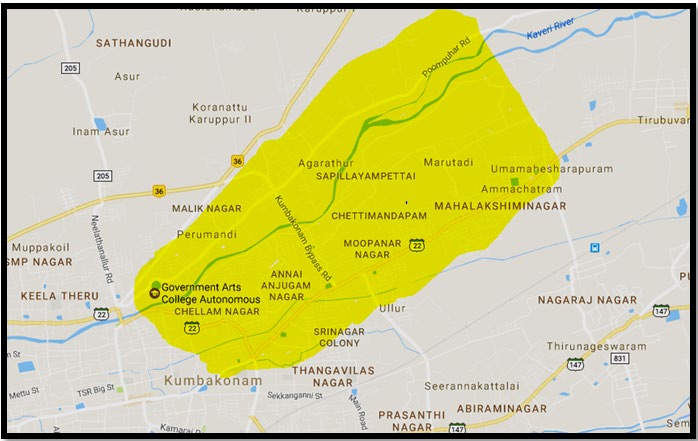
The town of Kumbakonam is surrounded by extensive paddy fields. Methods of irrigation were considerably improved following the opening of the Mettur Dam, et al. since 1934. The present study was conducted in the agriculture areas and water bodies of the villages adjacent to Kumbakonam town viz. Kumbakonam (Government Arts College Ground & Pond), Mananjeri (Agriculture Land & Pond), Thiruvisanallur, Naduvakarai, Pillayampetti (shruby and woody vegetation), and banks of Mananjery Kalungu areas.
The survey on butterflies was carried out to know the abundance and seasonality during the time period between 0900 and 1600 hrs by following the method of transect counting. Collection of specimen was made for taking photographic documentation. Butterflies were identified by using various field guides [10, 14]. Different types of habitats were searched for documenting butterflies including road sides, fodder bank, orchard planted areas, water reservoirs and agricultural lands. Pollard walking method was followed for observing butterflies [15] (Figure 1).
Results
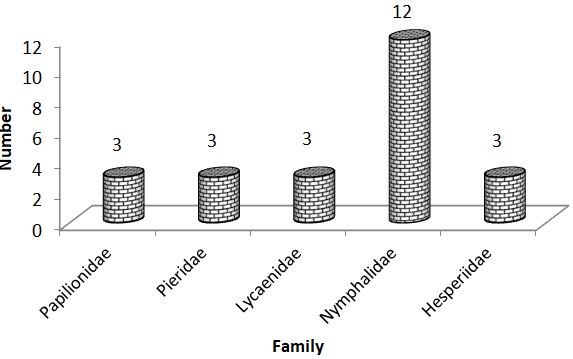
A total of 24 species of butterflies were collected from the Cauvery basin areas of Kumbakonam (Table 1). The data collected from the study area showed that the members from Nymphalidae family are higher (12), followed by 3 each of Papilionidae, Pieridae, Lycaenidae and Hesperiidae respectively (Figures 2 & 3).
| Family | Scientific name | Common name | Status | |
|---|---|---|---|---|
| 1 | Papilionidae | Pachlipta liomedon | Swallowtail | Protected, Schedule I |
| 2 | Papilionidae | Papilio helenus helenus | Red helon | Common |
| 3 | Papilionidae | Pachlipta hector | Crimson rose | Protected, Schedule I |
| 4 | Pieridae | Catopsilia pomona pomona | Common emigrant | Very common |
| 5 | Pieridae | Ixias marianne | White orange tip | Common |
| 6 | Pieridae | Eurema hecabe | Common grass yellow | Very common |
| 7 | Lycaenidae | Amblypodia anita | Leaf blue | Rare |
| 8 | Lycaenidae | Castalius rosimon | Common pierrot | Protected, Schedule I |
| 9 | Lycaenidae | Euchryops cnejus | Gram blue | Protected, Schedule II |
| 10 | Nymphalidae | Acraea violae | Tawny coster | Very Common |
| 11 | Nymphalidae | Danaus chrysippus | Plain tiger | Very Common |
| 12 | Nymphalidae | Mycalesis perseus | Common bush brown | Common |
| 13 | Nymphalidae | Melanitis leda | Common evening brown | Very Common |
| 14 | Nymphalidae | Euploea core core | Common crow | Very Common |
| 15 | Nymphalidae | Danaus genutia | Striped tiger | Very Common |
| 16 | Nymphalidae | Parantica aglea | Glassy Blue tiger | Fairly Common |
| 17 | Nymphalidae | Byblia ilithyia | Joker | Rare |
| 18 | Nymphalidae | Ariadne ariadne | Angled castor | Common |
| 19 | Nymphalidae | Junonia almana almana | Peacock pansy | Very Common |
| 20 | Nymphalidae | Junonia lemonias | Lemon pansy | Very Common |
| 21 | Nymphalidae | Symphaedra nais | Baronet | Rare |
| 22 | Hesperiidae | Tapena thwaitesi bornea | Dark flat | Rare |
| 23 | Hesperiidae | Celaenorrhinus ambaresa | Malabar spotted flat | Common |
| 24 | Hesperiidae | Caprona ransonnetti | Golden angle | Common |
Table 1: Diversity index of butterfly species recorded during the study period.
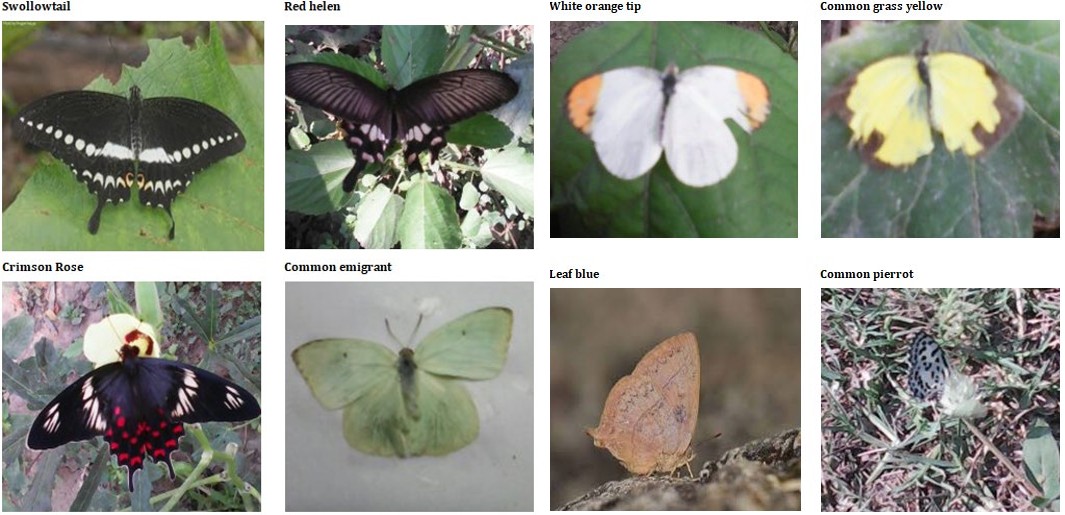
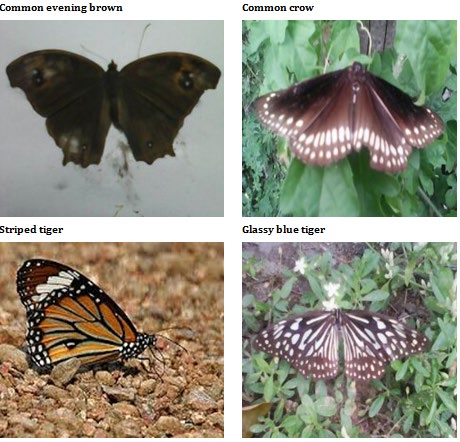
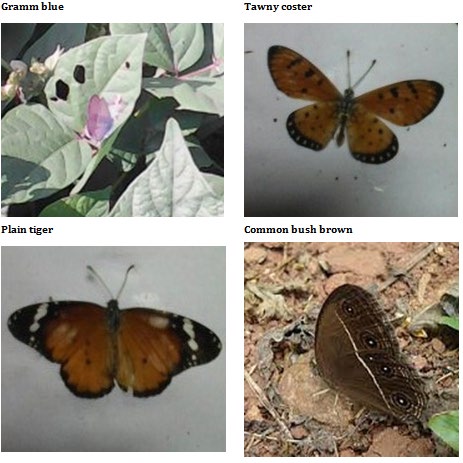
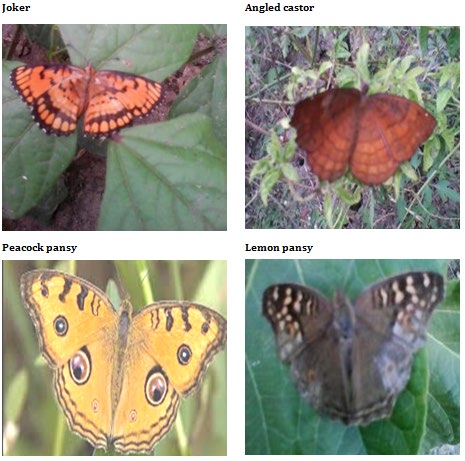
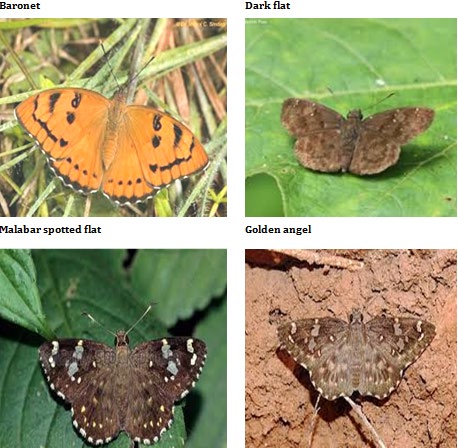
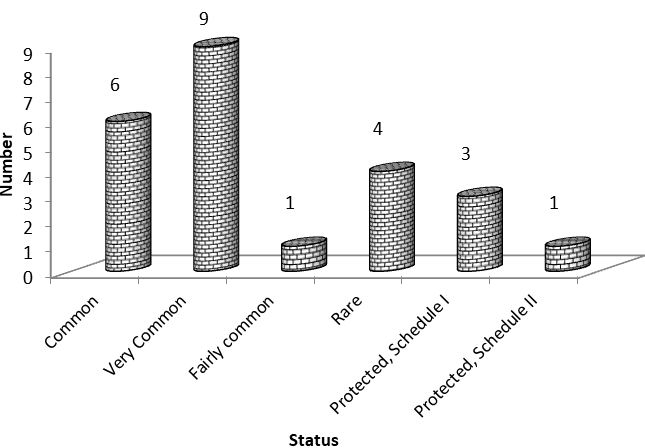
Most of the butterflies sighted in the study area are either Common (6 Nos.) or Very Common (9 Nos.). There are species falls under Rare category (4 Nos.) and protected under schedule I (3 Nos.) and schedule II (1 No.) of Wild Life (Protection) Act, 1972. Only one species falls under Fairy common category (Figure 4).
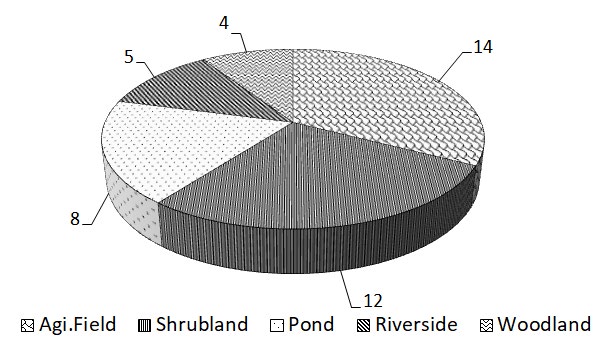
Similarly most of the species sighted in agriculture crop lands (14 Nos.). There are butterflies sighted in shrubland (12 Nos.), ponds (8 No.), Riverside (4 Nos.) and woodland (4 Nos.) respectively (Figure 5).
| Dec.2016 | Jan.2017 | Feb.2017 | Mar.2017 | |
|---|---|---|---|---|
| Individuals | 73 | 87 | 67 | 104 |
| Dominance_D | 0.2561 | 0.2488 | 0.2466 | 0.2467 |
| Simpson_1-D | 0.7439 | 0.7512 | 0.7534 | 0.7533 |
| Shannon_H | 1.477 | 1.49 | 1.503 | 1.501 |
| Evenness_e^H/S | 0.8757 | 0.8875 | 0.899 | 0.897 |
Table 2: Diversity index of butterfly species recorded during the study period.
The analysis of butterfly species recorded in the study area showed that even though there are variations of butterflies sighted under different genera, there are not much variation seen in Dominance, Simson index, Shannon index and evenness level (Table 2).
The statistical analysis of One way ANOVA on different species recorded during the study period shows that there are significant difference seen both between groups and within groups (p = 0.6079). Similarly the Welch F test in the case of unequal variances also shows that there is a significant variation between the species recorded (F = 0.5133, df= 8.79, p = 0.6834).
Discussion
The present study shows that the butterfly species belongs to the family Nymphalidae is higher than other members. The same results had been reported by earlier workers also [16, 17]. The Nymphalids are a larger group of robust bodied butterflies that are come in every shape and colour. Highest numbers of butterfly species are seen belonging to this Nymphalids family. Few species are distributed throughout the year. Family lycaenidae has blue upper sides and they are the prettiest and smallest butterflies, which include 25 species. The family Pieridae has the most familiar butterflies. Over 35 species are represented in this family in peninsular India, out of which 33 species are found in Western Ghats and 24 species in Alagarhills. Among them, common Jezeebel is endemic to peninsular India and Sri Lanka. Common grass yellow of this family is abundant. Even though family Lycaenidae, Pieridae and Nymphalidae
exhibited maximum species diversity, the reason for the abundance of Nymphalidae in the study area may be due to the dominance of larval food plants in the region [18].
The status of many species needs reassessment. As it has been rightly pointed out by Kunte [19], a large proportion of endemic and endangered species found in this area are not listed under any schedules of the Indian Wild Life (Protection) Act, 1972. In fact, a strict evaluation of the survival status of various species would lead to the inclusion of many more species under the protected category. Considering the high proportion of rare and endemic species found in this area, it is essential to adopt appropriate conservation strategies to protect the rich biodiversity contained in this area.
Summary and Conclusion
The data collected is revealed that the knowledge of butterfly diversity of Cauvery basin of Kumbakonam and its surroundings. It was observed that, the occurrence and distribution of butterflies were closely associated with the availability of its larval and adult host plants. Destruction, degradation of nature and unwise use of pesticides are the most worrying causes of butterfly species extinction; hence conservation of the natural habitats is very essential for the existence of species of butterflies and need to increase butterfly diversity. It provides useful information about their diversity as well as baseline data for upcoming researchers and gives wide scope for further detailed studies in the study area.
Acknowledgements
The authors are very much indebted to the staff members, Department of Zoology, Government Arts College (Autonomous), Kumbakonam and the peoples who rendered their help in various stages during the study period.
References
-
Kristensen NP, Skalski AW (1999) Phylogeny and palaeontology. In: Kristensen NP (Eds), Evolution, systematics and biogeography. Handbook of Zoology Lepidoptera: moths and butterflies 5: 7-25.
-
Chakravarthy AK, Rajagopal D, Jagannatha R (1997) Insect as a bioindicator of conservation in tropics. Zoos Print 12: 21-25.
-
Erhardt A (1985) Diurnal Lepidoptera sensitive indicators of cultivated and abandoned grassland. J Appl Ecol 22: 849-861.
-
Warren MS, Hill JK, Thomas JA, Asher J, Fox R, et al. (2001) Rapid responses of British butterflies to opposing forces of climate and habitat change. Nature 414: 65-69.
-
Battist A (1988) Phytophagous insect in the energy flow of an artificial stand of _Pinus nigra_ Arnold in northern Italy. Redia 71(1): 139-160.
-
Heppner J (1998) Classification of Lepidoptera. Part I Introduction. Holarctic Lepidoptera 5(1): 1-148.
-
Prabakaran S, Chezhian Y, Evangelan G, John William S (2014) Diversity of butterflies (Lepidoptera: Rhopalocera) in Tiruvallur District, Tamilnadu, India. Biology 2(3): 769-778.
-
Gaurav S, Ramamurthy VV (2008) A Checklist of Lepidopterous pests of vegetables in India. Zoological Survey of India, Check list on list source.
-
Gaonkar H (1996) Butterflies of Western Ghats with notes on those of Sri Lanka. A report to the Center of Ecological Sciences, Indian Institute of Science, Bangalore, Zoological Museum, Copenhagen and Natural History Museum, London, pp: 89.
-
Kunte K (2000) Butterflies of Peninsular India. Universities Press (Hyderabad) and Indian Academy of Sciences (Bangalore), pp: 254.
-
Rajagopal T, Sekar M, Manimozhi A, Baskar N, Archunan G (2011) Diversity and community structure of butterfly of Arignar Anna Zoological Park, Chennai, Tamil Nadu. J Environ Biol 32(2): 201-207.
-
Evans WH (1932) The identification of Indian Butterflies. 2nd (Edn.), Bombay Natural History Society, Mumbai, India.
-
Borges RM, Gowda V, Zacharias M (2003) Butterfly pollination and high contrast visual signals in a low density distylous plant. Oceologia 136(4): 571-573.
-
Antram CB (2002) Butterflies of India. Mittal Publication, New Delhi, pp: 226.
-
Pollard E (1977) A method for assessing changes in the abundance of butterflies. Biological Conservation 12(2): 115-134.
-
Kunte K, Joglekar A, Utkarsh G, Pramod P (1999) Patterns of butterfly, bird and tree diversity in Western Ghats, India. Current Science 29: 1-14.
-
Dolia J, Devy MS, Aravind NA, Kumar A (2008) Adult butterfly communities in coffee plantations around a protected area in the Western Ghats, India. Animal Conservation 11(1): 26-34.
-
Balasubramanian P, Mahendramani P, Padmapriya K (2001) Comparison of plant diversity pattern of various disturbed habitats of Moongilpallam area in the Western Ghats report, Salim Ali Centre for ornithology and natural history. Coimbatore, pp: 56-70.
-
Kunte K (2008) The Wildlife (Protection) Act and conservation prioritization of butterflies of the Western Ghats, Southwestern India. Current Science 94(6): 729- 735.
- Natural Decline to Extinction of A New Zealand Rabbit Population
- Mitochondrial Bio-Logistics: Steering Co-Enzyme Q10 and Lycopene Synergies within the Science 4.0 Bio-OS Framework
- Hymenoptera Specimens from the Caño Negro Wetland, of the National Museum Collection, Costa Rica
- Science 4.0: Comprehensive Architecture of the Biological Operating System (Bio-OS) A Framework for Systemic Resilience and Industrialized Bio-Governance
- Rabbit on, or Hare Back? Understanding Climate Change
- Clinical Validation of Science 4.0: Flow Steering and Epigenetic Drift Inversion on a 76-Year-Old Hybrid System