
The Richness and Diversity of Avifauna in Protected Areas of Croatia, National, Nature Parks and Ecological Network
Of the total area of Croatia, 56.598 km2, 6,106 km2 are protected in category of national (8) and nature parks (12), which makes 10.9% of the entire territory of Croatia, or 7% if the sea area is taken into account. Based on literature data and data from our own research for these areas, a list of 291 bird species have been recorded in all eight national parks, 348 bird species in 12 nature parks. This is 86% of all known birds species recorded so far out of 402 species recorded in our country [1,2].
Editorial
Of the total area of Croatia, 56.598 km2, 6,106 km2 are protected in category of national (8) and nature parks (12), which makes 10.9% of the entire territory of Croatia, or 7% if the sea area is taken into account. Based on literature data and data from our own research for these areas, a list of 291 bird species have been recorded in all eight national parks, 348 bird species in 12 nature parks. This is 86% of all known birds species recorded so far out of 402 species recorded in our country [1, 2]. Especially in 2020 Dinara Mountain was protected in the category of nature park on an area of 630 km2. Unfortunately, the Neretva estuary is still not in the category of a nature park, while the Mura estuary and the flow of the Drava in 2011 became a regional park and in 2012 UNESCO transboundary biosphere reserve Mura-Drava- Dunav. If we add here the other categories of protection, and the ecological network, the protected parts of Croatia are almost 37% of its total area and 380 recorded birds species. This is 95 % of all known Croatian birds species (Figure 1).
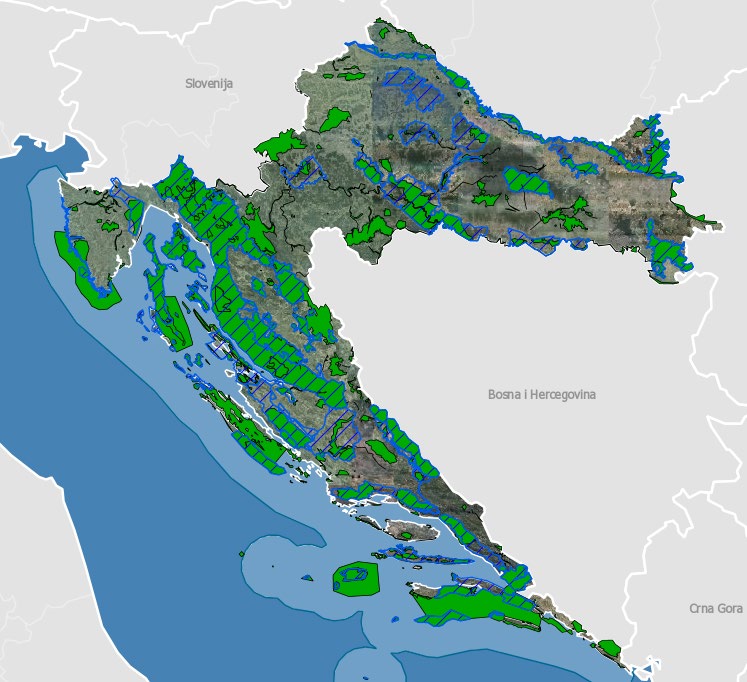
The research of certain protected areas of the Republic of Croatia is not uniform. Thus, there are lists of species for most national parks and most nature parks, which have been created in the last 20 years or so.
Of the 88 endangered bird species according to the Red Book of Birds of Croatia [3, 4], all species have been recorded in our protected areas. The importance of our national, nature parks and ecological network in the protection of rare and endangered bird species can best be seen by recording their ornithofauna and regular monitoring of endangered species. Complete lists of species exist in our national and nature parks, and inventory projects, monitoring of individual bird species are underway in some of them. In terms of ornithofauna, the bird life of most ecological network has been partially explored. The richness and diversity of the birds are especially prominent in the lowland continental areas, between the floodplains of the Drava and Sava rivers, Nature Park Kopački rit [5], with 292 species, and Nature Park Lonjsko polje with 246 birds species [6, 7, 8]. Along the Adriatic coast, these are National Park Paklenica (165 species), Nature Park Velebit (276 species), Nature Park Vransko jezero (250 species) and National Park Krka (229 species). The smallest number of species was recorded in mountain parks, National Park Risnjak (106 species), National Park Northern Velebit (114 species) and National Park Plitvička jezera (152 species), which have a specific and rich forest ornithofauna of semi-hollow and hollow birds, birds of prey and owls [9]. The mouth of the river Neretva as a possible future nature park with 310 recorded bird species [10]. So far, 315 bird species have been recorded in Istria. The areas of the Mirna river valley, the Raša estuary and the Palud swamp, near Rovinj stand out (Figure 2) [11, 12].
Of the 380 recorded birds species, 20 bird species were recorded in all 20 protected areas, so it can be said that the most common are: B. buteo, F. tinnunculus, C. livia f. domestica, U. epops, H. rustica, M. alba, E. rubecula, P. ochruros, P. collybita, R. regulus, T. merula, T. philomelos, S. atricapilla, Cyanistes caeruleus, P. major, G. glandarius, C. corax, F. coelebs, S. serinus, C. chloris, L. cannabina.
With two and three finds in each protected area, 32 species were recorded: Calonectris diomedea, Hydrobates pelagicus, Pelecanus onocrotalus, P. crispus, Bubulcus bisnis, Anser erythropus, Branta bernicla, Branta ruficollis, Aix galericulata, Tadorna ferruginea, Melanitta nigra, Tetrax tetrax, Glareola pratincola, Vanellus spinosus, Calidris canutus, Phalaropus lobatus, Stercorarius pomarinus, Larus fuscus, L. argentatus, Rissa tridactyla, Asio flammeus, Melanocorypha calandra, Anthus cervinus, Motacilla citreola, Phylloscopus bonelli, Corvus corone corone, Acanthis flammea, Plectrophenax nivalis, Emberiza pusilla.
Of the rare species with one finding, we recorded 25 species: Gavia immer, G. adamsii, Egretta gularis, Cygnus atratus, Branta leucopsis, B. canadensis, Aix sponsa, Anas falcata, Alectoris chukar, A. rufa, Porphyrio porphyrio, Glareola nordmanni, Numenius tenuirostris, Xenus cinereus, Larus audouinii, L. marinus, Sterna paradisea, Clamator glandarius, Merops supeiliosus, Oenanthe isbellina, Acrocephalus agricola, Montifringilla nivalis, Carduelis citrinellus, Acanthis flavirostris, Erythrina erythrina.
References
-
Lukac G, Mikuska T (2007) Bogatstvo i raznolikost ptičjeg svijeta nacionalnih parkova i parkova prirode Hrvatske. Zbornik povodom 20. godišnjice NP Krka. Šibenik pp: 357-370.
-
Lukac G, Milovac M, Busljeta N, Adzic I, Andacic N, et al. (2017) Velebitske ptice. Senj Zbor 44: 47-72.
-
Radovic D, Kralj J, Tutis V, Cikovic D (2003) Crvena knjiga ugroženih ptica Hrvatske. Ministarstvo zaštite okoliša i prostornog uredenja.
-
Tutis V, Kralj J, Cikovic D, Barisic S (2013) Crvena knjiga ugroženih ptica Hrvatske. Državni zavod za zaštitu prirode.
-
Mikuska J, Mikuska T, Romulić M (2002) Ptice. Vodič kroz biološku raznolikost Kopačkog rita. Matica Hrvatska, ogranak Osijek, knjiga 1: 1-112.
-
Rucner R (1970) The avifauna of Lonjsko polje. Larus 21(22): 33-64.
-
Schneider Jacoby M (1993) Vögel als lindikatoren für das ökologische Potential der Saveauen und Möglichkeiten für deren Erhaltung. Naturerbe, Verlag Jürgen Resch 261 pp. Konstanz.
-
Muzinic, J, Vasilik Z, Radovic A (2004) Popis ptica Sisačke Posavine u razdoblju od 1881 do 1998. Nat Croat 13 (1): 81-91.
-
Lukac G (2004) Ptice Nacionalnog parka Plitvička jezera. Plitvički bilten br. 6, Radovi pp: 29-70.
-
Rucner D (1998) Ptice hrvatske obale Jadrana. HPM i MRO, Zagreb.
-
Lukac G, Stelko R (2016) Atlas ptica Istre. JU Natura Histrica, Pula pp: 1-167.
- Natural Decline to Extinction of A New Zealand Rabbit Population
- Mitochondrial Bio-Logistics: Steering Co-Enzyme Q10 and Lycopene Synergies within the Science 4.0 Bio-OS Framework
- Hymenoptera Specimens from the Caño Negro Wetland, of the National Museum Collection, Costa Rica
- Science 4.0: Comprehensive Architecture of the Biological Operating System (Bio-OS) A Framework for Systemic Resilience and Industrialized Bio-Governance
- Rabbit on, or Hare Back? Understanding Climate Change
- Clinical Validation of Science 4.0: Flow Steering and Epigenetic Drift Inversion on a 76-Year-Old Hybrid System