
Turkey (Meleagris gallopavo) in Mexico
The turkey, Meleagris gallopavo, is native to America. This species of bird is found all over Mexican national territory. The different climates in Mexico and the method of domestication are the main factors that have caused variability in the genotypes and plumage colors of these turkeys. In some rural areas, turkey raising is typically done by housewives, who use food waste or mixed feed blend with nixtamalized corn; in daytime, turkeys are released into the backyard where they eat herbs or insects. Unfortunately, the breeding of these birds has been drastically reduced, due to the loss of Mexican traditions.
Introduction
The wild ancestor of the domestic turkey is the Mexican Meleagris gallopavo gallopavo. At the beginning of the seventeenth century, these Mexican turkeys were brought from Europe to Eastern North America, where they were hybridized with eastern turkeys (M. gallopavo silvestris), generating a new breed, which is the one that is commercialized [1]. M. gallopavo is a poultry that contributes to the production of meat worldwide [2].
Within the Mexican species of turkeys, there are three groups: relict (C1), merriami (C2), and mexicana/ intermedia/silvestris/osceola (C3), the latter group shares haplotypes with domesticated turkeys [3]. Environmental and breeding factors as density, group size, space availability, maturation, lighting, feeding and transportation can affect turkey behavior and development [4]. In addition, the physical, morphological and mechanical characteristics of eggs must also be considered, since the development of the embryo and hatching will depend on these characteristics [5]. In general, good management and care of turkeys should be considered, since they can have gastrointestinal parasites [6].
Origins of the Turkey
Exists evidence that confirms that this bird is native to America. The Mayas and Aztecs were the first to domesticate it, later it was adopted by other pre-Hispanic cultures. Some synonyms of the word Turkey in Mexico are: Huexolotl, Jolote, Chompipe, Cocono, Pipila, Pavo, Totol and úulum, among others. The domestic creole Turkey comes from M. gallopavo [7]. Nowadays the turkey is distributed throughout the National territory.
Genotypic Characteristics
Meleagris gallopavo is a species of bird that has been bred for many years in Mexico. The genotypic characteristics of this species can change due to the diversity of climates and to the different methods in small scale production [8, 9].
Phenotypic Characteristics
The color of the skin and tarsus, as well as the color and pattern of the plumage, are not very diverse, however, the influence of the conditions of their raise could cause some morphotypes to be lost [10].
Domestication
In Mexico the raising of the Turkey is common in rural and peri-urban areas. However, this activity has been reduced due to the loss of Mexican traditions, where it is commonly consumed [10].
Management of the Guajolote in Michoacan
In a study carried out in five physiographic regions in the state of Michoacán, it was shown that the Turkey can have variations in the color of its plumage, birds with the following colors were found: Tan, Narragansett, Royal Palm, Spanish Black, Slate or silver and Buffy (brown or red), other colors not included in this classification were found. Regarding weight, within the same investigation, at 12 months it was possible to know that the birds with the highest weight were those from regions with a temperate climate. In the same study, it was shown that female’s nest 2 to 3 times per year. Regarding production units, 94.3% are not technified; but in these cases, some improved management practices have been implemented, such as the use of balanced feed in poults up to two months of age. Likewise, few vaccination plans are used and very important the poultry farmers do not breed improved varieties, this means that the genetics of the turkey is autochthonous [11]. In another study carried out in the state of Michoacán, it was shown that female turkeys with gray feathers produced more eggs and with greater weight than those of any other color [12].
Management of Turkey in Campeche
In a study carried out in indigenous Mayan communities of the center and south of Campeche, it was shown that in the raising of the native Turkey, more than 60% of the growers use corn grains to feed them. Regarding diseases in this bird, the most common are respiratory and digestive, due to the few applications of vaccines. The flocks of this species are majorly constituted by birds in the juvenile stage, and the rearing is commonly carried out by women [13].
Management of the Turkey in Yucatán.
The turkey (M. gallopavo) is resistant to unfavorable environmental conditions; However, this species can have ectoparasites, such as Chelopistes meleagridis, Lipeurus caponis and Menacanthus stramineus, this was demonstrated in four municipalities of the State of Yucatán, Motul, Maní, Cepeda and Timucuy [14].
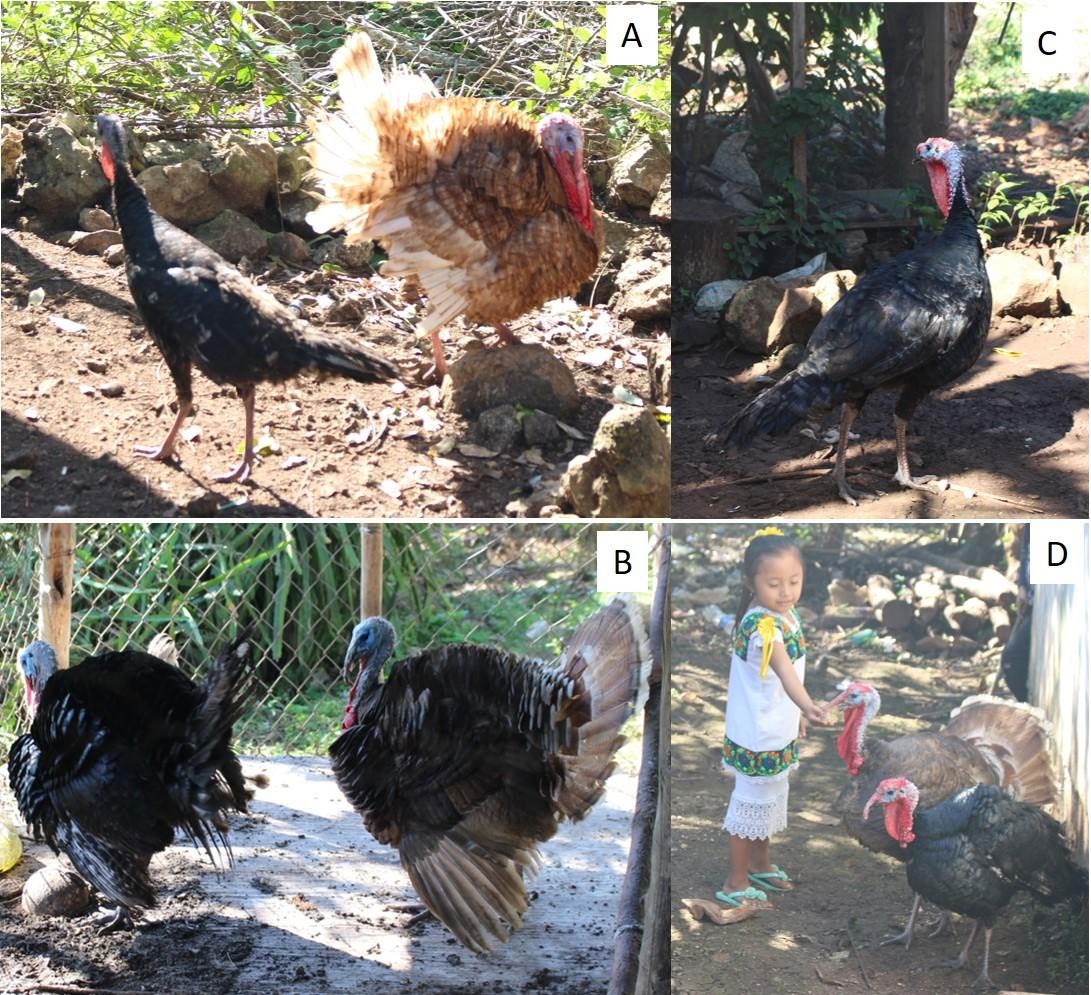
In an investigation I conduced this year in the south of the State of Yucatán, regarding the feeding of the turkey, in populations such as Xohuayan, Cankab, San Marcos, and in other nearby towns, some families feed their Turkeys, with corn grains, food waste or mix of balanced food with ground nixtamalized corn. However, the custom is that the turkeys are released in the backyard of the houses, where they feed on insects or herbs (Figure 1).
Conclusions
In Mexico the species M. gallopavo is mainly domesticated, but we can commonly find it in rural areas. The variety of colors in the turkey plumage and its growth characteristics may vary, thanks to the diversity of climates throughout our national territory. However, there is the possibility that some genotypes or phenotypes could disappear in the future, due to the conditions or domestication methods used in the management of this species. Furthermore, this species could disappear due to the loss of Mexican traditions, since they are normally consumed in these traditional events. Therefore, it is of great relevance to create or implement breeding programs for M. gallopavo in rural or peri-urban communities, as well as to promote the preservation of traditions.
References
-
Crawford RD (1992) Introduction to Europe and diffusion of domesticated turkeys from the America. Arch de Zootec 41(154): 307-314.
-
Aslam ML, Bastiaansen JWM, Elferink MG, Megens HJ, Crooijmans RPMA, et al. (2012) Whole genome SNP discovery and analysis of genetic diversity in Turkey (Meleagris gallopavo). Bio Med Central 13: 1-14.
-
Padilla‑Jacobo G, Cano‑Camacho H, López‑Zavala R, Cornejo‑Pérez ME, Zavala‑Páramo MG (2018) Evolutionary history of Mexican domesticated and wild Meleagris gallopavo. Genet Sel Evol 50: 1-15.
-
Marchewka J, Watanabe TTN, Ferrante V, Estevez I (2013) Review of the social and environmental factors affecting the behavior and welfare of turkeys (Meleagris gallopavo). Poul Sci 92(6): 1467-1473.
-
Galic A, Pliestic S, Janjecic Z, Bedekovic D, Filipovic D, Kovacev I, et al. (2018) Some Physical, Morphological, and Mechanical Characteristics of Turkey (Meleagris gallopavo) Eggs. Braz J of Poul Scien 2(2): 317-323.
-
Aniefiok-Udoh N, Abdulkarim-Luka S, Amidu-Audu P (2014) Prevalence of Gastrointestinal Parasites of Domestic Turkey (Meleagris gallopavo) Linnaeus, (1758) Slaughtered in Kaduna Metropolis, Kaduna State, Nigeria. J Nat Scie Res 4(17): 105-109.
-
Gallardo-Nieto JL, Villamar-Angulo L, Guzmán- Valenzuela H (2007) Situación actual y perspectiva de la producción de carne de guajolote (pavo) en México 2006. Claridades Agropecuarias 161: 3-37.
-
Cigarroa Vázquez F, Herrera Haro JG, Ruiz Sesma B, Cuca García JM, Rojas Martínez RI, et al. (2013) Phenotypic characterization of the autochthonous turkey ( Meleagris gallopavo ) and production system in the north central region of Chiapas, Mexico 47(6): 579-591.
-
Ángel-Hernández A, Morales-Flores S, Carrillo-Rodríguez JC, Rodríguez-Ortiz G, Villegas-Aparicio Y, et al. (2014) Historia, domesticación y situación actual del guajolote (Meleagris gallopavo gallopavo) en México. Revista Mexicana de Agroecosistemas 1(2): 132-143.
-
Zamora Martinez G, Carmona Hernandez O, Lopez del Castillo Lozano M, Arcos Barreiro SI, Lozada García JA (2019) Caracterización fenotípica del guajolote (Meleagris gallopavo) en localidades del municipio de Ixhuacán de los reyes en el estado de Veracruz, México, AICA 13: 6-9.
-
López Zavala R, Monterrubio Ricob TC, Cano Camacho H, Chassin Noria O, Aguilera Reyes U, et al. (2008) Caracterización de sistemas de producción del guajolote (Meleagris gallopavo gallopavo) de traspatio en las regiones fisiográficas del estado de Michoacán, México. Tec Pecu Mex 46(3): 303-316.
-
Juarez Caratachea A, Delgado Hurtado I, Ortiz Rodríguez R, Gutiérrez Vázquez E, Salas Razo G, et al. (2018) Effect of plumage color on the productive performance of turkeys (Meleagris gallopavo) in confinement. Liv Res Ru Devel 30(10): 1-4.
-
Portillo Salgado R, Herrera Haro JG, Bautista Ortega J, Ortega Cerrilla ME, Sánchez Villarreal A, et al. (2018) Descriptive Analysis Of Local Breeding And Management Practices Of Native Guajolote (Meleagris Gallopavo L.) In Campeche, Mexico. Agroproductividad 11(1): 88-94.
-
Canul SM, Sierra VA, Azcorra PG, Nava GFJ, Amaya MSM (2014) Contribution to the Identification of Mallophaga Turkeys in Natives of the State of Yucatán. AICA 4: 279- 2081.
- Natural Decline to Extinction of A New Zealand Rabbit Population
- Mitochondrial Bio-Logistics: Steering Co-Enzyme Q10 and Lycopene Synergies within the Science 4.0 Bio-OS Framework
- Hymenoptera Specimens from the Caño Negro Wetland, of the National Museum Collection, Costa Rica
- Science 4.0: Comprehensive Architecture of the Biological Operating System (Bio-OS) A Framework for Systemic Resilience and Industrialized Bio-Governance
- Rabbit on, or Hare Back? Understanding Climate Change
- Clinical Validation of Science 4.0: Flow Steering and Epigenetic Drift Inversion on a 76-Year-Old Hybrid System