
Active Compounds and Immunostimulating Potential of Holothuria Scabra Extract in Common Carp Fish (Cyprinus Carpio) Against Aeromonas Hydrophila Infection
Holothuria scabra is one of the sea cucumbers which has bioactive is assumed given beneficial effect for fish health. Therefore, this study aims to identifying of chemical compounds in ethanol H. scabra extract from coastal water in South East Sulawesi, Indonesia and to determine their potential effect as immunostimulant in common carp that were challenged using Aeromonas hydrophila infection. Immunostimulant potential test through with the administration of H. scabra extract was with immersion which doses 200 ppm, 400 ppm, 600 ppm and a treatment without the administration of H. scabra extract as positive control (K+). Then, experimental fish was challenged by A. hydrophila bacteria with cell density 107 CFU/mL, fish were injected as much as 0.1 ml/individual intra-muscularly. Result of qualitative test of active compounds indicated that ethanol extracts contained alkaloid, flavonoid and saponin. The conclusion of administration of sea cucumbers extract in different doses showed that the effect on the total erythrocyte, leukocyte and haematocrit parameters was better than the positive control but did not have a statistically significant effect. Relative Percent Survival (RPS) also showed lower survival than control fish, however fish survival among treatments did not have a statistically significant effect. Based on this, ethanol extract of H. scabra has potential as an immunostimulant in the preventive action of A. hydrophila infection, but this research needs to be continued to find out the best dosage that can be applied.
Azlan, Nur I* and Baytul Abidin LO
Keywords: Bioactive; Immunostimulants; Holothuria Scabra; Aeromonas Hydrophila
Introduction
Aeromonas hydrophila is an opportunistic microorganism that is reported to be responsible for hemorrhagic septicemia disease in freshwater aquaculture organisms. Diseases caused by these bacteria cause the mass death of aquaculture organisms [1, 2]. Disease control using antibiotics is common practice, but this treatment can have an impact on increasing resistance of pathogenic bacteria to antibiotics that are often used [3] and can cause antibiotic residues in the body of cultured organisms [4]. Based on this, the researchers then examined the potential use of natural ingredients as drugs in controlling disease. Active compounds derived from natural ingredients have been shown to control fish diseases.
Holothuria scabra is one of the sea cucumber which has active compound and is known to have antibacterial [5], antifungal activities [6] and antioxidant activities [7]. The whole body n-butanol extract of H. scabra is known to have antioxidant activity; it can increase the resistance of organisms to oxidative stress and has anti-aging activity so that it can increase lifespan in Caenorhabditis elegans [8]. Other studies have shown that scabraside D, a sulfated triterpene glycoside extract from sea cucumber H. scabra can induce apoptosis and inhibit the growth of human cholangiocarcinoma cells [9]. H. scabra body wall extract in ethyl acetate fraction also contains complex of triterpene glycosides that inhibit growth of human glioblastoma, the human brain tumor cell [10]. Based on this information, it is possible to use sea cucumber extract for the control of bacterial diseases in aquaculture organisms.
Research on fish disease control using extracts from natural products has been carried out as an alternative to antibiotics. Besides showing antibiotic activity, active compounds in natural products also have the potential to increase non-specific immune systems. In the same natural product, these two activities are often found at once, for example in Buton forest onion (Eleutherine bulbosa) [11], guava leaves (Psidium guajava) [12] and black cumin (Nigella sativa) [13]. Therefore, this study aims to identifying of chemical compounds in ethanol H. scabra extract from coastal water South East Sulawesi, Indonesia and to determine the potential of H. scabra extract as an immunostimulant in common carp that were challenged using A. hydrophila infection, focuses on the preventive concept.
Materials and Methods
Extraction of Sea Cucumber
The sea cucumbers used was collected in the coastal waters of Tanjung Tiram, South East Sulawesi, Indonesia. Sea cucumbers were dried at temperature of 50oC for 1-2 days until dry then mashed to become a powder. Extraction was carried out by macerating 1500 g of H. scabra powder with 3 litres of 96% ethanol solution for 24 hours and repeated for 3 days. The filtrate obtained was then evaporated with a maximum temperature of 40oC in order to obtain an extract with paste texture.
Identification of Active Compounds
Identification of chemical compounds in ethanol H. scabra extract was carried out to determine the content of alkaloids, steroids/terpenoids, flavonoids, saponins, and phenolics. The method used according to Lieberman- Burchard procedure [14].
Fish Rearing and Experimental Design
The common carp used was 10-12 cm in size and the average weight of the fish was 28 g. Fish were adapted for 7 days before treatment. During treatment, each aquarium containing 5 fish, feeding was done 2 times in a day and as much as 3% of body weight.
The doses of H. scabra extract used in this study were 200 ppm (Treatment A), 400 ppm (Treatment B), 600 ppm (Treatment C) and a treatment without the administration of H. scabra extract but challenged with A. hydrophila as positive control (K+). The fish that have been reared for 7 days were then immersed in H. scabra extract for 3 hours. Treatment was carried out twice, at days 7 and 14. After immersion for 3 hours, fish were then transferred back to the rearing aquarium.
Challenge Test with A. hydrophila
A challenge test with A. hydrophila bacteria was carried out after day 14 of reared and after treatment with extract at day 14. Bacteria of A. hydrophila with 107 CFU/mL cell densities were injected as much as 0.1 ml/individual intra- muscularly in experimental fish [15].
Haematological Profile
Haematological profile in this study included erythrocytes count/Red Blood Cells (RBC), leukocytes count/ White Blood Cells (WBC) and hematocrit levels. Before taking blood samples, 0.1 mL of 3.8% Na-citrate was added to syringe as an anticoagulant. As much as 0.1 mL of blood was taken from each fish observed. Blood samples were taken 2 times, at days 8 (1 day after immersed the fish with sea cucumber extract) and 18 (4 days after immersed challenge test with A. hydrophila). The fish sample used was 1 fish in each treatment unit. The value in each blood parameter is the average result of the replicates in each treatment.
Parameters Observed
Immune response parameters observed in haematological profile were erythrocytes and leukocytes count used Blaxhall and Daisley method [16] and haematocrit, also known as Packed Corpuscular Volume/PCV [17]. Relatif Percent Survival (RPS) was determined using the Amend equation [18] in which RPS (%) = 1- (Number of fish mortality in the treatment group/number of fish mortality in the positive control group) x 100%.
Results
Active Compounds of Ethanol Extract H. Scabra
Extraction of sea cucumber from 1500 g weight dry yielded 18.5 g ethanol extract of H. scabra powder so that the rendement obtained was 1.23%. Table 1 shows the results of qualitative test of active compounds, indicated that ethanol extract of H. scabra contained alkaloid, flavonoid and saponin.
| No. | Compounds | Colour Change Chemical Reaction | Result |
|---|---|---|---|
| 1 | Alkaloid | Orange-Brown-Yellow color | Positive |
| 2 | Terpenoid | Blue-purple color | Negative |
| 3 | Steroid | Blue-green color | Negative |
| 4 | Flavonoid | Orange-red color | Positive |
| 5 | Phenolic | Blue-purple color | Negative |
| 6 | Saponin | Foam formation | Positive |
Table 1: Active compounds of sea cucumber H. scabra extract
Haematological Profile
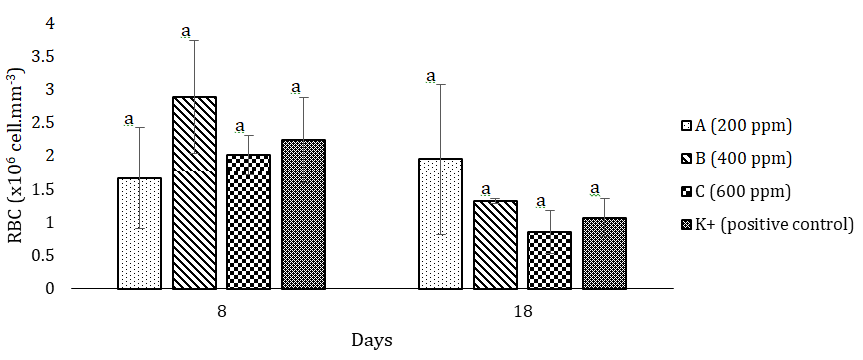
The results of RBC observations in Figure 1 show that measurement of RBC at day 8 showed an increase of RBC as a result of administration of H. scabra extract with treatment B (400 ppm) as a treatment that produces a dominant response. RBC measurement at day 18 showed a general decrease of RBC at all treatments except for treatment A (200 ppm). Statistical analysis of RBC data at day 18 also did not show a significant difference between all treatments.
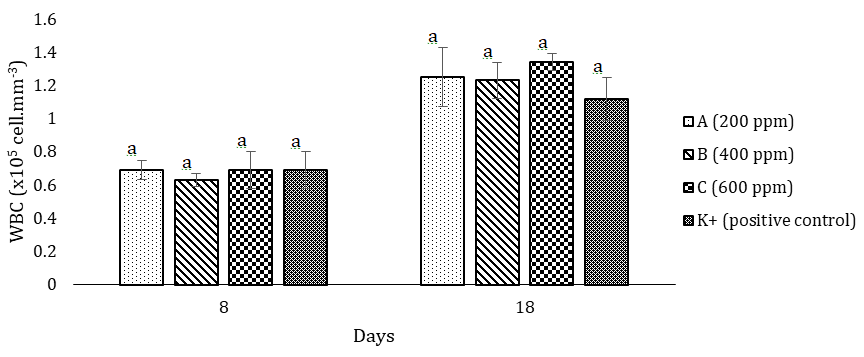
The results in Figure 2 show an increase of WBC at day 18 as post-infection immune response. There were no significant differences in the RBC response on observations at days 8 and 18. However, observations at day 18 showed that administration of the H scabra extract to treatments A (200 ppm), B (400 ppm) and C (600 ppm) caused common carp fish give respond to infection was better than positive controls.
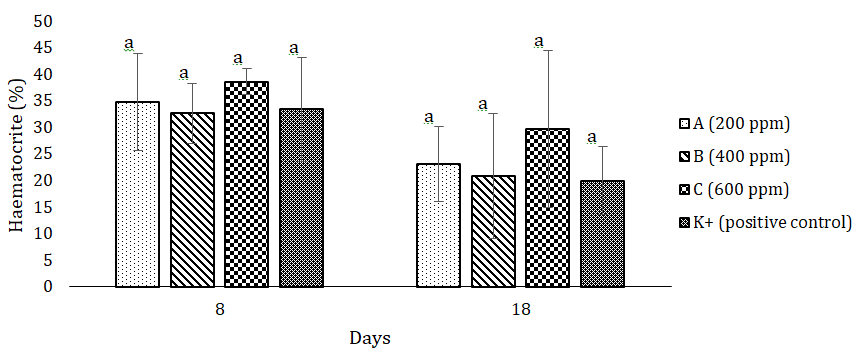
The results of the common carp fish haematocrit in Figure 3 resulted in the administration of H. scabra extract only had an effect on increasing of the haematocrit at treatments A (200 ppm) and C (600 ppm). The challenged test of A. hydrophila caused a decrease of the haematocrit in all observed fish but the haematocrits in the positive control was lower than the other extract treatments. In general, data of RBC, WBC and haematocrits showed a better response in common carp fish given H scabra extract but the all response was not statistically significant.
Relative Percent Survival (RPS)
| Treatment | Mortality (%) | RPS (%) |
|---|---|---|
| A (200 ppm) | 40 | 33.33 |
| B (400 ppm) | 40 | 33.33 |
| C (600 ppm) | 46.67 | 22.22 |
| K+ (positive control) | 60 |
Table 2: Relative Percent Survival (RPS) of common carp fish at day 18 (after challenged test of A. hydrophila).
The results of observations of common carp fish RPS at day 18 can be seen at Table 2. The RPS obtained was very low, reaching 33.33% due pathogen infection effect. Mortality in the range of 40-46.67% indicates that the dose of the extract H. scabra administration was not optimal to increase the immune system before the challenge test, so that at post- challenge observation still results high carp fish mortality.
Discussion
The active compounds contained in sea cucumber H. scabra extract are actually secondary metabolites that are not essential for growth. These secondary metabolites are generally used as a defence system for sea cucumbers. The active compounds obtained which consist of alkaloid; flavonoid and saponin are typical compounds in pharmacological potential of sea cucumbers. The active compounds obtained were as previously reported [19, 20, 21]. Saponin compounds are known to have antibiotic properties so that they can be used as drugs in controlling bacterial infection. Saponin or triterpene glycosides also exhibit inhibitory activity and cytotoxic effects on cancer cells [22]. The total phenol content in H. scabra extract contributes to its antioxidant activity. The DPPH scavenging activity test showed that the antioxidant activity increased along with the increase in the concentration of H. scabra methanol extract and standardized extracts. Friedelin, 3-hydroxybenzaldehyde, 4-hydroxybenzaldehyde contained in it are strong free radical inhibitors [7]. In addition, H. scabra extracted using alcohol solvents group showed antioxidant activity which increased resistance to oxidative stress [8], in other study showed that H. scabra extract was given a hepatoprotective effect on liver tissue damage induced by hepatotoxic drug doses [23]. Therefore, this extract deserves to be explored for its potential as an immunostimulant.
Haematological profile can be used as an indicator of an increase in the non-specific immune system. Erythrocyte count (RBC), leukocyte count (WBC) and haematocrit are commonly used blood parameters for this. The RBC parameters observed in this study indicated that treatment B (400 ppm) had an increased on RBC compared to the positive control after immersed H. scabra extract. After the challenge test, there was a decrease in RBC in all treatments including positive controls. RBC reduction symptoms in fish infected with A. hydrophila have been reported in other studies [24]. This occurs because the infection causes red blood cell damage and anemia. Bactera A. hydrophila infection is known as a disease that causes septicemia, a poisoning disease of the blood cells and mass destruction of red blood cells. The haemorrhagic that occurred decreased the RBC of the experimental fish. In more severe infections, haemorrhagic progression increases with the occurrence of ulcerative dermatitis on the body surface of the fish [25]. Previous studies on histology have shown that haemorrhagic and necrosis of the liver of fish infected with A. hydrophila [26], were also responsible for the decrease in erythrocyte count. Extract of H. scabra which has been tested to be hepatoprotective [23] is thought to have a major role in liver protection against infection with A. hydrophila bacteria, thereby preventing a decrease in RBC. However, administration of H. scabra extract at treatment B (400 ppm) prevented the decrease in RBC as occurred in positive controls although it did not show any significant difference compared to positive controls.
Leukocytes are blood components that function as non- specific defences that will localize and eliminate pathogens. Leukocytes (WBC) have a role to protect against microbial infection and other chemical factors. Observations on WBC parameters showed that the treatment given resulted in insignificant differences for all treatment against WBC both in the post-treatment sampling of H. scabra extract and after the A. hydrophila challenge test. However, post challenge observation showed that WBC in all treatments given H. scabra extract was higher than the positive control. The pattern found is identical to previous research that tested the phytopharmaca of jeruju leaf extract (Acanthus ilicifolius) as a preventive effort to control A. hydrophila infection disease [27]. The increase in WBC after infection is an indication that the fish’s defence system responds to pathogens that enter the body. Low WBC at post infection can be interpreted as a low immune response to the infection.
Haematocrits can be used as an indicator of stress caused environmental factors, handling (injection) or due to pathogenic infection. Observation of fish haematocrit on 8th day showed that higher haematocrit in all immersed treatments of H. scabra extract than positive control. The same pattern was also shown on the 18th day of observation or after challenge test. However, the both observations did not show a significant effect at haematocrit of all H. scabra extract immersed treatments than the positive control. The results obtained in this study are similar to the research administration of jeruju leaf extract (A. ilicifolius) [27] and Avena sativa extract [28] as a preventive effort to control A. hydrophila infection showed higher haematocrit for them than control treatment. Based on the results of observations on RBC, WBC and haematocrit, it can be concluded that the ethanol extract of H. scabra has the potential as an immunostimulant although statistically it does not have a significant difference between each treatment with positive control or without administration of H. scabra extract treatment.
In observation of the relative percent survival (RPS), administration of ethanol extract of H. scabra resulted the relative survival of common carp fish at 33.33% and 22.22%. The results of this study indicate that the treatment given is not able to provide good protection against A. hydrophila infection. The RPS obtained in this study was lower than the results of previous studies using phycocyanin from Spirulina platensis as an immunostimulant resulting the common carp fish RPS reaching 87.5% [29]. The treatment of administration extract of H. scabra through immersed method has not been able to optimally induce the non-specific immune system optimally. This is evidenced by an increase in the immune system as measured by haematological profile showing an increase in immune system indicators at all treatments administration of the extract of H. scabra but has not resulted in a statistically significant difference to the positive haematological profile control. These results are thought to correlate with the RPS of common carp fish that were challenged with A. hydrophila infection.
Conclusion
The conclusion in this study is the ethanol extract of H. scabra contained alkaloid, flavonoid and saponin compound and the administration of ethanol extract of the H. scabra in Cyprinus carpio has potential effect as an immunostimulants in the preventive action of A. hydrophila infection.
Conflict of Interest
The authors state that they have no conflict of interest.
Acknowledgment
The author would like to thanks the International Journal of Zoology and Animal Biology for invitation to publish this article free of cost.
References
-
Zhao XL, Jin ZH, Di GL, Li L, Kong XH (2019) Molecular characteristics, pathogenicity and medication regimen of Aeromonas hydrophila isolated from common carp (Cyprinus carpio L.). J Vet Med Sci 81(12): 1769-1775.
-
Zhang D, Xu DH, Shoemaker C (2016) Experimental induction of motile Aeromonas septicemia in channel catfish (Ictalurus punctatus) by waterborne challenge with virulent Aeromonas hydrophila. Aquac Rep 3: 18-23.
-
Stratev D, Odeyemi OA (2016) Antimicrobial resistance of Aeromonas hydrophila isolated from different food sources: A mini-review. J Infect Public Health 9(5): 535- 544.
-
Liu X, Steele JC, Meng XZ (2017) Usage, residue, and human health risk of antibiotics in Chinese aquaculture: A review. Environ Pollut 223: 161-169.
-
Arifin HN, Ningsih R, Fitrianingsih AA, Hakim A (2013) Antibacterial activity test sea cucumber extract (Holothuria scabra) Sidayu Coast Gresik using disk diffusion method. Alchemy 2(2): 101-106.
-
Mohammadizadeh F, Ehsanpor M, Afkhami M, Mokhlesi A, Khazaali A, et al. (2013) Evaluation of antibacterial, antifungal and cytotoxic effects of Holothuria scabra from the North Coast of the Persian Gulf. Journal de Mycologie Médicale 23(4): 225-229.
-
Nobsathian S, Tuchinda P, Sobhon P, Tinikul Y, Poljaroen J, et al. (2017) An antioxidant activity of the whole body of Holothuria scabra. Chem Bio Technol Agric 4(4): 1-5.
-
Jattujan P, Chalorak P, Siangcham T, Sangpairoj K, Nobsathian S, et al. (2018) Holothuria scabra extracts possess anti-oxidant activity and promote stress resistance and lifespan extension in Caenorhabditis elegans. Exp Gerontol 110: 158-171.
-
Assawasuparerk K, Vanichviriyakit R, Chotwiwatthanakun C, Nobsathian S, Rawangchue T, et al. (2016) Scabraside D Extracted from Holothuria scabra Induces Apoptosis and Inhibits Growth of Human Cholangiocarcinoma Xenografts in Mice. Asian Pac J Cancer Prev 17(2): 511- 517.
-
Sangpairoj K, Chaithirayanon K, Vivithanaporn P, Siangcham T, Jattujan P, et al. (2016) Extract of the sea cucumber, Holothuria scabra, induces apoptosis in human glioblastoma cell lines. Funct Food Health Dis 6(7): 452-468.
-
Munaeni W, Pariakan A, Yuhana M, Setiawati M, Abidin LOB (2017) In Vitro Phytochemical and Inhibitory Potential Tests of Buton Forest Onion Extract (Eleutherine palmifolia) on Vibrio harveyi. Microbiol. Indonesia 11(3): 75-80.
-
Nur I, Santi, Kurnia A (2020) Efficacy of Guava (Psidium guajava) Leaves Extract to Prevent Vibriosis in White Shrimp (Litopenaeus vannamei). Res J Med Plant 13(4): 136-144.
-
Nur I, Linianti, Munaeni W, Abidin LOB, Maulidiyah (2020) Assessment of antibacterial and immunostimulating activity of black cumin (Nigella sativa) extract against vibriosis in white shrimp (Litopenaeus vannamei). Thai J Vet Med 50(4): 549-557.
-
Hanani E (2014) Phytochemical Analysis (Indonesian). Medical Book Publishers EGC. Jakarta.
-
Nur I, Fitriani A, Asnani (2009) The Potential of Extract of leaves and flowers of Lantana camara Linn. as an antibacterial for catfish infected by Aeromonas hydrophila. Indones Aquac J 4 (1): 41-45.
-
Blaxhall, Daisley KW (1973) Routine Haematological Methods for Use with Fish Blood. J Fish Biol 5(6): 577- 581.
-
Anderson DP, Siwicki AK (1995) Basic Hematology and Serology for Fish Health Programs. Fish Health Section, Asian Fisheries Society. Manila.
-
Amend DF (1981) Potency Testing of Fish Vaccines. International Symposium on Fish Biologics: Serodiagnostics and Vaccines. Dev Biol Stand 49: 447- 454.
-
Bordbar S, Anwar F, Saari N (2011) High-value components and bioactives from sea cucumbers for functional foods-a review. Mar Drugs 9: 1761-1805.
-
Khotimchenko Y (2018) Pharmacological Potential of Sea Cucumbers. Int J Mol Sci 19(5): 1-42.
-
Aminin DL, Menchinskaya ES, Pisliagin EA, Silchenko AS, Avilov SA, et al. (2015) Anticancer activity of sea cucumber triterpene glycosides. Mar Drugs 13(3): 1202- 1223.
-
Nur I, Asnani, Yusnaini (2019) The potency of steroid extracts of sea-cucumber (Holothuria scabra) collected from Atowatu Coast of Kendari to control Vibrio harveyi (Indonesian). Journal of Fishery Science and Innovation 3(1): 26-31.
-
Abdulkadir WS, Tungadi R (2018) The effect of sea cucumber (Holothuria scabra) extract as hepatoprotective: Histopathological study. Asian J Pharm Clin Res 11(9): 391-393.
-
Palanikani R, Chanthini, KMP, Soranam R, Thanigaivel A, Karthi S, et al. (2020) Efficacy of Andrographis paniculata supplements induce a non-specific immune system against the pathogenicity of Aeromonas hydrophila infection in Indian major carp (Labeo rohita). Environ Sci Pollut Res 27: 23420-23436.
-
Harikrishnan R, Balasundaram C, Moon YG, Kim MC, Kim JS, et al. (2010) Phytotherapy of ulcerative dermatitis induced by Aeromonas hydrophila infection in goldfish (Carassius auratus). Acta Veterinaria Hungarica 58(1): 29-37.
-
Kumar R, Pande V, Singh L, Sharma L, Saxena N, et al. (2016) Pathological Findings of Experimental Aeromonas hydrophila Infection in Golden Mahseer (Tor putitora). Fisheries and Aquaculture Journal 7(1): 1-6.
-
Dianti L, Prayitno SB, Ariyati RW (2013) Nonspesific Imunne Cyprinus carpio Soaked in Jeruju (Acanthus ilicifolius) Leaf Extract Infected by Aeromonas hydrophila. Journal of Aquaculture Management and Technology 2(4): 63-71.
-
Baba E, Acar Ü, Öntaş C, Kesbiç OS, Yilmaz S (2016) The use of Avena sativa extract against Aeromonas hydrophila and its effect on growth performance, hematological and immunological parameters in common carp (Cyprinus carpio). Ital J Anim Sci 15(2): 325-333.
-
Muchtar M, Sukenda Nuryati S, Hidayatullah D (2019) The use of immunostimulant from phycocyanin of Spirulina platensis to control motile aeromonad septicaemia (MAS) disease in common carp Cyprinus carpio. Jurnal Akuakultur Indonesia 18(1): 101-109.
- Natural Decline to Extinction of A New Zealand Rabbit Population
- Mitochondrial Bio-Logistics: Steering Co-Enzyme Q10 and Lycopene Synergies within the Science 4.0 Bio-OS Framework
- Hymenoptera Specimens from the Caño Negro Wetland, of the National Museum Collection, Costa Rica
- Science 4.0: Comprehensive Architecture of the Biological Operating System (Bio-OS) A Framework for Systemic Resilience and Industrialized Bio-Governance
- Rabbit on, or Hare Back? Understanding Climate Change
- Clinical Validation of Science 4.0: Flow Steering and Epigenetic Drift Inversion on a 76-Year-Old Hybrid System