
Influence of Water Immersion using Guava (Psidium guajava), Lemon-Grass (Cymbopogon citratus) and Horse Radish (Moringa oleifera) Aqueous Leaves Extracts on the Nursing of Nile Tilapia (Oreochromis niloticus)
The study was conducted to determine the toxicity of guava (Psidium guajava), lemon-grass (Cymbopogon citratus) and horse radish (Moringa oleifera) aqueous leaves extract to Nile tilapia (Oreochromis niloticus) fry and to determine the plant extract that will provide better growth performance and survival during nursing period. Result showed that the most toxic plant extract was P. guajava at 6 mL/L and the least toxic was M. oleifera at 24 mg/L. Highest growth performance was obtained in fish reared with M. oleifera and C. citratus aqueous extracts which appeared to be statistically comparable to each other but significantly higher compared to the fish reared without plant extract (control treatment) and reared with P. guajava aqueous extract. Similarly, highest survival rate was obtained in fish reared with M. oleifera and C. citratus aqueous extracts. Lowest survival rate was generated in fish reared without plant extract and those treated with P. guajava extract. Water quality parameters such as dissolved oxygen, temperature and pH were within the range of recommended levels for Nile tilapia culture. The findings of the present study indicated that water immersion of C. citratus (5.00 mL/L) or M. oleifera (10.00 mL/L) aqueous extracts can potentially enhance the growth performance and survival of O. niloticus after 3 weeks of nursing.
Introduction
The steadily growing importance of fish farming has compelled improvements in the technologies necessary for securing the initial and basic requirements for productive aquaculture [1]. Fish culture today is hardly possible without the artificial propagation of fish seeds of preferred cultivable fish species. The need for the production of quality fish seed for stocking the fishponds and natural water bodies has indeed increased steadily [2]. Artificial propagation methods constitute the major practicable means of providing enough quality seed for rearing in confined fish enclosure waters [3]. The fish farmer has to obtain adequate number of young fish to meet his production goals [1].
In an effort for fish farmers to economically benefit from intensive farming systems, they started using synthetic antibiotics and other chemotherapeutic drugs to maintain good health of farmed fish [4]. The amount of information on chemical use in aquaculture and its significance for human health assurance, environmental protection and sustainable development of the sector, has been increasing throughout the last decade. The restriction on the use of in- feed antibiotics in many countries has fueled the interest in alternative products [5]. Common feed additives used in animal diets include immunostimulators, antimicrobials, antioxidants and herbal plants. In recent years, herbal plants serve as a new class of growth promoters that provide an alternative feeding strategy to replace antibiotic growth promoters [6].
Good tilapia seed in aquaculture is necessary in production and to increase the good seed production of tilapia, synthetic drugs are used. The adoption of these drugs in aquaculture appears to be only profit driven and unsustainable, as they present several other constraints such as fish pathogen drug resistance, immunosuppression, environmental pollution, and accumulation of chemical residues, which can be potentially hazardous to the public health [7]. Over the past two decades, there has been an increase in the number of research with common conclusions that indeed medicinal herbal extracts have the potential to eradicate the use of synthetic chemicals such as antibiotics and other chemotherapeutic drugs in aquaculture. Herbal and plant-source extracts stand out as potential alternatives as they provide useful biologically active metabolites with various benefits such as immune modulation [8]. It has been established that several medicinal herbal extracts have potent ability to improve a range of biochemical indices in fish including tilapia species.
In this connection, the objectives of our present study were to determine the toxicity levels of (Psidium guajava), lemon-grass (Cymbopogon citratus) and horse radish (Moringa oleifera) to Nile tilapia (Oreochromis niloticus) fry and to determine the plant extract that will provide better growth performance and survival.
Materials and Methods
Preparation of Plant Extracts
Leaves of the guava, lemongrass and horse radish were collected and washed to eliminate dirt and unwanted substances that were attached on the leaves. The plant materials were air-dried and pulverized using pulverizer. The aqueous leaves extract stock solutions of the guava, lemongrass and horse radish were prepared by dissolving the pulverized leaves in distilled water at a concentration of 100 g of powdered leaves per liter of water and store in air– tight bottles for 24 h at room temperature [9]. The mixtures were filtered using cheesecloth and the extracts (100 mg/ mL) were used immediately in the experiments in different dilutions.
Experimental Fish
Freshwater Aquaculture Center Selected Tilapia (FaST) strain, size #17 was used in the study. The fish were acclimatized in well-aerated aquaria at Wet Laboratory of Freshwater Aquaculture Center/College of Fisheries, Central Luzon State University, Science City of Muñoz, Nueva Ecija, Philippines to allow the fish to recover from handling stress at collection time. During the conditioning, the fish were fed daily but feeding was stopped two days prior to the actual toxicity test [10].
Experiment 1- Toxicity Test of Plant Extracts
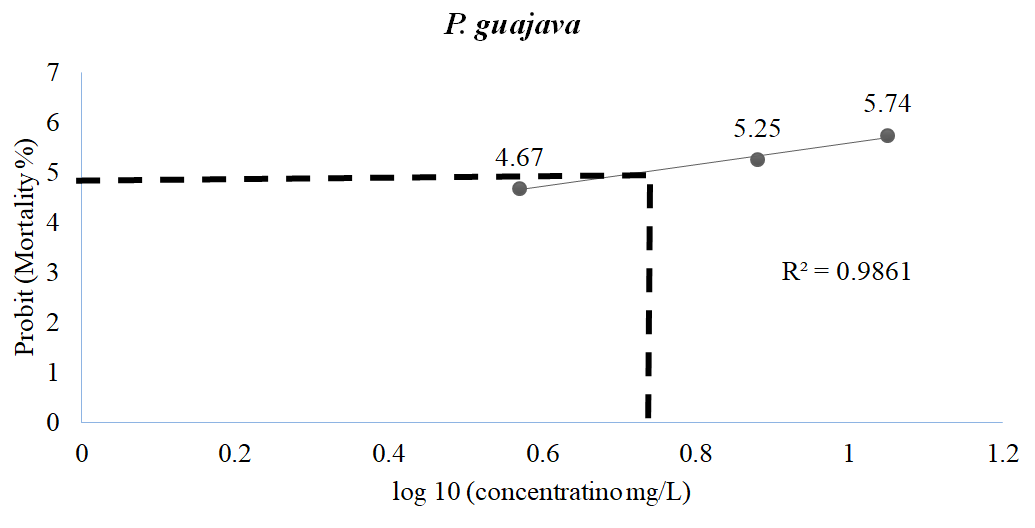
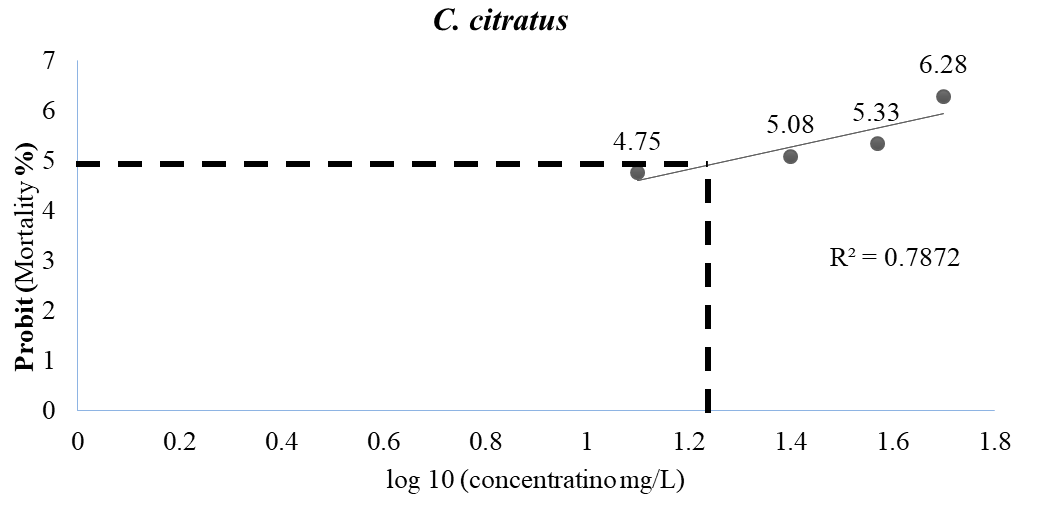
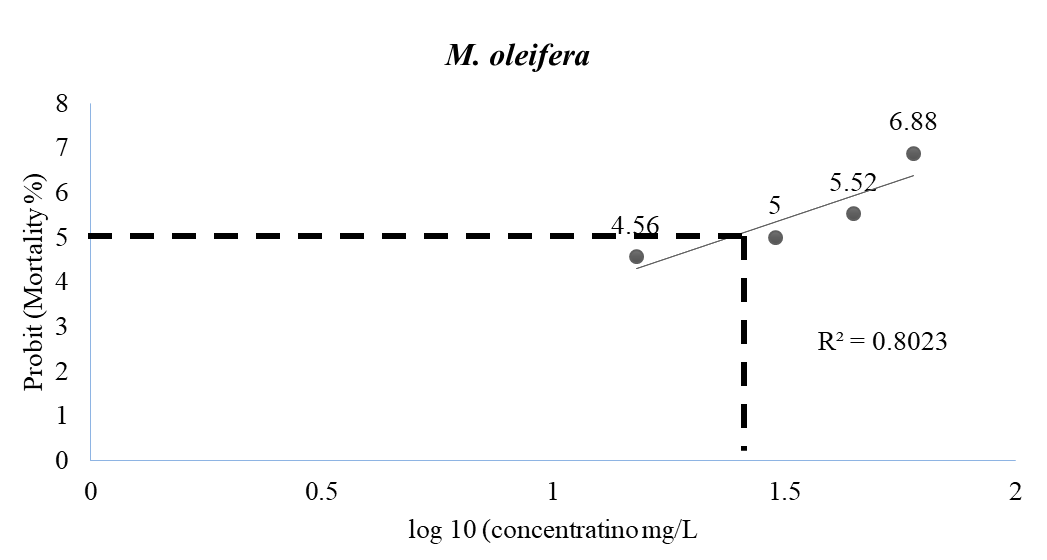
Toxicity test was run to determine the ideal dose of plants extract prior to the experiment. The toxicity test was conducted in aquaria with 4 L water for 96 hours. The determination of median lethal concentration value was done, following a range finding test concentrations of 3.75 mL/L, 7.50 mL/L, 11.25 mL/L and 15.00 mL/L for the leaf of guava (P. guajava) (Table 1), 12.50 mL/L, 15.00 mL/L, 22.50 mg/L and 30.00 mL/L for the leaf of lemon-grass (C. citratus) (Table 2) and 15.00 mL/L, 30.00 mL/L, 45.00 mL/L and 60.00 mL/L for leaf of horse radish (M. oleifera) (Table 3). Tap water was used for the control treatment. The number of dead fish was counted every 24 hours and removed immediately from the aquaria. Each container was stocked with 10 fry for a total of 450 fry used for the toxicity test. The mortality was recorded every 24 hours interval. Probit analysis was used to determine the 50% lethal concentration (LC50) and 10% lethal concentration (LC10) value and its corresponding 95% confidence limit.
For the toxicity test, each treatment was replicated thrice. A total of forty-five aquaria (10×10×10 inch) filled with 4 L of water were used. The extract solutions were mixed thoroughly in water before introducing to the experimental fish. The toxicity test was laid in a complete randomized design (CRD).
| Treatment | Concentration Of Diluted Aqueous Extract mL/L Water | ||
|---|---|---|---|
| P. guajava | C. citratus | M. oleifera | |
| 1 | 0 | 0 | 0 |
| 2 | 3.75 | 12.5 | 15 |
| 3 | 7.5 | 25 | 30 |
| 4 | 11.25 | 37.5 | 45 |
| 5 | 15 | 50 | 60 |
Table 1: The concentrations of guava (_Psidium guajava_), lemongrass (_Cymbopogon citratus_) and horse radish (_Moringa oleifera_
Experiment 2 - Nursing of Nile Tilapia Fry using Plant Extracts
After determining the LC50, the lethal concentration value with 10% (LC10) mortality was used for the Experiment 2, and a control treatment was prepared without the addition of the extract (Table 2). Twelve glass aquaria (30×60×30 cm) with a capacity of 50 L of water were used in the study. The study was composed of four treatments and each treatment was replicated thrice.
| Treatment | Concentration Of Diluted Plant Samples Aqueous Extract ML/L Water | Equivalent Amount of Plant Samples Used (MG) |
|---|---|---|
| T1 (control) | 0 | 0 |
| T2 (P. guajava) | 1.4 | 143 |
| T3 (C. citratus) | 5 | 500 |
| T4 (M. oleifera) | 10 | 1000 |
Table 2: The concentrations of guava, lemongrass and horse radish leaves for experimental trial.
The stocking density for the Experiment 2 was 20 fry in each aquarium and the extraction procedure from the Experiment 1 was also followed. Each treatment was diluted in 40 L water using (30×60×30 cm) aquaria for growth and survival data. The aquaria were covered to avoid fluctuation in water temperature and also to reduce light intensity penetration. At the end of the experiment, the survival and growth rate were determined and recorded.
The fish were fed with fry booster feed for 21 days using 15% feeding rate with a feeding frequency of three times a day at 8:00 AM, 12:00 NN and 4:00 PM [11]. The 50 % of water was replaced with the same concentration of extract for each treatment which was done every three days.
Data Gathered
The data on initial and final weight were recorded and body weight gain (BWG), absolute growth rate (AGR), specific growth rate (SGR), feed conversion ratio and survival rate were determined through the following formulas:
Body weight gain= Finalweight -Initialweight
Finalweight -Initialweight AbsoluteGrowth Rate(AGR)= Time(days) In(Finalweight)-In(Initialweight) Specificgrowth rate(%)= X100 Totalnumber of cultureddays feedgiven (g) Feed Conversation Ratio = Weightgain (g) Number of fishsurvived Survivalrate(%)= X100 Number of fish Water quality parameters such as temperature (°C), dissolved oxygen (mg/L), and pH were monitored every three days before water was exchanged for water quality analysis.
Statistical Analysis
Data ware analyzed statistically using one-way analysis of variance (ANOVA) and the means were compared using Tukey’s Range Test. Statistical analysis was administered using R software.
Results
Experiment 1 - Toxicity Test of Plant Extracts
The 96-h toxicity test, also called short-term or acute toxicity test, is one of the most commonly used tests in the evaluation of toxicity [12]. Based on the 96-hour median lethal concentration (LC50), the most toxic plant extract was P. guajava at 19 mL/L and the least toxic was M. oleifera at 24 mL/L (Table 3). The linear relationships between probit response and log concentration of plants sample are presented in Figures 1-3.
Fish mortality increased with increasing concentration, but the former decreased with time (Table 4). No mortality was recorded in the control treatment during the toxicity test. All fish subjected to higher concentration levels appeared in a more distressed condition. However, at lower concentrations (at 3.75, 12.50 and 15.00 mL/L), such physical distress was recorded only in P. guajava after long exposure and occasionally, even at short exposure. The P. guajava aqueous extract was the fastest to show abnormal behaviors of fish among the plant samples and it was recorded three hours after the administration of the plant extract. The first mortality was recorded after four hours at the highest concentration. On the other hand, Nile tilapia fry subjected to C. citratus aqueous extract showed abnormal behaviors and mortality on the highest concentration at 8 hour exposure period while fish exposed to M. oleifera attained first mortality after 12 hours.
- Plants Sample
- Conc.(ppt) log of conc.
- Mortality (%)
- Probit
- LC50 (PPT )
- LC10 (PPT )
- 0
- 0
- 0
- 0
- 3.75
- 0.57
- 37
- 4.67
- Guava (Psidium guajava)
- 7.5
- 0.88
- 60
- 5.25
- 6
- 1.4
- 11.25
- 1.05
- 77
- 5.74
- 15
- 1.18
- 100
- 0
- 0
- 0
- 0
- 12.5
- 1.1
- 40
- 4.75
- Lemongrass (Cymbopogon citratus)
- 25
- 1.4
- 53
- 5.08
- 19
- 5
- 37.5
- 1.57
- 63
- 5.33
- 50
- 1.7
- 90
- 6.28
- 0
- 0
- 0
- 0
- 15
- 1.18
- 33
- 4.56
- Horse radish (Moringa oleifera)
- 30
- 1.48
- 50
- 5
- 24
- 10
- 45
- 1.65
- 70
- 5.52
- 60
- 1.78
- 97
- 6.88
Table 3: Acute toxicity of guava (Psidium guajava), lemongrass (Cymbopogon citratus) and horse radish (Moringa oleifera) to Nile
- Table 3: Acute toxicity of guava (Psidium guajava), lemongrass (Cymbopogon citratus) and horse radish (Moringa oleifera) to Nile tilapia fry after 96 h of exposure at different concentrations.
- Plants Sample
- Conc. (PPT) log of conc.
- Exposure Time (H)
- Total Mortality
- Mortality %
- 24
- 48
- 72
- 96
- 0
- 0
- 0
- 0
- 0
- 0
- 0
- 0
- 3.75
- 0.57
- 4
- 0
- 0
- 0
- 4
- 36.7
- Guava (Psidium guajava)
- 7.5
- 0.88
- 5
- 0
- 0
- 0
- 6
- 60
- 11.25
- 1.05
- 6
- 0
- 2
- 0
- 8
- 76.7
- 15
- 1.18
- 6
- 2
- 2
- 0
- 10
- 100
- 0
- 0
- 0
- 0
- 0
- 0
- 0
- 0
- 12.5
- 1.1
- 3
- 1
- 0
- 0
- 4
- 40 lemongrass (Cymbopogon citratus)
- 25
- 1.4
- 4
- 1
- 0
- 0
- 5
- 53.3
- 37.5
- 1.57
- 4
- 2
- 0
- 0
- 6
- 63.3
- 50
- 1.7
- 6
- 2
- 1
- 0
- 9
- 90
- 0
- 0
- 0
- 0
- 0
- 0
- 0
- 0
- 15
- 1.18
- 2
- 0
- 0
- 1
- 3
- 33.3
- Horse radish (Moringa oleifera)
- 30
- 1.48
- 3
- 1
- 1
- 0
- 5
- 50
- 45
- 1.65
- 5
- 2
- 0
- 0
- 7
- 70
- 60
- 1.78
- 6
- 2
- 1
- 1
- 10
- 96.7
Table 4: Mortalities of guava (Psidium guajava), lemongrass (Cymbopogon citratus) and horse radish (Moringa oleifera) after 96
Experiment 2 - Nursing of Nile Tilapia Fry using Plant Extracts
The results of the growth parameters monitored in the present study are shown in Table 5. The highest final weight was obtained in fish immersed with aqueous extracts of M. oleifera (Treatment 4) and C. citratus (Treatment 3) which revealed to be statistically comparable to each other. On the other hand, fish reared with C. citratus and M. oleifera extracts attained significantly higher (P<0.05) final weight compared to fish reared without plant extract (control treatment) and to fish reared with P. guajava (Treatment 2). Similar pattern was obtained in terms of body weight gain (BWG), absolute growth rate (AGR), specific growth rate (SGR).
Based on the current study, significant results were observed in terms of feed utilization of fish immersed in different plant aqueous extract. Highest results in FCR was observed in fish immersed with M. oleifera leaves extract and C. citratus leaves extract which also revealed to be insignificantly different with each other. On the other hand, fish reared in C. citratus and M. oleifera leaves extracts attained significantly (P<0.05) lower FCR compared to fish reared with P. guajava extract and fish reared without plant extract (control).
Result in terms of survival rate revealed that fish reared with C. citratus and M. oleifera extracts attained the highest percentage survival. Both plant extracts and the control treatment were insignificantly different with each other. Lowest survival rate was generated among fish treated with P. guajava extract and it was significantly lower compared to the rest of the treatments (P<0.05).
| Parameter | TREATMENT | |||
|---|---|---|---|---|
| 1 | 2 | 3 | 4 | |
| Control | Psiduim guajava | Cymbopogon citratus | Moringa oleifera | |
| No plant extract | ||||
| Initial weight (g) | 0.28 ±0.034 a | 0.26±0.075 a | 0.23±0.02 a | 0.23±0.03a |
| Final weight (g) | 0.66 ±0.11 a | 0.78±0.03 a | 1.01±0.03 b | 1.07±0.05 b |
| Body weight gain (g) | 0.30 ±0.06 a | 0.38±0.06 a | 0.74±0.04 b | 0.78±0.03 b |
| Absolute growth rate (g/day) | 0.02 ±0.00 a | 0.03±0.01 a | 0.04±0.00 b | 0.04±0.00 b |
| Specific growth rate (%) | 4.12 ±0.23 a | 5.36±1.13 a | 7.06±0.42 b | 7.29±0.41 b |
| FCR | 4.37 ±1.01 b | 3.63±0.85 b | 1.84±0.12 a | 1.89±0.26 a |
| Survival rate (%) | 78.33 ±5.77 b | 65.00±5.00 a | 83.33±2.89 b | 80.00±5.00 b |
Table 5: Growth performance of Nile tilapia fry immersed in guava (Psidium guajava), lemongrass (Cymbopogon citratus) and horse r
Means (±SD) in rows with similar superscript are not significantly different at 5% level of significance. Table 5: Growth performance of Nile tilapia fry immersed in guava (Psidium guajava), lemongrass (Cymbopogon citratus) and horse radish (Moringa oleifera) leaves extracts after 3 weeks of rearing.
Water Quality Parameters
The results in water quality parameters such as dissolved oxygen (DO), pH, temperature and Total Ammonia Nitrogen (TAN) are presented in Table 6.
| Parameters | Treatment | |||
|---|---|---|---|---|
| 1 | 2 | 3 | 4 | |
| DO (ppm) | 7.86±0.23 | 7.18±0.09 | 7.65±0.53 | 7.53±0.32 |
| pH | 7.69±0.01 | 7.72 ±0.08 | 7.69±0.03 | 7.66±0.03 |
| Temperature (°C) | 24.37±1.90 | 25.59±0.21 | 25.88±0.21 | 25.43±0.17 |
Table 6: Summary of water quality parameters.
Means in rows with similar superscript are not significantly different at 5% level of significance.
Statistical analysis revealed that there were no significant differences (P<0.05) among all treatments in terms of DO, pH and temperature. Further, the monitored levels in DO, pH and temperature were within the range of recommended levels for Nile tilapia culture. According to Boyd, et al. [13] warm- water fish grow best at temperatures between 25°C and 32°C for dissolved oxygen (5.2-7.5mg/l) and waters with pH values of above 6.5 to 9 at daybreak are considered best for fish production.
Discussion
The reduction of mortality observed as time progressed on the toxicity test might be due to the lesser effect of the toxicity on the fish after a certain period, thus the fish gained tolerance towards the concentration. In addition, all fish reared without plant extracts in the toxicity test had survived which an indication that the mortality was dose-dependent and varies within the time of exposure of aquatic organisms to toxicants similar on the previous studies of Akinwande, et al. [14]; Ayoola, et al. [15] and Fafioye, et al. [16]. The abnormal behavior observed among fish exposed to higher concentration levels in relation to fish stress includes erratic swimming, mucus secretion, gasping for air, hemorrhages and stiff fin rays. The initial increased in opercular movement can be considered as an index of the suffocation stress felt by the fishes exposed to poisons [17].
Based on the current study, fish reared with P. guajava aqueous extract displayed abnormal behaviors even during the initial hours of observation which was different from the other plant extracts. According to Dhara, et al. [18] the abnormality observed could be due to toxicant induced cumulative deleterious effects at various metabolic sites of the fish body or due to disruption of nervous system function. Further, the observed behavioral responses of the fish might be due to the impairment in neural transmission, nervous impairment due to blockage of nervous transmission between the nervous system and various effected sites, induction of oxidative stress and disturbances in enzyme mediated metabolic pathways.
In terms of the nursing of Nile tilapia fry using the three plant extracts, the findings of the present study indicated that immersion of Nile tilapia fry with C. citratus (500 mg/L) and M. oleifera (588 mg/L) aqueous extracts can potentially enhance the growth performance of O. niloticus after 3 weeks of nursing. The enhanced growth obtained from the C. citratus and M. oleifera might be due to the phytocomponents and the antimicrobial activity of the plant extracts. Medicinal herbs including C. citratus and M. oleifera contained diverse groups of phytochemicals such as phenolics, flavonoids, alkaloids, polysaccharides, volatile oils and proteoglycans which have been reported to act as antimicrobial agents and have the capability to stimulate both specific and non-specific immunity in fish by modulating the functions of the immune cells, including T-cells, B-cells, NKcells and macrophages, increasing cytokine production and immune related gene expression, and increasing antibody production [19, 20]. Such immunostimulating properties of herbs may lead to better health condition, disease resistance and ultimately faster growth in fish [21]. Previous study reported the effectiveness of using medicinal herbs and leaves extracts as growth promoter to fish. The study of Turan, et al. [22] showed that the largest gain in body weight of African catfish (Clarias gariepinus) at the end of a 30 days immersion treatment was generated in Tribulus terrestris extract with 9 g/30 L. This study revealed that utilization of T. terrestris extract was effective in improving growth performance of African catfish. Previous study also reported that the phytochemicals compounds of plants extract have been reported to promote various activities, including ant stress, growth promotion, appetite stimulation, tonic and immunostimulating, and antimicrobial properties in fish culture [19]. Regarding the antimicrobial properties of substances derived from plants, studies on controlling parasitic infections in humans and animals, including fish, have been stimulated and those factor may contribute to high survival of the Nile tilapia fry [23].
Conclusion
The findings of the current study suggested that water immersion of 10.00 mL/L of M. oleifera and 5.00 m/L of C. citratus aqueous extracts during nursing period of Nile tilapia fry can potentially enhance the growth performance, feed utilization and survival rate. The findings of the present study may serve as preliminary information for future studies in terms of the determination of specific bioactive compounds present on the plant extracts used that may influence the enhanced growth performance and survival attained by Nile tilapia fry. Further, utilization of other herbal plant extracts on the nursing of Nile tilapia fry or other cultured species are also potential studies to be conducted. More over administration of plant extract through injection and oral administration on Nile tilapia fry is also recommended to further evaluate the effects of plant extract used in the study.
References
-
Akankali JA, Seiyaboh EI, Abowei JFN (2011) Fish Hatchery Management in Nigeria. Advance Journal of Food Science and Technology 2(3): 2042-4876.
-
Brain FD, Army C (1980) Induced fish breeding in South East Asia. Repot of the workshop held in Singapore.
-
Charo H, Oirere W (2000) River-based artificial propagation of the African Catfish, Clarais garipinus: An option for the small fish farmer. Naga, the ICLARM Quarterly 23(1): 14-16.
-
Gabriel NN, Redondo PG (2019) Review on the progress in the role of herbal extracts in tilapia culture. Cogent Food and Agriculture 5(1): 619-651.
-
Jacela YJ, DeRouchey MJ, Tokach DM, Goodband RD, Nelssen LJ, et al. (2010) Feed additives for swine: Fact sheets – prebiotics and probiotics, and phytogenics. Journal of Swine Health and Production 18(3): 132-136.
-
Hashemi SR, Davoodi H (2011) Herbal plants and their derivatives as growth and health promoters in animal nutrition. Veterinary research communications 35(3): 169-180.
-
Bulfon C, Volpatti D, Galeotti M (2013) Current research on the use of plant-derived products on farmed fish. Journal of Aquaculture Research 46(3): 513-551.
-
Zanuzzo FS, Urbinati EC, Rise ML, Hall JR, Nash GW, et al. (2015) Aeromonas salmonicida induced immune gene expression in aloe vera fed steelhead trout, Oncorhynchus mykiss (Walbaum). Aquaculture 435: 1-9.
-
Omoniyi I, Agbon AO, Sodunke SA (2002) Effect of lethal and sublethal concentrations of tabocco (Nicotiana tobaccum) leaf dust extract on weight and heamatological changes on Clarias gariepinus (Burch). Journal of Applied Sciences 6(2): 382-387.
-
El-Sherif MS, Ahmed MT, El-Damasoury MA, El-Nwishy HK (2009) Evaliuation of Diazinon toxicity on Nile Tilapia fish ( _niloticus_). Journal of fisheries and Aquatic Science 4(4): 169-177.
-
Bhujel RC (2013) On-farm feed management practices for Nile tilapia (Oreochromis niloticus) in Thailand. In: Hasan MR, New MB, et al. (Eds.), On-farm feeding and feed management in aquaculture. FAO Fisheries and Aquaculture Technical Paper No. 583. Rome, FAO, pp: 159-189.
-
Murty A S (1986) Toxicity of Pesticides to fish. RC Press Inc 1: 483-355.
-
Boyd CE, Pillai VK (1985) Water quality management in aquaculture. Central Marine Fisheries Research Institute, Special publication, Cochin, India 22: 1-44.
-
Akinwande AA, Sogbesan AO, Moody FO, Ugwumba AAA (2007) Piscicidal potential of mesocarp of neem plant (Azadirachta indica) fruit on hybrid, Heteroclarias. Journal of Environmental Biology 28(3): 533-536.
-
Ayoola SO, Kuton MP, Idowu AA, Adelakun AB (2011) Acute Toxicity of Nile Tilapia (Oreochromis niloticus) Juveniles Exposed to Aqueous and Ethanolic Extracts of Ipomoea aquatica. Nature and Science 9(3): 91-99.
-
Fafioye OO (2012) Acute and sub-acute toxicities of five plant extracts on white tilapia, Oreochromis niloticus (Trewavas). International Journal of Life- Sciences Scientific Research 2(13): 525-530.
-
Ferdous Z, Shakil K, Habib M (2018) Piscicidal effects of plant seed extracts on predatory fish, Channa punctatus (Teleostei: Channidae) reared in aquarium. Journal of Entomology and Zoology Studies 6(4): 1232-1236.
-
Dhara K, Karmakar S R (2016) Acute Toxicity of Neem (Azadirachta indica Juss) Leaf Extracts to Snake Headed Fish, Channa gachua (Ham.) with Special Reference to their Ethological Responses and Some Haematological Parameters. International Journal of Life-Sciences Scientific Research 2(5): 552-558.
-
Citarasu T (2010) Herbal biomedicines: a new opportunity for aquaculture industry. Aquaculture International 18: 403-414.
-
Chakraborty SB, Hancz C (2011) Application of phytochemicals as immunostimulant, antipathogenic and antistress agents in finfish culture. Reviews in Aquaculture 3(3): 103-119.
-
Chakraborty SB, Horn P, Hanc C (2013) Application of phytochemicals as growth-promoters and endocrine modulators in fish culture. Reviews in Aquaculture 6(1): 1-19.
-
Turan F, Cek S (2007) Masculinization of African catfish (Clarias gariepinus) treated with gokshura (Tribulus terrestris). Israeli Journal of Aquaculture – Bamidgeh 59(4): 224-229.
-
Abd El-Galil MA, Aboelhadid SM (2012) Trials for the control of trichodinosis and gyrodactylosis in hatchery reared Oreochromis niloticus fries by using garlic. Veterinary Parasitology 185(2-4): 57-63.
- Natural Decline to Extinction of A New Zealand Rabbit Population
- Mitochondrial Bio-Logistics: Steering Co-Enzyme Q10 and Lycopene Synergies within the Science 4.0 Bio-OS Framework
- Hymenoptera Specimens from the Caño Negro Wetland, of the National Museum Collection, Costa Rica
- Science 4.0: Comprehensive Architecture of the Biological Operating System (Bio-OS) A Framework for Systemic Resilience and Industrialized Bio-Governance
- Rabbit on, or Hare Back? Understanding Climate Change
- Clinical Validation of Science 4.0: Flow Steering and Epigenetic Drift Inversion on a 76-Year-Old Hybrid System