
Toxicity Test of Sea Cucumber Bohadschia sp Extract from the South East Sulawesi Coastal Waters Indonesia against Carp Fish (Cyprinus carpio Linn)
Sea cucumber is believed to have antimicrobial and immunostimulating active metabolites which can be utilized in aquaculture, though it requires a toxicity test before it is applied to aquatic organisms. The purpose of this study is to determine the toxicity level of sea cucumber extract Bohadschia sp in juvenile carp (Cyprinus carpio Linn). Sampling was conducted in the coastal waters of South Konawe Regency, SE Sulawesi, Indonesia. The extraction process involved methanol extraction of whole sea cucumbers that were cleaned from their intestine and then dried. The toxicity test was done by exposing the fish in an extract mixed water medium at various concentrations with a density of 10 fish per aquarium. This study was initiated by Range Finding Test (RFT), followed by an acute test. The concentration levels given in the RFT test were from low to high concentrations of 5, 50, 150, 1,500, 3000 to 6000 ppm. Meanwhile the concentrations in the acute toxicity test were determined from the results of the RFT, which were 130, 338, 878, 2280 and 5920 ppm. The upper threshold value of the RFT results was 6000 ppm while the lower threshold was 50 ppm. The results of the acute toxicity test showed that the LC50 values of sea cucumber extract for juvenile carp were 2668.83 ppm (24 h), 1062.90 ppm (48 h), 655.45 ppm (72 h) and 417.92 ppm (96 h).
Introduction
Sea cucumber (Holothuroidea) is an unique marine creature, easily recognized for its cylindrical body extending from the tip of the mouth towards the anus. Sea cucumber is known as a source of animal protein in marine fisheries, and has long been consumed by many people. With its nutritional content, sea cucumber can heal wounds and is used as an anticoagulant and antithrombotic, anticancer and anti-tumor, antibacterial, immunostimulants, antifungal, antiviral, antimalarial and antirheumatic as well as to lower cholesterol and blood fat [1, 2]. The bioactive ingredients in sea cucumber are antioxidants that help reduce damage in cells and body tissues. The antibacterial and antifungal properties of sea cucumber are desirable for skin care purposes. Sea cucumber is also known to have anti- proliferative (against cell cancer progression) and anti- inflammatory effects (against inflammation and reduce swelling) [3]. Sea cucumber (Holothuria scabra) is rich in secondary metabolite compounds, such as saponins, steroids, sapogenins, triterpenoids, glycosaminoglycan, lectins, alkaloids, phenols and flavonoids [4]. Moreover, Rasyid, et al. [5] also found that Bohadschia sp. contains bioactive steroids and saponins.
The research results from Suhermanto, et al. [6] showed that giving 0.09 mg/kg of total phenol from the extract of sea cucumber was optimal in increasing the non-specific immune response in carp. In addition, the total phenol in sea cucumber also increases leukocytes that have the most important function in the protective mechanisms of the fish body by producing Reactive Oxygen Species (ROS) and nitrogen which are toxic to pathogenic bacteria in fish, capable of destroying invading pathogens important indicators of non-specific defense in fish [7].
The large number of beneficial secondary metabolites from sea cucumbers allows it to also be useful for cultivated fish. Carp is the most widely cultivated freshwater fish and is the oldest freshwater aquaculture commodity in Indonesia [8]. Fish farming activities, for both consumption and ornamental fishes, are activities that are subjected to many risks. One of the causes of failure in fish farming is the disease factor, especially in carp fish which are susceptible to disease [9].
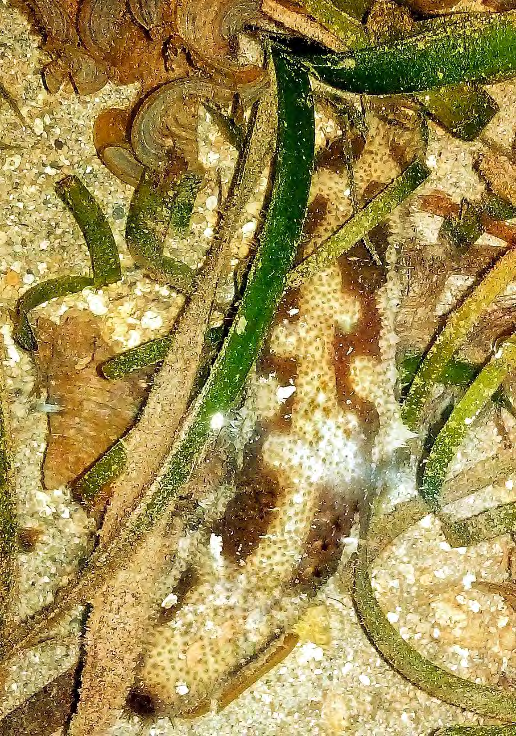
Figure 1: Sea cucumber Bohadchia sp. lives in seagrass habitats. Its morphology shows a similarity to the species Bohadchia cf. similis. The body shape of sea cucumbers in general is cylindrical, extending from the tip of the mouth to the anus (orally-aborally). Like the Echinoderms in general, the body of the sea cucumber is a radial symmetry with a horizontal axis. Another characteristic are the presence of a skeleton shape and a water-vascular system. The skeleton of the sea cucumber is modified in the form of microscopic spicules and is scattered throughout the body wall.
However, all substances to be used for the treatment of organisms must be tested for toxicity in advance. Toxicity testing will help to provide the correct dosage information so that it is not harmful to the organisms to consume. The toxicity test carried out by observing the level of mortality caused by the exposure of the test animal to the extract after 24 hours. The limit of biological activity was by value of LC50< 1000 µg/mL [10]. The smaller the LC50 value of the animal extract, the more toxic it will be and the more it has the potential to have biological activity or pharmacological effects [11].
Given that sea cucumbers have the potential as a medicinal, antibacterial and antifungal ingredients, sea cucumber extract can be applied for use in disease control. A toxicity test is deemed necessary in order to evaluate the toxicity effect of a substance. Therefore, it is necessary to conduct a toxicity test of the Bohadchia sp. extract to determine its safe use limit on carp fish.
Materials and Methods
Sea Cucumber Extract Preparation
Sea cucumber samples were collected between December 2017 and February 2018 from the coastal waters of South Konawe Regency, SE Sulawesi, Indonesia. Sea cucumbers were cut up and washed thoroughly, after which all body parts and organs were taken, except the intestines, and then dried in the sun and/or in the oven. After drying, the sea cucumbers were cut into 1-2 cm pieces and then chopped and ground using a food grade blender and processed in a powder form. The maceration procedure according to Nur I, et al. [12]; Azlan, et al. [13], was as follows: The dried and ground sea cucumbers were extracted using 70% methanol solution (1: 4, w/v). The powder was soaked for 24-hours in a methanol solution, then stirred and filtered. The soaking process has been performed twice. Until a thick crude extract was obtained, the methanol extract obtained was concentrated by means of an evaporator, and then the extract was aerated to evaporate the remaining methanol over a heater at 40 ◦C until the methanol solvent was free from the sample.
The Range Finding Test
The Range Finding Test (RFT) aims to find a certain range that causes 50% of the test animal’s mortality. This test is the basis for determining the concentration used in further tests or real toxicity tests, namely the concentration that causes the largest mortality approaching 50% and the smallest mortality approaching 50%.
This preliminary stage is to obtain a range of concentrations of upper threshold values and lower threshold concentrations. The number of carp seeds used in this study was 140 fish, with a density of 10 fish in each unit, where each treatment was Treatment A = negative control, Treatment B = 5 ppm, Treatment C = 50 ppm, Treatment D = 150 ppm, Treatment E = 1500 ppm, Treatment F = 3000 ppm and Treatment G = 6000 ppm and each consisted of 2 replications.
Fish mortality was recorded and converted into the percentage of deaths for each observation time. In addition, the fish behavior in the treated container was also observed. The mortality was calculated every 2 hours until the 48th hour. Based on the range finding test, a lower and upper threshold value will be obtained which was used as a reference for calculating the concentration used in the toxicity test for further research to determine the LC50 value.
Acute Toxicity Test
The toxicity test was carried out after the preliminary test to obtain an LC50 value or 50% fish mortality using the concentration range of sea cucumber extract based on preliminary tests. Furthermore, each aquarium was filled with 1 liter of water and added the extract of sea cucumber for different concentrations. Furthermore, the juvenile carp were sown in each aquarium simultaneously with a density of 10 per aquarium and then observed the mortality and behavior of the test fish. Observations were made every 6 hours, starting from the first exposure to sea cucumber extract. Each dead test animal was removed from the container and during the observation the test animal. During the study, the test animals were fed sufficiently, no water change and given aeration continuously.
Results
The results of the preliminary test of sea cucumber extract can be seen in Figure 2.
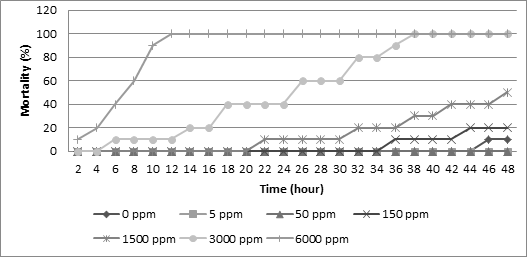
The results above show that at a concentration of 0 ppm there was 10% mortality, at a concentration of 5 ppm and 50 ppm there were no deaths in the test fish from the beginning to the end of the test range determination. Furthermore, for a concentration of 150 ppm there were 10% deaths at the 36th to 42nd hours and at the 44th to 48th hours as much as 10% again so that the total death at a concentration of 150 ppm was 20%. Meanwhile, observations at a concentration of 6000 ppm, test fish resulted death from the second hour as much as 10% and continued to increase until the 12th hour as much as 100%.
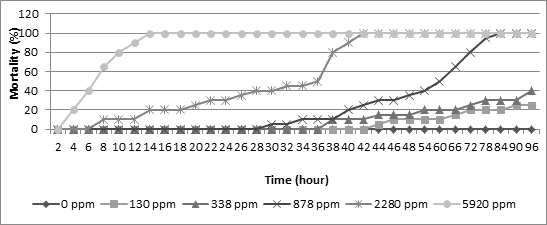
The graph of the percentage of fish mortality in the acute toxicity test (Figure 3) shows that the treatment using sea cucumber extract at a concentration of 130 ppm from the beginning of study until the 42nd hour the test fish were still alive, while at the 44th hour it was seen that the fish had started to experience death from 10% and continued to increase until the 96th hour by 25%. Furthermore, at a concentration of 5920 ppm, it was seen that the test fish began to experience death at the 4th hour by 20% and 100% at the 14th hour. Meanwhile, no mortality was found in the control treatment.
The relationship between the percentage of carp fish seed mortality, sea cucumber extract concentration and observation time at 24 hours can be seen in Figure 4.
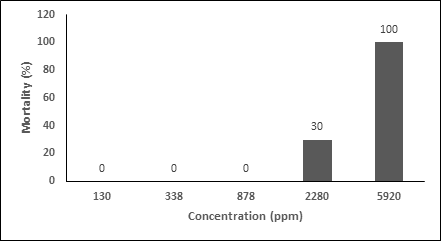
Based on the data above, it shows that at a concentration of 2280 ppm the test carp died were 30% within 24 hours, while at a concentration of 5920 ppm there was 100% mortality within 24 hours of observation.
The relationship between the percentage of carp fish juvenile mortality, sea cucumber extract concentration and observation time at 48 hours can be seen in Figure 5.
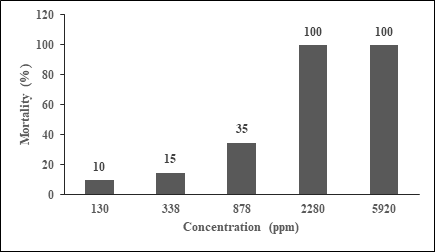
The data shows that at a concentration of 130 ppm there is 10% mortality, then at a concentration of 338 ppm there is 15%, while at concentrations of 2280 and 5929 ppm the mortality of test fish were 100% with 48 hours of observation.
The relationship between the percentage of carp fish juvenile mortality, sea cucumber extract concentration and observation time at 72 hours can be seen in Figure 6.
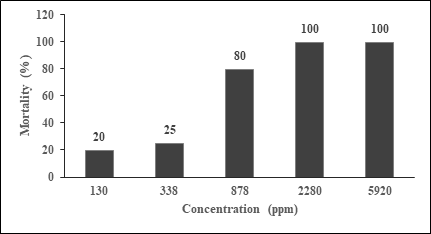
The data shows that the lowest mortality was obtained from the concentration of 130 ppm at 20% after 72 hours, then at a concentration of 338 ppm there is 25%, while at concentrations of 2280 and 5929 ppm the mortality of test fish were 100%.
The relationship between the percentage of carp fish juvenile mortality, sea cucumber extract concentration and observation time at 96 hours can be seen in Figure 7.
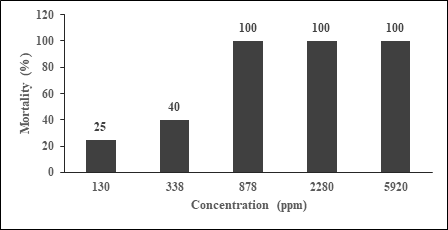
The data shows that at a concentration of 130 ppm there is 25% mortality, then at a concentration of 338 ppm there is 40%, while the highest mortality was found in the concentration of 878, 2280 and 5929 ppm at 100% with 96 hours of observation.
Discussion
For many decades, the discovery and production of natural products that reside in marine organisms as antipathogenic and immunostimulant agents has contributed to the development of drug therapeutics. Marine drug therapeutics is not only intended for human well-being, but is also applied in fish health management to increase aquaculture production. Marine natural products became increasing day to day because biodiversity of the marine environment more abundant than that of the terrestrial environment [14]. Among these, sea cucumbers (class Holothuroidea), mostly have bioactive secondary metabolites and the medicinal potential for drug discovery [12, 13, 14, 15]. In line with those found in the crude extract of sea cucumber species H. scabra, it contains steroid compounds [12].
Toxicity tests are an attempt to assess the toxicity of a sample by evaluating the effects of exposure to pattern assay of organisms [16]. In an effort to search for new marine natural products, there are some methods to determine toxicity activities of the organic crude extract of organs or tissues of animal species, such as brine shrimp lethality test (BSLT), probit analysis, LD50 test and histopathology [17, 18, 19]. BSLT assay uses an alternative method that uses small shrimp (Artemia salina) to replace large animals, reduce the mortality and stress of test animals so that it is easy to do in the laboratory. Meanwhile, in this study, the direct toxicity test was applied to fish because the sea cucumber extract will be applied in aquaculture. Common carp is a general species that is easily treated in a laboratory test.
In the range limit determination test (RFT) of sea cucumber extract shows an LC50 value of 666,412 ppm (48 hours) which means that the sea cucumber extract is said to be toxic. This is consistent with the statement of Meyer, et al. [10] that a substance is said to be active or toxic if the LC50 value is <1000 µg/mL.
Observation of fish behavior during the preliminary test took place when they were transferred to the research container and when they were moved all of them immediately swam quickly. The control treatments, concentrations of 5 and 50 ppm a few hours later were moving normally, while in the treatment the concentrations of 150, 1500, 3000 and 6000 ppm were still moving fast and some were moving abnormally until the end of the study. Fish exposed to toxic can be seen from the fish’s behavior, such as hyperactive movements, floundering and paralyzed and even dead.
The graph of the percentage of fish mortality in the acute toxicity test (Figures 5-7) shows that the treatment using sea cucumber extract Bohadschia sp. with the highest mortality of tested animals is at a concentration of 6000 ppm (100%) with a short time, namely at the 14th hour. Meanwhile, the low mortality rate is at a concentration of 130 ppm (25%) with a time of 96 hours. Sea cucumber extract on carp fry at several concentrations has a temporary and deadly effect. Fish respond differently to each concentration. Physical symptoms in the test animals at the initial exposure to the extract were the movement of hyperactive fish. In the low concentration treatment, initially it will look hyperactive and excrete feces but not too much, with time the test animals will swim as usual like the test animals in the control. Whereas at high concentrations the test animals looked hyperactive and the test animals excreted a lot of feces and often rose to the surface. Stress in fish is generally related to natural environmental changes, be it chemical, physical or biological fish that are exposed to toxic can be seen from the fish’s behavior, namely by hyperactive movements, floundering and paralyzed. This is thought to be a way to minimize the biochemical processes in the body that are poisoned, so that the lethal effect occurs more slowly.
Toxicity test acute is one form of research aquatic toxicology. This test serves to determine whether the substance is entering the water body contains a toxic compound inside certain concentrations because the death of the animal test expressed in terms of LC50 values. In addition, the extractor solution determines the concentration of bioactive and toxicant as the results obtained by Inayah, et al. [11] that the LC50 of n-hexane extract of sea cucumber (H. scabra) by BSLT method was (189.093 ppm) higher than the ethanol extract (286.031 ppm) Sea cucumbers are considered to be high in chemicals, phenol and triterpene glycoside (saponin). Saponins are holothurian-generated secondary metabolites as a type of chemical defense mechanism. Saponins, according to the organ, have various concentrations and compositions [20]. In addition, saponins are also thought to have biological effects, including antifungal, tumor cell cytotoxicity, hemolysis, and anticancer [21]. The research data of Mashjoor, et al. [22] strengthen the previous studies, they found that three species of Holothuria: H scabra, H. parva, H. leucospilota using organic extract had potential cytotocity toward cancer cell lines.
There are about 39 new saponins and 36 triterpene glycosides from ethanol extracted of viscera of H. lessoni. Triterpenoid saponins consist of aglycones composed of 30 atoms of carbon (C30), while steroid saponins consist of aglycones composed of 27 atoms of carbon (C27) [23]. In the previous works showed that triterpene glycoside of sea cucumber has anticancer activity [24]. Actinopiga sp. methanol extract inhibits cancer cell lines, such as WiDr (colon cancer) and T47D (breast cancer) with LC50 values of 55.93 and 87.55 μg/ml, respectively. Functional group analysis showed the presence of hydroxyl, amine, carboxylic acid, nitrate, amide, sulphur, ester and ether [25].
It is suspected that the active ingredients contained in the Bohadschia sample are saponins, together with other secondary metabolites, are potential in the health beneficial. Generally, the function of saponins is antioxidant and antibacterial. In the research of Akinpelu, et al. [26] Stated that saponins can prevent damage caused by free radicals and infections caused by pathogenic bacteria. Oyedapo, et al. [27] Mention that saponins and flavonoids can stabilize the lysosomal membrane both in vivo and in vitro. In order to protect animal welfare, testing at a dose of < 500 ppm should only be considered if available strong chances that the test results will have direct relevance to protect fish health. Ethanol extract testing with higher doses it can be feared cause further damage, as in research conducted by Diwan, et al. [28], indicated that increasing the dose of administration saponin (extract of the plant Citrullus colocynthis) could increase the number of necrosis cells on mice internal organs. However, the characteristics of saponins from sea cucumber are lowering level toxicity, large efficiency, and slight side impacts. Overall, the active ingredients contained by Bohadschia may be applied to fish at the right concentration.
Conclusion
Toxicity test results showed that the LC50 values of sea cucumber extract on carp fish, respectively, were 2668.83 ppm (24 h), 1062.90 ppm (48 h), 655.45 ppm (72 h) and 417.92 ppm (96 h). The authors recommend that for further research in using sea cucumber extract for disease control in fish, it is better to pay attention to toxic concentrations in order to give optimal results.
Conflict of Interest
The authors state that they have no conflict of interest.
Acknowledgment
The author would like to thanks the International Journal of Zoology and Animal Biology for invitation to publish this article free of cost.
References
-
Farouk AE, Ghouse FAH, Ridzwan BH (2007) New bacterial species isolated from Malaysian sea cucumbers with optimized secreted antibacterial activity. Am J Biochem Biotechnol 3(2): 60-65.
-
Ghadiri M, Kazemi S, Heidari B, Rassa M (2018) Bioactivity of aqueous and organic extracts of sea cucumber _Holothuria leucospilota_ (Brandt 1835) on pathogenic Candida and Streptococci. Int Aquat Res 10: 31-43.
-
Kareh M, Nahas REl, Aaraj LAl, Ghadban AlS, Deen NNAL, et al. (2018) Anti-proliferative and anti-inflammatory activities of the sea cucumber _Holothuria polii_ aqueous extract. SAGE Open Medicine 6: 2050312118809541.
-
Bordbar S, Farooq A, Nazamid S (2011) High-value components and bioactives from sea cucumbers for functional foods-A Review. Mar Drugs J 9(10): 1761- 1805.
-
Rasyid A (2016) Analisis metabolit sekunder, aktivitas antibakteri dan komposisi golongan senyawa dalam ekstrak teripang _Bohadschia_ sp. (Indonesian). secondary metabolites, antibacterial activity and compound group composition in sea cucumber _Bohadschia_ sp. extract (English). Jurnal Ilmu Kelautan dan Teknologi Kelautan Tropis 8(2): 645-653.
-
Suhermanto A, Andayani S, Maftuch (2013) Pengaruh total fenol teripang pasir (_Holothuria scabra_) terhadap respon imun non spesifik ikan mas (_Cyprinus carpio_ Linn)(Indonesian). Effect of total phenol of sea cucumber (_Holothuria scabra_) on non-specific immune response of goldfish (_Cyprinus carpio_ Linn) (English). Jurnal Bumi Lestari 13(2): 225-233.
-
Alexander CP, Kirubakaran, CJW, Michael RD (2010) Water soluble fraction of Tinospora cordifolia leaves enhanced the non spesific immune mechanism and disease resistance in _Oreochromis mossambicus_. Fish Shellfish Immunol 29(5): 765-772.
-
Food and Agriculture Organization of the United Nations (2020) National Aquaculture Sector Overview: Indonesia.
-
Hoole D, Bucke D, Burgess P, Wellby I (2001) Diseases of Carp and Other Cyprinid Fishes. Fishing News Books. Blackwell Science Ltd.
-
Meyer BN, Ferrighi NR, Putnam JE, Jacobsen LB, Nichols DE, et al. (1982) Brine shrimp: A convenient general bioassay for active plant consti-tuents. Planta Medica 45(1): 31-34.
-
Inayah N, Ningsih R, Adi TK (2012) Uji toksisitas dan identifikasi awal golongan senyawa aktif ekstrak etanol dan n-heksana teripang pasir (_Holothuria scabra_) kering Pantai Kenjeran Surabaya. Alchemy 2(1): 92-100.
-
Nur I, Asnani A, Yusnaini Y (2019) Potensi ekstrak steroid dari teripang pasir (_Holothuria scabra_) dari Perairan Atowatu Kendari untuk pengendalian bakteri Vibrio harveyi ) (Indonesian). The potency of steroid extracts of sea-cucumber (_Holothuria scabra_) collected from Atowatu Coast of Kendari to control Vibrio harveyi (English). Jurnal Sains dan Inovasi Perikanan 3(1): 26-
-
Azlan, Nur I, Abidin LOB (2021) Active compounds and immunostimulating potential of _Holothuria scabra_ extract in common carp fish (_Cyprinus carpio_) against Aeromonas hydrophila infection. International Journal of Zoology and Animal Biology 4(1): 000271
-
Jimenez GMS, Hernandez AB, Brauer JME (2012) Bioactive peptides and depsipeptides with anticancer potential: Sources from marine animals. Mar Drugs 10(5): 963-986.
-
Bordbar S, Farooq A, Nazamid S (2011) High-value components and bioactives from sea cucumbers for functional foods-A Review. Mar Drugs J 9(10): 1761- 1805.
-
Kroll D (2009) Handbook of Water Purity and Quality. Academic Press 343-377.
-
Albuntana A, Yasman Y, Wardhana W (2011) Toxicity test of extracts of the four sea cucumber (Family Holothuriidae) from East Penjaliran Island, Seribu Islands, Jakarta Based on the Brine Shrimp Lethality Test (BSLT). Jurnal Ilmu dan Teknologi Kelautan Tropis 3(1): 65-72.
-
Abrori C, Nurfadhila K, Sakinah EN (2019) Uji toksisitas akut ekstrak etanol daun kemangi (_Ocimum sanctum_) Diukur dari Nilai LD50 dan Histopatologi Ginjal (Indonesian). Acute toxicity tests of basil leaves (Ocimum sanctum) ethanolic extract determined by LD50 and renal histopathology (English). Journal of Agromedicine and Medical Sciences 5(1): 13-20.
-
Yusnaini Y, Emiyarti E, Nur I, Astuti O, Patadjai RS, et al. (2020) Sublethal toxicity test of Mercury (Hg) in the flesh and tissue of tilapia (_Oreochromis niloticus_). Omni- Akuatika 16(2): 99-107.
-
Caulier G, Dyck S V, Gerbaux P, Eeckhaut I, Flammang P, et al. (2011) Review of saponin diversity in sea cucumbers belonging to the family Holothuriidae. SPC Beche-de- mer Information Bulletin 31: 48-54.
-
Li YX, Himaya SWA, Kim SK (2013) Triterpenoids of marine origin as anti-cancer agents. Molecules 18(7): 7886-7909.
-
Mashjoor S, Yousefzadi M (2019) Cytotoxic effects of three Persian Gulf species of Holothurians. Iran J Vet Res 20(1): 19-26.
-
Bahrami Y, Zhang W, Franco C (2014) Discovery of novel saponins from the viscera of the sea cucumber _Holothuria lessoni_. Mar Drugs 12(5): 2633-2667.
-
Aminin DL, Menchinskaya ES, Pisliagin EA, Silchenko AS, Avilov SA, et al. (2015) Anticancer activity of sea cucumber triterpene glycosides. Mar Drugs 13(3): 1202- 1223.
-
Nursid M, Maharani AP, Riyanti, Marraskuranto E (2016) Cytotoxic activity and secondary metabolite characteristics of sea cucumber _Actinopyga_ sp. methanolic extract. Squalen Bull of Mar and Fish 11(1): 23-30.
-
Akinpelu BA, Igbeneghu OA, Awotunde A, Iwalewa EO, Oyedapo OO, et al. (2014) Antioxidant and antibacterial activities of saponin fractions of _Erythropheleum_ _suaveolens_ (Guill. and Perri.) stem bark extract. Sci Res Essays 9(18): 826- 833.
-
Oyedapo OO, Akinpelu BA, Akinwunmi KF, Adeyinka MO, Sipeolu FO, et al. (2010) Red blood cell membrane stabilizing potentials of extracts of _Lantana camara_ and its fractions. Int J Plant Physiol and Biochem 2(4): 46-51.
-
Diwan FH, Abdel Hassan IA, Mohammed ST (2000) Effect of saponin on mortality and histopathological changes in mice. East Mediterr Health J 6 (2-3): 345-351.
- Natural Decline to Extinction of A New Zealand Rabbit Population
- Mitochondrial Bio-Logistics: Steering Co-Enzyme Q10 and Lycopene Synergies within the Science 4.0 Bio-OS Framework
- Hymenoptera Specimens from the Caño Negro Wetland, of the National Museum Collection, Costa Rica
- Science 4.0: Comprehensive Architecture of the Biological Operating System (Bio-OS) A Framework for Systemic Resilience and Industrialized Bio-Governance
- Rabbit on, or Hare Back? Understanding Climate Change
- Clinical Validation of Science 4.0: Flow Steering and Epigenetic Drift Inversion on a 76-Year-Old Hybrid System