
Morphological Comparison of Northern (Salvelinus malma) and Southern (Salvelinus curilus) Dolly Varden Chars (Salmoniformes, Salmonidae)
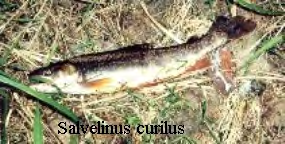
A morphological comparison of Northern (Salvelinus malma) and Southern (Salvelinus curilus) Dolly Varden chars was performed for 31 plastic and 8 meristic characters. Significant differences were observed in 24 plastic and 7 meristic signs, and in 29 cases the differences were highly significant (P > 0.999). In 11 cases, the differences reach the subspecific level- CD>1.28. Along the length of the upper jaw, there is a chiatus at the limits of variation of the index, and this is already at the level of the species. All this indicates significant differences between these samples and, once again, confirms the species status of southern Dolly Varden - Salvelinus curilus.
Introduction
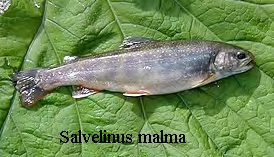
The Northern Dolly Varden Salvelinus malma was described by Walbaum in 1792 from the Paratunka River (Kamchatka). The Southern Dolly Varden Salvelinus curilus in 1814 described by Pallas from the rivers of the Kuril Islands. Later, both of these species were included in the Salvelinus alpinus complex but according to modern concepts, these are 2 species which was confirmed in the study of the mitochondrial genome [1, 2, 3, 4]. Both species have a similar lifestyle and form both anadromous and riverine, lake-river and stream forms.
Due to the high number of chars, their importance in the functioning of ecosystems is very high.
Both in Kamchatka and Sakhalin, Dolly Varden is an object of fishing, but its share in the total catch of salmon fish is small. The importance of Dolly Varden as an object of sports and recreational fishing is great.
The aim of our study is to make a morphological comparison of these char species by plastic and meristic characteristics and to assess the level of these differences.
Material and Methodology
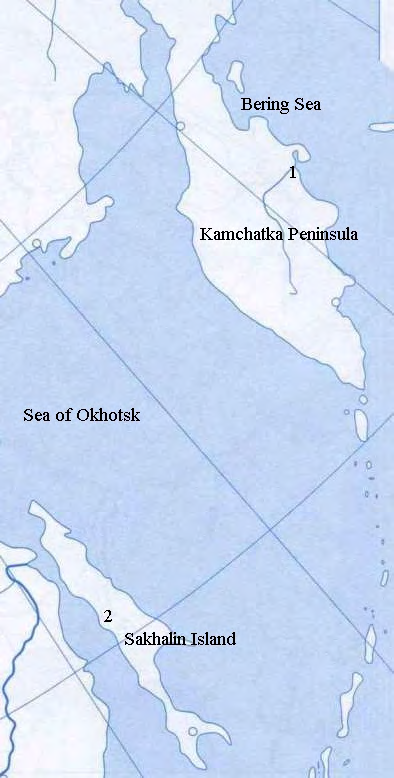
The work uses both own and literary materials. The Northern Dolly Varden is taken from the Ponomarka river, which flows into the Azhabachye lake (Ust’-Kamchatsky District, Kamchatka region, Russia). Fish were caught using the net traps in the summer of 1967. This char feeds and spawns in the river, and migrates to the lake for the winter. The maximum age of females is 8, males-7 years. The diet is dominated by aerial insects and their larvae, as well as sockeye salmon roe Oncorhynchus nerka Walbaum, which also spawns in this river [5]. The authors caught the Southern Dolly Varden with fishing rods in the autumn of 2000 in Lake Oktyabrskoye (Alexandrovsk-Sakhalinsky district, Sakhalin region), into which a small (5 km) river flows, in which the char spawns. Feeding and wintering take place in the lake. The maximum age is 9 years. This char feeds on aerial insects and their larvae, as well as its own young, since there are no other fish in the lake [6].
Measurement of fish and reading of meristic signs was carried out according to the scheme proposed by Pravdin, et al. [7]. During statistical processing of the material, the following values were calculated: M±m-the average value with an error, σ - the standard deviation; tst-Student’s criterion C. D.-coefficient of difference [8, 9].
Results and Discussion
A comparison of these samples of chars by plastic characteristics shows significant differences between them. Significant differences were noted for 24 characters out of 31 used, and in 22 cases P > 0.999. The most significant differences were: the length of the snout (CD =1.35), the horizontal diameter of the eye (CD =1.32), the length of the upper (CD =2.67) and lower (CD =1.49) jaws, the height of the dorsal (CD =1.31) and anal (CD =1.14) fins – large index values in % of the body length in southern malma. Along the length of the upper jaw, there is a chiatus along the limits of variation of the index. The northern malma differs significantly in the values of the indices: in the length of the carcass (CD =1.17), postdorsal (CD =1.45) in % of the body length, and postorbital (CD =1.30) distance in % of the head length (Table 1). Such significant differences in plastic characteristics can be due to both belonging to different species and slightly different habitats: the northern malma in our materials is adapted to life in the river, where it feeds and spawns. The southern malma used in our study spends most of its life in the lake and only goes into the river to spawn. The much larger size of the upper and lower jaws may be due to the feeding of its young, and this requires a larger mouth than when feeding on small food. This can also explain the greater height (CD =1.06) and shorter length of the caudal peduncle in southern Malma, since a powerful caudal peduncle can provide high speed when throwing for prey.
| Signs | Northern Dolly Varden (n=100) | Southern Dolly Varden (n=40) | t st | C.D. | |||||
|---|---|---|---|---|---|---|---|---|---|
| Lim | M±m | σ | Lim | M±m | σ | ||||
| LS, mm | 94.0-239.0 | 166.3±1.7 | 3.03 | 150.0-177.1 | 162.8±1.11 | 7.02 | |||
| In % of the body length according to Smith (LS) | |||||||||
| Sl | 90.5-96.0 | 92.68±0.09 | 0.91 | 88.6-98.0 | 90.8±0.35 | 2.19 | 5.2*** | 0.61 | |
| l | 68.2-75.8 | 72.89±0.15 | 1.52 | 64.7-71.9 | 69.1±0.27 | 1.72 | 12.3*** | 1.17 | |
| c | 17.6-25.6 | 21.46±0.11 | 1.14 | 21.4-24.9 | 22.8±0.16 | 0.98 | 6.9*** | 0.63 | |
| r | 3.5-6.0 | 4.77±0.05 | 0.5 | 5.3-8.2 | 6.4±0.11 | 0.71 | 13.5*** | 1.35 | |
| o | 3.1-4.8 | 4.03±0.04 | 0.44 | 4.4-5.5 | 4.9±0.03 | 0.22 | 17.2*** | 1.32 | |
| hc | 12.4-16.6 | 13.95±0.07 | 0.73 | 13.1-15.8 | 14.4±0.12 | 0.73 | 3.2** | 0.31 | |
| io | 5.3-7.9 | 6.48±0.06 | 0.56 | 5.8-7.3 | 6.4±0.06 | 0.4 | 0.9 | ||
| po | 10.7-13.6 | 12.27±0.06 | 0.62 | 11.7-12.7 | 12.1±0.05 | 0.29 | 2.2* | ||
| lmx | 6.1-9.9 | 7.85±0.07 | 0.67 | 11.7-15.7 | 13.4±0.22 | 1.41 | 24.0*** | 2.67 | |
| hmx | 1.52-2.40 | 1.97±0.02 | 0.22 | 1.9-2.4 | 2.3±0.02 | 0.14 | 11.7*** | 0.92 | |
| lmd | 9.4-14.6 | 11.82±0.09 | 0.9 | 13.8-18.5 | 15.7±0.24 | 1.54 | 15.1*** | 1.59 | |
| H | 15.6-22.2 | 18.65±0.14 | 1.41 | 16.4-21.6 | 18.8±0.20 | 1.24 | 0.6 | ||
| h | 6.1-9.3 | 8.01±0.06 | 0.58 | 8.3-9.7 | 9.0±0.06 | 0.35 | 11.7*** | 1.06 | |
| pl | 16.4-21.0 | 18.78±0.10 | 1.02 | 14.5-18.8 | 17.4±0.16 | 1.02 | 7.3*** | 0.68 | |
| AD | 38.6-45.3 | 41.47±0.13 | 1.33 | 38.4-44.8 | 41.6±0.23 | 1.43 | 0.5 | ||
| PD | 38.1-44.3 | 41.29±0.12 | 1.21 | 34.6-39.7 | 37.5±0.22 | 1.41 | 15.1*** | 1.45 | |
| AV | 42.1-50.3 | 46.85±0.17 | 1.65 | 43.9-49.8 | 46.5±0.29 | 1.84 | 1 | ||
| AA | 63.0-72.0 | 66.53±0.16 | 1.6 | 63.3-68.7 | 66.1±0.25 | 1.57 | 1.4 | ||
| lD | 9.6-13.3 | 11.74±0.08 | 0.8 | 10.6-14.2 | 11.7±0.13 | 0.81 | 0.3 | ||
| hD | 10.9-17.6 | 14.16±0.14 | 1.41 | 14.7-18.2 | 17.0±0.12 | 0.76 | 15.4*** | 1.31 | |
| lA | 6.7-11.4 | 8.92± 0.07 | 0.73 | 7.8-9.8 | 8.9±0.10 | 0.61 | 0.2 | ||
| hA | 11.8-15.8 | 13.89±0.08 | 0.79 | 13.8-17.0 | 15.7±0.13 | 0.8 | 11.9*** | 1.14 | |
| lP | 12.6-17.2 | 14.91±0.09 | 0.86 | 14.2-18.1 | 16.5±0.16 | 1.02 | 8.7*** | 0.85 | |
| In % of the head length (c) | |||||||||
| r | 15.6-27.5 | 22.12±0.25 | 2.5 | 24.0-33.5 | 28.1±0.36 | 2.3 | 13.6*** | 1.25 | |
| o | 15.0-23.1 | 18.7±0.14 | 1.38 | 19.7-23.4 | 21.4±0.17 | 1.08 | 12.3*** | 1.1 | |
| hc | 57.9-77.4 | 66.52±0.22 | 2.24 | 55.6-69.9 | 63.0±0.54 | 3.42 | 6.0*** | 0.62 | |
| io | 23.5-37.7 | 30.34±0.23 | 2.26 | 26.0-31.4 | 28.2±0.20 | 1.29 | 7.0*** | 0.6 | |
| po | 50.0-63.7 | 57.47±0.14 | 1.35 | 48.0-56.5 | 53.0±0.33 | 2.1 | 12.5*** | 1.3 | |
| lmx | 28.5-45.0 | 36.56±0.20 | 2.62 | 52.5-65.4 | 58.5±0.65 | 4.11 | 32.3*** | 3.3 | |
| hmx | 7.3-11.3 | 9.17±0.08 | 0.8 | 7.6-11.1 | 9.9±0.12 | 0.76 | 5.1*** | 0.47 | |
| lmd | 45.5-66.0 | 55.50±0.19 | 1.92 | 62.8-80.2 | 68.9±0.71 | 4.48 | 18.2*** | 2.09 |
Table 1: Plastic characteristics of Northern and Southern Dolly Varden and assessment of differences between them.
Designation of characters: LS - body length according to Smith, SL - length of the body to the end of the scaly cover, l - length of the body without a head - to the end of the scaly cover, c—length of head; r—length of snout - up to the front edge of the eye; o—horizontal diameter of eye; hc—head height at back of head; io—interorbital distance - forehead width; po—postorbital distance - from the posterior edge of the eye to the posterior edge of the gill cap; lmx—length of maxilla; hmx—maximum height of maxilla; lmd—length of mandible; H—maximum height of body - at the level of the anterior edge of the dorsal fin; h_—_minimum height of caudal peduncle; pl—length of caudal peduncle - to the end of the scaly cover; AD – antedorsal distance - from the front edge of the head to the front edge of the base of the dorsal fin, PD- postdorsal distance -from the posterior edge of the base of the dorsal fin to the end of the scale cover; AV - anteventral distance - from the front edge of the head to the beginning of the base of the ventral fin, AA –anteanal distance - from the front edge of the head to the beginning of the base of the anal fin; lD, lA—length of base of dorsal and anal fins, respectively; hD, hA—height of the leading edge of dorsal and anal fins, respectively; lP -length of pectoral fin.
Here and in Table 2: Lim - the limits of variation of the index, M±m the mean value and its error; σ - the standard deviation; tst - Student’s criterion: differences were significant at * P > 0.95, P > 0.99, and * P > 0.999; CD - coefficient of difference.
A comparison of these groups of chars by meristic characteristics reveals highly significant differences (P> 0.999) with large values in northern Dolly Warden for six out of eight used characteristic. This may be due to different species or geographical variability, since it is known that in the southern parts of the range of the char, the number of rays in the fins, scales in the lateral line and vertebrae is less than in the northern ones [10]. Southern Dolly Warden has a large number of gill rays. These samples do not differ only in the number of rays in the pectoral fins (Table 2).
| Signs | Northern Dolly Varden (n=100) | Southern Dolly Varden (n=40) | t st | C.D. | ||||
|---|---|---|---|---|---|---|---|---|
| lim | M±m | σ | lim | M±m | σ | |||
| ll | 127-143 | 133.79±0.34 | 2.34 | 124-137 | 129.2±0.45 | 2.85 | 8.1*** | 0.88 |
| D | 12-Sep | 10.59±0.06 | 0.59 | 12-Sep | 10.0±0.10 | 0.66 | 5.1*** | 0.47 |
| P | 13-Nov | 12.44±0.06 | 0.58 | 13-Nov | 12.3±0.10 | 0.64 | 1.2 | |
| A | 10-Jul | 8.79±0.05 | 0.52 | 9-Jul | 8.2±0.10 | 0.64 | 5.3*** | 0.51 |
| sp br | 16-24 | 20.01±0.16 | 1.58 | 15-22 | 17.2±0.21 | 1.31 | 10.6*** | 0.97 |
| r br | 13-Oct | 11.43±0.07 | 0.67 | 13-Nov | 12.2±0.12 | 0.78 | 5.5*** | 0.53 |
| vert | 62-70 | 67.26±0.13 | 1.28 | 62-64 | 63.0±0.09 | 0.55 | 26.9*** | 2.33 |
| p c | 21-35 | 27.90±0.32 | 3.14 | 21-27 | 23.6±0.28 | 1.77 | 10.1*** | 0.88 |
Designation of characters: ll—number of perforated scales in lateral line; sp.br_._—number of gill rakers on first gill arch; r br—number of gill rays; vert—number of vertebrae; с p—number of pyloric caeca.
Conclusion
The study demonstrates significant morphological differences between the two groups of chars. Significant differences were observed in 24 plastic and 7 meristic signs, and in 29 cases the differences were highly significant (P > 0.999). In 11 cases, the differences reach the subspecific level-CD>1.28. Along the length of the upper jaw, there is a chiatus along the limits of variation of index. This level of difference between these samples once again confirms the species status of southern Dolly Varden. Since the chars (Salvelinus) is characterized by a very high level of ecological plasticity, it is of considerable interest to compare chars of other ecological forms - river, lake and anadromous belonging to the same species.
References
-
Savvaitova KA (1989) Arkticheskie goltsy (Arctic Chars). Moscow: Agropromizdat, PP: 1-200.
-
Bogutskaya NG, Naseka AM (2004) Catalogue of Agnathans and Fishes of Fresh and Brackish Waters of Russia with comments on nomenclature and taxonomy. KMK Scientific Press Ltd. Moscow, pp: 1-389.
-
Shedko SV, Ginatulina LK, Miroshnichenko IL, Nemkova GA (2007) Phylogeography of Mitochondrial DNA in South Asian Dolly Varden Char _Salvelinus curilus_ Pallas, 1814 (Salmoniformes, Salmonidae): Mediated Gene Introgression?. Russian Journal of Genetics 43(2): 167- 176.
-
Balakirev ES, Romanov NS, Ayala FJ (2016) Complete mitochondrial genomes of the Northern (_Salvelinus_ _malma_) and Southern (_Salvelinus curilus_) Dolly Varden chars (Salmoniformes, Salmonidae). Mitochondrial DNA Part A 27(2): 1020-1021.
-
Savvaitova KA, Romanov NS (1969) Nekotorie osobennosti sistematiki i biologii karlikovoi ruch’evoy formi i molodi ozerno-rechnoi formi gol’tsa Salvelinus alpinus (L) is basseina Asabach’ego osera (Kamchatka) (Some features of the systematics and biology of the dwarf stream form and the young lake-river form of the Arctic char _Salvelinus alpinus_ (L.) from the Azabachy Lake basin (Kamchatka) Nautchnie dokladi vischei shkoli. Biologitcheskie nauki 8: 16-28.
-
Zvezdov TV, Safronov SN (2003) Lake-brook Malma _Salvelinus curilus_ (Pallas, 1833) of the Oktyabrskoe Lake of the Sakhalin Island. Vladimir Ya Levanidov’s Biennial Memorial Meetings 2 Vladivostok Dalnauka, pp: 387- 397.
-
Pravdin IF (1966) Rukovodstvo po isucheniyu ryb. (Guide to the study of fish). Moscow Agropromizdat, pp: 1-420.
-
Plokhinski NA (1970) Biometriya. (Biometrics). Мoskva. Isdatel’stvo Moskovskogo universiteta, pp: 1-367.
-
Mayr E (1969) Principles of Systematic Zoology. McGraw Hill Book Company. New York, pp: 1-428.
-
Vladykov VD (1934) Environmental and taxonomic characters fishes. Trans Roy Canad Inst 20(1): 99-140.
- Natural Decline to Extinction of A New Zealand Rabbit Population
- Mitochondrial Bio-Logistics: Steering Co-Enzyme Q10 and Lycopene Synergies within the Science 4.0 Bio-OS Framework
- Hymenoptera Specimens from the Caño Negro Wetland, of the National Museum Collection, Costa Rica
- Science 4.0: Comprehensive Architecture of the Biological Operating System (Bio-OS) A Framework for Systemic Resilience and Industrialized Bio-Governance
- Rabbit on, or Hare Back? Understanding Climate Change
- Clinical Validation of Science 4.0: Flow Steering and Epigenetic Drift Inversion on a 76-Year-Old Hybrid System