
Retrospective Study on the Occurrence of Warble Fly Infestation (Hypodermosis) of the Red Deer and Roe Deer Herds in NorthNorth-West Hungary (Szigetkoz, District of Ravazd and Tarjan)
We determined the infestation rates of larvae from two species of Warble Fly (Hypoderma diana and Hypoderma actaeon) on red deer (N=388) and roe deer (N=361) carcasses obtained in North-North-West Hungary (Szigetköz, District of Ravazd and Tarján) from October 2017 to February 2020. Of the total 28,584 Hypoderma Warble Fly larvae, counted on both deer species, were identified as H. diana (62% of total) and H. actaeon.(38% of total). Approximately 74% of the red deer and 79% of the roe deer were infested with either or both species. Red deer contained 17,717 and 10,867 larvae of H. diana and H. actaeon respectively. Of the 17,717 larvae of H. diana, 42% were found in red deer and the remaining 58% in roe deer. Of the 10,867 larvae of H. actaeon, 87% were found in red deer and the remaining 13% in roe deer. We interpreted our results in terms of QP 3.0 parasitological analysis and the need to map the spread of this serious parasitic infestation.
Introduction
The warble flies of the family Hypodermatidae belong to the so-called higherflie, to the Cylorrapha, group Schizophora, subgroup Calyptrata. The family Hypodermatidae comprises 11 genera and their 32 known species [1, 2, 3, 4, 5, 6, 7, 8, 9, 10, 11]. Hypoderma larvae are obligate parasites that migrate and feed for several months in host tissues. Newly hatched larvae penetrate unbroken host skin thanks to enzymatic secretion produced by their salivary glands. Once the penetration is complete, the larvae begin migrating in subcutaneous tissue [12].
Hypodermosis is widely distributed through all the continents of the Northern Hemisphere. Seven species of Hypodermatinae are known to cause myasis characterised by the presence of subcutaneous warbles on the dorsal and lumbal regions of domestic and wild ruminants. The most common species that cause WFI (Warble Fly Infestation) are Hypoderma lineatum and Hypoderma bovis in cattle and buffalo, Hypoderma sinense in yaks, Hypoderma (Oedamagena) tarandi and Przhevalskiana silenus in goats [1, 3, 4, 7, 9, 13, 14, 15, 16, 17, 18, 19, 20, 21, 22, 23, 24].
The Hypodermatinae that affect wild ruminants include Hypoderma actaeon and H. diana. The last species is euryxenic and affects red deer (Cervus elaphus), roe deer (Capreolus capreolus) and fallow deer (Dama dama). Larvae of this species have been found, also in the chamois, moufflon, four species of African antelopes kept in captivity, and on horses [20]. The fly is observed in Europe and Asia, and is most active during May and June. Hypoderma actaeon is considered to be strongly host specific, affecting red deer and sometimes roe deer [20] and its presence is restricted to Europe. WFI is not considered to have a great impact on the animal’s health: however, it causes great economic losses in terms of decreased venison and the depreciation of hides [18]. The larvae modulate the host’s immune response, which may predispose the host to an array of bacteria, fungi and viruses [1].
Material and Methods
Our investigations were carried out in the Dunazug wildlife management region in territory of Komáron- Esztergom county in the outskirts of Tarján village, in the Hanság-Moson wildlife management region in Szigetköz, and in the Bakonyalja-Komárom wildlife management region in territory of Győr-Moson-Sopron county in the surrounding of Ravazd settlement.
The major area of the Dunazug wildlife management region is located in Komárom-Esztergom and Pest counties, in almost equal proportions. Approximately 84% of its area is suitable for wildlife management. 41.1% of the area of the wildlife management landscape is covered by arable land and grassland, the proportion of forest is 39.1%. The management landscape located in mountainous areas are mostly large game and in some places mixed game area. Its character is determined by the ecological conditions of the Transdanubian Mountains, the lower productivity and from this resulting traits.
The Hanság-Moson wildlife management region is located in Győr-Moson-Sopron county. About 93% of its area is suitable for wildlife management. Nearly three-quarters (72.7%) of the area is covered by arable and grassland areas, and the proportion of forest is 17.0%. The last area of the Little Plain, which still shows significant small game traits, the population and spreading of red deer and wild boar is around the national average, but it is definitely smaller than the indicators of the surrounding large game areas.
The major area of the Bakonyalja-Komárom wildlife management region is located in Győr-Moson-Sopron and Komárom-Esztergom counties. About 91% of its area is suitable for wildlife management. 70.4% of the area of the region is covered by arable and grassland areas, the proportion of forest is 17.9%. Typically large game and mixed game wildlife management landscape, which has indicators around the average level for all big game, except for roe deer.
The determination of the infestation of red deer and roe deer in Tarján, Szigetköz and Ravazd herds and the distribution of larval stages were performed based on the sample collection between October 2017 and February 2020.
During this period, we collected data from a total of 388 red deer and 361 roe deer which were killed and transported to cold rooms. In details, we collected data from 152 red deer and 124 roe deer in Szigetköz, from 121 red deer and 118 roe deer in Tarján and its surroundings, and from 115 red deer and 119 roe deer in Ravazd area.
By palpating we located the larvae where the skin were incised with a scalpel (Aesculap BA20), and then the larvae were removed with anatomical forceps.
The skin of the locally sold specimens were also examined and the larvae found there were also collected. The larvae were separated per host bodies and conserved in 10% ethyl alcohol, stored in a refrigerator at + 4°C temperature.
The taxonomic identification of the larvae was performed at the Department of Animal Physiology and Animal Health, Széchenyi István University, Mosonmagyaróvár, using a WILD-LEITZ-LEICA M420 stereo microscope. Identification was performed using The larvae were identified by Papp and Szappanos [13] and by Minář, et al. [10] using determinant keys based on the characteristics of peritremas (Figure 1). Occasionally, we also used the results of our additional histological examinations [5].
![Figure 1: Characteristics of peritrema on H. diana (left-hand) and on H.actaeon (on the right) [10].](/fulltextimages/6936/fig_1.png)
Hypoderma diana Hypoderma actaeon Figure 1: Characteristics of peritrema on H. diana (left-hand) and on H.actaeon (on the right) [10].
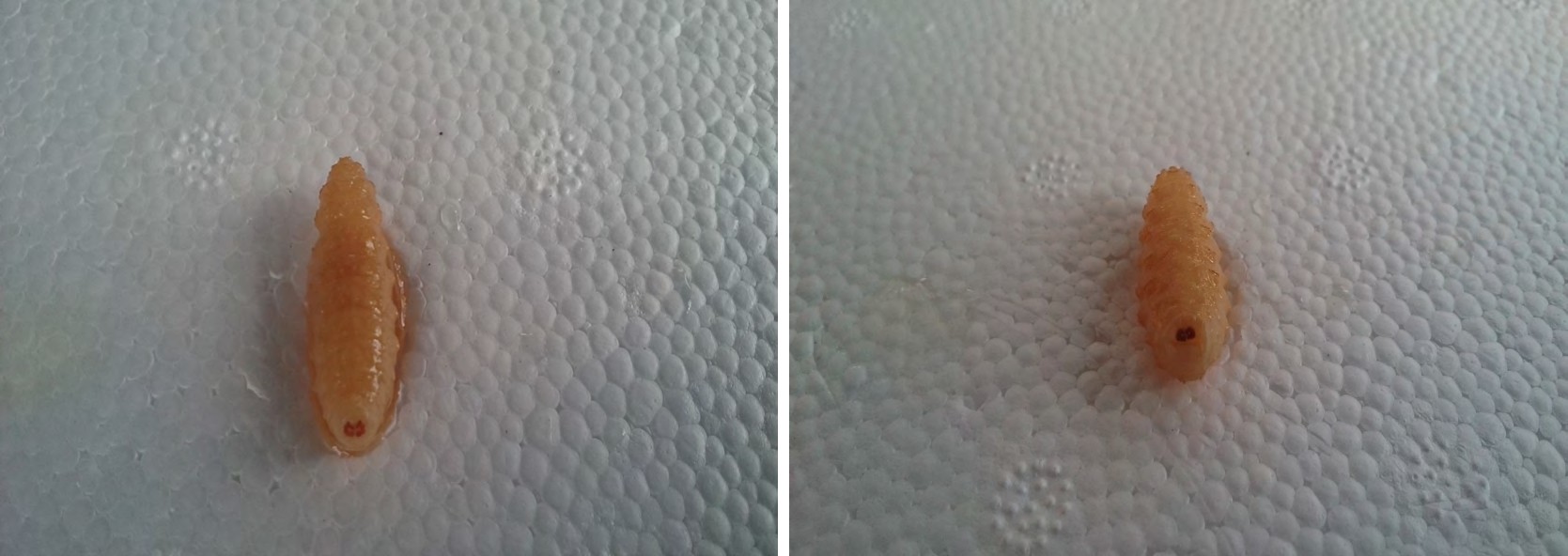
Figures 2&3: Characteristics of peritrema on H. diana (left-hand) and on H.actaeon (on the right) Quantitative-parasitological analysis of the results of our studies was performed based on the work of Rózsa, et al. [16]; Reicziegel, et al. [15] and Reicziegel, et al. [16]. The extent of infection is determined by the prevalence% (number of infected / tested individuals), the mean intensity (number of larvae found / number of infected individuals).Median intensity provides more accurate data, as parasitosis often has uneven distribution. We applied the Mood median test and calculated the discrepancy index which is characterizing the aggregation. The value of the discrepancy index can range from 0 to 1, (D = 0 for a uniform distribution, theoretical maximum: D = 1) [14].
Results and Discussion
In the years from 2017 to 2018, the total collected 6239 Hypoderma diana larvae 64,52% were found in roe deer and 35.48% in red deer. While from the total collected 3631 Hypoderma actaeon larvae 20,65% were found in roe deer and 79,35% in red deer.
Tables 1&2, the main quantitative parasitological characteristics of red deer and roe deer sample populations are shown.
| Key indicators | Red deer | ||
|---|---|---|---|
| Szigetköz | Tarján | Ravazd | |
| Total examined individuals | 49 | 40 | 36 |
| Number of infected individuals | 40 | 28 | 30 |
| Prevalence % | 81,6% | 70% | 83,3% |
| CI of prevalence ( P = 0,95 ) | 68,7-90,4 | 53,5-83,4 | 68-92,5 |
| Mean intensity | 43,6 | 53 | 68,1 |
| CI of mean intensity ( P = 0,95 ) | 33,3-61,3 | 36-94,5 | 44,2-95,6 |
| Median intensity | 31,5 | 34 | 41 |
| CI of median intensity | 17-44 | 17-49 | 28-62 |
| ( P = 0,95 ) | |||
| Discrepancy index | 0,560 | 0,667 | 0,566 |
| Total number of warble flies | 2184 | 1028 | 2613 |
| Minimum | 1 | 1 | 1 |
| Maximum | 238 | 322 | 284 |
| Key indicators | Roe deer | ||
| Szigetköz | Tarján | Ravazd | |
| Total examined individuals | 53 | 38 | 41 |
| Number of infected individuals | 43 | 29 | 33 |
| Prevalence % | 81,1% | 76,3% | 80,5 |
| CI of prevalence ( P = 0,95 ) | 68,1-89,9 | 60,6-87,3 | 66,0-90,8 |
| Mean intensity | 39 | 47,8 | 52,2 |
| CI of mean intensity ( P = 0,95 ) | 29,5-51,9 | 35,2-70,7 | 38,4-73,7 |
| Median intensity | 25 | 40 | 37 |
| CI of median intensity ( P = 0,95 ) | 16-36 | 22-52 | 23-55 |
| Discrepancy index | 0,581 | 0,564 | 0,555 |
| Total number of warble flies | 1678 | 1358 | 1723 |
| Minimum | 1 | 5 | 6 |
| Maximum | 148 | 230 | 215 |
Table 1: Main quantitative parasitological characteristics of red deer sample populations *.
*Data of larvae of Hypoderma species were processed by summation! Table 1: Main quantitative parasitological characteristics of red deer sample populations *.
*Data of larvae of Hypoderma species were processed by summation! Table 2: Main quantitative parasitological characteristics of roe deer sample populations*.
Between 2018-2019 years, from the total collected 5397 Hypoderma diana larvae 56.69% were found in roe deer and 43.31% in red deer. While from the total collected 3652 Hypoderma actaeon larvae 7,55% were found in roe deer and 92,45% in red deer.
In Tables 3&4. the main quantitative parasitological characteristics of red deer and roe deer sample populations are shown.
| Key indicators | Red deer | ||
|---|---|---|---|
| Szigetköz | Tarján | Ravazd | |
| Total examined individuals | 52 | 39 | 41 |
| Number of infected individuals | 43 | 30 | 33 |
| Prevalence % | 82,7% | 76,9% | 80,5,9% |
| CI of prevalence ( P = 0,95 ) | 70,4-90,9 | 60,7-88,9 | 65,1-91,2 |
| Mean intensity | 51,3 | 64,2 | 61,8 |
| CI of mean intensity ( P = 0,95 ) | 39,5-65,1 | 51,2-82,5 | 45,8-81,3 |
| Median intensity | 37 | 55,5 | 40 |
| CI of median intensity ( P = 0,95 ) | 21-66 | 40-83 | 21-78 |
| Discrepancy index | 0,540 | 0,491 | 0,554 |
| Total number of warble flies | 1729 | 1926 | 2038 |
| Minimum | 2 | 2 | 2 |
| Maximum | 172 | 166 | 168 |
| Key indicators | Roe deer | ||
| Szigetköz | Tarján | Ravazd | |
| Total examined individuals | 31 | 45 | 34 |
| Number of infected individuals | 23 | 35 | 24 |
| Prevalence % | 74,2% | 77,8% | 70,6 |
| CI of prevalence ( P = 0,95 ) | 55,4-88,1 | 62,9-88,8 | 52,5-84,9 |
| Mean intensity | 32,5 | 49,8 | 35,7 |
| CI of mean intensity ( P = 0,95 ) | 22,8-40,0 | 35,1-73,3 | 23,6-52,1 |
| Median intensity | 25 | 26 | 17,5 |
| CI of median intensity ( P = 0,95 ) | 30-Oct | 18-44 | Aug-42 |
| Discrepancy index | 0,578 | 0,611 | 0,637 |
| Total number of warble flies | 743 | 1747 | 1883 |
| Minimum | 2 | 4 | 3 |
| Maximum | 128 | 135 | 231 |
Table 2: Main quantitative parasitological characteristics of red deer sample populations *.
*Data of larvae of Hypoderma species were processed by summation! Table 3: Main quantitative parasitological characteristics of red deer sample populations *.
*Data of larvae of Hypoderma species were processed by summation! Table 4: Main quantitative parasitological characteristics of roe deer sample populations*.
From 2019 to 2020 warble fly larvae were found in 80.9% of the red deer individuals in Tarján, in 68.6% of the red deer individuals in Szigetköz and in 78.9% of the red deer individuals in Ravazd, while this ratio by the roe deer samples were 82.9%, 70%, 79.5%. In our investigations we found a total of 9665 warble fly (Hypodermiosis) larvae.
From the total collected 6081 Hypoderma diana larvae
52.64% were found in roe deer and 47.36% in red deer. While from the total collected 3584 Hypoderma actaeon larvae 10,58% were found in roe deer and 89,42% in red deer.
In Tables 5 & 6. the main quantitative parasitological characteristics of red deer and roe deer sample populations are shown.
| Key indicators | Red deer | ||
|---|---|---|---|
| Szigetköz | Tarján | Ravazd | |
| Total examined individuals | 51 | 42 | 38 |
| Number of infected individuals | 35 | 34 | 30 |
| Prevalence % | 68,6% | 80,9% | 78,9% |
| CI of prevalence | 54,1-80,9 | 65,9-91,4 | 62,4-90,4 |
| ( P = 0,95 ) | |||
| Mean intensity | 62,4 | 30,2 | 87,1 |
| CI of mean intensity | 42,4-93,3 | 19,9-47,3 | 68,1-109 |
| ( P = 0,95 ) | |||
| Median intensity | 31 | 41 | 70,5 |
| CI of median intensity | 17-62 | 17-24 | 52-101 |
| ( P = 0,95 ) | |||
| Discrepancy index | 0,690 | 0,658 | 0,484 |
| Total number of warble flies | 2180 | 1028 | 2613 |
| Minimum | 3 | 2 | 3 |
| Maximum | 211 | 166 | 209 |
| Key indicators | Roe deer | ||
| Szigetköz | Tarján | Ravazd | |
| Total examined individuals | 40 | 35 | 44 |
| Number of infected individuals | 28 | 29 | 35 |
| Prevalence % | 70% | 82,9% | 79,5 |
| CI of prevalence ( P = 0,95 ) | 53,5-83,4 | 66,4-93,4 | 64,7-90,2 |
| Mean intensity | 42 | 27,1 | 53,8 |
| CI of mean intensity ( P = 0,95 ) | 29,9-57,3 | 19,7-39,6 | 39,2-71,8 |
| Median intensity | 29,5 | 17 | 36 |
| CI of median intensity ( P = 0,95 ) | 14-41 | 27-Nov | 16-61 |
| Discrepancy index | 0,606 | 0,546 | 0,58 |
| Total number of warble flies | 1176 | 785 | 1883 |
| Minimum | 2 | 4 | 2 |
| Maximum | 166 | 135 | 150 |
Table 3: Main quantitative parasitological characteristics of roe deer sample populations* As it well known, the confidence range
*Data of larvae of Hypoderma species were processed by summation! Table 6: Main quantitative parasitological characteristics of roe deer sample populations* As it well known, the confidence range for the studied populations is characterized by the confidence interval, between 2019-2020 this value in the Ravazd roe deer herd clearly ranged widely from 39,2 to 71,8.
The degree of parasitic infestation may be significantly influenced by some highly infected individuals, and in this context the accuracy of the mean intensity is less objective, as evidenced by the 27.1 value of the Tarján deer herd (highest 150 and 209 larvae number per animal).
The median intensity values are related to the sample number and prevalence values, but since the median is not affected by the extreme infection values, its usage enables greater accuracy. In case of roe deer herd, both the median intensity (36) and its confidence interval (16–61) were relevant.
The extent of the discrepancy index (D) is proportional to the Crofton distribution (1971), namely to the fact that usually only a small number of parasites were found in many hosts. This value was by red deer 0,690; 0,658; 0,484 by roe deer 0,606; 0,546; 0,580.
Considering that the infestation of red deer and roe deer in Hungary is a permanent harmful factor, the need to map the spread of this parasitosis is indisputable.
However, as it is also known that herd-level management can only be performed in deer gardens, the protection of wild deer remains a challenge to be solved.
As a possible modification, instead of using organic phosphoric acid ester-containing agents mentioned by the previous authors, in the wild ivermectin- or moxidectin- containing preparations could be used in the form of granules, while in the case of farmed red deer a pour-on solution could be expedient.
References
-
Boulard C (1969) Anatomie et histologie du tube digestif de la larve d’Hypoderma bovis (Diptères, Oestriformes)”. Ann Soc Entomol 5: 371-387.
-
Cabanelas E, Panadero Fontan R, Fuertes M, Fernández M (2015) Histological and immunhistochemical characterization of Hypoderma lineatum (Diptera: Oestridae) warbles. Vet Parasitol 212(3-4): 361-367.
-
Domingez J, Panadero R, Fuente Lopez C (2010) Detection of Hypoderma actaeon infestation in Cervus elaphus with ELISA and Western blotting. J Wildl Dis 46(3): 934-938.
-
Egri B (2014) The prevalence of three major endo- and ectoparasitoses (fascioloidosis, hypodermosis and deer ked) of European Cervidae in North-West Hungary (1999-2011). Jpn J Vet Parasitol 13(1): 7-13.
-
Egri B, Bieber M, Husvéth B (2019) Notes on Micromorphology of Third Instar Larvae of Hypoderma Actaeon (Brauer, 1858) and _H. Diana_ (Brauer, 1858) (Oestridae, Hypodermatidae). Acta Microscopica 28(5): 933-937.
-
Egri B, Husvéth B (2007) The first time about the warble fly infestation of roe-deer and red deer in Szigetköz (In Hungarian). Magyar Állatorvosok Lapja 129(2): 121- 127.
-
Gan EI (1977) Comparative anatomy of Bots of Agricultural Animals. Fan Tashkent рp: 28-37.
-
Husvéth B, Egri B (2014) Spreading of warble fly infestation of roe deer and red deer in Tarján district (In Hungarian). Vadbiológia pp: 63-66.
-
Khan MN, Iqubal Z, Sajid MS, Anwar M, Needham GR, et al. (2006) Bovine hypodermosis. Prevalence and economic significance in Southern Punjab, Pakistan Vet Parasitol 141(3-4): 386-390.
-
Minář J (1995) Specificity of parasitism in the warble flies, namely in the roe deer- warble fly – Hypoderma diana. Dipterologica Bohemoslovaca 7: 123-128.
-
Minář J (2000) Hypodermatidae. In: Contributions to a manual of palearctic Diptera. Appendix Papp L, Darvas J, et al. (Eds.), Science Herald, Budapest pp: 479-494.
-
Nelson WA, Weintraub J (1972) Hypoderma lineatum (De Vill.) (Diptera: Oestridae): Invasion of the bovine skin by newly hatched larvae. J Parasitol 58(3): 614-624.
-
Papp L, Szappanos A (1992) Bagócslegyek: Gasterophilidae, Oestriade, Hypodermatidae. Magyar Természettudományi Múzeum, Budapest pp: 50-51.
-
Reicziegel J, Harnos A, Solymosi N (2010) Biostatisztika nem statisztikusoknak. Pars Kft, Nagykovácsi.
-
Reicziegel J, Rózsa L (2005) Mennyiségi parazitológia 3.0. Budapest.
-
Rózsa L, Reicziegel J, Majoros G (2000) Quantifying parasites in samples of hosts. J Parasitol 86(2): 228-232.
-
Sugár L (1976) On the Incidence of Larvae of Hypodermatidae in the Games of Wild Rodents of Hungary. Parasitologia Hungarica 9: 85-97.
-
Otranto D, Paradies P, Testini G, Lia Gianspero A, Traversa D, et al. (2006) First description of the endogenous life cycle of Hypoderma sinense affecting yaks and cattle in China. Med Vet Entomol 20(3): 325-328.
-
Otranto D, Puccini V (2000) Further evidence on the internal life cycle of Przhevalskiana silenus (Diptera, Oestridae). Vet Parasitol 88(3-4): 321-328.
-
Otify YZ, Mansour NK (1994) Hypodermatosis among animals furnishing meat production in Green Mountain- Lybia, Assiut. Vet Med J 32: 54.
-
Panadero R, Varas G, Pajares G, Markina F, López C, et al. (2017) Hypoderma actaeon, an emerging myiasis in roe deer (Capreolus capreolus). Med Vet Entomol 31(1): 94-96.
-
Yadav A, Katoch R, Khajuria JK, Katoch M, Agrawal R (2011) Prevalence and biology of goat warble fly infestation by Przhevalskiana silenus in Jammu province, India. Trop Anim Health Pro 43(8): 1487-1492.
-
Yadav A, Panadero R, Katoch R, Godara R, Cabanelas E (2017) Myiasis of domestic and wild ruminants caused by Hypodermatinae in the Mediterranean and Indian subcontinent. Vet Parasitol 243: 208-218.
-
Yeruham I, Rosen S, Yakobson B, Nyska A (1994) Severe infestation of imported roe deer (Capreolus capreolus coxi) by Hypoderma diana (Diptera: Oestridae). J Wildl Dis 30(4): 552-553.
- Natural Decline to Extinction of A New Zealand Rabbit Population
- Mitochondrial Bio-Logistics: Steering Co-Enzyme Q10 and Lycopene Synergies within the Science 4.0 Bio-OS Framework
- Hymenoptera Specimens from the Caño Negro Wetland, of the National Museum Collection, Costa Rica
- Science 4.0: Comprehensive Architecture of the Biological Operating System (Bio-OS) A Framework for Systemic Resilience and Industrialized Bio-Governance
- Rabbit on, or Hare Back? Understanding Climate Change
- Clinical Validation of Science 4.0: Flow Steering and Epigenetic Drift Inversion on a 76-Year-Old Hybrid System