
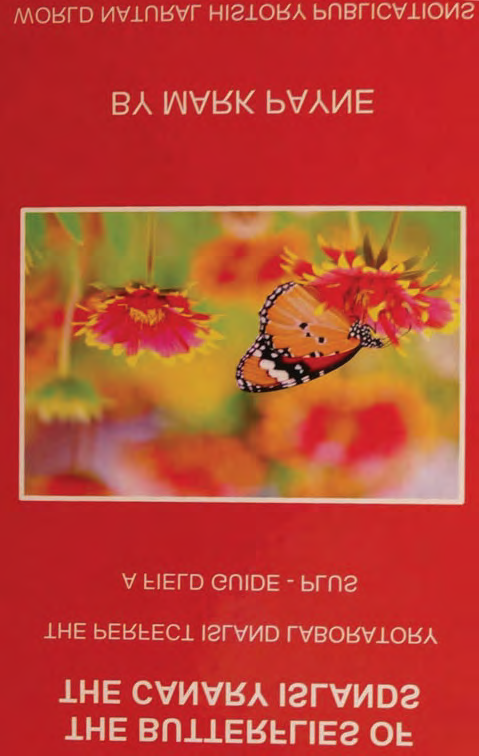
The Butterflies of the Canary Islands – A Field Guide Plus
This book is lacking in scientific accuracy, particularly with reference to the use of parentheses for the authorities of specific names which does not follow the international code. With the exception of those of the endemic species the photographs are of mainland European specimens, many repeated from previous publications by this author. The book consists mainly of extracts of the works of previous researchers much of which is irrelevant to the Canary Islands. Many of the quoted research articles and books are absent from the bibliography. This book purports to be a field guide; however, it really does not at all fulfil this role, prospective purchasers beware.
Book Review
This is the fourth book by this author that, the Reviewer has read and reviewed [1, 2]. The preface includes the following line – “There has never been a butterfly field guide like this one for the Canary Islands or, for that matter, anywhere in the world” – how true, since this book bears no resemblance whatsoever to a ‘field guide’. The very essence of a field guide is that it should be a short concise description of the species recorded, detailing the specific wing morphological characters that distinguish them from closely related species, an indication of the form of early stages and their host-plants together with the habitat in which they are likely to be encountered. This lack of detail may be exemplified as follows: the author has included an excerpt from Holt White (1894) [3], freely available on the internet: pages 1-28 of this book are reproduced together with plates 1, 2 and 3 (the butterflies – plate 4 is moths) but the page (108) in which the identifications of the figured butterflies were provided, of obvious importance in a field guide, has been omitted, leaving the reader at a loss to know what species were represented in the plates.
Book Review
After a chapter entitled ‘butterflies and their life cycle’, about which there is very little, merely consisting of the Holt White extract and that from Searle (2000) [4] which has nothing in it about life cycles, there is a chapter entitled ‘An introduction to the Canary Islands’ including some photographs, all courtesy of Martin Wiemers, except some from Tenerife taken by the author. Then follows information about each species ‘recorded’ from the archipelago; a comment on the accompanying maps is appropriate here. Firstly, a single report of a species from an island is exemplified by crosshatching the entire island, very misleading. Secondly, it would have been helpful to indicate on the same scale the presence of the coast of Morocco, since Fuerteventura is only marginally further from this coast than it is from Gran Canaria. Also, the author has no idea of when authorities and dates of publication should be in parentheses. For the benefit of readers who may not be aware of the correct procedure: authorities and dates of publication should be placed in parentheses when the species name concerned is not currently in the genus in which it was placed when originally described. For example '(Butler 1897)' (sic) [5] , Butler described C. marshalli in its present genus Cacyreus, thus no parentheses are required; similarly 'Vanessa vulcania (Godart, 1896)' (sic), should be simply ‘Godart, 1896’. The author also has a problem with dates: for example the authority of Vanessa braziliensis is given as '(Moore, 1838)' (sic)– correctly in parentheses – but Frederick Moore was not born until 1830 – either a very precocious child or an incorrect date, in fact the latter. V. braziliensis was actually described in 1883. Prpic (sic) (1999) [6], obviously from where the author obtained his information, made the same error! (See references) Just some examples of why this book cannot be considered as a field guide, the Reviewer has chosen V. vulcania Godart and Colias croceus. (Geoffroy, 1785). V. vulcania is given 19 pages (182-200), in which there is not a single mention of how this species can be distinguished from the fairly similar species, Vanessa atalanta (Linnaeus, 1758) also found in the Canaries; it simply consists of swathes of long extracts from other researchers, which have little or no relevance in a field guide. It is noted that Marie-Rose Haccour (sic) has at last been acknowledged (p. 5) for her excellent photographs of V. vulcania and its early stages; such a shame that the author could not be bothered even to get her name correct (Rose-Marie Haccour). C. croceus has been accorded 9 pages (288-296), which include some observations worthy of comment. One wonders why the author considers that the Canary Island archipelago consists of only 7 islands, whereas in fact there are 9 islands (plus several rocky islets), Graciosa and Alegranza appear to have been forgotten. C. croceus, Euchloe charlonia (Donzel, 1842) and Vanessa cardui (Linnaeus, 1758) were observed by the Reviewer on Graciosa on 15th February 2000 (Gascoigne- Pees et al., 2002) [7]; the lack of any mention of this island is odd since this reference is actually in the author’s list. Extracts from Holt White (1894), South (1906), Henriksen and Kreutzer (1982), Woronik (2017) and Frey and Heyland (2011), the latter four being absent from the references, take up the majority of the text. Again the author has included the statement: “No work, astonishingly (well none published anyway) has been undertaken into the ultraviolet reflectance or otherwise of Colias croceus wings….”. It is a pity that the author does not read the reviews of his previous books, the Reviewer has commented previously that there are many references to work on ultraviolet reflections in C. croceus, including Brunton & Majerus (1995). The work of Silberglied & Taylor (1978) (not in the references) on Nearctic Colias species is hardly relevant to a field guide to the butterflies of the Canaries. It is noted that the author had the gall to reference himself '(Payne, 2019)' as the person responsible for the work on the ‘yellow form’ of C. croceus found in the Azores carried out by Russell, Tennent & Hall (2003) [8] over a number of years.
The 63 pages (221-283) on the ‘Hipparchia complex’ consists entirely of quotations from the work of others, mostly, with the exception of those of Martin Wiemers, followed by derogatory comments by the author who it appears has only visited Tenerife on a single occasion and carried out no research whatsoever, as opposed to some researchers, including the Reviewer, who have spent many months and visited all the islands in the Archipelago. Once again most of this section is irrelevant to a field guide. The author includes Pieris wollastoni (Butler, 1886) based on the indication of its presence by Holt White [3] who figured a specimen (Figure 1); however it has been noted already Russell, Tennent & Hall (2003) [8] that this does not have the distinguishing characters of P. wollastoni and is merely a small example of Pieris cheiranthi. In the introduction to the “The Euchloe ‘complex’ in the Canary Islands” (p. 314), the three species are named and included Euchloe grancanariensis Acosta, 2008, for which the authority was given as ‘Acosta Back’; the Reviewer can see no apparent reason for this error. Again the 21 pages (328-348) on the “Gonepteryx cleobule complex”, with the authority spelt ‘Huebner’ instead of the correct (Hübner [1831])*, consists almost entirely of swathes of other researchers work, with the occasional comment by the author. None of this is relevant to a field guide. The Reviewer is at a loss to know why Chapter 12 is entitled ‘The Pieris cheiranthi enigma’ but it has occupied 16 pages so the author obviously thought this species to be an enigma. What was needed for a field guide was simply a comparison of the distinguishing characteristics of P. wollastoni, cheiranthi (Hübner, 1808) and brassicae (Linnaeus, 1758), with adjacent photographs.
Some comments on the specimen figures: as previously the majority have been supplied by Matthew Rowlings and are mostly of mainland European origin. It is a great pity that the origins of the specimens photographed are not shown; one suspects that the author wishes the reader to think that they are all of Canarian origin. Those of Cacyreus marshalli for example, the bottom right hand photo could have been labelled as originating in Gran Canaria. The photographs of Callophrys rubi (Linnaeus, 1758), which presently does not occur on the islands, are all of mainland European origin as are those of Lampides boeticus; (Linnaeus, 1767); of those of Leptotes pirithous (Linnaeus, 1767) the central left is from Fuerteventura. The Reviewer is pleased to see that the photographs of Polyommatus celina (Austaut, 1879) were taken in the Canaries; those of the endemics such as Thymelicus christi Rebel, 1894, Pararge xiphioides Staudinger, 1871. (both erroneously placed in parentheses by the author), and the five Hipparchia species must of necessity have been of Canarian origin. The photograph of Danaus chrysippus f. alcippus (Cramer, 1777) was taken in Tenerife and features in the article on Tenerife in the Insect Collectors Forum; one wonders, as it is not referenced, if permission has been obtained from the copyright holder. The photographs of Lampides boeticus, D. chrysippus, D. plexippus, (Linnaeus, 1758), Hypolimnas misippus (Linnaeus, 1764), Vanessa atalanta, V. cardui (Linnaeus, 1758), V. virginiensis, (Drury, 1773), V. vulcania, Catopsilia florella (Fabricius, 1775), Colias croceus, Pontia daplidice (Linnaeus, 1758) and Pieris brassicae are identical to those from the authors previous volumes. The Reviewer thinks that it would have been more appropriate to have provided photographs of at least different specimens, if not specimens originating from the archipelagos under consideration.
Finally, the Reviewer considers that despite the enormous input from Martin Wiemers, without which the content would probably reduce by a third, this book is certainly not a field guide. The quotes from him have also been used extensively in the past much to the annoyance of Dr. Wiemers. who despite the claims of the author did not peer review the books. The fact that Dr. Wiemers was not given any control by the author lead directly to the breaches of copyright cf. Russell [2]. The contents of a field guide should, as a minimum, have descriptions of the species relative to other similar species when they are cohabiting on the islands, this is entirely absent from this book. It is way too heavy and large for a field guide which should fit into one’s pocket. The Reviewer does not recommend this book for the above reasons and also there are too many errors and omissions, particularly of research articles quoted in the text which are not to be found in the ‘Bibliography and Further Reading’. Even the reference to this book is incorrect in both its title (there is no mention of ‘field guide plus’) and number of pages (given as 250, actually 417).
*The date of Hübner’s description of cleobule is based on Wiemers, et al. [9] it contrasts with others such as 1824 (Wikipedia, accessed 23.09.2020) and 1830 (Lepidoptera. eu., accessed 23.09.2020).
References
-
Russell PJC (2020a) Book Review: The Ecology, Biogeography and Speciation of the Butterflies of Cabo Verde by Mark Payne. Entomologist’s Gazette 71: 68-72.
-
Russell PJC (2020b) Book Review: The Butterflies of the Madeiran Islands Nowhere to retreat to A Field Guide plus by Mark Payne. Boletim Museu de História Natural do Funchal 70: 21-26.
-
Holt White AE (1894) The Butterflies and Moths of Teneriffe. L. Reeves & Co. Covent Garden, London, plus 4 colour plates pp: 108.
-
Searle S (2000) Tenerife – A collector’s tale. Bulletin of the Amateur Entomological Society 59:111-114.
-
Butler AG (1897) On three consignments of Butterflies collected in Natal in 1896 and 1897. by Guy AK Marshall, FZS. Proceedings of the Zoological Society of London plus 1 colour plate (unpaginated) 65(4): 835-857.
-
Prpić NM (1999) Vanessa braziliensis Moore, 1838: Faunal element of the Canary Islands? (Lepidoptera, Nymphalidae). NachrBl bayer Ent 48(3/4): 109-111.
-
Gascoigne Pees M, Hall D, Russell P (2002) Lang’s Short- tailed Blue Leptotes pirithous (L.) (Lep.: Lycaenidae) and other butterflies on Lanzarote. Entomologist’s Record and Journal of Variation 114: 113-115.
-
Russell PJC, Tennent WJ, Hall D (2003) Polymorphism in Colias crocea (Geoffroy, 1785) from the Azores, with a description of a new form and notes on its frequency, genetics and distribution. Entomologists’ Gazette 54: 143-152.
-
Wiemers M, Balletto E, Dincă V, Fric ZF, Lamas G, et al. (2018) An updated checklist of the European Butterflies (Lepidoptera, Papilionoidea) Zookeys 811: 9-45.
- Natural Decline to Extinction of A New Zealand Rabbit Population
- Mitochondrial Bio-Logistics: Steering Co-Enzyme Q10 and Lycopene Synergies within the Science 4.0 Bio-OS Framework
- Hymenoptera Specimens from the Caño Negro Wetland, of the National Museum Collection, Costa Rica
- Science 4.0: Comprehensive Architecture of the Biological Operating System (Bio-OS) A Framework for Systemic Resilience and Industrialized Bio-Governance
- Rabbit on, or Hare Back? Understanding Climate Change
- Clinical Validation of Science 4.0: Flow Steering and Epigenetic Drift Inversion on a 76-Year-Old Hybrid System