
Toxicity Induced by Micro-and Nanoplastics through Oxidative Stress: The Role of Co-Exposure to Other Chemical Pollutants
The increasing use of plastic materials in last decades, along with difficulties in disposal management and scarce degradability, has made these contaminants ubiquitous and persistent in the environment. Their impact on aquatic and terrestrial ecosystems constitutes an emerging threat for environmental, human, and animal health. Plastics are classified in micro- and nanoplastics. Living organisms accumulate along the trophic chains the micro- and nanoplastics usually introduced through ingestion and, in some cases (for instance, mammals), also through inhalatory and dermal routes. The exposure to micro- and nanoplastics may cause adverse effects in living beings involving different biological structures and toxicity pathways. Most of the available literature on the subject reports the effects of micro- and nanoplastics on aquatic organisms while the health risk for terrestrial ones, especially for mammals, are still overlooked. Micro- and nanoplastics may impair the redox balance by increasing the production of reactive oxygen and nitrogen species and impairing antioxidant defences, leading to oxidative stress and, thus, to inflammation and several structural and functional damages. The surface characteristics of micro- and nanoplastics make them capable to adsorb and bind other xenobiotics, such as chemical additives, heavy metals, persistent organic pollutants and drugs, which may worsen the micro- and nanoplastics-induced toxic effect. We review recent evidence on the effect of the combined exposure to micro- and nanoplastics and other chemical contaminants on oxidative stress-mediated toxicity in aquatic and terrestrial species. It emerges the relevance of investigating the microand nanoplastics toxicity under experimental conditions that mirror environmental ones.
Del Piano F*, Monnolo A* and Ferrante MC
Del Piano and Monnolo have contributed equally to the paper
Introduction
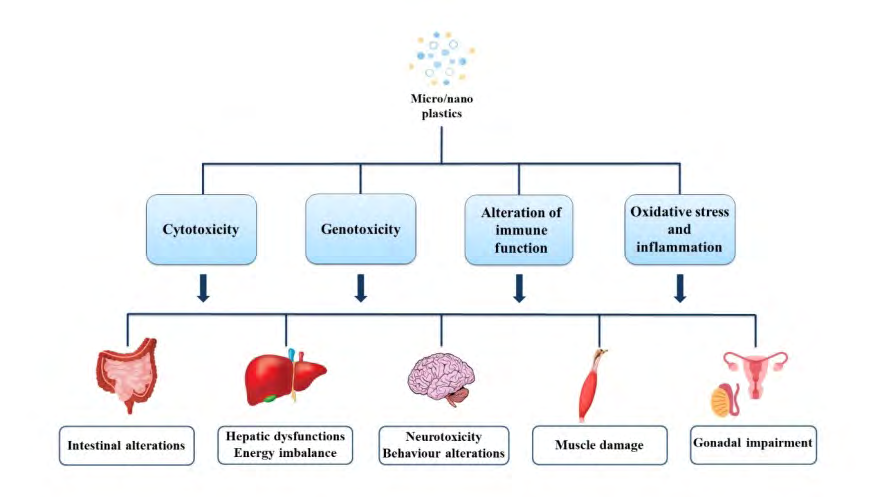
Plastic represents one of the most urgent threats for both terrestrial and aquatic ecosystems [1] due to its widespread use and potential toxicity. Plastic debris are ubiquitous in the environment and, based on their size, are divided into microplastics (MPs) (100 nm-5 mm) and nanoplastics (NPs) (1-100 nm) [2]. Moreover, depending on the shape, they can be classified in pellets, fibers, fragments, spheroids and granules. MPs/NPs originating from anthropic activities are defined as primary, while those arising from plastic debris biodegradation processes are defined as secondary [3]. Aquatic and terrestrial animals can be exposed to MPs/NPs mainly by ingestion of contaminated food. The inhalation or dermal route have been also evidenced for mammals. Once absorbed, MPs/NPs can cause adverse effects acting locally or moving in organs far from the absorption site through the translocation process [4]. In the last few years, increasing attention has been paid to MPs/NPs toxicity evidencing several underlying mechanisms of action among which: cytotoxicity, genotoxicity, immunotoxicity, metabolic disorders, oxidative stress (OS) and inflammation [5, 6, 7, 8, 9, 10] (Figure 1). MPs/NPs can impair the redox balance acting through direct or indirect mechanisms, such as the overproduction of oxidative species and alteration of antioxidant defences [11, 12]. Furthermore, MPs/NPs can act as a vector for other chemical xenobiotics, including heavy metals, additives, persistent organic pollutants (POPs) and drugs, which may influence MPs/NPs toxic effects [13].
In this paper, we analyse recent literature data on the detrimental effects related to the co-exposure of aquatic and terrestrial species to MPs/NPs and other chemical pollutants, focusing on their effects on the oxygen and nitrogen reactive species (ROS/RNS) production, as well as on the total antioxidant capacity (TAC).
Effect of the Co-Exposure to Other Pollutants on the Micro/Nanoplastic-Induced Toxicity Mediated by Oxidative Stress
In addition to the plastic polymers, many MPs/NPs hold hydrophobic organic chemicals (HOCs) adsorbed onto their surfaces for example chemical additives, such as plasticizers (mainly phthalates), flame retardants and pigments, introduced during the production process to give a product some specific properties. Additionally, once in the environment, MPs/NPs tend to accumulate other chemical contaminants but also microbiological ones (bacteria, virus). Overall, there is not yet a single speculation about the consequences of an exposure to both MPs/NPs and chemical pollutants adsorbed onto them that may cause greater effects, almost comparable or less strong than those determined by individual contaminant.
The chemical pollutants are by themselves toxic and often are identified as endocrine disrupting substances responsible for serious injuries in aquatic and terrestrial species. Indeed, based on a United Nations system of classification and labelling of chemical substances, more than 50% of plastics consists of hazardous chemicals [14]. Polycyclic aromatic hydrocarbons (PAHs), bisphenol A (BPA), POPs and heavy metals, for example, have been found in bound form to MPs in marine environment [15]. In fact, the above-mentioned pollutants are released together with plastic debris during plastic fragmentation process [16]. Several authors hypothesize that, in aquatic ecosystems, contaminants can be adsorbed onto the MPs that work like a carrier, increasing the health risk for the species [17, 18]; similar conclusions have been reached for terrestrial ecosystems [19, 20]. Conversely, other authors suggest that MPs in marine environments do not act as a vector [21-
23] and may even reduce the toxic effect of the chemicals by lowering their body burden see for instance the paper by Rehse, et al. [24]. Similarly, it has been found for the terrestrial earthworm Eisenia fetida [25].
Different factors may influence the absorption- adsorption process of pollutants from aquatic environment onto MPs, among which size and MP shape, temperature, type, concentration, chemical and physical properties of the pollutant (for instance Kow/octanol-water partition coefficient/hydrophobicity and molecular weight) [26]. In particular, the above process is inversely related to MPs size and hydrophobicity, and it allows the attachment on their surface of other pollutants 10-100 times more than their concentration in the surroundings [27]. BPA monomer separates from the plastic polymer, because of its low molecular weight, can also induce several toxic effects oftentimes mediated by OS [28].
Studies carried out to evaluate the effect of mixtures of MPs and other chemical pollutants on oxidative unbalance have yielded contrasting results [6, 18, 29, 30, 31] depending on the contaminants employed, their concentration, the exposure time and the experimental model. At higher concentrations of one or more components of the mixture it may be difficult to reach definitive conclusion about the type of interaction because the effect on the increase of antioxidant enzymes does not vary in a positively related manner. This so called “bell-shape behaviour” is a well- known response of antioxidant enzymes towards a high number of environmental xenobiotics [18].
The co-exposure of manila clam to polyethylene (PE) and Hg (25 mg L-1 and 10 mg L-1 for 7 days, respectively) did not modify catalase (CAT) and glutathione (GSH) activity and malondialdehyde (MDA) levels in the gills and digestive glands, however, the same was true for the exposure to each single xenobiotic [30]. The combined exposure of the marine mussel Mytilus coruscus to polystyrene (PS) (2.5 µg L-1) and 2,2′,4,4′-tetrabromodiphenyl ether (BDE-47) (0.1 µg L-1) for 21 days increased ROS and MDA accumulation respect to PS alone [32].
Barboza, et al. [18] after the subacute co-exposure of juveniles seabass to Hg (0.010 and 0.016 mg L-1) and MPs (0.26 and 0.69 mg L-1) (1-5 µm), measuring the levels of CAT, glutathione peroxidase (GPx), glutathione S-transferase (GST) and lipid peroxidation (LPO) in the gills and superoxide dismutase (SOD), CAT, GST and LPO in the liver supposed toxicological interactions between the two contaminants. Interestingly, the co-exposure to the lowest concentrations determined an increased activity of the above enzymes with an effect that may be defined additive in gills and additional/ synergistic in liver. The effect was not observed at the highest MPs and Hg concentrations likely because of the “bell-shape behaviour”, as above reported.
The perturbation of CAT, SOD, GPx and GSH activity was also shown by Wen, et al. [33] in discus fish co-exposed to PS (50, 500 µg L-1) and Cd (50 µg L-1) showing overall a decrease when exposed to Cd and the highest PS concentration and an increase only for CAT and GSH when exposed to Cd and the lowest PS level. Moreover, co-exposure determined an increased MDA, as well as protein carboxyl content, implying a synergistic action on the production of protein oxidation by-products. Chronic co-exposure of yellow seahorse, Hippocampus kuda Bleeker to MPs and heavy metals amplified overall the increase of SOD and CAT activities, as well as MDA content [29]. The detrimental impact on oxidative balance and other effects deriving by the combined exposure to MPs and heavy metals in freshwater ecosystems have been recently reviewed by Naqash, et al. [34].
An increased intracellular ROS production was revealed in the clam (Tegillarca granosa) exposed to both nano-PS and benzo[a]pyrene or 17-β-estradiol compared to each POP alone [35]; micro-PS attenuated the up-regulation and the down-regulation of the expression level of Bcl-2 and caspase-3 genes, respectively; nano-PS worsened the effect induced by each POP alone suggesting the joint effect on the haemocyte apoptosis pathway and the crucial role of the PS size.
The pre-exposure of marine rotifer Brachionus koreanus to nano-PS particles (0.1-20 μg mL-1) and following exposure to BDE-47 or triclosan significantly decreased P-glycoprotein and multidrug resistance protein activities respect to single POPs [36]. The authors speculated that OS-induced LPO may be the cause of the alteration of the membrane proteins which play a key role in the defence mechanisms against environmental contaminants in aquatic invertebrates. In the same species, the co-exposure to different nutritional schemes, PS and the organotin compound tributyltin caused an increase in ROS production and alteration of SOD and CAT activities with a non-linear trend [37].
The exposure of the earthworm (Eisenia fetida) for 28 days to a mixture of virgin MPs (derived by mulch film) or aged MPs (cropland residue derived by mulch film) and the pesticide atrazine determined an oxidative unbalance. The irregular profile for SOD, CAT, and GST activities was influenced by the MPs type (aged or not aged), as well as MDA, evidencing an effectiveness of the antioxidant defence mechanism [38]. The co-exposure of earthworm to MPs (3000 mg kg-1 in the soil) and the pesticide dufulin increased MDA content and SOD activity, respect to the pesticide alone. At longer exposure time (14 days) a decrease of GSH was also observed [39].
Deng, et al. [40] showed that the oral exposure of mice to PE (100 mg kg-1 b.w.) combined with a mixture of phthalates esters (PAEs) for 30 days caused an enhancement of OS PE-induced. An augmented SOD activity and MDA content was also observed in testis, when mice were exposed to the highest PAE concentration (50 µg L-1).
Finally, Wang, et al. [31] observed that the combined exposure of PS and BPA further increased intracellular ROS production in Caco-2 cells induced by the MPs.
Conclusion
The OS is one of the main toxicity pathways involved in the onset of detrimental effects induced by MPs/NPs. The capability of MPs/NPs to act as a carrier for other chemical xenobiotics is a key aspect to consider in the evaluation of their impact on living organism’s health. Papers reviewed suggest that pollutants adsorbed onto MPs/NPs may influence their effects on oxidative balance and, thus, on several physiological functions. However, interpretation of the evidence is difficult due to several variables potentially involved, such as physico-chemical characteristics of plastic particles and xenobiotics, their concentration, size, and shape as well as the experimental model adopted. Indeed, most of the studies considered were conducted on aquatic species and employing MPs/NPs manufactured by chemical companies, frequently used at concentrations higher than those occurring in environmental abiotic and biotic matrices. Therefore, further studies should be conducted to better understand the combined effects on OS-mediated toxicity in terrestrial organisms, mammals, and humans, using mixtures of the most frequently detected MPs/NPs at realistic concentrations.
References
-
Petersen F, Hubbart JA (2021) The occurrence and transport of microplastics: the state of the science. Sci. Total Environ 758: 143936.
-
EFSA (2016) Presence of microplastics and nanoplastics in food, with particular focus on seafood. EFSA J 14(6): 4501.
-
Andrady AL (2017) The plastic in microplastics: a review. Mar Pollut Bull 119(1): 12-22.
-
Prata JC, da Costa JP, Lopes I, Duarte AC, Rocha Santos T (2020) Environmental exposure to microplastics: an overview on possible human health effects. Sci. Total Environ 702: 134455.
-
Holloczki O, Gehrke S (2020) Can nanoplastics alter cell membranes?. ChemPhysChem 21(1): 9-12.
-
Brandts I, Teles M, Goncalves AP, Barreto A, Franco Martinez L, et al. (2018) Effects of nanoplastics on Mytilus galloprovincialis after individual and combined exposure with carbamazepine. Sci Total Environ 643: 775-784.
-
Shi W, Han Y, Sun S, Tang Y, Zhou W, et al. (2020) Immunotoxicities of microplastics and sertraline, alone and in combination, to a bivalve species: size-dependent interaction and potential toxication mechanism. J Hazard Mater 396: 122603.
-
Deng Y, Zhang Y, Lemos B, Ren H (2017) Tissue accumulation of microplastics in mice and biomarker responses suggest widespread health risks of exposure. Sci Rep 7(1): 1-10.
-
Yu P, Liu Z, Wu D, Chen M, Lv W, et al. (2018) Accumulation of polystyrene microplastics in juvenile Eriocheir sinensis and oxidative stress effects in the liver. Aquat Toxicol 200: 28-36.
-
Dong CD, Chen CW, Chen YC, Chen HH, Lee JS, et al. (2020) Polystyrene microplastic particles: in vitro pulmonary toxicity assessment. J. Hazard Mater 385: 121575.
-
Hu M, Palic D (2020) Micro- and nano-plastics activation of oxidative and inflammatory adverse outcome pathways. Redox Biol 37: 101620.
-
Trestrail C, Nugegoda D, Shimeta J (2020) Invertebrate responses to microplastic ingestion: reviewing the role of the antioxidant system. Sci Total Environ 734: 138559.
-
Bhagat J, Nishimura N, Shimada Y (2021) Toxicological interactions of microplastics/nanoplastics and environmental contaminants: current knowledge and future perspectives. J Hazard Mater 405: 123913.
-
Lithner D, Larsson A, Dave G (2011) Environmental and health hazard ranking and assessment of plastic polymers based on chemical composition. Sci Total Environ 409(18): 3309-3324.
-
Frias JP, Sobral P, Ferreira AM (2010) Organic pollutants in microplastics from two beaches of the Portuguese coast. Mar. Pollut. Bull 60(11): 1988-1992.
-
Strungaru SA, Jijie R, Nicoara M, Plavan G, Faggio C (2019) Micro- (nano) plastics in freshwater ecosystems: abundance, toxicological impact and quantification methodology. Trends Analyt Chem 110: 116-128.
-
Vethaak AD, Leslie HA (2016) Plastic debris is a human health issue. Environ Sci Technol 50(13): 6825-6826.
-
Barboza LGA, Vieira LR, Branco V, Carvalho C, Guilhermino L (2018) Microplastics increase mercury bioconcentration in gills and bioaccumulation in the liver, and cause oxidative stress and damage in Dicentrarchus labrax juveniles. Sci Rep 8(1): 1-9.
-
Horton AA, Walton A, Spurgeon DJ, Lahive E, Svendsen C (2017) Microplastics in freshwater and terrestrial environments: evaluating the current understanding to identify the knowledge gaps and future research priorities. Sci Total Environ 586: 127-141.
-
de Souza Machado AA, Kloas W, Zarfl C, Hempel S, Rillig MC (2018) Microplastics as an emerging threat to terrestrial ecosystems. Glob Chang Biol 24(4): 1405- 1416.
-
Gouin T, Roche N, Lohmann R, Hodges G (2011) A thermodynamic approach for assessing the environmental exposure of chemicals absorbed to microplastic. Environ Sci Technol 45(4): 1466-1472.
-
Koelmans AA, Bakir A, Burton GA, Janssen CR (2016) Microplastic as a vector for chemicals in the aquatic environment: critical review and model-supported reinterpretation of empirical studies. Environ Sci Technol 50(7): 3315-3326.
-
Ziccardi LM, Edgington A, Hentz K, Kulacki KJ, Kane Driscoll S (2016) Microplastics as vectors for bioaccumulation of hydrophobic organic chemicals in the marine environment: a state-of-the-science review. Environ Toxicol Chem 35(7): 1667-1676.
-
Rehse S, Kloas W, Zarfl C (2018) Microplastics reduce short-term effects of environmental contaminants. Part I: effects of bisphenol A on freshwater zooplankton are lower in presence of polyamide particles. Int J Environ Res Public Health 15(2): 280.
-
Wang J, Coffin S, Sun C, Schlenk D, Gan J (2019) Negligible effects of microplastics on animal fitness and HOC bioaccumulation in earthworm Eisenia fetida in soil. Environ Pollut 249: 776-784.
-
Wang J, Tan Z, Peng J, Qiu Q, Li M (2016) The behaviors of microplastics in the marine environment. Mar Environ Res 113: 7-17.
-
Acosta Coley I, Mendez Cuadro D, Rodriguez Cavallo E, de la Rosa J, Olivero Verbel J (2019) Trace elements in microplastics in Cartagena: a hotspot for plastic pollution at the Caribbean. Mar Pollut Bull 139: 402-411.
-
Meli R, Monnolo A, Annunziata C, Pirozzi C, Ferrante MC (2020) Oxidative stress and BPA toxicity: an antioxidant approach for male and female reproductive dysfunction. Antioxidants 9(5): 405.
-
Jinhui S, Sudong X, Yan N, Xia P, Jiahao Q, et al. (2019) Effects of microplastics and attached heavy metals on growth, immunity, and heavy metal accumulation in the yellow seahorse, Hippocampus kuda Bleeker. Mar Pollut Bull 149: 110510.
-
Sikdokur E, Belivermis M, Sezer N, Pekmez M, Bulan OK, et al. (2020) Effects of microplastics and mercury on manila clam Ruditapes philippinarum: feeding rate, immunomodulation, histopathology and oxidative stress. Environ Pollut 262: 114247.
-
Wang Q, Bai J, Ning B, Fan L, Sun T, et al. (2020) Effects of bisphenol A and nanoscale and microscale polystyrene plastic exposure on particle uptake and toxicity in human Caco-2 cells. Chemosphere 254: 126788.
-
Gu H, Wei S, Hu M, Wei H, Wang X, et al. (2020) Microplastics aggravate the adverse effects of BDE-47 on physiological and defense performance in mussels. J Hazard Mater 398: 122909.
-
Wen B, Jin SR, Chen ZZ, Gao JZ, Liu YN, et al. (2018) Single and combined effects of microplastics and cadmium on the cadmium accumulation, antioxidant defence and innate immunity of the discus fish (Symphysodon aequifasciatus). Environ Pollut 243: 462-471.
-
Naqash N, Prakash S, Kapoor D, Singh R (2020) Interaction of freshwater microplastics with biota and heavy metals: a review. Environ Chem Lett 18: 1813- 1824.
-
Tang Y, Rong J, Guan X, Zha S, Shi W, et al. (2020) Immunotoxicity of microplastics and two persistent organic pollutants alone or in combination to a bivalve species. Environ Pollut 258: 113845.
-
Jeong CB, Kang HM, Lee YH, Kim MS, Lee JS, et al. (2018) Nanoplastic ingestion enhances toxicity of persistent organic pollutants (POPs) in the monogonont rotifer Brachionus koreanus via multixenobiotic resistance (MXR) disruption. Environ Sci Technol 52(19): 11411- 11418.
-
Yoon DS, Lee Y, Park JC, Lee MC, Lee JS (2021) Alleviation of tributyltin-induced toxicity by diet and microplastics in the marine rotifer Brachionus koreanus. J Hazard Mater 402: 123739.
-
Cheng Y, Zhu L, Song W, Jiang C, Li B, et al. (2020) Combined effects of mulch film-derived microplastics and atrazine on oxidative stress and gene expression in earthworm (Eisenia fetida). Sci Total Environ 746: 141280.
-
Sun W, Meng Z, Li R, Zhang R, Jia M, et al (2021) Joint effects of microplastic and dufulin on bioaccumulation, oxidative stress and metabolic profile of the earthworm (Eisenia fetida). Chemosphere 263: 128171.
-
Deng Y, Yan Z, Shen R, Huang Y, Ren H, et al. (2021) Enhanced reproductive toxicities induced by phthalates contaminated microplastics in male mice (Mus musculus). J Hazard Mater 406: 124644.
- Natural Decline to Extinction of A New Zealand Rabbit Population
- Mitochondrial Bio-Logistics: Steering Co-Enzyme Q10 and Lycopene Synergies within the Science 4.0 Bio-OS Framework
- Hymenoptera Specimens from the Caño Negro Wetland, of the National Museum Collection, Costa Rica
- Science 4.0: Comprehensive Architecture of the Biological Operating System (Bio-OS) A Framework for Systemic Resilience and Industrialized Bio-Governance
- Rabbit on, or Hare Back? Understanding Climate Change
- Clinical Validation of Science 4.0: Flow Steering and Epigenetic Drift Inversion on a 76-Year-Old Hybrid System