
Comparative Examination of the Roundworm (Ascaris suum, Goeze, 1782) and Giant Thorny-Headed Worm (Macracanthorynchus hirudinaceus Pallas, 1781) Infestations of Free-Ranging (Living in Game-Preserve) and Free Living Wild Boar-Stocks in Midwest Hungary
We determined the level of roundworm (Ascaris suum, Goeze, 1782), and giant thorny head worm (Macracanthorynchus hirudinaceus Pallas, 1781) infestations of free ranging (living in game preserve) and free-living wild boars. Location of our investigations was an 11,893-hectare plot in Midwest Hungary, of which 248 hectares were treated closed as Wildlife Park (preserve). A total of 76 wild boars were shot during six hunting season from June 2015 to April 2020 and examined post mortem. Among of 33 free living and 43 free ranging wild boars the parasitological infestation rate was: 45.45% and 69.77%). As a result of identification, the incidence of 2 gastrointestinal species was established: Ascaris suum were found occur in 58.82% and Macracanthorhynchus hirudinaceus in 41.18% of wild boars. The 120 Ascaris suum (Goeze, 1782) were found occur in 30.0% (36) of free living, while 70.0% (84) in free ranging wild boar stocks. The 84 Macracanthorynchus hirudinaceus (Pallas, 1781) were found to occur in 3.57% (3) of free living, while 96.43% (81) in free ranging wild boar stocks.
Introduction
Since the 1990s the wild boar (Sus srofa scrofa, L.) population has increased remarkably in most areas of Europe, including Hungary. At present, wild boars move from their primary forest habitat in to an agricultural landscape (5). Within the midgut of these wild boars live gastrointestinal nematode-species that include Ascaris suum (Goeze, 1782) and the Macracanthorynchus hirudinaceus (Pallas, 1781), that have a completely different taxonomic classifications.
The species Ascaris suum belongs to the genus Ascaris in family Ascarididae, order Ascaridida, class Chromadorea (Rhabditea) phylum Nematoda. The Ascaris suum eggs,ovoid, golden brown, with a coarsely mamillated thick shell, 50- 70μm in size [2, 3]. The Ascaris suum, the largest nematode of the swine, are white worms, 15-40 cm in length.
The eggs are transformed in the soil into a filariform larva in about thirty days, which is released from its shell only in the intestine of the final host animal or in a paratenic host (e.g. earthworm). However, later consumed by the final host, but in both cases, it passes through the intestinal wall, then to the pharynx via the circulatory pathways through the liver and lungs, and then enters the small intestine by ingestion [4]. Ascaris suum is the most widespread internal parasite in swine worldwide, occurring 50-75% of pig herds in most countries, and the most important endoparasitic infection in economic terms [6, 10]. The species Macracanthorynchus hirudinaceus are pinkish, and transversely slightly wrinkled worms. Males: 6-10 cm, females 20-40 cm in length with both genders 4-10 cm in width [2]. This nematode belongs to the genus Macracanthorinchus in family Oligacanthorynchidae, main family Oligacanthorynchidea order Oligacanthorynchida, class Archiacanthocephala of the phylum Acanthocephala [2, 3]. The egg is almond shaped, thick-shelled with rough surface, greenish brown in colour, 7-10μm in size, containing acanthor when passed out in the feces. The larvae of Macracanthorynchus hirudinaceus are embedded in the soil through the bodies of boars in the form of elongated acanthor larvae, which are consumed by the grubs of beetles (May-bugs, dung beetles (Lamellicornia)) and in their intestines transformed into worm-like acanthella larvae. Infection occurs when grazing wild boars dig up and swallow an infected grub or have access to imagos of lamellicorn beetles [2]. These are consumed by the adequate host due to its natural eating habits and grow into adult worms in the small intestine in about two months. The adult worms are fixed on the intestinal wall [4]. Longevity for this nematode is 10 months or more.
Severe ascariosis and macracanthorhynchosis have been associated with abnormal lethargy and insufficient immune system function [1]. Human cases of macracanthorynchosis are mainly found in developing countries, as poor hygiene and nutritional conditions allow for the infection to occur. Macracanthorynchus hirudinaceus is an acanthocephalan helminth that lives in the small intestines of wild boars and can be transmitted to humans by accidental ingestion. Boar’s meat consumption in many parts of the world causes human to come into direct contact with this animal and consequently results in a chance to transmit diseases between humans and animals [7, 9].
These parasite infestations also cause serious economic disadvantages regarding farm animals and farmed wild boars, because poor nutrient utilisation results in a failure to grow, which may mean a loss of production; while superinfections due to a weakened immune system can lead to unnecessary and high veterinary costs.
The study aimed to compare the occurrence of these two midgut nematode species of wild boars, originating from two different (free living and free ranging) habitats.
Materials and Methods
Between June 2015 and April 2020, we conducted our parasitological tests of investigated wild boar stocks, on 11,893 hectares of hunting grounds of the Marcal- Bitvaköz Hunting Company. This wildlife management unit is located in the Marcal basin, right in the middle of the Pápa-Devecser Plains forest landscape of the Kisalföld forest area (Midwest Hungary). The hunting ground has a slightly diverse surface, but is essentially a flatland. The area has a very good water supply, which is very beneficial to the wild boar population living here. This area is characterized by a sandy loam-bearing, rust-coloured forest soil, which is characteristic in 80% of the area, with other variants also occurring.13.2% of the area under examination was forested, which is about 1570 hectares, most of which consists of two, almost conjoined large forest blocks: one is situated next to Nemesszalók (place of the free-living wild boar stock) and the other near the village of Dabrony. In the forest of Dabrony (place of the free-ranging wild boar stock), there is a 248 hectare wild boar garden (a game-preserve), where the forest vegetation typically includes pedunculate oak, sessile oak, bark oak, acacia, and a smaller percentage of pine. In the game preserve (“wild boar garden”), about 100-150 boars are hunted each year. The remaining 86.8% of the area is distributed to agricultural areas and pastures, the latter representing 7% of the total area.
A total of 76 wild boars were shot during six hunting season from June 2015 to April 2020 and examined post mortem. The sampling of free-ranging-area and free-living wild game was carried out in exactly the same way, except for the sampling conditions. The sex, age, body weight, health status, and the unique identifier of the wild boar, and the location of the shooting (on hunting) have been recorded. In all cases, the whole section of the stomach and small intestine has been prepared in the same way, the endoparasites were collected, stored, and identificated according to the next: after removal and separation of the viscera, the intestine and stomach have been washed and dissected, the contents have been captured in a thin-hole filter and after washing. After the preparation, the mucous membranes were examined and parasites were collected. The collected parasites were placed into an airtight, labelled glass jar and stored in 95%- 90% alcohol and 5% glycerol solutions in a refrigerator at 4 °C. The identification was carried out using a stereoscopic microscope (Type PZ0 MST131).
Data were analysed with the chi-square test while using the Cramer’s V ratio. We examined the number of infections followed a normal distribution using the Shapiro-Wilk test and Q-Q graph. The intensity of infestation was determined by Mann-Whitney and Mood median tests [8].
Results and Discussion
As a result of nematode identification, the incidence of 2 gastrointestinal species was established: Ascaris suum (Goeze, 1782) were found occur in 58.82% and Macracanthorynchus hirudinaceus (Pallas, 1781) in 41.18% (Figures 1 & 2).
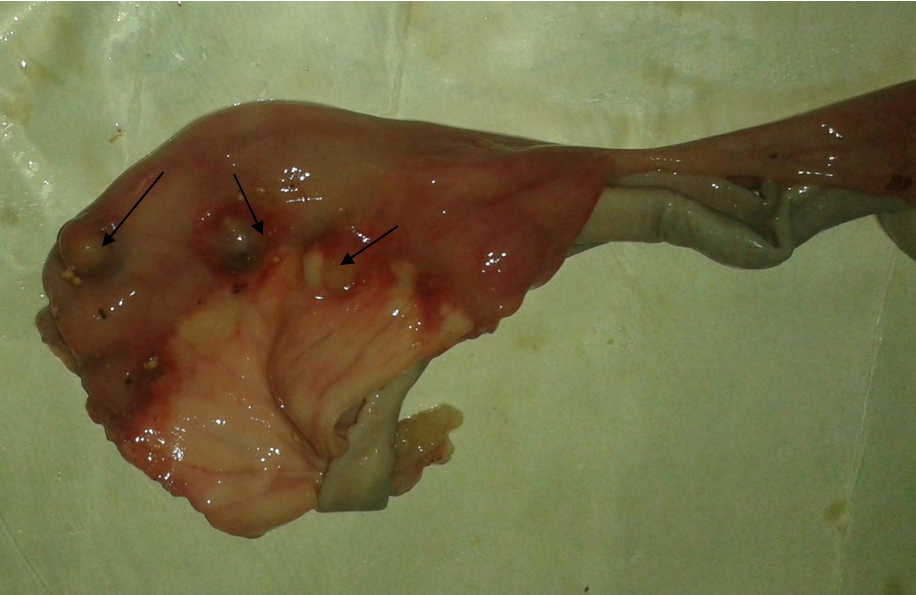
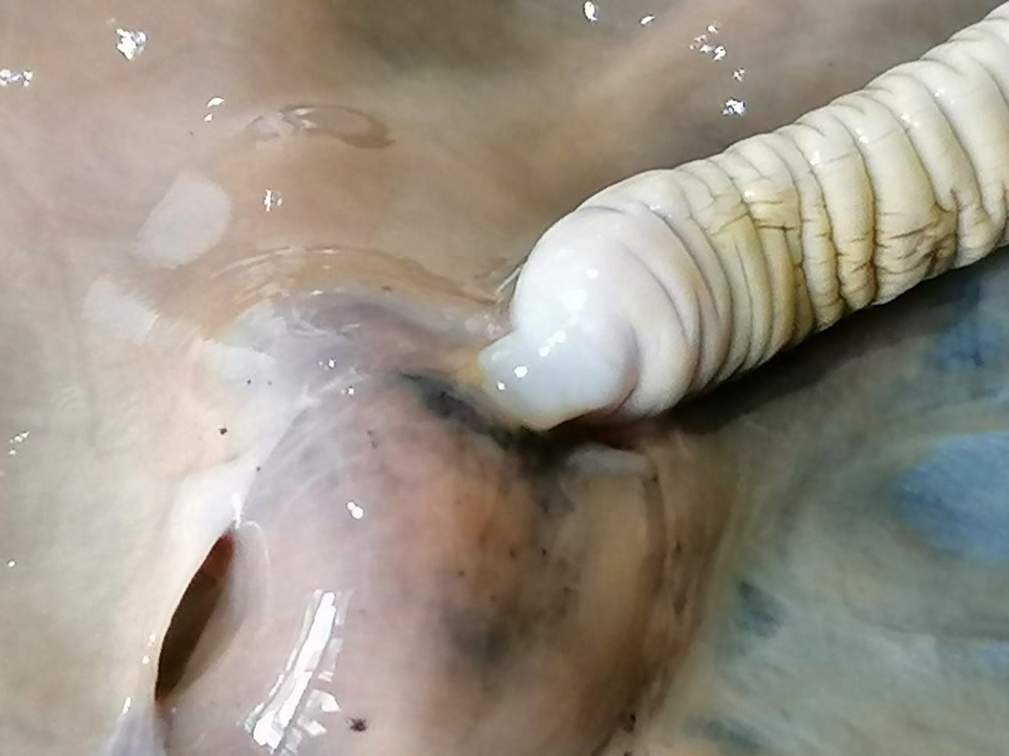
Wild boar stock / parasite-infestation relationship as it shown in Table 1. Value of Yule’s coefficient of association: Y=(15*13-18*30)/(15*13+18*30)= - 0,47, which suggests that the dominant populations are infested close-area populations and uninfected free-area populations.
| Parasite infestation | Yes | No | Total | |
|---|---|---|---|---|
| Stock | Free living | 15 | 18 | 33 |
| Free ranged | 30 | 13 | 43 | |
| Total | 45 | 31 | 76 |
Table 1: Wild boar stock / parasite-infestation relationship.
We examined two different farming technologies (free living or free ranging area management) from the point of view of parasitic infestations. For this purpose we used a chi-square test. From the data we can see that free ranging area infestation and free living area non-infestation were the dominant categories. The results of main quantitative parasitological characteristics of free living and free ranging wild boar poulations as it shown in Table 2.
| Hunted in free-living area | Hunted in free-ranging area | Total | |
|---|---|---|---|
| Total examined animals | 33 | 43 | 76 |
| Number of infected individuals | 15 | 30 | 45 |
| Prevalence % | 45.45% | 69.77% | 59.21% |
| CI of prevalence (95%) | 30.28% - 63.84% | 56,04% - 83.49% | 48.79% - 70.69% |
| Mean intensity | 2.6 | 5.5 | 4.533 |
| CI of mean intensity (95%) | 1.505 – 3.695 | 4.155 – 6.845 | 3.415 – 5.498 |
| Median intensity | 2 | 5 | 3 |
| CI of median intensity (95%) | 1-3 | 3-7 | 2-5 |
| Total number of infection | 39 | 165 | 204 |
| Minimum | 1 | 1 | 1 |
| Maximum | 9 | 14 | 14 |
Table 2: Main quantitative parasitological characteristics of shot on hunting free living and free ranging (Living in game preser
Table 2: Main quantitative parasitological characteristics of shot on hunting free living and free ranging (Living in game preserve) wild boar poulations Based on the tables the chi square test are the following: chi^2(1)=4.570, p=0.033, the link between the farming conditions of the herd and the level of infection is significant. The Cramer’s V indicator value, indicating the link between different game production technologies and infection, is 0.245, which shows a weak significant relationship, p=0.033. We have calculated the average number of parasites / infected animal. In case of animals of free ranging areas, this indicator was 5.5, much higher than in case of free living area, which were 2.6. We performed tests to see if the number of infections followed a normal distribution, using the Shapiro-Wilk test, and also plotted a Q-Q graph showing that it does not follow a normal distribution. Therefore, we applied a Mann-Whitney test and a Mood median test, both showing that the farming conditions of the population strongly influence the intensity of infection. In the case of free-ranging-area wild boars, the intensity is much higher. The Mann-Whitney test ranks the number of parasite per animal in an increasing order, irrespective of the group, and then calculates the group averages. The average rank was 15.57 for free-living area wild boars and 26.72 for free- ranging-area wild boars. The value of Mann-Whitney U was 440.5, p=0.002. The number of parasites show a significant difference between free-living-area and free-ranging-area holdings. In the case of free-ranging area conditions, the rate of infection is higher. The results of Mood median test’s (as it shown in Table 3) were the following: Chi^2(1)= 7.515, p= 0, 0.006, which results were similar to the Mann-Whitney
test. Mood median test results: Chi^2(1)= 7.515, p= 0, 0.006, which gives results similar to the Mann-Whitney test. The difference between the parasite count in wild boars shot in free areas and closed areas is significant.
| Free living area | Free ranging area | Total | |
|---|---|---|---|
| Median number of values above median | 3 | 19 | 22 |
| Number of values not greater than median | 12 | 11 | 23 |
| Total | 15 | 30 | 45 |
Table 3: Results of Mood median test (for quantitative parasitological characteristics) of shot on hunting in free living and sho
The 120 Ascaris suum (Goeze, 1782) were found to occur in 30.0% (36) of free living, while 70.0% (84) in free ranging wild boar stocks. The 84 Macracanthorynchus hirudinaceus (Pallas, 1781) were found to occur in 3.57% (3) of free living, while 96.43% (81) in free ranging wild boar stocks.
Conclude on the tables summarising the results of the measurements, we can saying that the parasitic infestations rate in free-ranging area much higher (69.77%), than in free- living-area (45.45%). The same can be claimed for parasite- infestations / animal, which was 5.5 for free-ranging areas and 2.6 for free-living areas. The total number of parasitic infestations was more than four times higher in free ranging areas than in their free-living counterparts.
Based on our studies, we presume the wild boar population in free-ranging areas is exposed to a much higher parasitological infestation rate, which can be treated and controlled effectively by broad-spectrum anthelmintic mixed in the feed in granular form or in the form of solution mixed in the drinking water, applied at an appropriate frequency. Proper targeted management of free living-area wild boar herds is a much larger task for the wildlife farmer, therefore it is recommended to apply a feed mixture specially prepared for wild boars, given in a feeding through specially developed for this purpose, causing aversion in other large game.
This publication is supported by the EFOP-3.6.3- VEKOP-16-2017-00008 project. This project is co-financed by the European Union and the European Social Fund.
References
-
Egri B, Sugár L (2007) Wildlife Diseases Paraziták. In: Bicsérdy Gy, Egri B, Sugár L, Sztojkov V, Vadbetegségek, et al. (Eds.), Mezőgazda kiadó, Budapest pp: 93.
-
Kassai T (1999) Veterinary Helminthology. Butterworth- Heinemann, Oxford 98(101): 142-145.
-
Kassai T (2003) Helmintológia (In Hungarian). Medicina Könyvkiadó Rt., Budapest pp: 30-31.
-
Majoros G (2018) Helmintológiai kompendium (In Hungarian). MÁOK Kft., Budapest 90(91): 122-123.
-
Nosal P, Kowal J, Wyrobisz Papiewska A, Wajdczyk M (2020) Gastrointestinal nematodes of European wild boar from distinct agricultural and forest habitats in Poland. Acta Veterinaria Scandinavica 62-69.
-
Ózsvári L (2017) Sertések parazitózisai által okozott termelési veszteségek (In Hungarian). Magyar Állatorvosok Lapja 139: 120.
-
Panayotova Pencheva M, Dakova V (2018) Studies on the gastrointestinal and lung parasite fauna of wild boars (_Sus scrofa scrofa_ L.) from Bulgaria. Ann Parasitol 64(4): 379-384.
-
Reicziegel J, Harnos A, Solymosi N (2010) Biostatisztika nem statisztikusoknak. Pars Kft, Nagykovácsi.
-
Sarkari B, Mansouri M, Najjari M, Derakhshanfar A, Mowlavi GH (2016) Macracanthorhynchus hirudinaceus: the most common helminthic infection of wild boars in southwestern Iran. J Parasit Dis 40(4): 1563-1566.
-
Thamsborg SE, Nejsum P, Mejer H (2013) Ascaris: The Neglected Parasite. Impact of _Ascaris suum_ in Livestock. Elsevier pp: 368-381.
- Natural Decline to Extinction of A New Zealand Rabbit Population
- Mitochondrial Bio-Logistics: Steering Co-Enzyme Q10 and Lycopene Synergies within the Science 4.0 Bio-OS Framework
- Hymenoptera Specimens from the Caño Negro Wetland, of the National Museum Collection, Costa Rica
- Science 4.0: Comprehensive Architecture of the Biological Operating System (Bio-OS) A Framework for Systemic Resilience and Industrialized Bio-Governance
- Rabbit on, or Hare Back? Understanding Climate Change
- Clinical Validation of Science 4.0: Flow Steering and Epigenetic Drift Inversion on a 76-Year-Old Hybrid System