
Current Epidemiological Situation on Echinococcosis in the Kyrgyz Republic on the Example of Osh Region
The subject of the research in this article is data on the current epidemiological situation on the incidence of echinococcosis in residents of the Kyrgyz Republic (KR) using the example of the Osh region. Based on the indicators, the dynamics of the incidence of echinococcosis for the period 1960-2020 was analyzed. As a result of the work carried out, we came to the following: when carrying out preventive measures, there is a decline in the incidence of echinococcosis from 2014 to 2020, but despite the decline in indicators, the Kyrgyz Republic is one of the countries where the epidemiological situation of echinococcosis remains.
Introduction
Echinococcosis is a worldwide parasitic zoonotic disease caused by Echinococcus granulosus. Human echinococcosis, being a severe parasitic disease widespread in many countries of the world, continues to remain a serious medical, social, veterinary and national economic problem due to the large number of patients and the existence of endemic regions, which includes the territory of the Kyrgyz Republic (KR) [1].
As a rule, echinococcosis, characterized by the development of parasitic cysts mainly in the liver, less often in the lungs, brain, heart, spine, as well as in other organs and tissues, with a long chronic course, severe organ and systemic disorders, the extent of the lesion, often lead to long-term disability and disability, can be complicated by rupture of the cyst and the development of anaphylactic shock, are diagnosed at an advanced stage, which leads to late surgical treatment, which does not give an effect, which ends in death [2].
The urgency of the problem of echinococcosis (hydatidous and alveolar) is determined by their wide distribution and significant socio-economic damage caused by these invasions to the health of the population.
By a WHO expert working group, created in 2015, the annual damage from cystic echinococcosis associated with the identification, treatment of patients, rehabilitation and medical examination is estimated at approximately US $3 billion. Echinococcosis is responsible for approximately 870,000 disability-adjusted life years lost each year (DALYs).
Purpose to analyze the incidence rate of echinococcosis in the Kyrgyz Republic at the level of Osh oblast and to assess the degree of invasiveness of the population, based on the effectiveness of preventive measures.
Research Methods
Retrospective epidemiological, descriptive analytical, statistical.
Results and Discussions
In the past two decades, there has been an increase in the number of patients with echinococcosis in the Kyrgyz Republic among rural and urban residents̆. A retrospective analysis was carried out according to the data of the Department of Disease Prevention and State Sanitary and Epidemiological Surveillance of the Ministry of Health of the Kyrgyz Republic (DPZiGSES of the Ministry of Health of the Kyrgyz Republic) for the period from 1960 to 2020 (Figure 1) [3].
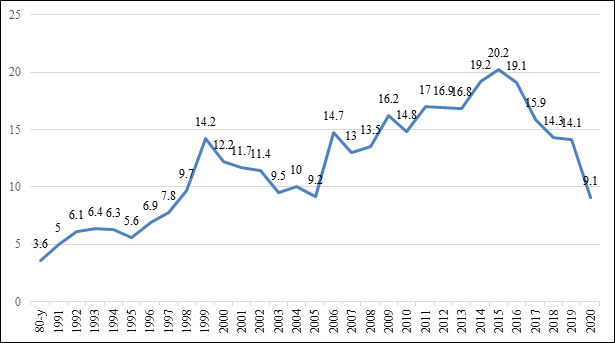
The official registration of echinococcosis in the republic began in the 60s of the last century, when the average intensive incidence rate was 2.5 per 100 thousand population, then in the 70s it increased to 3, in the 80s - 3.6, in 90s - 7.5, in 2000-2010 - already 12.4, and in 2010-2020 - 16.13 per 100 thousand population.
If we analyze the above data, the upward trend in the incidence of echinococcosis until 2010 has a pronounced character with an annual growth rate of 14.6%, from 2010 to 2014 - 16.9%, and from 2015 to 2020 - 14.6%. This indicates a decrease in the recorded incidence rates of echinococcosis by 2.31% in the period from 2010 to 2020.
As shown in Figure 1, in the republic since 2015, there has been a decrease in the incidence rate in connection with the measures taken. The Kyrgyz Research Institute of Veterinary Medicine is a co-executor of the Strategy for Combating Echinococcosis in the Kyrgyz Republic (2013- 2018) and carries out monitoring epizootological surveys among dogs after their preventive treatment with azinox.
2014 to 2018 2260 samples of faeces from deworming dogs from almost all regions of Kyrgyzstan were subjected to the study. At the same time, the infestation of dogs with teniids is steadily decreasing. In studies on the infection of dogs with teniids, a scatological and more sensitive ELISA method was used. When using both helminthological studies, a decrease in the infestation of dogs with teniids was confirmed. So, in the period from 2014 (the beginning of the implementation of the Strategy) to 2018, the average infestation rate of dogs was reduced from 20.2 to 14.3%. If in 2014 the intensive indicator was 20.2, then from 2015 to 2020. - 19.2, 15.9, 15.2, 14.3, 14.1, 9.1, respectively [4].
Echinococcosis in the Kyrgyz Republic is widespread both in its northern part, where the population is traditionally engaged in cattle breeding, and in the southern part, where the bulk of the population is engaged in field work (Figure 2). The results of the study show that in connection with the migration of the population, the morbidity in cities has increased significantly [1].
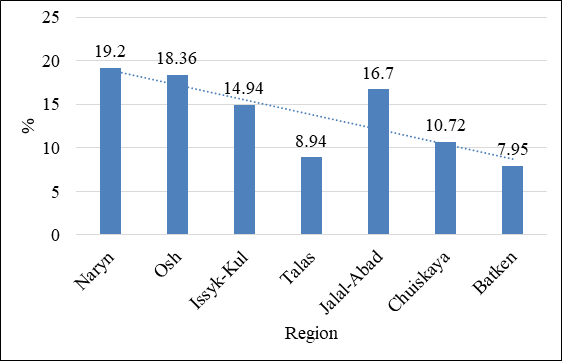
Based on the indicators in Figure 2, a retrospective analysis of the official statistics showed that in recent years, most cases of echinococcosis have been registered in Osh and Naryn regions. This is due to the fact that:
In these places, cattle breeding are well developed (Figure 3): in the majority of patients (76%), epidemiological risk factors for infection are associated with the presence of a large number of domestic animals [5].
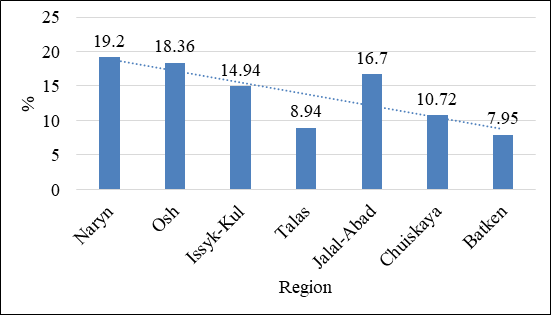
Despite the fact that here we see a large indicator of livestock breeding, veterinary supervision is at a low level.
In addition, rare deworming of dogs and cats is noted.
It should be noted that the population does not comply with the rules for keeping pets, personal hygiene and the failure to use the knowledge gained about the prevention of echinococcosis.
There is also the release of fresh animal viscera to dogs that feed on murine rodents, resulting in infections.
For a better understanding of the incidence of echinococcosis in the Kyrgyz Republic, we can consider the indicators at the level of one region - Osh, namely, according to the following criteria: By districts, by sex, by age, by contingent.
Therefore, we conducted a retrospective analysis of residents of Osh oblasts from 2015 to 2020 to study the degree and frequency of invasion among them according to the above criteria.
As shown in Figure 4, the intensive indicator (IP) for the districts of Osh oblast in 2015 is 33.4, then in 2016 it decreased by 4.27, in 2017 - by 4.29, in 2018 - by 3, 64, and in 2019 the PI increased by 2.3, as for 2020, there is a decline to 15.3.
If we analyze the above data, the PI of the incidence of echinococcosis in the Osh region for 2015-2020 has a pronounced character in the Alai region, and the lowest indicator is recorded in the Nookat region (Figure 4).
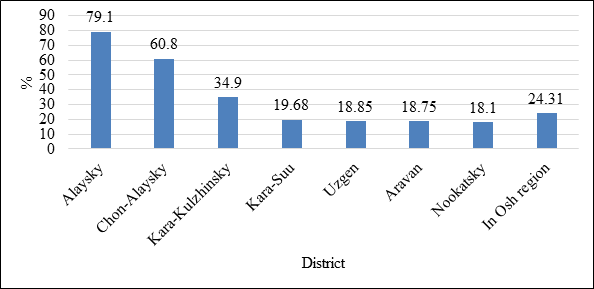
In all districts, there is a decline (Figure 4) in IP, but it is expressed in different ways, for example, in the Alai district, there is a gradual, gradual, and in Nookat, it is abrupt. This indicates that the effectiveness of the implemented preventive measures, as well as the quality of population registration, is not the same.
Data by sex: Analysis of the prevalence of echinococcosis among men and women showed almost the same invasion rate (47.8% - women and 52.8% - men). But these indicators may vary depending on the family structure, social status, family inferiority. For example, the prevalence of females in some regions is explained by the fact that in the Kyrgyz Republic, the care of domestic animals, including dogs, is carried out mainly by women. Data by age: According to Figure 5, there is a high proportion of morbidity in the category of 21-30 years old, which indicates that this segment of the population constitutes the main labor force, and there is also a high rate of migration, which is associated with a non-permanent job.
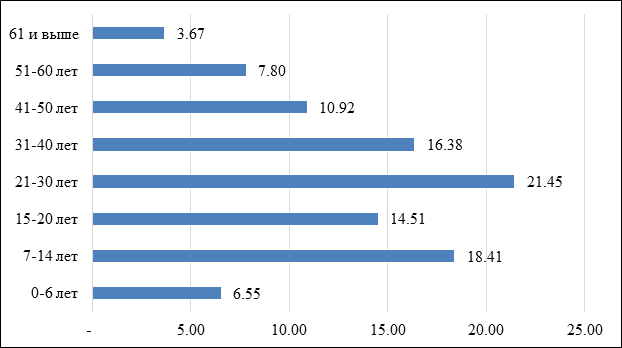
Of particular concern is the expressed level of morbidity in children under 14 years of age. This is due to the fact that they are unaware of the causes and consequences of many diseases, including echinococcosis. In addition, non- observance of hygiene rules, frequent contact with pets can affect the statistics of this stratum [6, 7].
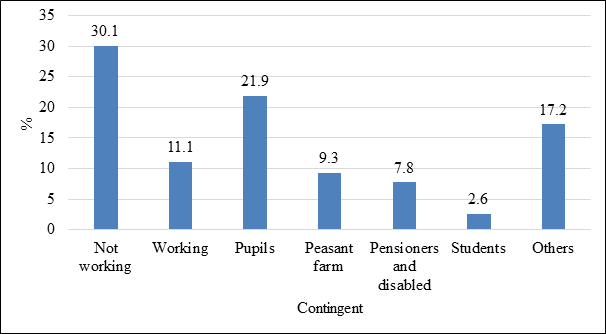
Data on the contingent: Cases of echinococcosis were registered among adults of all professions, however, they were more often detected among non-working people, the share is 30.1% of the total morbidity, and the share of workers is also quite high - 11.1% (Figure 6).
The phrase “unemployed persons” refers to the part of the economically active population who are able and willing to work, but cannot find a job. But here it is necessary to take into account the fact that in Kyrgyzstan there is a high rate of unregistered workers, which in turn raises the statistics. For example, hunters without a license, housewives, etc. The lowest incidence rate is observed among students. This can be explained by the fact that contact with pets and animals is minimized, the level of awareness is increased.
Conclusion
- For the analyzed period from 2014 to 2020, in the Kyrgyz Republic, there is a relationship between the effectiveness of preventive measures and the tendency for an increase in the incidence of echinococcosis.
- Naryn oblast (average PI = 20) and Osh oblast (average PI = 16.5) are leading in terms of the incidence of echinococcosis among the regions of the Kyrgyz Republic.
- As a result of the research, an analysis was carried out for the Osh region, as a result of which we can come to the following results: - Statistics on the incidence of echinococcosis depends on the level and quality of population registration. - The risk group includes those persons whose activities are related to animal husbandry, hunting, including their families.
- The high rate in Naryn oblast is associated with a significant increase in the number of sheep and goats throughout the Kyrgyz Republic.
- Despite the decrease in the incidence of echinococcosis in the Kyrgyz Republic, there are “hyperendemic territories”.
References
-
Raimkulov KM (2020) The current epidemiological situation for echinococcosis in the Kyrgyz Republic. Medical parasitology and parasitic diseases. pp: 20-27.
-
Toygombaeva VS, Raimkulov KM, Kuttubaev OT (2019) Identification and assessment of echinococcosis infestation in the population of Naryn, Osh and Batken regions. Medical parasitology and parasitic diseases 3: S25-33.
-
Imanaliev TI, Kalybekova BN (2016) Echinococcosis prevalence in the Kyrgyz Republic pp: 17-24.
-
Usubalieva ZhM, Raimkulov KM, Toygombaeva VS (2015) Epidemiological situation on the incidence of echinococcosis in the Kyrgyz Republic. Republican scientific-theoretical journal “Science, new technologies and innovations of Kyrgyzstan 4: 102-104.
-
Aboneev DV, Skorykh LN (2009) Efficiency of industrial crossing of North Caucasian sheep at different weaning times of young animals using morphometric indicators of placentas // Izvestiya TSKhA pp: 70-75.
-
Raimkulov KM, Toygombaeva VS, Kuttubaev OT (2019) Assessment of behavioral risk factors for echinococcosis and alveococcosis in endemic regions of the Kyrgyz Republic. Medical parasitology and parasitic diseases 3: S10-14.
-
Tursunov TT, Isaev MA, Ibragimova ZhA (2020) Some results of research work on the prevention of echinococcosis in Kyrgyzstan. International scientific conference 21: 428-431.
- Mitochondrial Bio-Logistics: Steering Co-Enzyme Q10 and Lycopene Synergies within the Science 4.0 Bio-OS Framework
- Hymenoptera Specimens from the Caño Negro Wetland, of the National Museum Collection, Costa Rica
- Science 4.0: Comprehensive Architecture of the Biological Operating System (Bio-OS) A Framework for Systemic Resilience and Industrialized Bio-Governance
- Rabbit on, or Hare Back? Understanding Climate Change
- Clinical Validation of Science 4.0: Flow Steering and Epigenetic Drift Inversion on a 76-Year-Old Hybrid System
- Seeds Planted by another Mind