
Biodegradation Study of Ammonia by Vibrio Alginolyticus Bacteria Species
Studies and research in the field of ammonia pollution treatment have led to the fact that microorganisms have a major role in treating such environmental pollution and thus contributing to environmental balance as they have the ability to dismantle ammonia into harmless elements. This study has been carried out on the Tobruk Bay aiming to detect the level of ammonia contamination from different sources and the potentiality of using bacteria to degrade it. The studied area involving 6 sites are namely the Corniche Beach, Commercial Port and, which has a pipe for the discharge of untreated sewage, Electricity Company and Desalination Plant, which use heavy fuels in the city’s operations, in addition to the Brega and Gulf Oil Companies. The results of ammonia contamination were 0.776mg/l, 0.180mg/l, 0.180mg/l, 0.280mg/l, 0.190mg/l, 0.240 mg/l for the Commercial Port, Electricity Company,El Brega Company, the Corniche Beach, Desalination Plant and Gulf Oil Company respectively. It was noticed that the higher level of concentration of ammonia at the Corniche Beach due to the flow of untreated sewage. On the other hand, the ammonia-dissolving bacteria were isolated from 3 sediment sampleswere collected from Corniche Beach at a distance one meter from beach linebecause it was the highest level of pollution with ammonia and measured its ability toward ammoniabiodegradation. Measurements were taken at different periods of two hours, the first period was recorded as 2.11 mg/l reading of ammonia concentration, and after 22 hours it reached 0.18 mg/l, thus proving its high ability to biodegrade ammonia. The isolated bacterial was defined at Alexandria University in Egypt by 16S rRNA method .This isolate was found to be consistent with another previous study in China, the name of the lysate bacteria was Vibrio alginolyticus.
Introduction
One of the strange situations is that the seas and oceans in which the first life began billions of years ago, and life continued to be confined to them for up to 90% of the history of life on earth, life in them is now threatened, as a result of the activity of the inhabitants of the planet that lives on land.
Man whose numbers have increased rapidly, especially in the twentieth century, has become the threat to wildlife... His horrific increase, escalating consumption, and agricultural, industrial and urban expansion, especially in coastal lands, have led to degrees of environmental destruction and coastal pollution [1, 2].
Some studies show that more than half of the world’s population lives on the continents within 100 km of coasts. It has also been found that the rates of population increase in coastal cities exceed global growth rates, and that most new cities are established near the coasts [3]. It was also found that nine of the ten largest cities in the world are coastal cities, and that coastal cities are increasing in bays and at the mouths of rivers, as these areas are suitable for establishing ports and anchoring ships [1]. Most of the pollution in the waters of the seas and oceans starts from the waters of the rivers that flow into them, which are usually loaded with sewage, industrial and agricultural products for the cities and villages that pass through them, as well as from the direct drainage of population and industrial gatherings on the seas and oceans [4]. It has been estimated that the sewage waste that results from a population complex in which one million people exceeds 250 thousand cubic meters per day, and that one liter of this water contains 2-3 billion microbes. Sick microbes on coastal residents and frequenting these polluted beaches [5].
Where the marine environment is considered one of the largest environments compared to land, the seas cover approximately 71% of the area of the globe. This environment is characterized by its wideness, depth, continuous movement and increased salinity [6]. The issue of wastewater pollution has become a critical issue more than ever, due to the increasing costs of wastewater disposal, and the issuance of stricter laws in terms of the levels of pollutants allowed in the sewers. Municipal wastewater consists of liquid or portable waste produced by health facilities in homes, institutions, and commercial or industrial establishments, in addition to ground and surface water and rainwater [7].
Untreated wastewater contains large amounts of organic matter and micro-organisms as well as nutrients and toxic compounds, which pose environmental and health hazards [8]. Therefore, wastewater must be removed quickly from its sources and treated appropriately before it is discharged. The ultimate goal of wastewater management is to protect the environment in a manner that is commensurate with the requirements of public health, economic and social issues [8]. Wastewater is one of the most dangerous environmental pollutants because it contains many types of harmful pollutants, including infectious causes, organic and inorganic chemical pollutants, in addition to radioactive materials. It is known that the discharge of human, biological and industrial wastes into water bodies such as rivers or sea beaches poses a danger to human health and transmits some deadly diseases [9]. Therefore, it is necessary to emphasize the treatment of sewage water before its final discharge into the marine environment. This study comes on some of the beaches of the city of Tobruk to assess the pollution of its sewage water through microbial analyzes of E. coli bacteria [10].
Location of Study
This study has been conducted on the polluted marine environment at Bay of Tobruk basin which located in the southeast of the city (Figure 1), at the intersection of longitude 23.59 13.06 E and latitude 32.04 09.46 N, northeast of Libya. There is a shipping lane in the Bay basin used for the movement of ships and oil tankers. The average depth of water in this corridor is about 16 meters The width of the opening of the Bay Basin is about 1.58 km and the length of the navigational passage is 3.85 km. Six different location sites were chosen in the studied area are namely Corniche Beach Commercial Port, , Electricity Company, Desalination Plant, Brega Oil Marketing Company and Gulf Oil Export Company that denoted by site 1 through site 6 respectively. Addition 3 samples of Corniche Beach sediments have been collected from one meter distance from beach line (S1, S2 & S3) and they were kept cold until they reached the laboratory whereas the laboratory experiments were conducted on them.
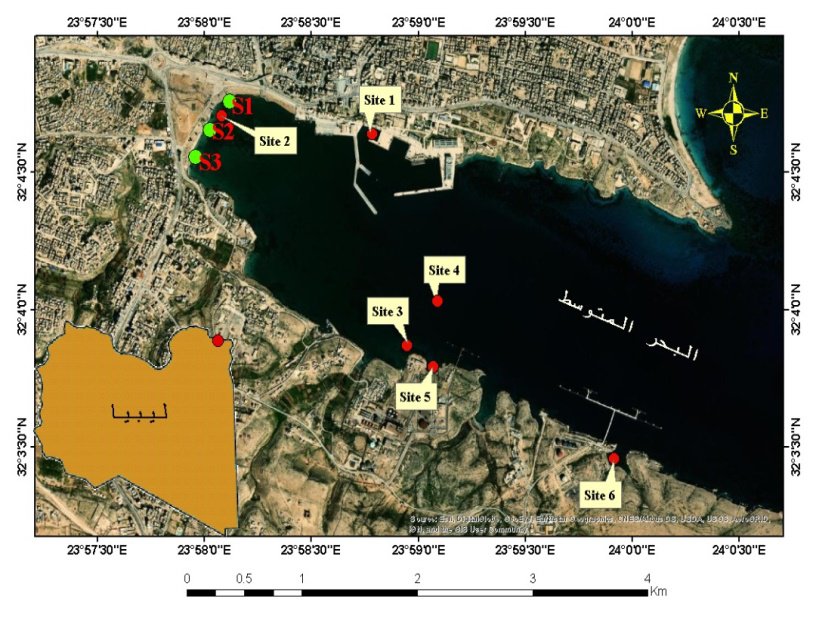
The Bay of Tobruk also contains many facilities with oil activity, which are located in the southeastern side of the Bay, which are represented in the oil refinery and port of Hariga for the export of crude oil, and the port of the Brega oil company for the export of oil derivatives, and the two power generation and seawater desalination plants, which use heavy fuels in operations In addition, some economic facilities are located on the southwestern side of the Bay, such as the port of the Turks for fishing boats, in addition to the Al Masirah Hotel, the largest hotel in the city of Tobruk. To receive commercial ships, fishing and rescue boats, in addition to the Corniche resort, which is used for entertainment, these facilities can cause pollution to the Bay waters with oil waste and its derivatives as a result of what may leak out of it during the loading of crude oil and its derivatives, or as a result of dumping waste water containing the resulting heavy fuel From leaks and maintenance operations in the power generation and water desalination plants, in addition to pollution by Heavy metals, salts and untreated city sewage waste.
Objectives of Study
This study mainly aiming to 1- Measuring the level of ammonia in the Bay Basin region. 2- Isolation of bacteria capable of biodegrading ammonia. 3- Measuring the ability of the selected bacteria to biodegrade ammonia.
Materials and Methods
Material and Apparatus
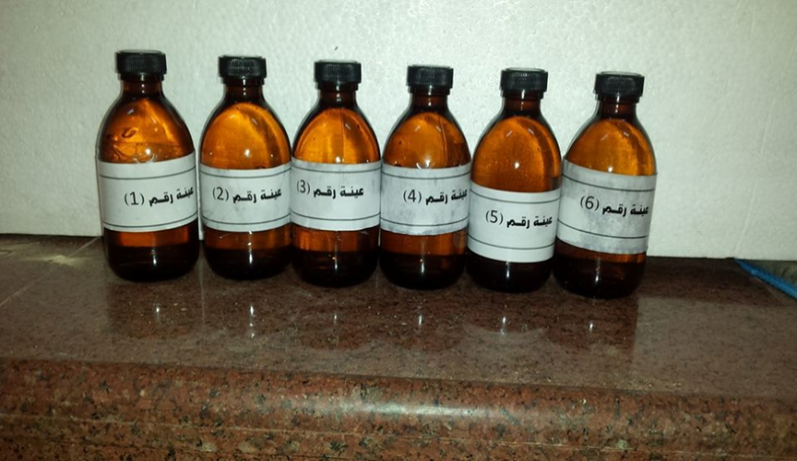
Sample Collection: Six samples of sea water were collected in sterile 250 ml bottles (Figure 2) from 6 different location sites within the study area are namely Commercial Port, Corniche Beach, Electricity Company, Desalination Plant, Brega Oil Marketing Company and Gulf Oil Export Company). Addition 3 samples of sandy soil from the Corniche beach from a depth of about 1 meter and they were kept cold until they reached the laboratory whereas the laboratory experiments were conducted on them.
Ammonia Measurements: Ammonia was measured using a Spectrophotometer U.V-Vis turbidity device using special reagents at a wavelength of 630 nm [11].
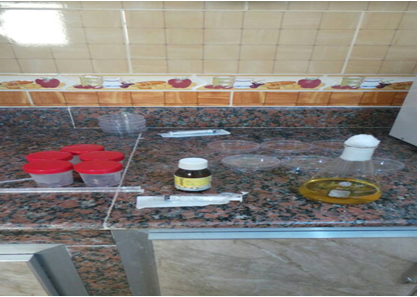
Isolation of ammonia-dissolving bacteria from the study area: The nutrient agar medium (NUTRIENT AGAR) was prepared and 3.5% NaCl and 40% ammonia concentration was placed as the sole source of nitrogen to the basal medium, and then the medium was sterilized with its contents in the sterilizer at a temperature of 121 °C for 15 minutes. The capacity of these bottles was 25 ml (Figure 3).
Then, 1 ml of the collected sandy soil samples was added to the previously prepared dishes containing the nutrient agar and ammonia and was placed in the incubator at a temperature of 34°C and the bacterial growth was monitored for 48 hours [12].
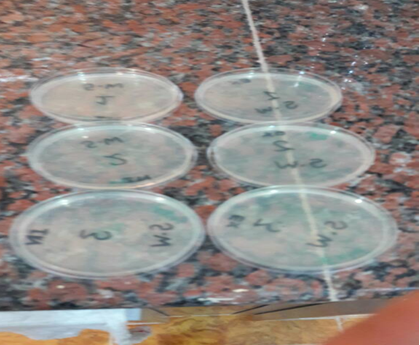
Purification of isolated bacterial strains: After the incubation period ended, the bacteria that gave growth on the nutrient agar medium supplemented with ammonia and 35 g/l salt were cultured on other plates containing the same nutrient medium (Figure 4). Incubation period Another subculture was carried out for the purpose of purifying the bacterial strains grown on the nutrient agar medium and transferred according to their different phenotypes [13].
Preservation of bacterial isolates: After the bacteria that gave growth were cultured on Nutrient Agar medium supplemented with ammonia at a temperature of 34°C inside the incubator for 18-24 hours, after their growth they are plotted on Slant agar and kept at a temperature of 34°C for 18-24 hours, After the isolates grow, they are kept cool at a temperature of less than 4°C.
Efficiency study of selected bacteria for degradation ammonia: To estimate the ability of the selected and known bacteria to decompose ammonia, the experiment was conducted according to the following: The three types of bacteria were cultured on nutrient agar media and incubated at 30-32°C for 18-24 hours, after which sterile glass bottles were prepared containing 500 ml ofsterile sea water with a concentration of 30% ammonia added. Turbidity for 48 hoursand readings were taken through a turbidity measuring device using its own reagents. Definition of the selected bacterial isolates: The selected isolate was identified by 16S rRNA method at Alexandria University.
Ammonia Compound and its Properties
Ammonia or spirit of ammonia is a colorless alkali gas, made up of four parts one nitrogen and three parts hydrogen. Ammonia is lighter than air and has a characteristic pungent odor. Its chemical symbol is NH3 and it is prepared by distillation of coal or some nitrogenous substances. Ammonia gas does not ignite in air, but it ignites in oxygen and produces a weak yellow flame.
Significantly when it is dry but when it melts it reacts with a lot of chemicals. Ammonium hydroxide is equivalent to highly water-soluble ammonia. It forms a solution known as ammonium hydroxide NH4OH, and ammonia is not reactive to many acids and forms the corresponding ammonium salts. For example, if hydrochloric acid (HCL) is added to ammonium hydroxide (NH4OH), an NH4CL ammonium chloride solution will be produced according to the equation:
NH4OH + HCl→NHCl + H2O Ammonia turns into a liquid at -33.35°C. And liquid ammonia boils at the same temperature, freezes and turns into a pure solid at -77.7°C. In its transformation from liquid to gas again, ammonia absorbs a great deal of heat from the outside environment, so that one gram of ammonia absorbs 327 calories. For this reason, ammonia is widely used in refrigeration equipment. The venting of this substance can be detected by the sense of smell and limits the place of venting by igniting fingers of sulfur near the place where venting is suspected, and white smoke appears in the event of venting. Ammonia completely mixes with lubricating oils (2).
Ammonia Impacts on the Environment
Anhydrous ammonia causes inflammation and irritation of the skin, eyes, nose, throat and upper respiratory tract. Since ammonia is the main source of nitrogen needed for the growth of aquatic plants, ammonia may contribute to eutrophication of stagnant or slow-flowing water bodies, especially those with limited content. From nitrogen. In addition, ammonia is considered moderately toxic to aquatic organisms. So far, it has not been scientifically proven that ammonia is a carcinogen. Ammonia is a major component of the nitrogen cycle in nature. In lakes, rivers, and natural waterways, ammonia is converted to nitrate. It is also used to adjust the pH of boiler water in power plants.
It is known that fish excrete ammonia in the water as waste and waste as a result of the processes of vital metabolism and excretion, which are acceptable proportions, but the danger comes from food residues left in the aquarium after feeding the fish or the remains of dead plants if the aquarium is planted if it is not removed and here comes the role of bacteria Rotting decomposes fish waste, food residues and any other organic residues and produces nitrogen, which soon combines with the hydrogen in the water to form ammonia.
H2+N2=NH3 This non-ionic form of ammonia is very toxic to aquatic organisms in general and to fish in particular, causing an increase in.
Methods for Detecting Ammonia
Detection by Chemical Reagents
There are types of chemicals that are used to detect ammonia in water, the most famous of which is the (Nestler) reagent, where you take a sample of the water in the aquarium and put three points of the reagent, and we find that the water is colored yellow according to the concentration of ammonia, and then we compare the gradient of the yellow color from light to dark to know the percentage of ammonia in the water But if the water is salty or has a percentage of salinity, we first use the Rachel detector to precipitate the dissolved salts in the water, then we use the Nisler detector in the same way as before, and this is the most accurate method for detecting ammonia in water.
Detection by Litmus Paper
It can be detected by taking a sample of water and put sunflower paper in it. If its color turns blue, this is evidence of increased alkalinity as a result of ammonia, and it is an inaccurate method. It is not possible for the color to change according to other conditions, especially the degree of acidity and the alkalinity of the water, and not according to the percentage of ammonia.
Results and Discussion
The chemical analysis of the investigated water samples reveal the ammonia concentration in the six studied sites as reported Table 1, which indicates that there are high levels of ammonia comparing with the natural situation. Ammonia levels should be almost non-existent, as it is produced naturally from the output of fish and other marine organisms. Ammonia is considered one of the most important factors affecting water quality and the living organisms in it.
| Commercial Port | Corniche Beach | Electric Company | Desalination Plant | Al Brega Company | Gulf Oil Company | |
|---|---|---|---|---|---|---|
| Ammonia concentration (mg/l) | 0.776 | 0.28 | 0.18 | 0.19 | 0.18 | 0.24 |
Table 1: Ammonia concentration in the investigated sites.
Ammonia is formed in two forms in water, an ionized form NH4 and a non-ionized form NH3 (gas), which is the toxic form, and the proportion of undispersed ammonia should not exceed 0.06 mg/liter, and it was found that high ammonia and low dissolved oxygen in the summer are the most important factors that cause large quantities of mortality for marine organisms. With an increase in pH and temperature, the proportion of toxic ammonia in the water increases. As the level of oxygen in the water decreases, the toxicity of ammonia increases due to the lack of oxygen to oxidize it.
Likewise, the increase in ammonia levels suffers from the desalination plant overlooking Tobruk Bay Basin, where the ammonia interacts with the mineral component of the desalination plant and causes it to corrode, which led to the deterioration of the desalination plant. The reason for the presence of ammonia in high rates in the study area is the sewage flow in Bay water.
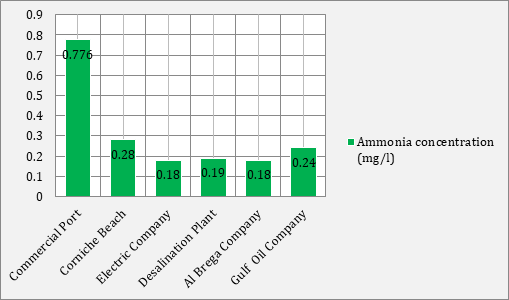
On the other hand, the bar chart in Figure 5 depicts the concentration of ammonia in the investigated locations and reflect the level of each source pollution. It is obviously from the obtained results the Commercial Port represents the highest level (0.776 mg/l) while the lowest source is Corniche Beach and Al Brega Company (0.180 mg/l).
Isolation Dissolving Bacteria of Ammonia from Collected Samples
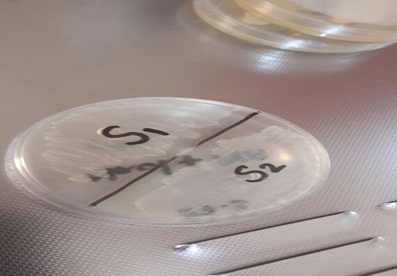
The results showed that all isolates grew without exception, (S1, S2, S3) and the best and fastest growth in the first site compared to the other sites, where we saw that the first site S1 gave isolate excellent growth and the second site gave isolate weak growth (S2) while the third site the sample showed good growth (S3).
Ability of Isolated Bacteria and Detection of Ammonia Hydrolyze
The best bacterial growth was selected and its ability to analyze ammonia was tested by monitoring the optical density by means of a turbidity meter, where it was noted that isolate S1 gave excellent growth on the substrate (Table 2).
| Time | 11.2 | 1.2 | 3.2 | 5.2 | 7.2 | 9.2 | 11.2 | 1.2 | 3.2 | 5.2 | 7.2 | 9.2 |
|---|---|---|---|---|---|---|---|---|---|---|---|---|
| Ammonia concentration (mg/l) | 2.11 | 2.07 | 2 | 1.8 | 1.74 | 1.59 | 1.34 | 1.27 | 1.02 | 0.95 | 0.59 | 0.18 |
Table 2: Biodegradation of ammonia at a concentration of 30% by selected bacteria.
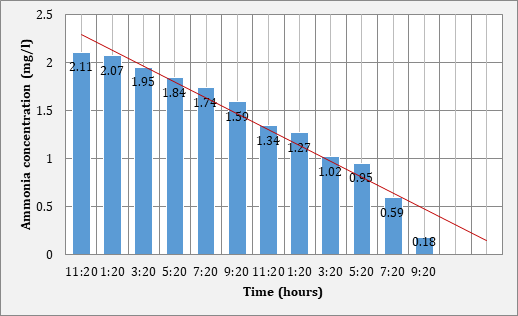
The results shown in Table 2 indicate that the bacterial isolate S1 has the ability to biodegrade ammonia, where the measurement was periodically every two hours and the first reading was 2.11 and the last reading after about 22 hours 0.18, which indicates the ability of the isolated bacteria to biodegrade ammonia with high efficiency and this isolation after its definition. It was found that it agrees with the study of [14], which was found to biodegrade a high load of ammonia in sea water.
From the findings it is obviously that the ammonia concentration displays strong negative correlation with time; whereas, the relationship shows linear degradation with increasing time throughout the periods of investigations as shown in Figure 6.
Bioremediation has become an important method in restoring polluted environments to their former state by exploiting natural activities with the ability to analyze [15], where the efficiency of biodegradation by fungi in soil ranges from 6% to 82% and the biodegradation efficiency of bacteria in soil It ranges from 0.13% to 50% and the efficiency of marine bacteria in biodegradation ranges between 0.003% to 100% [16, 17]
The bacteria isolated from the samples to which the ammonia was added gave positive results. This may be attributed to the bacteria’s adaptation to the ammonia- contaminated environment, as the microbial growth reflects the link to biodegradation [18, 19].
Definition of Isolated and Selected Bacterial Strains
The selected bacterial isolates were identified by S rRNA16 method and the name of this isolated bacteria is Vibrio alginolyticus as shown in (Figure 7) [20, 21, 22, 23, 24].
Conclusion
In the light of the previous study it can be draw the following conclusion:
- The studied area of Tobruk Bay was suffering from high levels of ammonia content.
- The contamination of ammonia refers to several sources and varies from source to another.
- The findings reveal a variation of ammonia contamination throughout the investigated locations.
- The possibility of treating ammonia pollution by autogenous bacteria isolated from the same area of contamination.
- The potentiality of using the isolated and defined bacterial strains: Vibrio alginolyticus in the treatment of ammonia pollution in the marine environment.
- The difficulty of large-scale using this bacterium due to its pathogenicity, and to note the need for further work in this direction [25, 26].
Recommendations
- Supporting studies and research in the field of treating ammonia pollution and sewage in polluted places in the city, while studying environmental factors to find out the extent of the seriousness and development of ammonia pollution.
- Maintenance of the sewage purification plant as a solution to stop the flow of untreated sewage into the Gulf of Tobruk basin. With regard to the strategy of the Libyan state towards the problem of oil pollution in Libyan ports and beaches, we recommend the following:
- Using the conclusions and recommendations of this study in the implementation of plans and strategies that would protect and preserve the marine environment from sewage and oil pollution.
- Implementation of Law No. (15) for the year (2003), related to the protection of the marine environment in Chapter Three, especially Articles (22, 23, 28, 29), as the Libyan state provides facilities for ships in the main ports, and this in turn, ships must abide by To protect the marine environment in general, and to abide by local laws and international agreements in the field of marine environment protection, or to be subject to financial fines and penalties.
- The study recommends a continuous monitoring program for the Libyan coast.
References
-
Martinez, ML, Intralawan A, Vazquez G, Perez Maqueo O, Sutton P, et al. (2007) The coasts of our world: ecological, economic and social importance. Ecological Economics 63(2-3): 254-272.
-
Woodworth PL, White NJ, Jevrejeva S, Holgate SJ, Church, JA, et al. (2009) Evidence for the accelerations of sea level on multi-decade and century timescales. International Journal of Climatology 29: 777-789.
-
Small C, Nicholls RJ (2003) A global analysis of human settlement in coastal zones. Journal of coastal research pp: 584-599.
-
Anju A, Ravi SP, Bechan S (2010) Water pollution with special reference to pesticide contamination in India. Journal of Water Resource and Protection 2010.
-
Corcoran (2010) Sick water: the central role of wastewater management in sustainable development: a rapid response assessment. UNEP/Earthprint.
-
Cater C, Cater E (2001) Marine environments. The encyclopedia of ecotourism pp: 265-282.
-
Hader DP, Banaszak AT, Villafañe VE, Narvarte MA, González RA et al. (2020) Anthropogenic pollution of aquatic ecosystems: Emerging problems with global implications. Science of the Total environment 713: 136586.
-
Topare NS, Attar SJ, Manfe MM (2011) Sewage/ wastewater treatment technologies: a review. Sci. Revs. Chem. Commun 1(1): 18-24.
-
Awuchi CG, Awuchi CG (2019) Impacts of plastic pollution on the sustainability of seafood value chain and human health. International Journal of Advanced Academic Research 5(11): 46-138.
-
Salem SI, Saleh RH, Hamad NM, Karim BI, Hamad FAH (2015) Assessment of biological pollution with sewage water in St. George Beach, Beach and Diving Club Beach - Tobruk. Bachelor’s degree research. College of Natural Resources. Tobruk. Libya.
-
Zhang X, Fang Y, Zhao Y (2013) A portable spectrophotometer for water quality analysis. Sensors & Transducers 148(1): 47.
-
Boden R, Scott KM, Williams J, Russel S, Antonen K, et al. (2017) An evaluation of Thiomicrospira, Hydrogenovibrio and Thioalkalimicrobium: reclassification of four species of Thiomicrospira to each Thiomicrorhabdus gen. nov. and Hydrogenovibrio, and reclassification of all four species of Thioalkalimicrobium to Thiomicrospira. International Journal of Systematic and Evolutionary Microbiology 67(5): 1140-1151.
-
Lotfabad TB, Shourian M, Roostaazad R, Najafabadi AR, Adelzadeh MR, et al. (2009) An efficient biosurfactant- producing bacterium Pseudomonas aeruginosa MR01, isolated from oil excavation areas in south of Iran. Colloids and Surfaces B: Biointerfaces 69(2): 183- 193.
-
Kim J, Sugano JN, Hiral M, Makoto S (2000) Removal of a high load of ammonia fas a marine bacterium , Vibrio alginolyticus , Bioscience and Bioengineering 4: 410- 415.
-
Atlas RM (1991) Microbial hydrocarbon degradation bioremediation of spill. Journal of chemical Technology and Biotechnology 52: 149-156.
-
Hollaway SL, Faw GM, Sizemore RK (1980) The bacterial community composition of an active oil field in the Northwestern Gulf of Mexico,Marine Pollution Bulletin 11: 153-156.
-
Hazen TC, Tien AJ, Worsztynowicz A, Altman DJ, Ulfig K, et al. (2003) Biopiles for remediation of petroleum– contaminated soils: Apolish case study. Lawrence Berkeley national laboratory Institute for ecology of Industrial Areas pp: 1-15.
-
Rahman KSM, Rahman JT, Kourkoutas Y, Petsas I, Marchant R, et al. (2003) Enhanced bioremediation of n-alkane in petroleum sludge using bacterial consortium amended with rhamnolipid and micronutrients. Bioreso Technol 90: 159-168.
-
Stephens EL, Molina V, Cole KM, Laws E, Johnson CN (2013) In situ and in vitro impacts of the Deepwater Horizon oil spill on _Vibrio parahaemolyticus_, Marine Pollution Bulletin 75(1): 90-97.
-
AL Saleh E, Drobiva H, Obuekwe C (2008) Predominant culturable crude oil degrading bacteria in the coast of Kuwait. International Biodeterioration and Biodegradation 63: 400-406.
-
Doumenq P, Aries E, Asia L, Acquaviva M, Artaud J, et al. (2001) Infiuence of n-Alkane and petroleum on fatty acid composition of a hydrocarbonoclastic bacterium: _Marinobacterhydrocarbonoclasticus_ strain 617. Chemosphere 44: 519-528.
-
Jones J, Knight M, Byron JA (1970) Effect of gross population by kerosene hydrocarbons on the microflora of a moorland soil. Nature 227: 1166.
-
Kostka JE, Prakash O, Overholt WA, Green SJ, Freyer G, et al. (2011) Hydrocarbon-Degrading Bacteria and the Bacterial Community Response in Gulf of Mexico Beach Sands Impacted by the Deepwater Horizon Oil Spill. Appl Environ Micrbiol 77(22): 7962-7974.
-
Lattuati A, Metzger P, Acquaviva M, Bertrand JC, Largeau C (2002) n-Alkane degradation by _Marinobacterhydrocarbonoclasticus_ strain SP 17: long chain B-hydrox acids as indicators of bacterial activity. Organic Geochemistry 33: 37-45.
-
Phillips GJ, Stewart JE (1974) Distribution of hydrocarbon utilizing bacteria in Northwestern Atlantic waters and coastal sediments, Canadian Journal of Microbiology 20: 955-962.
-
Pinholt Y, Struwe S, Kjoller A (1979) Microbial changes during oil decomposition in soil, Holarctic Ecology 2: 195-200.
- Mitochondrial Bio-Logistics: Steering Co-Enzyme Q10 and Lycopene Synergies within the Science 4.0 Bio-OS Framework
- Hymenoptera Specimens from the Caño Negro Wetland, of the National Museum Collection, Costa Rica
- Science 4.0: Comprehensive Architecture of the Biological Operating System (Bio-OS) A Framework for Systemic Resilience and Industrialized Bio-Governance
- Rabbit on, or Hare Back? Understanding Climate Change
- Clinical Validation of Science 4.0: Flow Steering and Epigenetic Drift Inversion on a 76-Year-Old Hybrid System
- Seeds Planted by another Mind