
Welfare Appraisal of Unilateral Eyeball Enucleation in a Stray Dog
A stray dog having abnormal left eye was rescued from the street of Bharatpur metropolitan city. The dog was kept in kennel for 3 days for acclimatization and fasted overnight before the surgery. The abnormal large growth in the eyeball was diagnosed as tumor of eye. After careful examination and assessing the complications of the affection, it was decided to enucleate the eyeball. The Procaben-LA (20,000 IU/Kg) and Meloxicam (0.3 mg/kg) were injected intramuscularly as a prophylactic antibiotic and preemptive analgesia, respectively 30 minutes before the initiation of enucleation surgery. The dog was induced with intravenous administration of Diazepam and Ketamine-HCl (1:1 v/v) combination and maintained with the same anesthesia (1:2 v/v). After anesthetization, dog was restrained in right lateral recumbent position. The affected eye and adnexia was prepared for aseptic surgical intervention. The auriculo-palpebral nerve block was also achieved by injecting 5 ml of 2% Lignocaine-HCl to cause both sensory and motor paralysis of the eyelids. The affected eyeball was enucleated very carefully following the standard surgical procedure. Finally, the both eyelids were sutured together as a tarsorrhaphy using vicryl in intradermal suture pattern. The same antibiotic i.e., Procaben-LA was administered intramuscularly again after 2 days. Meloxicam were injected intramuscularly daily for next 2 days. The operated area was dressed daily with povidone iodine till it healed completely. The enucleation surgery of the eyeball resulted in an eventual recovery of the dog.
Introduction
Enucleation is the removal of an eye and its adnexial structures. It is a salvage and decisive procedure to alleviate the pain associated with any eye problem, especially if the eye is blind and of no further use to the animal. All medical attempts at saving the eye are usually tried before this procedure. An earlier study [1] reported that it is the most commonly performed surgical procedure for irreversibly blind and painful eyes in primary care and referral practice in the UK. Enucleation and blindness are tolerated well by dogs and cats. Unilateral enucleation is generally practiced in owned dogs and cats. It may also be recommended for ocular diseases resulting in irreversible ocular pain and blindness, such as trauma or severe corneal perforation [2]. However, bilateral enucleation should be recommended as an end stage solution to primary or secondary glaucoma that is not responsive to medical management [3, 4].
The dog suffered with chronic pain shows subtle signs which are by virtue not noticed by owners. It is the responsibilities of veterinary surgeons to attenuate the pain and suffering in their animal patients [5]. However, the ocular pain is often ignored by veterinary surgeons [6]. The veterinary surgeons should emphasize for enucleation surgery where the ocular pain cannot be controlled by medicinal therapy. However, there is great dilemma to veterinary surgeon whether or not to perform enucleation surgery for stray dogs. In fact the dogs with irreparable eye diseases may not show dominancy to maintain their territory or survive independently. In rare instances, the dogs might be suffered with bilateral ocular tumor or irreparable diseases. Considering the welfare, veterinary surgeon must perform the unilateral enucleation of the eye but it should be irrational to perform the bilateral enucleation of eye in stray dogs and cats. However, there is discrepancy regarding the bilateral enucleation of eyes in owned dogs.
Many dog owners consider the bilateral enucleation as daunting procedure and instead prefer euthanasia because of fear of the risks of anesthesia, postoperative aesthetic values, the ability of the dog or owners to cope postoperatively, concerns of the impact on welfare and quality of life, and the impact on the human-canine bond as eye contact is a key communicative technique between owner and dog [7, 8]. It is essential to aware owners about the bilateral enucleation surgeries and the reasons for performing it, it is equally important that owners have a clear prognostic expectation and appearance of their animals [1].
Case History and Clinical Observation
An adult non-descript dog rescued from the street of Bharatpur Metropolitan City of Nepal. The dog had tumorous growth on the left eyeball (Figure 1A-D). The dog received Procaben-LA (20,000 IU/Kg) and Meloxicam (0.3 mg/kg) intramuscularly as a prophylactic antibiotic and preemptive analgesia, respectively 30 minutes before the enucleation surgery. The dog was sedated with intramuscular injection of Xylazine-HCl @ 2 mg/kg body weight. The catheter was inserted into right cephalic vein and affixed properly with adhesive tape to infuse 0.1 ml/kg of 1:1 (v/v) and 1:2 (v/v) mixtures of Diazepam and Ketamine-HCl for induction and maintenance of anesthesia. The affected eyeball was thoroughly and gently washed with normal saline for clinical examination. After careful clinical examination, it was decided to enucleate the tumorous eyeball and to relieve the animal suffering from pain. The presence of hair on a tumorous mass clipped and shaved properly. The surgical site was scrubbed with povidone iodine at least 5 times and auriculopalpebral nerve was blocked with infiltration of 5 ml of Lignocaine-HCl to achieve analgesia of the eyelids. The surgical site was draped and finally painted with isopropyl alcohol. Since this block did not cause complete analgesia of the eye ball, the local infiltration of Lignocaine-HCl was done at the site of operation. The entire tumorous mass was clamped with forceps at the base of the eyeball and the chromic catgut (1-0) was used for transfixing ligation of blood vessels and optical nerve stump of eyeball beneath the clamping forceps. The mass was excised above the clamping forceps and checked for bleeding (Figures B-C).
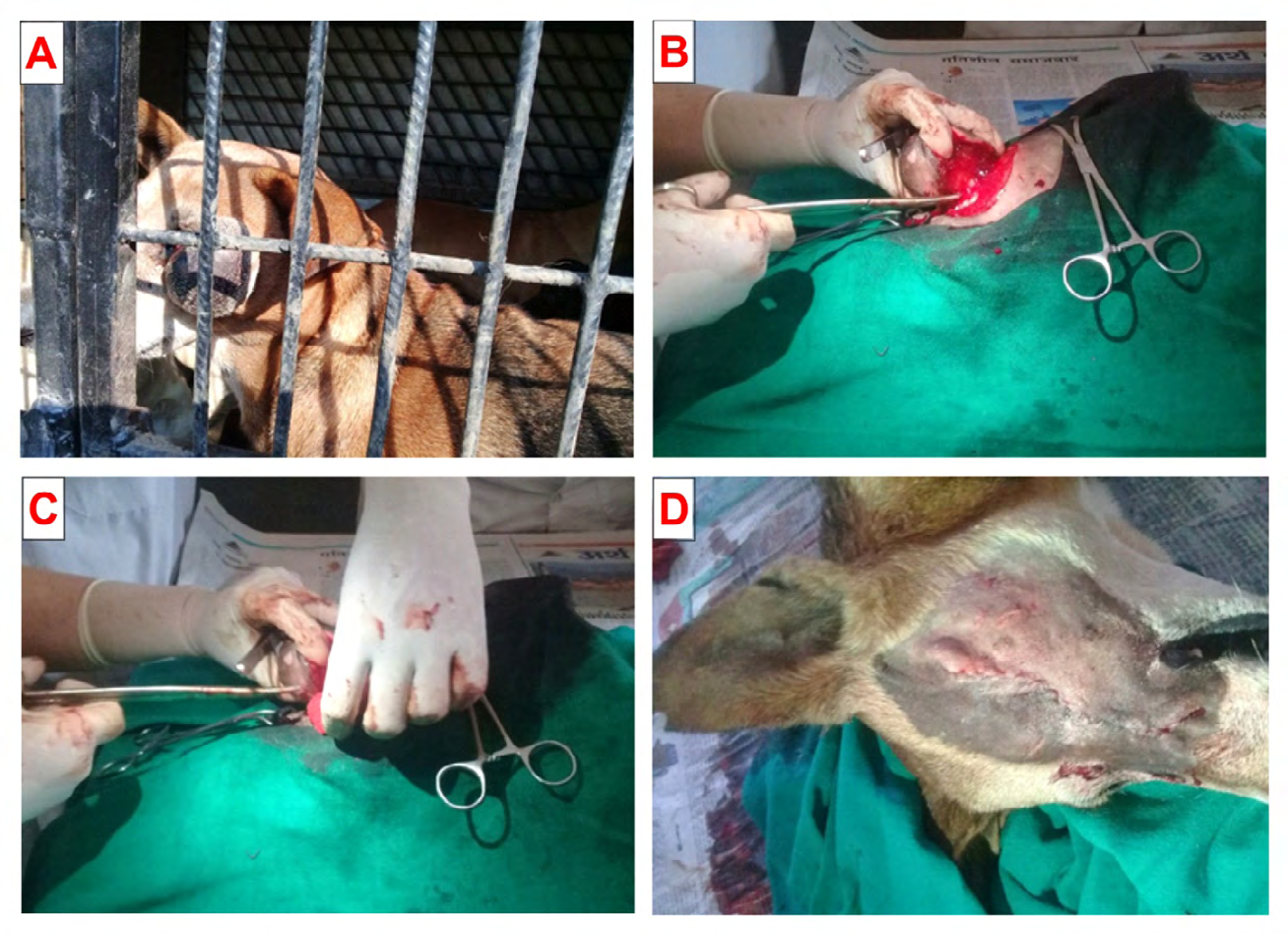
There was no bleeding at site of excision. Tarsorrhaphy was done using vicryl 2/0 in intradermal suture pattern to close both the eyelids (Figure D). Betadine ointment was applied topically over the operated region. The operated dog was kept in kennel after recovery from anaesthesia.
Procaben-LA (20,000 IU/Kg) was injected intramuscularly again after 48 hours of surgery and Meloxicam (3 mg/kg) were injected intramuscularly once a day daily for next 2 days. Food and water are provided ad libitum during the postoperative period.
Discussion
Enucleation, the surgical removal of the eye ball and its adnexial structures, is indicated for blind, tumerous, glaucoma and painful eyes which are unresponsive to routine medicinal treatment. Enucleation seems a feasible, simple, inexpensive option of treatment for many types of severe ocular pathology including tumerous eye [9]. Enucleation surgery results in minimal postoperative complications and has the potential to resolve chronic pain, infection, and neoplastic disease [10].
Enucleation surgery offers a humane alternative to constant pain, the threat of neoplasia metastases, or euthanasia of an otherwise healthy animal. This procedure is supposed to be well tolerated by animals because the animal with blind and painful eye, there is no doubt that the animal will be very much happier without eye. Despite these facts, owners take the issue very emotive and therefore do not accept the enucleation surgery. Veterinary surgeon should convince the owner that this procedure results in animal’s overall comfort and improved demeanour. The unilateral eye nucleation may be well accepted by the owner and even the stray dog may survive with one normal eye. Careful owner counseling prior to the enucleation procedure is indicated for enhancement of the owner satisfaction. However, bilateral eyes enucleation may not be acceptable by the owner and it should be totally contraindicated in stray dogs and cats. The bilateral enucleation remains a viable option to manage dogs with severe ocular pain considered refractory to medical treatment and is perceived by owners to improve their dog’s quality of life [11].
Conclusions
Unilateral enucleation seems only practical option for veterinary surgeon to manage the severe ocular pain of tumerous eye and to improve their dog’s quality of life. Enucleation of eye in a stray dog could be practiced deliberately, with minimal or no any complications.
Acknowledgements
It is noteworthy to extend heartfelt thanks to HART for referring the case for enucleation surgery and One Health International for providing the surgical supplies.
Competing Interests
The author declares no any competing interests.
Author Contributions
MKS performed the enucleation surgery, drafted and revised the manuscript. The author read and approved the final manuscript.
References
-
Hamzianpour N, Smith K, Dawson C, Rhodes M (2019) Bilateral enucleation in dogs: A review of owner perceptions and satisfaction. Vet Ophthal 22(5): 566- 576.
-
Ledbetter EC, Gilger BC (2013) Diseases and surgery of the canine cornea and sclera. In: Gelatt KN , et al. (Eds.), In: 5th (Edn.), Wiley-Blackwell, Ames, Iowa pp: 976-1049.
-
Plummer C, Regnier A (2013) The canine glaucomas. In: Gelatt KN, Gilger B, Kern T, (Eds.). In: 5th (Edn.), Wiley- Blackwell, Ames, Iowa, USA, 2: 1050-1145.
-
Spiess BM, Pot S (2013) Diseases and Surgery of the Canine Orbit. In: Gelatt KN, Gilger B, Kern T, et al. (Eds.), In: 5th (Edn.), Wiley-Blackwell, Ames, Iowa, USA, 7: 793- 831.
-
Royal College of Veterinary Surgeons (2017) RCVS code of professional conduct for veterinary surgeons.
-
Hellyer P, Rodan I, Brunt J, Downing R, Hagedorn JE, et al. (2007) AAHA/AAFP pain management guidelines for dogs and cats. J Feline Med Surg 9: 466-480.
-
Nagasawa M, Kikusui T, Onaka T, Ohta M (2009) Dog’s gaze at its owner increases owner’s urinary oxytocin during social interaction. HormBehav 55: 434-441.
-
Nagasawa M, Mitsui S, En S, Ohtani N, Ohta M, et al. (2015) Oxytocin-gaze positive loop and the coevolution of human-dog bonds. Science 348: 333-336.
-
Thakur B, Regmi B, Sah MK (2018) Surgical management of Corneal dermoid complicated by ruptured cornea with maggot infestation in a calf. I J Vet Surg 39(1): 70.
-
Ali M (2015) Ocular Field Surgery in Ruminants. Int J Vet Med (2015): 1-8.
-
Mitchell N (2008) Enucleation in companion animals. Iri Vet J 61(2): 108-114.
- Mitochondrial Bio-Logistics: Steering Co-Enzyme Q10 and Lycopene Synergies within the Science 4.0 Bio-OS Framework
- Hymenoptera Specimens from the Caño Negro Wetland, of the National Museum Collection, Costa Rica
- Science 4.0: Comprehensive Architecture of the Biological Operating System (Bio-OS) A Framework for Systemic Resilience and Industrialized Bio-Governance
- Rabbit on, or Hare Back? Understanding Climate Change
- Clinical Validation of Science 4.0: Flow Steering and Epigenetic Drift Inversion on a 76-Year-Old Hybrid System
- Seeds Planted by another Mind