
Assessment of Avian Diversity in Gudalur Forest Division, the Nilgiris, Tamil Nadu
Avian community is an important component of forest ecosystem. Birds are playing a major role as pollinators, consumers, dispersers of plant seeds and predators of insects. Majority of the studies on bird community were focused on understanding of the structure of a community based on the population. A number of environmental factors are known to influence the population of birds directly. The present survey was made to find out the avian diversity in the lantana dominated area of Gudalur Forest Division. Line transect method was applied for recording birdlife communities. A total of 33 species of birds were recorded during the survey conducted in three phases in Gudalur Forest Division. Among the species identified, 26 are abundant and 7 are very abundant.
Introduction
Declining biodiversity is one of the most dramatic and irreversible aspects of anthropogenic global change and biological invasions are believed to be the second largest cause of current biodiversity loss after habitat destruction [1, 2, 3]. Avian community is an important component of forest ecosystem. Birds are playing a major role as pollinators, consumers, dispersers of plant seeds and predators of insects. Studies on bird community starting from MacArthur, et al. [4] have attracted wide attention. Investigations on the bird communities of the Western Ghats to plan for biodiversity friendly development are gaining significance [5]. The focus of community ecology is the study of the grouping of species, their distribution and the interactions between them and the physical and biological factors of their environment [6]. According to Cody, et al. [7] bird communities have direct relation with the structure of habitat and are indicators of environmental changes. Birds are one of the best indicators of environmental quality of any ecosystem [8]. Many other groups of animals such as [9], tiger beetle [10], birds [11] and mammals as well as plants [12] have been used to assess the habitat quality.
Majority of the studies on bird community were focused on understanding of the structure of a community based on the population [4, 7]. They attempted to explain the diversity, especially with respect to the forest structure or floristic diversity. The presence of a particular species in a type of forest was traditionally explained in terms of the availability of foraging substrates and vegetative layers. In recent years, the trend among community ecologists is to elucidate the function of a community focusing on habitat selection.
A number of environmental factors are known to influence the population of birds directly. Availability of food, detectability and capture, location of nesting sites, availability of nesting materials, presence of predators and competitors are the major factors influencing the foraging and breeding of birds and subsequently their population. One of the key aspects in community structure is the food habits of a species which is critical in understanding the pattern and process of community organization [6]. Population studies have been traditionally used to monitor long term changes in avian population and to assess both habitat quality and the responses of birds to both natural and human caused environmental changes [6].
Eight percent of bird species in India occur in Gudalur and adjacent Mudumalai Tiger Reserve. Among the 227 bird species found in this region, 110 species are insectivores, 62 are carnivores, 23 species are fishwives, 12 species are omnivores and 20 species are gramnivores. These include the unique near threatened Black-and-orange Flycatcher. Regional endemics include Malabar trogon and Malabar grey hornbill. Some rare birds of prey like the Rufous bellied hawk eagle can occasionally be seen in this area. Other predatory birds include crested hawk-eagle, crested serpent eagle, Changeable Hawk Eagle, Black Eagle, Oriental Honey-buzzard, Jerdon’s Baza, Bonelli’s Eagle, Crested Goshawk, Besra sparowhawk, Mottled Wood Owl and Brown Hawk Owl, Minivet sp. There are also Hornbills, Golden Oriole, Chloropsis, Paradise flycatcher, Golden-backed Woodpecker, Malabar Great Black Woodpecker, Blue- winged Parakeet, Fairy bluebird, Jungle fowl, Racket-tailed Drongo, Peacock, Red Spurfowl, Grey Francolin, Painted Spurfowl, Painted Bush Quail, White-bellied Woodpecker, Lesser Yellownape, Golden Woodpecker, Streak- throated Woodpecker, Chestnut-headed Bee-eater, Emerald Dove, Green Imperial Pigeon, Pompadour Green Pigeon, Grey- bellied Cuckoo, Indian Cuckoo, Alpine Swift, Black-hooded Oriole, Greater Racket-tailed Drongo, Black-headed Cuckooshrike, Grey-headed Bulbul, Forest Wagtail, Crimson- backed Sunbird and Loten’s Sunbird. It also holds the isolated southern population of the Striped Tit-babbler. The present survey was made to find out the avian diversity in the lantana dominated area of Gudalur Forest Division with an objective of study the avian diversity in prior to removal of invasive alien species Lantana camara of Gudalur Forest Division.
Methods
Line transect method [13] was applied for recording birdlife communities. Sometimes the transect might even gone beyond our physical target area. The care was taken that transects’ midpoint should cross on the target area. Survey was made to count the number of birds along with the transect. Using binocular bird species were identified from the transect. Grimmett, et al. [14] was referred for the identification of birds in the field. The diversity variables are collected to estimate encounter survey. For each sighting of the bird 1 m radius circle was laid at sighting location in order to record micro habitat utilization of the bird species.
Results and Discussion
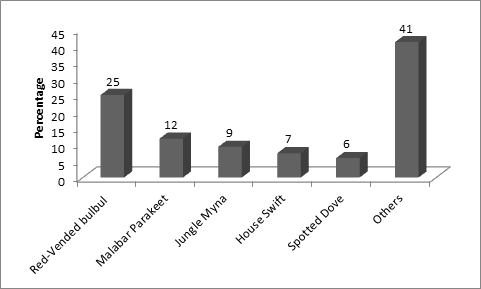
A total of 33 species of birds were recorded during the survey conducted in three phases in Gudalur Forest Division (Table 1). Out of these species Red vented bulbul (25%), Malabar Parakeet (12%), Jungle myna (9%), House swift (7%) and Spotted dove (6%) were sighted dominantly, whereas the other species (41%) are sighted very few (Figure 1).
| Sl. No. | Common Name | Scientific Name | No. of birds sighted |
|---|---|---|---|
| 1 | Ashy prinia | Prinia socialis | 1 |
| 2 | Black Drongo | Dicrurus macrocercus | 3 |
| 3 | Black eagle | Ictinaetus malayensis | 5 |
| 4 | Blue winged leaf bird | Choloropsis cochinchinensis | 1 |
| 5 | Common myna | Acridotheres tristis | 2 |
| 6 | Golden backed Wood pecker | Dinopium benghalense | 2 |
| 7 | Greater coucal | Centropus sinensis | 2 |
| 8 | Greater Racket tailed drongo | Dicrurus paradiseus | 1 |
| 9 | Grey Jungle Fowl | Gallus sonneratii | 4 |
| 10 | Grey wagtail | Motacilla cinerea | 3 |
| 11 | House Swift | Apus affinis | 15 |
| 12 | Indian Robin | Saxicoloides fulicata | 4 |
| 13 | Indian scimitar babbler | Pomatorhinus horsfieldii | 4 |
| 14 | Indian swiftlet | Collocalia unicolor | 2 |
| 15 | Jungle Myna | Acridotheres fuscus | 19 |
| 16 | Long tailed shrike | Lanius schach | 1 |
| 17 | Malabar Grey Hornbill | Ocyceros griseus | 2 |
| 18 | Malabar Parakeet | Psittacula columboides | 24 |
| 19 | Oriental white-eye | Zosterops palpebrosus | 3 |
| 20 | Purple sunbird | Nectarinia asiatica | 4 |
| 21 | Red Spur fowl | Galloperdix spadicea | 1 |
| 22 | Red-Vended bulbul | Pycnonotus cafer | 51 |
| 23 | Red-whiskered Bulbul | Pycnonotus jocosus | 6 |
| 24 | Scaly breasted munia | Lonchura punctulata | 5 |
| 25 | Shikra | Accipiter badius | 2 |
| 26 | Small Green bee eater | Merops orientalis | 3 |
| 27 | Small Minivet | Pericrocotus cinnamomeus | 7 |
| 28 | Spotted Dove | Steptopelia chinensis | 12 |
| 29 | Streak throated wood pecker | Picus xanthopygaeus | 3 |
| 30 | White browed wagtail | Motacilla maderaspatensis | 4 |
| 31 | White cheeked barbet | Megalaima viridis | 4 |
| 32 | Yellow browed bulbul | Iole indica | 1 |
| 33 | Yellow-billed Babbler | Turdoides affinis | 3 |
Table 1: Bird species sighted during the field survey in Gudalur and Bitherkad regions of Gudalur Forest Division.
The area is highly rich in avifauna. This high diversity may be attributed to the fact that this area supports good vegetation. Among the species identified, 26 are abundant and 7 are very abundant. The value of Simpson’s dominant index is very low (0.006) indicating co-dominance of species structure [15, 16]. The diversity index is rather fair (4.7267) which are almost similar to the bird diversity index of other luxuriant Western Ghat forests. The bird species were more or less evenly distributed in this area as indicated by the evenness value close to one (0.8416) (Table 2). The area is dominated with deciduous habitats provide good forage ground to bird diversity supports increased bird species diversity in this region.
| Indices | Value |
|---|---|
| Richness index | 26.86826 |
| Hill’s abundant number (N) | 108.638 |
| Simpson’s dominant index | 0.006 |
| Shannon’s diversity index | 4.7267 |
| Pielou’s evenness index | 0.8416 |
Table 2: Various alpha diversity indices of bird species at Gudalur Forest Division.
The relative density of different bird species seen during the field work during pre monsoon, monsoon and post monsoon seasons are given in the Tables 3-5. Using birds as an indicator taxon, we assessed the consequence of invasion of lantana camara on the health of the ecosystem of the moist and dry deciduous forests of the division. Bird diversity was lower at high intensities of lantana in both the moist and dry deciduous forests but the species richness did not show a similar pattern. Various diversity parameters (such as species richness, Shannon diversity and abundance) were correlated with the average tree canopy cover and the average lantana cover. In the moist deciduous forest, bird species richness was positively correlated with average tree cover, but the Shannon index values were negatively correlated with the lantana cover. We stratified the birds into 4 guilds (Canopy, Understorey, Ground and Open Areas) based on their microhabitat preferences and analyzed the impact of lantana on these guilds. There was a decrease in canopy specialists as the density of lantana increased in both vegetation types, whereas under-storey species were low at low levels of lantana. The other guilds did not display any patterns over the range of lantana sampled. We also stratified birds based on feeding habits and analysed their response to lantana. Insectivores and frugivores showed high species richness at moderate levels of lantana intensity in dry deciduous forests. Our results suggest that lantana does not affect the bird community as severely as it is believed to affect other components of the ecosystem.
| S.NO | Common Name | Species Name | FREQ-UENCY | RD | MEAN | SD | SE |
|---|---|---|---|---|---|---|---|
| 1 | Malabar Grey Hornbill | Ocyceros griseus | 2 | 5.56 | 1 | 0 | 0 |
| 2 | Red-Vented Bulbul | Pycnonotus cafer | 4 | 11.11 | 1.33 | 0.47 | 0.24 |
| 3 | Yellow-billed Babbler | Turdoides affinis | 3 | 8.33 | 1.5 | 0.5 | 0.29 |
| 4 | Grey Jungle Fowl | Gallus sonneratii | 1 | 2.78 | 1 | 0 | 0 |
| 5 | Red Spur fowl | Galloperdix spadicea | 1 | 2.78 | 1 | 0 | 0 |
| 6 | Red-whiskered Bulbul | Pycnonotus jocosus | 2 | 5.56 | 1 | 0 | 0 |
| 7 | Spotted Dove | Steptopelia chinensis | 1 | 2.78 | 1 | 0 | 0 |
| 8 | Black Drongo | Dicrurus macrocercus | 1 | 2.78 | 1 | 0 | 0 |
| 9 | Jungle Myna | Acridotheres fuscus | 4 | 11.11 | 2 | 1 | 0.5 |
| 10 | Malabar Parakeet | Psittacula columboides | 11 | 30.56 | 2.75 | 1.09 | 0.33 |
| 11 | Small Minivet | Pericrocotus cinnamomeus | 1 | 2.78 | 1 | 0 | 0 |
| 12 | Indian Robin | Saxicoloides fulicata | 2 | 5.56 | 1 | 0 | 0 |
Table 3: Pre-monsoon (overall data).
| Bitharkadu | Gudalur | |||||||||||
|---|---|---|---|---|---|---|---|---|---|---|---|---|
| S.NO | Common Name | Scientific Name | Freq-uency | RD | Mean | SD | SE | Freq-uency | RD | Mean | SD | SE |
| 1 | Red-Vended bulbul | Pycnonotus cafer | 21 | 25.3 | 15.8 | 0.96 | 0.39 | 11 | 29.73 | 1.83 | 0.69 | 0.3 |
| 2 | Malabar parakeet | Psittacula columboides | 8 | 9.64 | 2 | 0 | 0 | |||||
| 3 | House Swift | Apus affinis | 2 | 2.41 | 1 | 0 | 0 | 13 | 35.14 | 1.86 | 0.64 | 0.2 |
| 4 | Spotted dove | Steptopelia chinensis | 11 | 13.25 | 2.2 | 0.4 | 0.18 | |||||
| 5 | Grey Jungle fowl | Gallus sonneratii | 1 | 1.2 | 0 | 0 | 0 | |||||
| 6 | Black eagle | Ictinaetus malayensis | 2 | 2.41 | 1 | 0 | 0 | 2 | 5.41 | 1 | 0 | 0 |
| 7 | Golden backed Wood pecker | Dinopium benghalense | 2 | 2.41 | 1.5 | 0.5 | 0.35 | |||||
| 8 | Black drongo | Dicrurus macrocercus | 2 | 2.41 | 1 | 0 | 0 | |||||
| 9 | Jungle myna | Acridotheres fuscus | 7 | 8.43 | 3.5 | 0.5 | 0.35 | |||||
| 10 | Small Minivet | Pericrocotus cinnamomeus | 3 | 3.61 | 1.5 | 0.5 | 0.35 | 1 | 2.7 | 0 | 0 | 0 |
| 11 | Greater Racket tailed drongo | Dicrurus paradiseus | 1 | 1.2 | 0 | 0 | 0 | |||||
| 12 | Greater coucal | Centropus sinensis | 1 | 1.2 | 0 | 0 | 0 | |||||
| 13 | Scaly breasted munia | Lonchura punctulata | 5 | 6.02 | 2.5 | 0.5 | 0.35 | |||||
| 14 | White cheeked barbet | Megalaima viridis | 4 | 4.82 | 1.3 | 0.47 | 0.27 | |||||
| 15 | Indian swiftlet | Collocalia unicolor | 2 | 2.41 | 0 | 0 | 0 | |||||
| 16 | White browed wagtail | Motacilla maderaspatensis | 4 | 4.81 | 2 | 0.4 | 0.18 | |||||
| 17 | Indian robin | Saxicoloides fulicata | 2 | 2.41 | 0 | 0 | 0 | |||||
| 18 | Yellow browed bulbul | Iole indica | 1 | 1.2 | 0 | 0 | 0 | |||||
| 19 | Small Green bee eater | Merops orientalis | 1 | 1.2 | 0 | 0 | 0 | |||||
| 20 | Jungle myna | Acridotheres fuscus | 2 | 2.41 | 0 | 0 | 0 | 2 | 5.41 | 0 | 0 | 0 |
| 21 | Long tailed shrike | Lanius schach | 1 | 2.7 | 0 | 0 | 0 | |||||
| 22 | Blue winged leaf bird | Choloropsis cochinchinensis | 1 | 2.7 | 0 | 0 | 0 | |||||
| 23 | Indian scimitar babbler | Pomatorhinus horsfieldii | 2 | 5.41 | 0 | 0 | 0 | |||||
| 24 | Streak throated wood pecker | Picus xanthopygaeus | 1 | 2.7 | 0 | 0 | 0 | |||||
| 25 | Purple sunbird | Nectarinia asiatica | 2 | 5.41 | 0 | 0 | 0 | |||||
| 26 | Shikra | Accipiter badius | 1 | 2.7 | 0 | 0 | 0 |
Table 4: Monsoon (overall data).
| Bitharkad | Gudalur | |||||||||||
|---|---|---|---|---|---|---|---|---|---|---|---|---|
| S.NO | Common Name | Scientific Name | Frequ-ency | RD | Mean | SD | SE | Frequ-ency | RD | Mean | SD | SE |
| 1 | Red-Vended bulbul | Pycnonotus cafer | 7 | 23.33 | 1.4 | 0.43 | 0.22 | 8 | 27.59 | 2 | 0.71 | 0.35 |
| 2 | Jungle myna | Acridotheres fuscus | 4 | 13.33 | 1.33 | 0.5 | 0.35 | |||||
| 3 | Greater coucal | Centropus sinensis | 1 | 3.33 | 0 | 0 | 0 | |||||
| 4 | Malabar parakeet | Psittacula columboides | 5 | 16.67 | 2.5 | 0 | 0 | |||||
| 5 | Grey Jungle fowl | Gallus sonneratii | 2 | 6.67 | 1 | 0 | 0 | |||||
| 6 | Small Green bee- eater | Merops orientalis | 2 | 6.67 | 1 | 0 | 0 | |||||
| 7 | Oriental white-eye | Zosterops palpebrosus | 3 | 10 | 1.5 | 0.5 | 0.35 | |||||
| 8 | Ashy prinia | Prinia socialis | 1 | 3.33 | 0 | 0 | 0 | |||||
| 9 | Grey wagtail | Motacilla cinerea | 3 | 10 | 1 | 0 | 0 | |||||
| 10 | Small Minivet | Pericrocotus cinnamomeus | 2 | 6.67 | 0 | 0 | 0 | |||||
| 11 | Red-whiskered bulbul | Pycnonotus jocosus | 4 | 13.79 | 1.33 | 0.47 | 0.33 | |||||
| 12 | Spotted dove | Steptopelia chinensis | 4 | 13.79 | 2 | 1 | 0.71 | |||||
| 13 | Shikra | Accipiter badius | 1 | 3.45 | 2 | 0 | 0 | |||||
| 14 | Black eagle | Ictinaetus malayensis | 1 | 3.45 | 0 | 0 | 0 | |||||
| 15 | Purple sunbird | Nectarinia asiatica | 2 | 6.9 | 1 | 0 | 0 | |||||
| 16 | Indian scimitar babbler | Pomatorhinus horsfieldii | 2 | 6.9 | 0 | 0 | 0 | |||||
| 17 | Streak throated woodpecker | Picus xanthopygaeus | 2 | 6.9 | 1 | 0 | 0 | |||||
| 18 | Common myna | Acridotheres tristis | 5 | 17.24 | 1.67 | 0.47 | 0.27 |
Table 5: Post Monsoon (overall data).
Management Implications
Lantana berries attract frugivorous birds and mammals, which disperse its seed to new areas. Once it reaches an area, Lantana spreads quickly. It forms dense, impenetrable thickets that smother native vegetation. It coppices so well, that efforts to eradicate it have failed. It quickly grows in and colonizes burnt areas. It has become a serious obstacle to the natural regeneration of important native species. Removal of Lantana in heavily infested areas is advised to control of spread of this species through bird communities.
References
-
Cronk QCB, Fuller JL (1995) Plant Invaders. Chapman and Hall. London.
-
Usher MB (1991) Biological invasions into tropical nature reserves In: Ramakrishnan PS, et al. (Eds.), Ecology of Biological Invasions in the Tropics pp: 21-34.
-
Vitousek PM, D’Antonio CM, Loope LL, Westbrooks R (1996) Biological invasions as global environmental change. American Scientist 84: 468-478.
-
MacArthur RH, MacArthur JW (1961) On bird species diversity. Ecology 50: 793-801.
-
Pramod P (1995) Ecological studies of Bird communities of Silent valley and neighbouring forests. Ph. D. Thesis submitted to the University of Calicut, Kerala.
-
Wiens JA (1989) The ecology of bird communities. Foundations and patterns. Cambridge University Press 1: 539.
-
Cody ML (1985) An introduction to habitat selection in birds. In: Cody NL, et al. (Eds.), Habitat Selection in Birds. Academic Press, Orlando pp: 4-56.
-
Ripley SD (1978) Changes in the bird fauna of a forest area: Similipal Hills, Mayurbhanj District and Dhenkanal District, Orissa. J Bom nat Hist Soc 75: 570-574.
-
Brown KS (1991) Conservation of neotropical environments: insects as indicators. In: Collins NM, Thomas JA, et al. (Eds.), The conservation of insects and their habitats. Academic Press. New York, USA pp: 349- 404.
-
Rodriguez JP, Pearson DL, Barrera RR (1998) A Tests for the Adequacy of Bioindicator Taxa: Are Tiger Beetles (Coleoptera: Cicindelidae) appropriate Indicators for Monitoring the Degradation of Tropical forests in Venezuela?. Biological Conservation 83(1): 69-76.
-
Debinski DM, Brussard PF (1994) Using biodiversity data to assess species-habitat relationships in Glacier National Park, Montana. Ecological Applications 4(4): 833-843.
-
Cronk Q (1988) Biodiversity: The key role of plants. IUCN, WWF pp: 13.
-
Burnham KP, Anderson DR, Laake JL (1980) Estimation of density from line transect sampling of biological populations. Wildlife Monographs 72(1): 202.
-
Grimmett R, Inskipp C, Inskipp T (1999) Pocket Guide to the Birds of the Indian Subcontinent. Oxford University Press.
-
Kremen C (1992) Assessing the indicator properties of species assemblages for natural areas monitoring. Ecological Applications 2(2): 203-217.
-
Mittermeier RA (1988) Primate diversity and the tropical forest: Case studies from Brazil and Madagascar, and the importance of the megadiversity countries. In: Wilson EO, et al. (Eds.), Biodiversity. National Academy Press, Washington, DC pp: 145-154.
- Mitochondrial Bio-Logistics: Steering Co-Enzyme Q10 and Lycopene Synergies within the Science 4.0 Bio-OS Framework
- Hymenoptera Specimens from the Caño Negro Wetland, of the National Museum Collection, Costa Rica
- Science 4.0: Comprehensive Architecture of the Biological Operating System (Bio-OS) A Framework for Systemic Resilience and Industrialized Bio-Governance
- Rabbit on, or Hare Back? Understanding Climate Change
- Clinical Validation of Science 4.0: Flow Steering and Epigenetic Drift Inversion on a 76-Year-Old Hybrid System
- Seeds Planted by another Mind