
Territorial Analysis of Human-Crocodile Interactions in a Highly Urbanized Area of Northeastern Mexico
Ciudad Madero is an urban area with a high population density that has settled between the lagoon system of southern Tamaulipas (Northeast of Mexico). In these places, wetlands and mangroves are habitat for the swamp crocodile, with populations that have recovered due to the protection of the species. In recent years, more and more human-crocodile interactions have been recorded around bodies of water. We capture the information in a database, to be georeferenced and used in a geographic information system, in which we generate growing buffers from 100 to 500 meters of the lagoons and channels. 86% of the interactions occurred within 200 m or less of a body of water, concentrating on flat areas of former wetlands that became human settlements without paving in many of their streets and with a high population density. For this reason, we consider that these may be the areas with the greatest risk of human-crocodile interaction, and that is where prevention efforts and environmental education policies for the inhabitants of the municipality should be concentrated.
Introduction
Ciudad Madero is a city-municipality that is part of the metropolitan area of southern Tamaulipas (Northeast of Mexico), developed from the port of Tampico. It has a total territory of 48.4 Km2, with more than 50% of non- residential areas. 205,933 inhabitants reside there [1], so it reaches an approximate density of 8,685 inhabitants per square kilometer. Within the non-residential territory of Ciudad Madero there are 5.4 Km2 of lagoons, as well as other artificial and natural bodies of water, such as canals and other tributaries. If these areas are included with non-inhabitable flood zones, the surface increases to 9.5 Km2 (Figure 1). These wetlands, together with others in the metropolitan area, are still the habitat of an iconic biodiversity that has been maintained despite the impacts of urbanization and industrialization in the area.
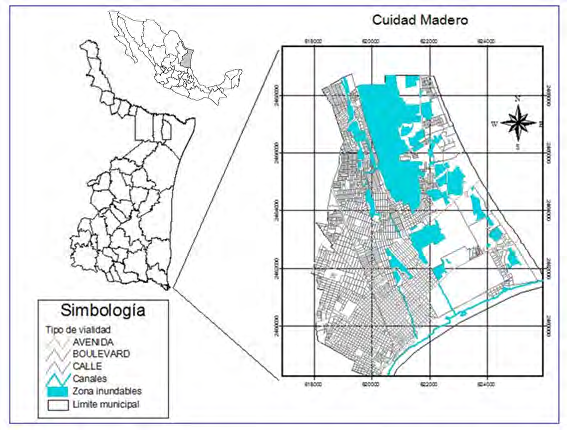
Within this biodiversity, they stand out for being an icon of the metropolitan area: the otter (Lontra longicaudis), which gives its name to the port of Tampico; the blue crab (Callinectes sapidus), mascot of the local soccer team; the swamp crocodile (Crocodylus moreletii), with an already legendary individual known as “Juancho”; and more recently the raccoon (Procyon lotor), which has given new tourist “life” to the north pier of the Pánuco River. The one that represents the greatest risk to society is the swamp crocodile, since, due to the high human density, interaction with them is almost daily in the city. It has its northernmost distribution in the state of Tamaulipas, where its hunting has been prohibited since 1954 and in Mexico since 1970; that is why the population of these lizards recovered after having been almost decimated since colonial times [2], observing that their populations remain stable according to the latest national studies [3].
Crocodiles play a predominant role within the ecosystem where they live, since it controls other animal populations in their environment and facilitates the reuse of important nutrients in the environment [4]. They have a high commercial interest for the use of their skin and its by-products such as ossified dermal plates, fangs, nails, skulls that are used to make handicrafts, as well as their meat and some organs that are tasted as exotic dishes in various parts of the country and the world [5]. For that reason, and because of their danger, they were persecuted and hunted indiscriminately, for which the species is listed by the official Mexican standard as “Subject to special protection” [6], in appendix II of CITES [7], as well as on the IUCN red list (Figure 2).
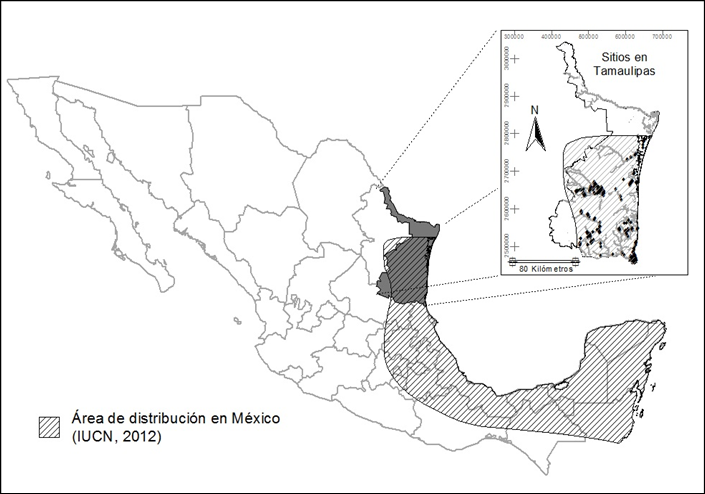
Currently the inhabitants of the urban area know that crocodiles are a tourist attraction linked to the restoration of their urban habitats. People seek to get a photo of the lizards, so human-crocodile interactions are becoming more common and can be a risk for the residents of the municipality and visitors [8]. This becomes critical in rainy seasons, since the bodies of water overflow and the crocodiles leave their habitat, creating a risk of attacking the inhabitants of the residential area adjacent to rivers and lagoons, , looking for places to sunbathe or new places to live. Therefore, in this work we had the objective of studying the territory where human-crocodile interactions were recorded outside their habitat in the municipality of Ciudad Madero.
Method
To achieve the objective, we collected data on captures or sightings of C. moreletii at the fire station and civil protection substation north of Ciudad Madero. The fire department is in charge of attending the interactions, but its information is only recorded on paper. For this reason, the following data was first entered into a spreadsheet: address (street, number, neighborhood); date; capture time; capture or sighting; general observations and other morphological data of interest.
In total, we entered 351 records, of which we eliminated those that lacked precise addresses, those that had a date outside the study period (2011-2016), or those that the record was prone to confusion. Each address of the 253 valid ones was located in Google Maps, to georeference it and establish it as a Google Earth position mark. We convert it to ESRI shapefile format, and perform spatial analyzes in a geographic information system.
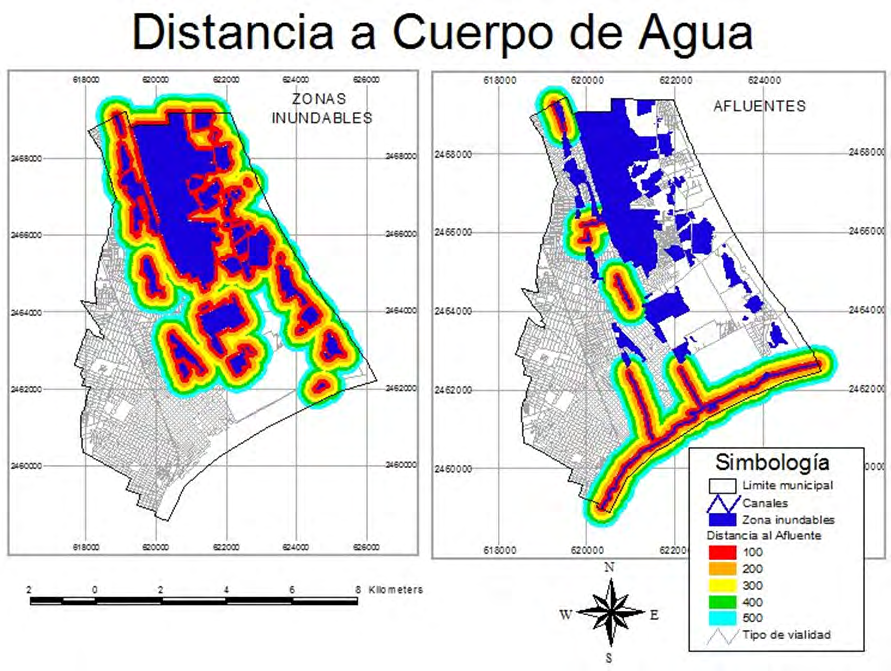
To determine the distances of the C. moreletii records from the tributaries and water bodies (lagoons, chanels), we built buffers at a distance of 100, 200, 300, 400 and 500 m (Figure 3). Subsequently, we count the points in each buffer, to obtain an interaction risk record, according to the distances to the water bodies.
Results and Discussion
We obtained a total of 253 records with the information required for georeferencing. Of these, four were found in a range greater than 500 m away from a body of water. Due to its territorial distribution (Figure 4), it is observed that the largest number of registered specimens of C. moreletii (86.2%) are found in the first 200 m surrounding a body of water: 141 records in the 100 m buffer, 84 in the 200 m buffer, and 14 records are located in the 100 and 200 m buffers, both for channels and lagoons. This could be classified as the highest risk area for human-crocodile interactions.
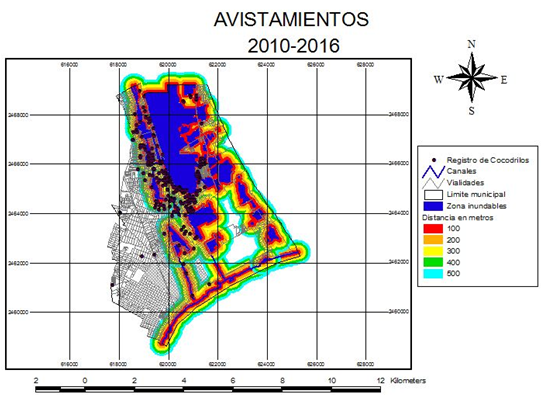
The rest of the sightings are located from 300 to 500 m, with the exception of four individuals recorded outside the range. Of these, one is located almost 500 m from a flood zone and 100 m from a drainage canal in the neighboring municipality of Tampico. Another was recorded just over 100 m from a wetland of the international airport of that city. The other two were located 1,400 and 1,500 meters from the nearest body of water, so, as there is not enough information on the maximum distance that this species travels on land (in 2016, Barão-Nóbrega, et al. [9] recorded a juvenile that moved overland 469 m between two bodies of water), we assume that the address recorded by the fire department is most likely incorrect.
110 (43.5%) of the records are found in two or more buffers, since they overlap due to the proximity of water bodies and canals in the municipality. However, the records were counted within the buffer closest to a body of water. For example, if a record was found in buffers 200 and 400, it was counted within 200m buffer. In addition, we consider that the area of greatest uncertainty is where two buffers with the same distance to a different body of water overlap (7 records in the 100m buffer; 4 in 200m; 13 in 300m; 5 in 400m and 1 in 500m).
It is necessary to point out that the distances that this species or other crocodilians travel on land outside their habitat are not known with certainty, since the reports of individuals of this species outside a body of water do not specify the distances recorded [10]. Nor are they specified in other studies of the distribution of their natural habitat [8, 9, 11] or in populated areas [12, 13], or related to human- crocodile interaction [14, 15].
Studies on distances traveled by crocodilians only mention animals that move through or between water bodies, either translocated animals that return to their original site or animals that move to other water bodies for various reasons such as territoriality, search for new habitats, among others [16, 17, 18, 19, 20, 21, 22]. For this reason, this work presents the first data on land movement in urban areas by C. moreletii, which could serve to determine the risk areas near water bodies and thus carry out adequate contingency plans for each situation.
The areas with the highest concentration of records are located to the east and south of the “El Chipuz” lagoon system, which is the largest body of water in the municipality. There are mangrove areas there, as it was once part of the southernmost wetlands of Laguna de San Andrés (currently separated by the industrial port of Altamira, at the north of Ciudad Madero). The lagoons of the system are interconnected with channels among themselves and with the main lagoon. In this area there are human settlements with a flat topography and where there are many unpaved or poorly maintained streets, which are usually flooded in the rainy season, since some were established in old wetlands.
These factors explain the higher concentration of records in these areas, since crocodiles generally prefer to remain hidden among the mangroves [23, 24]. In addition, with the loss and disturbances in their vital areas to carry out their biological cycle (such as refuge areas, sunbathing areas, nesting, among others), some individuals seek to migrate to surrounding areas [25], residential areas in this case. On the other hand, the houses and streets of these areas allow a greater flow and stagnation of water in the rainy season, which is when more records were kept, which coincides with those observed outside its habitat by Carvajal, et al. [25].
We consider that the areas with the highest concentration of records are those with the highest risk of human-crocodile interaction. For this reason, it is in these places where the corresponding authorities should focus the efforts of prevention policies, as well as planning the management and conservation of the habitat and the species. In addition, it is possible to generate environmental education programs that help the population understand the importance of the crocodile in its habitat, and allow them to have an adequate interaction with these reptiles.
The foregoing in order to contribute to the development of future risk prevention programs that ensure the management and conservation of this species. As well as implementing the existing human-Crocodilian contingency care protocol, to adequately minimize incidents between both species.
Acknowledgment
The authors thank the National Council of Science and Technology (CONACyT) for grant No. 252384 awarded to César Cedillo-Leal for his doctoral research at the Institute of Applied Ecology, as well as Daniela Vázquez-Loya’s degree thesis at the Faculty of Engineering and Sciences, where this work comes from. We also thank Jorge Olivares-Mendoza for his support with the translation of the manuscript.
References
-
INEGI (2020) Instituto Nacional de Estadística y Geografía (2020) Censo de Población y vivienda.
-
SEMARNAP (1999) Ministry of the Environment, Natural Resources and Fisheries. Project for the conservation, management and sustainable use of Crocodylia in Mexico (COMACROM). INE/SEMARNAP. Mexico, DF, pp: 107.
-
Rivera-Téllez E, López Segurajáuregui G, Antaño Díaz LA, Benítez Díaz H (2017) Report of the Swamp Crocodile Monitoring Program in Mexico, 2014 to 2015 seasons and analysis of trends from 2011 to 2015. National Commission for the Knowledge and Use of Biodiversity, Mexico, pp: 35.
-
Cupul Magaña FG (2002) “What the hell are crocodiles for?” Thesis “The swamp crocodile Crocodylus moreletii as a strategic element for the conservation of the ENPs Mangroves of Tumilco and Ciénega del Fuerte.” CUC Gazette, 11:10. Thesis to obtain the title of: Master in Management of Marine and Coastal Ecosystems.
-
CONABIO, Comisión Nacional de Biodiversidad (2006) Estrategia Tri-nacional Belice-Guatemala-México para la Conservación y el Manejo Sostenible del Cocodrilo de Morelet (Crocodylus moreletii). CONABIO, México, DF, pp: 1-286.
-
SEMARNAT, Ministry of the Environment and Natural Resources (2019) MODIFICATION of Normative Annex III, List of species at risk of the Official Mexican Standard NOM-059-SEMARNAT-2010, Environmental Protection- Mexican native species of wild flora and fauna -Risk categories and specifications for their inclusion, exclusion or change-List of species at risk. Official Gazette of the Federation of December 30, 2010.
-
CITES (2105) Convention on International Trade in Endangered Species of Wild Fauna and Flora Appendix I, II and III valid from October 4 2017.
-
Cedillo Leal CN, Requena Larz JC, Martínez González DA, Vázquez Loya EG, Cienfuegos Rivas (2019) Distribución de Crocodylus moreletii Dumeril & Bibron en Tamaulipas, México. AGROProductividad 12(1): 59-65.
-
Barão Nóbrega JAL, Puls S, Acton C, Slater K (2016) Natural History Notes. Crocodylus moreletii (Morelet’s Crocodile) movement. Herpetological Review 47(2): 291.
-
Corado García VA, Cajas Castillo JO, Benítez Moreno JA (2020) Estado poblacional y distribución del cocodrilo de pantano (Crocodylus moreletii) en regiones prioritarias de Petén, Guatemala. Revista Latinoamericana de Herpetología 3(2): 23-33.
-
Flores Escalona CI, Charruau P, Lopez Luna MA, Zenteno Ruiz CE, Rangel Mendoza JA, et al. (2021) Population status and habitat preference of Crocodylus moreletii Duméril & Bibron, 1851 (Crocodilia: Crocodylidae) within the limits of two protected natural areas in southeastern Mexico. Herpetology Notes 14: 55-62.
-
Cupul Magaña FG (2012) Registro de los movimientos de dos ejemplares de cocodrilo americano, Crocodylus acutus, en Puerto Vallarta, Jalisco, México. Bol Invest Mar Cost 41(2): 479-483.
-
González Desales GA, Sigler L, García Grajales J, Charruau P, Zarco González MM, et al. (2021) Factors influencing the occurrence of negative interactions between people and crocodilians in Mexico. Published online by Cambridge University Press.
-
García Grajales J, Rubio Delgado A, Casiano González C, Buenrostro-Silva A (2021) Nuevos registros de interacciones humano-cocodrilo en México desde 2018 hasta el primer semestre de 2021. Revista latinoamericana de herpetología 4(2): 153-160.
-
Mascarenhas PB, Maffei F, Muniz F, Freitas Filho RF, Campos Z, et al. (2021) Conflicts between humans and crocodilians in urban areas across Brazil: a new approach tosupport management and conservation. Ethnobio Conserv 10: 37.
-
Tucker AD, Limpus CJ, McCallum HI, McDonald KR (1997) Movements and home ranges of Crocodylus johnstoni in the Lynd River, Queensland. Wildlife Research 24: 379- 396.
-
Kay WR (2004) Movements and home ranges of radio- tracked Crocodylus porosus in the Cambridge Gulf region of Western Australia. Wildlife Research 31: 495-508.
-
Campos Z, Coutinho M, Mourao G, Bayliss P, Magnusson WE (2006) Long distance movements by Caiman crocodilus yacare: implications for management of the species in the Brazilian Pantanal. Herpetological Journal 16: 123-132.
-
Read MA, Grigg GC, Irwin SR, Shanahan D, Franklin CE (2007) Satellite tracking reveals long distance coastal travel and homing by translocated estuarine crocodiles. PLos One 2: e949.
-
Brien ML, Read MA, McCallum HI, Grigg GC (2008) Home range and movements of radio-tracked estuarine crocodiles (Crocodylus porosus) within a non-tidal waterhole. Wildlife Research 35: 140-149.
-
Calverley PM, Downs CT (2015) Movement and Home Range of Nile Crocodiles in Ndumo Game Reserve, South Africa. Koedoe 57(1): 13.
-
Thorbjarnarson J (1989) Ecology of the American crocodile (Crocodylus acutus). In: Hall PM, et al. (Eds.), Crocodiles: Their ecology, management and conservation. IUCN- The World Conservation Union Publications, Gland, Switzerland pp: 228-258.
-
García Grajales J, Montoya Márquez JA, Buenrostro Silva A, Rosales Jaillet PL, Sánchez Estudillo (2008) Analysis of the abundance and habitat use of the American crocodile (Crocodylus acutus, Cuvier 1807) in two lagoons on the central coast of Oaxaca, Mexico, In: Extensive proceedings of the XXV Symposium on Wildlife, Faculty of Veterinary Medicine and Zootechnics, University National Autonomous of Mexico, Mexico DF, pp: 69-81.
-
Escobedo Galván AH (2003) Períodos de actividad y efecto de las variables ambientales en cocodrilos (Crocodylus acutus Cuvier 1807): evaluando los métodos de determinación de la fracción visible. Ecología Aplicada 2: 136-140.
-
Carvajal RI, Saavedra M, Alava JJ (2005) Ecología poblacional, distribución y estudio de hábitat de Crocodylus acutus (Cuvier, 1807) en la “Reserva de producción de fauna manglares El Salado” del estuario del golfo de Guayaquil, Ecuador. Revista Biología Marina y Oceanografía 40: 141-150.
- Mitochondrial Bio-Logistics: Steering Co-Enzyme Q10 and Lycopene Synergies within the Science 4.0 Bio-OS Framework
- Hymenoptera Specimens from the Caño Negro Wetland, of the National Museum Collection, Costa Rica
- Science 4.0: Comprehensive Architecture of the Biological Operating System (Bio-OS) A Framework for Systemic Resilience and Industrialized Bio-Governance
- Rabbit on, or Hare Back? Understanding Climate Change
- Clinical Validation of Science 4.0: Flow Steering and Epigenetic Drift Inversion on a 76-Year-Old Hybrid System
- Seeds Planted by another Mind