
Breeding Aspects of the Toco Toucan and the Chestnut-eared Aracari (Aves, Ramphastidae) in the Brazilian Cerrado
Toucans are among the most conspicuous and famous birds in the Neotropics, but numerous aspects of their biology remain poorly known. The Toco Toucan (Ramphastos toco) and the Chestnut-eared Aracari (Pteroglossus castanotis) are commonly found in central Brazil, where studies on their breeding are scarce. The objective of this study was to examine aspects of their breeding in the Brazilian Cerrado. Searches for photographs with evidence of breeding activities were done in the WikiAves database. Citizens produced 126 records of copulations, nests, eggs and/or young. Records of the Toco Toucan (n = 92) tended to be concentrated in central and southeastern Cerrado, while those of the Chestnut-eared Aracari (n = 34) occurred mainly in its central and southwestern regions. Nests of the Toco Toucan were in hollows of palm and non-palm trees, termite nests and a pole. They were in native or human-modified habitats, and had 2–3 eggs or young in the early rainy period (October- December). On the other hand, nests of the Chestnut-eared Aracari were in hollows of non-palm trees in unknown habitats; regarding these records, a single nestling was found in the nest entrance in November, and clutch and brood sizes were unknown. Records of copulations, eggs and young in the nest indicate that the onset of breeding season of both species occurs from the late dry season to the early rainy season. Records of young indicate that the breeding seasons might reach the dry season in the Cerrado. Citizen science can improve our knowledge about toucans.
Introduction
The Ramphastidae family belongs to the Order Piciformes and comprises birds popularly known as toucans, which are distributed in five genera and 36 species [1]. Toucans are endemic to the Neotropics, where they are found from southern Mexico to southern Brazil and northern Argentina, except in highlands and dry forest regions [2]. They are small to medium-sized birds, remarkable for their colorful bill and plumage [3]. The bill is enormous and plays important roles involving thermoregulation of the body, feeding strategies, communication, and fighting conspecifics [3, 4, 5].
Several toucan species are threatened, mainly due to habitat loss, capture for illegal pet trade, and hunting for food and medicinal purposes [1, 3]. Toucans are forest birds, relying on a wide range of wooded habitats, from lowland rainforest to montane cloud forest [1, 2]. Their diet is mainly based on fruit, but they also feed on vertebrates and invertebrates [6, 7, 8, 9]; geophagy has been rarely reported [10].
Toucans nest in cavities they or other birds, such as psitacids and woodpeckers, excavate [1, 2, 3]. Typically, nests do not have lined grasses or stems; instead, cavities usually contain only seeds and wood chips [1, 3]. Clutch size is usually one to five eggs, incubated by both parents for about 15 to 18 days; the nestling period lasts for about 40 to 60 days, and fledglings are fed by parents or helpers for six or more weeks [1].
A total of 22 species of the Ramphastidae family occur in Brazil, where two species are widely distributed [11, 12]: the Toco Toucan Ramphastos toco (Muller, 1776) and the Chestnut-eared Aracari Pteroglossus castanotis (Gouldi, 1834). The Toco Toucan is widely distributed; substantially overlapping the Cerrado region with adjacent biomes, but also reaching southern Brazil and northern Argentina [13]. It is less reliant on forests than other toucans and is commonly found in nearby woodland savannas and grasslands [3, 14]. The Chestnut-eared Aracari inhabits tall forests and occurs extensively in the southern and western portions of the Amazon basin, and throughout most of the central and western Cerrado [15]. Both species are primarily frugivorous, but also feed on invertebrates, avian eggs, and nestlings, as well as other small vertebrates [3, 13, 15]. They are considered important seed dispersers [3, 16, 17].
In Brazil, the Toco Toucan nests in tree hollows such as the buriti palm, ravines, and termite nests [3, 14, 16]. Its clutch size is two eggs in the Pantanal [16], and the breeding season occurs from August to November in central Cerrado [14]. The Chestnut-eared Aracari nests in tree hollows created by woodpeckers, but occasionally uses arboreal termite nests [3, 16]. Clutch size is two eggs, and its incubation and nestling periods are unknown [15].
Toucans are extremely cautious when visiting their hollows during the nesting period, making it difficult to study their breeding activities [3]. Moreover, information on the breeding of ramphastids in Brazil is scarce since there are few specific detailed studies on this aspect of their biology. Apparently, only a few studies [18, 19] investigated in detail the breeding of toucans in Brazilian biomes. This scarcity of information may be mitigated using citizen science data, as has been recently done for breeding aspects of aquatic and land bird species in Brazil [20, 21, 22, 23].
The objective of this study was to examine the breeding of the Toco Toucan and the Chestnut-eared Aracari in the Brazilian Cerrado, a region where both species are commonly found [3, 24, 25]. I investigated mainly the breeding season, and the types of structures used for nesting. In lesser detail, I also examined aspects of nests, eggs, and young. Results were discussed in terms of the breeding of both species and other ramphastids in the Neotropics.
Methods
Study Area
The Cerrado is the savanna province that dominates central South America, being bordered by four major biomes–the Atlantic Forest, the Amazon, the Pantanal, and the Caatinga [26, 27]. It covers approximately 2 million km2 mainly in Brazil, but also occurs less extensively in Bolivia and Paraguay [28, 29, 30]. Typically, the native matrix types of landscapes are woodland savannas, grasslands, and semideciduous forests. Less extensive vegetation physiognomies are rocky grasslands, riverine forests, and marshy areas [28, 29, 30]. Climate in the Cerrado is tropical and marked by a rainy summer and a dry winter. Two well- defined seasons occur annually: the rainy season occurs between October and April, and the dry season lasts from May to September. Most of the annual rainfall (1,200 to 2,000 mm) is restricted to the rainy season. Temperatures tend to vary between 10 oC in June/July and 40 oC in January/ February [31].
Data Collection
This study includes photographic records with evidence of breeding activities of the Toco Toucan and the Chestnut- eared Aracari in the Brazilian Cerrado. They were obtained between 17 and 28 December 2020, by searching the WikiAves database. This is the largest database of Brazilian birds obtained with citizen science. During the search period, this database had contributions from about 37,000 citizens and harbored approximately 3,389,000 records. The search used the filters Registro (record) and Busca Avançada (advanced search). The scientific name of each species was typed in the field Espécie (species), and then a word related to breeding activities of birds was selected: ovo (egg), ninho (nest), filhote (young), jovem (juvenile), chocando (incubating), alimentando filhotes (feeding young), fazendo ninho (nest building), acasalando (copulating), and cortejando (courtship). Each term was searched individually for each species.
The resulting photographs were carefully examined to select only those showing evidence of breeding activities in the Brazilian Cerrado: copulation, eggs, young in hollows, adults cleaning nests, adults feeding young, and young outside the nest in the company of adults or alone. As toucans usually prey on eggs and nestlings of other species found in hollows, photographs showing adults with part of their bodies in the entrance, without evidence of young feeding, were excluded (e.g., WA1471446 and WA3620250). Records of food gifts among birds with very similar bills and body sizes were also excluded (e.g., WA2866706, WA3154506). Since adult toucans of a given pair or group usually feed each other (see Sick 1997), these records would not represent the feeding of young by adults. Photographs that did not show clear evidence of adults feeding the young because of the position of the birds were also excluded (e.g., WA115596), since they could represent other activities.
When two or more photographs collected in a given municipality referred to the same nest or bird in the same season, only one was selected. This procedure was adopted to avoid replicates that could overestimate the number of photographs of an event in any given period. However, photographs of nests showing different aspects of breeding were included (e.g., young in the nest, and nest cleaning). I contacted the authors of the selected photographs in late December 2020 to ask about three aspects of the breeding: (1) the approximate height of the nest entrance, (2) whether the tree used for nesting was alive or dead, and (3) whether the tree used for nesting was a palm tree or not. I received permission to include the photographs in this paper.
Data Analysis
The young of both species were grouped into developmental categories based on their size, plumage, and bills. Young Toco Toucans were classified into three categories: (1) “young with undeveloped plumage”, i.e., nestlings with completely nude skin, or body partially covered with a downy plumage, a very short bill, and with open eyes or blind; (2) “young with a moderately developed bill”, i.e., birds with a short and completely yellow bill, and a plumage comparable to adults’; (3) “young with a substantially developed bill”, i.e., birds with a yellow bill, shorter than that of adults, with a black or blackish patch at the tip, both maxillas with a few vertical orange strips, and plumage similar to adults.
Young Chestnut-eared Aracaris with undeveloped plumage were not recorded by citizens, likely due to difficulties in obtaining photographs of the inside of cavities used for nesting. Thus, young Chestnut-eared Aracaris were classified into two categories: (1) “young with a moderately developed bill”, i.e., birds with a short and yellow bill with some dark or grayish portions mainly on the superior side of the maxilla and lower side of the mandible (very distinct from adults), a dark head (chestnut/black) similar to adults, and the nude patch around the eye was greenish or blue; (2) “young with a substantially developed bill”, i.e., birds with a bill shorter than adults and with some differences in the color pattern, most notably: dark mandible, but not as black as adults, and the yellow, “teeth-like” traces on the black portion of the superior maxilla of adults were absent or undefined.
Results
Number and Distribution of Records
Citizens produced 92 and 34 records of the Toco Toucan and the Chestnut-eared Aracari, respectively, with evidence of breeding activities in the Brazilian Cerrado between 2008 and 2020 (Table 1). These correspond to 0.78% and 0.85% of the 11,735 and 3,982 photographs, respectively, of these species available in the WikiAves database during the search period. Records of the Toco Toucan were obtained mainly in central and southeastern Cerrado, while those of the Chestnut-eared Aracari were gathered mainly in central and southwestern Cerrado (Figure 1). For both species, most records showed young birds perched on vegetation outside hollows. Records of structures used for nesting were less common, while a few records documented copulation (Table 1).
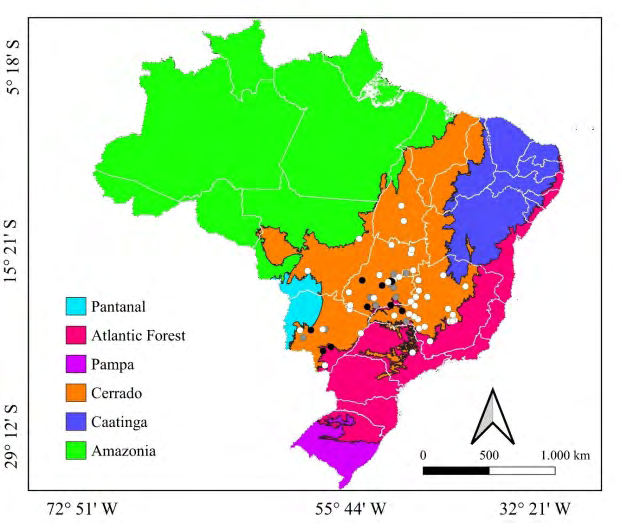
Figure 1: Geographic distribution of localities with photographic records with evidence of breeding activities of the Toco Toucan (white circles) and the Chestnut-eared Aracari (black circles), and both (gray circles) in the Brazilian Cerrado. Records were obtained by citizens between 2009 and 2020, and gathered in the WikiAves database in December 2020.
| Evidence of breeding activities | Toco Toucan | Chestnut-eared Aracari |
|---|---|---|
| Copulation | 3 | 2 |
| Eggs in the nest | 4 | 0 |
| Nest cleaning | 0 | 1 |
| Young with undeveloped plumage in the nest | 4 | 0 |
| Young in the nest | 9/0 | 4/0 |
| Young on the ground | 2/0 | 0/0 |
| Young being fed by an adult within the nest | 3/0 | 0/0 |
| Young being fed by an adult outside the nest | 1/01 | 2/2 |
| Young perched outside the nest | 18/42 | 9/12 |
| Young eating without the help by adults | 0/4 | 0/1 |
| Young flying | 1/2 | 2/0 |
| Total | 92 | 34 |
Table 1: Total number of documentary records of breeding activities of the Toco Toucan (Ramphastos toco) and the Chestnut-eared A
Table 1: Total number of documentary records of breeding activities of the Toco Toucan (Ramphastos toco) and the Chestnut-eared Aracari (Pteroglossus castanotis) in the Brazilian Cerrado, and obtained by citizens between 2008 and 2020. Values above and below the bar (/) refer to the numbers of records of young with moderately and substantially developed bills, respectively. Data was gathered in the WikiAves database in December 2020. Two records of young feeding in the nest by adult Toco Toucans were included only in the Total, as their age was unknown.
Habitat and Structures used for Nesting
Citizens produced records of 21 nests of the Toco Toucan in the Brazilian Cerrado (Table 2). Most nests (n = 16, 76%) were hollows of tree trunks. Of these, 10 (63%) nests where within trunks of non-palm trees, while six (37%) were part of palm trees. Five palm trees were dead (Figure 2), while the other record did not provide this information (Table 2). The palm trees used by the Toco Toucan for nesting could not be identified. On the other hand, all non-palm trees used for nesting were alive. Four of these trees were identified to the species level (Table 2). Three records (14%) were termite nests used for nesting in distinct habitats. Only one nest was the hollow of a modified trunk, which was part of a fence (Figure 2). Citizens reported that four structures chosen for nesting by the Toco Toucan were used for over a year (Table 2). The same nest site was reutilized for two (n = 2), four (n = 1), or ten (n = 1) consecutive nesting seasons. This later information was provided by Laurent Quéno, a forest engineer. Most hollows used for nesting were at urban environments (n = 8, 38%) or pastures (n = 6, 29%), while fewer nests were found in other habitats (Table 2).
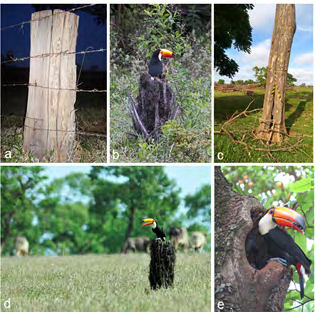
Figure 2: Photographic records showing external aspects of structures containing cavities that were used by the Toco Toucan (Ramphastos toco) for nesting in the Brazilian Cerrado: (a) a modified tree trunk in a pasture; (b) a dead and short palm tree in a recovering area; (c) an alive tree with a lateral entrance at the ground level in a pasture; (d) a short and dead palm tree in a pasture; (e) an alive angico tree in urban environment. Photo authors: Taís Pires (a), Fábio Freire Diniz (b), Marco de Barros Costacurta (c), Luis Eduardo Junqueira Maluf (d), Wagner de Araújo Batista (e).
| Species/ evidence | Code | Municipality | State | Date | Eggs, young and adults | Clutch size | Aspects of structures used for nesting | Height (m) |
|---|---|---|---|---|---|---|---|---|
| Eg | WA898396 | Guarda-Mor | MG | 11-Oct-12 | 3 white eggs. | 3 | Tn; in a grassland patch. | 1 |
| Eg | WA1128656 | Davinópolis | GO | 19-Oct-13 | 3 white eggs. | 3 | Tt; NPT; DT; R*; part of a fence in a pasture. | 1.5 |
| Eg | WA2322865 | Uberaba | MG | 14-Oct-16 | 3 white eggs. | 3 | Tt; PT; DT; in a pasture. | 1.5 |
| Eg | WA2745770 | Alfenas | MG | 21-Oct-17 | 2 white eggs. | 2 | ? | ? |
| Yn | WA932725 | Davinópolis | GO | 9-Dec-12 | 3 udp young; Eo | 3 | Same of WA1128656 | 1.5 |
| Yn | WA1116676 | Delfinópolis | MG | 9-Oct-13 | 2 udp young; Bl | 2 | Tt; PT; DT; in a second growth area. | 1 |
| Yn | WA1557550 | Paracatu | MG | 18-Nov-14 | 2 udp young; Eo | 2 | Tn; in a cerrado sensu stricto patch. | 1.5 |
| Yn | WA2356642 | Uberaba | MG | 7-Nov-16 | 3 udp young; Bl | 3 | Tt; PT; DT; in a pasture. | 1.5 |
| Yn | WA111213 | Formosa | GO | 28-Nov-09 | 2 mdb young. | ? | Tt; PT; DT; unknown habitat. | 10 |
| Yn | WA519897 | Nova Ponta | MG | 10-Dec-11 | 2 mdb young. | 3* | Tn; in a pasture. | Ground level |
| Yn | WA1567635 | Anápolis | GO | 15-Nov-14 | 1 mdb young. | ? | Tt; NPT; AT; Fb; bilosca tree; in a pasture*; R* | 5 |
| Yn | WA1903395 | Brasília | DF | 7-Nov-15 | 1 mdb young. | ? | Tt; NPT; AT; pau-de- balsa tree*; Fb; urban area*. | 10 |
| Yn | WA2359548 | Brasília | DF | 7-Nov-16 | 2 mdb young. | ? | Tt, NPT; AT; pau-de- balsa tree*; Fb; R*; urban area*. | ? |
| Yn | WA2374947 | Cuiabá | MT | 21-Nov-16 | 1 mdb young. | ? | Tt; PT; DT; R*; unknown habitat. | 8 |
| Yn | WA2381003 | Santa Helena de Goiás | GO | 25-Nov-16 | 1 mdb young. | ? | Tt; PT; adjacent to a highway. | ? |
| Yn | WA3926912 | Chapadão do Sul | MS | 22-Nov-18 | 1 mdb young. | 2* | Tt; NPT; AT; Nc; vertical entrance; in a pasture. | Ground level. |
| Yn | WA4007023 | Rio Verde | GO | 24-Oct-20 | 1 mdb young. | ? | Tt; NPT; AT; guava tree; Fb; urban area. | 1.5 |
| Yfn | WA1518721 | Brasília | DF | 17-Nov-14 | 1 mdb young being fed with a cicada. | ? | Tt; NPT; AT; pé-de- balsa tree*; Fb; urban area. | 10 |
| Yfn | WA1534398 | Esmeraldas | MG | 30-Nov-14 | 1 mdb young being fed by 1 adult. | ? | Tt; NPT; AT; Fb; urban area. | ? |
| Yfn | WA3080139 | Brasília | DF | 7-Nov-16 | 1 mdb young being fed with 2 fruits. | ? | Tt; NPT; AT; Fb; urban area. | 6 |
| Yfn | WA1885601 | Brasília | DF | 25-Oct-15 | Adult bringing a food item to young in the nest.* Age unknown. | ? | Tt; NPT; AT; Fb; urban area. | ? |
| Yfn | WA2796374 | Goiânia | GO | 26-Nov-17 | Young being fed with a nestling.* Age unknown. | ? | Tt; NPT; AT; angico tree*; Fb; urban area. | 6 |
| Aracari | ||||||||
| Nc | WA2362637 | Itumbiara | GO | 11-Nov-16 | 1 adult cleaning a nest. | ? | Tt; NPT; Fb | ? |
| Yn | WA807749 | Uberaba | MG | 17-Nov-12 | 1 mdb young. | ? | Tt; NPT; Fb | ? |
| Yn | WA2441937 | Campo Grande | MS | 9-Nov-16 | 1 mdb young. | ? | Tt; NPT; Fb | ? |
| Yn | WA2380998 | Itumbiara | GO | 25-Nov-16 | 1 mdb young. | ? | Tt; NPT; Fb | ? |
| Yn | WA3577322 | Campo Grande | MS | 19-Nov-19 | 1 mdb young. | ? | Tt; NPT; Fb | ? |
Table 2: Records showing evidences of breeding activities of the Toco Toucan (Ramphastos toco) (n = 22) and the Chestnut-eared Ar
Table 2: Records showing evidences of breeding activities of the Toco Toucan (Ramphastos toco) (n = 22) and the Chestnut-eared Aracari (Pteroglossus castanotis) (n = 5) involving nests in the Brazilian Cerrado, and obtained by citizens between 2009 and 2020, with information on the location and date of records, nests, eggs, young, adults, and structures used for nesting. Evidence: Eg (eggs in the nest), Nc (nest cleaning), Yn (young in the nest), Yfn (young being fed in the nest). Eggs, young and adults: udp (young with undeveloped plumage), mdb young (young with a moderately developed bill), sdb young (young with a substantially developed bill), Eo (young with the eyes open), Bl (blind young). Aspects of structures: AT (alive tree), DT (dead tree), Fb (the entrance of the hollow appeared to be the basis of a fallen branch), Nc (natural cavity), NPT (non-palm tree), PT (palm tree), R (reutilization of the cavity in consecutive breeding seasons), Tn (termite nest), Tt (tree trunk). The sign “*” indicates that the information was provided by the author of the photograph. Records were listed by species, then according to the type of evidence and young type, and then chronologically. Data was gathered in the WikiAves database in December 2020.
The entrance of the cavities found in palm trees could be at the top of the trunk or at the side. In non-palm trees, except for a trunk with an elongated crack (Figure 2), the entrances of 90% of the hollows used for nesting were, apparently, the bases of former branches (Figure 2 & Table 2). The height of the entrances of nests found by citizens ranged from ground level (Figure 2) to 10 m above the ground. Considering all Toco Toucan nests found by citizens, the mean height of entrance was 3.9 m above ground (s.d. = 3.7, n = 17), with 1.0 m and 1.5 m as the most frequent values (Table 2).
Citizens found four nests of the Chestnut-eared Aracari (Table 2). They were hollows in tree trunks. The entrance of these cavities appeared to be based on former branches of large non-palm trees. Evidence of nesting was mainly provided by four photographs of a young bird with a moderately developed bill with its head outside the cavity. A further record documented nest cleaning (Table 2). Citizens did not provide information on the trees this species used for nesting, the height of the nest entrance, and the habitat where trees were located.
Eggs and Young
Clutches of the Toco Toucan were shown in four records, and had two (25%) or three (75%) white eggs (Table 2). Eggs were white and elliptical. Six records either had a visible number of young in the nest (photographs showed the inside of the hollow), or this information was provided by the citizens–nests had two (50%) or three (50%) young. Four of these records documented young birds with an undeveloped plumage, blind or with open eyes. The other two records showed young with moderately developed bills (Appendix). Another thirteen records only showed external portions of the structures used for nesting by Toco Toucans; thus, it was not possible to know clutch and brood sizes. These photographs documented between one and two young with part of their bodies outside the cavity (85%), or an adult bringing food items to hidden nestlings (15%). Records of the Chestnut-eared Aracari did not provide information on clutch and brood sizes, since there were no photographs of the inside of hollows used for nesting. Records showed only one young bird with its head outside the cavity. As it occupied most of the cavity entrance, it was not possible to know whether there were others in the nest.
Breeding Season
Five records documented copulations (Table 1), and they occurred in the late dry season and early rainy season, for both species (Figure 3). Only Toco Toucan eggs were recorded; they were found in the early rainy season (October), and may represent the laying or the incubation period. Nest cleaning was recorded only once, for the Chestnut-eared Aracari, in the early rainy season (November) (Appendix). Young Toco Toucans were found in nests from late October to early December, while this occurred in November for Chestnut- eared Aracaris (Figure 3). These records showed young with moderately developed bills, and some involved feeding by adults (Figures 4&5, Appendix).
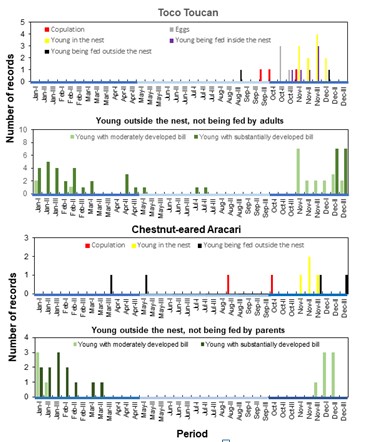
Figure 3: Seasonal distribution of records involving documented evidence of breeding activities of the Toco Toucan (Ramphastos toco) and the Chestnut-eared Aracari (Pteroglossus castanotis) in the Brazilian Cerrado, and obtained by citizens between 2008 and 2020. Data was gathered in the WikiAves database in December 2020. Arabic numerals after each month represent three periods–(I): days 1–10, (II): days 11–20, (III): days 21–31 of each month.
Totals of 65 and 21 records documented young Toco Toucans and Chestnut-eared Aracaris outside the nest not being fed by adults, respectively. Most of these records showed young perched on vegetation, while a few showed them during flight, or on the ground (Appendix). Those of young Toco Toucans with moderately developed bills (n = 21, 32%) occurred in the rainy season, from November to February, while those with Chestnut-eared Aracaris (n = 9, 43%) were obtained from November to January (Figure 3). Records of young Toco Toucans with substantially developed bills (n = 44, 68%) were obtained from December to July, while those regarding Chestnut-eared Aracaris (n = 12, 57%) were documented from January to March. As a result, the two phases of young development overlapped from December to February for Toco Toucans, and in January for Chestnut- eared Aracaris (Figure 3).
Six records showed young with moderately or substantially developed bills being fed by adults outside nests. Those (n = 4) of the Chestnut-eared Aracari occurred between November and May, while two records showed Toco Toucans in December and August (Figure 3, Appendix). Only five records documented young feeding without help by adults. The four records of Toco Toucans had young with substantially developed bills consuming fruits and winged termites, from December to February. The only record of the Chestnut-eared Aracari had a young with a substantially developed bill consuming some fruit in March (Figures 4&5, Appendix).
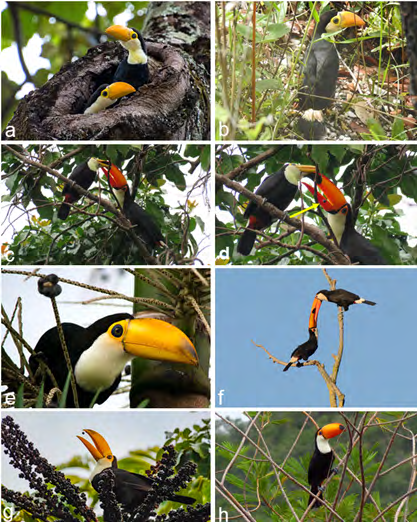
Figure 4: Records of young Toco Toucan (Ramphastos toco) obtained by citizens in the Brazilian Cerrado: (a) young with moderately developed bills in the entrance of a tree hollow; (b) young with a moderately developed bill on the ground of a forested area; (c) young with a moderately developed bill being fed by an adult with fruits outside the nest; (d) a fruit falling (yellow arrow) after an unsuccessful feeding attempt; (e) young with a substantially developed bill perched on a palm tree; (f) young with a substantially developed bill being fed by an adult; (g) young with a substantially developed bill eating a fruit; (h) an older young with a substantially developed bill. Photo authors: Moacir dos Santos (a), Geraldo Costa (b), Leonardo Mosqueira (c, d), Daniel Faria (e), Saulo Gomes (f), André Siade (g), Bruno Duarte (h).
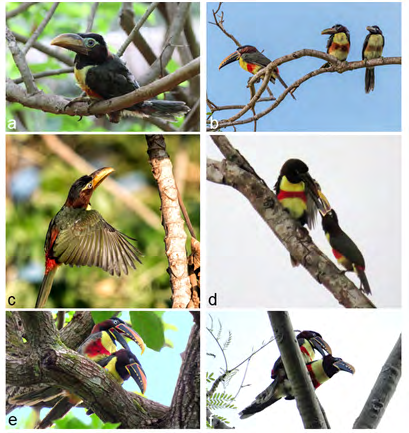
Figure 5: Photographic records showing evidence of breeding activities of the Chestnut-eared Aracari (Pteroglossus castanotis), and obtained by citizens in the Brazilian Cerrado. (a) young with a moderately developed bill outside the nest; (b) young with moderately developed bills perched on the side of an adult; (c) young with a moderately developed bill flying to reach a Cecropia tree; (d) young with a substantially developed bill being fed by an adult; (e) two adults copulating in early October; (f) two adults copulating in mid-August. Photo authors: Madalena Silva (a), Geancarlo Merighi (b), Daniel Soares de Arruda (c), Marco Costacurta (d), Douglas Oliveira (e), Estevão F. Santos (f).
Discussion
Overall
The 126 photographic records of the Toco Toucan and the Chestnut-eared Aracari obtained by citizen scientists in the Cerrado allowed this study to produce one of the largest data sets regarding the breeding of free-living ramphastids in Brazil. This is because previous information on their breeding is briefly reported in major books regarding the Brazilian avifauna [3, 14, 16, 32], or in a few studies based on 1–2 nests [18, 19, 33]. Further, my approach allowed the obtention of data over extensive areas, differing from these previous investigations conducted at a single locality. Other difference was that my study involved activities from copulations to young feeding outside nests, and not only observations restricted to nests. Although my study did not involve nest or bird monitoring, the examination of this range of different record types allowed me to investigate some aspects of their breeding considering all the data obtained over large spatial and long temporal scales.
Geographic Distribution of Records
Previous studies of breeding toucans in the Cerrado have not mentioned the localities where the information was obtained, as they refer to books about the regional avifauna [3, 14]. In my study, both species were recorded by citizen scientists over large spatial scales, with a high concentration of records in Goiás state and its surroundings. The observed record distribution of each species might represent combined effects of citizen activity, and the abundance of both species, in different municipalities. Despite this, further studies on their breeding biology could consider sampling primarily regions with concentration of records of their breeding activities. Likely, this would increase the probability of data acquisition, as there is a chance that they are common in these regions.
Habitats used for Nesting
Citizens recorded Toco Toucan nests in a range of native and modified habitats. As I do not know how often citizens visited each habitat type, it is not possible to examine nest- site selection. However, some conclusions can be done. First, the low number of nest records obtained in native vegetation might represent mainly citizens’ difficulties in accessing protected areas. Second, near 40% of the nests recorded by citizens were in urban areas, where activities by citizens might be intense. These nest records showed young with moderately developed bills, or adults bringing food items. Thus, Toco Toucans can breed in urban areas, even in large cities such as Brasília and Goiânia. This fact is reinforced by numerous records of young with moderately or substantially developed bills perched in vegetation, and citizens’ reports of successful reutilization of the same tree hollow in consecutive years in wooded urban areas.
The use of a given hollow for nesting during consecutive years has been reported for several ramphastids [18, 19, 34, 35], and also was observed for an isolated tree and a fence pole in pastures. Thus, the value of pastures for the Toco Toucan can be improved through the maintenance of trees in these managed areas, even if dead, isolated and shortened/broken. Although further studies are necessary to compare the breeding success in protected areas and in modified landscapes, this study agrees with previous studies [36, 37] pointing out that the presence of part of the native vegetation in exotic pastures can benefit several bird species in the Cerrado.
My study could not provide information on the habitats chosen for nesting by the Chestnut-eared Aracari. As this species is usually found in forests associated with water courses, such as várzea, swampy and gallery forests [15], searches for nests in these habitats would be essential to improve the knowledge on its breeding. Secondary and modified forests also could be sampled, as they can be used for nesting by some aracari species [34, 38, 39].
Structures used for Nesting
I could not obtain information on the height and dimensions of the entrances of hollows where Chestnut- eared Aracari nested. Previous studies of breeding aracaris report variable information on their nests. For example, a pair of the Black-necked Aracari (Pteroglossus aracari) was observed disputing over a tree hole of a large live tree with parrots in southeastern Brazil; its entrance had 10 cm and was 9 meters above the ground [33]. Also, six nests of Pale-mandibled Aracaris (P. erythropygius) found in western Ecuador were holes of 28-117 cm dbh live trees, typically Carapa guianensis; nest height was 1.4-25.00 m [34]. Also, the first nest of the Green Aracari (Pteroglossus viridis) found in French Guiana was described; it was an old cavity made by woodpeckers in a dead awarra palm (Astrocaryum vulgare), its entrance was through the top of a broken trunk that had 25 cm dbh at a height of 5.5 m) [38]. The low numbers of nests involved in these scarce studies indicates that the obtention of knowledge about Pteroglossus nesting sites will be a hard task for neotropical ornithologists.
The Toco Toucan appears to be more flexible than the Chestnut-eared Aracari in respect to the range of structures used for nesting. Although this difference might be influenced by the relatively high number of nest records of the Toco Toucan obtained by citizens, the use of several types of hollows by this species agrees partially with the literature, as the use of tree hollows and termite nests for nesting had been reported previously [3, 14, 16]. However, the use of tree hollows close to the ground (< 1.5 m high) appears to have not been reported previously. Also, the use of hollows in stream banks [3, 14, 16] was not documented by citizens in the Cerrado. Further, the use of a fence pole, reported in my study, and the nesting in nest-boxes [18] suggest that Toco Toucans accept human-made structures for nesting in nature, what can be useful for future investigations and conservation programs.
Clutch and Brood Sizes
As I did not monitor nests, eggs could have been photographed in the laying or incubation period, and I could not examine egg and young survival. However, the finding of 2–3 eggs or young in Toco Toucan nests agrees with the review made for its entire geographic distribution [13], that reported clutches consisted of 2-4 eggs. It is important to note that these eggs and young photographed by citizens in the Cerrado were in cavities whose entrances were at heights < 1.50 m (see Table 1). Thus, citizens were able to photograph their interior portions. On the other hand, nests (55%) with higher entrances had only their external portions photographed, thus allowing the detection of nesting activities, but not to know the brood size.
The approach of my study was not adequate to know the clutch and brood sizes of the Chestnut-eared Aracari. Probably, citizen scientists had difficulties in obtaining photographs of the inside of cavities used for nesting. Investigations supported by cameras small enough to pass through the hollow entrance would increase the knowledge about the clutch and brood sizes of the Chestnut-eared Aracari and other ramphastids in the Neotropics.
Breeding Season
Records involving breeding activities were obtained in both the rainy and dry seasons, for both ramphastids. As copulation records involved four months (August-November), earlier phases of the breeding season of both species, such as reproductive calls, courtship and pairing might start in the late dry season (August-September) in the Cerrado. Eggs of the Toco Toucan were found in nests prior to young, as expected, and these two record types involved three months (October to December). Considering that its incubation period lasts around 17-18 days [13], eggs photographed in October might have been laid since September, what agrees with copulation records in this month. With this, the nesting period of the Toco Toucan in the Cerrado appears to occur from September to December. As records of Chestnut-eared Aracari nests with young occurred in November, it is likely that their nestling period also reaches December, and that incubation occurs mainly in October. As its incubation period is unknown [15], it is difficult to estimate the egg laying period; however, it is likely that it occurs from August to October, when copulation records were obtained.
Records obtained by citizen scientists were not restricted to the nesting period, contrasting with most studies of free- living ramphastids in the Neotropics [18, 19, 34, 38, 39]. As they obtained numerous photographs of young without totally developed bills outside nests, it was possible to know the period of occurrence of fledged young in the Cerrado. For both species of my study, young with moderately developed bills occurred outside the nests mainly from the early rainy season (November). As expected, a decline in the number of their records was observed in December-January, when young with substantially developed bills started to be recorded. This indicates their morphological change during this period of their year.
For both species, a decline in the number of young with substantially developed bills occurred from February. This means that it became difficult for me to distinguish them from adults in the late rainy season (March-April) and early dry season (May-July), when not framed with adults. However, a few records showed them being feed by adults in the dry season. It occurred in August for the Toco Toucan and in May for the Chestnut-eared Aracari. A careful examination of these photographs allowed me to conclude that the birds being fed were young, due to bill size and color, thus eliminating the chance of representing feeding among adults [3]. Therefore, by using the criteria that the breeding season lasts until young are fed by adults, the breeding season of the Toco Toucan might last until May to August (dry season), i.e., when records of young with substantially developed bills were scarce or involved young feeding by adults. For the same reasons, the end of the breeding season of Chestnut- eared Aracaris occurs in March-May in the Cerrado, thus involving both the rainy and dry seasons. Observational studies accompanying families would be necessary to know about the transition period that comprises the first feeding attempts by young and their total foraging independence from adults.
Timing of breeding of the Toco Toucan varies substantially with region [2, 13]. They reported that its breeding season in central Brazil, what included the states of Goiás, Minas Gerais and Bahia, lasts from November to February. Thus, it refers to a shorter period, restricted to the rainy season, when compared with the results of my study. Similarly, it was reported that the breeding season of the Chestnut-eared Aracari lasts from September to February in southeastern Brazil [15], a period shorter than that observed in my study. As citizens obtained records throughout more extensive areas than in their study, part of these differences might result of the spatial scale involved in each study. Concluding Remarks Citizen science projects have been substantially improving scientific knowledge about wild birds on all continents [40, 41, 42]. Although I did not engage and coordinate volunteers in field activities, as typical in such projects, my study suggests that photographic records obtained by citizen scientists, and deposited in databases such as WikiAves, can be used to increase our knowledge regarding breeding aspects of Brazilian toucans and other birds. This is because the number of records obtained by citizens involved a range of breeding activities, from copulation to young feeding by adults outside the nests. Thus, their records comprise a longer period of breeding activities, when compared with results of studies that have observations restricted to the incubation and nestling periods. Also, data obtained by citizen scientists involved a larger number of records, over a larger spatial range, than that obtained by professional ornithologists studying toucans, as occurred recently for some species in Brazil [21, 22, 43, 44]. Thus, I suggest that Brazilian ornithologists make an intense use of the extraordinary quantity of records available in databases such as Wikiaves and eBird to study breeding aspects of birds.
Conflicts of Interest
The author declares that there are no conflicts of interest.
Acknowledgements
I thank Universidade Federal Rural do Semi-Árido (UFERSA) for logistic support. I also thank all citizens that deposited photographs of the Chestnut-eared Aracari and the Toco Toucan in the WikiAves database. I´m very grateful to Ana Paula Elias Fonseca, André Siade, Bruno Duarte, Daniel Faria, Daniel Soares de Arruda, Douglas Oliveira, Estevão F. Santos, Fábio Freire Diniz, Geancarlo Merighi, Geraldo Costa, Leonardo Mosqueira, Laurent Quéno, Luis Eduardo Junqueira Maluf, Madalena Arantes da Silva, Marco de Barros Costacurta, Margi Moss, Moacir dos Santos, Saulo Gomes, Taís Pires and Wagner de Araújo Batista for having given permission to include photographs of their authorship in this manuscript. Leandro Bugoni, Luís Inoue, Renata Cambraia improved this manuscript with numerous suggestions.
Funding
There was no funding.
References
-
Winkler DW, Billerman SM, Lovette IJ (2020) Toucans (Ramphastidae). In: Billerman SM, Keeney BK, Rodewald PG, Schulenberg TS, et al. (Eds.), Birds of the World. Cornell Lab of Ornithology, Ithaca, USA.
-
Short LL, Horne JFM (2001) Toucans, barbets and honeyguides. Ramphastidae, Capitonidae and Indicatoridae. Oxford University Press, Oxford, UK.
-
Sick H (1997) Ornitologia brasileira. Editora Nova Fronteira, Rio de Janeiro, Brazil.
-
Tattersall GJ, Andrade DV, Abe AS (2009) Heat exchange from the toucan bill reveals a controllable vascular thermal radiator. Science 325: 468-470.
-
Guaraldo AC, Antqueves LMC, Manica LT (2019) Beyond a feeding and thermoregulatory structure: toucan’s bill as a sword and pincer. Revista Brasileira de Ornitologia 27: 145-148.
-
Novaes FC, Lima MFC (1991) Geographical variation and notes on morphology and biology of Selenidera gouldii (Picifomes: Ramphastidae). Ararajuba 2: 59-63.
-
Remsen JV, Hyde MA, Chapman A (1993) The diets of Neotropical trogons, motmots, barbets and toucans. Condor 95: 178-192.
-
Silva JN, Azevedo CS (2012) Rattus rattus (Mammalia: Rodentia) predation by Ramphastos vitellinus (Aves: Ramphastidae) in Santa Teresa municipality, Espírito Santo, Brazil. Revista Brasileira de Ornitologia 20: 156- 157.
-
Lima DM, Martínez C, Raíces DSL (2014) An avifaunal inventory and conservation prospects for the Gurupi Biological Reserve, Maranhão, Brazil. Revista Brasileira de Ornitologia 22: 317-340.
-
Matinata BS, Perrella DF (2020) First record of geophagy by a Ramphastidae species (Piciformes). Ornithology Research 28: 174-177.
-
Stotz DF, Fitzpatrick JW, Parker III TA, Moskovits DK (1996) Neotropical birds. Ecology and conservation. The University of Chicago Press, Chicago, USA.
-
Piacentini VQ, Aleixo A, Agne CE (2015) Annotated checklist of the birds of Brazil by the Brazilian Ornithological Records Committee. Revista Brasileira de Ornitologia 23: 91-298.
-
Sedgwick CW (2020) Toco Toucan (Ramphastos toco). In: Schulenberg TS, et al. (Eds.), Birds of the World. Cornell Lab of Ornithology, Ithaca, USA.
-
Antas PTZ, Cavalcanti RB (1998) Aves comuns do planalto central. Editora Universidade de Brasília, Brasília, Brazil.
-
Short LL (2020) Chestnut-eared Aracari (Pteroglossus castanotis). In: Del Hoyo J, Elliott A, Sargatal J, Christie DA, Juana E, et al. (Eds.), Birds of the World. Cornell Lab of Ornithology, Ithaca, USA.
-
Antas PTZ (2004) Pantanal. Guia de aves. SESC, Rio de Janeiro, Brazil.
-
Pizo MA, Donatti CI, Guedes NMR, Galetti M (2008) Conservation puzzle: endangered Hyacinth Macaw depends on its nest predator for reproduction. Biological Conservation 141(3): 792-796.
-
Cziulik M (2010) Cuidado parental de Selenidera maculirostris, Pteroglossus castanotis e Ramphastos toco (Piciformes–Ramphastidae), no interior de ninhos. Universidade Federal do Paraná, Curitiba, Brazil.
-
Jesus S, Buzzato AC, Monteiro Filho ELA (2012) Nidificação de Ramphastos dicolorus (Linnaeus, 1766) (AVES: Ramphastidae) na região metropolitana de Curitiba, estado do Paraná. Ornithologia 5: 19-25.
-
Barnett JM, Ingels J, Roos AL, Lima JLG, Naka LN (2014) Observations on the breeding biology of the Pygmy Nightjar Nyctipolus hirundinaceus in the Caatinga of Bahia and Ceará, Brazil. Revista Brasileira de Ornitologia 22: 201-209.
-
Tubelis DP (2020) Breeding biology of the Horned Screamer (Anhima cornuta) in non-protected areas in the Brazilian Cerrado. Ornithology Research 28: 115- 124.
-
Tubelis DP, Sazima I (2020) Reproductive biology of the yam, Aramus guarauna (Gruiformes: Aramidae), in the Brazilian Pantanal, using data from citizen science. Ornithological News 215: 8-11.
-
Tubelis DP, Mendonça LGA, Vieira IKC, Borges K (2020) Breeding and seasonal occurrence of the Orinoco Goose (Neochen jubata) in Brazil. Ornithology Research 28: 105-114.
-
WikiAves (2022a) Map of records of the Chestnut Aracari (Pteroglossus castanotis).
-
WikiAves (2022b) Map of records of the tucanuçu species (Ramphastos toco).
-
Ab’Saber NA (1977) The Morphoclimatic Domains in South America First Approach, Geography Works 52: 1-21.
-
Rizzini CT (1997) Tratado de fitogeografia do Brasil. Editora Âmbito Cultural Ltda, Rio de Janeiro, Brazil.
-
Eiten G (1972) The cerrado vegetation of Brazil. Botanical Review 38: 205-341.
-
Oliveira PS, Marquis RJ (2002) The Cerrados of Brazil. Ecology and natural history of a neotropical savanna. Columbia University Press, New York, USA.
-
Scariot A, Sousa Silva JC, Felfili JM (2005) Cerrado: ecologia, biodiversidade e conservação. Ministério do Meio Ambiente, Brasília, Brazil. pp: 1-118.
-
Assad ED (1994) Rain in the savannas. Analysis and spatialization. Embrapa/SPI, Brasilia, Brazil.
-
Dubs B (1992) Birds of southwestern Brazil: catalogue and guide to the birds of the Pantanal of Mato Grosso and its border areas. Küsnacht: Betrona.
-
Christianini AV (2018) Several cavity-nesting birds fight for a single tree hollow in an Atlantic Forest fragment: consequence of increasing nest-site limitation? Revista Brasileira de Ornitologia 26: 12-14.
-
Berg KS (2001) Notes on the natural history of the Pale- mandibled Araçari. Journal of Field Ornithology 72: 258- 266.
-
Lill A (1972) Nidification in the Channel-billed Toucan (Ramphastos vitellinus) in Trinidad, West Indies. Condor 74: 235-236.
-
Tubelis DP, Cavalcanti RB (2000) A comparison of bird communities in natural and disturbed non-wetland open habitats in the Cerrado’s central region, Brazil. Bird Conservation International 10: 331-350.
-
Godoi MN, Laps RR, Ribeiro DB, Aoki C, Souza FL (2018) Bird species richness, composition and abundance in pastures are affected by vegetation structure and distance from natural habitats: a single tree in pastures matters. Emu-Austral Ornithology 118: 201-211.
-
Ingels J, Pelletier V, Giraud-Audine M (2012) Description of the first nest of Green Araçari (Pteroglossus viridis) for French Guiana. Boletín SAO 20: 79-82.
-
Skutch AF (1958) Roosting and nesting of aracari toucans. Condor 60: 201-219.
-
Chandler ML, See K, Copas AM, Bonde BC, López F, et al. (2017) Contribution of citizen science towards international biodiversity monitoring. Biological Conservation 213: 280-294.
-
Kelling S, Johnston A, Bonn A, Fink D, Ruiz-Gutierrez V, et al. (2019) Semistructured surveys to improve citizen science data for monitoring biodiversity. BioScience 69: 170-179.
-
Adler FR, Green AM, Sekercioglu ÇH (2020) Citizen science in ecology: a place for humans in nature. Annals of the New York Academy of Sciences 1469: 52-64.
-
Tubelis DP, Dornas T (2021) Breeding aspects of the Sunbittern (Eurypyga helias) in Brazil, based on citizen science data. Ornitología Colombiana 20: 1-10.
-
Tubelis DP, Sazima I (2021) Nuptial gifts among Brazilian cuckoos: an outline based on citizen science. Ornitology Research 29: 188-192.
- Mitochondrial Bio-Logistics: Steering Co-Enzyme Q10 and Lycopene Synergies within the Science 4.0 Bio-OS Framework
- Hymenoptera Specimens from the Caño Negro Wetland, of the National Museum Collection, Costa Rica
- Science 4.0: Comprehensive Architecture of the Biological Operating System (Bio-OS) A Framework for Systemic Resilience and Industrialized Bio-Governance
- Rabbit on, or Hare Back? Understanding Climate Change
- Clinical Validation of Science 4.0: Flow Steering and Epigenetic Drift Inversion on a 76-Year-Old Hybrid System
- Seeds Planted by another Mind