
New Record of Brown Widow Spider (Latrodectus geometricus Koch, 1841) in Ha’il Region, Saudi Arabia
Brown Widow Spider (Latrodectus geometricus) is recorded for the first time in Hail Region of Saudi Arabia .Three specimens of brown widow spider (L. geometricus ) were found and collected on October, 2021 from inside a beehive in Al Hait city (Southern of Ha’il region of Saudi Arabia). The specimens were collected and submitted to Biology department of Hail University for the identification of morphological characters and DNA barcode sequence analysis of the specimen. Phylogenetic analysis was performed to compare the DNA sequence of the newly discovered female brown widow spider with the other species of Latrodectus genus.
Bandar Hamad Aloufi* Ahmed Mohajja Alshammari and Md Jahoor Alam
Introduction
Brown widow Spider species belongs to genus Latrodectus Walckenaer, 1805 (Family: Theridiidae). The widow spiders consists of 30 currently recognized species of genus Latrodectus Walckenaer, 1805. Latrodectus is a genus of spiders that includes numerous species that are collectively known as true widows. The common term “widow spiders” comes from the predominance of sexual cannibalism. After mating, the female of brown widow spider eats the male) [1]. The Latrodectus genus consists of two phylogenetic groups, the mactant clade also known as black widow and the geometricus clade also known as brown widow [2]. The genus of Latrodectus has a global distribution, with species found on several continents and marine islands. Many species of Latrodectus have been discovered across the globe. Among these are L. indistinctus and brown widow L. geometryius in Africa; black widow (L. mactans) in North America; black wolf (L.tredecimguttatus) in Europe (Poland, Spain and Turkey); red widow (L. bishopi) in the USA; northern widow (L. variolus) in the USA; and red-back spider (L. hasselti) in Australia, India, and Japan [3] argued that [2]. Brown widow spiders are members of the Theridiidae spider family [4]. This family is known as comb-foot spiders because of the broad curving bristles on the tarsal bones of their hind legs that seem like comb-like rows. Cobweb spiders are sometimes known as grey widow spiders because of the color of their webs [5].
However, it is widely accepted that the brown spider was initially discovered in South America. Its current pantropical range [6, 7] presently covers many subtropical regions of the planet. They’ve established themselves across the United States as well as other countries like Japan and South Africa. Compared to female brown spiders, male brown spiders’ bodies are much smaller [8, 9]. According to Heeres, et al. [10], the patterns and hues of women vary widely; they might be practically black, white, grey or light brown. For whatever reason, moulting causes a change in colour, which may be due to the substrate colour changing [11].
mactans’s venom may kill people, however the fatality rate of its venom is less than 1% [12]. A study published in 1992 by Clark, et al. [13] Humans have been killed by the brown widow’s venom in Madagascar since 1991. The identification of the spider, the effects of delayed medical intervention, and the case’s specifics remain a mystery to this day [14]. Fertilized females produced an average of twenty three egg sacs over their lifetimes. Brown widow egg sacs are distinguished from other Latrodectus species by white silk spikes on the outside [15]. The eggs of little spiders hatch around 14 to 21 days, although they remain in the egg sac during a period of time ranging from a few days to a month until they are ready to emerge. Small spiders that have just born are white and lack any patterning. They moult and develop patterns like as an hourglass, although the hourglass is white rather than orange as they emerge from their egg sac. In this study, we provide morphological features and DNA barcode analysis as methods for identifying the brown widow spider in Hail, Saudi Arabia.
Materials and Methods
• Material Examined: HUM1501, Al Hait city (Southern of Ha’il region of Saudi Arabia), 28.10.2021.
• Remarks: Three specimen of Brown Widow Spider were collected from inside an empty beehive can in open desert area in Al Hait city, 500 m from the highway road between Ha’il and Almadinah Almonorah City.
Demography of Location
The Hail principality is located in the Kingdom of Saudi Arabia’s northern central region, between 25°17’N and 28°52’N and 39°18’E and 44°21’E. It covers an area of about 112,444 square kilometres. In the southern Hail area, the weather is often dry from February through December. With temperatures averaging over 38°C (100°F), August is the hottest month of the year in the area. With an average high temperature of 16°C (60°F), January is the coldest month of the year.
Collection of Specimen
The Specimens of L. geometricus were collected from small sweeping net from Saudi Arabia’s Southern Hail region. The specimens of brown widow spider were found in a wooden box of Beehive. One of them along with eggs sac.
Preservation of Specimen
After collection of the specimens, they were transferred to the research center at department of Biologyof University of Hail, Saudi Arabia. The specimens were preserved in 70% isopropanol for further study.
Morphological Identification
We use morphological characteristics including body form, eye pattern, and epigyne structure to assess and identify spiders [16]. We confirmed the genus of our specimen by comparing the above morphological features according to morphological features reported by Vincent, et al. [16].
Molecular Identification
We used a sterilised sharp blade to cut the spider leg and remove the spider’s tissue. Thermo Scientific GeneJet Genomic DNA Extraction & purification kit was used to extract and purify the DNA of spider following the manufacturer’s instructions. PCR was used to amplify the COI mitochondrial gene’s standard barcode region (681base pairs). Using gel electrophoresis, the PCR product was compared to a known- size ladder (Fermentas #1173) in order to verify the resulting bands. In order to see the bands under a UV illuminator, we added Ethidium bromide to our solution, visualized and sequenced according to Ashfaq, et al. [17].
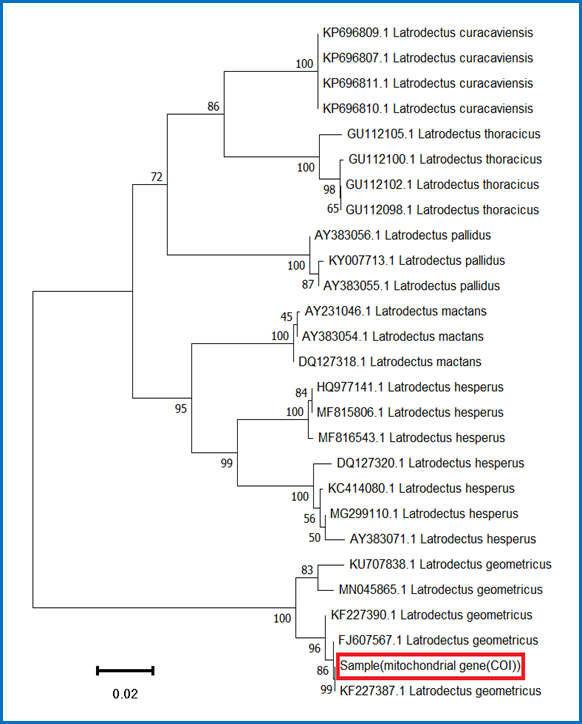
Nucleotide-BLAST [18] was used to determine the most closely related sequences and species in our collection, as well. Using MEGA 11 [9] and 1000 bootstrap replications, we generated a neighbor-joining (NJ) tree (Figures 1 & 2).
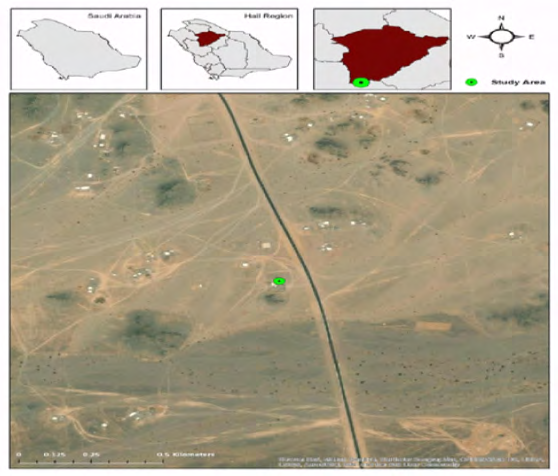
Results & Discussion
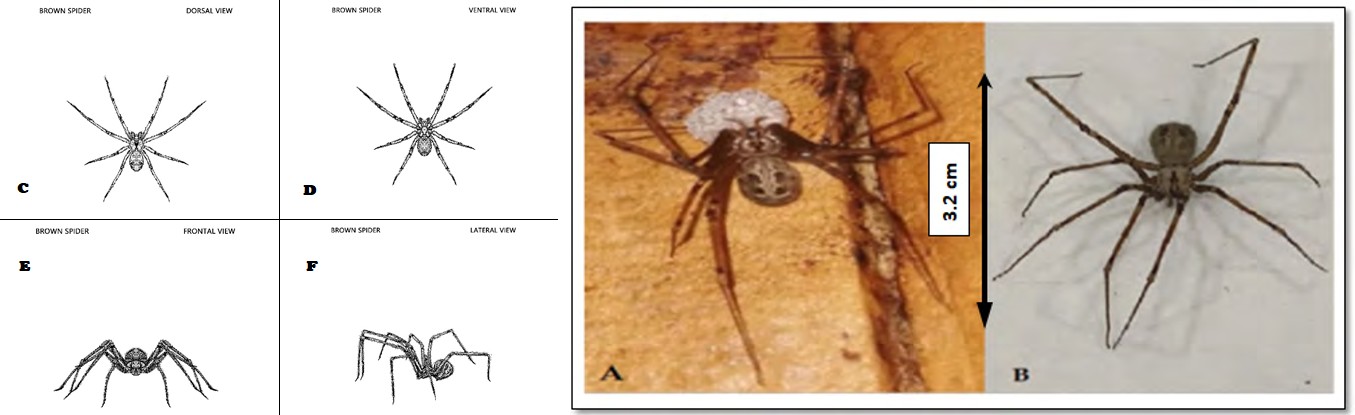
Different morphological characters were proved that the collected species is the brown widow spider (L. geometricus). Morphological characteristics analysis determined that the collected species is L. geometricus such as egg sacs, length of legs, comb feet, eyes and geometrical marking underside the abdomen. L. geometricus has four pairs of eyes are arranged in two parallel rows, and the hind tarsal bristles form a comb-like pattern [16]. The bottom of the abdomen of the widow spider has an hourglass-shaped stripe that ranges from light yellow to dark yellow or orange in mature spiders of this species [20]. Figure 2 shows all the morphological characteristic observed of brown widow female spider.
Male brown spider differs in body size form the female brown spider. The body length of the brown female spider was measured to be 12-16mm (excluding the legs) [16].
Molecular Identification
The mitochondrial cytochrome oxidase subunit I (COI) gene sequence was compared to NCBI GenBank records, and only the top four records are shown here in Table 1. An exact match has been found between the DNA sequence of a brown widow spider from Malaysia and a street in Akron. L. geometricus, a brown widow spider from California, shares 97 percent of its DNA sequence. In addition, a neighbor- joining (NJ) (Saitou and Nei, 1987) tree was created using MEGA 11 to investigate the evolutionary connection [21]. According to the results of a NJ tree, the sequences clustered together with those of the L. geometricus sequence, validating the species.
| Source | Query Coverage % | Sequence identity % | Country/Region | Accession Number | |
|---|---|---|---|---|---|
| Query Sequence of widow brown spider | Mitochondrion L. geometricus | 100 | 100 | Kuala Lumpur Malaysia | KF22738.1 |
| Mitochondrion L. geometricus | 100 | 100 | East Mill Street, Akron | FJ607567.1 | |
| Mitochondrion L. geometricus | 100 | 97.72 | USA California | KU707838.1 | |
| Mitochondrion L. geometricus | 100 | 97.11 | Rancho Penasquitos, USA,California | MN045865.1 |
Table 1: The result of BLASTn search of sample COI sequences found in Hail region of Saudi Arabia.
For many decades, the brown spider was solely discovered in State of Florida (USA), where it is still rather prevalent [22]. Since the first decade of the 21st century, the brown spider has been progressively increasing its range from Texas (USA) to the Gulf of Mexico and along the Atlantic coast in South Carolina [6]. In 2001, it was discovered as far north as Beaufort, South Carolina, indicating that it has now spread to every county in Florida. In addition to southern California and Hawaii, the brown widow spider has been reported [16]. As long as the habitat is ideal, brown spiders will continue to spread across North America and other places where they may thrive. There is a good chance that the brown spider L. geometricus will spread to New Mexico. The brown widow spider was later discovered in Israel, Turkey and the Philippines, as well as South Asia (Pakistan and India) and East Asia (Japan) [23].
Malaysian Peninsular is the most recent place to be infested with brown widows according to reports from South and North America. This is the first time that the brown spider has been found in the Hail area of Saudi Arabia, according to the findings of this research. The physical qualities of the specimen made it easy to identify. DNA barcoding was used to confirm the species of the material.
As with black widow bites, brown widow bites tend to be less severe, and the pain is typically localized to the region where the bite occurred [24]. The bites may also be dry, meaning no venom is administered, in roughly 15% of cases [25]. However, some black widow bites might produce more significant systemic symptoms. The more severe, systemic signs that black widows are renowned for do occur in certain cases [26, 27, 28, 29, 30, 31, 32, 33, 34, 35, 36].
References
-
Segoli M, Arieli R, Sierwald P, Harari AR, Lubin Y (2008) Sexual cannibalism in the brown widow spider (_Latrodectus geometricus_). Ethology 114: 279-286.
-
Garb JE, González A, Gillespie RG (2004) The black widow spider genus Latrodectus (Araneae: Theridiidae): phylogeny, biogeography, and invasion history. Molecular phylogenetics and evolution 31: 1127-1142.
-
Giridhar P, Reddy BO, Ravishankar G (2001). Rare sighting of poisonous spider _Latrodectus hasseltii_ indicus Simon (Araneae: Theridiidae) in a cotton field in Baroda district, Gujarat. Current Science 81: 1170.
-
Foelix R (1996) Biology of Spiders: Oxford University Press. New York, pp: 330.
-
Liu Y, Maas A, Waloszek D (2009) Early development of the anterior body region of the grey widow spider _Latrodectus geometricus_ Koch, 1841 (Theridiidae, Araneae). Arthropod structure & development 38: 401- 416.
-
Brown K, Necaise J, Goddard J (2008) Additions to the known US distribution of _Latrodectus geometricus_ (Araneae: Theridiidae). Journal of Medical Entomology 45: 959-962.
-
Muslimin M, Wilson JJ, Ghazali ARM, Braima KA, Jeffery J, et al. (2015) First report of brown widow spider sightings in Peninsular Malaysia and notes on its global distribution. Journal of Venomous Animals and Toxins including Tropical Diseases 21: 1-8.
-
Edwards GB, Marshall S (2002) Florida’s fabulous spiders, World Publications (FL) DBA National Art Service.
-
Benjamin SP, Zschokke S (2003) Webs of theridiid spiders: construction, structure and evolution. Biological Journal of the Linnean Society 78: 293-305.
-
Heeres A (1991) Natural history observations of the brown widow spider Latrodectus geometricus (Araneae: Theridiidae). Naturalist, Port Elizabeth 35: 31-34.
-
Lamoral BH (1968) On the nest and web structure of Latrodectus in South Africa, and some observations on body colouration of _L. geometricus_ (Araneae: Theridiidae). Annals of the Natal Museum 20: 1-14.
-
Gaisford K, Kautz DD (2011) Black widow spider bite: a case study. Dimensions of critical care nursing 30(2): 79-86.
-
Clark RF, Wethern kestner S, Vance MV, Gerkin R (1992) Clinical presentation and treatment of black widow spider envenomation: a review of 163 cases. Annals of emergency medicine 21: 782-787.
-
Ramialiharisoa A, De haro L, Jouglard J, Goyffon M (1994) Latrodectism in Madagascar. Medecine tropicale: revue du Corps de sante colonial 54: 127-130.
-
Abalos J (1962) The egg-sac in the identification of species of Latrodectus (Black-Widow Spiders). Psyche 69: 268-270.
-
Vincent LS, Vetter RS, Wrenn WJ, Kempf JK, Berrian JE (2009) The brown widow spider _Latrodectus_ _geometricus_ CL Koch, 1841, in southern California. The Pan-Pacific Entomologist 84: 344-349.
-
Ashfaq M, Blagoev G, Tahir HM, Khan AM, Mukhtar MK, Akhtar S, et al. (2019) Assembling a DNA barcode reference library for the spiders (Arachnida: Araneae) of Pakistan. PLoS ONE 14(5): e0217086.
-
Chen Y, Ye W, Zhang Y, Xu Y (2015) High speed BLASTN: an accelerated MegaBLAST search tool. Nucleic acids research 43: 7762-7768.
-
Tamura K, Stecher G, Peterson D, Filipski A, Kumar S (2013) MEGA6: molecular evolutionary genetics analysis version 6.0. Molecular biology and evolution 30: 2725-2729.
-
Saitou N, Nei M (1987) The neighbor-joining method: a new method for reconstructing phylogenetic trees. Molecular biology and evolution 4: 406-425.
-
Tamura K, Stecher G, Kumar S (2021) MEGA11: molecular evolutionary genetics analysis version 11. Molecular Biology and Evolution 38: 3022-3027.
-
Pearson JF (1936) _Latrodectus geometricus_ Koch in southern Florida. Science 83: 522-523.
-
Shukla S, Broome VG (2007) First report of the brown widow spider, _Latrodectus geometricus_ CL Koch (Araneae: Theridiidae) from India. Current Science 93: 775-777.
-
Almeida R, Ferreira J, Chaves RS, Barraviera B (2009) Envenomation caused by _Latrodectus geometricus_ in São Paulo state, Brazil: a case report. Journal of Venomous Animals and Toxins including Tropical Diseases 15: 562- 571.
-
Reyes lugo M, Sánchez T, Finol HJ, Sánchez EE, Suárez JA, et al. (2009) Neurotoxic activity and ultrastructural changes in muscles caused by the brown widow spider _Latrodectus geometricus_ venom. Revista do Instituto de Medicina Tropical de São Paulo 51: 95-101.
-
Goddard J, Upshaw S, Held D, Johnnson K (2008) Severe reaction from envenomation by the brown widow spider, _Latrodectus geometricus_ (Araneae: Theridiidae). Southern Medical Journal 101: 1269-1270.
-
Bayram A, Danisman T, Yigit N, Kunt K, Sancak Z (2008) A brown widow spider new for the Turkish araneo- fauna: _Latrodectus geometricus_ CL Koch, 1841 (Araneae, Theridiidae). Turk J Arachnol 1: 98-103.
-
Edwards G (2002) Venomous Spiders in Florida. Pest Alert. Florida Department of Agriculture and Consumer Services, Division of Plant Industry.
-
Howell WM, Jenkins RL (2004) Spiders of the eastern United States: a photographic guide, Pearson Education.
-
Keegan H, Blauw A, Anderson R (1950) Latrodectus Geometricus Koch on Luzon1. The American journal of tropical medicine and hygiene 1: 901-907.
-
Levy G, Amitai P (1983) Revision of the widow-spider genus Latrodectus (Araneae: Theridiidae) in Israel. Zoological Journal of the Linnean Society 77: 39-63.
-
Müller G (1993) Black and brown widow spider bites in South Africa: a series of 45 cases. South African Medical Journal 83: 399-405.
-
Ono H (1995) Records of _Latrodectus geometricus_ (Araneae: Theridiidae) from Japan. Acta arachnologica 44: 167-170.
-
Pinter LW (1980) The widow spiders of Hawaii. Proceedings of the third conference in natural sciences. In: Smith CW, et al. (Edn.), Hawaii Volcanoes National Park. University of Hawaii at Manoa, Hawaii Volcanoes National Park, Manoa, HI pp: 265.
-
Pocock RI (1900) The fauna of British India, including Ceylon and Burma. Arachnida, Today and Tomorrow Publisher.
-
Suchard JR (2009) Spider Bite. Annals of emergency medicine 54: 11.
- Mitochondrial Bio-Logistics: Steering Co-Enzyme Q10 and Lycopene Synergies within the Science 4.0 Bio-OS Framework
- Hymenoptera Specimens from the Caño Negro Wetland, of the National Museum Collection, Costa Rica
- Science 4.0: Comprehensive Architecture of the Biological Operating System (Bio-OS) A Framework for Systemic Resilience and Industrialized Bio-Governance
- Rabbit on, or Hare Back? Understanding Climate Change
- Clinical Validation of Science 4.0: Flow Steering and Epigenetic Drift Inversion on a 76-Year-Old Hybrid System
- Seeds Planted by another Mind