
First Report of Lutzomyia edwardsi and Lutzomyia gasparviannai Infected by Nematodes in a Rio de Janeiro Cave
In 1984, a case of a wild rodent (Proechimys iheringi) infected with Leishmania (Leishmania) forattinii was reported. Lutzomyia gasparviannai is considered the vector of this etiological agent. In 2001, infection of the species Lutzomyia edwardsi by Leishmania (Viannia) braziliensis was described, suggesting the involvement of L. edwardsi in the transmission cycle of cutaneous leishmaniasis. In 2002, in the Lapinha cave, Belo Horizonte, Minas Gerais, Brazil, specimens of Lutzomyia longipalpis infected by nematodes were captured, providing motivation for studies on the biological control of phlebotominae. Thus, the aim of this study was to collect data from phlebotominae species in Sumidouro, Rio de Janeiro, Brazil. Specimens were captured in a cave and the surrounding Atlantic Forest using Center of Disease Control traps, twice a month, overnight from 18h to 6h. The collection periods were from June 2009 to May 2010 and from March 2015 to February 2016. The phlebotominae were mounted on slides and covered with coverslips at the Oswaldo Cruz Institute. A female L. edwardsi specimen infected with nematodes, captured in 2009, and a female Lutzomyia gasparviannai specimen infected with Wuchereria bancrofti, captured in 2015, were among the collected specimens. Phlebotominae and nematodes were identified by morphological analysis, using an optical microscope. The nematode species W. bancrofti was identified by the curator of the Helminth Collection of the Oswaldo Cruz Institute, where it was deposited along with the L. gasparviannai specimen. Exemplars of L. gasparviannai were deposited in the Entomological Collection of the Oswaldo Cruz Institute. The slide containing L. edwardsi and the nematodes was deposited in the Entomological Biodiversity Laboratory. This is the first report of W. bancrofti nematodes in these species, in a cave, and in the state of Rio de Janeiro. Thirteen species of phlebotominae were collected. L. gasparviannai was the most frequent, followed by L. edwardsi. The predominance of these two species, considered vectors of the etiological agents of leishmaniasis, and their nematode infections suggest that studies on the biological control of nematodes should be conducted and that cases of filariasis in this region should be assessed.
Introduction
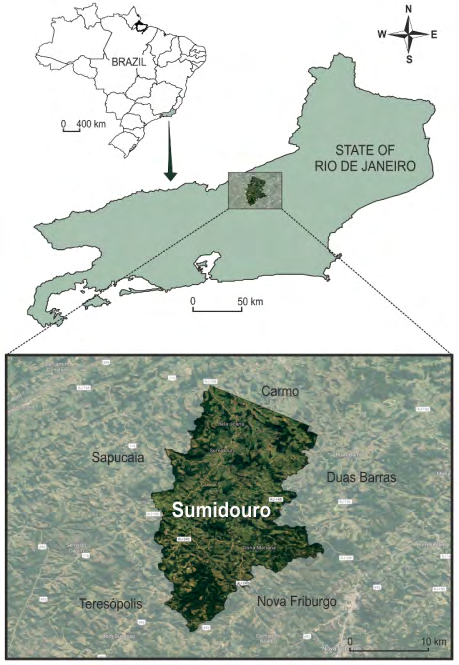
In 1984, a wild rodent (Proechimys iheringi) infected with Leishmania (Leishmania) forattinii was reported in Viana, Espírito Santo, Brazil, an area endemic for leishmaniasis. Lutzomyia gasparviannai is considered the vector of this etiological agent [1]. L. gasparviannai Martins, Godoy & Silva, 1962 was captured for the first time outside the municipality of Nova Iguaçu, the type locality (Rio de Janeiro, Brazil) which is 113 km away from the locality studied [2, 3, 4, 5, 6, 7]. In 2001, the species Lutzomyia edwardsi was reported to be infected by Leishmania (Viannia) braziliensis, indicating the involvement of L. edwardsi in the transmission cycle of cutaneous leishmaniasis [3]. A year later, in the Lapinha cave, near Belo Horizonte, Minas Gerais, Brazil, specimens of Lutzomyia longipalpis infected by nematodes were captured, inspiring studies on the biological control of phlebotominae [4]. Accordingly, the objective of this study was to collect data from phlebotominae species inhabiting Sumidouro, Rio de Janeiro, Brazil (Figure 1).
Material and Methods
Specimens were captured in a cave and the surrounding Atlantic Forest overnight between 18h and 6h, using Center of Disease Control traps. The captures were conducted twice per month, from June 2009 to May 2010 and from March 2015 to February 2016. The phlebotominae were mounted on slides and covered with coverslips at the Oswaldo Cruz Institute. Phlebotominae and nematodes were identified via morphological analysis, using an optical microscope [5, 6].
Results and Discussion
A total of 4,079 phlebotominae were collected, comprising 13 species: 2 of the genus Brumptomyia, B. brumpti (Larrouse, 1920) and B. guimaraesi (Coutinho & Barreto, 1941ª), and 11 of the genus Lutzomyia, L. gasparviannai (Martins, Godoy & Silva, 1962b), L. edwardsi (Mangabeira, 1946), L. tupynambai (Mangabeira, 1942b), L. hirsuta (Mangabeira, 1942b), L. whitmani (Antunes & Coutinho, 1939), L. migonei (França, 1920), L. intermedia (Lutz & Neiva, 1912), L. davisi (Root, 1934), L. cortelezzii (Brethés, 1923), L. microps (Mangabeira, 1942ª), and L. quinquefer (Dyar, 1929).
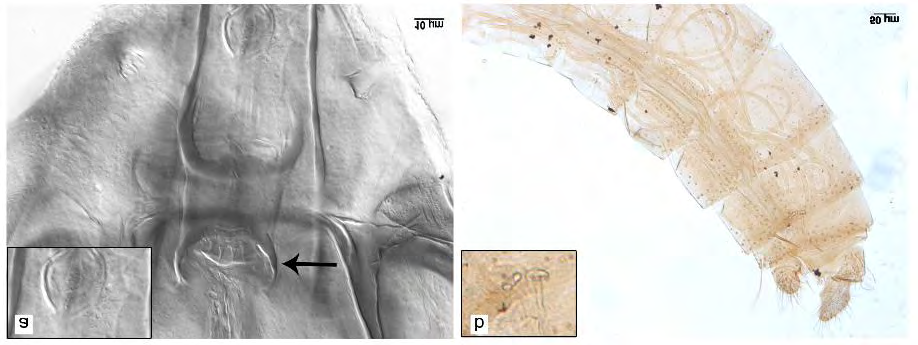
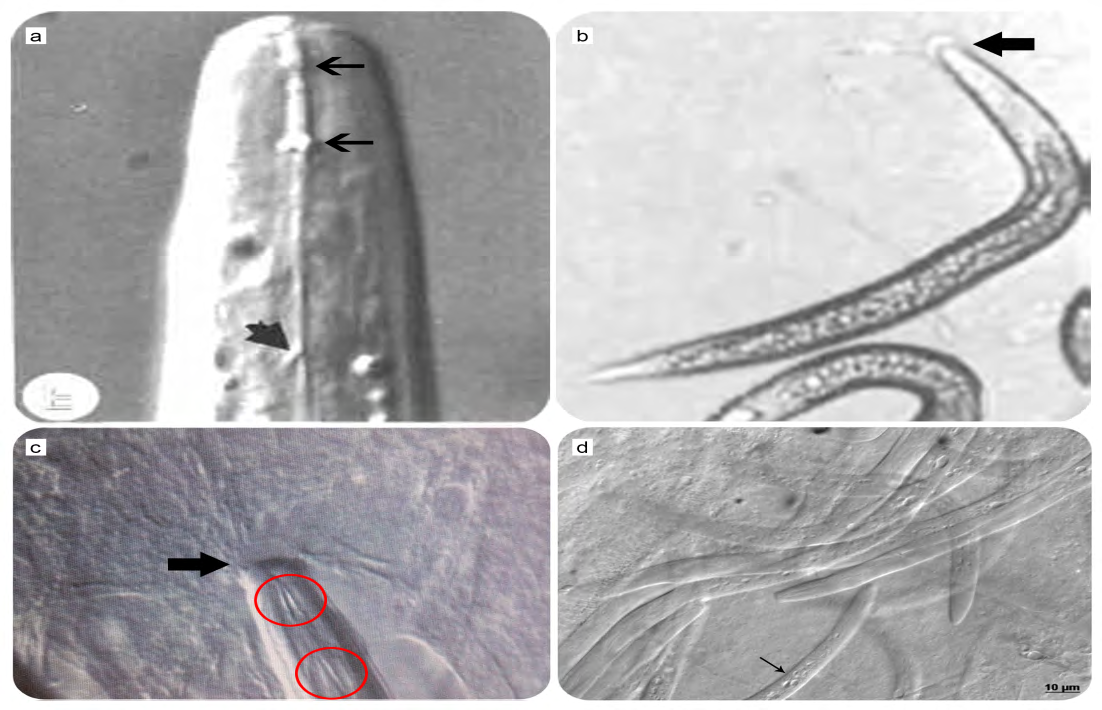
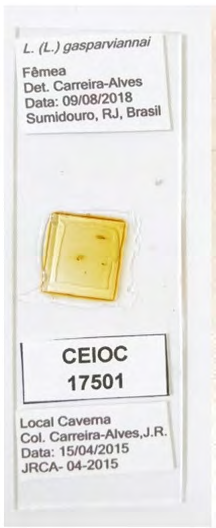
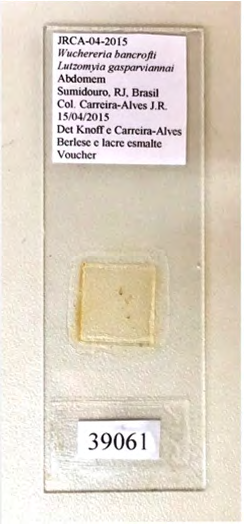
Lutzomyia gasparviannai was the most common species, comprising 55.8% of the total, followed by L. edwardsi, at 20.47% [7]. A female L. edwardsi specimen infected by nematodes and a female L. gasparviannai specimen infected by Wuchereria bancrofti, captured in 2009 and 2015, respectively, were recorded (Figures 2 & 3). The nematode species W. bancrofti was identified by the curator of the Helminth Collection of the Oswaldo Cruz Institute, where it was deposited along with the L. gasparviannai specimen (Figure 5). L. gasparviannai specimens from the same collection were deposited in the Entomological Collection of the Oswaldo Cruz Institute (Figure 4). The slide containing L. edwardsi and the nematodes was deposited in the Entomological Biodiversity Laboratory. This is the first time that these nematodes have been reported in these species, in a cave, and in the state of Rio de Janeiro [6].
Conclusion
The predominance of L. gasparviannai and L. edwardsi, considered vectors of etiological agents of leishmaniasis, and their infection by nematodes suggest that further studies on the control of biological vectors with nematodes should be conducted and that cases of filariasis in this location should be assessed.
Acknowledgments
To Dr. Felipe Ferraz Figueredo Moreira, Laboratory of Entomological Biodiversity, for his trust, support, and assistance; to Dr. Márcio Felix, for his trust and belief in my work; to Professor Francisco Gerson Araújo, for his advice and friendship; to Heloisa Maria Nogueira Diniz, for image production and processing; to the residents of São Caetano, Sumidouro, for their affection and attention; and to the reviewers, for their valuable collaboration.
References
-
Falqueto A, Grimaldi Júnior G, Sessa PA, Varedão JBM, Deane LM (1985) Lutzomyia gasparviannai Martins, Godoy & Silva, 1962, probable vector of Leishmania mexicana ssp. in Viana municipality, Espírito Santo State, Brazil. Memorias do Instituto. Oswaldo Cruz 80(4): 497.
-
Martins AV, Godoy Jr TL, Silva JE (1962b) A new species of sandflies from the states of Rio de Janeiro and Espírito Santo – Lutzomyia gasparviannai n. sp. (Diptera, Psychodidae). Journal of the Tropical Medicine Institute of São Paulo 4(2): 85-90.
-
SUCEN (2005) Encounter of infected Lutzomyia edwardsi in the Greater São Paulo region. Public Health Journal 39: 137-138.
-
Secundino NFC, Araújo MSS, Oliveira GHB, Massara CL, Carvalho OS, et al. (2002) Preliminary description of a new entomoparasitic nematode infecting Lutzomyia longipalpis sand fly the vector of visceral Leishmaniasis in the new word. Journal Invertebrate Pathology 80(1): 35- 40.
-
Poinar GO, Ferro C, Morales A, Tesh RB (1993) Anadranema phlebotophaga n. gen., n. sp. (Allantonematidae: Tylenchida), a new nematode parasite of phlebotomine sand flies (Psychodidae: Diptera) with notes on experimental infections of these insects with parasitic rhabditoids. Fundamental and Applied Nematology 16(1): 11-16.
-
Poinar GO, Trevor AJ, Nigel LB, Mohd BW (2002) Elaeolenchus parthenoneman. n.gen., n. sp. (Nematoda: Phaerularioidea: Anandranematidae n. fam.) Parasitic in the palm-pollinating weevil Elaeidobius kamerunicus Faust, with a phylogenetic synopsis of the Sphaerularioidea Lubbock, 1861. Systematic Parasitology 52(3): 219-225.
-
Alves JRC (2019) Phlebotominae Fauna(Diptera: Psychodidae; Phlebotominae) and identification of Leishmania sp vectors in a cave region, in the municipality of Sumidouro, State of Rio de Janeiro, Brazil. Doctoral thesis, Federal Rural University Rio de Janeiro, Seropédica, Brazil.
- Mitochondrial Bio-Logistics: Steering Co-Enzyme Q10 and Lycopene Synergies within the Science 4.0 Bio-OS Framework
- Hymenoptera Specimens from the Caño Negro Wetland, of the National Museum Collection, Costa Rica
- Science 4.0: Comprehensive Architecture of the Biological Operating System (Bio-OS) A Framework for Systemic Resilience and Industrialized Bio-Governance
- Rabbit on, or Hare Back? Understanding Climate Change
- Clinical Validation of Science 4.0: Flow Steering and Epigenetic Drift Inversion on a 76-Year-Old Hybrid System
- Seeds Planted by another Mind