
Copper and Zinc Levels in the Liver Tissue of Healthy Cattle Affected by Fasciola hepatica in a Slaughterhouse
Fasciolosis is considered the most important liver disease in animals, the most notorious damages are caused by death, it causes a reduction in the production of meat, wool and milk, seizure of affected organs, secondary infections by bacteria, interference with fertility and expenses derived from its treatment. The objective of this research was to determine the relationship of Cu and Zn levels in the liver with the affectation by Fasciola hepatica in slaughterhouse cattle. Determinations of Cu, Zn, ash and dry matter were carried out using the atomic absorption spectrophotometry technique in healthy liver tissue affected by fasciolosis in 40 cattle slaughtered in the slaughterhouse. The association between possible risk factors for hepatic Cu and Zn values below the critical limit and the event of livers affected by F. hepatica was carried out in a retrospective case-control observational study. The levels of Cu and Zn in healthy livers affected by F. hepatica in cattle slaughtered in the municipal slaughterhouse of Sagua la Grande, Villa Clara, Cuba are deficient and show low reserves of these microelements with values below the critical value. No association was found between Cu and Zn levels in liver tissue with liver involvement by F. hepatica in slaughterhouse cattle, although it was observed that slaughtered cattle with hepatic Zinc values lower than the critical limit are affected approximately two times more due to fasciolosis than bovines with normal hepatic zinc values.
Introduction
The presence of the veterinarian in the slaughterhouse is to supervise that the organs destined for human consumption are free of alterations that could affect the quality of the product and human health, and to seize those that are altered. The ability to process and analyze the information obtained from the seizure of these organs and then relate it to different factors, including production, makes it possible to detect the critical points of livestock and health on farms and to evaluate the behavior of different diseases and causes of discard based on the examination obtained in slaughterhouses [1].
The pathological findings in slaughterhouses are varied in nature, however, there is a limited series of pathologies that stand out widely for their greater frequency and that differ according to the species involved. The organs affected by these highly prevalent pathologies are normally those of greatest economic value and, in turn, those of easiest sanitary control from the point of view of post-mortem inspection. Most of the pathologies associated with post- mortem inspection are found primarily in liver and lung and secondarily in the rest of the organs or tissues [2].
The association links between the areas of origin of slaughtered animals and the occurrence of seizures allow establishing feedback to evaluate risk factors for the introduction and spread of diseases, as well as opportunities to mitigate their impact through early warning and timely response [3]. Copper (Cu) is an essential element for plants, animals and humans, about one percent of body enzymes require Cu for their activity, it is directly linked to hemoglobin formation, red blood cell maturation and functioning of enzyme systems. It is involved in the formation of bone and connective tissue and the immune system. It is important for the integrity of the central nervous system and cardiac musculature. It is distributed in all tissues of the organism, mainly in the form of metalloproteins, functioning as an enzyme [4]. Zinc (Zn) is an essential mineral element for life as it is part of numerous enzyme systems. It has its main action in tissues with high cell formation rate and that is why its deficiency impairs the growth of calves; it decreases sperm production in bulls and favors skin and hoof diseases [4, 5]. Zn is essential as a trace mineral because of its structural, catalytic and regulatory role in cellular activity. On the one hand, Zn acts by stabilizing proteins to maintain their spatial conformation and normal activity. In this sense between 3 and 10% of genome-associated proteins and more than 300 enzymes are Zn-dependent metalloproteins [5, 6]. Assuming that these enzymatic functions and gene expression can be altered by Zn deficiency, the possible range of consequences on animal health is understandable [7].
Fasciola spp. in addition to being one of the main causes of liver seizures in slaughterhouses, involves other damage associated with infection: reduced meat, milk or wool production and body weight, infertility, reduced growth, reproductive retardation, abortions and loss of resistance to other diseases. Costs increase, due to anthelmintic treatments, as well as frequent secondary bacterial infections, which can lead to the death of animals [8].
There are several studies that evaluate various risk factors such as season, temperature, soil moisture conditions, region, breed, sex and age of the animals, associated with Fasciola hepatica infection in cattle [9, 10, 11]. However, there are few studies in cattle destined for slaughter where Cu and Zn levels in the liver are related to F. hepatica infection. The objective of this research was to determine the relationship between Cu and Zn levels in cattle livers with the F. hepatica parasite in the municipal slaughterhouse of Sagua la Grande, Villa Clara, Cuba.
Material and Methods
Study Area
The research was carried out in the “Lorenzo González” bovine slaughterhouse, which is located in Sagua la Grande municipality, Villa Clara province, Cuba. The geographical coordinates of this slaughterhouse are the following: 22 degrees 49’11.42” N with 80 degrees 04’18.71” W (Figure 1).
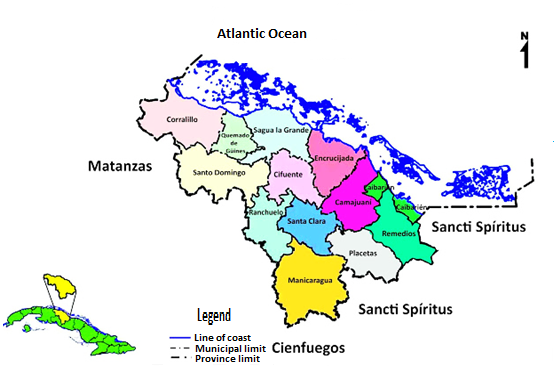
Source: Provincial Meteorological Center of Villa Clara. Figure 1: Administrative Map of the Province of Villa Clara.
Universe and Samples
The liver samples were obtained from animals that were slaughtered by electrical insensitization and later exsanguination by section of the jugular vein, in the “Lorenzo Gonzalez” slaughterhouse of the Sagua la Grande municipality belonging to the Villa Clara Meat Company, Cuba, where about 1430 cattle are slaughtered per month. Within 15 minutes after the slaughter of the animals, samples were obtained from the ventral edge of the right lobe (15 cm3) of apparently healthy livers and equal size of the portions affected by fasciolosis, according to sanitary inspection of the veterinary services of the slaughterhouse. The samples were stored at -10 °C until analysis.
Determination of Sample Size
The total population of animals destined for slaughter was estimated with the 1,430 cattle slaughtered on average monthly at the municipal slaughterhouse of Sagua la Grande. The sample size was determined by applying the formula for finite populations according to the expected prevalence [12].
$$ \mathrm {n} = \frac {\mathrm {N} ^ {*} \mathrm {Z} \alpha^ {*} (\mathrm {p} ^ {*} \mathrm {q})}{d ^ {2} \left(N - 1\right) + Z \alpha^ {2} * \left(p ^ {*} q\right)} $$ $$ n = \frac {1 4 3 0 ^ {*} 1 , 9 6 ^ {*} 0 , 2 4 ^ {*} (1 - 0 , 2 4)}{0 , 0 1 (1 4 3 0 - 1) + 3 , 9 2 ^ {*} (0 , 2 4 ^ {*} 1 - 0 , 2 4)} = 2 9, 5 9 $$ Legend: n = sample size, N = population size, Zα = value corresponding to the Gaussian distribution = 1.96, p = expected prevalence of the parameter to be assessed, q = 1 - p, p = proportion of the population expected to be affected, d = 0.10 allowed error, d2 = absolute precision on both sides of the proportion.
All sampling was conducted in the period from January 2019 to June 2019. It was taken into account that the size of the study population was 1,430 cattle. The expected prevalence included in the formula was 24 %, based on a previous study conducted in the provincial slaughterhouse of Villa Clara province itself, by Lazo, et al. [3]. The confidence level was 90 % so the absolute error accepted was 10 %. Although the calculated n was 30 animals, 40 were used to decrease the sampling error (Table 1).
| Number of livers | Cows | Bulls | Healthy | Affected |
|---|---|---|---|---|
| 40 | 21 | 19 | 20 | 20 |
Table 1: Sampling composition.
Techniques and Procedures Used
The determinations of Cu and Zn in liver tissue were performed by atomic absorption spectrophotometry, according to the technique of Miles, et al. [13] in an SP-9 equipment of the firm PYE UNICAM, according to the manufacturer’s procedures. To study the association between possible risk factors, hepatic Cu and Zn values below the critical limit and the occurrence of livers affected by F. hepatica. The odds ratio was estimated with a retrospective observational case-control study.
Statistical Processing
A mean comparison analysis was performed to determine if there were significant differences between the mean values of Cu, Zn, ash and dry matter in healthy and F. hepatica- affected livers. The statistical package STATGRAPHICS CENTURION ver XV was used in these processes II. In addition, the relative risk (Odds ratio) was estimated by the conformation of 2x2 contingency tables, applying a retrospective observational study of case-control type, where 20 livers affected by F. hepatica were considered as cases and 20 healthy livers as controls (Table 2).
| Classification | Cases | Controls | Total | |
|---|---|---|---|---|
| Exposed | a | b | a+b | |
| Not exposed | c | d | c+d | |
| Total | a+c | b+d | a+c+b+d |
Table 2: Relative risk estimation (Odds ratio).
The proportion of affected livers exposed to levels below the critical limit of Cu (75 ppm) and Zn (160 ppm) (p1) can be given by the equation: P1 = a / (a + c). The proportion of healthy livers exposed to levels below the critical limit of Cu and Zn (p2) is expressed by P2 = b / (b + d). Likewise, the Odds ratio is determined by: OR = (a x d) / (c x b). For this risk analysis, the program for epidemiological analysis of tabulated data EPIDAT ver 3.1 was used.
Results and Discussion
Table 3 shows the average levels of Cu, Zn, ash and dry matter in liver tissue of cattle slaughtered with and without liver involvement by F. hepatica.
| LC* | Healthy liver (n = 20) | Affected liver (n = 20) | Value of p | |
|---|---|---|---|---|
| LC* | X ± DE | Value of p | X ± DE | |
| Cu (ppm) | 75 | 67.05 ± 46.32 | 79.7 ± 76.25 | 0.52 |
| Zn (ppm) | 160 | 143 ± 19.22 | 137.5 ± 37.11 | 0.55 |
| Ashes (%) | - | 0.051 ± 0.00 | 0.048 ± 0.00 | 0.13 |
| MS (%) | - | 0.29 ± 0.06 | 0.29 ± 0.04 | 0.8 |
Table 3: Descriptive statistics of the mineral profile in liver tissue of cattle investigated at the slaughterhouse. *Los limites
100 % of the liver samples had low Cu and Zn reserves with values below the critical value in both healthy and affected livers. There were no significant differences between the average values of Cu, Zn, ash and dry matter of healthy and F. hepatica affected livers.
The liver Zn concentrations in this investigation are in correspondence with those reported by McDowell, et al. and Underwood, et al. and Rosa, et al. and Rosa, et al. [14, 16, 17, 18], which indicate that hepatic Zn fluctuates between 100 to 400 mg/kg dry basis, but do not correspond with Cu which according to these authors ranges between 200 and 300 mg/ kg.
There is no single criterion on the reference parameters for hepatic Cu reserves Bavera, et al. [19], refers values of 200-400 ppm, while Alvarez, et al. [20] and McDowell, et al. [14], of 100-200 ppm and Radostits, et al. [15] of 100-4000 ppm, however, there is consensus among these authors that the critical limits of deficiency for this mineral in liver are 75 ppm.
However, in the production conditions of the central region of Cuba, the reference parameters for Cu in liver tissue in Holstein x Zebu female cattle are 46.54 ppm, and those for Zn are 142.97 ppm [21].
These results are in correspondence with those obtained by other authors in studies carried out in Cuba [22], which diagnosed low reserves of Cu in liver, ranging between 25 and 75 ppm in rainy and dry seasons, respectively. Subsequently, in the central region of the country, specifically in Villa Clara province, 72% of the samples investigated in liver tissue were deficient in Cu [23].
In Cuba, the gradual deterioration of the food base, poor pasture management, reduction of soil dynamics and the lack of mineral supplementation, especially of microelements, are objective conditions for the existence of mineral insufficiencies [24, 25].
The Cu and Zn deficiencies found in this study correspond to the results obtained by Noval, et al. [26], who confirmed that mineral deficiencies have a variable geographical incidence depending on multiple factors, although they are a generalized problem throughout the country.
In Cuba, microelement deficiencies are diagnosed in different regions of the country and genotypes of cattle, always associated with the deterioration of reproductive efficiency indicators of herds [27, 28, 29]. Subsequently, articles were published on severe deficiencies of Cu and Zn in dairy cows throughout the country, affecting the three regions: western, central and eastern [30, 31, 32, 33, 34, 35].
The low availability, deficiency or imbalance of minerals in the soil affects the concentration of the deficient element in forages and contributes to low plant growth and productivity [36, 37, 38], and to the low nutritive value of pastures [39], so most pastures in tropical regions do not completely satisfy the mineral needs of animals [40].
In the risk analysis performed when comparing F. hepatica-affected livers with healthy livers, there was no association (OR = 0.81) between the factor hepatic Cu values below the critical limit (-75 ppm) and the F. hepatica-affected livers event. Because, in both cases (affected livers) and controls (healthy livers), the proportion of those exposed to hepatic Cu values below the critical limit did not differ statistically (p ≥ 0.05) (Table 4).
| Estimation | IC: 95% | |
|---|---|---|
| Proportion of cases exposed | 0.5 | |
| Proportion of controls exposed | 0.55 | |
| Odds ratio | 0.81 | 0.23 – 2.83 |
| Ji- cuadrado | 0.1 | |
| Valor de p | 0.75 |
Table 4: Risk analysis and association between hepatic Cu deficiency and liver involvement by F. hepatica.
An association was found between the factor hepatic Zn values below the critical limit (160 ppm) and F. hepatica affected liver (OR = 1.88), this association was significant (CI: 0.38-9.27), but not statistical (p ≥ 0.05). Eighty-five percent of affected livers and 75% of healthy livers were exposed to Zinc values below the critical limit. Although slaughtered cattle with liver Zinc values below the critical limit are affected approximately twice as much (OR = 1.88) by fasciolosis as cattle with normal liver Zinc values, this factor does not constitute a risk factor (Table 5).
| Estimation | IC: 95% | |
|---|---|---|
| Proportion of cases exposed | 0.85 | |
| Proportion of controls exposed | 0.75 | |
| Odds ratio | 1.88 | 0.38 – 9.27 |
| Ji- cuadrado | 0.62 | |
| Valor de p | 0.42 |
Table 5: Risk analysis and association between hepatic Zn deficiency and liver involvement by F. hepatica.
The results of the study preliminarily infer that, hepatic Zinc at levels below the critical limit in cattle, is a condition that favors infection caused by the ingestion of F. hepatica metacercariae, but further studies with a greater number of samples of liver tissue from livers affected by fasciolosis and healthy livers would be necessary.
These results are in correspondence with those obtained by Barragán, et al. [41], who determined and compared the concentration of hepatic Copper, Zinc and Cobalt in healthy and fasciolosis affected cattle in Colima, Mexico. In this study, it was evidenced that there was no difference (p>0.05) in the concentration of the three minerals between healthy and infected livers, observing an overall average concentration of Copper, Zinc and Cobalt of 54.03; 11.99 and 0.28 mg/kg dry weight, respectively.
Conclusion
The levels of Cu and Zn in healthy livers and livers affected by F. hepatica in cattle slaughtered in the municipal slaughterhouse of Sagua la Grande, Villa Clara, Cuba, are deficient and show low reserves of these microelements with values below the critical value. No association was found between Cu and Zn levels in hepatic tissue with the affectation of livers by F. hepatica in slaughterhouse cattle, although it was observed that slaughtered cattle with hepatic Zinc values below the critical limit are affected approximately twice as much by fasciolosis as cattle with normal hepatic Zinc values.
Acknowledgement
The author would like to thank all those who have helped the author in this research, but specially to Prof. Freddy E.
Zambrano Gavilanes, Ph.D. for is financial contribution to defray the costs of processing the article.
Disclosure of Conflict of Interest
The authors declare that there is no conflict of interest regarding the publication of this article.
Statement of Informed Consent
Informed consent was obtained from all individual participants included in the study.
References
-
Quevedo DAC, Marquez AC, Garzón C, Bolanos CAD (2011) Comparative Study of Mineral Metabolic Profiles in Dairies of two Regions of Nariño. Orinoquia 15(2): 160-168.
-
Rodríguez TPÁ (2015) Determination of anatomopathological lesions in bovine liver, slaughtered at the Empresses Metropolitan Public Company of Rastro-Quito. Career of Veterinary Medicine and Zootechnics. UTC. Latacunga, Ecuador, pp: 69.
-
Lazo PL (2017) Bases para la implementación de un sistema de vigilancia sindrómica en el diagnóstico pasivo de Fasciola hepatica en hígados decomisados en matadero. VIII Simposio de Medicina Veterinaria. Convención Científica Internacional. Caibarien, Villa Clara, Cuba, pp: 23-27.
-
Waldron KJ, Rutrherford JC, Ford D, Robinson DJ (2009) Metalloproteins and metal sensing. Nature 460: 823- 830.
-
Tapiero H, Tew KD (2003) Trace elements in human physiology and pathology: zinc and metallothioneins. Biomed Pharmacother 57(9): 399-411.
-
Nunnery GA, Vasconcelos JT, Parsons CH, Salyer GB, Defoor PJ, et al. (2007) Effect of source of supplemental zinc on performance and humoral immunity in beef heifers. J Anim Sci 85(9): 2304-2313.
-
Sekler I, Sensi SL, Hershfinkel M, Silverman WF (2007) Mechanism and regulation of cellular zinc transport. Mol Med 13(7-8): 337-343.
-
Palacio CN, Bertot VJA, Beltrao MM (2020) Fasciolosis en Cuba y el mundo. Rev de Producción Animal 32(3): 15- 22.
-
Yatswuako S, Alhaji NB (2017) Survey of bovine fasciolosis burdens in trade cattle slaughtered at abattoirs in North- central Nigeria: The associated predisposing factors and economic implication. Parasite Epidemiol Control 2(2): 30-39.
-
Robertos NFO, Garduño RG, Cruz SC, Torres JAP, Palomera CL, et al. (2020) Factors associated with confiscation of livers positive for Fasciola sp in an endemic area of southeastern Mexico. Rev mex of science livestock 11(2): 565-575.
-
Opio LG, Abdelfattah EM, Terry J, Odongo S, Okello E (2021) Prevalence of Fascioliasis and Associated Economic Losses in Cattle Slaughtered at Lira Municipality Abattoir in Northern Uganda. Animals 11(3): 681.
-
Thrusfield M, Christley R (2018) Veterinary Epidemiology. 4th (Edn.), ISBN: 978-111-828-0270.
-
Miles PH, Wilkinson NS, McDowell LR (2001) Analysis of Minerals for Animal Nutrition Research. In: 3rd (Edn.), Dept Anim Sci Univ, Florida, USA.
-
McDowell L, Arthington R (2005) Minerales para rumiantes en pastoreo en regiones tropicales. In: 4th (Edn.), IFAS, pp: 91.
-
Radostits OM, Gay CC, Blood DC, Hinchliff FW (2007) Veterinary Medicine. A text book for the diseases cattle, sheep, pigs, goats and horses. 10th (Edn.), Bailliere multivalent vaccine administration in beef calves. Tindall, London, UK.
-
Boorman KN (1999) The Mineral Nutrition of Livestock. In: Underwood EJ, Suttle NF, et al. (Eds.), 3rd (Edn.), Wallingford: CABI Publishing. British Journal of Nutrition 84(3): 283-342.
-
Rosa DE, Mattioli GA (2002) Metabolism and copper deficiency in cattle. Veterinary Analecta 22(1): 7-16.
-
Rosa DE, Fazzio LE, Picco CJ, Furuns CC, Mattioli GA (2008) Metabolism and zinc deficiency in cattle. Veterinary Analecta 28(2): 34-44.
-
Bavera GA (2000) Suplementación mineral del bovino a pastoreo y referencias al ganado de engorde a corral. 2nd (Edn.), Edit. Hemisferio Sur S.A. Buenos Aires. ISBN 987- 43-2113-X.
-
Álvarez CJL (2004) Bioquímica nutricional y metabólica del bovino en el trópico. Ediciones Universidad de Antioquia. 1st (Edn.), Medellín, Colombia. ISBN: 958-655-081-8, pp: 28.
-
García JR (2016) Perfil metabólico del bovino lechero en la región central de Cuba. Spanish Academic Publisher pp: 25-34.
-
Tarrero R, Lavandeira L, Pedroso R, Martínez MM, Ruiz T, et al. (1988) Corrección de la Deficiencia de Cobre en rebaños de Vacas Lecheras y su relación con la Reproducción en Condiciones de Producción. Rev Cubana de Reproducción Animal 1: 59-77.
-
Diaz JRG (2008) Relación entre la cupremia y los indicadores reproductivos de la hembra bovina. La Habana, Cuba, pp: 1-154.
-
Alfonso A, Figueroa A, García T, Rodríguez I, Donatién M (2007) Influencia de la época, momento del servicio post- parto y eficiencia del celaje sobre el comportamiento reproductivo del Siboney de Cuba. Memorias del VI Congreso Internacional de Ciencias Veterinarias, Palacio de las Convenciones. La Habana, Del 10 al 13 de abril. CD-ROM 978959-282-047-3.
-
ONEI (2007) Clasificación agro productiva de los suelos de Cuba, año 2001.
-
Noval AE, García DJR, García LR, Quiñones RR, Mollineda TA, et al. (2012) Evaluación del efecto de la suplementación parenteral de cobre y un complejo de cobre (Cu), zinc (Zn) y manganeso (Mn) sobre la hemoquímica y la ganancia de peso en terneros. Rev Electrónica Veterinaria/REDVET 13(10).
-
Ruiz T, González N, Pedroso R (1995) Deficiencias minerales en el ganado bovino en Cuba. IX Fórum de Ciencia y Técnica. CITMA, La Habana, Cuba, pp: 16-17.
-
Pedroso R (2005) Interacción entre nutrición y reproducción en la hembra bovina. Conferencia. Instituto de Ganadería Tropical. Ministerio de la Agricultura. La Habana, Cuba.
-
García DJ, Cuesta MM, Pedroso SR (2005) Administration of Copper Sulfate on Hemochemistry, Hematology and Bioactivity of Ruminal Fluid in Cows. Rev MVZ Cordoba 10(2): 639-647.
-
Valera M, Gutiérrez O, Gallego C, Oramas A, Sánchez L (2011) Macro y microelementos sanguíneos en rebaños lecheros en pastoreo pertenecientes al Instituto de Ciencia Animal (Nota técnica). Revista Cubana de Ciencia Agrícola 45(2): 121-122.
-
García JR, Cuesta M, Quiñones M, Figueredo JM, Mollineda, et al. (2010) Caracterización del contenido de microelementos en el sistema suelo planta animal y su influencia en la reproducción bovina en la zona central de Cuba. Rev Cubana Cienc Agric 44(3): 233-237.
-
Noval AE, García DJR, López RG, Quiñones RR, Mollineda TA (2014) Characterization of some chemical components, in soils of different livestock agroecosystems. Centro Agrícola 41(1): 25-31.
-
Viamonte GMI (2010) Sistema integrado de manejo para incrementar la productividad en vacas de la raza Criolla cubana [tesis doctoral]. La Habana: Repositorio del Instituto de Ciencia Animal (ICA). San José de las Lajas, Cuba.
-
Fajardo H, Rondón G, García LR, Gutiérrez O, Sánchez M, et al. (2011) Hembras bovinas lecheras en pastoreo en el valle del Cauto II. Caracterización del perfil metabólico y su influencia en la reproducción. Ciencia y Tecnología Ganadera 5(2-3): 113-123.
-
Galindo J, Gutiérrez O, Ramayo M, Leyva L (2014) Estatus mineral de las vacas y su relación con el sistema suelo- planta en una vaquería de la región oriental de Cuba. Rev Cubana de Ciencia Agrícola 48(3): 241-245.
-
Senra FA (2007) Suplementación mineral de bovinos en pastoreo. Artículos Técnicos. Rvta ACPA 1(44): 1-3.
-
Depablos L, Godoy S, Chicco, CF, Ordeñez J (2009) Mineral nutrition in livestock systems of the central savannahs of Venezuela. Zootechnics Trop 27(1): 25-37.
-
Barrios M, Espartaco S, Borges J, Sánchez D (2013) Efecto de una suplementación mineral sobre P sérico, parámetros productivos y reproductivos en vacunos doble propósito de fincas deficientes en fósforo edáfico. REDVET 14(2): 1-15.
-
López M, Godoy S, Alfaro C, Chicco C (2008) Evaluation of mineral nutrition in well-drained savannahs in the south of Monagas state, Venezuela. Rev Científica FCV- LUZ 18(2): 197-206.
-
Salamanca A (2010) Mineral supplementation for cattle production. REDVET 11(9): 1-12.
-
Barragán A, Macedo R, Barragán FJ, Rodríguez A, García LJ, et al. (2016) Hepatic Copper, Zinc and Cobalt in Beef Cattle Healthy and Affected by Fasciolasis in Colima, Mexico. AICA 8: 9-12.
- California Red-Legged Frog and Non-Listed Amphibians Response to Non-Native Fish Removal
- Industrial Standardization of the Bio-OS: Algorithmic Codification of Resilience Engineering Guidelines and Version V8 Architecture
- Climate Variability and the Sustainability of Snail Farming in Nigeria: Past Trends, Present Challenges and Potential Outlook
- The Evaluation of the Surveillance System of Anthrax in Gilgit-Baltistan, Pakistan, 2018
- Natural Decline to Extinction of A New Zealand Rabbit Population
- Mitochondrial Bio-Logistics: Steering Co-Enzyme Q10 and Lycopene Synergies within the Science 4.0 Bio-OS Framework