
Morphometric Analysis and Sexual-Size Dimorphism of Myotis punicus (Chiroptera, Mammalia) in Bejaia (North Algeria)
In the past, morphometric studies were restricted to quantitative description. In recent years, the use of morphometric has increased in ecological research and has been well recognized as a new approach in morphological studies, because morphometric data have been proven to be an important source of information to understand many biological phenomena especially in bats. According to specialists on chiropterology external morphology is commonly used to identify bats as well as to investigate flight and foraging behavior, typically relying on simple length and area measures or ratios. Traditionally three species of the genus Myotis belonging to the family Vespertilionidae have been reported from the Maghreb: M. myotis, M. punicus, and M.blythii, but recent studies indicate that only the maghrebian mouse- eared bat Myotis punicus occurs there. This species is difficult to identify as it has a mixture of characters from both the other two species. Therefore, its systematic position has long been troubled. The morphometric analysis of the species was done only in Corsica (France), Malta and Europe but not in Algeria, the current paper presents the result of a its morphometric data and a sexual-size dimorphism. The IUCN red list of threatened species (2008) lists Myotis punicus as deficient data, indicating that more data are needed for categorization and population trends.
Introduction
Morphometric studies on The maghrebian mouse- eared bat Myotis punicus Felten are really rare, only four studies were found: Dietz, et al. [1] in Europe, Beuneux, et al. [2] in Corsica, Kowalski, et al. [3] in Algeria (as Myotis blythii) and recently Baron, et al. [4] at Malta. No studies were performed on M. punicus in Algeria. This is why we are interested in this study which can inform us about a very important aspect of the ecology and behavior of this animal with the morphometrics data and sexual-size dimorphism.
Collection and analysis of biometrical data from animals captured for another project contributed to the definition of morphometric characteristics of the species and the detection of differences and variations between populations at different biogeographical scales and between males and females. M. punicus is found in the extreme northern part of Africa from Morocco, Algeria, Tunisia, to Libya, and on the Mediterranean islands of Corsica (France), Sardinia (Italy) and Malta (including Gozo) [5].
Traditionally three species of Myotis, M. myotis (Borkhausen, 1797), M. punicus (Felten,1977) and M.blythii(Tomes, 1857)) were recognized to occur in the Maghreb but Castella, et al. [5] definitely proved the presence of only M.punicus , The maghrebian mouse- eared bat in Algeria, where it has no known distributional overlap with the two other species.
The Maghreb mouse-eared bat belongs to the bat family Vespertilionidae which form the largest family of the Microchiroptera, including over 300 species divided over 35 genera. Representatives of this family are found all over the world, except for Antarctica. Vespertilionidae are remarkable by the large size of their auditory flaps related to the development of their echolocation system. M. punicus is difficult to identify, because it has a mixture of characters from the two other species of mouse-eared bats (M. myotis and M.blythii) and its systematic position has long been controversial. Originally, the maghrebian mouse- eared bat was described as a subspecies of the little mouse-eared bat (M. blythii), which was for a long time considered to be synonymous with the greater mouse-eared bat (M. myotis). The latest genetic molecular work (cytochrome b and microsatellites) separated the it from the other two species and concluded that its status as a separate species should be accepted [6, 7]. The latest researches show that the species is full [8].
Because of its patrimonial status, it is classified by the red list of IUCN of threatened species as a species with deficient data, meaning that more data is needed for categorization and the evaluation of its population trends.
Measurements of Algerian M. punicus (as M. blythi) were previously published by Gaisler, et al. [9] and Kowalski, et al. [3]. They measured the ears (E) and the forearm (FA) and they found a mean of 25.2 mm for the female’s ears (Min 22 mm – Max 27 mm) and 24.4 mm for the males (Min 21 mm – Max 26.5 mm). For the forearm the mean in females is 60.8 mm (Min 53 mm – Max 65 mm) , and in males Mean 59.2 mm ( Min 57 mm – Max 62 mm ) .
In Corsica Myotis cf. punicus seems to have, generally a short forearm and large ears. However, the work of Beuneux, et al. [2] on the morphometry of M.punicus was based on studying the measurements of FA (Forearm), D5 (Length of the fifth digit), D3 (Length of the third digit) and CM3 (Upper tooth row length), with average values and lower and upper limits for both sexes. For the males he found a mean of 58.54 mm for the forearm (Min 53.8 mm-61.5 mm), a mean of 76 mm for the length of the fifth digit D5 (Min 74 mm- Maximal 79 mm), for the length of the third digit D3 he found a mean of 95.58 mm (Min 95 mm-Max 98 mm) and for the upper tooth row length CM3 he found a mean of 9.22 mm (Min 9.1 mm-Max 9.6 mm). For the females of the species in Corsica the results are mean of 59.26 mm for the forearm (Min 54.3 mm – 62.3 mm), a mean of 75.84 mm for the length of the fifth digit D5 (Min 71 mm- Maximal 80 mm), for the length of the third digit D3 he found a mean of 96.3 mm (Min 91.5 mm-Max 102 mm) and for the upper tooth row length CM3 he found a mean of 9.16 mm (Min 9 mm-Max 9.3 mm).
From the other side, the data of the work of Dietz, et al. [7] in the identification key of European bats stipulated that M. punicus is nearly as large as M. myotis: FA: 56.0 mm- 62.4 mm, D5:73 -74 mm, D3: 92 - 94 mm. . The ears appear longer and wider compared to the size of the head: LO: 26.1- 29.0 mm, LaO: .14.7 – 17.9 mm. The ears are very large in the middle because of their oval shape, inside the ears there are seven to ten horizontal folds, the shape of the tragus is very varying, wide at the base and similar to M. myotis but without black spot at the inner end and the curve is slightly more developed as –in M. blythii. Muzzle and eye size is comparable to M. blythii –and there is a clear line between - dorsal and ventral coat colour, -the latter is white. Length of the upper tee this one (between the two other species M. myotis et M.blythii: CM3: 8.9-10.0 mm.
Recently data for six morphometric variables were collected from M. punicus, with individuals caught from 11 different localities around the islands of Malta and Gozo by Baron, et al. [4] and descriptive statistics for six morphometric variables were investigated on individuals from Malta, et al. The number of males and females sampled, mean, standard deviation and range are given for each morphometric variable (Table 1).
| Character | N | MEAN | Min | Max. | |
|---|---|---|---|---|---|
| M | F | ||||
| Forearm-length | 126 | 100 | 60 | 54.5 | 65 |
| Ear Length | 82 | 56 | 26.2 | 21 | 30.9 |
| Weight | 48 | 30 | 21.8 | 17.1 | 29 |
| Wing span | 24 | 9 | 383.6 | 361 | 409 |
| Tragus length | 26 | 38 | 11.2 | 9.2 | 16.5 |
| Tragus width | 17 | 16 | 3.4 | 2.9 | 4.6 |
Table 1: Descriptive statistics for six morphometric variables investigated in Myotis punicus individuals from Malta.
Today we must consider that the study of bats in Algeria has just begun, which makes it difficult to define the evolution of populations and the study of parameters to consider for conservation. For this purpose, to be familiar with the bats in Algeria, inventories need to be made all over the country, which can be used to set up recommendations for conservation work .Habitat mapping, studies of measurements and more research is strongly recommended.
Material and Methods
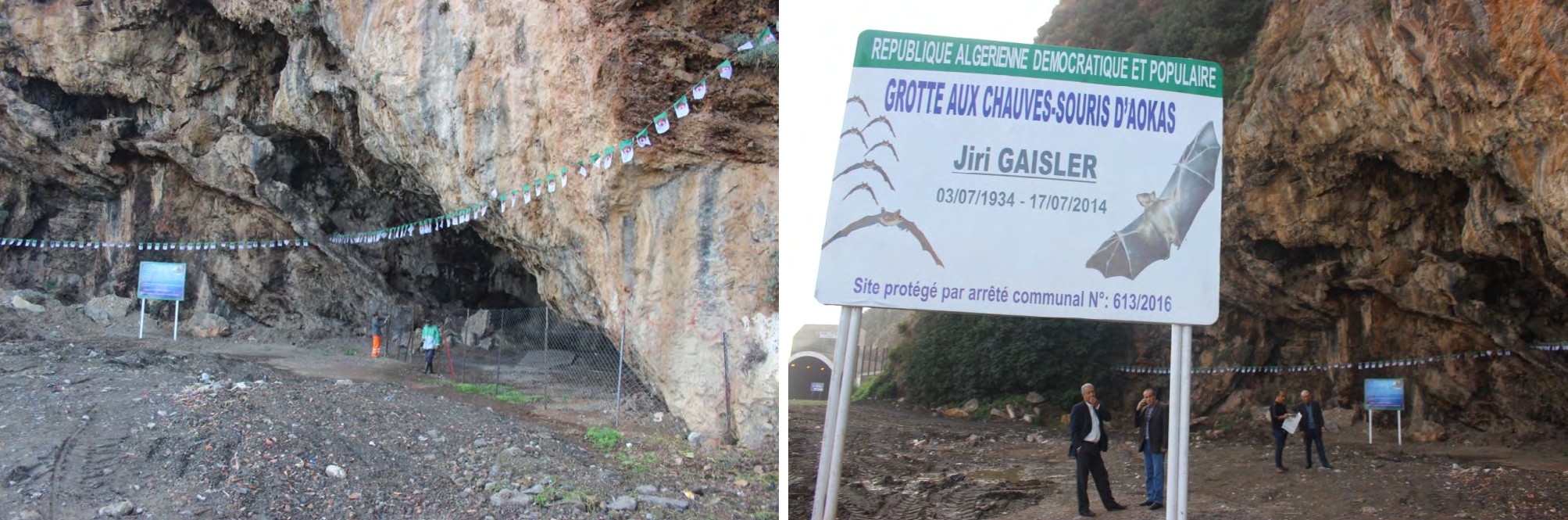
This study was performed at a cave in the town of Aokas, a coastal region at 27km east of Bejaia and 230 km east from Algiers, its geographical details are between latitude 36°.15 and 36°.55 North and longitude 4°.30 east and 5°.30 west.
This refuge of Chiroptera was a simple natural gulf, formed by the movements of the waves The cave’s entrance is now situated 25m above sea level, since some 20 centuries ago, the sea level used to be higher than now. Before the independence of Algeria, the construction of a tunnel for the crossing of a railroad which would link the port of Bejaia cliffs-was started but has not been completed and -gave the cave a form which is characterized by an entrance in the form of a large natural spherical chamber, followed by two tunnel forks.
The right fork is less frequented by bats as it leads to open air through a free opening, this fork is 110m long, 3.5 m wide and its height is very varying (2m, 2.7m). The left side of the tunnel is more frequented by bats, as it is dark and humid. It has a length of around 300 m, a width of 3 m, and its height is approximately 2 m. It is also a narrow, natural fissure in the tunnel wall opposite to the entrance room (Figure 1).
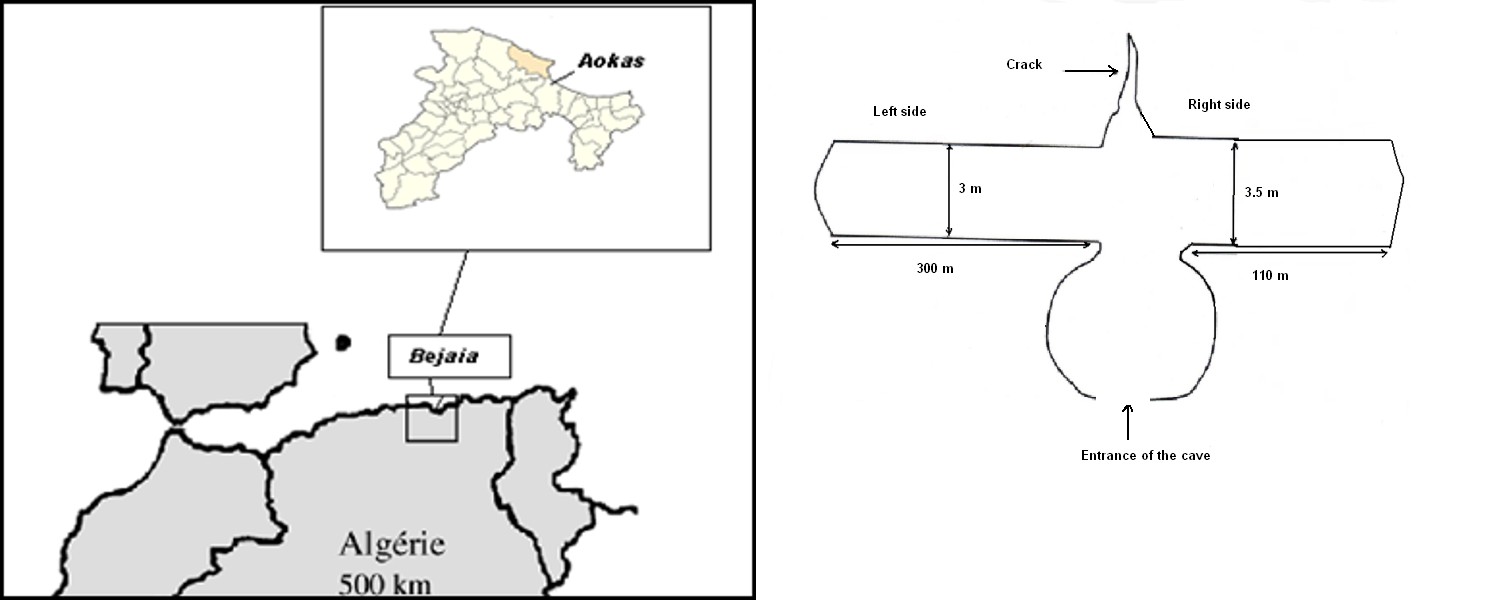
To achieve significant measurable results-from our work, which consists –of the morphometric analysis of the results of the body measurements of the species we studied, we had performed 12 field sampling days in 2 months during this period we had to capture 100 individuals of M. punicus; (42 males and 58 females).
We began our work in this cave at the beginning of April 2011 and it continued to the end of May 2011-at frequency of a maximum of two sampling days-every week, and an average duration of nearly three hours per output. We continued to monitor bat colonies in this cave until 2021 and noticed no changes in the ecology and behavior of any species including M. punicus. We would nevertheless like to point out that the bats were disturbed by the smoke from the fires in the summer of 2021.
Living individuals are caught by hand from the tunnel walls (wearing protective gloves or using sweep nets when they were resting higher on the walls. The bats were then placed in special bags to carry them out of the cave to be measured. The individuals were marked with red nail polish to prevent them from being measured again, and were eventually released. Four measurements were taken with calipers (to 0.1 mm) and a metal ruler (to 1 mm?): the length of the forearm (FA), the length of the fifth finger (D5), the length of the third finger (D3) and the length of the tragus (LT). His basic statistical data (min, max, mean, standard deviation and variance) were calculated using XLSTAT 7.5.2
Results
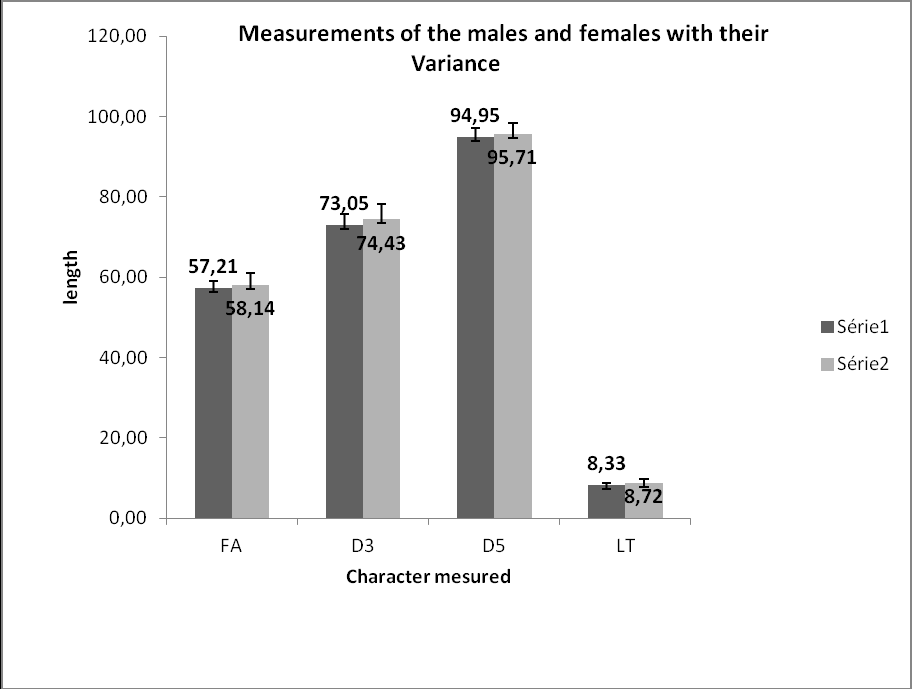
The measurements and the basic statistical date of the 58 female and 42 male of the maghrebian eared_mouse bat M. punicus specimens captured during this study, are presented in the Table 2.
| FA | D3 | D5 | LT | |||||
|---|---|---|---|---|---|---|---|---|
| M | F | M | F | M | F | M | F | |
| N | 42 | 58 | 42 | 58 | 42 | 58 | 42 | 58 |
| x | 57.21 | 58.14 | 94.95 | 95.71 | 73.05 | 74.43 | 8.33 | 8.72 |
| ( x .x )2 | 26.76 | 215.009 | 107.856 | 144.42 | 87.882 | 195.37 | 21.38 | 53.62 |
| Standard deviation 2 ∑(x−x) s= n | 0.63 | 0.6 | 2.56 | 2.49 | 2.09 | 1.83 | 0.5 | 0.92 |
| Variance 2 ∑(x−x) S2 = n | 1.88 | 2.96 | 2.63 | 3.9 | 2.14 | 2.63 | 0.52 | 0.94 |
Table 2: Basic statistical data on the morphometry of males and females of Myotis punicus from Bejaia.
Discussion
For the measurements of the length of the forearm (FA) of males, Kowalski, et al. [3] found an average of 59.2 mm ((min-max of 57-62 mm) , Beuneux, et al. [2] found in Corsica, an average of 58.4 mm (53.8-61.5 min-max) and the individuals studied by Baron, et al. [4] from Malta have an average of 59.75 (min-max 54.5-65.0). Our work shows that the forearm of males of M.punicus in Algeria has averaged
57.21 mm (min-max 55-60), we note that the length of the forearm in Algeria is smaller than for the other three studies, the mean and the largest is now at Malta, followed by M.blythii for Algeria and finally by Corsica.
The same tendencies were found in females with an average of 60.8 mm (min-max 53-65) for Kowalski and Rzebik-Kowalska (1991) 59.26 mm for Corsica (min-max 54.3-62.3) and 59.75 mm for Malta (min-max 54.5-65.0).
We deduce that probably this variability, especially with the results of Kowalski and Rzebik-Kowalska (1991) for Algeria on M. blythii is probably due to the efforts of sampling, and for the difference with Malta and Corsica it is due probably to the position of insularity indicates (?) that the wings are larger on M.punicus. A second comparison was made on the fifth finger (D5) only with individuals from Corsica, since this measurement was made by Beuneux, et al. [2] and not by the other authors. The results show an average length for males of 76.22 mm (min-max 74-79), while we found 73.05 mm (min-max 70- 76) for Algeria, while in females they are 75.84 mm (min- max 71.80) and we found for Algeria –an average of 74.43 mm (min-max 71-79). These results show a clear difference between Algerian and Corsican specimens, the D5 of Corsican individuals is longer than the D5 of the Algerian individuals for both sexes.
The same comparison with the same author was made on the length of the third finger (D3) and gave the results for males of 95.58mm (min-max 95-98) for Corsica and for Algeria -94.71 mm (min-max 92-98), while for females we have 96.3 mm (min-max 91.5-102) for Corsica and 95.71 mm (min-max 93-100) for Algeria.
We notice, therefore, that the comparison between the FA, D5 and D3 males are respectively 58.4 mm, 76.22 mm and 95.58 mm for Corsican male individuals, while in Algeria the average lengths are 57.21 mm, 73.05 mm and 94.95 mm, and for females the average lengths of the same measurements are 59.26mm, 75.84mm and 96.3 mm for Corsica –and 58.14 mm, 74.43 mm and 95.71 mm for Algeria.
These three combined measurements show clearly that the wings of individuals of both sexes in Corsica are larger than of the Algerian population with an evident sexual-size.
The first conclusion that can be reached is that the wings of Corsican specimens (forearms, fifth finger, third finger) are larger than those in Algeria, the thing which could eventually answer the insularity which could be explained by the M.punicus in Corsica and Malta (although for Malta we have only the results of the forearm).
According to Fenton and Bogdanowicz, et al. [10], the morphometric study of 41 species of Myotis has revealed close associations between morphological characters and the food quest [11, 12, 13].
Morphometric analysis also shows that some species of Myotis have intermediate morphological characters which are associated with the use of different power modes alternately. These results focus the hypothesis that the morphological characters used can help to determine the sub-genera of Myotis are more functional than phylogenetic, which was confirmed by recent genetic analysis.
The fourth and last criterion which was measured and compared with individuals is in the island of Malta using the results of measurements performed by Baron, et al. [4] on the length of tragus show that in individual- males and females the measurements were11 mm (92-96.5 min-max) while for Algeria we found 8.33 mm (min-max 7-10) for males and 8.72 mm (min-max 6-10) for females. These results also show that the length of the tragus in Algerian individuals is smaller than in the Maltese –population and demonstrate a sexual-size dimorphism.
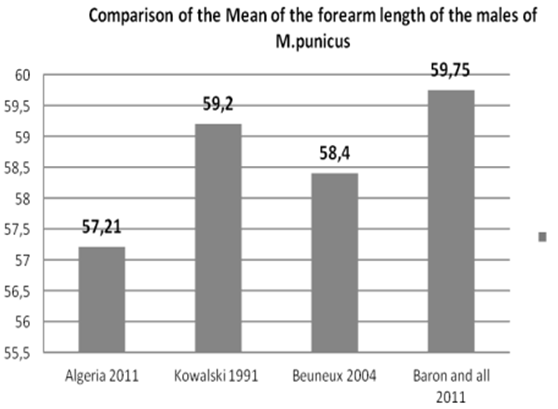
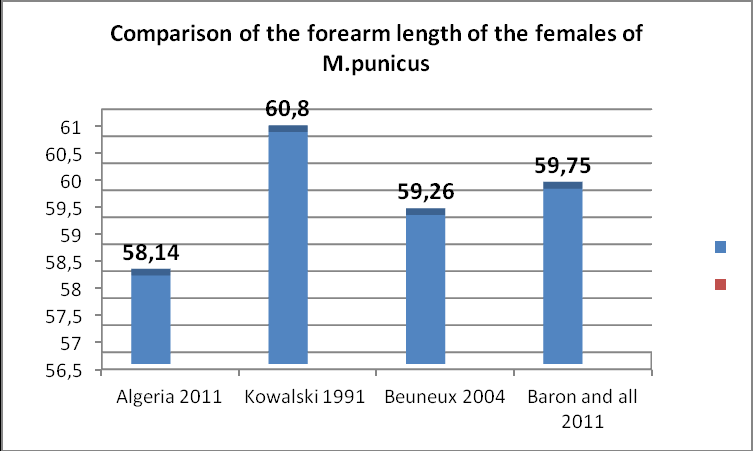
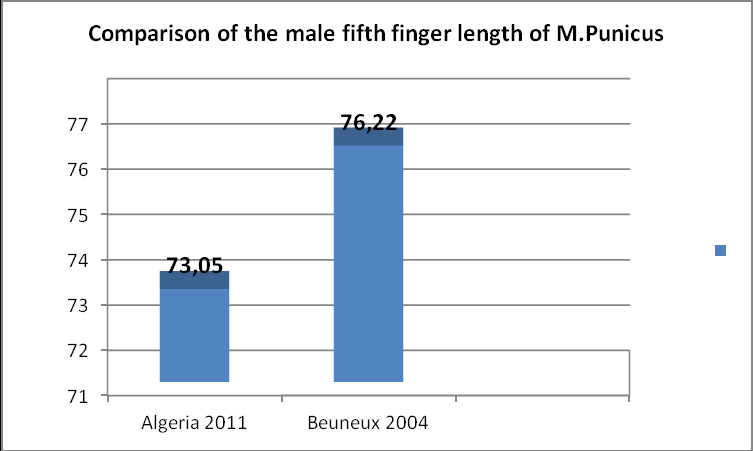
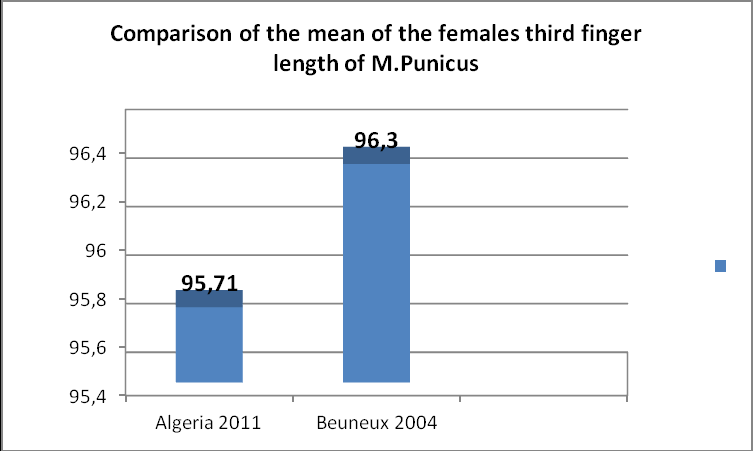
Figure 6 : Comparison of female fifth finger length.
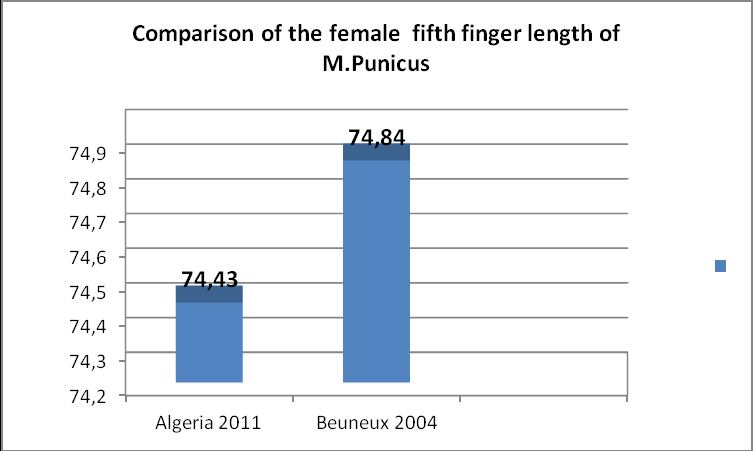
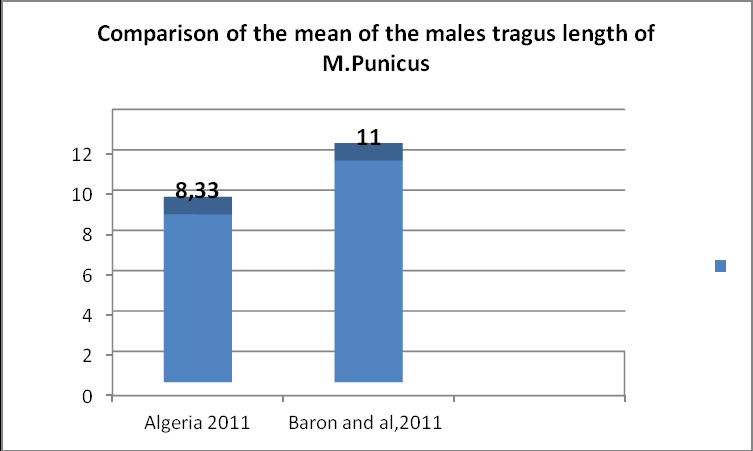
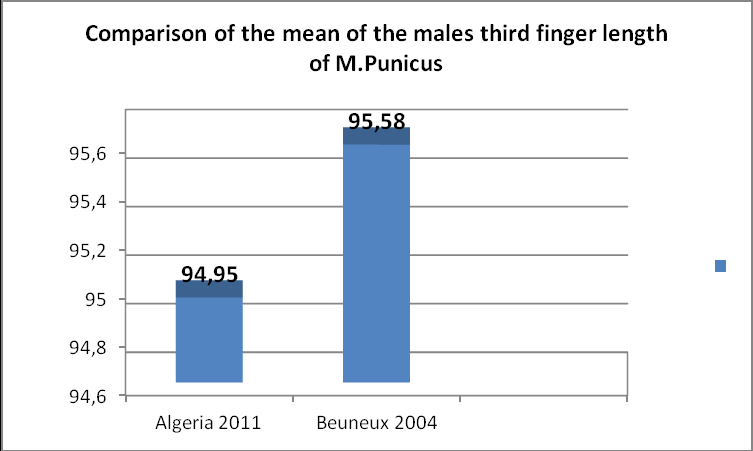
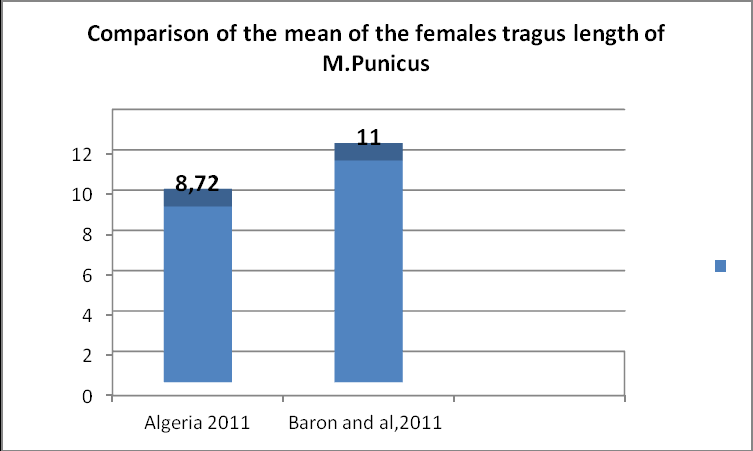
Figure 10 : Comparison of the mean of the female tragus length.
Conclusion
The study of the morphometry of Chiroptera, in this case that of the Maghreb Myotis (M.punicus) in Algeria has allowed us to better assess the ecological importance of this order of mammals, which remains, so far, unknown in our country.
Indeed, our knowledge about the world of Algerian bats is very limited or nonexistent, particularly for morphometry of M.punicus for which no comprehensive study has ever been made.
The aim of this study was therefore to record some measurements of M.punicus in its natural habitat in northern Algeria- and compare these with the results of existing studies in Europe by Dietz, et al. [7], in Corsica by Beuneux, et al. [2] and Baron, et al. [4] on the same species, and finally by Kowalski, et al. [3] in Algeria on the small Mouse eared bat (M.blythii).
The results showed that individuals living in Algeria are smaller in size compared to individuals of Corsica and Malta, as well as those of Europe and presents a sexual-size dimorphism .The purpose of our study was to ascertain the measurements of this species and suggest possibilities for more detailed research to determine why there are differences between measurements of specimens found -elsewhere.- Hypotheses remain to be verified concerning the difference of our morphometric individuals with those of Corsica, Malta and Europe by further research on the Mouse eared maghrebian bat Myotis punicus in Algeria in the future.
Acknowledgement
The following persons are warmly thanked for their help and support: The author would like to thank The Professors
Ross Baker and Lynn Whitfield who helped me on correcting this manuscript and also Sue Davidson. Thank too to the reviewers and the editor.
References
-
Dietz C, Helversen VO (2004) Illustrated identification key to the bats of Europe.electronic publication. Germany, pp: 72.
-
Beuneux G (2004) Morphometrics and ecology of _Myotis_ cf. _punicus_(Chiroptera,Vespertilionidae) in Corsica. Mammalia 68(4): 269-273.
-
Kowalski, Rzebick-Kowalska B (1991) _Mammals of_ _Algeria_. Polish Academy of Sciences. Wroclaw, Warszawa, Krakow, pp: 370.
-
Baron B, Borg JJ (2011) Evidence of niche expansion in the _Myotis punicus_ ( Mammalia Chiroptera ) of the Maltese Islands . Il Naturalista sicil 17(3-4): 407-417.
-
Castella V, Ruedi M, Excoffier L, Ibanez C, Arlettaz R, et al. (2000) Is the Gibraltar Strait a barrier to gene flow for the bat _Myotis myotis_(Chiroptera:Vespertilionidae) Molecular Ecology 9(11): 1761-1772.
-
Arlettaz R., Ruedi M, Hausser J (1991) Field morphological identification of _Myotis myotis_ and _Myotis_ _blythii_ (Chiroptera, Vespertilionidae): a multivariate approach. Myotis 29: 7-16.
-
Bogan MA, Setzer HW, Findley JS, Wilson DE (1978) Phenetics of _Myotis blythi_ in Morroco. In: Olembro RJ, Castellino JB, Mutere FA, et al. (Eds,). Proceedings of the Fourth International Bat Research Conference, Nairobi, pp: 217-230.
-
Ruedi M, Mayer F (2001) Molecular systematics of bats of the genus _Myotis_ (Vespertilionidae) suggests deterministic ecomorphological convergences. MolecularPhylogenetics and Evolution 21(3): 436-448.
-
Gaisler J (1983) Nouvelles données sur les Chiroptères du nord algérien. _Mammalia_ 43(3): 359-369.
-
Fenton MB, Bogdanowicz W (2002) Relationships between external morphology and foraging behaviour: bats in the genus _Myotis_. Canadian Journal of Zoology 80(6): 1004-1013.
-
Hutson AM, Mickleburgh SP, Racey PA (2001) _Michrochiropteranbats:_ _global_ _status_ _survey_ _and_ _conservation_ _action_ _plan_. IUCN/SSC Chiroptera SpecialistGroup. IUCN, Gland, Switzerland and Cambridge, UK, pp: 259.
-
IUCN (2008) IUCN Red List of Threatened Species.
-
Topal G, Ruedi M (2001) _Myotis blythii_ (Tomes, 1857)-Kleines Mausohr. In: Krapp F, Handbuch der, et al. (Eds.), Säugetiere Europas Band 4: Fledertiere. Teil I. Rhinolophidae, Vespertilionidae 1. Aula-Verlag, Wiebelsheim, Germany, pp: 209-255.
- California Red-Legged Frog and Non-Listed Amphibians Response to Non-Native Fish Removal
- Industrial Standardization of the Bio-OS: Algorithmic Codification of Resilience Engineering Guidelines and Version V8 Architecture
- Climate Variability and the Sustainability of Snail Farming in Nigeria: Past Trends, Present Challenges and Potential Outlook
- The Evaluation of the Surveillance System of Anthrax in Gilgit-Baltistan, Pakistan, 2018
- Natural Decline to Extinction of A New Zealand Rabbit Population
- Mitochondrial Bio-Logistics: Steering Co-Enzyme Q10 and Lycopene Synergies within the Science 4.0 Bio-OS Framework